
How to Run a Competition Team on Tournament Day

You've probably seen the other kind of team at a tournament.
Kids warming up alone. A parent asking three different people which mat their son is on. A coach sprinting across the venue because two brackets fired at once, and you genuinely don't know if he'll make it to the match in time.
This is how we run a competition team on tournament day, from the owner's side.
It starts weeks before the event and ends in the first class back.
Our team at NEO Martial Arts gets a lot of praise for the opposite. We hear it from everyone, but the last time came from the family of a gray belt who'd joined NEO just weeks before Pan Kids.
He'd done Pan Kids the year before, and plenty of other tournaments, some of them without a coach at all.
They were shocked when they realized we organize where we stay and where we train, and game plan weeks in advance with the athletes who travel. Every athlete knows ahead of time who their mat-side coach is, and who their secondary coach is.
And we walk them through how the tournament runs, especially if we've been to that one before.
Everyone knows where they're supposed to be. Almost all of that comes from what we set up before we ever get to the venue.
If you're still deciding whether a team is worth it, start with investing in a competition team. The weeks before the event have their own work too, and that's how we prepare athletes for competition. Hosting your own event is a different job, and in-house tournaments have their own playbook.
Treat Tournament Day Like the Airport
My rule is at least 90 minutes before a scheduled match. Earlier if I can. Closer to two hours for an international competition.
It's basically like going to the airport, and you'd never show up twenty minutes before an international flight. You need to park, check in, weigh in, find your team's spot, and get warm.
And you have to do all of it on a schedule you don't control.
Why the schedule is a suggestion
The time printed next to a match is an estimate.
Even at the best-run tournaments, it can move up or down by an hour or more. Brackets move all day.
A division ahead of yours finishes early. A mat falls behind and the organizers move matches to other mats. Then the match you planned around lunch gets called while half your team is still in the parking lot.
You never know how the schedule is going to shift, so you plan for it.
For the owner, that means watching the brackets for the whole team. When eight people are competing across several mats, somebody has to know who's up soon and who's two divisions away.
Who's in whose corner
We decide who's cornering whom before we get there.
Every athlete has a mat-side coach and a secondary coach, and we tell them both names ahead of time.
If the event runs on Smoothcomp, Coach Companion can hold that plan for your coaching crew. It's a free app for any coach with a Smoothcomp account. Your academy's matches show up in the order they'll run, and you assign a coach to each athlete.
It sends a push notification when two of your matches are about to run at the same time.
It also sends one when a match has nobody in the corner. Athletes can't see those assignments, though, so telling them who's in their corner is still on you.
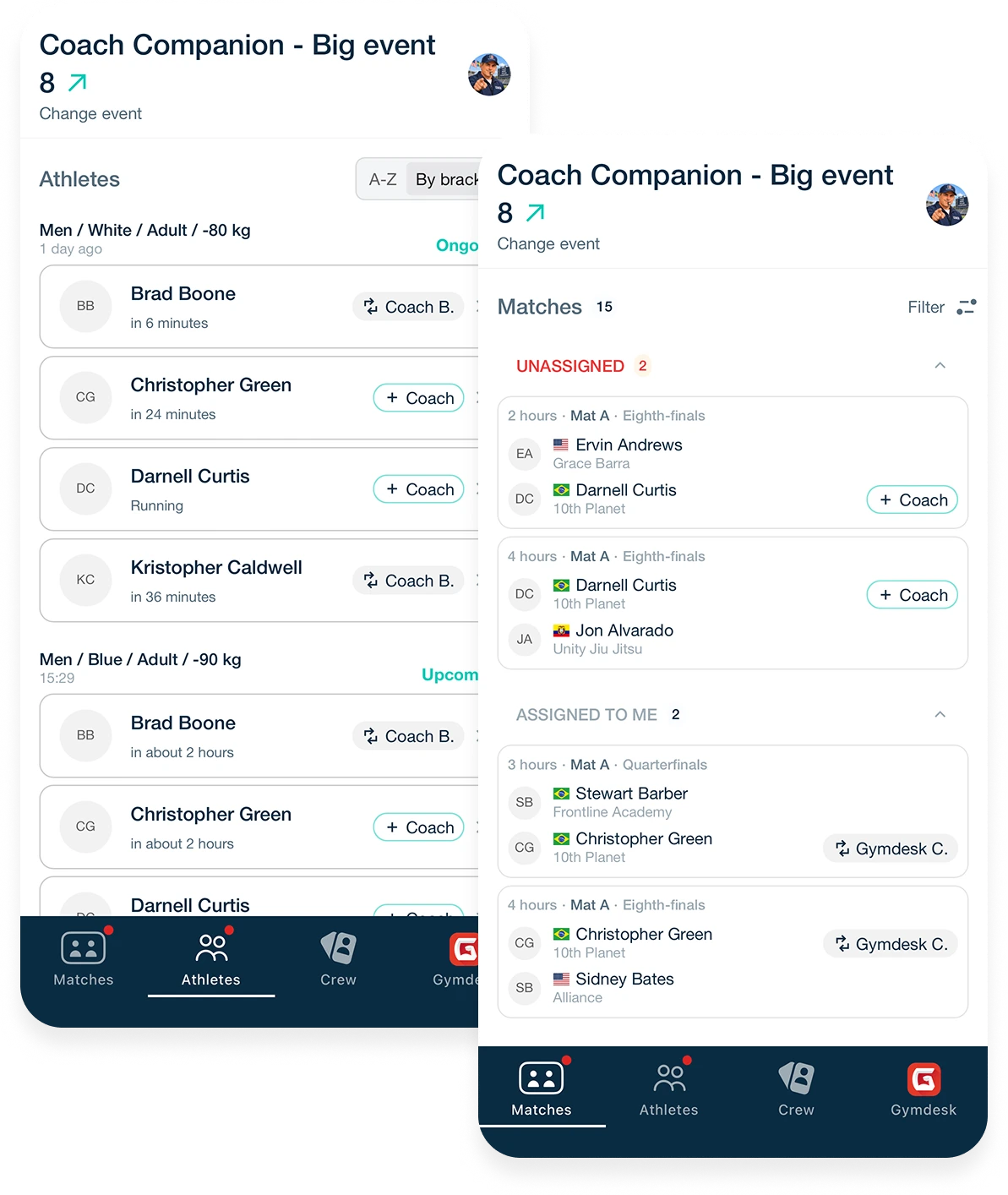
We haven't used it live yet, but we plan to at our next tournament.
When a match gets called without you
I've had athletes miss a match because they went off the original schedule instead of waiting in the bullpen.
One time, a match got moved up by a lot and our athlete wasn't around.
The ref called it a no-show. The athlete was overwhelmed, our coaches were confused, and the parents were worried.
One of our lead coaches stepped in, figured out what had happened, and talked to the ref and the event coordinator. They put our athlete back on the match.
It doesn't always end that well.
That's why, once a division is close, our athletes stay near the bullpen, and a coach is tracking where they are.
What a moving schedule does to nerves
Missing a match is the worst case. The more common one is what the waiting does to athletes.
Most of the time, a moving schedule hits them in their nerves. They don't have control, and they're stuck in the waiting game. Not knowing when they'll fight is what gets to them.
The more experience you get, the more you let go of that and just focus on the job, the task at hand, which is the fight.
Until then, part of our job is helping newer athletes stay loose while they wait.
Some of that happens before the day.
Our competitors, especially the kids, hear from us ahead of time that the coaching staff will be there to support them. Knowing that takes a lot of weight off a nervous kid before the day even starts.
What athletes handle before they leave the house
The advice I give our competitors is the same list I use myself.
Before anyone gets to the venue, they've handled everything that could get them disqualified. That means making weight, cutting nails, and a gi that will pass inspection.
Bring a competition gi and a backup, and check both against the federation's standards. For IBJJF, I actually check mine with a gi-measurement stick, and that's the level of prepared I want our athletes walking in with too.
When you arrive days early
Build in extra time up front for anything major enough that you travel internationally.
If there's a time difference, or our athletes compete on different days, we'll usually arrive at least a day early to acclimate.
We'll keep you in the loop with fresh content, podcasts, how-to guides, tool reviews, and product exclusives.
Who Can Be Mat-Side (The Rule That Surprises Parents)
The coaching access rules aren't intuitive, and they're different for kids and adults.
At most tournaments we go to, kids' divisions allow one coach per team on the mat. For adults at a standard tournament, coaches usually stand behind the barricade and shout instructions in. And it varies by organizer, so you check it for every event.
Where this catches families off guard is mostly whether a parent or coach can be there with their kid.
I see it at tournaments all the time with families from other teams.
Parents get confused about why they can't be on the mat. They get overwhelmed because they can't see their kid's match past the people crowding the barricade, or frustrated because they can't film it.
I've seen some freakouts at barricades. I think it almost always comes down to not knowing the information beforehand.
So we tell parents what usually happens before the day, either ahead of the competition or at a team meeting where we walk them through what it looks like.
We're upfront that every federation runs this a little differently, and that our job in that moment is to help manage the kids, because there's a lot happening at once.
It helps that our parents trust us. We've been doing this a while, and we stay organized.
How it changes the way you coach
Honestly? Not much.
Coaching an adult from behind the barricade vs being mat-side with a kid doesn't change my actual coaching. Mostly it's volume.
From the barricade you have to be louder, and you have to make sure the athlete knows where you are, so they know where to look and where to listen.
You also can't see everything from there, sometimes not even the score.
So you have to be really in tune with the match.
Parents Are the Crew—and the Real Customer
For your kids' program, the main customer is the parent. A martial arts academy is a business, and owners don't always want to hear that part.
Kids can't register themselves for most tournaments, and they can't drive themselves there. The athletes do the work on the mat, but every bit of communication runs through the parents.
They're the coordinators and the main point of contact for the whole day.
Where the day goes sideways
Picture forty parents, all different, with no shared information.
One thinks the match is at noon. Another is asking you where to park while you're trying to watch a bracket.
That's where competition gets exhausting for coaches.
The fix is what you give parents before the day. A parent who already knows the arrival time, the parking, and the mat rules doesn't need to find you at the venue.
What we hand parents before the event
We give parents as much information about the venue as we can, including when to arrive and what to bring.
For international events, it's close to the same prep we ask of the athletes: check your gi, pack appropriately, and know what to expect.
For those trips, we run a WhatsApp group with the parents and athletes in it, and it starts weeks before we leave. Parents know when we'll get there, what the schedule looks like every single day, and what we'll be drilling each day.
We send suggestions on what to pack and remind families to check things before they travel.
We keep parents involved the whole way, because at the end of the day they're the organizers for their kids. We've done this enough times to know what works and what doesn't.
So we over-communicate, and parents aren't caught off guard by anything we can control.
Some of this started with registration. The "how do I sign up?" question got so repetitive that we built a registration doc for it.
Two things have made our parent side a lot easier over time:
- Experienced parents help the new ones. It happens naturally, at the barricade and in the group chat. As we've done more events, local and traveling, we've also gotten better at what we hand people ahead of time.
- We share a team schedule for bigger events. We put together a schedule of when each of our athletes goes on, because our team wants to support each other. When you know when your teammates compete, everyone gets a chance to be on the sideline cheering.
Takeover Jiu-Jitsu sees the same thing, with members who show up to cheer their competitors whether they win or lose.
That schedule matters to parents too. A kid who loses in the first round and then spends the afternoon cheering for teammates goes home with a very different feeling about the day, and the parent driving them home hears all about it.
That feeling is a big part of why kids quit or keep coming back. A team that shows up for each other is one of the less obvious gym retention strategies.
FOR COMPETITION TEAMS
A kid who spends the afternoon cheering for teammates goes home with a better feeling about the day, and that's part of why families keep coming back. Plug your own numbers into the retention calculator and see what keeping one more family around for another year adds up to.
Run the Retention CalculatorWhat belongs in a parent briefing:
What parents need to know | What it covers | Why it matters on the day |
Arrival time and venue | When to be there, where to park, where the team sets up | The 90-minute rule only works if families follow it |
What to bring | Competition gi, a backup gi, mouth guard, water, snacks, registration card | A missing item at weigh-in can end the day before it starts |
Gi check and weigh-in | The federation's gi standards, nails, weight | Where prepared kids still get disqualified |
Mat-side rules | Who can be on the mat with a kid, where adults coach from, that it varies by organizer | Stops the surprise at the barricade |
The team schedule | When each athlete on the team is expected to compete | Lets families plan and lets teammates show up to cheer |
The team group chat | Daily schedule, what the team is drilling, last-minute changes | One place to check instead of forty parents asking a coach |
Travel details (for away events) | Where the team is staying, arrival day, how people get around | Keeps families together and on the same plan |
Travel as a Team
For anything beyond a local event, the trip is its own system, and we plan it as a team.
My co-owner, Patrick, ran a travel agency before this, which is a big part of why NEO coordinates trips deliberately. We book so families can stay together.
The kids hang out, train together, and travel as a unit.
A lot of it comes down to planning:
- Where you stay. An Airbnb with a kitchen is worth more than a hotel when someone's still cutting weight.
- Food and training. How easy is it to eat well and get on a mat near where you're staying? Where we've built relationships with gyms in the area, we'll get in some open mats so everyone stays warm and adjusts to the weather and the time zone.
- Getting around. Do you need a car, or can the team just Uber everywhere?
Years of doing this has made the travel itself a lot less stressful.
The Pan Kids trip
One trip that stands out is our last IBJJF Pan Kids.
We brought a good number of athletes and were about as organized as we've ever been. Most families stayed in the same complex, so the kids could hang out by the pool and have dinner together, even with people arriving on different days.
We built training days into the trip so coaches and athletes could game-plan together.
We also had a new team member on that trip: the gray belt from the family I mentioned at the start, who'd joined us only weeks earlier. His family had been investing in international competition, and then found out his coach wasn't available to support it.
We ended up being a better fit for him because our team travels to these events, and we as a team invest in our coaches to support athletes who invest in them.
Within days of being with us, it wasn't just the coaches making sure he felt like he belonged.
His new teammates were right there too.
He'd never traveled as part of a team like that before. His parents had made their own plans for the trip before they understood how our team travels. He kept asking to be included in ours, because he saw the camaraderie and wanted to be part of it.
He ended up winning his division. Pan Kids champion.
And the way our team showed up for him was no different than if he'd been with us for a decade, even though it had only been weeks.
What's Going Through a Coach's Head on the Day
When I compete, I'm managing my own nerves and I want to win. We say this a lot at NEO: win it all or nothing at all.
As a coach, the order looks different: experience, then safety, then logistics.
Experience comes first, which means making sure the kids actually have fun. Win or lose is on the athlete, but a kid who walks away thinking the whole day was terrible misses most of the benefits of competing.
That's a kid you might not see at the next event, or at the next class.
Luiz Costa at Octa Jiu-Jitsu said it this way:
Safety sits right alongside it. Injuries are part of the risk of the sport, and safety on the day comes from how you've prepared your athletes to protect themselves while they're learning to roll and compete.
Then logistics. Every coach, every parent volunteer, every athlete knowing where they're supposed to be.
What changed with reps
The first time I coached, I was younger and a lot less experienced, and I was worried I'd let the athlete down.
I didn't even know why. Maybe it was imposter syndrome.
Am I good enough? What if I don't know the rule set? What if I can't coach them through a tough situation?
I got through it. And what I realized was it's better to have a coach who cares in your corner than no coach at all, or one that doesn't care.
Those thoughts don't go through my head anymore.
At bigger tournaments with more pressure, I still feel the nerves. But my job is to help the athlete the best I can, and as long as I show up for my job, I can confidently say I did my best.
A lot of my early energy also went into just hoping nobody cried.
Now the emotional side is part of the process, which frees me up to focus on the athletes in front of me.
On the day, I'm mostly excited for our kids. I hope they have a good time, and I want them to execute their game plan.
Feedback Happens Between Matches—Keeping It Is the Hard Part
On the day, your corner gives feedback right after each match, because there's usually another one coming. It's immediate and it's useful.
Afterward is where we lose a lot of it.
At one event this season, we had almost sixty competitors, and most of them had around three matches. That's roughly 180 pieces of coaching feedback in a single day.
It depends on the tournament, but at some of the recreational events, a lot of it never makes it past a voice note.
What we capture right now
We try to stay in the moment.
As coaches, it really is moments over medals for us. But we've gotten better about not losing what happens in those moments.
After events, the coaches do a same-day reflection on how we ran the day, so the next one goes better. For the athletes themselves, at majors specifically, Patrick and I have started doing video or voice-memo feedback right after a match, so there's a record we can share with the athlete afterward.
We haven't been able to do that as consistently at the local level.
The volume's just higher, so it's whatever's fastest in the moment: pen and paper, a voice note, a quick video.
What does survive ends up in a Google Sheet. That sheet is the closest thing we have to a system, and getting each note back to the right athlete is still manual work.
It's not a system yet.
How that feedback gets back to a kid depends on how they did and which tournament it was. It might be a conversation during class, the video or memo right after the match, or taking some 1:1 time during rolls.
It's hard to get to every kid.
Where match notes can live now
The best time to write a match note is at the mat, while the detail is still fresh.
Coach Companion lets a coach do that at Smoothcomp events, writing a note on the match as it finishes.
If your gym runs on Gymdesk and has connected its Smoothcomp academy, the note shows up on the athlete's member record. Then your coaching staff can read what happened without chasing down the coach who was in the corner.
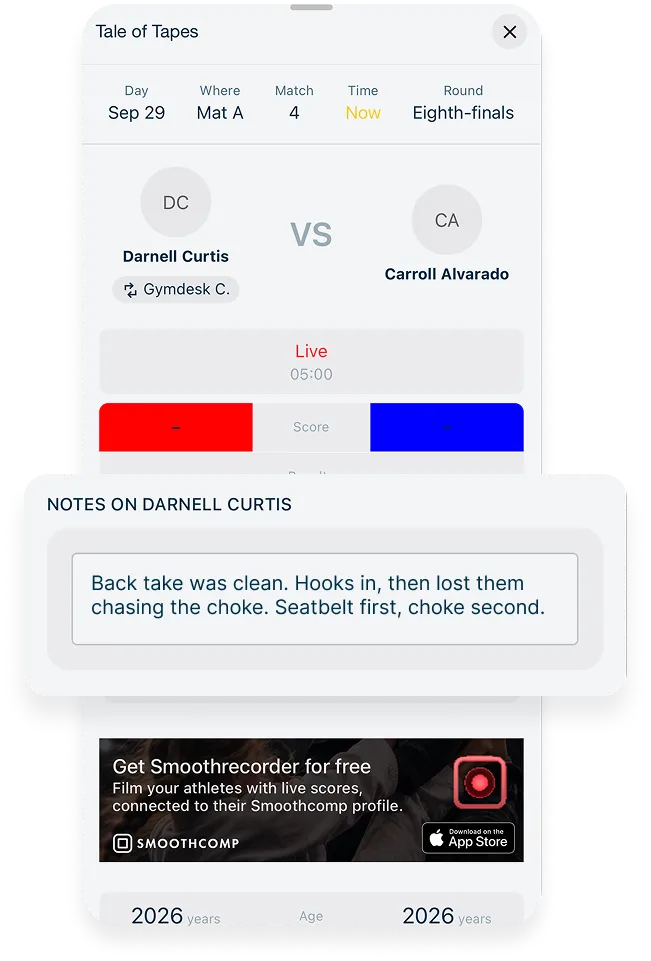
For events that don't run on Smoothcomp, we're still on the sheet, and it's still manual. It's slower, but it beats a phone full of voice notes nobody goes back to.
Where tournament feedback goes today, and where it should end up:
Moment | Feedback given | Where it goes now | Where it should go |
Between matches (local event) | A quick correction before the next match | Pen and paper or a voice note, typed into a shared sheet later | The athlete's record, where the next coach can see it |
Right after a match (major) | Video or voice-memo breakdown | A coach's phone, logged in the sheet and shared manually | A dated entry on the athlete's record |
Back in class | A conversation, a video, or 1:1 time during rolls | Whatever the coach remembers | A note any coach on staff can pull up before the next class |
What to Capture Before Your Team Gets Bigger
At sixty competitors, we're already missing kids. And the day a coach is out, every correction that coach was carrying goes with them.
Whatever you use should keep each athlete's feedback in one place, no matter who was in the corner, so the next coach can pick up where the last one left off.
KEY TAKEAWAY:
Whatever you use should keep each athlete's feedback in one place, no matter who was in the corner, so the next coach can pick up where the last one left off.
Start with what you already track for classes.
A coach reading tournament feedback needs to know whether the athlete actually trained for that event, and whatever attendance tracking methods you use answer that. In Gymdesk, the attendance feature shows who's been training and how often.
Before the first class back, I want to know how each kid actually did.
In Gymdesk's Competitions tab, once you connect your Smoothcomp academy, Gymdesk matches your members to their Smoothcomp results. Each member's competition history shows on their profile, event by event, with their matches and the score or submission.
Members who link their own Smoothcomp account get the fullest history. Athlete Activity shows when each member last competed, so you can spot who's stopped competing.
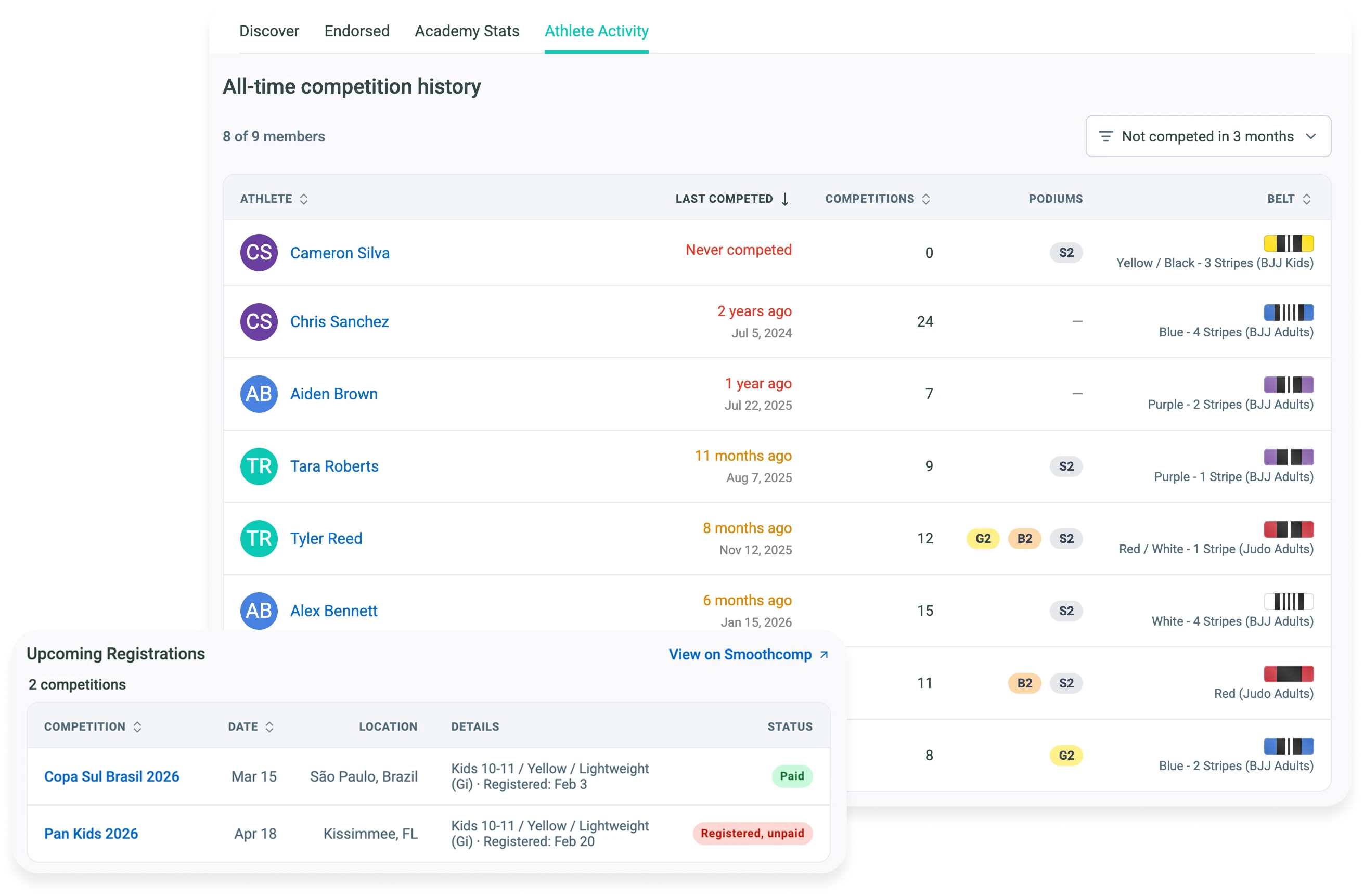
Be more careful about where the match feedback itself goes. We used to put it in the general notes section of each member's profile, and it wasn't the right place for it.
Tournament feedback needs its own home: one entry per athlete per event, dated, with the match, the correction, and the coach who gave it.
That's what we've used a spreadsheet for, and the match notes above help at Smoothcomp events. Wherever yours live, any coach on your staff should be able to pull up an athlete's last few tournaments before the first class back.
The goal is that every kid gets that follow-up, including the ones no coach happened to remember.
Running a Competition Team on Tournament Day Starts Before It
Most of what makes our tournament days run smoothly, we set up weeks ahead with a group chat and a spreadsheet, and you can start there too.
As your team grows, martial arts software keeps attendance and competition results on the same member record once you connect your Smoothcomp academy.
Match notes from Coach Companion land there too, so the first class after a tournament starts from what happened at the event.
Gym management software that frees up your time and helps you grow.
Simplified billing, enrollment, student management, and marketing features that help you grow your gym or martial arts school.


FAQ
Tournament Day FAQs

Solana Be is Community Growth Manager at Gymdesk and co-founder of NEO Martial Arts in Brampton, Ontario, where she directs the academy's women's BJJ program. A BJJ brown belt and active IBJJF Masters competitor, she's medaled at the European and Pan championships—and she ran NEO on Gymdesk as a customer before joining the team.


