
How to Run One Competition Team Across Multiple Locations

Imagine it's a Saturday, it's 8am, and the gym bag smell has already found the bleachers. You're at a local tournament with kids from both of your schools.
Two of them win gold in back-to-back divisions.
They train with the same coaches in the same Tuesday comp class, and they're wearing the same team shirt.
The scoreboard lists them under two different academy names. The team trophy goes to a gym with fewer medals than you won combined.
(That one's a hypothetical. If it's also a memory for you, I'm sorry.)
A competition team across multiple locations breaks in a handful of predictable places.
Who leads it, where it trains, which name goes on the bracket, who pays, and how a kid at the small school feels like part of the same team.
This guide covers those decisions for a multi-location martial arts gym, or a school inside an affiliation, that wants one team across all of its schools.
Most of what's here comes from two owners featured on Gymdesk Originals: Luiz Costa of OCTA Jiu-Jitsu and Lucas Lepri of Alliance Jiu-Jitsu in Charlotte.
I'm mostly the scribe. Where they didn't cover something, I'll say so and tell you what I'd do.
If you're building a team from scratch at one gym, start with how to build a competition team. This post picks up where that one stops: at your second front door.
Decide Whether Your Locations Run One Team or Several
For most owners, one shared team beats several small ones, unless each school can fill a comp class on its own.
Luiz runs OCTA Jiu-Jitsu, now seven locations around Oakville, Ontario. He said it plainly on the first episode:
“We do have a competition team within our group, but it's not my focus. My focus is to bring jiu-jitsu to everyone.”
So OCTA has one team for the whole group, and it comes second to the family program. Luiz sends members who want to go further to dedicated competition schools. His son Michael trained in New Jersey for exactly that reason.
Before anything else, answer two questions:
- Is competing a core part of what your schools sell, or something a smaller group of members does on the side?
- Do you have enough competitors at each school to fill a comp class on its own?
If the answers are "on the side" and "no," go with one shared team.
Five competitors at each of three schools is a thin class three times over. Put all fifteen in one room, and you have a team.
Illustration: one team or several
School A
5 competitors: a thin class
School B
5 competitors: a thin class
School C
5 competitors: a thin class
One room
15
Put all fifteen in one room, and you have a team.
An illustration of the example above: five competitors at each of three schools is a thin class three times over.
Pick One Person to Lead the Team
A team across locations needs one name at the top.
Whoever happens to be teaching the comp class that night can't also be picking the season.
At OCTA, Michael is now a brown belt and an instructor at Oakville North, the newest school. On the second episode, Luiz talked about what that means for the school's competition program:
“We're going to have a good competition program in this school because it's natural that he's the one leading that. But it's not the focus for this school.”
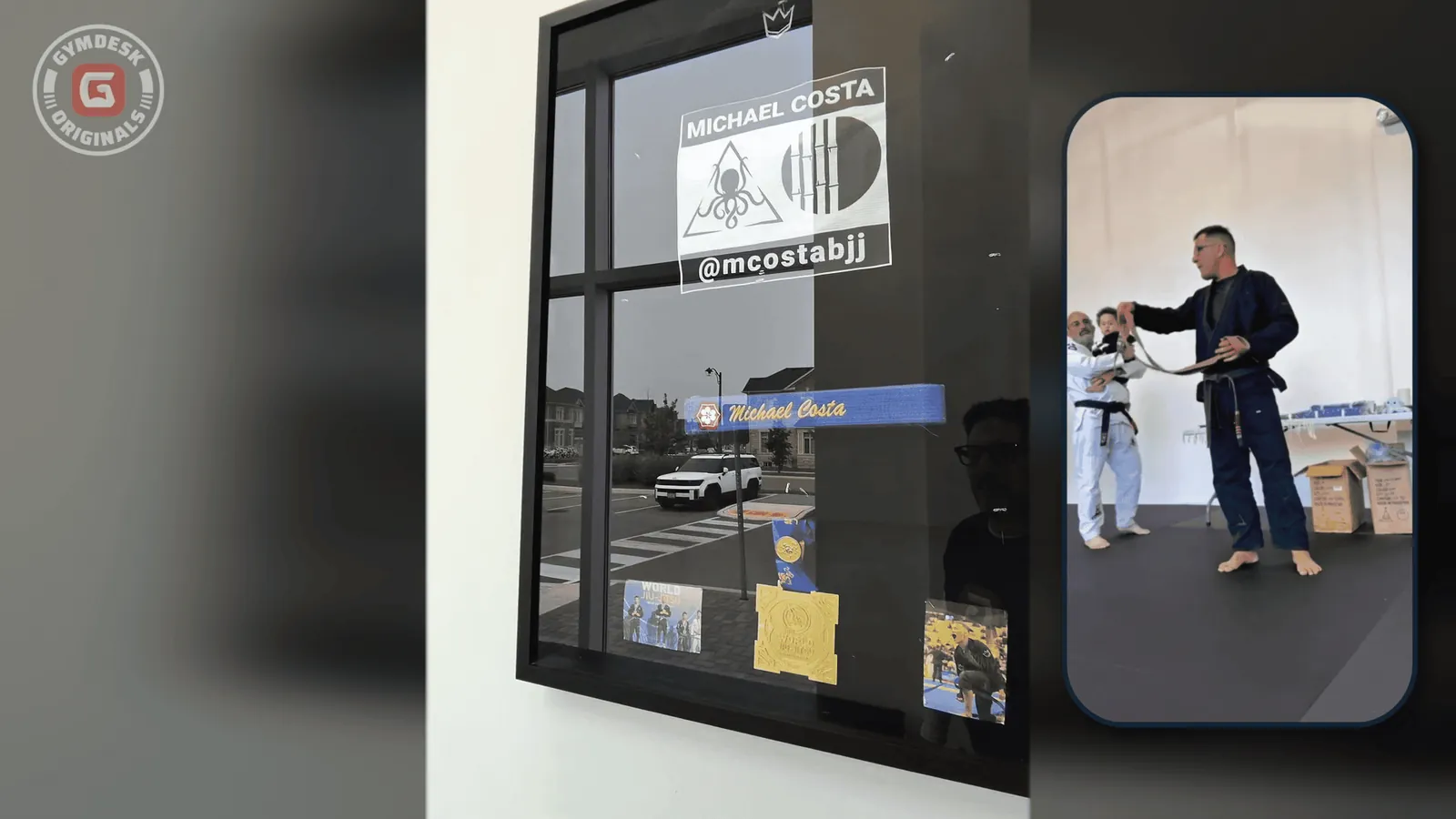
That's one school's program.
Nobody on the episodes described a single coach leading a team across every location, so here's how I'd set it up.
One lead coach owns the team.
They pick the season's events, decide who's ready, and set who corners whom. Each school can still run its own comp class with its own instructor, and everyone answers to the lead on competition calls.
Write these down:
- The team lead. One person picks the events the team targets and decides who handles registration.
- A contact at each school. Usually the head instructor there. They spot new competitors and handle the local logistics.
- The cornering rule. Who corners when the lead coach can't be on every mat at once. (They can't. Mats are big, and coaches are one person each.)
Who decides what
Team lead
Picks the season's events, decides who's ready, and sets who corners whom
School A contact
Spots new competitors and handles the local logistics
School B contact
Spots new competitors and handles the local logistics
School C contact
Spots new competitors and handles the local logistics
The cornering rule
Who corners when the lead coach can't be on every mat at once
Everyone answers to the lead on competition calls. Schools A, B and C stand in for your locations.
The lead also needs the instructors at every school on board, including the ones they've never shared a mat with.
The hub post on choosing a team coach covers the rest of what makes a good one.
We'll keep you in the loop with fresh content, podcasts, how-to guides, tool reviews, and product exclusives.
Decide Where the Team Trains Together
Run a local comp class at each school, and bring the whole team into one room at least once a month.
This is where distance starts to cost you.
A shared team needs shared mat time, or it's just a group chat with medals. And every mile between your schools is a reason a teenager's parent says "not this week."
OCTA keeps its schools about 20 minutes apart, on purpose. Luiz explained why on the second episode:
“I don't want to have schools too far because it defeats the purpose. I want to have a community that supports each other.”

Twenty minutes is also close enough to get every school to headquarters for an open mat once a month.
It's a group-wide open mat for every member, competitor or not. It also helps that every OCTA school teaches the same topic each week, so nobody shows up to a joint session a month behind.
A few ways to set up team training, roughly in order of commitment:
Setup | How it works | Worth knowing |
|---|---|---|
One hub session | The whole team trains together once a week at one school. | Simple, but it puts all the driving on the families at the far schools. |
A rotating host | The joint session moves between schools each month. | Fairer on the drive. Send families the month's location in writing. |
Local comp classes plus a monthly joint session | Each school runs its own comp class, and the team meets in one room once a month. | The plain version I'd start with. Add an extra joint session in the two weeks before a target event. |
Nobody on the OCTA episodes laid out a comp-class schedule, so that last row is my pick, not Luiz's.
Suggested starting schedule
A month at a glance
A regular month
Week 1
Comp class at each schoolJoint session: whole teamWeek 2
Comp class at each schoolWeek 3
Comp class at each schoolWeek 4
Comp class at each schoolA month with a target event
Week 1
Comp class at each schoolJoint session: whole teamWeek 2
Comp class at each schoolWeek 3
Comp class at each schoolExtra joint sessionWeek 4
Comp class at each schoolTarget eventThe two weeks before the event
My suggested starting schedule, not Luiz's. The week each session lands in is an illustration.
Choose the Name on the Bracket
Register each school under its own academy name and link them all to a single affiliation.
Then check how your events count team points.
When a member registers for a tournament, they pick the academy they represent.
On Smoothcomp, points go to the academy a member represents. So if your two schools register under two unlinked names, your points split between them, and neither one wins the trophy.
That's the Saturday from the top of this post. Nobody lost a match. The paperwork did.
Illustration: the Saturday from the top of this post
Before
Two unlinked academy names
The team result splits between two names. The team trophy goes to a gym with fewer medals than you won combined.
After
Both linked to one affiliation
Two golds roll up under one flag, at events that count affiliations.
An illustration of the hypothetical from the opening, not a real result. No points are shown because each event's organizer decides how standings count.
Academy or affiliation
Smoothcomp already has two words for this. (Full disclosure: Gymdesk and Smoothcomp are now one company.)
- An academy is one school in one place.
- An affiliation is one team made up of several academies that compete under the same flag.
Academy or affiliation
Affiliation
One team made up of several academies that compete under the same flag
Academy
One school in one place
Academy
One school in one place
Academy
One school in one place
Anyone who represents that academy also represents the affiliation.
Once an academy manager connects the academy to an affiliation, and the affiliation's manager approves it if approval is on, anyone who represents that academy also represents the affiliation.
Affiliations aren't self-serve.
Smoothcomp's support team sets them up, and you email them to become the affiliation's manager.
The event organizer decides how standings count. Smoothcomp lets organizers build ranking lists by academy, by affiliation, or both combined.
That gives you two workable setups for an affiliation team:
My pick
Each school keeps its own academy name, all linked to one affiliation
Local results stay local, and the team result rolls up under one flag at events that count affiliations.
Simplest scoreboard
Everyone registers under one academy
A member's local school disappears from their record. That cuts against everything you've done to give each location its own identity.
My pick for most multi-location owners is the first one. Ask your own events which one they count before you choose.
The approval trap
Warning
If a Smoothcomp academy turns on member approval, members have to be approved before the event.
Smoothcomp's own help article warns that otherwise the points aren't counted for your academy.
With several schools, you can end up with two queues: each academy's member approvals and the affiliation's academy approvals. Put one name next to each.
Why the name matters
Some gyms count their team titles.
On his episode, Lucas Lepri said his academy had won the Charlotte Open 16 times, and that every year is a challenge because the other teams prepare too.
If your team will be counting, settle the name before the first registration goes out.
Settle Who Registers and Who Pays
Two jobs land on nobody when a team spans schools: sending the registration links and covering the bills.
Who registers
Each instructor assumes someone else sent the link. Pick one of these and write it down:
- The team lead registers everyone. You get one list and one deadline. You also get one person doing a lot of data entry.
- Each school registers its own members. Spreads the work, and spreads the chance someone misses an early-bird price tier.
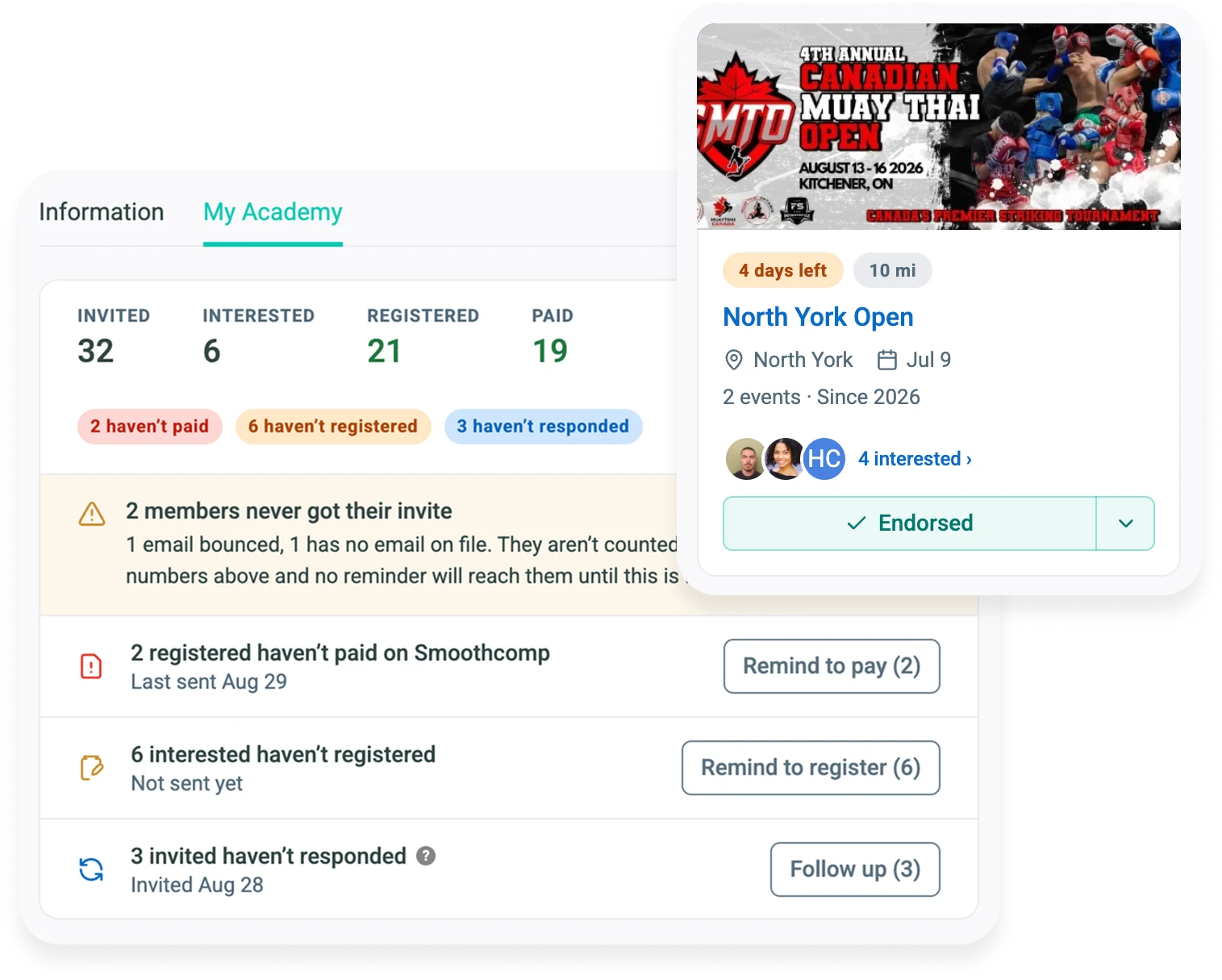
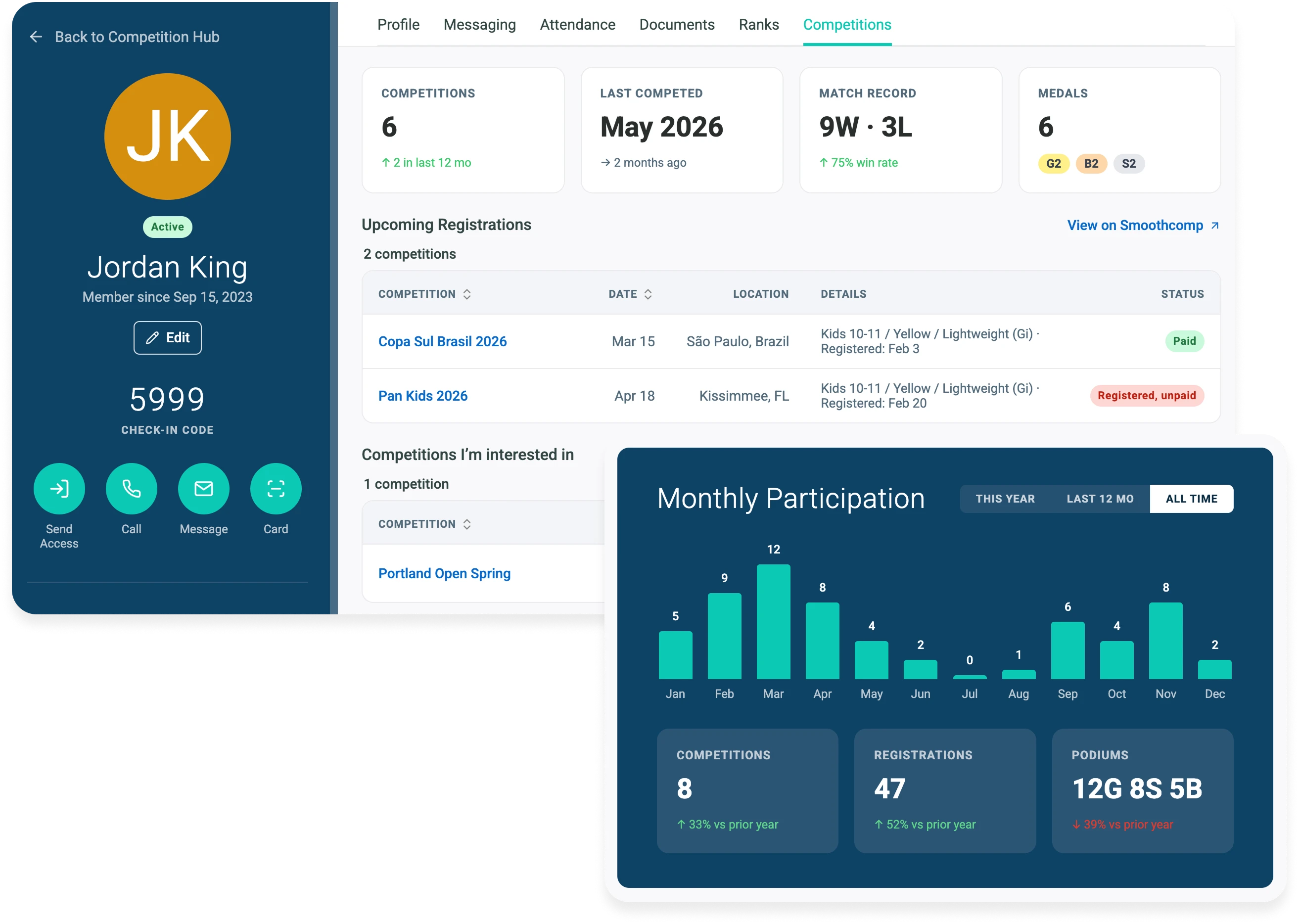
Gymdesk handles the registration list.
The Competitions tab pulls in Smoothcomp events with the price tiers and the registration deadline on the same row.
You can send members a registration link or register them yourself. The form fills from the member record with your connected academy locked, so nobody types in the wrong gym.
Registered and paid show up separately, so an unpaid entry doesn't pass for a confirmed one.
Who pays
The money needs the same treatment. Settle these before the first deadline:
Entry fees
- Member pays
- School pays
- The team covers a first tournament
Our call:
Coach costs
- Who pays for the lead coach's travel and day
- From which school's budget
Our call:
Team gear
- One shirt for the whole team
- Each school's own logo on the back
Our call:
None of these has a right answer. They just need an answer, and the first registration deadline is when you'll wish you had one.
Keep Local Pride Without Splitting the Team
Your schools will compare themselves to each other. That's fine. That's people.
OCTA already has its schools competing on the numbers. Luiz checks each location's results in Gymdesk's franchise view.
Alex Cuevas, Gymdesk's CEO and the host of the episodes, asked how often he looks. Luiz said:
He sets goals for every school, and the professors see how they're doing against each other.
Alex also asked whether an in-house tournament between locations would bring out the same rivalry. Luiz said yes: "We can definitely have that and have the rank, right?"
OCTA was planning its first one when the episode was filmed.
My rule: keep the rivalry inside your own buildings. An interclub tournament between your schools gives every location something to defend.
At a public event, everyone competes under the team name.
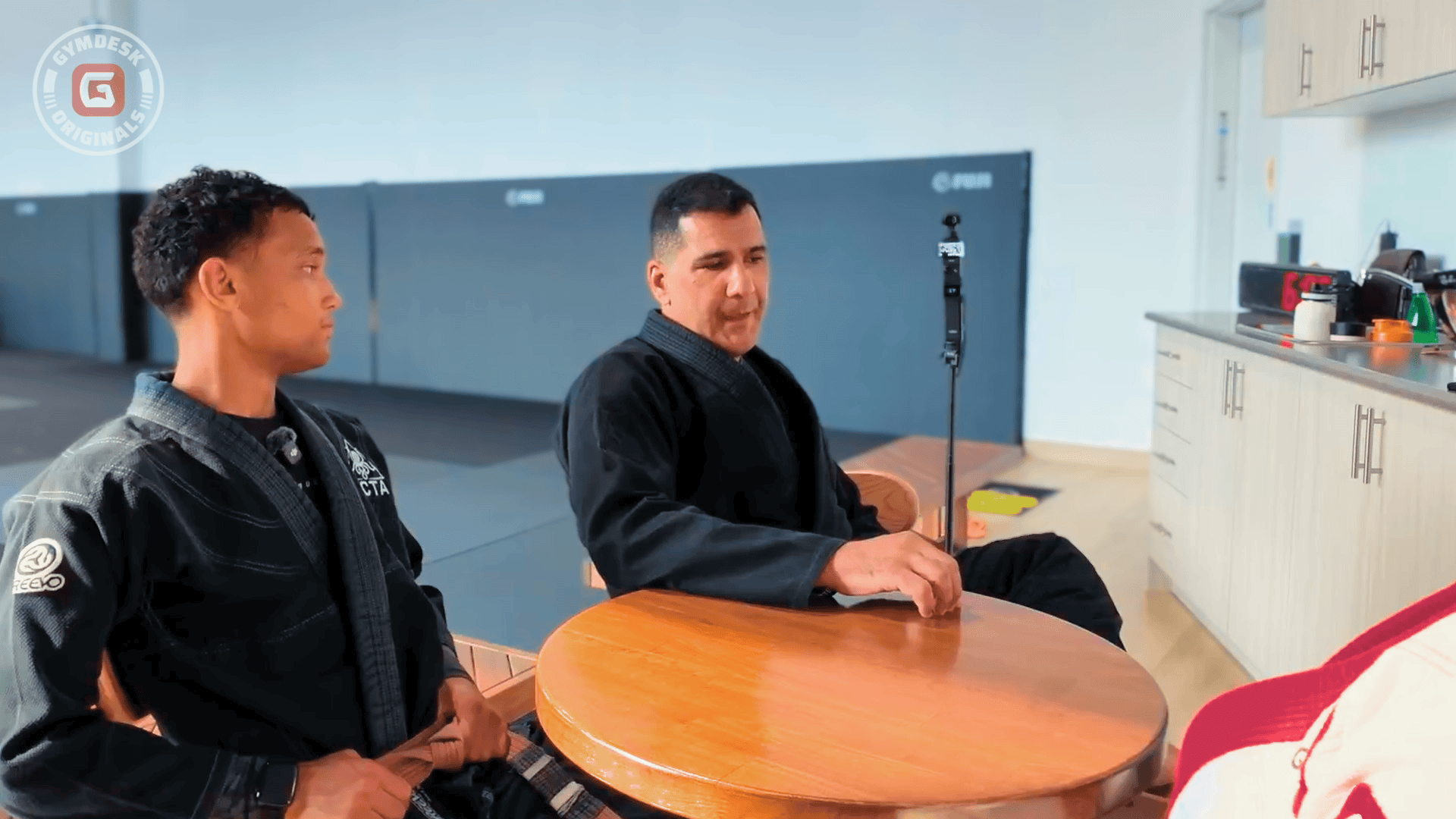
Luiz describes his schools as one organization that covers for each other. When one school needs help, the others come in:
“So a student of Oakville North is not a student of this school alone.”
A competition team works the same way. Keep each school's name on its door and its own social accounts, and see keeping local identity for that side.
Then give the team one shirt and one photo at the end of the day with everyone in it.
Run Tournament Day With Coaches From Different Schools
On the day, a multi-school team brings a multi-school crew.
You'll have your lead coach, an instructor from each location, and a few parents who know the drill.
The hard part is the same at any gym: making sure every match has someone in the corner when brackets run behind and two mats call your athletes at once.
(Brackets always run behind. It's the one schedule in martial arts you can set your watch to, as long as your watch is slow.)
The tournament-day team system covers the full playbook, including travel. Half your crew may never have coached together before, so that playbook matters more here.
Free app
Pick the event and your academy's registered athletes are already there.
Add assistants and parents to your crew by QR code or search, and assign a coach to each athlete.
The app shows any match that still has nobody in the corner.
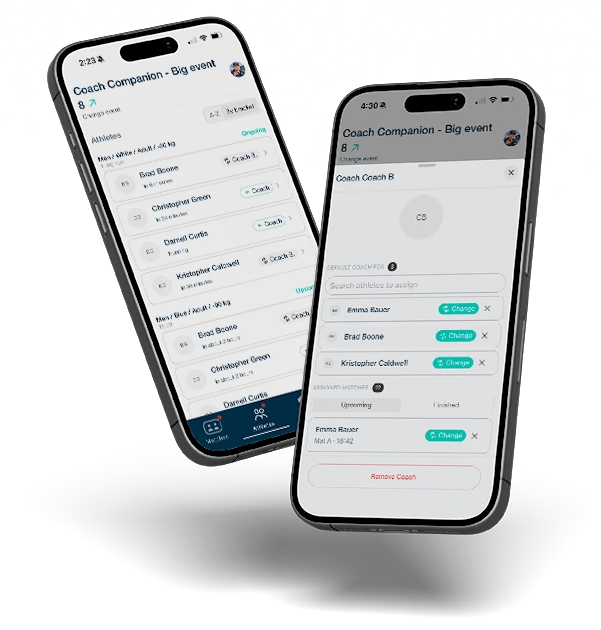
If your academy runs on Gymdesk, match notes land on that member's record for next week's conversation.
Put the Whole Thing on One Page
Every decision above fits on one sheet. Share it with every instructor at every school before your next target event.
Every decision above fits on one sheet
Your one-page team sheet
Team lead
One name, and a contact at each school
Team training
The joint session (where, how often) and each school's own comp class
Bracket name
Each school's academy name, the affiliation, and who manages each approval queue
Registration
Who sends the links and by which deadline
Money
Who pays entries, coach costs, and team gear
Tournament day
Who corners whom, and where the crew meets
Revisit it after the season's first event. Something will have broken. Now you know which line to fix.
If your gym runs on Gymdesk, the Competitions tab tracks who's registered and who's paid, and Coach Companion keeps the corners covered.
Gym management software that frees up your time and helps you grow.
Simplified billing, enrollment, student management, and marketing features that help you grow your gym or martial arts school.


FAQ
Competition Team Across Multiple Locations FAQs
Short answers to the questions owners ask most when their team spans more than one school.

Sean has spent the last decade creating content that helps businesses—small and not so small—grow smarter to allow operators to do more of what they love. You know, the fun stuff.
From shipping and international logistics to web development and marketing, he's done the work (not just the words) to scale retail and service businesses efficiently.
You can find his work at Sendle, Shogun, The Retail Exec, Gymdesk, and more.