
How to Build a Competition Team at Your Martial Arts Gym

Most martial arts gyms sell the same promise: everyone's welcome, train at your own pace, nobody's going to throw you into a shark tank on day one. A competition team is the opposite of that.
It's a small group training harder, sparring longer, and spending weekends in high school gyms waiting for their bracket to be called.
So should your gym have one?
For most gyms, yes, as long as you run it as a separate track: its own class and coach, with a budget you settle before the first event.
Done that way, a team gives your most committed members a goal and gives prospects proof that your instruction works. Run it badly and everyone else starts to feel in the way.
Most of what's below comes from people who coach and compete.
Daniel de Groot, a BJJ coach who trained with a top team in Brazil, wrote the 2020 original of this guide, and his lines are quoted throughout.
Owners we've filmed for Gymdesk Originals show how it works at a real gym.
Gymdesk and Smoothcomp are now one company (announcement), so the tournament sections also lean on people who coach mat-side, like Solana Be, who runs the competition team at NEO Martial Arts.

Should Your Gym Have a Competition Team?
Start with the reason. You probably want a team for one of two things, and each one leads to a different kind of team.
Reputation. Medals are the most visible proof that your gym teaches well.
When Gymdesk surveyed BJJ practitioners on Reddit about choosing a gym, two factors dominated the rest: instruction and location. Your building isn't going anywhere, so instruction is the one you can show off.
In that survey, "instruction" also covered the instructor's attitude and teaching style, so medals aren't the only way to show it, just the easiest one to point to.
Retention. Your blue belts who've trained for three years need something to aim at.
For some of them, that's a tournament date on the calendar, and you can make a real case for the benefits of martial arts competition.
If you're after reputation, you'll pick members on results. For a retention team, anyone willing to put in the training belongs in the room.
Then check whether you're ready.
You're in good shape if most of these are true:
- At least two or three members already compete, or have asked about it
- You or one of your coaches has competed and knows the current rules
- You can spare one or two mat slots a week that don't bump a busy class
- You've decided what the gym will pay for (more on that below)
- You're prepared to keep regular classes exactly as welcoming as they are now
Missing the coach is fixable, since you can borrow one (more on that below). If you're missing the members, start with a first tournament: get a few people to one and see who comes back wanting more.
What a Competition Team Costs You
Nobody puts this part on the flyer. A team costs money, and it eats mat time you'd otherwise sell to everyone else in the gym.
Where the money and time go:
Cost | What it looks like | Who usually pays |
Mat time | One or two competition classes a week, plus open mats before big events | The gym (it's a slot you can't sell to another class) |
Coach hours | Class time, plus full days cornering at tournaments | The gym, or a head coach who does it as part of the role |
Entry fees | Per event, per division; more for major circuits | Usually the competitor; some gyms subsidize |
Travel | Gas, hotels, and meals for events outside your city | The competitor, or split for team trips |
Gear | Team rash guards or gis, patches, banners | Split: competitors buy, gym subsidizes the first set |
Photos and video | Someone filming and shooting at every event | A non-competing member, or the gym if you hire it out |
Decide your policy before the first event, and write it down. "We'll figure it out" turns into an argument in the parking lot.
A simple starting policy: members cover entries and travel, the gym covers the competition class and the coach's time, and the team shirt is on the house.
You can get more generous once you know how many people actually show up.
Choosing Competitors: Try-Outs, Scouting, or Opt-In
Most gyms should start with the simplest method: opt-in.
Method | How it works | Suits | Risk |
Try-outs | Once or twice a year, you pick the team based on level and effort | Larger gyms with more would-be competitors than coaching time | Members who don't make it can feel shut out |
Scouting | You recruit proven competitors from outside the gym | Big teams with a budget and a brand to build | Expensive, and it can breed resentment among home-grown members |
Opt-in | Anyone who wants to compete comes to the competition class | Small and mid-size gyms | The class can fill with people who never actually sign up for events |
Daniel de Groot, the BJJ coach who wrote the original version of this guide in 2020 after training with a top team in Brazil, used it with his own team there: if you want to be on the team, you show up to competition class.
To fix the opt-in risk, add one rule.
You stay in the competition class if you've competed, or registered for an event, in the last six months. That keeps the class for people who actually compete, with no try-out needed.
Who Leads the Team
Your competition team needs a coach who has competed seriously and trains the way competitors train. A purple belt who competes every month can do the job. (World champions are rare, and booked solid.)
What matters is that your coach knows the current rule set (for BJJ, that usually means the IBJJF rule book plus whatever your local events use) and can corner a match without panicking.
Keeping up with what's winning at events helps too.
Most gym owners aren't full-time competitors, and that's normal.
In Daniel's experience, jiu-jitsu in the Netherlands is treated as a hobby:
In Brazil, he found coaches and many competitors training full-time. You don't need to become a full-timer.
If you haven't competed recently, you have two options: hand the team to one of your coaches who fits, or bring in an outside coach for the competition class. When Daniel ran his own classes, he regularly brought Brazilian teammates and coaches over to help.
Whoever leads, put it in writing, including who corners on the day.
How to Structure Competition Classes
Your competition class can use the same outline as a regular class. Two things change: your competitors get more freedom to work on their own game, and the intensity goes up.
This is the structure Daniel used, built from his own training in Brazil.
Quick warm-up
Keep it short, and structure the warm-up around getting people moving and lowering injury risk. Have your competitors handle strength and conditioning outside class.
Competition-focused drills
This block can be loose.
You can leave the drilling open, or take drills from your regular curriculum and add competition detail. The most useful ones take situations that come up constantly in matches and focus on scoring points, or not conceding them, under the rule set your team competes in.
Positional sparring
Start each round from a set position (for example: mount, then turtle, then closed guard). Your members get far more reps in the positions that decide matches than free rolling ever gives.
Free sparring
Start standing and go until the timer stops. Play with the number of rounds and how long each one runs as events get closer.
Daniel's team in Brazil ran five eight-minute rounds most days, and ten rounds of ten minutes on Fridays.
That's one way to find out who's been skipping cardio.
More rounds means more wear, so build recovery and injury prevention into the plan. Courtney Anderson, co-founder of Grapple Zone in London, repeats one word to everyone on his mats:
Q&A
End with questions.
A few minutes where competitors ask about rules, strategy, or a recent loss teaches more than another round would. Daniel added a weekly Q&A at the end of his Saturday class.
Bonus: group by weight
For competition training, pair people by size.
Knowing how to handle a bigger opponent matters for self-defense, but in a bracket you'll face people your own weight. Put most of each competitor's rounds with partners in the same weight division.
For the event-specific side (peaking and making weight in the last two weeks before a tournament), see our guide to preparing BJJ athletes for competition.
Getting Members to Their First Tournament
The most reliable way to get members to a first tournament is to compete yourself.
A lot of members who could compete never sign up. Entry forms are annoying, the date is six weeks away, and "I'll do the next one" is a very comfortable sentence.
You can try a lot of fixes here: paying entry fees, win bonuses, free gear.
Daniel, in the original version of this guide:
If you compete, your students will. When someone who trains in the same class, with the same coach, wins a match, everyone else in the room starts doing the math: could I do that?
A few other things help:
- Choose the event yourself. Pick one local tournament and announce the date two months out. Offer five events to choose from and nobody signs up.
- Make it a team trip. People who'd never go alone will go with six teammates and a group chat.
- Start with beginner divisions. A first tournament should be about finding out what a match feels like. Winning is a bonus.
- Handle the nerves out loud. Tell first-timers what the day will actually be like, including the long waits and the adrenaline dump. For the mental side, read up on mental toughness in martial arts.
If you're picking between organizers you don't know yet, Martin Janson walks through what to check in his guide to choosing a competition.
Once you've picked an event, Gymdesk's Competitions tab can help you announce it. It lists Smoothcomp events you can filter by date, distance from your gym, and sport.
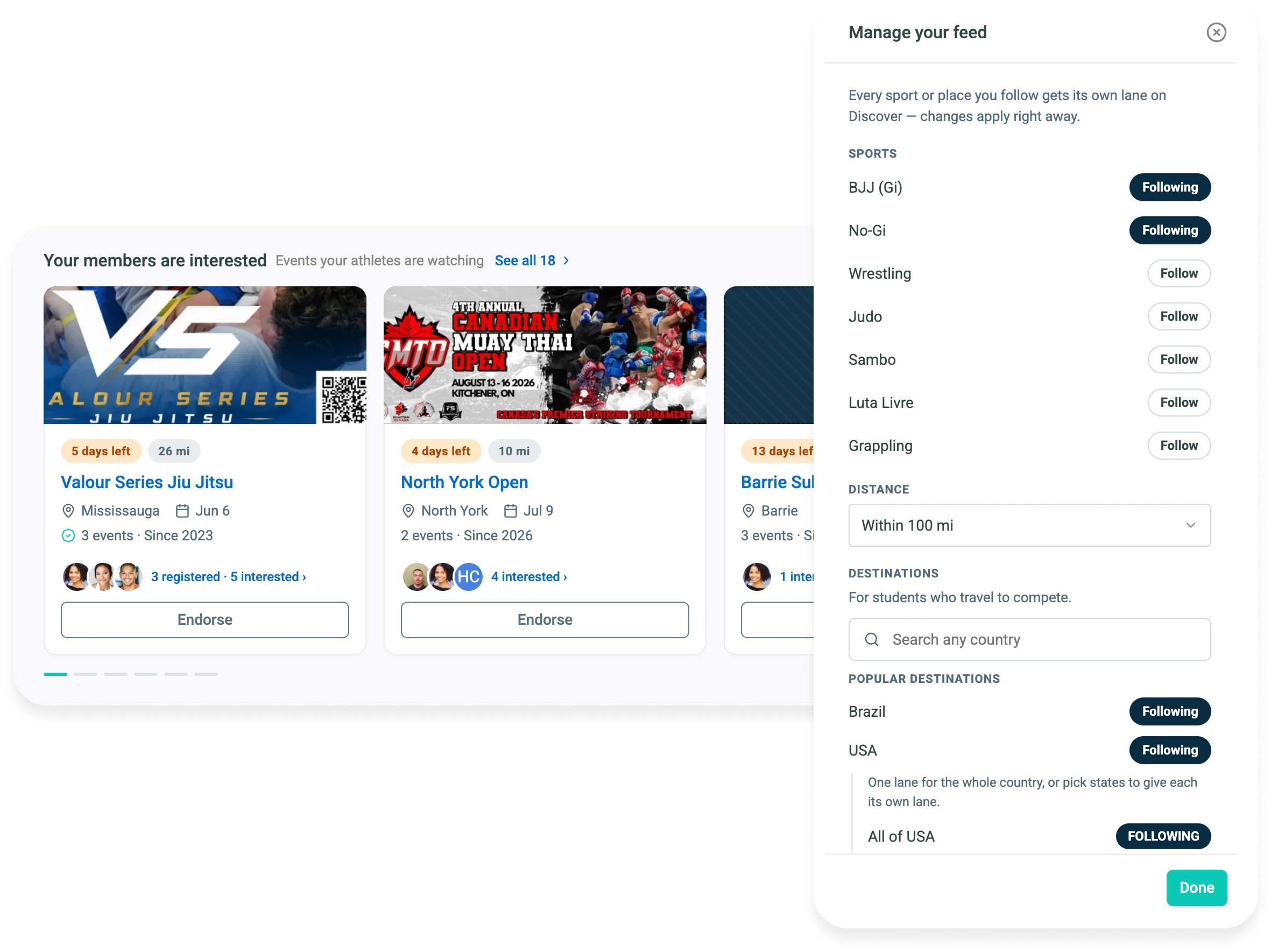
Endorse the one you chose, and members see it marked Academy Approved.
You can register each member from the Gymdesk record with your academy already filled in.
The list covers Smoothcomp events only. For federation events like the IBJJF's, you'll still register on the organizer's own site.
Tournament Weekend
At a busy tournament, three of your members can be on three different mats at once.
The day runs on logistics, and most of what goes wrong goes wrong because nobody knew where to be.
Before the weekend, make sure everyone on your competition team knows their division, weigh-in time, and arrival time. Assign a coach to each mat you'll be on, and confirm who's filming (more on that below).
On the day, keep one shared schedule the whole team can see. Brackets run late, and sometimes early at the worst possible moment.
Solana Be's rule is to arrive at least 90 minutes before a scheduled match, the way you'd show up for a flight. Her guide to running a team on tournament day covers the full system, from coach assignments to the first class back.
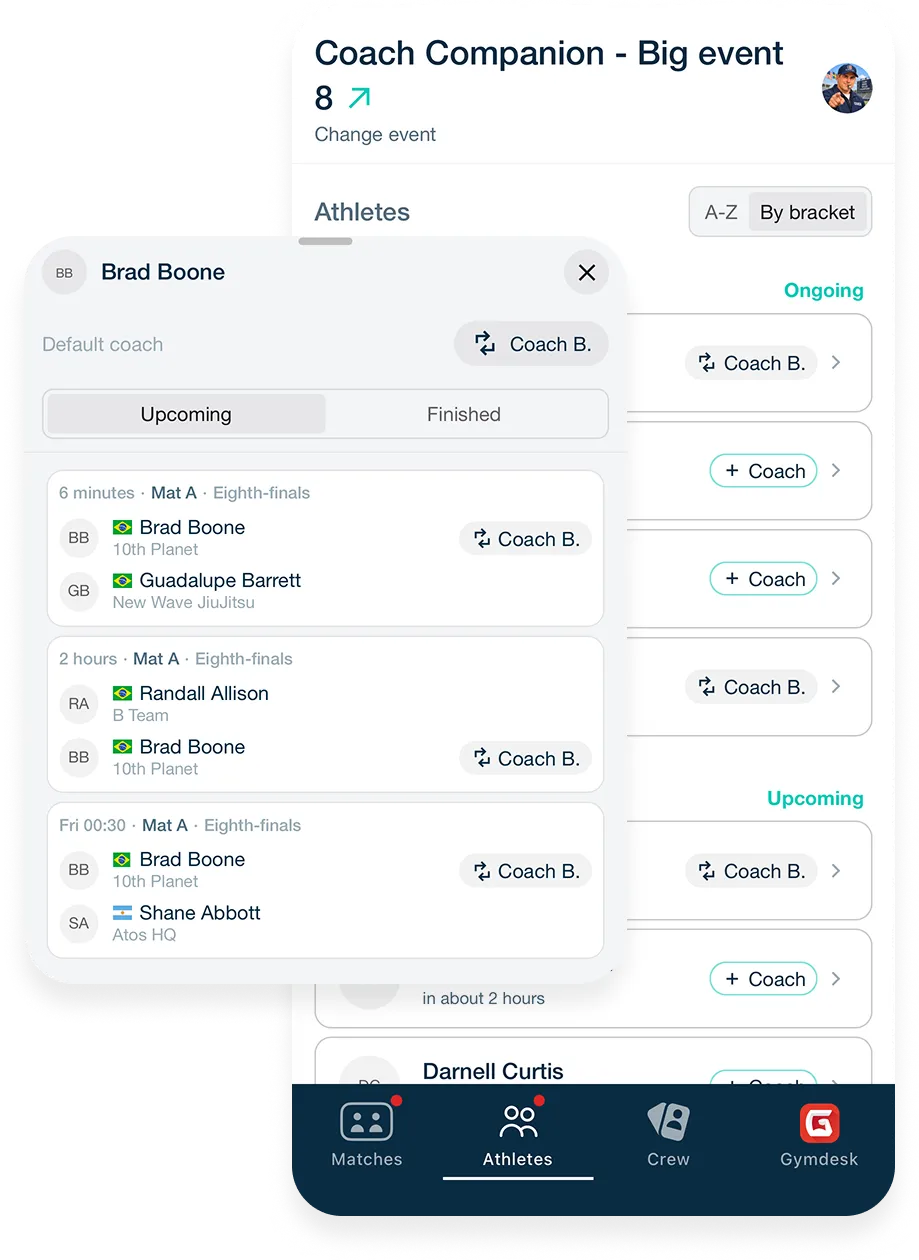
At Smoothcomp events, Coach Companion handles the mat-side part. It's a free app on iPhone and Android for any coach with a Smoothcomp account.
Your athletes are listed in match order, and you put a coach on every match. The Matches screen shows any match with nobody in the corner, and the app warns you when two of your matches are about to run at once.
After the Result: Wins, Losses, and Who Comes Back
After the event, write down what each competitor needs to work on while it's fresh. It becomes the plan for the next block of competition classes.
If you coached from Coach Companion and your gym runs on Gymdesk, the note you write after each match lands on that member's record.
Any coach can read it before the first class back.
Then there's the Monday after. That's when people quietly decide on the next one.
Winners get the easy part. Celebrate every win, in class and on your gym's social accounts.
Members who lost need more of your attention, and it's worth giving. Coaches see it all the time: a first-timer loses, hears nothing, and quietly stops coming to competition class.
Some stop coming to the gym.
A short conversation in the first week, about what went well and when the next event is, can make the difference.
Once your Smoothcomp academy is connected, Athlete Activity in Gymdesk shows when each member last competed. That makes the first-timer who went quiet easier to spot.
And the member who competed once and doesn't want to go again? That's a fine outcome.
Make it clear that regular classes are still home.
Kids and Women on the Team
If your team is only the adult men who were already competitive, it stays small. Your kids program and your women members are the two easiest places to grow it.
Kids
At Grapple Zone in London, co-founder Courtney Anderson talks about kids who started in the junior classes not knowing what a takedown was.
Three years after the gym opened, those same kids are competing and winning their first gold and silver medals.
If you can, grow your team from your kids program. Kids who start competing young grow into teenagers with years of mat time and a lot of loyalty to your gym.
For kids, keep the focus on effort and experience, and let parents opt in event by event. If you post photos of minors, get written consent from a parent first. If your kids program is new, start with running a kids BJJ program.
Women
A woman on your team may get fewer matches per event than the men do.
Check the women's brackets before you pick an event; at many local tournaments they're thin, and it can be worth travelling a little further for a stronger one.
Bringing more women into the gym in the first place is its own project, and a look at the best martial arts for women is a good place to start.
Ask your women members directly about competing, since many won't volunteer. And make sure the competition class has training partners close to their size.
Keeping Recreational Members Happy
That's Daniel, on where competition teams most often go wrong.
Your recreational members pay most of the bills. Most train twice a week to feel better, and you'll lose them if every class feels like tournament camp.
Keep the line clear. Competition intensity stays in the competition class, and regular classes stay the way your beginners found them. Let the rest of the gym hear about the team's results, and feel proud of them, without having to train like it.
Courtney Anderson and his partners opened Grapple Zone after leaving a gym with cliques, and coaches who held people back at grading. He wanted a place where people could train safely and competitively, and:
"come here to de-stress, not come here and get more stressed."
One of his coaches has taken silver at the No-Gi Worlds, and the regular classes are still where people come to unwind.
You can read Grapple Zone's story in full, and there's more on the culture side in the guide to building a martial arts gym community.
Marketing Your Competition Team
Once your team is competing regularly, results start showing up, and so does content.
Podium photos and match clips give you a week of social media from one Saturday. Technique breakdowns from real matches do well too, because your members will watch a teammate's armbar far more times than a stranger's.
All of it feeds the same social media plan you'd use for the rest of the gym.
- Assign a filmer. Coaches are busy coaching. A member who isn't competing that day, with a phone and a charged battery, is enough.
- Ask before you post. Some members won't want a loss on Instagram, and that's fine. For minors, get written parent consent.
- Announce it in the gym. A shout-out at the start of Monday's classes does more for your culture than a post with 40 likes.
Competition results also belong on your website, where prospects comparing gyms will look for proof.
Keeping Your Competition Team Organized
A spreadsheet handles five competitors. It gets messy at fifteen.
A team adds admin, most of it about who's registered for what and who needs a reminder about weigh-ins. Whatever you use, track three things per competitor: rank and division, the events they're registered for, and their deadlines.
In Gymdesk, you can add your competitors to a roster and filter your member list by that roster or by rank.
From there, send the whole team an email (or a text, once you've set up a texting number) about an upcoming registration deadline. When the competition class runs, you can check in the team together and see who's actually training before the big event.
The tournament side lives in the Competitions tab, which every Gymdesk martial arts gym has, on any plan. It connects to Smoothcomp through Smoothcomp Connect.
You can endorse an event, register members, and see who has paid. Results then land on each member's record, next to attendance.
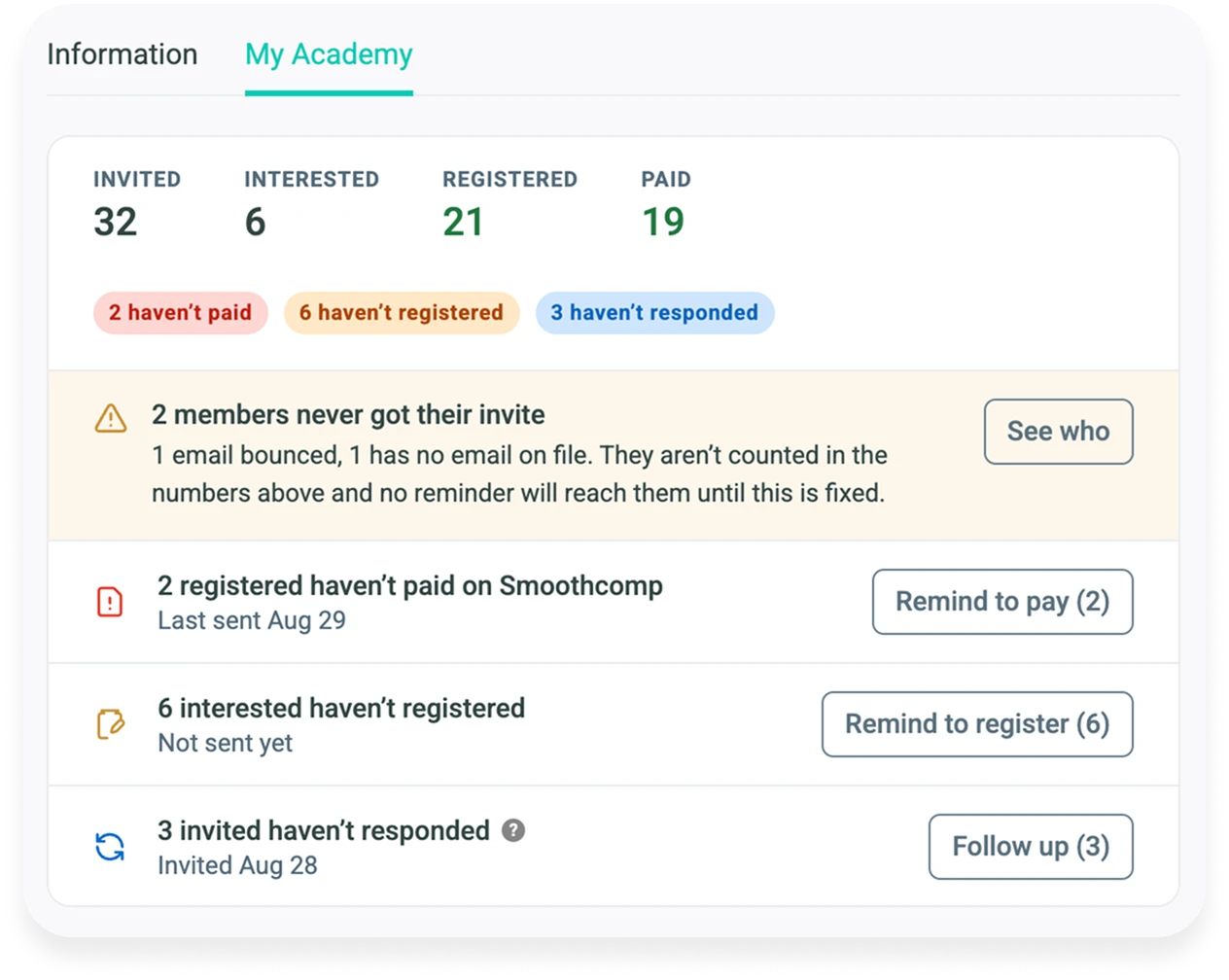
So the night before weigh-ins, you're checking one list instead of scrolling through fifteen text threads.
Competing vs Hosting Your Own Tournament
A competition team sends your members to other people's events. Hosting means running a tournament at your own gym.
An in-house tournament is a low-pressure first match for kids and beginners. Once they're ready, the team takes them to outside events.
If you're considering hosting, start with our guide to in-house martial arts tournaments, and run the numbers with the in-house tournament ROI calculator. For a gym that's made in-house events part of its identity, read how Etobicoke BJJ runs its tournaments.
If you outgrow an in-house bracket and want to run an open for other gyms, our comparison of martial arts tournament software covers the tools organizers use, Smoothcomp included.
Bottom Line
We'll keep you in the loop with fresh content, podcasts, how-to guides, tool reviews, and product exclusives.
Gym management software that frees up your time and helps you grow.
Simplified billing, enrollment, student management, and marketing features that help you grow your gym or martial arts school.


FAQ
Competition Team FAQs
Quick answers to what owners ask before they start a team.

Sean has spent the last decade creating content that helps businesses—small and not so small—grow smarter to allow operators to do more of what they love. You know, the fun stuff.
From shipping and international logistics to web development and marketing, he's done the work (not just the words) to scale retail and service businesses efficiently.
You can find his work at Sendle, Shogun, The Retail Exec, Gymdesk, and more.