
BJJ Open Mat Sessions: The Complete Guide for Gym Owners
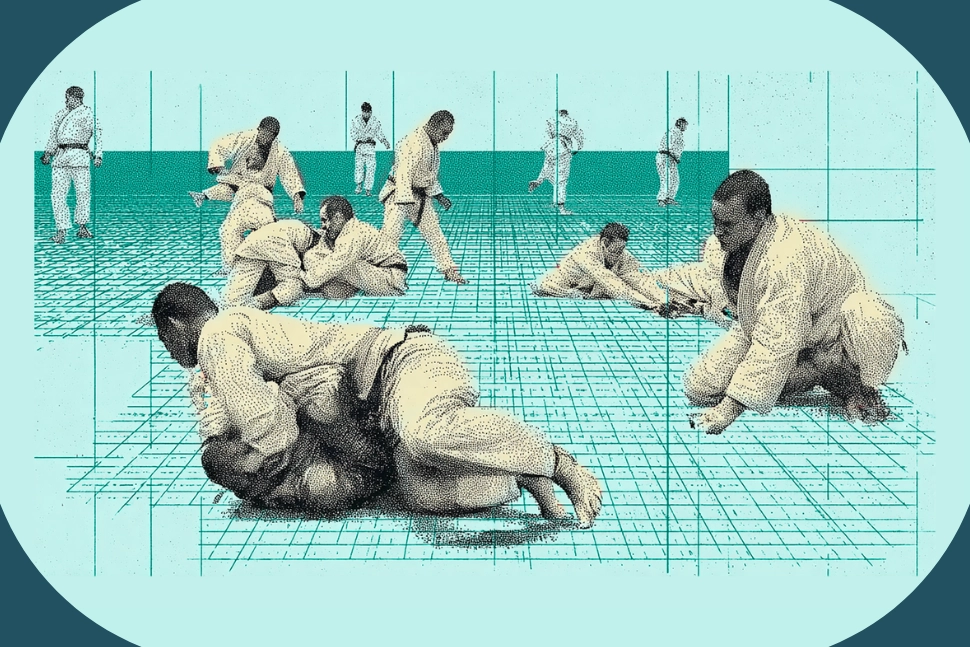
I was flat on my back in the LA sun, baking between a thick gi and oven-hot foldout mats. A black belt named Jestin Icasiano had just finished putting me through a blue belt assessment—not the kind with a clipboard and a checklist. Just rolling. Hard.
I felt like a child out there. Every move I made got exploited and turned against me.
Here's the thing, though. Jestin didn't build that kind of skill through drilling alone. He built it through hundreds of open mat sessions—showing up, finding partners, testing what worked, refining what didn't.
No instructor calling out techniques. No structured warm-up. Just mat time and the freedom to figure things out.
That's the power of open mat. And if you're not offering it at your academy, you're leaving one of your best retention and community-building tools on the table.
What Is Open Mat in BJJ?
Open mat is an unstructured training session where students set their own agenda. No formal instruction, no roll call, no curriculum.
Members show up, pair up, and train however they want—free rolling, drilling specific techniques, flow rolling, or troubleshooting positions they've been stuck on.
Think of it as the gym equivalent of a pickup basketball game.
Students arrive at their convenience within the session window, find a partner, and get to work. Some drill guard passes for an hour. Others do five-minute rounds with every partner in the room.
A few sit on the side and watch higher belts roll, picking up details they'd never catch in a regular class.
That lack of structure is the whole point.
Why You Should Offer Open Mat
Open mat does more for your academy than fill a time slot.
It addresses the biggest reasons students quit, strengthens the relationships that keep them coming back, and costs you almost nothing to run.
It fills a gap that structured classes can't
Your regular classes follow a curriculum.
You pick the technique, set the pace, and everyone works on the same thing. That's great for systematic learning—but it doesn't give students space to work on their specific problems.
The white belt who keeps getting swept from closed guard needs reps.
The purple belt preparing for a competition needs hard rounds with bigger partners. The blue belt who just learned a new submission needs a low-pressure spot to test it live.
Open mat gives them that space.
There's real psychology behind this, too. Self-determination theory says people need three things to stay motivated: autonomy (freedom to choose what they work on), competence (feeling like they're improving), and relatedness (connection with others).
A single open mat session delivers all three.
KEY TAKEAWAY:
Self-determination theory says people need three things to stay motivated: autonomy (freedom to choose what they work on), competence (feeling like they're improving), and relatedness (connection with others).
A single open mat session delivers all three—without you planning any of it. That's a powerful retention tool sitting inside a time slot you probably already have open.
It's one of your best retention tools
Here's the business reality: most students quit BJJ before they leave white belt. A big chunk of blue belts disappear too—the infamous "blue belt blues."
Why? Frustration. They feel stuck. Classes move on to new techniques before they've absorbed the last ones.
Open mat directly addresses this.
When students choose what to work on, they tackle the specific things holding them back. They get extra reps on techniques from class. They find training partners who challenge them at the right level.
Members who attend open mat train more often, build deeper relationships, and feel more connected to your academy. All of that makes them less likely to quit.
GYM OWNER TIP:
Track which members attend open mat regularly versus those who don't. You'll probably notice a pattern—open mat regulars stick around longer.
If a consistent member suddenly stops showing up, that's an early warning sign worth a check-in text. Catching disengagement early is far easier than winning back someone who's already mentally checked out.
It builds community without you doing anything
Open mat creates organic relationships between members.
A white belt asks a brown belt for help with a sweep. Two purple belts who normally train at different class times finally meet and become regular training partners. A competition team forms naturally as the members who want hard rounds gravitate toward each other.
These connections happen without you orchestrating them. You just provide the space and the time. The community builds itself.
We recently had an open mat event with Alliance Jiu-Jitsu:
The peer mentorship effect
Something happens during open mat that you rarely see in regular class. Upper belts naturally start mentoring lower belts—not because you assigned them to, but because they want to.
A black belt pauses between rounds to show a white belt why their armbar isn't finishing. A purple belt shares the small detail that made a technique click for them.
This kind of peer mentorship accelerates learning across your entire student body. And it gives your upper belts a sense of purpose that keeps them engaged, too.
How to Structure Your BJJ Open Mat Sessions
You don't need to overthink this. A few decisions about scheduling, format, and supervision will cover most of it.
Scheduling and frequency
Most academies offer open mat once or twice per week. Weekend mornings are the most common slot—Saturday or Sunday, when members have more flexibility.
Here's what works:
- Once per week is the minimum to build a habit. Students need to know it's a reliable option.
- Twice per week (one weekday evening, one weekend morning) gives members more flexibility and drives higher attendance.
- Duration: 90 minutes to two hours is the sweet spot. Shorter than 90 minutes and people feel rushed. Longer than two hours and attendance thins out naturally anyway.
If you're just starting out, pick one consistent time slot and stick with it.
OPEN MAT SCHEDULING CHEAT SHEET:
Frequency: Start with once per week—consistency matters more than frequency
Best time slots: Saturday or Sunday morning (10 AM–12 PM), or add a weekday evening once attendance is steady
Duration: 90 minutes to two hours is the sweet spot
Format: Alternating gi/no-gi weeks is the most common approach
Consistency matters more than frequency. A Saturday 10 AM open mat that members can count on every week beats an inconsistent schedule that changes monthly.
Gi, no-gi, or both?
You have three options:
- Gi-only or no-gi-only: Simple. Everyone knows what to wear. Works well if your academy leans heavily one direction.
- Alternating weeks: Gi one week, no-gi the next. Gives variety without requiring everyone to bring both.
- Open format: Students choose gi or no-gi. Most flexible—but can create awkward mismatches if one person is in a gi and their partner isn't.
The most common approach is alternating weeks, or matching it to whatever your regular class schedule emphasizes that week.
Do you need an instructor present?
You don't need to teach during open mat—that defeats the purpose. But having a black belt or an experienced upper belt present is strongly recommended for two reasons:
- Safety. Someone needs to step in if rolling gets too intense or a newer student is in over their head.
- Insurance. Most liability policies require a qualified instructor on premises during any training session. Check your policy—this matters.
You don't have to be actively coaching. Sit on the side, do your own training, or handle admin work. Just be available.
PRO TIP:
Open mat is a great chance for your assistant instructors and upper belts to get their own training in. Rotate who supervises so it doesn't always fall on you.
This also builds ownership from your senior students—people take better care of something they help run.
Open Mat Rules and Etiquette
"Unstructured" doesn't mean "no rules." A few clear expectations keep sessions safe and productive for everyone.
Set ground rules early
Post these on the wall and cover them during new member onboarding:
Safety:
- Warm up before rolling. No jumping straight into hard rounds cold.
- Tap early, tap often. Ego injuries are the most preventable kind.
- Match intensity with your partner. If someone is going light, don't crank it to 100%.
- No heel hooks or neck cranks for white belts (adjust based on your academy's policies).
Etiquette:
- Ask before you roll. Don't just grab someone.
- Respect all belt levels. A white belt asking a black belt for a round is how the sport works.
- Keep rounds to a reasonable length (five to seven minutes is standard) so partners can rotate.
- If you're much more experienced, use the round to work defense or positions—not to submit them 15 times.
Hygiene (non-negotiable):
- Clean gi or rashguard every session. No exceptions.
- Trim fingernails and toenails.
- No training with open wounds or skin infections.
- Shower before training if possible.
Managing rolling intensity
This is the most common issue during open mat.
A newer student pairs with a more experienced one who doesn't know how to dial it back. Or two competitive blue belts turn a friendly roll into a death match.
Address intensity expectations directly. Something like: "Open mat isn't competition practice unless both people agree it is. Default to 70% intensity. If you want hard rounds, find a partner who wants the same."
Some academies designate specific rounds or areas for competition-level intensity. That works well if you have the space.
IMPORTANT:
Don't just post intensity rules on the wall—say them out loud. New members follow whatever vibe they walk into. If your regulars go hard by default, newcomers will either match it and get hurt, or feel unwelcome and stop coming.
Set the tone intentionally. A 30-second reminder at the start of every open mat costs nothing and prevents the injuries that cost you members.
Drop-In Visitor Policies
Visitors from other gyms are one of the best parts of open mat—if you handle the logistics right.
Why visitors are good for your academy
Members from other gyms visiting your open mat is a net positive.
Your students get exposure to different games and styles. And if a visitor is traveling or considering switching academies, you've just made a strong first impression.
Setting up a drop-in policy
Keep it simple:
- Pricing: $20–$40 per session is standard. Some academies offer a discounted rate for open mat versus regular classes since there's no formal instruction.
- Requirements: Visitors should be active members at another academy. Ask for their home academy name and their instructor's name. A quick social media check usually confirms this.
- Waivers: Every visitor must sign a liability waiver before stepping on the mat. Before training, every time.
If you use gym management software, you can set up a digital waiver that visitors complete on a tablet at the front desk.
Gymdesk lets you create booking forms with built-in document signing—so the waiver is handled before they even change into their gi. No paper, no chasing people down.
Welcoming visitors the right way
How a visitor is treated at your open mat says a lot about your academy. Here's how to make it smooth:
- Greet them personally. Introduce yourself, ask about their training background, and learn their name.
- Pair them with an appropriate partner for their first round. Don't throw a visiting white belt in with your most aggressive competitor.
- Introduce them to the room. A quick "Hey everyone, this is Marcus, he trains at an academy downtown" goes a long way.
- Check in after. Ask how their experience was. Invite them back.
Some of your best future members will come from visitors who loved the vibe at your open mat.
Liability and Insurance for Open Mat
This is the unsexy part—but it's the part that protects your business if something goes wrong.
Waivers are not optional
Every person who trains at your academy—members and visitors—needs a signed liability waiver on file. For regular members, this should be part of your signup process. For drop-in visitors, it needs to happen before every visit.
Paper waivers get lost. Digital waivers don't.
Whatever system you use, make sure you can pull up a signed waiver for any person who's trained at your academy if you ever need it.
IMPORTANT:
The risk isn't that someone gets injured—injuries happen in combat sports. The risk is that someone gets injured and you can't produce a signed waiver, proof of supervision, or an attendance record.
That's the difference between a covered incident and a lawsuit you lose. Get the paperwork right before you need it.
Check your insurance policy
Your gym liability insurance should cover open mat sessions, but don't assume—verify. Specifically, confirm:
- Supervision requirements. Does your policy require a certified instructor present during all training? If so, open mat counts.
- Visitor coverage. Are drop-in visitors covered under your policy, or do you need additional coverage?
- Activity scope. Does your policy cover unsupervised rolling, or only instructor-led classes?
If your insurance doesn't cover open mat or drop-in visitors, talk to your provider. This is fixable—but only if you address it before something happens.
Keep attendance records
Document who attends every open mat session.
If there's ever an injury or incident, you'll need to show who was present, that they had a signed waiver, and that a qualified instructor was supervising.
A simple check-in system handles this.
Members check in via an app or kiosk upon arrival, and the record is automatically saved. For visitors, their waiver and check-in create a paper trail you'll be glad you have if you ever need it.
Many gym owners handle this manually until something goes wrong. Don't be that gym owner.
The Bottom Line
Open mat is one of the simplest things you can add to your schedule—and one of the most effective for retention, community, and student development.
- It gives students autonomy over their own training, which keeps them motivated and progressing.
- It builds community organically through training partnerships and peer mentorship.
- It costs you almost nothing—just mat space and time.
- Drop-in visitors bring fresh training and potential new members. Welcome them well.
- Cover your bases with waivers, insurance, and attendance tracking. The admin takes minutes; the protection lasts.
If you're not running open mat yet, pick a time slot, set some ground rules, and open the doors. Your members will thank you—and your retention numbers will show it.
Gymdesk handles the operational side—scheduling open mat sessions, tracking attendance, managing drop-in waivers digitally, and flagging which members are showing up consistently (or aren't). Try it free for 30 days and see how it fits your academy.
Gym management software that frees up your time and helps you grow.
Simplified billing, enrollment, student management, and marketing features that help you grow your gym or martial arts school.


FAQ
BJJ Open Mat FAQs

Josh is a martial arts educator and coach who bridges live training on the mats with evidence-based teaching. A 4th degree Taekwondo black belt and dedicated Brazilian Jiu-Jitsu practitioner, he’s spent years running classes, mentoring students, and helping instructors move beyond rote drills to training that actually works under pressure.
He holds a Master of Education in Teaching & Learning from Liberty University and runs Combat Learning, where he breaks down ecological dynamics, constraints-led coaching, and games-based training for combat sports. Through his writing and podcast work with Gymdesk, Josh turns coaching science and gym-owner stories into practical ideas you can use to run better classes and build a stronger martial arts school.