
BJJ Weight Divisions: The Complete Guide to Competition Weight Classes (2026)

If you run a jiu-jitsu or martial arts school, the first competition question you'll get from a nervous student usually isn't about technique. It's "which division am I even in?"
BJJ weight divisions are the answer: the bodyweight brackets that keep tournament matches fair by matching similarly-sized athletes, instead of letting a 60 kg blue belt get folded in half by someone 40 kg heavier.
Understanding how BJJ weight classes work does three things for you as a coach or owner. It helps you guide each competitor to the right bracket, keep them safe on the scale, and run clean divisions at your own in-house events.
This guide covers every system your members will run into (the IBJJF, ADCC, NAGA, AJP, ASJJF, AGF, UFC BJJ Opens, and Grappling Industries), with each chart checked against the federation's own published table in October 2026. There's a division finder that converts pounds and kilos for you. Then it gets into how to put all of it to work for your gym.
KEY TAKEAWAYS:
- BJJ weight divisions keep competition fair by matching athletes of similar size, and the IBJJF chart is the reference most coaches start from.
- Systems vary a lot: IBJJF adults get 9 men's and 8 women's divisions, ADCC Worlds uses 5 men's and 3 women's, and NAGA runs 11 men's and 12 women's classes layered with skill levels.
- Check what goes on the scale. IBJJF and ASJJF weigh you in your competition uniform. NAGA and AGF don't weigh you in the gi, and Grappling Industries makes it optional.
- IBJJF no-gi limits sit 2 to 3 kg under the gi limits, so a competitor's real body weight lands in the same named division either way.
- Weigh-in rules decide how much margin you have. IBJJF gives you one attempt before your first match. NAGA lets you weigh in the night before and moves you to the right class if you miss.
- The safest weight management is competing close to your walking-around weight—crash-cutting costs more performance than the size advantage is worth.
What Are BJJ Weight Divisions?
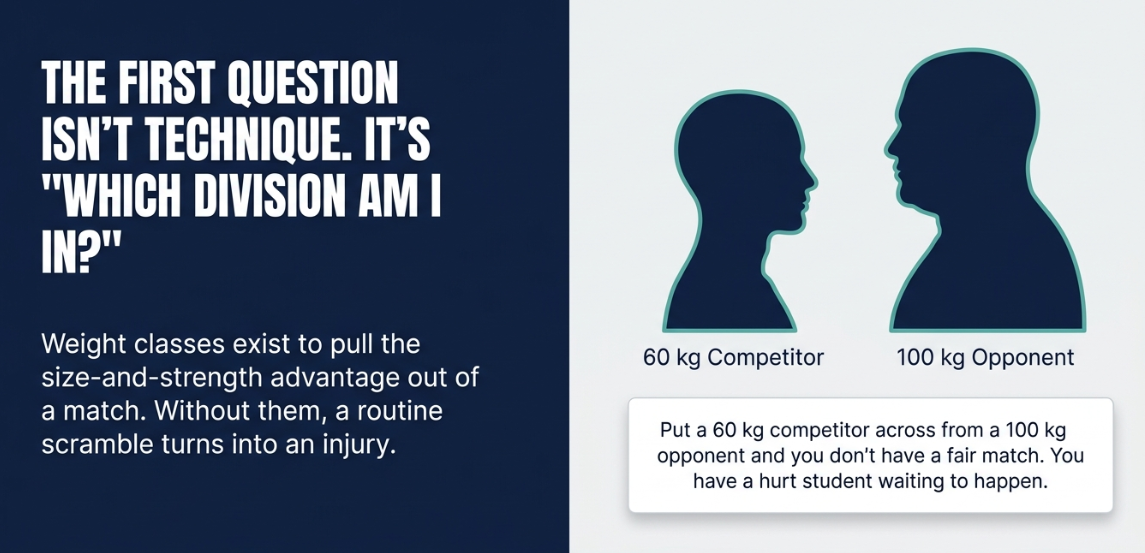
BJJ weight divisions are standardized bodyweight brackets that decide who competes against whom. They exist to pull some of the size-and-strength advantage out of a match, so technique carries more of the result.
They never erase that advantage completely. They just chop it into ranges narrow enough that two competitors face a roughly fair fight.
There's a safety job here too, and it's the part owners should care about most. Weight classes prevent the kind of size mismatch that turns a routine takedown or scramble into an injury.
Put a 60 kg competitor across from a 100 kg opponent and you don't have a fair match. You have a hurt student waiting to happen.
Jiu-jitsu didn't always work this way. The sport grew out of judo and catch wrestling, both of which already used weight divisions, but the early Gracie Challenge and Vale Tudo era leaned hard into open-weight matches to prove the whole "technique beats size" point.
That changed as sport BJJ exploded through the 1990s and 2000s. Once brackets got big, the IBJJF and others needed standardized weight classes just to run tournaments that finished on schedule.
One distinction trips up almost every first-time competitor: gi versus no-gi weigh-ins.
At IBJJF events you weigh in wearing your full uniform, so the gi limit on the chart already includes the gi. No-gi divisions weigh you in your no-gi uniform, and the IBJJF sets those limits 2 to 3 kg lower to land on the same body weight.
Your gi "feather" and your no-gi "feather" describe nearly the same athlete. Only the clothing on the scale changed.
Not every organization works this way, though. NAGA and AGF weigh you without the gi and use one chart for both formats.
BJJ Weight Division Finder: Pounds to Kilos
A steady trickle of the searches that land on this page are someone converting a number straight off a chart. "135.6lb to kg." "181.4lb to kg." (Our tables list both units, but fair enough. Nobody wants to do decimal math at the scale.)
So here's the shortcut. Enter a weight in either unit, pick the event, and the finder shows the division, its limits in both units, and how close you are to the class below.
BJJ Weight Division Finder
Enter a weight in pounds or kilos, pick the event, and see which division it lands in, with the limits in both units.
Enter a weight to see the division.
It covers adults and masters for every federation below, plus juveniles (16–17) wherever the federation publishes a separate chart. Kids' brackets change by age and event, so check the event page for those.
The Major BJJ Organizations and Their Weight Classes
Each major organization handles weight a little differently, and those differences matter when you're helping a student pick an event. Here's how the big ones break down, with the current charts.
IBJJF weight classes
The IBJJF is the global standard for sport jiu-jitsu, and its weight classes are the reference point coaches use even when they're competing somewhere else.
Adult men get nine divisions from Rooster up to Ultra Heavy; adult women get eight, topping out at an open-weight Super Heavy. Masters use the same limits as adults; the IBJJF prints them in one column.
Remember the gi rule when you read this: these are maximum weights with the gi on.
Division | Male | Female |
Rooster | 57.5 kg (126.8 lb) | 48.5 kg (106.9 lb) |
Light Feather | 64.0 kg (141.1 lb) | 53.5 kg (117.9 lb) |
Feather | 70.0 kg (154.3 lb) | 58.5 kg (129.0 lb) |
Light | 76.0 kg (167.6 lb) | 64.0 kg (141.1 lb) |
Middle | 82.3 kg (181.4 lb) | 69.0 kg (152.1 lb) |
Medium Heavy | 88.3 kg (194.7 lb) | 74.0 kg (163.1 lb) |
Heavy | 94.3 kg (207.9 lb) | 79.3 kg (174.8 lb) |
Super Heavy | 100.5 kg (221.6 lb) | no upper limit |
Ultra Heavy | no upper limit | n/a |
IBJJF gi weight classes (adults & masters, maximum weight including gi)
Source: IBJJF official gi weight chart, checked October 2026.
IBJJF no-gi uses the same names with lower numbers, since there's no gi on the scale.
Division | Male | Female |
Rooster | 55.5 kg (122.4 lb) | 46.5 kg (102.5 lb) |
Light Feather | 61.5 kg (135.6 lb) | 51.5 kg (113.5 lb) |
Feather | 67.5 kg (148.8 lb) | 56.5 kg (124.6 lb) |
Light | 73.5 kg (162.0 lb) | 61.5 kg (135.6 lb) |
Middle | 79.5 kg (175.3 lb) | 66.5 kg (146.6 lb) |
Medium Heavy | 85.5 kg (188.5 lb) | 71.5 kg (157.6 lb) |
Heavy | 91.5 kg (201.7 lb) | 76.5 kg (168.7 lb) |
Super Heavy | 97.5 kg (215.0 lb) | no upper limit |
Ultra Heavy | no upper limit | n/a |
IBJJF no-gi weight classes (adults & masters, maximum weight)
Source: IBJJF official no-gi weight chart, checked October 2026.
A few notes worth passing on to students:
- Juveniles (16–17) have their own, lighter chart. At the major championships, 16-year-old and 17-year-old boys get separate ladders, while juvenile girls share one. A juvenile boy's gi Rooster is 48.5 kg at 16 and 53.5 kg at 17. The finder above has every juvenile limit.
- Divisions are split by belt rank too, so a white belt and a black belt at the same weight never meet.
- The absolute (open-weight) division is the IBJJF's nod to jiu-jitsu's roots: one bracket, any weight, where conditioning and technique matter more than the number on the scale. Who can enter it depends on the tournament's own rules, so check the event page.
ADCC weight divisions
ADCC is the most prestigious event in submission grappling, and it takes the opposite approach to the IBJJF: fewer, wider divisions. At the World Championship and the Trials that qualify for it, the brackets are deliberately broad.
Division | Men | Women |
1 | −65.9 kg (145.2 lb) | −55 kg (121.2 lb) |
2 | −76.9 kg (169.5 lb) | −65 kg (143.3 lb) |
3 | −87.9 kg (193.7 lb) | +65 kg (143.3 lb) |
4 | −98.9 kg (218.0 lb) | n/a |
5 | +99 kg (220.5 lb) | n/a |
Absolute | open class | not listed |
ADCC weight classes (World Championship and Trials)
Source: ADCC official weight classes, checked October 2026.
That's five weight classes for men and three for women at Worlds and Trials, against the IBJJF's nine and eight. The 11 kg gap between the −76.9 and −87.9 kg classes leaves real room for size differences inside a single bracket. Worlds and Trials are open only to competitors over 16.
ADCC Open events are a different animal. The Opens use a longer ladder that runs to nine adult men's classes and eight women's, and ADCC's own sites don't fully agree on it. If a student is entering an Open, check that event's registration page for the exact classes.
NAGA weight classes
NAGA helped build the modern grassroots grappling scene in North America, and its system is geared for running large, mixed-experience tournaments. It uses imperial weights and adds something the federations don't: skill divisions stacked on top of weight and age.
Division | Male | Female |
Sub-Atomic | n/a | ≤99.9 lb |
Atomweight | n/a | 100–109.9 lb |
Strawweight | n/a | 110–119.9 lb |
Flyweight | ≤129.9 lb | 120–129.9 lb |
Bantamweight | 130–139.9 lb | 130–139.9 lb |
Featherweight | 140–149.9 lb | 140–149.9 lb |
Lightweight | 150–159.9 lb | 150–159.9 lb |
Welterweight | 160–169.9 lb | 160–169.9 lb |
Middleweight | 170–179.9 lb | 170–179.9 lb |
Light-Heavyweight | 180–189.9 lb | 180–189.9 lb |
Cruiserweight | 190–199.9 lb | 190–199.9 lb |
Heavyweight | 200–224.9 lb | ≥200 lb |
Super-Heavyweight | 225–249.9 lb | n/a |
Ultra-Heavyweight | ≥250 lb | n/a |
NAGA weight classes (adult / master / director / executive, US events)
Source: NAGA official divisions, checked October 2026.
Three things to flag for your members:
- Gi and no-gi use the same ranges, and NAGA doesn't weigh you in the gi. You enter each format as a separate bracket.
- Skill divisions matter here. Adult no-gi brackets run Novice (up to 6 months), Beginner (6 months to 2 years), Intermediate (2 to 5 years), and Expert (5+ years). Gi brackets go by belt rank. That's great for a first-timer who'd otherwise get fed to the wolves.
- The weigh-in is the most forgiving on this list. You can weigh in the night before or on the day, up to 90 minutes before your division, with a 1 lb allowance. Miss weight and NAGA moves you to the class you actually weighed. Nobody gets sent home.
NAGA's age groups are Adult (18–29), Master (30–39), Director (40–49), and Executive (50+).
AJP weight classes
AJP (Abu Dhabi Jiu-Jitsu Pro) doesn't copy the IBJJF. It uses kilos only, MMA-style names, and every class has a published ceiling, including the heaviest.
Division | Men | Women |
Rooster | n/a | −49 kg (108.0 lb) |
Light Feather | −56 kg (123.5 lb) | −55 kg (121.3 lb) |
Feather | −62 kg (136.7 lb) | n/a |
Light | −69 kg (152.1 lb) | −62 kg (136.7 lb) |
Welter | −77 kg (169.8 lb) | n/a |
Middle | −85 kg (187.4 lb) | −70 kg (154.3 lb) |
Light Heavy | −94 kg (207.2 lb) | n/a |
Heavy | n/a | −95 kg (209.4 lb) |
Super Heavy | −120 kg (264.6 lb) | n/a |
AJP weight classes (Amateur/Professional 18–29 and Masters 30+)
Source: AJP official divisions, checked October 2026.
That's seven men's classes and five women's. Masters men (30+) use the same limits, split into four age bands, and women's masters is one 30+ group. Youth athletes (16–17) get a separate, lighter ladder with eight classes each for boys and girls, which is in the finder.
AJP still posts these as 2022 tables, and its rulebook doesn't spell out weigh-in timing, so confirm both on the event page.
ASJJF weight classes
ASJJF is the Asian Sport Jiu-Jitsu Federation (the "A" trips people up). It publishes its chart in pounds with separate gi and no-gi limits, much like the IBJJF.
Division | Male gi | Male no-gi | Female gi | Female no-gi |
Rooster | 127.5 lb | 123.5 lb | 107 lb | 103 lb |
Super Feather | 141 lb | 137 lb | 120 lb | 116 lb |
Feather | 154 lb | 150 lb | 135 lb | 131 lb |
Light | 167.5 lb | 163.5 lb | 150 lb | 146 lb |
Middle | 181 lb | 177 lb | 165 lb | 161 lb |
Medium Heavy | 194.5 lb | 190.5 lb | 180 lb | 177 lb |
Heavy | 207.5 lb | 203.5 lb | over 180 lb | over 177 lb |
Super Heavy | 221 lb | 217 lb | n/a | n/a |
Ultra Heavy | over 221 lb | over 217 lb | n/a | n/a |
ASJJF weight classes (adults & masters, maximum weight)
Source: ASJJF official weight table, checked October 2026.
ASJJF weighs you in with your uniform on, once, before your first match. Its gi limits run close to the IBJJF's, so a student who knows their IBJJF division usually lands in the same-named ASJJF one.
AGF weight classes
The American Grappling Federation publishes one chart in both pounds and kilos and uses it for gi and no-gi.
Division | Men | Women |
Light Rooster | 115 lb (52.3 kg) | 105 lb (47.7 kg) |
Rooster | 130 lb (59.1 kg) | n/a |
Light Feather | 145 lb (65.9 kg) | 120 lb (54.5 kg) |
Feather | 160 lb (72.7 kg) | 135 lb (61.4 kg) |
Light | 175 lb (79.5 kg) | 150 lb (68.2 kg) |
Middle | 190 lb (86.4 kg) | 165 lb (75 kg) |
Medium Heavy | 205 lb (93.2 kg) | 180 lb (81.8 kg) |
Heavy | 220 lb (100 kg) | over 180 lb |
Super Heavy | 235 lb (106.8 kg) | n/a |
Ultra Heavy | over 235 lb | n/a |
AGF weight classes (juvenile through seniors, maximum weight)
Source: AGF official divisions, checked October 2026.
AGF weighs you without the gi and allows 1 lb over the limit. Anything past that is a disqualification.
UFC BJJ Opens and Grappling Industries
Two more names your students will ask about.
UFC BJJ Opens is the open tournament series that launched in 2026 under the UFC BJJ banner, for all ages and skill levels. It's separate from the pro UFC BJJ events you see on Fight Pass, which crown champions in their own classes (bantamweight 135 lb, lightweight 155 lb, and welterweight 170 lb at launch).
The Opens use MMA weight names in pounds:
- Men: 125, 135, 145, 155, 170, 185, 205, 265, and over 265 lb (Flyweight through Ultra Heavyweight)
- Women: 105, 115, 125, 135, 145, 155, 170, 185, and over 185 lb (Atomweight through Light Heavyweight)
Weigh-in closes 20 minutes before your bracket starts, per the UFC BJJ Opens rulebook.
Grappling Industries runs small brackets as round robins, so a student in a three- to five-person division gets a match against everyone in it. Men's classes run −135, −145, −155, −170, −185, −200, −215, −230, and over 230 lb. Women's run −105 through −185 lb in the same steps, then +185.
There's no weight allowance at Grappling Industries, and missing weight means no match (Grappling Industries rules).
Other organizations worth knowing
A few more systems your traveling competitors might run into:
- UAEJJF and AJP get mixed up constantly. AJP's own history treats them as separate bodies, so don't assume a UAEJJF chart matches the AJP one.
- SJJIF publishes the same pound-based chart ASJJF uses.
- Pro shows set weight classes match by match or borrow MMA names, which is why a student who watches a lot of pro grappling may show up quoting numbers no federation uses.
The takeaway for a coach: never assume the weight class names transfer between organizations.
Quick comparison
When a student asks "wait, is ADCC the same as IBJJF?", the answer is no, and this is the fastest way to show why.
Org | Adult classes (men / women) | Weigh-in | Gi on the scale? | Registration |
IBJJF | 9 / 8 | Before your first match, one attempt | Yes (gi events) | IBJJF's own system |
ADCC Worlds & Trials | 5 + absolute / 3 | Check the event | No-gi only | Opens: Smoothcomp |
NAGA | 11 / 12 | Night before or day of, 1 lb allowance | No | Smoothcomp |
AJP | 7 / 5 | Check the event | Check the event | Smoothcomp |
ASJJF | 9 / 7 | Before your first match, one step | Yes | ASJJF's own system |
AGF | 10 / 7 | Day of, 1 lb allowance | No | Smoothcomp |
UFC BJJ Opens | 9 / 9 | Closes 20 min before your bracket | Check the event | Smoothcomp |
Grappling Industries | 9 / 9 | Up to 60 min before your division, no allowance | Optional | Smoothcomp |
IBJJF Age Divisions
The IBJJF sets age divisions by birth year, not birthday. Your division is the age you are, or will turn, during the tournament's calendar year. A student who turns 30 in December competes as a Master 1 all year.
Division | Age in the tournament year |
Mighty Mite I–III | 4, 5, 6 |
Pee Wee I–III | 7, 8, 9 |
Junior I–III | 10, 11, 12 |
Teen I–III | 13, 14, 15 |
Juvenile I–II | 16, 17 |
Adult | 18+ |
Master 1 | 30+ |
Master 2 | 36+ |
Master 3 | 41+ |
Master 4 | 46+ |
Master 5 | 51+ |
Master 6 | 56+ |
Master 7 | 61+ |
IBJJF age divisions
Source: IBJJF Rule Book, version 6.1, checked October 2026.
Adult and Master divisions only set a minimum age. A 45-year-old can still enter Adult if they want the younger bracket.
Scoring works the same across age groups: mount and back control are worth 4 points, a guard pass 3, and a takedown, sweep, or knee on belly 2. Match length does change with age and belt, from 2 minutes for Mighty Mites to 10 for adult black belts. The jiu-jitsu point system guide covers advantages, penalties, and tie-breaks.
How to Help a Competitor Choose the Right Division
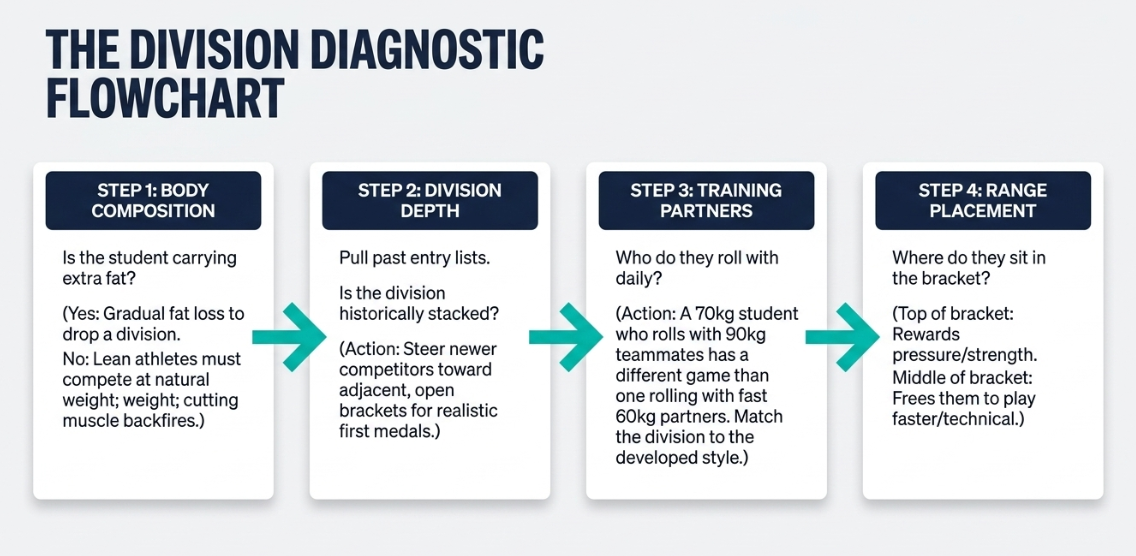
Picking a weight class is more than finding where today's bodyweight lands on a chart. As a coach, it's one of the most important conversations you'll have with a competing student.
It usually comes down to four questions:
- What's their actual body composition? A student carrying extra fat can often drop a division through gradual fat loss and compete stronger. A lean student is better off at their natural weight; cutting muscle and water to make a lower bracket backfires on the mat.
- How deep is the division? Pull entry lists from past local events. Some classes are stacked with the region's best while the one above or below sits wide open. There's no shame in steering a newer competitor toward a bracket where a first medal is realistic.
- Who do they train with? A 70 kg student who only rolls with 90 kg partners has built a very different game than one who drills with smaller, faster teammates. Daily training shapes which division plays to their strengths.
- Where do they sit in the range? Competing at the top of a class (cutting down to it) rewards pressure and strength. Sitting in the middle frees a competitor to play faster and more technical. Neither is wrong, but it should be a choice, not an accident.
Weight Management and Cutting Strategies
IMPORTANT:
The cutting ranges in this guide are widely-used rules of thumb from the grappling and combat-sports community, not medical advice. Every athlete responds differently, and any aggressive cut should involve a qualified coach or nutritionist. When in doubt, compete heavier.
Because most BJJ events weigh in the same day, there's no overnight window to rehydrate from a big cut. That single fact should shape your whole approach: in jiu-jitsu, the conservative competitor usually has the advantage, not the one who gambled on the scale.
The sustainable version of "making weight" starts 12 or more weeks out and looks like slow fat loss—on the order of half a kilo a week, not a crash.
Aim to arrive within a few percent of the target through body composition, so fight week is a small adjustment instead of a rescue mission.
Fight week itself is mostly about lightening digestive load, not dehydrating. A lower-fiber approach in the last few days reduces what's sitting in the gut, and easing back on sodium can help manage water.
The goal is to step on the scale comfortably, not to survive it.
On competition day, the last real meal goes in a few hours before weigh-in so the stomach is empty, with fluids tapering close to the cutoff. Done right, this nudges off a kilo or two without wrecking performance.
The moment the scale clears, the priority flips to controlled rehydration: small, frequent sips and easy carbs. The athlete should step onto the mat fueled, not flattened.
Watch for the warning signs, in yourself or your students: nagging fatigue, irritability, cramping, fuzzy focus in training. Those are the body saying the cut is too big. The right response is to move up a division, not to push harder.
How Fighting Styles Change by Weight Division
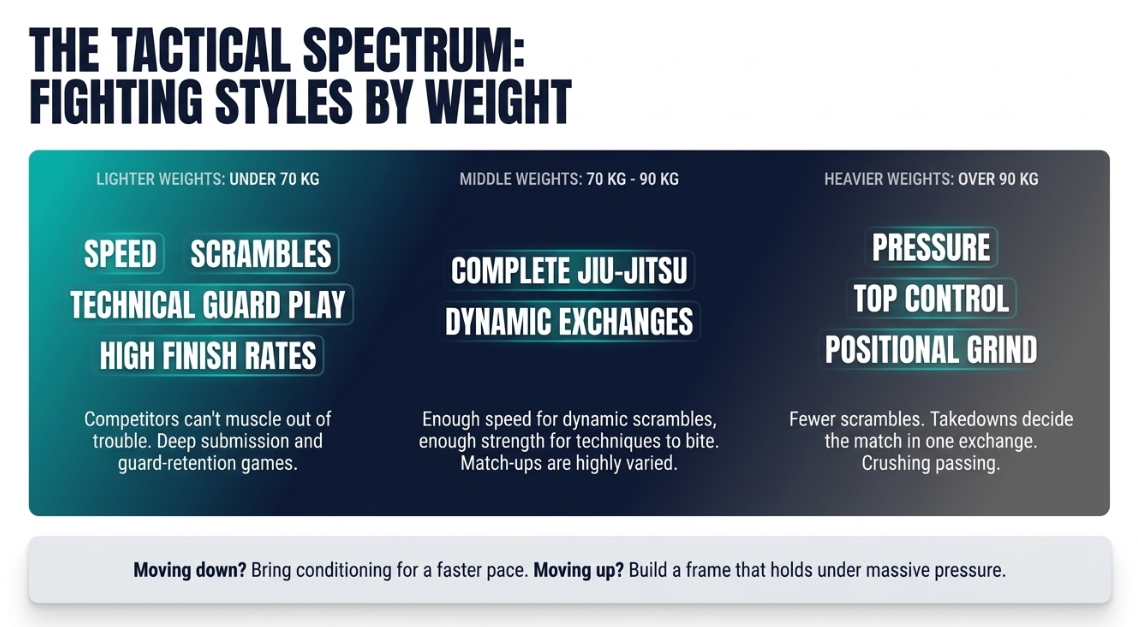
Each weight range tends to grow its own style, shaped by what bodies in that range do well. It's worth understanding so you can prepare a competitor for what they'll actually face.
Lighter divisions, roughly under 70 kg, run on speed and technical volume. These are the matches full of inverted guard, berimbolos, leg drags, and frantic scrambles, with positions changing by the second.
Lighter competitors generally can't muscle out of trouble, so they develop deeper submission and guard-retention games, and finish rates tend to run high.
The middle ranges, about 70 to 90 kg, are where a lot of coaches think the most complete jiu-jitsu lives. There's enough speed for dynamic exchanges and enough strength for the techniques to bite.
Match-ups are varied, from guard-pullers to takedown artists, and outcomes usually come down to who's simply better. That's what makes these matches such good study film for developing students.
Heavier divisions, 90 kg and up, are about pressure and position: top control, crushing passing, and takedowns that decide a match in one exchange.
There are fewer scrambles and longer stretches of positional grind. Finishes come less often, but when a big athlete locks one up, there's not much to be done about it.
This matters at the practical level: a lighter competitor moving up a division needs to build a frame that holds under pressure, while a heavier athlete dropping down has to bring the conditioning to survive a faster pace.
Competition Rules and Weigh-In Procedures
The rules around weigh-ins differ enough between organizations that one wrong assumption can cost a student their entire tournament. Make sure your competitors know the protocol for the specific event they've entered.
IBJJF weighs you in right before your first match, in your full gi (or your no-gi uniform at no-gi events). You get one step on the scale: miss weight and you're disqualified, with no changing divisions on the day and no refund.
Because gi models vary in weight, smart competitors test their exact competition gi on a scale beforehand. Gi inspection happens before the weigh-in too, and you can't swap gis after it for your first match.
NAGA sits at the other end. You can weigh in the night before or on the day, you get a 1 lb allowance, and missing weight just moves you to the class you actually weighed.
AGF weighs you without the gi and allows 1 lb over. Grappling Industries lets gi competitors weigh in without the gi, gives no allowance at all, and closes weigh-ins up to 60 minutes before your division.
A few rules cut across most organizations:
- Assume you can't switch divisions once registration closes. The IBJJF forbids it on the day, and most events treat the registration choice as the real commitment.
- Absolute-division eligibility varies. It's set by each tournament's rules, so check the event page before promising a student a shot at the open bracket.
- Medical oversight is light compared to pro combat sports, so the responsibility for safe weight management sits with the athlete and coach.
That last point is exactly where a good school earns its reputation.
Getting Students Registered in the Right Division
Here's a mistake that never makes the highlight reel. A student registers for the wrong weight class, the wrong age group, or the wrong academy, and nobody notices until the bracket goes up.
It's an easy one to make. Your members are juggling five federations' charts, three units of measurement, and a group chat full of half-remembered advice.
Most of the federations above don't publish divisions for you to copy into a spreadsheet anyway. NAGA, AJP, AGF, Grappling Industries, UFC BJJ Opens, and ADCC's Open events all take registrations on Smoothcomp, so each event's divisions live in its Smoothcomp event page. The IBJJF and ASJJF run their own registration systems.
Gymdesk and Smoothcomp are now one company, which is why Smoothcomp events show up inside Gymdesk.
With tournament registration in Gymdesk, you can search Smoothcomp events, register members from a pre-filled form, and see who has registered and who has paid. Entry options, discounts, and eligibility rules come straight from the event on Smoothcomp, so there's nothing to cross-check against a chart.
The weight class still has to be the right one. But the name, date of birth, and academy come off the member record, which takes care of most of the ways a registration goes sideways.
Helping Your Members Compete—and Stay Safe on the Scale
Here's where weight divisions stop being trivia and become part of how you run a school. The way your gym handles competition weight is a duty-of-care issue, and quietly, a retention one.
Students remember the coach who talked them out of a dangerous cut far longer than they remember a single medal.
A few habits go a long way:
- Coach to their walking-around weight. If a student has to starve to make a bracket, they're in the wrong bracket.
- Start the conversation early, well before fight week, so nobody's making desperate decisions the night before.
- Know your students. The teenager trying to crash two divisions to "go down a class" is the one who needs you to step in.
It's also a community-building opportunity, not just a safety one. A school that prepares people thoughtfully for competition, and celebrates the ones who compete regardless of result, builds the kind of competition team that becomes a recruiting engine.
Parents and new students notice a gym whose competitors show up healthy, prepared, and well-matched. The case for a women's program as a growth flywheel tracks closely with how competition culture spreads.
On the admin side, the unglamorous logistics are worth automating. Knowing who's competing, at what weight, in which event is much easier when registrations and member info live in one place instead of a group chat.
Gym management software like Gymdesk lets you track members and their attendance, so you can spot who's competition-ready and follow up with the ones who've gone quiet before an event sneaks up.
Running Your Own Weight Divisions at an In-House Tournament
Once you understand how the federations structure weight, you can borrow that structure for your own events—and in-house tournaments are one of the best things a school can do for culture and revenue. You don't need IBJJF infrastructure; you need sensible brackets and clean organization.
Start by adapting, not copying. Federation charts are built for hundreds of entrants, but your in-house event might have twelve people in a division's worth of range.
Widen the brackets to fit your actual roster: group by realistic weight ranges and by experience. A four-month white belt and a two-year blue belt shouldn't meet just because they weigh the same.
NAGA's skill-division model is a useful template here.
Keep the weigh-in simple and same-day, like the IBJJF, and decide your gi-or-not policy in advance so the numbers mean something. A cheap digital scale and a printed bracket sheet cover the basics.
The goal isn't a flawless replica of Worlds. It's matches that are fair, safe, and fun enough that people sign up again next quarter.
The operational side is where an event either runs smoothly or eats your weekend. Registration, weigh-ins, bracketing, and messaging all need to happen without a dozen back-and-forth texts.
This is where running it through your gym management platform pays off: take signups and payment through online booking, keep every competitor's details in one roster, and message participants in a couple of clicks.
If you want to pressure-test whether an event is worth running, the in-house tournament ROI calculator models the numbers for you, and the full in-house tournament guide walks through the logistics end to end.
Common Mistakes to Avoid
A few errors show up again and again, and most are coachable before they ever happen:
- The crash cut. Shedding more than about 5% of bodyweight before a same-day weigh-in tanks performance, raises injury risk, and leaves no time to recover. The fix is calendar, not willpower: start 12-plus weeks out and lose fat, not water.
- Ego picking the division. Plenty of competitors default to the lowest class they can theoretically make, ignoring depth, body type, and training. Honest self-assessment usually points higher, and sometimes that means competing a division up and actually performing.
- Winging fight week. Last-minute cuts and brand-new diets introduce chaos exactly when you want routine. Rehearse anything you'll do on competition week at a smaller event first.
- Tunnel vision on the scale. Making weight is half the job; showing up rehydrated and fueled is the other half. A competitor who makes weight and then gasses out in round one didn't win the cut, they lost the match early.
- Beginners overthinking it. New competitors obsess over weight when they should be banking experience. Compete near your natural weight, focus on the match itself, and worry about optimization later.
Where BJJ Weight Divisions Are Heading
Weight classes keep shifting as the sport grows, and a few changes are worth watching:
- UFC BJJ is pulling grappling toward MMA weight names. Its pro events launched in 2025 with bantamweight, lightweight, and welterweight titles, and the UFC BJJ Opens series uses MMA names for every class.
- Women's divisions keep getting deeper. UFC BJJ already has a women's featherweight champion, and its October 2026 card puts a women's flyweight title on the line for the first time.
- Youth competition is getting its own circuits. UFC BJJ Opens runs youth brackets with a 1 lb allowance for kids, alongside the IBJJF's long-standing kids' and teen divisions.
None of it changes the fundamentals you've read here; it just adds more charts to check.
Turn Weight Divisions Into a Competition Culture
Weight divisions come down to one thing: giving every competitor a fair, safe match. Get that right, and competition becomes one of the best culture-builders (and recruiting tools) your school has.
When you're ready to make competing a regular part of gym life, Gymdesk handles the unglamorous parts: tracking who's competition-ready, registering your team for Smoothcomp events, and running your own in-house tournaments without the spreadsheet chaos.
Gym management software that frees up your time and helps you grow.
Simplified billing, enrollment, student management, and marketing features that help you grow your gym or martial arts school.


FAQ
BJJ Weight Divisions FAQs

Josh is a martial arts educator and coach who bridges live training on the mats with evidence-based teaching. A 4th degree Taekwondo black belt and dedicated Brazilian Jiu-Jitsu practitioner, he’s spent years running classes, mentoring students, and helping instructors move beyond rote drills to training that actually works under pressure.
He holds a Master of Education in Teaching & Learning from Liberty University and runs Combat Learning, where he breaks down ecological dynamics, constraints-led coaching, and games-based training for combat sports. Through his writing and podcast work with Gymdesk, Josh turns coaching science and gym-owner stories into practical ideas you can use to run better classes and build a stronger martial arts school.