
The Brown Belt Is His Father's. So Is the School.

Michael Costa's brown belt came out of his father's bag.
Alex Cuevas saw it happen before he ever set foot in the school. Somebody filmed it and put it on Instagram—Luiz going into the bag, pulling out the belt, wrapping it around his son—and Alex brings it up twice on camera, both times admitting it got to him.
Michael is taking over OCTA Jiu-Jitsu's seventh school, Oakville North.
Alex asked him how it felt to be wearing it.
He isn't speaking figuratively.
A Belt as Old as He Is
Alex was guessing. He guessed low.
The belt has a longer story than the promotion does. Michael says his father used to tell him about his own early years in jiu-jitsu, and one of those stories was about what happened at that school every time somebody got promoted.
Luiz tells his half of it in the past tense.
So when I got my purple belt, my blue belt went to another friend at the school. […] So that was a kind of a tradition we had, passing the knowledge to the next one.

Every other colored belt Luiz earned went to somebody else on the way up. The brown belt is the one that stayed.
But the brown belt […] so the brown belt is his.
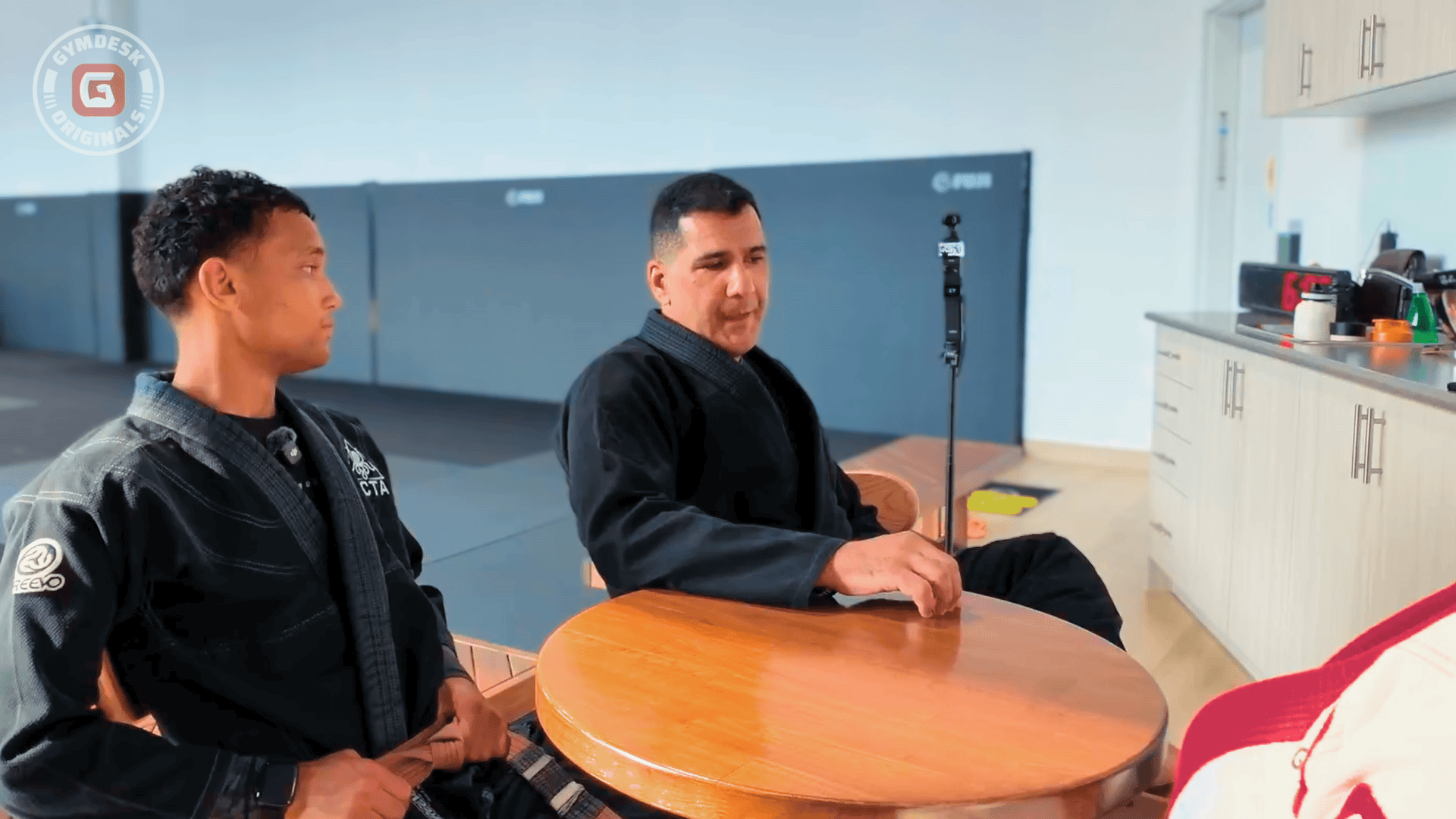
And Michael had asked for it. That part was the son's idea.
Thirteen Years, Four of Them Teaching Kids
Luiz led with the résumé.
And even if he's still young, he's been around for 13 years training jiu-jitsu, he's been teaching for four years, teaching kids. So he knows what he needs, what needs to be done.
Thirteen years on the mat, four of them teaching kids. If you've ever tried to staff a kids program, you know which of those two numbers is harder to buy.
Luiz is also still in the building.
Even if I'm helping and assisting and overseeing, I have him here taking care of this school.
The Conversations Alex Has Had
Luiz was still describing the team that makes seven schools possible when Alex cut in with the version of the story that doesn't end well.
Alex went at succession from the operational side: have you had to let somebody go, and how do you filter for that?
That happened before, but the way we structured is the vision is the same. The mission is the same. The principles don't change. And we have all the process in place.
Then he described the machine he built so that it would matter less the next time.
A Tentacle on the Octopus
What happens to a school when the person running it has to go?
That unit, for example, Oakville North is not an isolated unit. It's a member of this whole organization. So it's like a tentacle on the octopus.
When one room wobbles, the rest of the organization shows up. Luiz describes managing across locations almost entirely in those terms.
Everyone comes together to assist. Everyone comes together to help.
That reaches the membership too.
So a student of Oakville North is not a student of this school alone. It's part of the entire OCTA.
Which is what makes a swap survivable. If you run one location, the risk of a bad hire sits entirely on you and your members feel all of it. Spread across seven rooms, it lands softer. One of those rooms sits inside a commercial gym.
So if we have someone that we have to replace, we can plug someone else in that is more aligned with what we want to do.
A caveat lands a few seconds later in the same exchange: "Of course, you have that connection." Students bond to their coach, and replacing one costs OCTA something regardless of how the membership is structured.
The Trial Runs Both Ways
The trial came up seconds later, in the same answer about replacing someone.
The trial does the obvious thing, which is let a prospective member find out whether they like the place. It also runs in the other direction. If your trial only asks whether the member likes you, you're running half of it.
The trial that we have at Oakville is not for you to see if you like the school. Not only that, but we also doing our assessment to see if you're the right fit.
And it gives OCTA somewhere to send the people who don't fit.
Because if you come here and you don't align yourself with what we're trying to do, we're going to introduce you to some other schools […] So when you have this, and if you have to remove someone that is not working, it becomes a little bit easier. And we had that before.
(The people who don't fit get introduced to somebody else. It's a referral, and it's a kindness.)
The screen works the same either way, and by the time anybody has to leave, both sides already worked out that it wasn't a fit.
The structure Luiz Costa describes when Alex Cuevas asks him about replacing the person running a location.
The trial screens both ways
OCTA assesses the prospect while the prospect assesses OCTA. People who do not align get introduced to another school.
The room is not isolated
Oakville North is a member of the whole organization, not a standalone unit. Luiz calls it a tentacle on the octopus.
The organization assists
Everyone comes together to assist. Everyone comes together to help.
Plug in a more aligned operator
When someone has to be replaced, OCTA puts in somebody closer to what the organization wants to do.
The student stays with OCTA
A student of Oakville North is not a student of that school alone. They are part of the entire OCTA.
Luiz names the cost anyway, in the same breath: of course you have that connection. Students bond to their coach. Source: Luiz Costa, on camera in the Gymdesk Originals episode at OCTA Jiu-Jitsu.
Promoting a Student You Didn't Train
OCTA runs the same topic of the week across all seven rooms, so a missed class can be made up anywhere. Luiz says his students take him up on it.
So as a professor in Oakville, my students, they go everywhere. And when it's time to evaluate them, I can still check what kind of classes they are getting.
He's describing his own students at the Oakville headquarters, where he's the professor. Aim the same problem at somebody in his second week of running a room and it gets harder. How do you call a student ready for belt promotions when a chunk of their mat time happened in a room you've never taught in?
Luiz was answering about his own room. The problem travels.
OCTA runs on Gymdesk, and the feature Luiz singles out is the skills library.
Gymdesk has a very nice way for you to attach skills to the class […] When I attach the skills to the schedule, I know exactly what's missing for that specific person, what kind of class they did not have yet.
Skills get attached to sessions on the schedule. A member checks in, and that session's skills log against their record on their own. Skills are also one of the requirement types a martial arts program can set for promotion, alongside attendance, training hours, and days in rank.
PROMOTION REQUIREMENTS
A martial arts program in Gymdesk can combine any of these six. A member has to satisfy every enabled one to become eligible. Skills is the one Luiz Costa singles out.
Sessions
Number of sessions attended while at current rank
Hours
Training hours accumulated at current rank
Days in Rank
Calendar days spent at current rank
Days Attended
Number of distinct training days at current rank
Skills
Specific skills that must be mastered
In the postAge
Minimum age of the member
Source: Gymdesk promotion requirements, martial arts software. Requirements are combinable, so a belt can demand several at once.
So you can ask which classes your student actually covered.
It sits on top of ordinary attendance tracking, which OCTA still runs. Luiz says the alternative would be worse—"if we didn't have Gymdesk integrated, it would be harder to do that"—and then volunteers how far along they actually are.
So there's a functionality that we didn't explore to its full potential, but we will for sure.
The promotion picture gets sharper the more of the curriculum they tag.
What It Costs to Grow This Way
Luiz is aiming past seven, and he says so plainly.
I want to get 10 locations. […] I think there's always, always room for growth. […] What we want to make sure that we have, we keep the same quality.
The constraint he names is people, and he names it twice.
So if I didn't have that group of people supporting me, this team that really embrace the idea that believes in what we're trying to do, it would be impossible.
If I continue investing and finding this kind of people, the sky's the limit, because jiu-jitsu is growing everywhere.
He wants ten. He has seven, and one of them is two weeks old.
That one came with a belt attached. Michael teaches in a brown belt older than the school he teaches in, and by his own account, it's a pretty stinky belt.
A 7-part email course covering everything from lease negotiation to your first 100 members. Written for martial arts instructors ready to open their own school.
OCTA Jiu-Jitsu operates seven locations across southern Ontario, headquartered in Oakville. Watch the full episode on Gymdesk Originals.
Gym management software that frees up your time and helps you grow.
Simplified billing, enrollment, student management, and marketing features that help you grow your gym or martial arts school.


FAQ

Sean has spent the last decade creating content that helps businesses—small and not so small—grow smarter to allow operators to do more of what they love. You know, the fun stuff.
From shipping and international logistics to web development and marketing, he's done the work (not just the words) to scale retail and service businesses efficiently.
You can find his work at Sendle, Shogun, The Retail Exec, Gymdesk, and more.