

Grading week at your school. The after-school kids come through the door at 4pm in a wave of backpacks and untied belts.
Thirty of them are testing for their next kyu on Saturday. Three are siblings. One family has already asked if the test fee can go on next month's bill.
And nobody can tell from the attendance book who actually has the classes to test.
Sorting that out is what karate school software is for.
Mersina Giampapa, who owns and teaches at Lion's Heart Family Martial Arts in Ontario, hit that wall with a mix of once-a-week and unlimited memberships:
"I don't know how to organize all of this on a spreadsheet anymore. I like my spreadsheets, but I can't do it."
THE SHORT VERSION
- Belt tests and family billing on one record: Gymdesk is the best fit for most independent karate schools with a kids' program.
- Why: It ties attendance to belt tests, bills a whole family to one payer, and charges the test fee at promotion.
- A tiny dojo on a tight budget: Kicksite or Black Belt CRM.
- A school that runs everything around grading: Martialytics.
I write about gym software for a living, and I couldn't teach you a kata to save my life. So this post sticks to the paperwork.
Every price here comes from the vendor's own page, dated.
Each tool got the same karate questions, whether it sells itself as karate studio software or as a general gym platform.
What Karate School Software Has to Handle
A karate school runs on a kyu and dan ladder and a kids' program full of families. So the software has to connect attendance to grading, and grading to the bill.
General gym software often treats those as separate jobs. Here's what that looks like in a karate school, need by need.
Belt tests gated by attendance
Before grading day, you need a list of who's eligible: enough classes attended, enough time at their current rank, and old enough for the next belt.
Then you want to promote the whole group in one step.
NC Budo is an Okinawan karate school in Belmont, North Carolina. It sets a minimum number of classes before a student can move up a rank, and checks it in the attendance tracker.
Every belt-based art has this problem, and belt tracking software handles it the same way across them.
Getting kids ready for the day itself is its own job, covered in how to prepare students for belt promotions.
Your kyu and dan ladder, exactly
Every style counts its belts a little differently.
Shotokan, Goju-Ryu, Kyokushin, and your own association's ladder won't share one fixed list.
So you need custom ranks, with stripes or tips if you use them, and a way to hold two ladders on one student. Think karate plus kobudo, or a kids' program with its own belt colors.
If you're still settling your ranks, the standard karate belt order is a good place to begin.
Test fees at promotion
In plenty of dojos, the test fee is still cash at the door. That's a lot of counting on a Saturday morning.
Software should put the fee on the student's bill when they're promoted, using the card already on file.
Family billing
A family with three kids should get one bill, with the sibling discount already applied.
When each child bills separately, someone ends up doing the sibling math by hand, and someone else ends up with a refund.
Martial arts billing software goes deeper on how family billing should work.
Kata and curriculum by rank
Students practice at home, and parents want to know what their kid is supposed to be practicing.
Lion's Heart posts every form to a YouTube channel, start to finish, so a parent can pull up the right video for the right belt. Software that shows each student the content for their own rank does the same job, and it keeps the yellow belts out of the brown belt material.
What goes into a karate curriculum for each rank is a post of its own.
After-school programs and camps
At NC Budo, the after-school program is the biggest part of the school.
You need separate programs, pickup-day schedules, and camp registration with deposits. No software drives the van, sadly.
The business side of after-school martial arts programs has its own guide, and the summer camp profitability calculator will run your camp numbers.
Parent waivers and attendance alerts
Every minor needs a parent's signature on a liability waiver, kept on file.
And when a kid's attendance drops, you want to know before the family cancels. Kids rarely announce that they're done. They just stop showing up, which is why it pays to read up on why kids quit karate.
Here's the checklist in one place, with what good looks like and the red flag for each:
Need | What good looks like | Red flag |
Belt tests | An eligibility list from attendance and time at rank, and the whole group promoted in one step | A notes field and the sensei's memory |
Kyu and dan ladder | Custom ranks and tips, and more than one ladder per student | A fixed belt list built for another art |
Test fees | The fee charged to the card on file at promotion | Cash in an envelope on grading day |
Family billing | One payer, one bill, sibling discounts applied for you | Three invoices and a refund |
Kata by rank | Videos each student sees for their own belt | A playlist nobody can find |
After-school and camps | Separate programs and camp registration with deposits | A camp sign-up sheet on the front desk |
Waivers and attendance alerts | A parent signature for every minor, and a flag when a kid stops coming | Finding out when the cancellation email arrives |
How This Comparison Was Built
A tool made the list if it publishes martial arts features you can check and a price.
It also had to show up where karate school owners look: in searches for karate management software and dojo software, and in the karate lists that rank.
I read every price off the vendor's own pricing page on October 27, 2026. Each tool was judged on the needs above, and Gymdesk got the same treatment, gaps included.
The parent comparison of martial arts management software covers every belt-based art. This one goes deeper on karate.
A few names from other karate lists aren't here.
Member Solutions now sells billing services, and ATLAS Martial Arts Software doesn't publish a price. Wild Apricot, Join It, and Gym Assistant are association or general gym tools with no belt testing.
The Best Karate School Software in 2026
Which is the best karate software for you depends on your school's size and on how much of it runs on grading.
These aren't ranked.
Gymdesk comes first because this is Gymdesk's blog (I'd be out of a job otherwise).
The rest are grouped by the kind of school they suit. This table is the quick version, with what each tool suits and what it costs to start:
Tool | Best for | Starting price | Grading tools | Family billing |
Gymdesk | Independent schools with kids and families | $75/mo ($100 with your own processor) | Promotion criteria, ready-to-test alerts, mass grading events, promotion fees | Family accounts, one payer, family discounts |
Kicksite | Tiny dojos under 25 students | $49/mo (up to 25 students) | Belt testing events, eligible-to-promote list | Family profiles |
Black Belt CRM | Price-first schools | $49/mo (up to 25 members) | Ready-to-test by classes or time at rank, test days | One family account and statement |
Spark Membership | Marketing-led schools | $199/mo | Eligibility per rank, test invitations, certificates | Family accounts, automatic sibling discounts |
Martialytics | Grading-first schools | $69/mo (up to 50 students) | Ready-to-grade view, video lessons by rank | Not listed |
Zen Planner | Large multi-program schools | From $99/mo | Eligibility alerts, testing events | Not listed |
PushPress | Schools already in PushPress's world | $159/mo for rank tracking | Custom ranking criteria, invite-only test events | Not listed |
MyStudio | Fast-growing kids-heavy schools | $159/mo for test readiness | Ready-to-test, testing events, bulk promotions | Not listed |
Dojo Expert | Small multi-art dojos, especially in Europe | €24/mo for check-in (Basic €14, manual attendance) | Promotion candidate lists, exam records, certificates | Not listed |
Prices from each vendor's own pricing page, October 27, 2026. "Not listed" means the vendor's pages don't say. The feature may still exist, so ask.
Gymdesk

Gymdesk is martial arts school software built for independent gyms.
You build your kyu and dan ladder as custom ranks, and set promotion criteria for each one: classes attended, days at the current rank, training hours, minimum age, or skills.
Students see their progress toward the next belt in the member portal, and you get notified when someone's ready to test.
At least one comparison list still says Gymdesk lacks belt tracking. It doesn't. The FAQ on the member profiles page answers that question directly.
On grading day, you promote students one at a time or in bulk, with scheduled dates, evaluation forms, and promotion fees. Family accounts put siblings on one payer, and a family discount can apply automatically.
Gymdesk uses active-member pricing. It costs less when you process through Gymdesk Payments, and you can still bring your own processor.
- Micro (up to 50 active members): $75/mo with Gymdesk Payments, $100 with your own processor
- Small (51–100): $100 / $125
- Medium (101–150): $150 / $175
- Large (151–250): $200 / $240
- Enterprise (251+): quoted
Prices are in US dollars. The lower rate applies with Gymdesk Payments in the US and Canada, or with an approved processing partner elsewhere, subject to approval.
Visitors, frozen and cancelled members, and prospects don't count toward the active total. Every plan includes every feature, unlimited staff accounts, and a gym website, and there's a 30-day free trial with no credit card.
Limitations: Under 50 students, it isn't the cheapest tool here.
There's no make-up class tracking for once-a-week plans. Lion's Heart handles make-ups by hand, using the attendance flag to see who missed the week.
A branded app in the app stores is $100/mo extra. The standard member app is included.
Ask them: How do I set up my style's kyu ladder with time-at-rank rules? What will my bill be at the student count I expect a year from now?
Best for: an independent karate school with a kids' program, families, and a grading every few months.
Kicksite

Kicksite is built for martial arts schools and nothing else.
You can build a custom belt rank curriculum, create belt testing events, and see an "Eligible to Promote" list you can promote from in one click. It also has family profiles and digital waivers.
Kicksite bills by active student count: 0–25 students $49/mo, 26–50 $99, 51–100 $149, and 101+ $199. Every feature comes on every tier.
Limitation: the price doubles at the 26th student, and card processing runs through its preferred partner, Basys.
Ask them: Do frozen students count toward my band? Can I set a minimum class count per rank?
Best for: a small traditional dojo under 25 students that wants a martial-arts-only vendor.
Black Belt CRM

Black Belt CRM publishes its prices in member bands, with belt testing on every one.
It shows who's ready to test by classes attended or time at their rank, and lets you put them on a test day.
Each program gets its own rank ladder, from white belt up to 10th dan, with your own test fees. Families get one account, one statement, and one autopay.
Price, by active and suspended members: Starter $49/mo for up to 25, Studio $79 for 26–50, Club $119 for 51–100, Center $159 for 101–250, Institute $199 for 251–500, and Enterprise $249 for 501+.
There's no setup fee and no contract, and there's a 30-day free trial.
Limitation: card processing and text messaging are priced separately, and the pricing page lists both as "varies."
Ask them: What will processing cost on my card mix? Can a test fee go on a family's statement?
Best for: a price-first school that wants published tiers with belt testing on every one.
Spark Membership
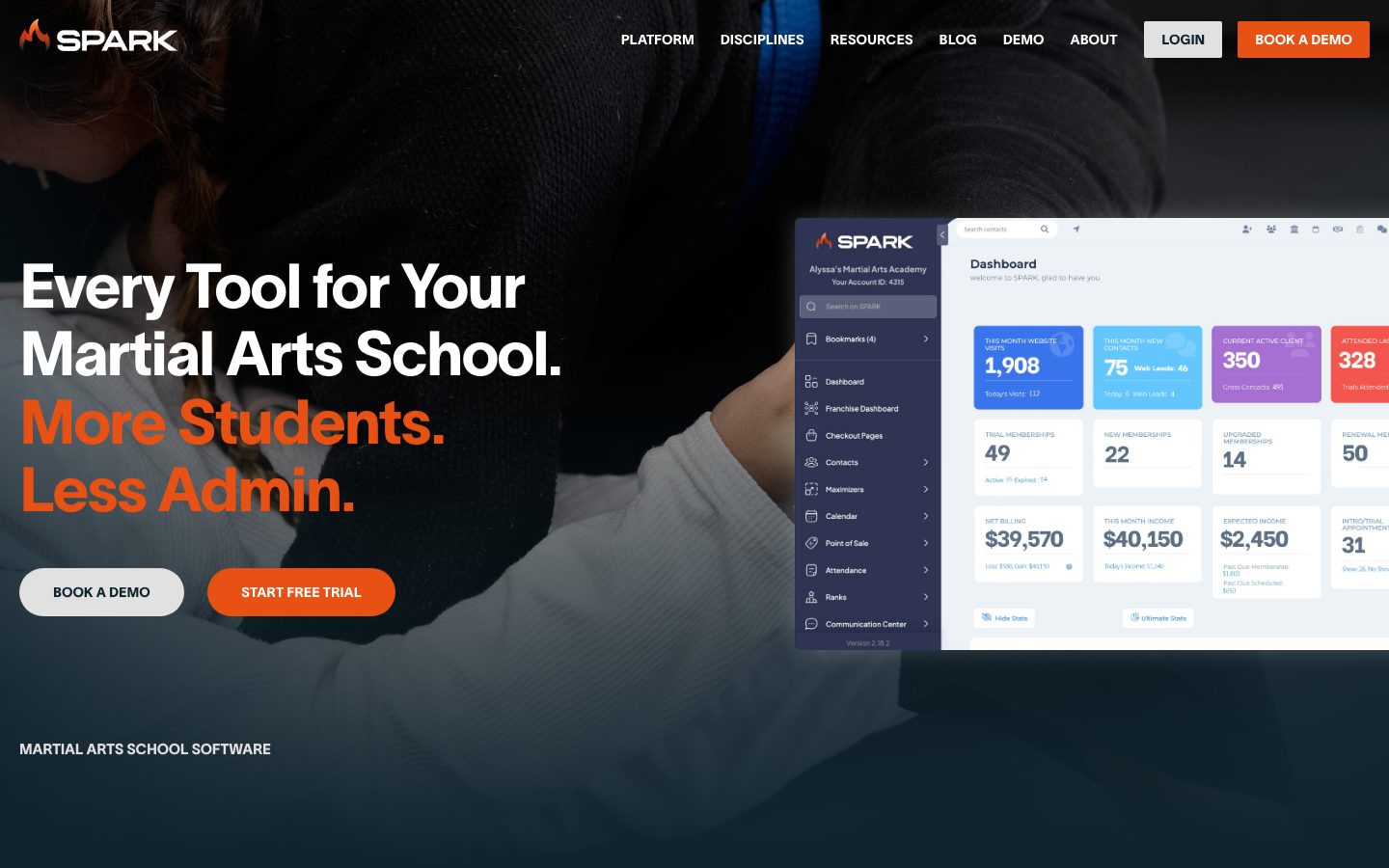
Spark Membership sells one plan, built for marketing-led schools.
Its karate page promises to handle "everything except the kata," which seems fair.
You set attendance eligibility per rank, and Spark flags who's ready for the next test. It sends testing invitations and generates certificates, and family accounts bill as one, with sibling discounts applied automatically.
Price: an eight-week free trial, then $199 a month.
Limitation: there's no smaller tier, so a 30-student dojo pays what a 300-student school pays.
Ask them: Is there a lower price under 50 students? Can I run two rank ladders on one student?
Best for: a growth-focused school that wants its software vendor helping with enrollment marketing.
Martialytics

Martialytics puts grading at the center.
Its features page promises you'll know exactly who's ready to grade. Its student app has video lessons sectioned by rank, and every plan has every feature, with unlimited locations and users.
Price, by student count: 0–50 students $69/mo, 51–100 $99, 101–200 $129, and 200+ $199. Leads and inactive students are free, and there's a 30-day trial.
Limitation: its pages don't describe family billing or the specific promotion criteria you can set.
Ask them: Can I set a minimum class count per rank? Can one parent pay for three kids on one bill?
Best for: a school built around grading that wants a low price per student.
Zen Planner

Zen Planner is an established multi-program platform.
It tracks belts, stripes, and skill milestones across disciplines, notifies students when they're eligible for promotion, and runs testing events.
Packages start at $99/mo for Studio, with Essentials from $198 and Ultimate from $348. Add-ons include a website from $99/mo, Engage from $249/mo, and a branded app at $39/mo.
Limitation: nearly every price on the page says "starting at," so you'll need a demo to get your real number.
That number put Mersina Giampapa off. Her old instructor ran Zen Planner, so she looked at it first:
"I saw the fees for Zen Planner and I was like, no, we're not that big."
Ask them: What's my price at my active-member count? Is the website included or a module?
Best for: a large multi-program school that wants modules and a demo-led setup.
PushPress
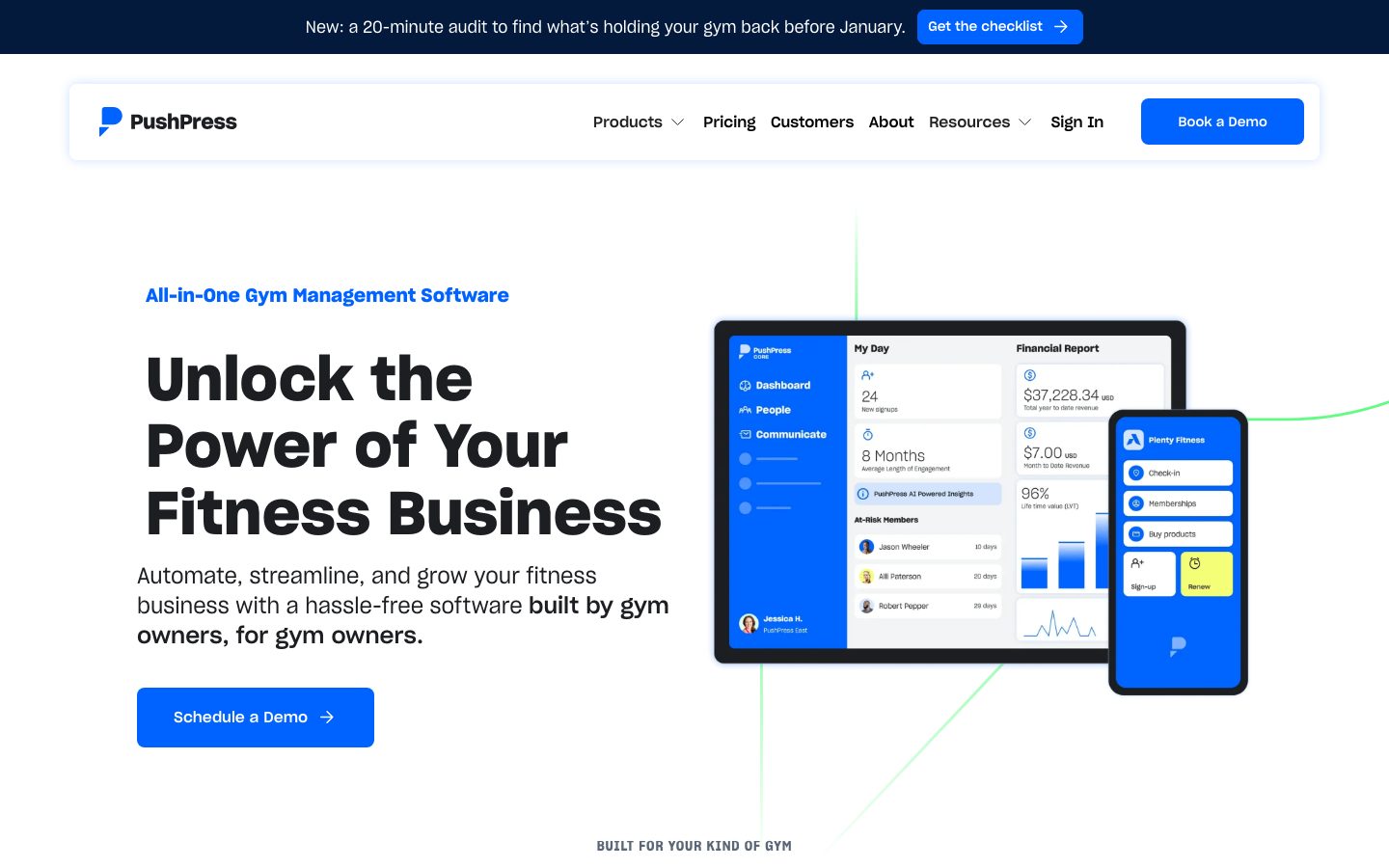
PushPress started in CrossFit, and it now has martial arts rank tracking.
Its rank tracking lets you set custom ranking criteria and manage promotions, and invite-only events work well for belt tests.
The Free plan is $0 a month with higher card processing (4.99% + 30¢). Pro is $159/mo, and Max is $229/mo. A branded app is $97/mo, and the Grow CRM is $329/mo.
Limitation: rank tracking isn't on the Free plan. The plan comparison shows it from Pro, so belt tracking starts at $159 a month.
Ask them: Can I set a minimum class count per rank on Pro? Is there family billing with one payer?
Best for: a school that wants PushPress's app and CRM add-ons and will pay for Pro.
MyStudio
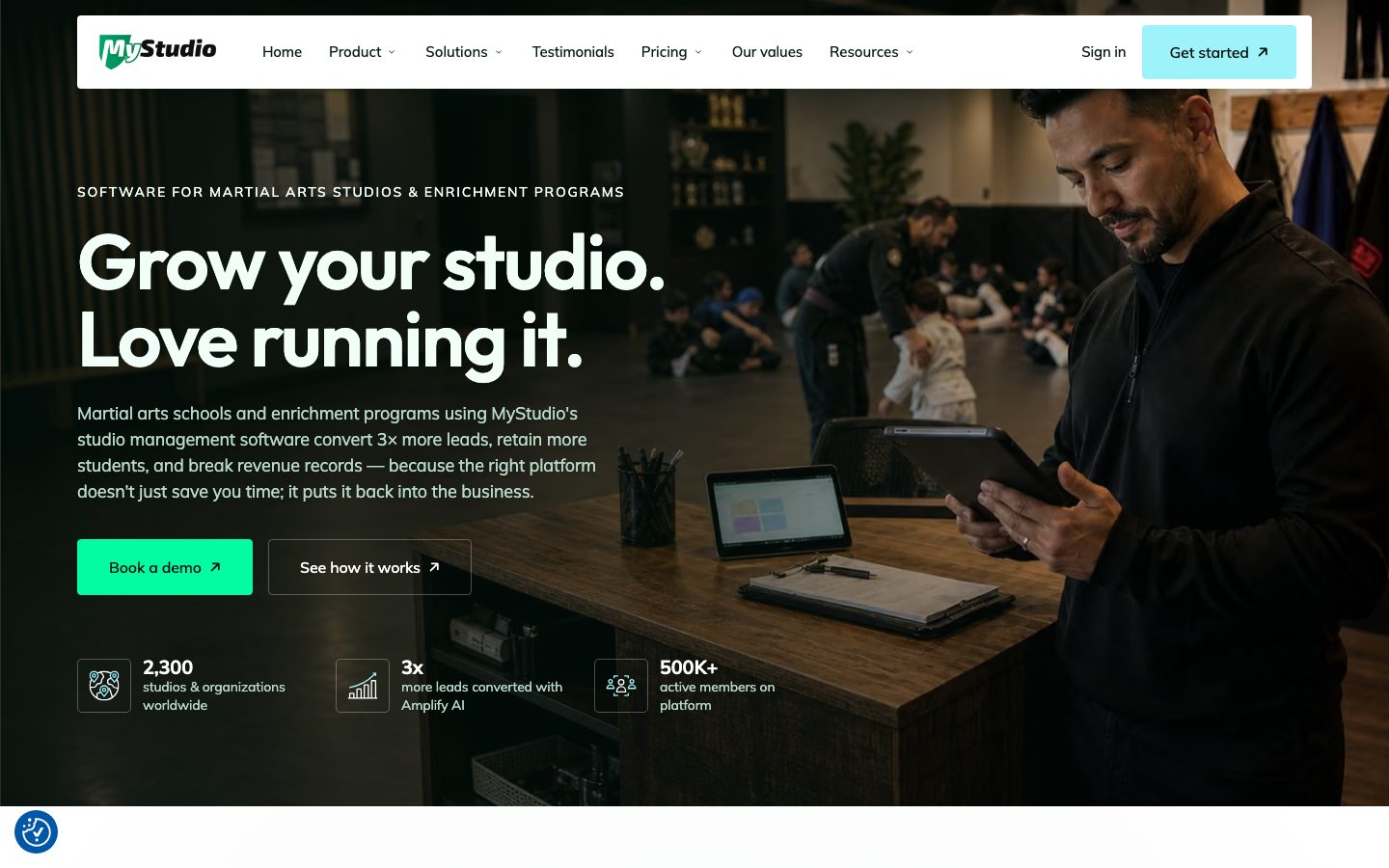
MyStudio charges per location, with unlimited students.
It's built for martial arts studios and kids' enrichment programs. Its entry plan includes rank and belt tracking. Growth adds a view of who's ready to test, based on attendance and performance, plus testing events, bulk belt promotions, and belt inventory.
Price: Essentials $79/mo, Growth $159/mo, and Scale $239/mo, per location. Its page lists card processing at 2.9% + 30¢ and ACH at 1%.
Limitation: the grading-day features start at the $159 Growth plan.
Ask them: Is there a free trial? What does Essentials do on grading day without the Growth features?
Best for: a fast-growing, kids-heavy school that wants unlimited students at one price.
Dojo Expert

Dojo Expert is dojo management software from Europe, priced in euros.
You define your own belt system, run several arts, and set belt milestones and custom requirements. It builds promotion candidate lists, keeps belt exam records, and designs and prints certificates, all on every plan.
Basic is €14/mo for up to 100 members, Pro is €24 for up to 1,000, and Ultimate is €33 with no limit. Each includes five dojos, paying yearly takes 20% off, and there's a 14-day trial.
Limitation: Basic attendance is a roster you tick by hand. QR and kiosk check-in, class booking, and the student app start at Pro, and Stripe payments and digital waivers need Ultimate.
Ask them: What does a karate school need on Ultimate that it doesn't get on Pro? Can I bill a family as one payer on Ultimate?
Best for: a small multi-art dojo, especially in Europe, that wants grading records cheaply.
Also worth knowing: MartialArts.io ($47/mo up to 50 students, $97 up to 150, $147 up to 1,000) includes tests, ranks, and promotions on every plan, with a 14-day trial. MyDojang also comes up in karate searches.
What Karate School Software Actually Costs
At 40 students, published prices run from €14 to $199 a month. On some tools, the plan that runs grading day costs well above the entry price.
The pricing model changes your bill more than the headline number does.
Picture a made-up school called Sensei-ble Karate (sorry). It has 40 students, mostly kids.
Then picture it two years later at 120.
This is what each tool costs Sensei-ble Karate a month, on the plan that includes belt tracking and grading, before card processing:
Tool | Pricing model | 40 students | 120 students | Watch for |
Gymdesk | By active members, all features | $75 with Gymdesk Payments / $100 own processor | $150 / $175 | Frozen members don't count |
Kicksite | By student band | $99 | $199 | Price doubles at 26 |
Black Belt CRM | By member band | $79 | $159 | Processing priced separately |
Spark Membership | One flat plan | $199 | $199 | Eight-week trial |
Martialytics | By student band | $69 | $129 | Inactive students free |
Zen Planner | By active member, modules extra | From $99 | Not published | Demo needed |
PushPress | Plan tier (rank tracking from Pro) | $159 | $159 | Free plan has no rank tracking |
MyStudio | Flat per location (grading from Growth) | $159 | $159 | Essentials lacks test readiness |
Dojo Expert | By member cap, EUR | €24 (Pro, for QR/kiosk check-in; Basic €14 is a manual roster) | €24 | €33 for Stripe and waivers |
Prices from each vendor's own pricing page, October 27, 2026. Each vendor's own definition of an active student applies.
Two things to take from the table.
At 40 students, Gymdesk is mid-pack: $75 on Gymdesk Payments, which Martialytics ($69), MartialArts.io ($47), and Dojo Expert undercut, and $100 on your own processor, which Black Belt CRM ($79) undercuts too.
MartialArts.io isn't in the table. It's in the "Also worth knowing" note above.
The case for Gymdesk is the combination on one record: promotion criteria built on attendance, the promotion fee charged when a student is promoted, and family billing with one payer.
Frozen members don't count toward your tier, either. Black Belt CRM, for one, counts suspended members.
Watch the plan, too. PushPress and MyStudio put grading behind their $159 plans, and Dojo Expert's Basic plan has no self check-in.
To run your own numbers, try the gym software cost calculator. For the wider picture, see gym management software cost.
We'll keep you in the loop with fresh content, podcasts, how-to guides, tool reviews, and product exclusives.
Which Karate School Software Fits Your School
The kind of school you run decides most of what you need.
An independent karate school with a big kids' program
This is the most common kind of karate school: families, grading every few months, test fees, and after-school or camps.
Gymdesk fits this one best. Spark is worth a look if you want a vendor running setup and marketing alongside it.
A small traditional dojo under 25 students
On price, start with Kicksite ($49) or Black Belt CRM ($49), which both include belt testing at that size.
Gymdesk Micro costs more, but it holds the same price all the way to 50 students.
A grading-first school
Martialytics is built around grading, so look there first.
If grading has to tie into family billing and test fees, look at Gymdesk.
A multi-art dojo
Karate alongside kobudo, judo, or a kids' program with its own belt colors means several rank ladders on one student.
Dojo Expert handles that for the least money of any dojo management software here, priced in euros. For a separate ladder per program, plus family billing, go with Gymdesk.
A new karate school
Price out the whole first year, and pick a tool you won't outgrow at student 26. Gymdesk Micro and Martialytics both hold one price up to 50 students.
If you're still at the planning stage, here's how to start a karate school.
Each school type, with a typical size and where to start:
School type | Typical size | Start with | Why |
Independent school with a kids' program | Roughly 50–150 | Gymdesk | Belt tests tied to family billing |
Small traditional dojo | Under 25 | Kicksite or Black Belt CRM | Lowest published prices with belt testing |
Grading-first school | Any | Martialytics or Gymdesk | Grading at the center |
Multi-art dojo | Varies | Dojo Expert or Gymdesk | Several rank ladders per student |
New karate school | Under 50 | Gymdesk Micro or Martialytics | One price up to 50 students |
Running a Karate School on Gymdesk
If Gymdesk is on your shortlist, here's how the karate-specific jobs work in it, and each one is something you can try in the trial:
- Grading day. Run the cohort as one grading event, with attendance tracking deciding who's on the list.
- Families. Put siblings under one parent account, so every child's test fee goes on one bill.
- Kata by rank. Upload text and video that students see based on their current rank.
- Attendance alerts. Attendance flags who hasn't checked in all week, which is how Lion's Heart catches a missed week.
- Rank progress at home. The member portal shows each student's progress to the next belt, and the member app shows their ranks and schedule.
At Lion's Heart, most of the school now runs through it. Mersina said:
"Booking anything gets done through Gymdesk, the portal and attendance daily."
The rest of the Lion's Heart story is on the blog, and so is NC Budo's after-school karate program.
Tournaments your students enter
Some karate schools grade on the mat and compete on weekends, so the last piece is tournaments.
Gymdesk and Smoothcomp are now one company.
Smoothcomp runs karate events too, with kata brackets among its formats. Smoothcomp Connect brings Smoothcomp's events into a Competitions tab in Gymdesk, which is on by default for martial arts gyms.
You can endorse an event for your students, and members handle tournament registration from a form pre-filled from Gymdesk.
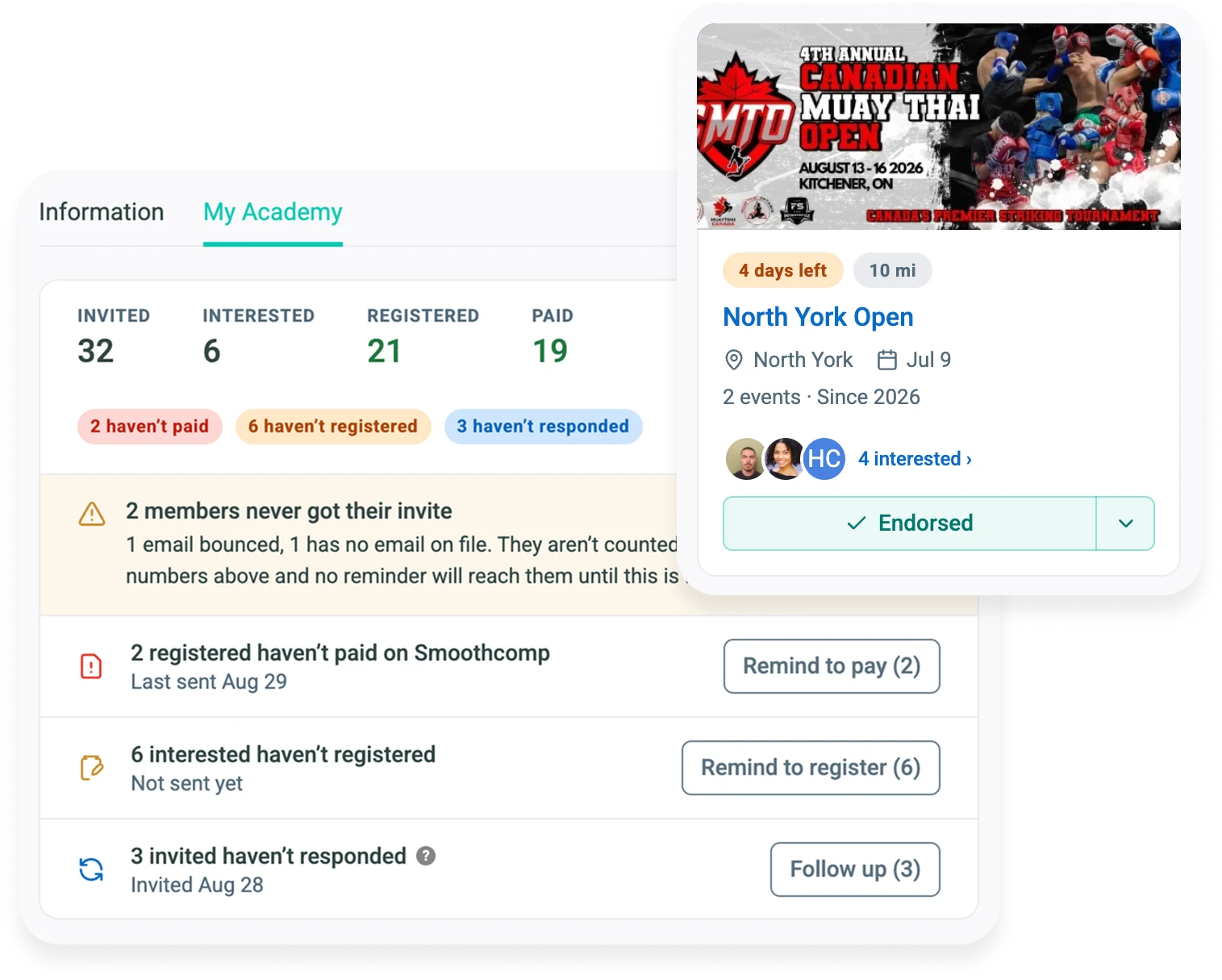
Only events that run on Smoothcomp show up, though. Federation events on other systems, and your own in-house showcases, won't appear.
Events that need a federation membership show up but finish registration on Smoothcomp for now.
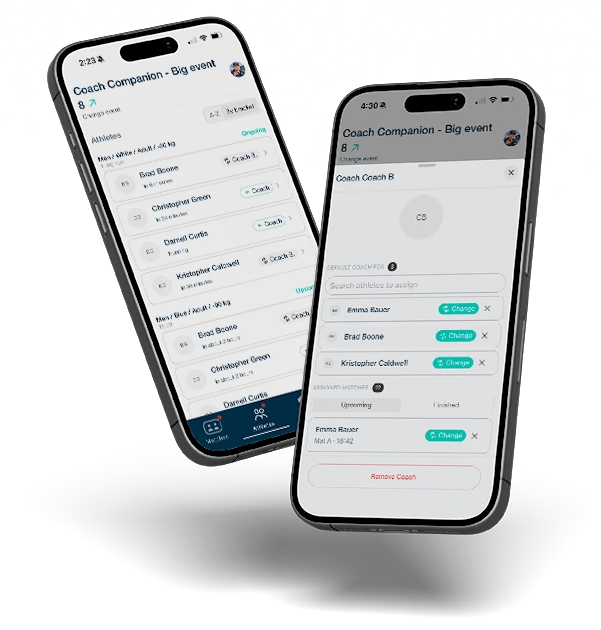
On the day, coaches can use the free Coach Companion app, built by the Smoothcomp and Gymdesk teams. It puts your athletes' matches in order, keeps the coaching crew on one screen, and the match notes land on the member's Gymdesk record.
If you're the one hosting the tournament, that's a different tool. See martial arts tournament software.
Pick the Software That Runs Your Grading Day
Price the plan that actually runs your belt tests. Then ask every vendor what happens on grading day, step by step.
The good ones will have an answer before you finish bowing.
If you want your belts and your families in one system, start a free 30-day trial of Gymdesk's martial arts software. No card, no contract.
FOR KARATE SCHOOLS
Kyu and dan ladders with promotion criteria, test fees charged at promotion, and siblings on one family bill. Try it free for 30 days. No card, no contract.
Gym management software that frees up your time and helps you grow.
Simplified billing, enrollment, student management, and marketing features that help you grow your gym or martial arts school.


FAQ
Karate School Software FAQs
Short answers to the questions karate school owners ask most.

Sean has spent the last decade creating content that helps businesses—small and not so small—grow smarter to allow operators to do more of what they love. You know, the fun stuff.
From shipping and international logistics to web development and marketing, he's done the work (not just the words) to scale retail and service businesses efficiently.
You can find his work at Sendle, Shogun, The Retail Exec, Gymdesk, and more.