

You're a highly skilled karateka. You've worked hard to master your craft.
You've learned how to teach and lead others. It's time for you to open your own school, so why does it feel like you're a white belt again?
This is the part that new instructors struggle with.
Teaching isn't the problem; it's the day-to-day operations required to start, manage, and sustain your school.
Today, we'll show you how to bridge that knowledge gap with a karate-specific roadmap you can use to open a dojo that grows like clockwork.
Karate shares the same startup fundamentals as any discipline—if you want the cross-vertical playbook, start with our guide on how to start a martial arts school.
Is Starting a Karate School Right for You?
You've decided to make the leap—you're going to open your karate school. It's a big step, but it starts with an honest self-assessment.
You'll want to assess:
- The minimum requirements needed to open
- The risks if these requirements aren't met
- How to build/meet these requirements
Let's take a closer look at what's required.
Factor | Minimum to Open | Risk if Missing | How to Build It |
Black belt rank | 3rd-degree (or equivalent experience) | Low credibility, poor retention | Continue training under a reputable lineage; add competition wins |
Teaching experience | 2+ years as assistant or lead instructor | Disorganized classes, high dropout | Apprentice at an established school before opening |
Curriculum outline | Belt requirements + class structure mapped | Student stagnation, inconsistent progression | Reverse-engineer from advanced-level goals |
Class management | Timed lesson plans + behavior systems | Safety incidents, parent complaints | Use a structured format (warm-up, skill, drill, sparring) |
Retention system | Attendance tracking + milestone check-ins | Unstable revenue, churn outpaces signups | Set monthly check-in cadence + belt-test milestones |
Financial runway | 6 months minimum (12 ideal) | Forced closure under early-year pressure | Save before launch or secure an SBA line of credit |
Pricing strategy | Researched against 3+ local competitors | Underpricing or pricing out the market | Study successful local schools; talk to non-competing owners |
Sales process | Trial, consult, close framework | Low conversion of walk-ins to members | Learn consultative selling basics; script the trial close |
1. A mindset shift
If you choose to take this step, you'll need to develop two things: a solid curriculum for kids and adults, and an entirely different set of skills—business planning, sales, marketing, and student retention, to name a few.
These skills are just as important as kata.
You should be willing to:
- Promote your school
- Treat sales as part of the job
- Focus on student retention
In the martial arts community, sales has a bad reputation. It shouldn't. Selling well doesn't mean selling sleazy.
You'll also need to focus on important pre-work tasks:
- Market/location research
- Copywriting
- Pricing strategy
- Pitching (for partnerships, grants, promotion, etc.)
2. Rank and teaching experience
Typically, karate instructors are at least 3rd-degree black belts with years of experience as assistant instructors.
If you're going to run your own classes, you're going to need the experience, credibility, and ability to run your classes solo.
These are the bare minimums:
- A 3rd-degree black belt (or equivalent experience)
- 2+ years teaching classes
- An initial outline of your curriculum
This is generally about your time investment (assuming that you're an A-player student).
3. Financial runway
If you're starting lean or working from savings/loans, you should expect minimal income in your first 6–12 months as an instructor.
Here's what you'll need:
- A list of your fixed and variable costs
- 6–12 months of financial runway
- A draft of your business plan
- Access to capital/credit
TL;DR don't quit your day job (at first).
You'll need time to build up your school so the revenue coming in can support you.
PRO TIP:
If you're starting lean or working from savings and loans, expect minimal income in your first 6–12 months. Don't quit your day job (at first). You need time for the school's revenue to grow large enough to support you.
Lock in three things before you sign a lease: a list of fixed and variable costs, a draft business plan, and access to capital or credit. Schools that skip this step force themselves into desperate decisions in year one.
Expert tip: A gym management platform is an easy way to build all of this quickly. Why? These platforms already include all of the systems and tools you need. A good platform will show you the systems you need. The best ones come with guardrails that protect you from making rookie mistakes.
Choosing Your Karate Style and Organization Affiliation
This is an important decision that shapes your curriculum, branding, and your school's future growth path.
Picking your style
Most school owners choose to stick with the style they've mastered—it's the path of least resistance. This decision is an important one because it shapes your school's curriculum, ranking, and affiliated organizations.
Style | Primary Focus | Student Profile | Major Organizations |
Shotokan | Linear power | Traditional, structured | JKA, ISKF |
Goju-Ryu | Close-range combat | Practical/self-defense | IOGKF |
Wado-Ryu | Movement/evasion | Balanced learners | Wado federations |
Kyokushin | Full-contact | Fighters, tough training | IFK, Kyokushin orgs |
This leads to the very next area you'll have to deal with.
Independent vs affiliated
You'll want to decide if you're going to open your school as an independent or whether you'll opt for affiliation. Here's a brief breakdown of the pros and cons.
Path | What You Get | What You Give Up | Best For |
Fully affiliated (JKA, WKF, ISKF) | Credibility, tournament access, standardized ranks, name recognition | Curriculum freedom and branding control; annual fees are required | Owners new to the area; styles where lineage drives enrollment |
Independent | Full curriculum + branding control; no licensing fees | You build credibility from scratch; no built-in tournament circuit | Experienced owners with established local reputation |
Hybrid (most common) | Credibility from affiliation + flexibility on curriculum tweaks | Some compliance overhead; partial fees | Most schools after 2–3 years of operation |
There are several scenarios where instructors feel a shift away from their original affiliation/style is necessary. This usually depends on factors like lineage, organizational affiliation, and/or personal philosophy.
Drift Pattern | Why It Happens | What It Looks Like |
Organizational independence | Avoid licensing fees or strict curriculum constraints | Drop the org name; rebrand as "Traditional Karate" or "American Freestyle" |
Evolving philosophy | Owner wants to modify or modernize the curriculum | Add what works, remove what doesn't; develops a recognizable sub-style |
Commercial rebranding | The style name doesn't sell well in the local market | Teach Goju-Ryu but market as "Karate" or "Martial Arts" |
Blending styles | Owner has rank in multiple martial arts | Officially fold in judo, kickboxing, or BJJ alongside karate |
You'll find this drift is natural—if your goals or circumstances require it, change is inevitable. The good news here is that you're not locked into a specific option. You can change your mind whenever you need to.
Writing Your Karate School Business Plan
Your business plan is a roadmap.
If it's written well, it will serve as a formal roadmap for your gym—the culture you'll build, how you'll operate, and how you'll respond to challenges.
It sets strategy.
You want to cover all of the details that are included in the business plan, but you'll also want to focus on:
- Your revenue model (kid-focused, competition-focused, etc.)
- How you handle seasonal swings (e.g., back-to-school spikes, holiday and summer vacation dips, etc.)
- Belt testing revenue (i.e., pricing, requirements, approach, etc.)
- Tournament and event income
Take a look at this comprehensive guide. It'll give you the structured framework and step-by-step instructions you need to write an excellent, well-structured business plan.
Startup Costs and Funding
Karate schools have unique startup expenses. Research from Langford and Langford shows that startup costs typically range from $25,000 to $100,000.
Here's a breakdown of the costs:
Expense Category | Low | Mid | High |
Lease & buildout | $10,000 | $40,000 | $80,000 |
Mats & flooring | $5,000 | $15,000 | $30,000 |
Equipment | $2,000 | $8,000 | $15,000 |
Insurance | $1,000 | $3,000 | $6,000 |
Marketing | $3,000 | $10,000 | $20,000 |
Software & systems | $500 | $2,000 | $5,000 |
Affiliation fees | $500 | $2,000 | $5,000 |
Take a look at this guide for a more detailed breakdown.
This brings us to the next issue. Funding.
CB Insights analyzed startup failure. They looked at the most common reasons behind business failures. Here's what they found.
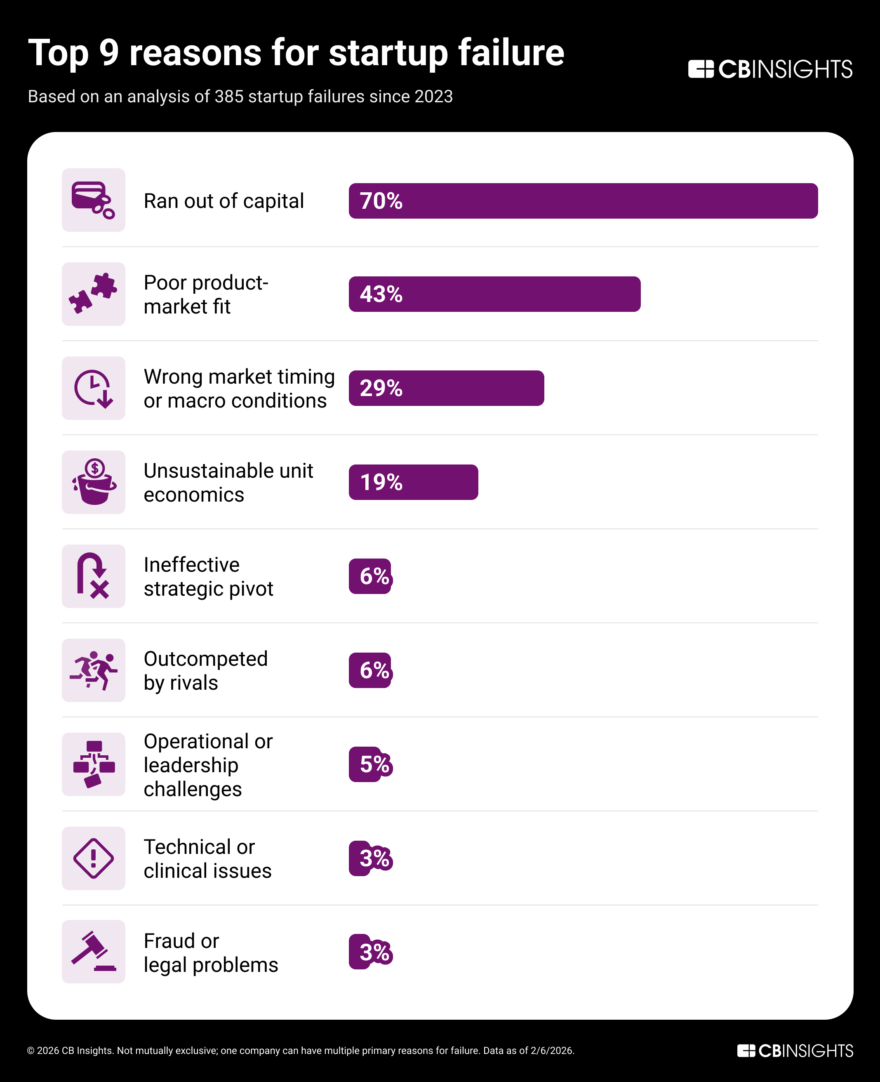
The biggest reason for startup failure is running out of cash. This means you'll need steady, reliable access to cash.
Funding options
When it comes to funding, you have a variety of options:
- Personal savings (most common)
- Friends and family (risky)
- Grants (takes time)
- Lines of credit (personal/business)
- SBA loans
- Equipment loans
- Bootstrapping (e.g., a lean launch)
- Equity financing (via investors)
These options will be more or less accessible depending on your credit, personal circumstances, or preferences.
With cash flow, you'll want to focus your attention on several areas as a consistent theme:
- Make the sign-up process easy and frictionless
- Remove revenue/cash flow barriers
- Make receivables predictable (via subscriptions, memberships, and autobilling)
- Work to minimize accounts payable. Negotiate payment terms, delay or extend non-essential purchases, and require pre-payment for merchandise
- Always be on the lookout for flexible, low-cost access to cash
- Always be on the lookout for partnership opportunities
Manage cash flow well early, and the rest of the business gets easier.
Finding the Right Location for Your Dojo
Which location is best for your karate school? Schools thrive when they have the right environment.
Priority | Factor | Why It Matters for Karate | How to Verify |
Must-have | High ceilings (12 ft+) | Spinning kicks, kata, weapons forms need clearance | Measure before signing; check for sprinkler/HVAC obstructions |
Must-have | Affordable rent vs. revenue potential | Rent >15% of projected revenue is a death sentence | Project at 50% of capacity, not full |
Must-have | Flexible interior layout | Mat space + lobby + private lesson area need separation | Walk the space with mats taped on the floor |
Must-have | Strong local demographics (kids 5–12) | Kids are the primary revenue driver for most karate schools | Pull census data + drive nearby elementary schools at pickup |
Must-have | Parking for drop-offs | Parents idle during 45-min kids classes | Visit at 4–6 PM and count available spots |
Nice-to-have | Visible storefront for walk-ins | Walk-in trials convert well in family-traffic areas | Sit in the lot at peak hours and count foot traffic |
Nice-to-have | Near complementary family businesses | Pediatric dentists, dance studios, kids' hair salons drive cross-traffic | Map within 0.5 miles |
Nice-to-have | Easy access from main roads | Reduces "I forgot we had class" no-shows | Drive the route from 3 nearby neighborhoods |
Nice-to-have | Room for growth (extra sq ft) | Lets you add a second class slot without moving | Negotiate first-right-of-refusal on adjacent suites |
Need more help as you shop for a location? For a full breakdown, take a look at this detailed breakdown.
Legal Structure, Insurance, and Compliance
As a general rule, the more aggressive and comprehensive your approach to business formation and asset protection, the more money you'll need to invest upfront.
Here's a list of corporate entities you can use:
- LLC
- S-corporation
- C-corporation
- Partnerships (LLP)
Think about your ultimate goals for your school:
- Need a fast, low-cost option? An LLC or S-corp may be what you're looking for
- Looking to protect your assets? Choose the right state, structures, and setup in advance (speak with an attorney)
- Want to keep your other companies and assets separate from your school? Ask your attorney about a more complex structure that uses a combination of corporations and trusts
As a martial arts instructor, you need insurance.
A good insurance policy is your financial safety net; it's intended to protect you from unexpected events like accidents, illnesses, theft, or property damage.
Types of insurance to get:
Insurance Type | What It Covers | Why Karate Schools Specifically Need It |
General liability | Third-party injury, property damage, advertising injury | Mat injuries, slip-and-falls in the lobby, sparring accidents involving non-members |
Professional liability | Negligence claims, training-related injury, bad instruction | Students hurt by improper technique correction, sparring mismatches, advanced moves taught too early |
Property coverage | Building, equipment, mats, inventory damaged by fire, theft, or weather | Mats, bags, and weapons are expensive to replace; older buildings flood |
Workers' comp | Staff injuries on the job | Required by law in most states once you have W-2 employees (assistant instructors, front-desk staff) |
If you have a business partner, add a buy/sell agreement funded by life or disability insurance—keeps the school operating if a partner exits unexpectedly.
These are partner-specific and need legal language; talk to an attorney and your insurance broker together.
Here's a comprehensive look at insurance for your karate school.
Working with minors
You'll want to verify that your instructors are following safety protocols and best practices when working with minors.
Non-negotiable legal and safety mandates:
- Pass a comprehensive background check
- Complete SafeSport certification
- Be CPR and first-aid certified
- Complete concussion awareness training
Technical and professional criteria:
- Verified instructor lineage and rank
- Age-appropriate curriculum knowledge
- Classroom management skills
Interpersonal and behavioral skills:
- Clear communications
- Conflict management skills
- Emotional intelligence
- Modeling behavior
Recommended hiring criteria
Criteria | Lead Instructor | Assistant Instructor |
Background Check | Required (State + Federal) | Required (State + Federal) |
SafeSport Training | Required | Required |
CPR/First Aid | Required | Preferred (Required if left alone) |
Years of Training | 5–10+ years (Black Belt) | 2–4+ years (Senior Student) |
Experience with Kids | Previous teaching required | Volunteer/camp experience okay |
Where are you supposed to find candidates who meet these criteria? It's simple, you grow them.
As your school grows, you'll find a portion of your students are interested in teaching and mentoring others. This is your virtual bench, the list of potential candidates you can use to identify instructor talent.
If you're doing this, you'll focus on:
- Building an instructor pipeline
- Promoting senior students
- Training assistant instructors
- Developing teaching standards
A key point about all of this. The values and culture you've instilled in your students are the same ones they'll offer to the students they teach.
Student-to-instructor ratios
When you're working with minors, a good rule of thumb is one instructor and one assistant for every eight students.
This isn't just about physical safety and injury prevention; it's also about avoiding any questionable behavior.
IMPORTANT:
Two adults must be present with any group of children at all times. No exceptions.
This protects kids from any inappropriate or abusive behavior—no minors should ever have unsupervised, 1-on-1 time with instructors or other adults — and it builds the verifiable trust parents expect when they hand you their child for 45 minutes.
You're looking to achieve two clear goals:
- Protect kids from any inappropriate or abusive behavior. No minors should have unsupervised, 1-on-1 time with instructors or adults. Just don't do it.
- Build trust with parents. It goes without saying that parents expect you to protect their kids, but that's not enough; they should be able to verify their kids' safety in your program.
This, of course, assumes that you have the appropriate waivers, forms, and disclaimers—your legal ducks, in a row.
Building Your Karate Curriculum
Believe it or not, your curriculum is your retention engine.
Parents and students want to see success over time. If your curriculum produces consistent results, you'll find that students are eager and excited to continue training.
Wondering why? It's about status.
If your curriculum helps students improve faster in a shorter period of time, that will be reflected in outcomes—more competition wins, greater confidence, and faster progression.
To build a karate curriculum that does that, you create a structured system that everyone follows, then work to improve it over time. When you create a repeatable process, you can follow it to get repeatable results.
Here's a comprehensive guide to developing your own curriculum.
Structuring your kyu/dan system
Take the time to define your kyu/dan system up front. You'll want to clearly define:
- Belt requirements: What are the criteria students must meet to progress to the next belt rank?
- Minimum time-in-rank: What's the minimum amount of time students must spend at each rank before progressing to the next rank?
- Attendance thresholds: What is the minimum number of classes students must attend to be promoted to the next rank?
Looking for step-by-step guidance on belt order and ranking requirements? Here's a clear, no-nonsense breakdown explaining karate belt order.
Class format
It's a good idea to set time limits for your kids' and adult classes.
Kids' karate classes typically range from 30 to 60 minutes; 45 minutes is a common duration for school-age kids. Adult classes are generally 60 minutes.
Here's a common format for 30–45 minute kids classes:
- Warm-up games
- Basics (kihon)
- Kata practice
- Drills or kumite (for older kids)
If you're looking to make classes engaging for very young kids, you can gamify each option to keep training consistently enjoyable.
Here's a common format for a 60-minute class:
- Warm-up and basics (kihon)
- Kata practice
- Kumite or drills
What about student progress? Well, if you make progress visible, students are much more likely to stay.
When you have clear belt requirements, a well-defined curriculum, and a consistent class format, students' progress accelerates.
This works wonders for student retention.
Designing Your Class Schedule and Programs
You'll want to create a mix of programs so classes sync with each other. For example, kids classes at 3:30 PM and adult/family classes at 5 PM.
It's a great idea to structure private lessons around classes, either before or after.
This is ideal because it's free advertising: all of your students who come to class notice that Ralph is getting private lessons. All of a sudden, they realize that Ralph is significantly better.
That's going to trigger a desire for the same outcome.
Obviously, if you have to schedule private lessons at a different time, you do what you have to do. But generally speaking, this structure is ideal for classes and retention.
Core programs
- Kids classes (primary revenue driver)
- Adult classes
- Family classes
- Private lessons
The 4 to 6 PM time slot is a significant, after-school advantage. These can become your biggest revenue stream, especially if your program is tailored for specialty groups (e.g., latchkey kids).
It's an easy way to increase student retention and lifetime value.
Setting Your Pricing and Membership Structure
The right pricing structure is important.
With the right pricing structure, you'll find that you're able to balance student retention with the financial health of your gym. Here are three models you can use for your school.
The membership tier model
In this model, you offer several pricing options to parents and students:
- Basic tier: 1–2 classes per week. This plan would be ideal for beginners or hobbyists
- Unlimited tier: Unlimited classes, plus access to specialized seminars or "Black Belt Club" sparring sessions
- Family tier: A discounted flat rate for 3+ family members, which is excellent for long-term retention
The paid-upfront model
Instead of the monthly membership, parents opt to pay for a set block of time upfront—3, 6, 9, or 12 months upfront.
This is great because it gives your school an immediate cash flow boost and locks in student commitment. You can offer parents/students a 10–20% discount on the monthly rate.
If students are willing to spend this amount of money upfront, it's a good indication that their trust, engagement, and rapport with you are high.
The hybrid "intro-to-commitment" model
This model prioritizes lowering the barrier to entry, then transitioning students into a stable membership or contract.
- Irresistible offer. A low-cost introductory offer (e.g., "$50 for 5 weeks + a free kimono").
- Trial-to-member. After the trial, students transition into a 12-month membership or agreement.
Here's why this strategy works. Hybrid pricing allows students to experience the "vibe" of your school before committing to a membership or long-term contract.
This boosts trial-to-member conversions, turning "walk-ins" into long-term members.
Not sure where to start with your pricing strategy? Here's a detailed walkthrough showing you how to set, maintain, and improve your pricing strategy.
Here's how these models break down:
Model | Best For | Retention Impact |
Tiered | Rapid growth | Medium-high |
Term (PIF) | Boosting cash flow | Very high |
Hybrid | Growth/new signups | High |
Belt testing fees
You'll also want to set rates for your belt testing fees. Culturally, this is accepted in karate, and it's another revenue stream.
Just make sure that your students' belts feel earned, never forced.
Equipment
You can also charge families for their:
- Gi (uniform)
- Sparring gear
- Training weapons (optional)
Marketing Your Karate School Before and After Opening
Here's what you need to promote your school aggressively before and after your grand opening.
Acquisition tools:
- An ad platform (i.e., Facebook or Google ads)
- A simple website
- An email service provider
Content:
- Your class schedule
- Your story
- Why students should train with you
- A few offers you can test (2–3 offers)
Platforms:
- Google Business Profile
- Review profiles (e.g., Google reviews, Facebook, Yelp)
- A gym management platform
Next, you'll want to set an ad budget.
You can get started with as little as $10 per day ($300 per month). You'll want to divide your budget into three: 10% for cold traffic, 30% for warm traffic, and 60% for hot traffic.
Here's how you'd spend your budget:
Audience Temp | Budget | Audience |
Cold traffic | 10% of your budget | Introductions to people who have never heard of your karate studio. They're someone interested, but they're not ready to sign up. |
Warm traffic | 30% of your budget | People who are familiar with you and have shown some interest in your offer/school. They've downloaded your schedule, read your blog post, watched your YouTube content, etc. |
Hot traffic | 60% of your budget | These people have shown an explicit interest in your school. They're interested. They've contacted you directly, and they've attempted a trial class. |
You're operating with a specific goal in mind.
Pre-opening (critical)
- Traffic goal: 2,000 website visitors per month
- An advertising conversion goal of 2% (conservative)
- Pre-sales campaign (goal: 40–100 members before opening)
- School demos
- Community events
Post-opening
Once you've had your grand opening, you continue your marketing push and expand your focus to include student retention.
- Referral programs
- Trial classes
- School partnerships
You can also increase retention and loyalty by upselling, yes, upselling your students. Here's a list of things you can sell to students.
- Kimonos
- Instructionals
- Merch
- Digital seminars (discounted)
- Digital workshops (discounted)
- VIP access to upcoming events
Looking for more marketing tips? Check out this comprehensive marketing guide for a full breakdown of the options you can use to promote your karate school.
Managing Your School With Systems (Not Spreadsheets)
Managing your school with spreadsheets, post-its, and Google Docs is a recipe for disaster.
Manual systems fail first—as soon as there's a bit of pressure. If you're flooded with more students than you can handle, billing and attendance tracking go first.
That means progression/rank tracking goes next.
If you can't keep track of which students are attending class and you're not tracking progressions, how do you know your students are ready for promotion? You won't.
If you're relying on manual tracking, here's what fails first in a crisis and what you need to replace it:
What Fails First | Why It Breaks Under Pressure | What Replaces It |
Billing | Manual invoices get missed when class volume spikes; cash flow stalls | Automated recurring billing + autopay |
Attendance tracking | Spreadsheets fall behind; you lose visibility into who's actually showing up | Tap-in or app-based attendance with auto-sync to student profile |
Skill/rank progression | Without attendance data, you can't tell who's earned a belt test | Curriculum tracking tied to attendance and instructor sign-off |
Lead capture + follow-up | Walk-ins and inquiries get forgotten in a flooded inbox | Website form, CRM, automated trial-class email sequence |
Gymdesk ties all of these into a single dashboard.
This system will save you an average of 10–20 hours per week, eliminating the administrative chaos most gyms face. Try it free.
A First-Year Roadmap
Here's what your first year could look like as you build this thing out:
- LLC + insurance in place
- 40–100 founding members signed
- Soft-opening date set
- All members onboarded in software
- Class schedule running consistently
- First belt test held
- Hit 50% of break-even student count
- First assistant instructor in training
- Referral program live
- Churn under 5%/month
- Break-even reached
- Second class slot or program added
Common Mistakes New Karate School Owners Make
Are you making any of these rookie mistakes?
Mistake | Core Issue | The Fix |
Underpricing | Devaluing your expertise out of guilt or fear | Use overhead + profit, or value-based pricing |
No curriculum | No clear progression paths | Create a milestone-based syllabus |
Neglecting the business | Treating the dojo as a hobby | Block out time to address core business issues |
Selling to everyone | Diluted brand and messaging | Choose a focus area (i.e., youth competitors) |
Neglecting parents | Ignoring the person paying the bill | Create a culture of communication, highlighting successes and challenges |
Looking for retention options for your school? Start by understanding how drop-offs happen. Check out our primer: Why Kids Quit Karate.
Use This Roadmap to Start Your Karate School
This guide is a karate-specific roadmap you can use to open a dojo that runs like clockwork.
The discipline, consistency, and grit you've developed on the mat are the tools you need here. Pair that with solid systems and a clear plan, and you can build a dojo that lasts.
Here's a recap of the details we've covered today:
- Technical skill and knowledge aren't enough. Schools that struggle don't fail because of their technique or curriculum; they fail because they don't have the right systems.
- Location matters more than most owners admit. The right neighborhood, the right target audience, and growth gets a lot easier.
- Sales and marketing are essential. They're the oxygen that keeps students coming in and the bills paid. Get comfortable with both.
- Student retention beats acquisition. A mediocre marketing system with strong retention will outperform the opposite every time.
- Financial runway gives you time to learn. Without breathing room, instructors make desperate decisions and rookie mistakes that hurt long-term growth.
- Systems beat talent. Curriculum, sales process, communication—running these well is what turns an instructor into an owner.
If you're ready to move forward, start with a structured system from day one—it's the difference between a struggling hobby and a profitable school.
Looking for a gym management platform that helps you to manage the day-to-day to-dos in your gym?
Gymdesk has everything you need to manage your karate school: manage members, signups, waivers, billing, auto-payments, attendance tracking, facility access, and more. Try Gymdesk free for 30 days, no obligation or credit card required.
Gym management software that frees up your time and helps you grow.
Simplified billing, enrollment, student management, and marketing features that help you grow your gym or martial arts school.


FAQ
Karate School FAQs
.webp)
Andrew McDermott is a gym owner, Brazilian Jiu Jitsu brown belt, and digital marketer. He’s on a mission to build premier, high-stakes grappling tournaments, world-class academies, and a championship team of high-level athletes.


