
Martial Arts Billing Software: 7 Platforms Compared for 2026

It's the last Sunday of the month, and you're doing the thing you swore you'd stop doing. Bank statement open, a list of names beside it, and a growing suspicion that four families haven't paid you since the spring session.
You didn't open a school to become a collections agency. But billing is where a school quietly leaks money, and it's the one job that doesn't care how good your armbar is.
So let's fix the Sunday. This is a guide to martial arts billing software: seven platforms, ranked on how well they actually get you paid in 2026.
IMPORTANT:
One thing up front: this is Gymdesk's post. We build martial arts billing software, so there's a horse in this race. The comparison is honest anyway. Every platform gets a fair "best for" line, the price is real wherever the vendor publishes one, and the table at the end lets you check the work.
This is the martial-arts cut of the billing question: family plans, kids programs, belt-linked dues, the works. Want the wider view across every kind of gym? Our gym billing software comparison runs the same honest check on ten general-fitness platforms.
What Martial Arts Billing Has to Do That Generic Gym Billing Doesn't
Most gym billing tools assume one member, one card, one monthly charge. A martial arts school in 2026 is rarely that simple.
You've got a family of four on one invoice and two kids on a discounted second-child rate. You've got a teen who ages out of the youth program mid-year, and a summer camp that bills as a one-off on top of the monthly dues.
Generic billing handles the first case fine and fights you on the rest.
Here's what the martial-arts version has to do:
- Recurring dues that survive real life. Members freeze for an injury, pause over the holidays, and come back. The billing follows without you rebuilding the plan each time.
- Failed-payment recovery that runs itself. A declined card is the number-one silent way members slip away. If recovering it means you noticing and chasing, you'll miss most of them.
- ACH as well as cards. Card fees eat a real slice of a $150 monthly membership, and cards expire. Bank debit (ACH) is cheaper and stickier, which matters more at a school billing the same families for years.
- Family and household billing. One payer, several students, sibling discounts, and a single invoice a parent doesn't have to think about.
Belt tracking and attendance get all the attention in martial-arts software. Billing is the part that keeps the lights on. So it's the axis this comparison ranks on.
How I Ranked These
I didn't score these on a 40-row feature grid. Most of those rows don't decide anything, and every vendor checks most of the boxes anyway.
I ranked on the money questions a school actually feels, in this order:
- Recurring and automated billing. Does it run on schedule without you touching it?
- Failed-payment recovery. Does it retry declines and get the money back on its own?
- ACH and card support. Can members pay by bank debit, not just card?
- Family and household plans. One invoice, sibling discounts, multiple students per payer.
- How pricing is published. A real number you can act on, or a "book a demo" wall?
- Martial-arts fit. Is billing built around dues, programs, and families, or bolted onto a CrossFit or boutique core?
- Operational fit. Does the platform bundle something that changes what billing costs you to run, like deep reporting, student engagement, or door access?
Every price here was checked live on each vendor's own pricing page in 2026, the week this went up.
Prices drift, and a roundup that quotes a number from last year is worse than useless. So if you're reading this later, click through and confirm before you budget around anything, including our own figure.
We'll keep you in the loop with fresh content, podcasts, how-to guides, tool reviews, and product exclusives.
The 7 Best Martial Arts Billing Software Platforms in 2026
Read the "best for" line first, then the price and how it's published. The right pick is usually the one that matches how your school bills, without charging you for size you don't have yet.
1. Gymdesk: Best for schools that want billing to run itself
Gymdesk is martial arts management software built for owners who coach, and billing is the part it's proudest of. You set up dues once, and it charges on schedule while you're on the mat. Monthly plans, family plans, sibling discounts, program add-ons.
The billing specifics a school cares about:
- Automated recurring billing with plans that follow freezes, pauses, and returns.
- Failed-payment recovery on autopilot. Leave automatic retries on and Gymdesk recovers roughly six in ten declined payments without you chasing anyone. That's the exact admin you're trying to get off your plate.
- Both card and ACH bank debit, and your choice of processor. Keep Stripe, Square, Authorize.net, or GoCardless, or move to Gymdesk Payments for a fully integrated setup. Your gym, your call.
- Family and household billing. One payer, several students, one invoice a parent doesn't have to think about.
Pricing runs by active members, not by location. With Gymdesk Payments, it's $75/month up to 50 active members, $100 for 51 to 100, $150 for 101 to 150, and $200 for 151 to 250. Past 250, you talk to us for a price. Use your own payment processor instead and it's $25 a month more ($40 on Large). Frozen and canceled members don't count against your cap.
Every plan includes every feature, so you never pay extra for a feature. Optional extras like additional locations, door access, and a branded app are priced separately. Smoothcomp Connect comes with every plan at no extra cost, so you can find tournaments, register your students, and see their results come back to their member records without leaving Gymdesk. Most schools are billing live the same day.
Where it fits: owner-run schools and community-first gyms that want billing, families, and belt tracking in one tool, priced by members instead of locations.
If you're a 30-location franchise with a head-office finance team, keep reading.
2. Kicksite: Best for dojos built around belt testing and student communication

Kicksite is martial-arts-first, and it leans hard into the student lifecycle.
Testing, outreach, and a CRM built around keeping students enrolled between belts. Its billing is clean and its pricing is refreshingly public.
On the billing side:
- Automated recurring billing keyed to your student count.
- Failed-payment alerts, so a decline surfaces instead of quietly costing you a member.
- A past-due view that shows every overdue student invoice at a glance.
- Integrated flat-rate card processing through its stated payment partner, Basys.
Kicksite publishes four transparent tiers, all features included at every one: $49/month for up to 25 students, then $99, $149, and $199 as your roster grows (verified live in 2026, first 30 days free).
That transparency is a genuine strength and worth crediting.
The trade-off is scope. Kicksite is strongest at the front desk, and a student who stays enrolled between belts is a student who never becomes a billing problem.
It's thinner once you need deep reporting or multi-location rollups. Our Kicksite comparison runs the full head-to-head.
3. Zen Planner: Best for established or multi-location schools wanting deep reporting
Outgrown a single-owner setup and want serious billing reporting across a bigger operation? Zen Planner is the most direct martial-arts-native option here.
It's long-established, and its membership and reporting tooling are built for schools running at volume.
Zen Planner's Studio plan starts at $99/month and is tiered by active-member count, which the pricing page states plainly.
The figure climbs as your school grows (verified live in 2026). Billing and payment processing are included, though Zen Planner doesn't publish its processing rates, and the marketing and branded-app pieces are priced as separate extensions.
That depth is the whole pitch, and the billing setup carries the same accumulated complexity as the rest of the interface.
For a single school or a small chain, you're paying for reporting you won't use, and a bill that climbs with every member you add. We keep a fuller Zen Planner comparison if you want the detail.
4. Spark Membership: Best for schools that want one simple all-in plan

Spark is built by martial arts school owners for martial arts school owners, and it sells one plan with everything switched on.
No tiers to decode, no locked screens. If the appeal is "give me the whole thing for one price," Spark aims squarely at you.
The plan runs $199/month, currently promoted at $99/month for the first 12 months with a few weeks free on top (confirmed in 2026). Every feature is included on that single plan.
There's a catch to a demo-gated funnel.
The billing detail beyond the headline (failed-payment handling, ACH, family invoicing) isn't spelled out publicly, so confirm the specifics that matter to your school in the trial. Our Spark comparison covers where the two of us differ.
5. MyStudio: Best for studios wanting unlimited students on a flat monthly
Watching a bill climb with every new sign-up gets old fast.
MyStudio answers that with unlimited students on every plan, built for martial arts and fitness studios that would rather pay a flat monthly. Its billing pitch is a self-serve funnel: members sign up, pay, and renew through your own storefront.
MyStudio publishes three monthly tiers ($79, $159, and $239), plus a quote-only AI plan and quote-only franchise management (verified live in 2026). It automates recurring billing and payment recovery, with processing starting around 2.9% plus 30 cents a transaction.
The unlimited-students model suits a single busy studio.
The pieces a martial arts school specifically leans on, like sibling discounts and belt-linked plans, are worth checking in a trial before you commit.
6. Pike13: Best for multi-location businesses that need family-account billing

Pike13 serves activity-based businesses generally, from martial arts to dance, music, and fitness franchises.
Its standout for a school is genuine family-and-dependent account handling, where one parent manages and pays for several kids.
Three flat per-plan tiers, priced by plan and not by member: Essential at $139/month on an annual commitment or $159 month-to-month, Advanced at $195 or $225, and Premium at $249 or $286 (verified live in 2026, and note the headline $139 is the annual rate).
Billing includes automated collections, the family-account tools above, and the option to pass card fees to members through surcharging.
The breadth is the caveat. Belt and rank features aren't its first language. For a multi-location operation that bills a lot of families, though, the account structure earns its slot.
7. GymMaster: Best for schools that also run unstaffed hours
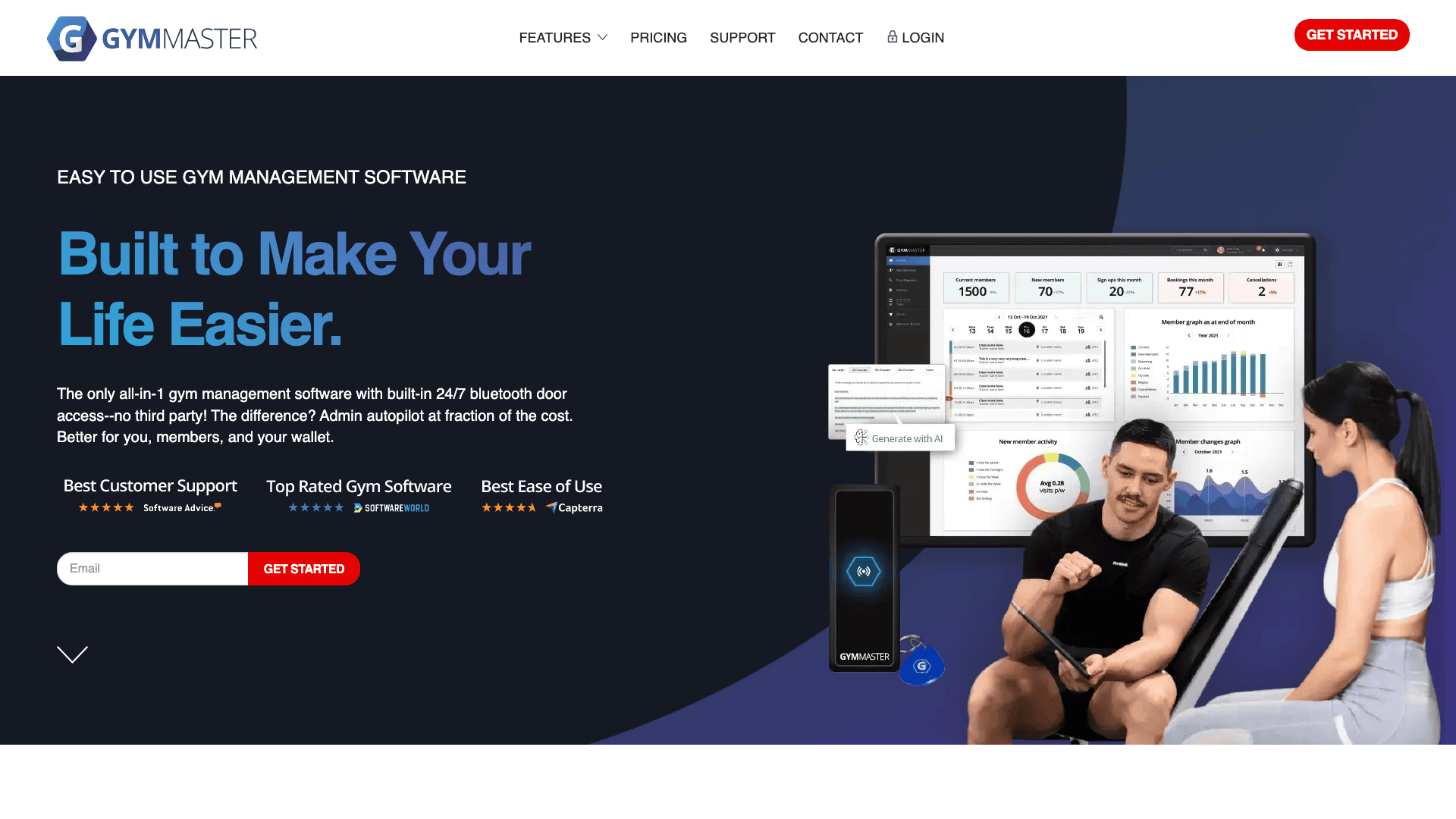
GymMaster prices billing and keyless door access as one system, which is the reason a school with open-gym or 24/7 access hours would look.
Integrated recurring billing is included on every plan, priced by member count per site.
Software-only starts at $89/month for up to 100 members, then $129 up to 400, $209 up to 1,300, and a quoted Enterprise tier. Bundling door-access control lifts those to $129, $169, and $249 (verified live in 2026).
If your building also needs keyless access, GymMaster bundles it into the same system and the same monthly bill.
It's a general-gym tool, so dues, families, and belts are handled generically. Fine for a mixed facility, thinner for a dedicated dojo. Our GymMaster comparison has the feature detail.
The Best Martial Arts Billing Software by School Type
Same seven platforms, sorted by the kind of school you actually run in 2026:
Your school | Best-fit pick | Starting price | Why |
Owner-run dojo that wants billing automated | Gymdesk | $75/month with Gymdesk Payments (≤50 active members) | Recurring dues, failed-payment recovery, ACH, and family billing built in |
Belt-testing- and communication-led school | Kicksite | $49/month | Martial-arts-native, transparent tiers, failed-payment alerts |
Established or multi-location school | Zen Planner | From $99/month (by members) | Deep reporting; scales by active-member count |
School wanting one simple all-in plan | Spark Membership | $199/month (promo $99) | Single flat plan, every feature on, martial-arts-built |
Studio wanting unlimited students, flat rate | MyStudio | $79/month | Flat monthly, unlimited students, self-serve payment funnel |
Multi-location business billing many families | Pike13 | $139/month (annual) | Family-and-dependent account billing, flat per-plan pricing |
School that also runs unstaffed hours | GymMaster | $89/month | Billing and keyless access in one system |
Pricing verified live against each vendor's own site in 2026. Prices move, so check the source before you budget around any number here, including ours.
Read the price column against the "priced by" logic and a pattern shows up.
Platforms that charge by member or by location get more expensive precisely as your school succeeds, while the flat and member-banded plans stay flatter as you grow.
That's the difference between billing software that helps you grow and billing software that taxes the growth.
Card vs ACH, and Where a School Quietly Loses Money
One number decides more than most owners realize: how your members pay.
Card processing typically runs around 2.9% plus a fixed fee per charge, the standard published rate at most processors. Cards also expire, get lost, and get reissued, and every one of those is a failed payment waiting to happen.
ACH, the direct bank debit, costs a fraction of that and rarely expires. On a $150 monthly membership billed to the same family for three years, the gap is real money.
The other quiet leak is the decline you never chase. A card fails, the member doesn't notice, you don't notice, and two months later they've "quit." Except they didn't decide to quit. The billing just stopped.
That's why failed-payment recovery sits so high on the ranking: the tools that retry declines automatically get back money you'd otherwise write off.
Want to see what those leaks add up to at your school? Our gym billing leakage calculator does the math.
When Gymdesk Is the Right Call for Billing
From the people who build it: look at what actually pushes owners off the other tools on this list. Bills climb with every member or location, pricing hides behind a sales call, and family-and-belt billing gets handled generically because the tool wasn't built for a school.
Gymdesk was built specifically not to do those things.
If you run a martial arts school and you're the one coaching most nights, the billing was designed for your shape:
- Priced by active members, not locations. A second location doesn't double your bill, and trials or frozen members don't tip you over a cap.
- Failed payments that recover themselves. Leave retries on and roughly six in ten declines come back without a text from you.
- Family plans and belt-linked dues built in. Not a module bolted on to win a martial arts school.
- Billing live the same day. No dedicated ops person, no multi-week onboarding.
Scaling into a big franchise with a finance department, or need billing welded to 24/7 door access? One of the six above may be the better call, and now you know which and why.
We won't claim Gymdesk wins for every gym. It wins for the owner-run school that wants billing off its plate for good.
Test It on Your Own Billing Before You Commit
Whichever way you lean, test it with real data before you switch.
A vendor demo shows you the software running the way they set it up. One real billing cycle (your dues, your families, one declined card) shows you the rest.
FOR MARTIAL ARTS SCHOOLS
A vendor demo shows you the software the way they set it up. One real billing cycle—your dues, your families, one declined card—shows you the rest. Comparing for a BJJ school specifically? See our BJJ gym software comparison.
Start a 30-day free trialGym management software that frees up your time and helps you grow.
Simplified billing, enrollment, student management, and marketing features that help you grow your gym or martial arts school.


FAQ
Martial Arts Billing Software FAQs

Sean has spent the last decade creating content that helps businesses—small and not so small—grow smarter to allow operators to do more of what they love. You know, the fun stuff.
From shipping and international logistics to web development and marketing, he's done the work (not just the words) to scale retail and service businesses efficiently.
You can find his work at Sendle, Shogun, The Retail Exec, Gymdesk, and more.