How Two Experienced Instructors Built NC Budo Into Gaston County's Karate Community
Starring
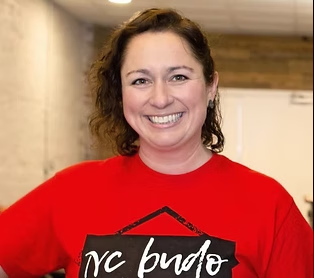
Sensei Jena Hare is a seasoned martial artist who co-founded NC Budo in 2016 with Sensei Michael Baez. She teaches Classical Okinawan Kempo Karate and co-leads programs emphasizing mental discipline, emotional stability, and physical conditioning.
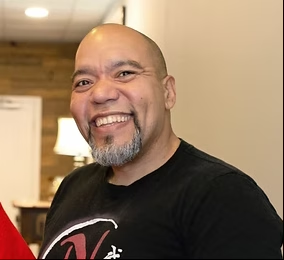
Sensei Michael Baez is an experienced martial arts instructor who co-founded NC Budo in 2016 alongside Sensei Jena Hare in Belmont, North Carolina. He teaches Classical Okinawan Kempo Karate, focusing on developing mind, body, and spirit through traditional martial arts principles of mental discipline, emotional stability, and physical conditioning.
About the Gym
NC Budo is a boutique martial arts school serving Gaston County’s downtown communities, founded in 2016 by best friends Sensei Michael Baez and Sensei Jena Hare.
Drawing on decades of combined experience, they created a place where students of all ages can access the lifelong benefits of traditional karate training. Their curriculum is rooted in Classical Okinawan Kempo Karate, giving students a deeply grounded system to develop mind, body, and spirit in a close-knit, community-focused environment.
The school offers a mix of karate classes, competitive training, after-school programs, summer camps, and wellness classes, all built around three guiding principles: mental discipline, emotional stability, and physical conditioning. NC Budo emphasizes a boutique, community-focused approach that prioritizes personal attention and long-term relationships, helping everyone from after-school kids to competitive martial artists find a long-term home on the mats.
📍 101 S Main St, Belmont, NC 28012
📞 980-288-8750
Summary
This is the story of NC Budo, a boutique martial arts center in Belmont, North Carolina, and how co-founders Sensei Jena Hare and Sensei Michael Baez turned their martial arts expertise into a community-focused karate school. The episode features both instructors explaining their approach to Classical Okinawan Kempo Karate and how they've built programs serving students from after-school kids to competitive martial artists. The video highlights their philosophy of mental discipline, emotional stability, and physical conditioning as the foundation for lifelong martial arts practice.
We show NC Budo's flagship Belmont location and explores how the school balances traditional karate teachings with modern wellness programs. Sensei Jena and Sensei Michael share their vision for creating a boutique martial arts experience that serves Gaston County's downtown communities. The episode emphasizes how two experienced instructors made the transition from individual practice to building a lasting martial arts legacy for their community.
What They Told Us
Alex Cuevas took the Gymdesk Originals camera to NC Budo in Belmont, North Carolina, a Gaston County school run by two partners who arrived from opposite directions. Michael Baez has trained since he was eight and teaches the martial arts; Jena Hare spent her career building businesses and didn't step on the mats until her thirties. The conversation kept circling one idea—that martial arts only sticks when a school gives kids enough time and structure for the lessons to become real, and that the after-school program is what buys that time.
A martial way, not a single style
Budo means "martial way," and Michael built the school around that concept rather than any one discipline. He came up cycling through Kung Fu, Okinawan and Japanese karate, Filipino arts, boxing, and kickboxing, and he bristles at schools that force a student into a single lineage—he calls that "martial mimicry." Ask him why it matters and he frames it as a community problem the martial arts world talks around but rarely fixes.
"One of the biggest problems that I came across is we speak a great game about community. But we're very challenged about trying to pigeonhole our beliefs or our martial philosophy."
—Michael Baez, Co-Owner, NC Budo
The after-school pivot
NC Budo's biggest program isn't its evening karate or boxing classes—it's after school and summer camp, which runs the back of the building until 6 p.m. every day. Jena explains that Belmont is full of young children, so the school leaned into serving them, and that the pivot reached kids who would never have walked in for a martial arts class. On the walkthrough she was blunt about which part of the mission actually moves her.
"And so we quickly learned that as much as we love teaching martial arts, what we love even more is being able to reach children who wouldn't have otherwise come through our door through our after school programming."
—Jena Hare, Co-Owner, NC Budo
Discipline has to become real
Michael's frustration with the wider industry is that every school promises focus and discipline but few explain what it takes for those to outlast the class. His answer is a partnership with parents—he treats himself as a co-study, not a vending machine for character. The point is to move a lesson from a slogan on the wall into something a kid actually lives.
"I will show your children the map to get discipline and focus, but we have to work together as two people to develop this person to show them that it's not just an ideal or a concept. It can be a reality."
—Michael Baez, Co-Owner, NC Budo
The lessons happen off the mats
Because the after-school kids are in the building for three or four hours, not a single 30-minute class, the coaches get pockets of time between and around sessions—a kid who defused a conflict at school, a small win worth celebrating. Michael argues that a dojo is supposed to be a family, and families need time together for any of it to land. That extra time, he says, is where the real teaching happens.
"I get to apply more martial principle off the mats than I actually do on the mats."
—Michael Baez, Co-Owner, NC Budo
Outgrowing the spreadsheets
The business grew fast—roughly 50 new students a year—and the systems didn't keep up. Jena, who ran companies before this one, described a patchwork of tools that got harder to manage as enrollment climbed, and said the first software they tried felt built for a much bigger operation. When Alex asked how they found Gymdesk, she started with the mess it replaced.
"I was using DocuSign for contracts. I was creating every template that we used in Canva and storing things in every possible spreadsheet. Three different segments of Google Calendar."
—Jena Hare, Co-Owner, NC Budo
Read the full transcript
Lightly edited for readability. Speaker labels are omitted because the source recording is not diarised; quotes attributed elsewhere on this page were verified against context.
The End of the World The End of the World Good afternoon, this is Alex Cuevas here at NC Budo in Charlotte, North Carolina. Going to go check out a different kind of a class today. Pretty excited. Come on, let's go check it out. Hi, my name is Jena Hare. I'm one of the owners at NC Budo in Belmont, North Carolina. Come with us and we'll show you around. This is the front area of our dojo. It's where we teach the majority of our evening classes. So starting at about 4.30 in the afternoon, our more traditional martial arts students come in and take a little bit of everything from Okinawan Kimpo karate classes to stick boxing as they're doing now.
We'll have lightsabers a little bit later today. And then we move into our 6.30 and 7.00 p.m. adult programming, which focuses on boxing and boxing. Come this way with me. I'll show you the rest of our school. The biggest part of our program is our after school and summer camp. And so the back part of our building is where up until 6.00 p.m. Every evening, our children are here. That has been the biggest key to success in our market. The Belmont area is full of little children.
And so we quickly learned that as much as we love teaching martial arts, what we love even more is being able to reach children who wouldn't have otherwise come through our door through our after school programming. This is our homework area. It's a little dark. Give you some light. So they have a room where they can close off and focus. And we have a room where they can close off and focus. We have a room where they can close off. And we have a couple other guys here, too.
With our after school program, we don't just have our kids come in like a lot of schools do and stay in one spot. They rotate with 30 minute rotations through a different schedule each day. So kids that are fifth and sixth graders, as an example, will come in, they'll have their snack time. They may rotate first homework. They'll go to arts and crafts. They'll go to mindful and yoga. And then they will also jump on the mats for martial art training each day. And that schedule flexes a little bit for them so that they can have the flexibility to leave early some days if needed and not miss their favorite activities.
This is where we do our yoga and mindfulness time. And our kids also have a nice area here to be able to read or play games. So it's a lot of fun. Our older teens, especially, like to situate themselves out here and have a little bit of a cool hangout area. This is our main after school area. This is Mike, my business partner. Nice to meet you, Sarah. We'll do that. That's impressive. So it's a whole lot of fun. Up until six, this is where our after schoolers are doing their training and digging in for snack time and stuff.
We have a drive through that runs to the back. But starting at 6:00 PM, whenever we need larger space, we're able to come back this way. This is Sensei Mike's favorite. Do you want to try too? Oh, absolutely. - Boom. - Boom. - Boom. - Cover it off the mat and just don't think anything, but I'm a little bit hot from the little battle in it. Sir, thank you so much. That's it. Thank you very much for having me. - Thank you for coming to visit us today.
- Yeah, this is so cool. I mean, my mind is blown. I'm so excited to talk about this right now, but maybe we can just start with a little quick introductions on yourselves and we'll hear it. - Yeah, that's cool. - Okay, well, my name is Michael Baez. I have been training in martial arts since I was eight years old. I am 49 and I've been teaching. - Like everything, my friend. - Yeah, good number, right? - Yeah. - And I've been teaching for about 20 years.
- Okay. - My background is kind of mixed up. I've done everything from Kung Fu, Okinawan, Japanese karate, Filipino martial arts, boxing, kickboxing. This is what I do. This is what I love. - Well-rounded passion for all the arts itself. - My father was very big on diversity. He actually made me study four or five different styles, but not trying to go for bouncing it now, but like it was like three to four years in one place and then introduced me to another teacher. I just kind of kept on with the pattern.
- Yeah, that's great. Awesome. Can I say Jena? - My name's Jena Hare and I have not been training since I was eight. I didn't start until I was about 30 when my youngest daughter was seven or eight. Watching them be on the mats inspired me to jump on the mats and get some extra physical activity with them. And what I have been doing for a very long time is building businesses. And so when I sold my last business and didn't know who I wanted to be when I grew up, Mike and I were training together in Okinawan Kimpo and he said, "Man, I wish I had that problem.
I love to teach martial arts every day." And we've never really seen a school be very successful with the business and the martial arts side of things combined. And so we came together to build NC Budo. - Yeah. - That's how we're here today. - Wow. That's great. I mean, I have so many questions. I can say I'm very excited to get into it, to unpack all this. Maybe we should start with the name though. NC North Carolina? - Yes. - And then can you tell us what Budo means?
- Yes. Budo means martial way. And there's a lot of different interpretations of it. Some people say method, martial method or law or way of the fist. And the one thing I embraced about it was it was talking about a concept of martial practice, not a specific discipline, not a hard singing or style. martial way. Identifying and connecting with your martial way and then finding the ways to express it. One of the biggest problems that I came across is we speak a great game about community.
But we're very challenged about trying to pigeonhole our beliefs or our martial philosophy. And this is the way the karate guys do karate and jiu-jitsu guys do jiu-jitsu. And it's really like a horrible rendition of West Side Story. And I just think it's kind of close the street and we have each other. - Yeah. - And I've never understood it. I, growing up as I'm getting older and again, being exposed to multiple styles, there were times when I couldn't tell my teachers that I was training or competing in something else.
And I never really understood it. I'm like, how do we grow? Especially if you're into competition, if you're fighting, how do you grow as a fighter, as a veteran, as a martial artist, if you're only allowed one philosophy? How is that in martial arts? That's martial mimicry. So, the concept of introducing, exposing, allowing, and letting people identify and find their Buddha, their martial way, is kind of, I guess that really is kind of the core of my passion. - It's a tagline too, as we have students come to us through many non-traditional methods.
So, having kids walk through the door that have no idea they're about to learn martial arts. Because they're just here for after school, like their summer camp. - Sometimes. - Yeah. And, you know, some of them try it and it's not, it's not for them. Some of them try it and love any component of it. I personally, when I first began, only liked to fight. And, we definitely believe that it's about connecting someone with whatever speaks to them. So that they can create that unique path.
When we see it with our kids, it's really cool. - Yeah. So, there's two places I want to go. First, with respect to the arts. I mean, you have several things that you're doing here, right? Can you walk us through the different arts? - Absolutely. So, I have a deep love of the Okinawan culture and the history of martial arts. It's a fantastic example of how a smaller or less powerful entity kept their culture and integrated and evolved even when they were under the influence of China and then under the influence of Japan.
and when I'm going to go over the national China and Japan both occupied and moved over Okinawan at the exact same time. - Oh, I had no idea. - Yes. There's the story we know and then there's the actual history. The history is amazing if you get into it, but I don't think you have four hours, so I'm scared. But it's a really culture of adaptation, acceptance, and diversity. Okinawan Kenpo, or Okinawan Karate, is actually a combination of martial arts from China, the Philippines, Thailand, and their traditional grappling art called Dish.
So, a lot of people with mixed martial arts actually know the original karate was the first mixed martial art. And this was an art that was really based off of self-defense and life protection. But then when we had the Japanese influence, that's where a different philosophy came in. Where we went more into the aesthetic and the ideal and the principle of pursuing perfection. Practicing something to find the purgatory essence of it. Not necessarily in a combative or martial form, but more in a philosophical form of constant understanding, learning, and progress.
They both have great weight and significance, but they don't usually stay in the same field. And I'm happy to change that. So, we have our competition teams that have martial arts and kakas that have a little bit more Japanese skills. A bit more linear, a bit more structured, looks amazing, but probably not tactical in the fight. And then you have aspects of Okinawa, which is more about structure and balance. More about keeping your movements small and not being… I guess one of the things they like to say is that which is theatrical is not practical.
And that which is practical is not theatrical. Okinawa and martial arts, their core and their essence is practicality and efficiency. And Japanese martial arts, in my opinion, don't come back from you guys. It's more about the aesthetic and the pursuit of an uphill. And I guess they both have weight. And so the karate is our core. We teach that in curriculum to our after-school students in smaller rights. We teach the core principles of it to our three to six-year-olds. But of course, three to six-year-olds in traditional martial arts don't necessarily line up.
We do have an adult curriculum for that as well. But then we have a population here that's really interested in fitness and exercise and explaining their horizons. So you teach boxing, kickboxing, all sorts of fun stuff to keep, you know, people having an opportunity to experience a good variety and find what fits them best. So a lot of different options for people to find their ways. Yeah. And again, like as Jaira said, Okinawa Kenpo, Okinawa Hrape. I'm going to bounce back and forth with those words.
One is a common identifier. One is what it actually is. But they are great for development of children. Because we have things that the four states of mind. How we think, so how we learn. We have things that call the five core principles. How we identify what we're doing is sound practice. So, and all of these principles, the four states of mind, the five core principles, the dojo coups, these are all things that carry very easily outside of martial practice. And into every day, how do I break down the problem?
How do I decompress and reset myself? All of those things, which I feel like I have more weight in, you know, everyday life and just learning how to throw punches. And that's where my mouth was. That's what I used to structure and identify and kind of bring things back, you know, from the wild into what I can adapt and adjust to. And it helped me so much. And it still does. And I figured this has to be passed forward. So, one of the things that stood out immediately for me is the second thing I was going to talk about.
And right away when I walk in here, first of all, I was excited about the class. It will definitely impact that some. But there's the whole after school thing. I've visited so many schools. And I've not once ever seen a set up like this, where you have like a study area for kids. And then you have like a little fun area, it looks like in the back. You saw it in this video. So, I'm sure. They haven't ever shown that part. So, we're in the back.
We have video games back there. I think it's a... I'll take a class. It's important. Yeah. So, I'm looking at this as if I was a kid or like a parent, your programs will allow my children to come here. First stop, this first stop, right? In here? Change this room? So, the kids stretch rotation they're a part of. Okay. But everybody will rotate, room share. Yeah. As a part of the day. Which will check the boss's homework. You better. Yeah. So, homework is taken care of here.
I'm feeling good as a parent. They also live in a social area of playing. Little library back there, aren't you? Yes. It's amazing. And then, martial arts? Yes. Wow. The mindfulness in Europe is a piece too. Yeah. And I think it's a really important piece that backs our martial philosophy because it's helping children learn to self-regulate. And I don't know that always has to take place on the mats in a martial arts school. I love the idea of them having to learn, you know, breath in a chaotic, sometimes noisy environment to self-regulate.
I love them learning to regulate the movement so we can learn a little bit of all of that. Some of our older students will lead our younger students through it from time to time too, which gives them a really nice experience for leadership. So, it's fun. Our after-school program is, I think it's one of the smartest things we did because it serves children in this community in a way they weren't being met. So, it's also a great way to kind of co-sign or show them to practice what we preach.
The mindfulness aspect that we speak of in our martial art practice, we utilize in our yoga. When we have disputes among the children, we talk about things like where are you pausing? Are you trying to hear the other person or are you just trying to get yourself heard? What aspect of that applies to our training? So, the fact that we have this area here and this separate thing here and this homework area here and this game area here and yet we can still apply these principles in every single one kind of helps them carry that outside the school.
You know, it's great to say it on the mat. It's great to teach it when everybody's standing at attention, but it becomes real when you see how it works outside of the air. I also, maybe I'm projecting here, but I would imagine, you know, when I speak to instructors who talk about the joy they feel of influencing the young mind in developing discipline, confidence, anti-bullying or what have you. You have them, but then beyond that, you have this other thing where you're, you know, you have more time to them.
So, you're framing a larger part of influencing others there. Do you guys think about that a lot? Yes. Yeah, it's really fun. I mean, like, that's the biggest thing that we kind of, I guess the biggest thing that I really want to kind of push out there is that every martial art place that you go to promises focus, you have this discipline and all these amazing aspects, but no one really speaks to what it takes for those to actually carry and resonate and become something other than an idea.
And I always tell them, like I told parents, I say, I am a co-study to you. I will show your children the map to get discipline and focus, but we have to work together as two people to develop this person to show them that it's not just an ideal or a concept. It can be a reality. And that's like, I believe, dojos are supposed to be families. And when we have the after school aspect, that becomes more so because we are engaging with the parents in these various aspects.
And because it's an after school and not just that 30 minute block that we have, and we get to hang out with these guys for three, four hours at a time, we celebrate and talk about the things that happen outside of the gym. I did this really well in class. I did this. I defuse that. I did this. We talk about it and we celebrate it or we coach and we advise. And that's where, again, the concept goes from an ideal into an actual reality. I think that when you walk into some schools, you see a very structured program.
Yes, sir. No, sir. Very quiet. All in our form. It's the opposite of our program. Yeah. But it's also intentionally designed that way. Think about it. When you go to a library, if you learn to use your inside voice in the library, does that skill carry through into everyday life? So we try and give our kids moments where they have to follow directions. They do have to be quiet. They do have to show respect. But we also want them to be able to be kids. They're coming in at their long day scale.
It's the hardest part of the day for these guys. Yeah. So having those 30 minute rotations that they can rotate through keeps them engaged, allows them to get some of that energy out. And then we give them settings that allow them to put the buses. We're teaching them our mats into action in a real life situation. So our community garden that they're learning to grow plants and to donate time and join out here and helping tend. Our animal plan. Absolutely. Yeah. That's the point. I grew up in a school.
Stand up. Sit down. You know? Come this forward. And yeah, I knew what to do when the scary guy was yelling at me. I was really, really good at it. But the second class is over. I was a wild one. Yeah. So it was my kids because I knew that didn't really stick the way I'd like to. I don't do that. My big one is what this could look like. What should you be doing versus what you are doing? And it's crazy because when I say that, they, on their own, get exactly where they need to be.
Which most they need now. They just need to be reminded about, hey, no, this isn't the situation with me. This is how I'm supposed to carry myself. And I think challenging the kids to find their, what good looks like, or how to like, let them solve their problems. Or have faith that they can solve their problems instead of telling them what to do. I mean, you do that. You spend your life waiting for someone else to tell you what to do. Right. And we need thinkers, not followers.
So. Yeah. That's been, you know, my, I was brought up much in that way you described. Oh, yeah. Go do this, go do this. And, um, I, when, when my dad is there and he had the fist, I'm like. Made sense, right? Oh my. Perfect. Outside I was goofing off and, you know. Right. Exactly. I was in high school, you know. Um, which is fine. But the, uh, biggest leap for me is, um, as I raised my son today, is this whole idea of emotional regulation, waiting for them to, uh, helping them because they can't, I don't understand it because I'm way past that, you know?
Yeah. And my wife still does a great job with, like, um, helping me see that. Now I see even more. That's, that's really important, right? You don't want to raise your children to just be following murders. Everybody knows, like, what to do when they're in trouble. Like, do we know what to do to not get in trouble in the first place? Like, we're very good at backpedaling, but do we know how to see a situation and go, you know what? I'm just going to stay clear of it all together.
And I think that if we learn that from a foresight, we're going to have the people that can solve their problems and have to enjoy a lot of those obstacles, you know, much jokes in a way. So. Today we have an interesting situation that feels well addressed to this. We have a young man who's a great student. She has been having a really hard time self-worthiering his emotions lately. Like a lot of stories that's going on in his life. And I'm going to decide what's going on.
And he's like, these bad things just keep happening earlier in my day. And I gave a really nice teachable moment where we sat down. We made a silly note for each bad thing that had happened today. And we made a silly note for each good thing that had happened. And we talked about the ability that when we have a good day, it can cancel out a bad thing. Just that people don't always give us those good things. Sometimes we have to find those good things for ourselves to make, to put on those notes.
And so the suggestion I made, and I brought our staff in to talk about it, was that he made a list of all the things that he can do that are good things for himself. So he can make sure every day that he has more of the good things than the bad things. And we can start fixing this and trying the list to help impact it. Well, that's a big talking point. Yeah. You can't stop from having bad moments, but you can choose whether you're going to have a bad day.
And we're going to identify a bad moment and classify it as bad. And then say, all right, we'll put that in that cell there. And I'm going to work on having a good day. Totally. And the social problem, too, of being able to kick and choose to impact our own environment with our own things. So, of course, Ms. Long, who's grown, she's like, "I'm making work shoots. We're all doing this in the mindfulness. Thank you for the idea. Everyone's going to have their own list, and we're going to have little squares, and we're going to fill them out." But it's those types of moments that come up that if we only saw our kids for 30 minutes, we will not get a deep end of this.
Yeah. I just can't imagine that conversation happening within the scope of the class. Yeah. You're somewhere else that you had that conversation. There's between Dr. Small. Yeah, for sure. Yeah. And that, you know, I guess that's evidence for me in terms of what I was suggesting. There's the span of time that you have that allows you to have these types of conversations and influence, which is right. It's really pretty cool. I think it's important, too. As far as, like, when we take an ideal and make it into a teachable principle or something that you carry with you, it can't happen in 30 minutes.
We forget the very last. It can't happen in an hour. You know, that's kind of like that whole concept of, like, the old, old belief is that the martial arts community is supposed to be that. It's supposed to be a community. It's supposed to be a family. And families spend time together. We engage. We share the, you know, the highs and the lows. You're not going to do that when I'm teaching how to punch and kick and dunk and block. Right. But I have these little pocket moments in between classes or the four classes or after classes where I get people signed and get discovered.
That's the funny thing. I get to apply more martial principle off the mats than I actually do on the mats. Yeah. I don't think I ever would have realized that outside of this very unique situation. Yeah. Really cool. Really cool idea. Now, if my son was getting out of, I don't know, would kids get out of school about three or something? 2:30 here, 2:45. And then what time your door is open? So our doors are open. We have staff in the building prior to the first, after school are arriving.
And the buses drop off here starting at about 2:30. The buses will drop off here? So our local schools that serve this very area. If we had a home here, they would be dropping off. They bring those children to us. And so we have bands. They have seven vehicles that go up. Amazing. Okay. So now you're, everyone comes in at a specific time. We'll call that group one or something. Yeah. Yeah. They have a track. They have a track. Yeah. And what is that track? What are the parts of that?
So usually in the beginning, it's a little snack time. Okay. Healthy snacks. But like a little bit of snack time. And then from there, you would cycle to, for example, class, then homework, then the yoga, then arts and crafts. And that would be the normal cycle. But then on top of that, for people who want more, we have clubs. So we have our animal care. And the kids, like, actually, they get to sign up and they get to rotate. So they're not kind of committed to stuff.
As you guys know, we're pretty big on diversity here. But we have kids that are going a little bit more. So they can sign up for the animal club. And then they're going to be caring for the animals for that week. Or they can sign up as helpers. And we have junior helpers. You have to get to a certain rank and show that you have that knowledge. And you can be assistance to instructors or help lead normals. We have the Kolodo club to learn the old school languages.
We have, you know, a groundwork at a kind of chintzy club. We have the gardening club. So we have these, like, opportunities for people to hyperfocus or fall into. And then, yeah, we have our teams. And we do a lot. Some of our kids, I think, with rotations, we're done. Especially our middle schoolers. They're like, okay, we've done all the things. I'd like to go sit and finish some more homework now. Because I've got a bigger school road. Or I want to be social with my friends.
And so we kind of have... Like a social area? Yeah. We've got the nice, broad variety. No electronics for our kids. So they have to have, like, old fashion fun. Which is... Which is pretty cool. Yeah. And so, community. Yes. I'm sure it's organic based on how you're doing this. But do you see people that are part of this... We'll call this a community, too. Do they go out and stuff outside of here as well? Like, do they become, like, super close friends? Yeah. Yes. Initially, no.
Because, like, the culture has shifted. You know, like, we're more kind of zoned into the me or the individual. But with time and with realizing that, you know, how much fun it is to have other people out, which you're about. Yes. We have people that are friends in high school and like that. And they actually have the same sports teams outside of that. And sometimes we've got a lot of band people that have some fun together. Our competition teams definitely pull the kids together. Yes. And that's when you start to see the relationships form.
The families become tight and these kids kind of start hanging out socially with each other, too. Yeah. And a lot of our kids actually have, like, play dates and they hang out, like, on weekends and they don't hang out together. We have a few, like, nice clusters that they're going to go in there all the time. It's kind of a lot. Yeah. And have you guys, I'm sure, right? At this point, your program is pretty successful. There's a lot of kids in these, what do you call them, tracks, I guess?
Yeah. Stellations that we do. Well, we try to keep it under a certain number. I don't want kids to kind of get lost in the zone of mass of it. So it gets challenging. But once we hit a certain side, we actually try to create more stations so that we keep that touch. I try to keep my classes no more than 20, 25. So I have lots of classes throughout the day. Yeah. But that way I can have all these guys to kind of have their individual experience with each other and with the teacher.
And we're placed with a program. Yes. So that's important because we serve from a small school age. So we're serving five to at least 15. So being able to have our middle schoolers together makes it more enjoyable for them and keeps it where it's super appropriate for our little guys. Yeah. So, you know, you probably were in that school of 30 or 50 students. So, you know, the little kids in the front, you know, I mean, it was nerve-hopping me. I was in that environment. I did not like it.
So the, what we call like the kind of boutique kind of small studio feel, even though it's a larger program, I think it's still important to keep. We'll have 150 people rotating through our space in any given moment. But the way that it's, you know, laid out allows, as you can see in here, the class is up to about two minutes. Yeah. This is about, yeah. To fit comfortably and to be able to have that insulated feel. It's no different than when we first started and we only had two minutes.
Yeah. We found it worked. We tried to keep it. Yeah. So, I mean, that's been, I mean, sounds like you have a lot of success and that's been good for the business basically, right? Yes. I mean, that is definitely what puts food on our table is our after-show program. Yeah. So, it makes it where then Mike can have fun classes like your Monday took tonight. Oh, yeah. And whether five or 15 people show up, the after-schools are grown in butter and those get to be truly that passion project.
Yeah. The feed his love for things, the boxing and kickboxing do the same for me. So, we keep bringing in the people that we usually train with. Yeah. So, that it's not just Mike teaching. In the very beginning, it was us both teaching and it's not that anymore. They get the best of him and then they get to get the best of pro boxer Ricky Rainey who is here tonight. They get, you know, you have really talented people that come in and teach those special issues.
So, that's pretty cool. Yeah. Cool. I mean, one more question on this is you have so many people. I'm sure you have stories of seeing change in kids. Maybe they're shocked. Oh, yes. Oh, yes. Oh, yes. Any cool stories that sell out? We met Miss Dawn today. Yes. You need to have Miss Dawn working for us because of her daughter, Katherine. Katherine's in high school now. And I'd love to say she's still training. But we see her only, only sporadically now. But she came to us looking for an after school purpose.
She was struggling. And Katherine really found that she liked to fight. And her rebellious, sweet personality really bloomed though. And she had never trained martial arts before. And getting to have that outlet, she knew she needed it. I'll never forget his conversations in the beginning. She came and defeated. She started out with this mentality of people are only going to see, you know, various reaction and energy, right? Defensive, combative, because you feel like, you know, you're always prejudged and attacked. And she came to us in a state where it's like, people already have this idea of who I am and what I'm in.
And there's not really much of a point of trying to show differently. And I think martial arts and community and again, like our methods and our rules and the way we decompress and the way we express, got her to, got the confidence and courage to actually, one, have a voice that's other than what other people say she is. And she stood up and expresses like, you know, no, this is who I am. This is how I feel. And I get why you saw this, but give me a chance to show you that there's been one.
And then a couple of years into her journey, she was competing. Yeah. Very successfully competing. And she went to worlds. She did. And her mom came to us and was like, Hey, I've always had a corporate job. I really believe in what y'all do. I've seen it with my daughter. I don't know a whole lot about this, but I thought to learn. And Miss Dawn has truly, when we say she was a part of our business, she has felt the impact of after school for her daughter.
So having her now recreate that experience for the other families. She believes. She believes. This is like one of the best success stories ever. Because now she's, Catherine might have aged out of owning Detroit. But her mom was kind of cheering on that belief that, you know, this role can make a difference for kids. And the fun thing is that, you know, you say you have one example. Actually, like off the top of my head, I have six. And if I really thought about it, there are a lot more.
And, you know, I do have some very phenomenal young, focused, dedicated kids that are really, really doing well. After a while, like, you know, some of my younger black belts out there. And one of the things that kind of makes me feel great is that they're in college now. But they'll come and visit since they'd like. And they'll ask me to run a comment with them. Or they will drive by and just, they're not there to take class. They just, they want to still be a part of this.
And I'm like, you know something? If you're a student, if you welcome that and you're my student, you're my student until we both move on to whatever's after this. Like, so that's the thing. It's like, and I love that. The door is always open. They don't feel embarrassed about, oh, I forgot to write that. Or something like that. No, they know that in this environment, you don't have to worry or judge or show up. Meet a standard. You just have to show up here and you have to watch some practice.
Yeah, that's it. And we just hate that. We're done. So hitting year nine, we have students now that are here. Are you here nine, you said? We are. So we have students that are coming back from college over the summer and helping us run our summer dance. So it's really cool to get to see that, you know, next generation of leadership as they kind of share a little, not just their martial skills. It's cool. The fact that they started up like me and now they're also already not so cool.
That's a good part of the ego, but it's a beautiful thing. Wow. That means that's really cool. That like a 10 year old coming back. Yeah. I mean, to help or something like that. Yeah. I mean, some of our best, you know, junior staff members, our kids that started with us when we first opened our doors. Wow. And that's the other fun thing is that we are a lot of the first jobs to a lot of our students. Oh. So, you know, they might come here and then they get the experience of the journey structure.
And then when they get to the appropriate age, they can be like counselor or they can help. And they help in our summer camp. So it's, again, like I said, it's not just on the mat. It really does grow. Yeah. I mean, this was my first job out of it. What you just described. Exactly. I taught martial arts. That was the first job I got to pay for. But I got a little black belt. So there's a, yeah. What brings back a lot of things is going back several years.
Another thing that brings me back, shaking out 40 years of my life is tonight's class. I was sitting there just grooving and at the same time I was enjoying it. There was a little bit of guilt because my eight-year-old son is not here with me in the class. It was so cool. I mean, what, I've never seen that before. And I just, you guys have an actual class. Yes. Yes. They say, first, my goodness. So, well, I was going to show a lot of footage about that.
And our little dude would be amazing. But how'd you come up with that idea? And tell us about that. Learning how to cooperate. As emotional arts, you understand that even though it's supposed to be training or sparring, when you're young and you're full of ego and pride, if you don't want to spar, you're going to win. And so getting people to learn how to work with each other outside of trying to show more talent and more ability, or trying to establish some kind of tier in there.
You know, stage combat and choreography requires collaboration. It requires us. If you try to win in a stage match, it looks like a really sloppy battleground. But I think I showed you that little clip of some of my seniors. Yeah. When those kids created their own choreography, they work to make each other look good in their execution. Because they know that if I make you look good in your series of attacks, and then you make me look good in my series, we both make something that makes us look amazing.
Right? And that whole mentality of, hey, no, work together. Communicate with each other. Build each other up. Don't try to step on that person to get yourself hired. Because they're going to fall and you're going to fall. And you all think. This really just had the most immediate success with communication and collaboration. And when I saw that, I was like, we got something here. So yes, I think we're my favorite class, but I try because not everybody's a sci-fi fan. I don't understand why. So it's actually a bit more than that.
We do stage combat. So it might be like licking a fight scene. Karate versus boxing. Or whatever. Or various. I do a lot of classical weapons. So I might have somebody go with Funk Fa versus Bo. And we work together and we create these things. And they love it. It goes through it. And it just shows you how much more you can do when you're actually working with a partner. Instead of trying to beat somebody. That's our first one. We stumbled upon it. We were looking for a fun like parents night out kind of concept.
So at first we did just a couple like once a month seminars with it. And the kids, like, not just the kids, the parents, he ended up. They wanted to come play too. And I had to make a separate adult. Did you really? I did. I did. I still would if I get the numbers. Yeah. Oh, there was at least one adult. Yeah. Yeah. And then a little older kid. Yeah. And she said, okay, glad that I wouldn't be doing it all day long. Oh, absolutely.
That was fun. Um, no, uh, I guess let me, uh, segue into how did you guys decide you wanted to do this? Like what point? So your prior life, you were doing businesses and it was entrepreneur type. Okay. And then yourself for us. Well, I've always taught and trained in martial arts, but I actually worked in sales. Okay. My father owns a design studio and I worked with him for many years. Okay. And then, uh, we still work on commission sales and every category you can think of from industrial equipment to clothing, it's a vehicle.
Okay. Um, I guess I always was comfortable communicating and trying to connect with people. And we met up at another studio. And you guys were training together, right? Yeah. Yeah. Okay. So we both had kids that were, you know, training age. And when we met, I really had no idea what I was going to do after I sold my last business. I knew I didn't want the day to day of something, um, the way it happened for me. I didn't want something that I wanted something that I could touch and infuse in moments.
I could still experience life and travel. And I was like, I don't know. I'm going to do a day. I love this. I want to teach. I want, you know, to be hands on. So it's a beauty, pretty blend, um, of trying to take someone's passion and find a way to make it a viable business. Mm-hmm. And this market, even at what market you're going to land in to start, you know, to start with. And Belmont made itself a very easy choice. And once we landed here, we need to shift our business original plan a little bit.
Um, because the age of children here is much younger. Um, in the areas we were in, we thought we were going to be a competitive martial arts center. And then we do have a branch of that. What we have here are three to 10 year colleagues who are hungry for after school. We're in a long martial arts. What? Yes. Uh, that was a big shift. My background actually is more in combative competition and, uh, life. I used to teach, um, seminars, um, self-defense, things of that nature, um, quite a bit.
Um, so I really initially did not have a lot of, um, exposure to teaching very, very young. And I did not realize I had a niche for it. Um, I think this could work the same maturity though. But, um, you know, it turned out that, uh, you know, one, it does feed me to a great deal. I love working with, um, you know, my juniors a lot. And I found some gems that I wouldn't expect to find in the little ones. Um, I think old school Kanape really was kind of like 13.
It was about as young as you were getting a pound get into it. But we're talking about like 1970s to 1990s where they threw you on a Harvard floor. Yeah. Nowadays, they did half the stuff that worked. It was reasonable. I used to get spurners in my feet. Oh my goodness. I found a whole in half my side. I was like, why did you think this was okay? Um, like, you know, usually, um, you know, it's funny. There's what you finished. There's what, like, you know, one, I think we all knew exactly what we wanted.
In life. No one would be unhappy. Right? But we have the perception of what we think it is. And, uh, sometimes if we're talking to that, we actually miss real opportunities or real, you know, those moments where you can really shine. And, uh, that's some adjusting and some allowance. And, uh, that's the oldest karate that I know of. The one that's with these opening up and, um, style that I kind of fell in love with. Um, it is not. It's not the children. And the first three people that walked through our gallery were between the ages of three and five.
And I thought, you know what I did? The perfect button. He still had his full-time job. And we were, you know, we had a goal of, you know, within the first year, getting him out of his full-time position and full-time within Sikudo. And I remember Paul young, but I'm like, I know you said, like eight or nine was the youngest he won. How bad do you want to do this full-time? Yeah. I thought I was being generous with that eight or nine. A week later, I'm writing blogs off the basics of martial arts for three to six-year-olds.
And so that's my market here. And I think that's the biggest thing that we've learned through COVID through, you know, moving into two different markets is you have to adjust. You have to be flexible. You have to read your audience and not sacrifice the quality of what you teach or the way that you want to teach. But you have to bend to the needs of the community. Our community needs that. Okay. Yeah. Our community likes variety. Our kids here are involved in so many other activities that we have to have a very, very, very full, robust schedule so that they can pick classes around their other seasonal sports.
So we keep shifting and tweaking our business model as we keep learning what our audience needs. And we found it to be the perfect composition so far. Yeah. That was asking what advice you have for someone who is the wrong thing you've been doing for nine years. I think that's excellent advice. And, you know, one of the things that I've experienced, so I train. Right now I'm mostly doing Jiu Jitsu. And my son is doing Jiu Jitsu more tight. But the problem I have is his classes are at different times than mine.
So then it's super inconvenient because I have to burn, you know, 30 minutes to get in the class. Then it's changed for an hour. And then I have to take them home. So I can't stay in the adult class. And so it's this, that is like one of these things. I'm not going to not take them. But if there was a program like this, you know, this solves it. You know, I've seen other solutions where people have classes for kids and adults at the same time, or some both in one.
But all these things, I think the adaptability for what the market's looking for is really important. Just making sure you understand, you know, especially time crunches out there, you know. But the, yeah, I love what you guys are doing here. Just being able to care for someone's child has really helped them develop. And, yeah, it's been great. I'm just curious, getting anything to do with us. How do you find this? We, when we first began, we were doing things the real old school way. I was using DocuSign for contracts.
I was creating every template that we used in Canva and storing things in every possible spreadsheet. Three different segments of Google Calendar. Like we have problems with this. But we were growing by, you know, 50 students a year, at least. We were almost like, I would say every year, we were like, we were jumping on that 50. It was aggressive. And it was really hard to keep up. So the first solutions we looked at seemed overly complicated for a really small business. Mm-hmm. And this seemed to have the perfect, like, fit for what we did plus a little.
But not in such a... Yeah, that's the thing. It's, um, you see some of the other programs out there. It may be nice and not much work. Yeah. But it's kind of funny. Yeah, I know. I was like, she can say it, she can say it. But it's, you know how, I actually think just like in martial arts, how something presents all this flash and all this stuff that then we come down to what we actually are going to use and read. It's like, wow. Uh, it made sense and it seemed like a great deal, but I actually only need 20% of what this stuff.
And I like, I have no use for this other stuff. And in real time application, the value shifts really hard and fast. And, um, we just needed something clean to the point. And again, very user friendly. I mean, you know, that's kind of changed through with that. And you guys have grown as we've needed things to be implemented. So it's almost like you're two steps ahead of us. So when we hit this point where we're like, Hey, it would be nice to be able to sort reports this way.
Yeah. You know, there's an email that's Dom's like, no, I saw an email last month. You know, they have this new feature now. So we're not even touching, I think the full capacity of what we could use the software for. Um, but it definitely makes our life a lot easier. Yeah. Are there any features in particular that it does really rely on that you use every day? Um, I like the attendance tracker. Um, I, as you know, like kids have different skill levels and different abilities.
And then the curriculum has this kind of thing, you know, this general thing. And I think a lot of people kind of treats emotions and growth almost like cramps for a test. So if I have like this time and I've really studied these four forms, then maybe I can jump my health and go to the next thing. And I'm like, no, honey. I'm like, I'm so impressed with your abilities, your dedication, how hard you're working, but you've only taken four classes this month. And we have our consistency.
And we're about steady growth. They continue growth. And who knows that for you to qualify for the next medical, you have to have a minimum of us this time here. And that lets me kind of do a quick check because I have some real talent. I have some guys that technically have curriculum down three bouts of editing, but they still have to put in the time. Yeah. And that kind of helps me organize and keep tracking that. So I'm big on that. I love being able to kind of look and kind of check where my guys are, where they've been left and like little reminders.
It's somebody's birthday and they just, we do have, I can always use more numbers, but we do have a nice number of kids and it's hard to keep track of everybody. And that being able to kind of fill it up on my phone and have it and see the dates and all that stuff is really good for me. The texting, the emailing, the ability to go in and create forms and just update them every year. Like yesterday was Cyber Monday. So we have a pre-registration form that we use for summer camp where our existing students can go ahead and sign up for the full summer.
So the ability just to go in and, you know, one button, select those folks and have that document upload and have them have an email reminder sent to them is super, super helpful. So. Especially if we would help them to take that email, like text. Yes. There's a small, small communication ever. Have you guys loved the marketing information? Neither have. We haven't done a very good job of telling people about that. I mentioned this quite a bit when I go out there, but it's, it allows you to set rules that you cannot have to follow.
Like, for example, someone's interested in filter forms, it can take actions for you. Like wait a day, send a text message. If there's a response, then, uh, you can go down this path. If there isn't a response, send an email. Oh, so it has an information program. Yes. Yes. And at any moment in the sequence, call me sequence, if they sign up and book themselves, stop. So you can break out of it anytime. So, um, super powerful. One of the things I wanted to come here, you know, 14 months ago, 15 months ago, I was looking at, you know, uh, jumping onto the Gymdesk train.
I saw it. I was like, whoa, that's like enterprise software capabilities. They were giving it to gyms. Amazing. But, um, some of it requires you to have some skill of setting up. If then. So we actually have a bunch of templates now. Yeah. So we go in there and we asked our marketing experts, like if you had a martial arts, school, what would you want? So now there's a bunch. You can just click on it and it built it for you. So it's highly encouraging to check out the plan with that.
Yeah. That's pretty cool. Um, and then also we have the, uh, the, um, that is included. There's an extra charge for that. And that allows them to do push notifications in case everyone. Use a third mechanism when you email us, but if they have the app, it will actually, you know, buzz us. So another cool thing you guys might want to check out. Yeah. Um, yeah. Thank you for having me. Thank you so much for the class. I'd say that was amazing. It was a lot of fun. It was so nice to meet you today. Thank you. Thank you for having me. And yeah. We'll see you guys again soon. Hopefully. Cool. Maybe I'll bring my son. Game engineer. Bye. Bye. Bye. Bye. Bye.