
The Best Martial Arts Management Software in 2026, Compared Honestly

Below: All nine platforms, bias disclosed, including where each of the other eight is the better call.
The best martial arts management software handles what general fitness platforms can't.
That means belt and rank tracking, family memberships with sibling discounts, multi-program scheduling, and digital waivers for minors.
The right pick depends on your discipline and your school size. Below is an honest, complete comparison of the nine platforms a martial arts academy owner should actually be choosing between in 2026.
Two notes before the list.
Full disclosure: I work at Gymdesk, and Gymdesk is on this list. I'll be straight about that bias. I'll also be straight that Gymdesk was built for martial arts academies, so I know this category well.
And I'm not going to leave a single real competitor off the list to make us look better. Every platform that genuinely competes for a martial arts school is in here, PushPress included, treated fairly.
How this list is built. Nine platforms, each evaluated on the four things that actually matter for a dojo, each with a real strength and a real limitation named.
A comparison is only useful if it's complete. A list that quietly drops a major competitor isn't a comparison. It's an ad.
OK. Let's get into it.
Where I can, I've pointed at owners who went on the record—Gymdesk Originals has martial arts owners explaining what they actually run and why, including two academies that left, tried five or six competitors, and came back.
What Martial Arts Software Has to Do That Gym Software Doesn't
A martial arts academy is not a gym with a different sign out front.
It runs on four operational realities that general fitness platforms either ignore or bolt on badly. If your software misses one, you end up running that part of your school on a spreadsheet, which is exactly the problem the software was supposed to solve.
A martial arts platform has to handle four things gym software treats as afterthoughts, plus one problem every gym shares that hits academies harder.
Manual rank tracking misses promotions
Every student has a progression history: stripes and belts for BJJ, kyu and dan grades for karate, geup and poom for taekwondo, kyu ranks for judo.
The software needs to track that history per student, support your specific belt and rank system, and tie promotions to something real, like attendance and curriculum progress, instead of a coach's memory.
Family plans need sibling pricing built in
Most academies make more revenue from families than from individuals: two kids and a parent who all train.
Your software needs multi-member family billing with automatic sibling discounts. The platforms that don't have this force you into manual monthly math, and that is where billing errors and lost revenue creep in.
Multi-program scheduling: gi, no-gi, kids, adults
Gi and no-gi, kids and adults, fundamentals and open mat and fight team.
Different programs run on different schedules, with different capacities and different coaches. The billing and scheduling need to handle a student who's enrolled in two programs without breaking.
Minor compliance: a parent's signature for every kid
Half your students are kids. That means parent-signed digital waivers, membership agreements, and liability paperwork stored against the member profile, not in a filing cabinet.
Liability waivers are not optional, and chasing paper ones is a part-time job nobody wants.
Failed payments: one declined card, a whole family overdue
Every gym deals with declined cards. Academies get hit harder.
So much of an academy's revenue runs through family plans, where one parent's card covers two or three students. One decline, and the whole household is overdue.
Your software should retry failed charges on a schedule you set.
It should email the member the moment a payment fails and warn you before a card expires. If it doesn't, you find out at the front desk, with the kid standing right there.
Here's how failed payment recovery works in practice.
Hold those five in your head as you read the rest. They're the filter.
How I Built This Comparison
Four criteria, weighted in this order:
- Rank tracking depth. Native belt/stripe progression with full per-student history, supporting custom systems, not a generic "achievements" field.
- Family billing. Multi-member family plans with automatic sibling discounts, no manual workarounds.
- True monthly cost. The all-in number after add-ons, not the headline base price. This is where vendor pricing pages get slippery.
- Discipline fit. A platform great for a 600-student traditional karate school may be wrong for a 40-student no-gi garage gym, and vice versa.
The list includes every major martial arts management platform, nine of them. That's deliberate.
If you're going to spend a year or more on a piece of software, you deserve to see the whole field, including the options I'd rather you didn't pick. Gymdesk leads the list, and every other entry gets a fair, specific read.
If another platform fits your school better, this guide will say so.
Platform |
Best for |
Rank tracking |
Starting price |
Free trial / plan |
Gymdesk |
Martial arts academies of any size; value |
Mature, attendance-based promotions |
$75/mo Micro · $100/mo small school (with Gymdesk Payments) |
30-day trial, no sales call |
PushPress |
Owners wanting AI/CRM features + a free tier |
Yes (added 2025) |
Free Core · $159/mo Pro · $229/mo Max |
Free Core plan |
Kicksite |
Small traditional dojos with simple needs |
Yes |
$49/mo (by student count) |
Demo |
Zen Planner |
Established multi-discipline studios |
Yes |
Studio $99/mo (+ paid add-ons) |
Demo |
Martialytics |
Belt-tracking and grading-first dojos |
Yes, deep |
$69/mo for 50 students |
30-day trial |
Spark Membership |
Marketing-led schools |
Yes |
$199/mo |
8-week free trial |
Wodify |
MMA gyms with a performance focus |
Limited |
Starting at $199/mo per location |
Demo |
RhinoFit |
Budget-conscious schools |
Yes |
~$57/mo ($0 start-up tier) |
Start-up tier |
Mindbody |
Large studios with wellness crossover |
No |
From $79/mo per location (quote-only) |
Demo |
Pricing reflects what's published on each vendor's pricing page as of October 2026. Confirm before committing—several of these platforms quote rather than publish, and tiers change.
The 9 Best Martial Arts Management Software Platforms in 2026
A note on customer lists: most of these vendors will show you a wall of prestigious academy logos. Logos are easy to print. What's harder to fake is owners going on the record about why they stayed.
Gymdesk Originals, our gym-owner interview series, has martial arts owners doing exactly that.
The series includes a jiu-jitsu operation running seven locations on Gymdesk's franchise dashboard. It also includes two academies that left Gymdesk, tried five or six competitors, and came back.
Brian Foster runs King Tiger Taekwondo in Harrisburg and switched to Gymdesk after a competitor left him stuck with high fees and nobody to call. What he wanted from the software was simple:
The hardest thing about doing a business is running a business. If we can just not have to worry about the system—like the billing system, the business side of it—it helps us tremendously.

That's the whole job. The software that disappears into the background so you can coach is the one worth paying for.
We'll keep you in the loop with fresh content, podcasts, how-to guides, tool reviews, and product exclusives.
1. Gymdesk: Best for Martial Arts Academies of Any Size
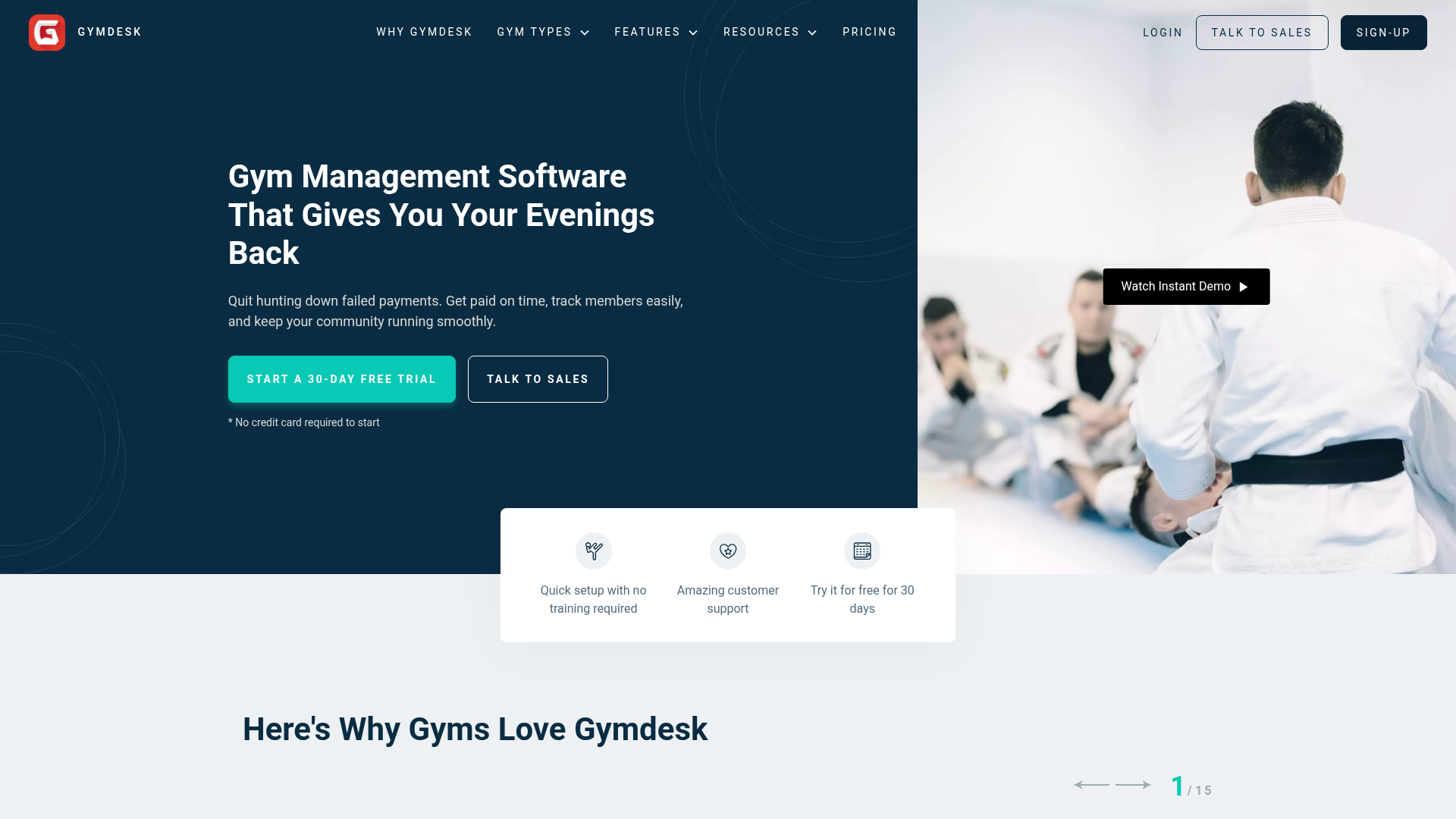
Here's the disclosed-bias entry. I'll keep it specific so you can check it.
Gymdesk started as martial arts software, and the rank-and-curriculum engine is still the oldest and deepest part of the product.
Promotions tie to real criteria the platform tracks: attendance, skills, time in rank, hours on the mat.
It surfaces who's eligible for a stripe or a belt, so grading isn't a memory exercise.
It supports BJJ belts and stripes through black, karate kyu/dan, taekwondo geup/poom, judo kyu, and custom systems. You can read more on how Gymdesk handles attendance and progression.
The rest of the academy stack is native, not bolted on: family memberships with sibling discounts, multi-program scheduling for gi/no-gi or kids/adults, parent-signed digital waivers, automated recurring billing with failed-payment recovery, and a member app included at every tier.
Pricing is flat by member count with Gymdesk Payments: $75/month up to 50 members, $100 for 51 to 100, $150 for 101 to 150, and $200 for 151 to 250. Past 250, you talk to us for a price.
Use your own payment processor instead and it's $25 a month more ($40 on Large). Every feature is included at every tier. Smoothcomp Connect comes with every plan at no extra cost, so you can find tournaments, register your students, and see their results come back to their member records without leaving Gymdesk.
The 30-day trial needs no credit card and no sales call.
Honest limitation: Gymdesk does not have a native AI lead assistant. Its CRM is integrated rather than a standalone product like PushPress Grow.
We have marketing automation, but if an AI tool that qualifies leads and books tours is a priority for you, PushPress is stronger there. That gap is real, so name it before you trial.
The full feature set lives on the martial arts gym software page.
2. PushPress: Best for AI and CRM Features
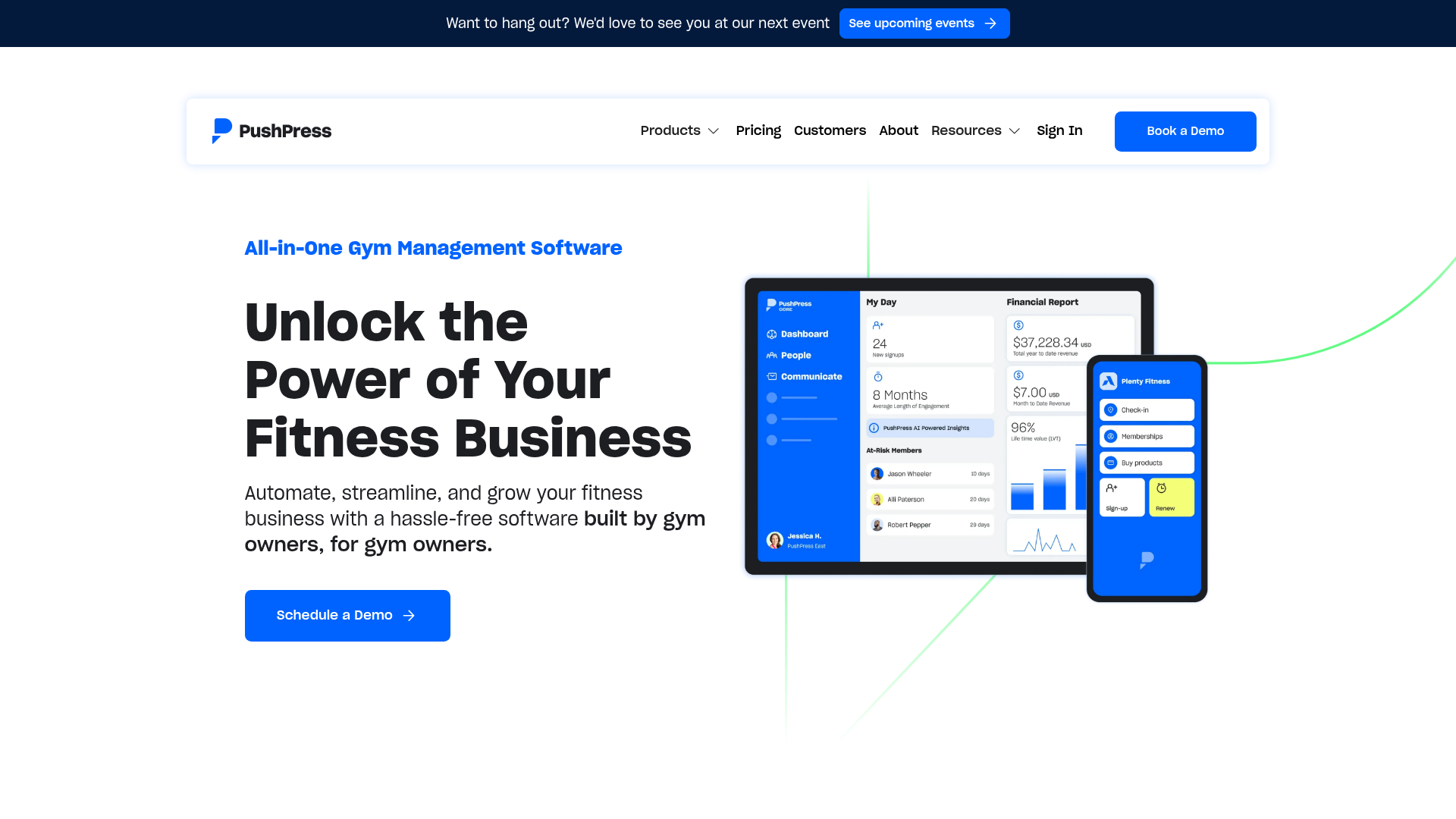
PushPress is a genuinely capable platform and a real competitor. I'm not going to pretend otherwise.
Concede the strengths up front.
It offers a free Core plan with no time limit, and it has the most mature AI and CRM stack in this comparison—the Grow product handles automated SMS, email, and WhatsApp follow-up.
It ships a polished branded member app, and it serves a large base of martial arts schools, including well-known BJJ academies. Paid tiers run $159/month (Pro) and $229/month (Max).
One caveat worth knowing before you trial it: martial arts is a newer vertical for PushPress. They launched dedicated martial arts pages and native rank tracking in 2025.
That's capable, recent work—not a knock, just a fact about how long the features have been in production.
The other thing to watch is cost.
The add-on products (Grow, Train, the branded app) raise the real monthly number meaningfully as you scale past Core. For the deeper breakdown, here's our take on whether PushPress is good for gyms.
3. Kicksite: Best for Small Traditional Dojos
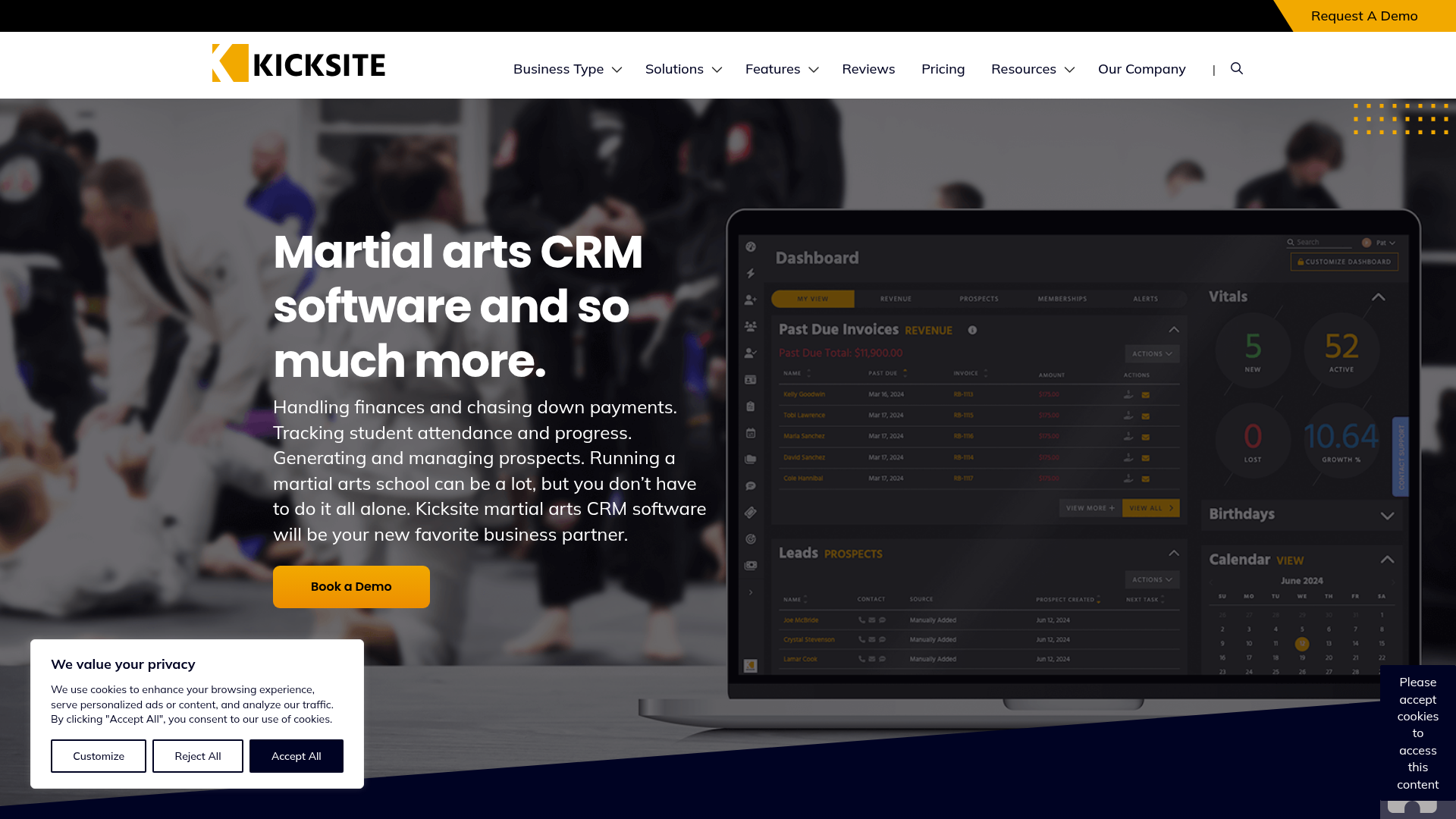
Kicksite is an established martial-arts-only platform, and the pricing is refreshingly transparent.
It handles belt tracking, attendance, and recurring billing competently.
Entry pricing starts at $49/month, scaling by active student count, with all features included at every tier. For a small traditional dojo with simple needs, it's a legitimate, no-surprises option.
Where it falls short: the platform shows its age. The interface and the member-facing experience feel a generation behind the newer entrants, and schools with complex multi-program or multi-location needs tend to outgrow it.
4. Zen Planner: Best for Established Multi-Discipline Studios
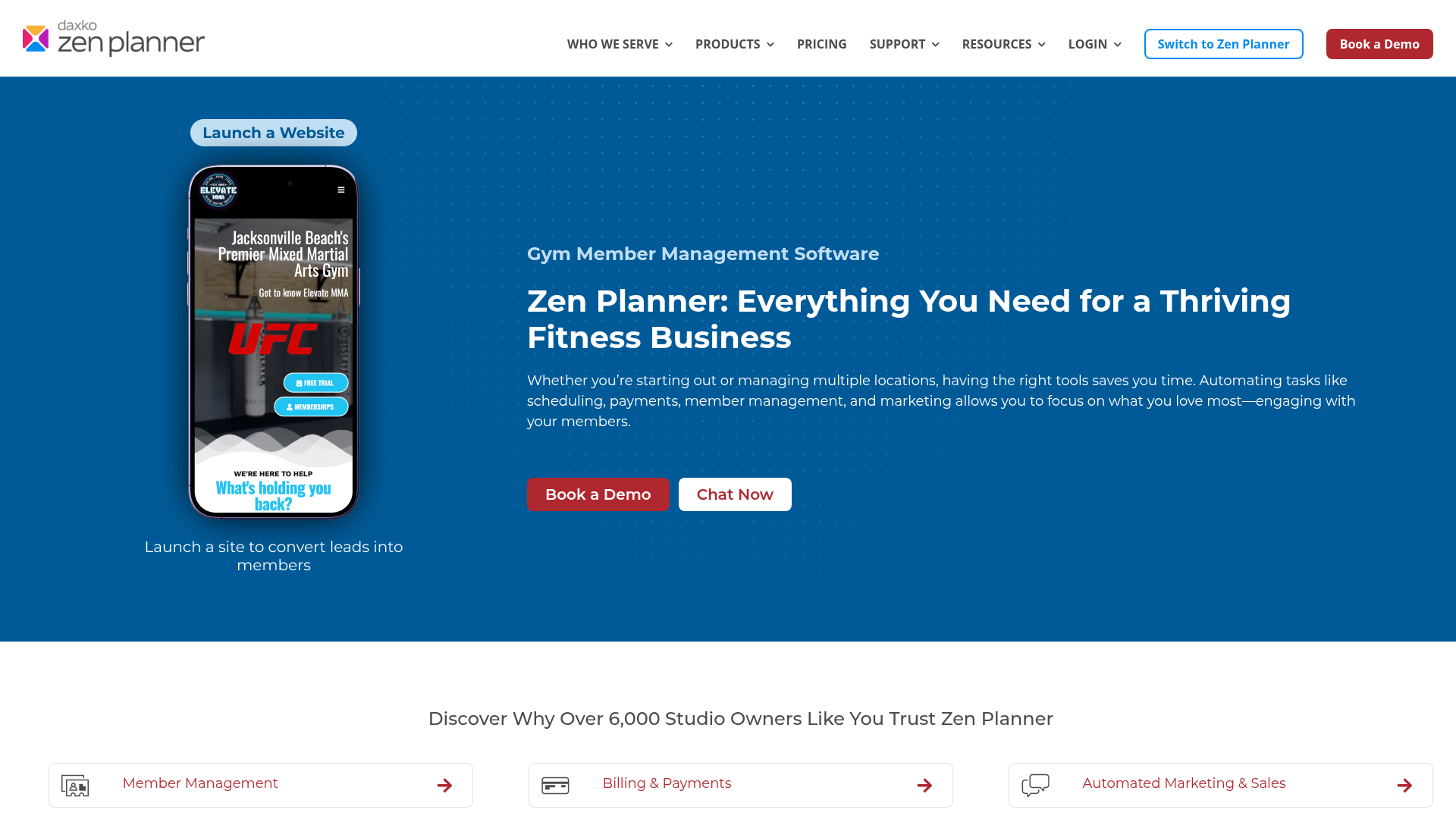
Zen Planner is a mature, broad platform with real martial arts support: belt and skill tracking, scheduling, billing, member management. It's a reasonable fit for an established multi-discipline studio that wants a long track record behind its software.
The catch is the pricing.
Studio, the core product, starts at $99/month—but the things a modern school expects are unbundled add-ons. Website is $99/month, the Engage marketing module is $249/month, the branded app is $39/month.
Stack two or three of those and the real monthly cost is well north of the advertised base.
Zen Planner is also part of Daxko, a large parent company, which in our experience tends to mean a slower pace of product updates than the independent platforms.
5. Martialytics: Best for Grading-First Schools

Martialytics is the specialist's pick.
It was built around the attendance-and-grading engine, and for a school where belt progression and grading events are the center of gravity, the rank-tracking depth is genuinely excellent. Pricing starts at $69/month for 50 students and scales per active student, with a 30-day trial and no feature lockouts.
Honest limitation: the depth is concentrated in rank and attendance. Billing, CRM, marketing, and the member app are lighter than a full-platform competitor.
If grading is your priority and you're fine running marketing elsewhere, that trade is worth it. If you want one system for everything, it's a gap.
6. Spark Membership: Best for Marketing-Led Schools

Spark Membership leans hard into lead generation and sales automation.
For a school where enrollment is the bottleneck, and the owner wants automated follow-up, sales pipelines, and lead nurture as first-class features, Spark has a real story.
Where it falls short: the operational features—rank tracking, scheduling, billing—feel secondary to the marketing engine, and at $199/month it's priced like a marketing tool, not a budget back-office one.
If your pain is "I can't fill classes," Spark is worth a demo. If it's "my back office is a mess," start elsewhere.
7. Wodify: Best for MMA Gyms with a Performance Focus

Wodify came out of the CrossFit world, and its strength is performance and workout tracking.
For an MMA gym that programs serious strength-and-conditioning and wants athletes logging sessions and tracking numbers, Wodify's performance depth is real.
List pricing starts at $199/month per location, before promotional discounts.
For a traditional martial arts school, though, it's built around the wrong center. Rank tracking is limited next to the martial-arts-native platforms, and the performance depth is overhead you won't use if your school runs on belts, not barbells.
8. RhinoFit: Best for Budget-Conscious Schools

RhinoFit is the budget option.
It covers the operational basics—membership management, scheduling, billing, and rank tracking—at a low price point.
The standard plan runs around $57/month (pricing is promo-driven, so confirm the current rate), and there's a genuine start-up tier at $0/month for very small schools (20 or fewer active users and under $2,500 processed per month, with feature restrictions).
You can feel the price, though. The member app and the automation features are lighter than the mid-tier platforms, and the start-up tier's limits are real.
For a brand-new school watching every dollar, RhinoFit is a defensible starting point. Most schools outgrow it.
9. Mindbody: Best for Large Studios with Wellness Crossover

Mindbody serves the wider wellness industry—spas, salons, yoga, fitness—and runs a consumer-facing marketplace that can send new leads to businesses listed on it.
For a large studio with genuine wellness crossover, that reach is a real consideration. Mindbody advertises a $79/month per-location starting price, and every tier is quote-based.
The problem for a dojo: Mindbody has no native martial-arts rank tracking.
For a martial arts academy, that's close to disqualifying on its own. You'd be back to spreadsheets for the single most martial-arts-specific job on the list. Mindbody is built for wellness, and it shows the moment you point it at a dojo.
The Best Software by Martial Arts Discipline
| What matters most | BJJ academies | MMA & Muay Thai | Karate / TKD / traditional |
|---|---|---|---|
| Native stripe / belt & rank tracking | ✓ | – | ✓ |
| Custom rank system (kyu/dan, geup/poom) | – | – | ✓ |
| Multi-program scheduling (gi/no-gi, striking/grappling) | ✓ | ✓ | – |
| Family billing with sibling discounts | ✓ | – | ✓ |
| Per-program capacity limits & instructor payouts | – | ✓ | – |
| Parent-signed digital waivers & testing-event fees | ✓ | – | ✓ |
Rank systems, scheduling complexity, and family-billing patterns differ enough across disciplines that it's worth choosing software discipline-by-discipline rather than from a generic feature list.
BJJ academies. BJJ runs on gi/no-gi scheduling and stripe-and-belt progression through black. Open mat sits alongside structured classes, and family plans matter because parents and kids often train together.
This is the most software-sensitive discipline on the list—enough nuance that we wrote a dedicated BJJ gym software comparison for the deep dive.
The short version: native stripe-and-belt tracking and reliable family billing are the two features that separate a real BJJ platform from a general one.
MMA and Muay Thai gyms. These gyms run multi-program schedules. Striking, grappling, MMA, and conditioning each run on their own timeline, with fight-team training and drop-in pricing for fight camp layered on top.
Membership models get complex fast, because you're managing tiered access by program alongside multi-coach classes and instructor payouts. What matters most here: class capacity limits per program, attendance tracking by discipline, and reporting that shows which programs actually pay the rent.
Karate, taekwondo, and traditional schools. Traditional schools live on structured kyu/dan and geup/poom curricula, with big kids programs, family memberships, and testing events that carry their own fees and waivers.
Rank-system integrity is everything: the promotion history has to be accurate per student across years. The features that matter are custom rank progression, family pricing, parent-signed waivers, and a member app where families can see milestones coming.
Running a karate, taekwondo, or Muay Thai school? Here's the short answer for your style. BJJ owners, yours is in the FAQ below.
What's the best software for a karate school?
Look for custom kyu and dan ranks, belt tests you can run as an event, and testing fees that bill on their own. Gymdesk handles all three.
It supports kyu/dan and flags which students meet your requirements for the next belt.
Promotion fees charge to the card on file, family plans included. Kicksite is a solid lighter option for a small dojo, and Martialytics fits a school built around grading.
What's the best software for a taekwondo school?
Taekwondo schools run geup and poom ranks and usually a large kids' program. Rank tracking and family billing matter most.
Gymdesk supports geup/poom and lets you set a minimum age as a promotion requirement. Family plans get automatic sibling discounts. King Tiger Taekwondo in Harrisburg runs on it.
For a martial-arts-only alternative, Kicksite and Martialytics both handle belt tracking.
What's the best software for a Muay Thai gym?
Plenty of Muay Thai gyms don't run formal ranks. What matters more is selling class packs and drop-ins, and keeping the fight team's schedule apart from fitness classes.
Gymdesk handles session-based memberships and drop-in pricing on any class. Each program runs on its own schedule. If you grade with khan or prajied, you can build that as a custom rank system.
If your gym leans hard into strength and conditioning, look at Wodify too.
Waivers, Minors, and Compliance: What to Check
If you run a kids' program, every child on the mat needs a waiver signed by a parent or guardian. Every student also needs a membership agreement on file.
On paper, that's a filing cabinet and a guess about who's missing. Good software should handle four things for you.
Guardian signatures set by age. You pick the age cutoff. The software asks for a parent or guardian signature on any student under it, and it can require the student to sign too.
Signing during sign-up and booking. Waivers and agreements show up in the online sign-up form and the booking flow. Families arrive with the paperwork done.
Expiry alerts. If your waivers renew every year, the system should flag one a week before it lapses. Otherwise you find out after a kid trained on an expired form.
Records you can find. Signed copies belong on the member's profile, next to emergency contacts and medical notes. You also want a bulk download for the day your insurer asks for everything.
Gymdesk covers all four. You set the guardian age and whether both signatures are required. Waivers attach to memberships, so they appear at sign-up.
Documents can carry an expiry date with an alert a week before it. Every signed copy lives on the member's profile as a downloadable PDF.
One honest limit: software stores and tracks your waiver, but the wording is on you. Whether a minor's waiver holds up depends on where you operate. Have a local attorney review it.
How to Choose the Right Martial Arts Software for Your School
Three questions cut through vendor marketing faster than any feature comparison. Ask them in every demo.
3 QUESTIONS BEFORE YOU CHOOSE:
1. Does it track rank natively, or am I still keeping a spreadsheet? If the platform's answer is an "achievements" field or a workaround, you don't have rank tracking. You have a place to type things. Native rank progression with per-student history is the floor, not a premium feature.
2. Does family billing work without manual monthly math? Have the rep set up a family of four with a sibling discount, live, during the demo. If it takes more than two minutes, or involves the word "manually," you've found a recurring chore.
3. What's the true monthly cost after add-ons? Not the headline base. Add the website, the branded app, the marketing module. A $99 base that becomes $387 fully loaded is a $387 platform. Make the vendor tell you that number. If Gymdesk and PushPress are both on your shortlist, you can run the cost comparison yourself instead of taking either rep's word for it.
Then a quick read on school size. Solo and small schools want simplicity, value, and a low-friction trial. You do not have a back-office admin, so the software has to be runnable by you between classes.
Established multi-discipline or multi-location schools can justify more reporting depth, and should weigh how the platform handles scale. If you're not sure which bucket your school is in, the martial arts growth diagnostic can help you place it.
Given the disclosure I've already made: for most independent martial arts academies, the honest recommendation lands on Gymdesk, because it's built for this, the pricing is flat, and the trial is full. But if the three questions above point you somewhere else for your specific school, go there.
Martial Arts Academies Need Software Built for the Mat
For a martial arts school, belt progression and family billing and minor compliance aren't edge cases. They're the operating model.
A platform that treats them as first-class features will always beat one that adapted them from general fitness software. The adaptation shows the first time you try to run a grading event or set up a family plan.
That's the honest case for martial-arts-native software—and yes, the case for Gymdesk is part of it. It was built for academies, the pricing is flat, and you can run your whole school on the 30-day trial before you decide, no sales call.
Give it a real week:
- Set up your programs.
- Import your students.
- Run a week of real classes.
- Run a mock promotion.
Then decide whether it fits.
If it doesn't, the list above is complete on purpose. Pick the right one of the other eight. Bias disclosed, every option on the table, your call.
That's how a comparison is supposed to work. And whichever platform you choose, the software is the floor: it handles the member management so you can spend your hours on the mat instead of the back office.
FOR MARTIAL ARTS ACADEMIES
Rank tracking, family billing, multi-program scheduling, and parent-signed waivers—native, not bolted on. Run your whole school on the 30-day trial before you decide. No credit card, no sales call.
Start the free trialGym management software that frees up your time and helps you grow.
Simplified billing, enrollment, student management, and marketing features that help you grow your gym or martial arts school.


FAQ
Martial Arts Management Software FAQs
Here are the questions martial arts school owners ask most often when comparing platforms.

Sean has spent the last decade creating content that helps businesses—small and not so small—grow smarter to allow operators to do more of what they love. You know, the fun stuff.
From shipping and international logistics to web development and marketing, he's done the work (not just the words) to scale retail and service businesses efficiently.
You can find his work at Sendle, Shogun, The Retail Exec, Gymdesk, and more.