

There is no universal karate belt order.
Belt progression depends on style, organization, and how a school structures its curriculum. This is exactly why parents keep finding contradictory answers online and showing up confused.
As an academy owner, you've probably heard this question: “What belt comes after yellow?”
Students and parents are often confused about the karate belt order—the list they found online doesn't match what their dojo uses.
At this point, people outside the industry are hit with the unexpected realization.
In karate, the belt order isn't universal.
The belt order depends on your style, your organization, and how you’ve structured your curriculum.
According to the World Karate Federation, there are more than 100 million Karatekas worldwide, and 3-4 million in the United States.
Here's why this matters. There are thousands of studios operating nationwide—each with its own curriculum structure and promotion standards.
If you’re running a school—or explaining belts to families—this guide will give you a clear, authoritative reference you can share with your students and parents.
Think of this as the explanation you wish every student and parent would read before asking about belts.
100 million+ karatekas worldwide, with 3-4 million in the United States
3-5 years average time from white belt to black belt for adults training 2-3 classes per week
50% of martial arts students drop out within the first year — clear belt progression is one of the strongest retention tools
The Standard Karate Belt Order Progression
Let's take a look at the most common belt order progression that's used by most types of karate dojos.
This is the simple answer your students and their parents are looking for:
- White belt: These are beginners learning the basics of being a Karateka—etiquette, fundamentals, and culture.
- Yellow belt: These students are introduced to basic katas and techniques, which build coordination.
- Orange belt: Students improve their strength, balance, and consistency as they perform their techniques.
- Green belt: Your students are expanding their inventory of techniques, combinations, and movements.
- Blue belt: At this rank, students work to develop their timing, control, and intermediate skills.
- Purple belt: Your students work to refine the techniques they already know, and they begin introducing more advanced drills.
- Brown belt: Advanced preparation and rigorous preparation before testing for their black belt.
- Black belt: Students who achieve their black belt begin advanced-level study.
This is the progression that most modern karate schools teach, particularly in North America.
That said, it’s important to emphasize to families that differences in belt progression are normal and to be expected.
Understanding the Kyu and Dan Ranking System
It seems natural, but terms like 8th Kyu or 1st Dan can be confusing to Western audiences.
Here’s the simple explanation you can share with students and parents:
RANK TYPE | WHAT IT MEANS | HOW IT WORKS |
Kyu ranks | Ranking before black belt | Numbers count down (i.e., 10th kyu to 1st kyu) |
Dan ranks | Rankings after black belt | Numbers count up (i.e., 1st dan to 10th dan) |
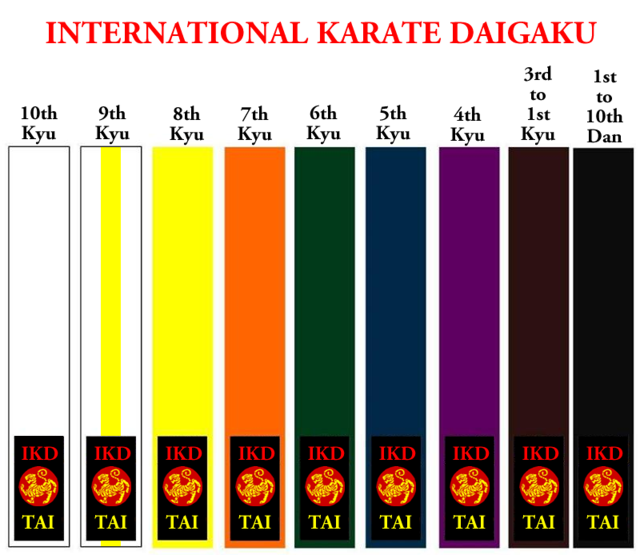
This is similar to the ranking systems used in many different types of martial arts, though karate remains one of the largest and most widely recognized.
Parents and adult beginners often arrive comparing karate to BJJ specifically — our karate vs jiu-jitsu comparison covers the differences in belt timelines, training format, and what each art is best for.
Why Different Schools Have Different Belt Orders
Belt progressions are different from school to school—belt systems aren't standardized globally. There’s no governing body that supersedes the promotion criteria.
Instead, there are many governing bodies, each with its own criteria.
They’re influenced by several factors, including individual styles, associations, and even the head instructor’s preferences. This can be confusing.
Strong communication is key here; there's no need to overcomplicate things.
When students and parents ask, “Why is your belt order different from the one I saw online?” hit them with a simple answer.
There's no universal karate belt system.
It's probably no surprise, then, that there are slight differences from school to school. There are several reasons for this variation.
The four major karate styles
While there are 10+ styles of Karate, four are recognized globally.
- Shotokan Karate: This style is known for deep, long stances and powerful, linear strikes. It was popularized by the father of modern Karate, Gichin Funakoshi.
- Goju-ryu Karate: Translates to "hard-soft" style; it’s an adaptive style that combines hard linear strikes with circular, fluid movements, focusing on breathing techniques.
- Shito-ryu Karate: Known as the style of a thousand kata (forms). This is a technically demanding style that draws on techniques from both the Shuri-te and Naha-te traditions.
- Wado-ryu Karate: A style that incorporates Jujutsu principles. Wado-Ryu focuses on body mechanics, evasion, movement, and agility over the raw power of Shotokan.
These styles originated in different regions of Japan, so their belt structures evolved alongside their teaching methods. This is why each style uses slightly different belt progressions.
Belt order variations by style
It’s important to note that organization affiliation often has a bigger impact on belt order than the affiliation style itself.
Two Shotokan schools in the same city can run totally different progressions depending on whether they're JKA, ISKF, or independent.
Here’s a breakdown showing how belt systems differ across these four major karate styles.
STYLE | BELT VARIATIONS YOU MAY SEE | DETAILS |
Shotokan | White, Yellow, Orange, Green, Blue, Brown, Black | It's common for purple belt to be omitted |
Goju-ryu | White, Yellow, Orange, Green, Brown, Black | This style uses fewer intermediate belts |
Wado-ryu | White, Yellow, Orange, Green, Blue, Brown, Black | This style is very similar to Shotokan |
Shito-ryu | White, Yellow, Orange, Green, Blue, Purple, Brown, Black | Frequently includes purple belt |
Differences between academies aren’t the exception; they’re the rule.
If students decide to transfer between schools, these differences become a source of confusion.
Organization-level differences
Even within the same style, competing organizations create their own ranking standards.
Governing bodies include:
- Japan Karate Association (JKA)
- World Karate Federation (WKF)
- International Shotokan Karate Federation (ISKF)
To complicate things further, each school sets its own standards and requirements, which include:
- Required techniques
- Minimum training time
- Testing standards
- Promotion timelines
What does this mean then? If you compare two Shotokan schools side by side, they may have slightly different belt structures, even though they're part of the same style.
So how do you deal with this?
The most successful schools take the time to clearly define and document their standards. This is something every head instructor should practice while training instructors and staff to maintain consistent expectations across classes.
American vs traditional Japanese systems
Then there's geography.
Geography is another major reason belt systems differ. It's common for traditional Japanese systems to use fewer belt colors.
As karate spread internationally (especially to the US), additional belts were added to create more frequent milestones for students.
This is why you see colors like purple, blue, and red more frequently in Western karate programs.
Why the extra belts?
From a school-owner perspective, these extra belts keep students motivated as they train. These aren't simply cosmetic add-ons or a covert cash grab. They're helpful tools that maintain training momentum and keep students interested.
Here's why this matters: A 2018 study found that 35% of martial arts students were between the ages of 10 and 19; participation decreased with age for a variety of reasons.
Structured progression functions as a powerful retention tool for academy owners and a helpful motivation tool for students. Each style/school sets its own curriculum, so the colors may vary—but the emphasis is the same: Competence, proficiency, then mastery over time.
What Students Are Really Learning at Each Belt
This is a point that parents are confused about.
Karate belts aren’t just trophies or rewards—they’re milestones and curriculum markers.
They're used to:
- Track technical progress
- Create motivation milestones for students
- Create structure for long-term learning
- Build student confidence as they make achievements
Treat these belts like grade levels in school. When these belts are missing, student progression becomes fuzzy and confusing; that's a problem because unclear progression leads to student disengagement.
From a teaching standpoint, your student's belt ranks are more than promotions. They're progress indicators that serve as milestones for your student's stages of development.
Here’s how that progression (typically) looks:
STAGE | BELT RANGE | CORE FOCUS |
Beginner | White-to-orange | Learning fundamentals |
Intermediate | Green-to-blue | Applying techniques, building competency |
Advanced | Purple-to-brown | Technical refinement and control |
Mastery | Black belt | Leadership and mastery |
Clear student progression is a strong predictor of long-term student retention. If your students know the outcome they're pursuing, they’re much more likely to stay engaged and motivated.
Strong karate schools invest time into: (1.) building consistent training structures and (2.) maintaining a healthy culture in your dojo. Creating a positive culture in your martial arts school is a key retention strategy.
Karate Belt Colors and What Each Level Means
Okay, the families in your school understand the karate belt order. Their next question will probably be: What does each belt actually mean?
From a practical standpoint, karate belts are about symbolism; they’re signifiers that indicate progression, skill development, and readiness.
Every promotion your student receives should reflect verifiable progress with the fundamentals—kihon (basic techniques), kata (forms), and kumite (sparring).
Structure makes this so much easier.
If you have structured martial arts lesson plans in place, student progression is consistent and repeatable. Every instructor teaches from the same roadmap, the same lesson plans, but one student knows, they all know.
When this happens, your students' growth becomes predictable—it's something parents can see and track over time.
Let's take a look at how you can explain each karate belt level to families in your school.
BELT | KYU RANK | TIME IN RANK | KEY FOCUS |
White | 10th–9th | 3–6 months | Stances, basic blocks, dojo etiquette |
Yellow | 8th | 3–6 months | Stance transitions, combinations, directional movement |
Orange | 7th | 3–6 months | Complex block combos, kicking control, balance |
Green | 6th–5th | 4–6 months | Controlled sparring, kata complexity, advanced combos |
Blue | 4th | 6–9 months | Timing drills, sparring under pressure |
Purple | 3rd | 6–9 months | Refined sparring, strategy, tactical thinking |
Brown | 2nd–1st | 12–18 months | Advanced tactics, teaching fundamentals, leadership |
Black (Shodan) | 1st dan | 3–5 yr adults / 5–8 yr kids | Technical refinement, teaching, dojo leadership |
White belt (beginner)
Most students walk in excited but unsure what to expect.
This stage isn't really about technique—it's about teaching them how to stand still, listen, and move with control. The front-kick catches up later.
Skills developed: Basic stances (front, horse), the three core blocks, straight punches, front kicks, and a first introductory kata — all of it built on top of learning dojo etiquette.
What parents see: The child comes home calmer and more willing to follow instructions at home. That's usually the first signal the belt system is working, not the technique.
Watch out for the "is my kid ready for a promotion?" question—it shows up fast at white belt, before anyone fully understands what promotion means.
Setting clear standards upfront is how you stop status-chasing from taking over.
If you haven't already, take a minute to go through the stages of learning in martial arts. White belts are firmly set in the cognitive stage—they’re learning what to do, they're not really aware of how to do it.
Yellow belt
These are your novice students.
This is where your new students begin to take their first steps forward. They're no longer learning isolated movements; they're beginning to chain techniques together.
What students learn: They're learning the principles and systems that govern karate. At yellow belt, students typically develop stronger transitions between stances, expanded kata and basic combination techniques.
At this stage, students lean into repetition and training consistency. This is where they begin moving from conscious to unconscious competence, performing movements more naturally.
What parents typically notice: Parents often comment on the small wins their child has achieved and their growing enthusiasm for training.
Motivation is essential here.
Many new students quit during their first year; understanding why kids quit karate is so important. It helps with student motivation, providing instructors with the tools they need to minimize unnecessary dropout.
Orange belt
This is where unconscious competence takes off.
At this rank, your students' excitement matures into quiet confidence that's backed by evidence. They're no longer beginners; they're competent practitioners, and they're beginning to put the pieces together.
What students learn: At orange belt, students typically focus their attention on building more complex blocking combinations, improving kicking control, expanding kata sequences, and beginning basic sparring drills.
Students at orange belt are focused on building consistency. It's a challenging habit to build, especially if they've been waiting to spar with their peers.
What parents typically notice: Parents begin to notice that their child has significantly improved their balance and developed strength throughout their movements. They have greater confidence when interacting with their peers.
This is typically where instructors begin noticing the internal changes in their students—a greater sense of personal discipline. Their orange belts arrive focused and ready to train.
Green belt
These students are no longer beginners.
In many belt orders, this is the halfway mark. Green belt is the rank where students move from beginner to intermediate practitioner.
This change can be jarring—students at this rank are much more technical, but karate itself begins to feel more technical. This can be challenging and difficult for students.
What students learn: At green belt, focus their attention on adding more powerful kicks, building competency with light and controlled sparring, and expanding kata complexity.
At this rank, instructors typically encourage their students to focus on precision and timing. This is especially important as sparring now plays a more dominant role in their training.
What parents typically notice: Parents often see a marked increase in their child's athletic ability. Their consistent training has led to increased patience and a willingness to persevere when facing challenges.
From a curriculum perspective, this is where strong structure becomes essential. Many schools rely on carefully designed martial arts curriculum frameworks to ensure students develop the right skills at the right time.
Blue belt
These students look like martial artists.
Your blue belt students look like experienced martial artists. They display the unconscious competence of an experienced practitioner; they're able to weave techniques together, with a natural, fluid flow.
What students learn: As a blue belt, students focus their attention on: timing and reaction drills, controlled sparring development, advanced blocking sequences, and more demanding kata performance. Here's what makes blue belt so significant. Students are learning to apply core techniques under pressure. It's no longer just about drilling.
What parents typically notice: Parents see a new level of training and intensity in their child. They frequently make comments like: “They look more serious about training now, their confidence has really grown, or they’re taking responsibility for practice.”
This stage often marks the shift from casual participation to long-term commitment.
Purple belt (where used)
This belt is an introduction to advanced belts.
This belt isn't used universally. Some schools use it, some don't. The ones that do tend to use this belt as a milestone between intermediate and advanced training.
What students learn: Purple belt students focus on developing refined sparring techniques, and a greater sense of control and accuracy throughout their technique. They spend more time focused on advanced kata complexity, tactical thinking and precise movement. Their defensive reactions are unconscious and automatic.
At this rank, it's no longer just about technique. This is where students expand their focus to include strategy and tactics.
What parents typically notice: Parents frequently mention that they see more independence and creativity from their child during training; there’s a significant improvement in physical conditioning
At this rank, parents and instructors notice that their students are showing a new level of creativity and independence. They're using what they've learned to develop their own style.
Brown belt
This belt is a stepping stone to advanced training.
Brown belt is the final rank before black belt. It's also one of the most demanding phases of training to work through. The expectations from students at this rank are heavy—they’re preparing to take on advanced-level expectations.
What students learn: Here's what's expected from students at this final step:
- Advanced sparring strategies and tactics
- A consistent display of high-level kata
- Multiple combination techniques
- Leadership skills and mentoring
- Physical conditioning improvements
It's common for many schools to introduce assistant instructor responsibilities for students at this rank.
What parents typically notice: Parents often report an increased level of maturity in their child. Strong leadership qualities and a willingness to teach and serve others and increased self-discipline overall.
This is where instructors begin a deeper evaluation of a student's character.
Black belt (Shodan — first degree black belt)
One of the biggest misconceptions about the black belt is the belief that it represents mastery. This seems to be a common belief across martial arts.
In reality, the word Shodan means “first step.” A student's black belt marks the transition from beginner-level training to advanced-level study.
What students learn: As a black belt, students typically focus on advanced technical refinement—they begin teaching fundamentals to up-and-coming students. They lead from the front, displaying outstanding leadership and mentoring within the dojo.
These black belts display digh-level sparring strategy and tactics. This isn't the end of their learning, it's the start of a deep, lifelong journey.
What parents typically notice: Parents usually recognize their child's role as a leader in their dojo. Their child projects strong confidence and technical proficiency. Their peers recognize them as a leader in the gym.
Over time, parents come to realize that their child's black belt journey produced far more than physical skills—it built habits that transferred into their school, work, and life.
How Long Does It Take to Earn Each Karate Belt?
Karate Belt Timeline Calculator
Estimate how long it takes to reach black belt from your current rank
Based on averages. Individual school standards and student progress vary.
Here's another question parents ask almost as often as the karate belt order. “How long will it take my child to get a black belt?”
The unsatisfying answer is that it depends.
It depends on the consistency and effort students put in, as well as the standards you've set at your school.
On average, it takes anywhere from 3–5 years of consistent training (e.g., 2–3 classes per week) for adults to progress from white to black belt in karate. If we're talking about kids, that timeline is usually longer, 5–8 years; younger students require more repetition and maturity.
The average time between karate belt levels
Every school structures its promotions a bit differently. Here's a breakdown of the promotion timelines used by many karate schools across the country.
BELT LEVEL | TYPICAL TIME IN RANK | FOCUS OF TRAINING |
White-to-yellow | 3–6 mo. | Fundamentals and coordination |
Yellow-to-orange | 3–6 mo. | Combining skills |
Orange-to-green | 3–6 mo. | Balance and control |
Green-to-blue | 4–6 mo. | Refining technique |
Blue-to-purple | 6–9 mo. | Sparring and timing |
Purple-to-brown | 6–12 mo. | Advanced technique control |
Brown-to-black | 12–18 mo. | Technical mastery and leadership |
So here are some important assumptions about these timelines. These promotion timelines assume students have consistent attendance, usually 2–3 classes per week. We also assume that our promotion schedule gives students enough time to develop.
Factors that affect student promotion speed
Each student progresses at their own pace. Some students will progress faster than others. A variety of factors influence promotion timelines on a student-to-student basis.
This is completely normal. Let's take a look at the variables that influence student promotion timelines.
Training frequency
This is the biggest factor that affects student promotion timelines. So if your students train:
- 1x per week, they'll progress slowly
- 2–3x per week, they'll progress steadily
- 4x per week (or more), they'll progress faster
Consistency always matters more than intensity, but only if quality remains high.
Age of the student
Children need consistent repetition. On the other hand, most adults can process and understand instructions faster, but many struggle with flexibility and conditioning.
This is why kids progress slowly.
This is also why kids’ programs often use modified pacing—similar to approaches seen in other martial arts systems (e.g., kids’ BJJ programs).
Individual school standards
As I mentioned earlier, every school sets its own promotion criteria. Karate schools tend to focus heavily on:
- Technical accuracy
- Physical conditioning
- Sparring performance
- Character development
Consistency is the key detail here. When schools set and maintain clear expectations, they’re ensuring that their students meet clearly defined, predetermined benchmarks before they rank up.
Minimum time-in-rank policies
The majority of reputable schools have minimum time-in-rank requirements between belt tests. This ensures students can't skip development stages.
Here's an example of time in rank minimums:
- Beginner belts: 3–4 mo.
- Intermediate belts: 6–9 mo.
- Brown belt: 12+ mo.
Students need time to develop. Without these standards, student promotion becomes a belt factory, inconsistent and difficult to manage.
The “belt factory” warning signs
Schools that promote quickly undermine the value of their belts. These students are being given belts they can't carry. It's a long-term disaster.
Red flags include:
- Student promotions every month
- Guaranteed promotions without an evaluation
- No clearly defined skill requirements
- Students advancing regardless of their performance
This needs to be addressed. When parents bring their kids to class, many assume that faster promotion means better teaching.
In reality, it's actually the opposite.
Rapid promotion is an indicator of poor standards. Good schools take immense pride in their curriculum, milestones, and the standards they have set.
The easier it is to “earn a belt,” the more questionable that belt is.
Managing promotion readiness across dozens of students
Tracking student readiness is a big operational challenge for school owners. If you're managing a large group of students, it can be difficult to give each student the attention they deserve.
If you’re managing:
- 50–100 active students
- Multiple instructors
- Several belt levels
It becomes difficult to remember which student has mastered what skills.
Many schools find they need to move away from manual tracking systems (e.g., paper, post-its, and spreadsheets) and move towards digital tools, enabling instructors to log student performance in real time.
Once you pass ~80 students and you’re managing multiple instructors, paper and post-its stop working. If you continue to rely on manual entry, promotions start depending on whoever taught the last class remembering best.
There’s a better way. Gymdesk is purpose-built for this: every instructor logs what a student has actually demonstrated against the same checklist, so promotion readiness stops being a judgment call and starts being a lookup
It's difficult to create a fair, consistent system when you're relying on memory to manage promotions for 50-100 students.
This digital tracking becomes especially useful when combined with structured attendance methods, as discussed in our guide on attendance tracking for martial arts gyms.
Karate Belt Testing: What Parents and Students Need to Know
Your students are ready for their next big milestone, the belt test. Students and parents want to know when testing will happen, sure.
That's not the most important question.
They want to know what to expect. This is an area that requires clear communication and transparency.
What is a karate belt test?
A belt test is exactly what it sounds like. An evaluation in which instructors confirm that their student has all the necessary knowledge, skills, and experience for the next rank.
Most karate schools focus on four core areas:
COMPONENT | DESCRIPTION | PURPOSE |
Kihon | Basic techniques | Measures technical proficiency |
Kata | Pre-arranged forms | Assesses sequencing and control |
Kumite | Sparring | Tests performance under pressure |
Knowledge | Terminology and etiquette | Reinforces understanding of fundamentals |
As you might have guessed, every school evaluates these elements differently.
While the balance of these elements differs from school to school, virtually all reputable schools evaluate a student's knowledge, understanding, skills, and experience.
How belt testing is structured
Most schools use one of three testing models to evaluate their students. Let's take a look at these options.
Model #1: Formal testing events
Students show up for their belt test on scheduled dates. These events are often set up every 3–4 months. This is the most common model in karate.
This model works well because it:
- Creates clear milestones
- Builds student excitement
- Allows group evaluation
Model #2: Continuous assessment
Some schools evaluate their students during normal classes. Instructors assess their students as they train; students are promoted once they demonstrate they're ready.
This model works well because it:
- Put less pressure on students
- Creates a more individualized evaluation
Model #3: Hybrid systems
It's also common for schools to use a combination of both methods, a continuous evaluation, and formal testing for major promotions.
This is a common approach that some instructors feel is the best of both worlds.
Typical belt testing fees
Testing fees are a standard part of the promotion process at most schools. Fees vary considerably—most reputable schools charge between $25 and $75 per test.
These fees cover:
- Instructor time
- Certification materials
- Belt replacement
- Administrative costs
Fees above $100, especially for beginner ranks, should raise many questions.
How students should prepare for a belt test
Students should begin preparing for their belt test several weeks before the actual test. Students who perform well typically:
- Attend class consistently
- Practice kata at home
- Review technique details with their instructors and peers
- Ask their instructors for feedback
As students prepare for their test, the process fosters ownership and accountability—essential qualities for student leaders.
What happens if a student doesn’t pass?
This is a difficult conversation, especially if parents paid for their child's promotion. It's a conversation that needs to be handled delicately.
In a strong school, not every student passes their belt test. If it's handled poorly, you may push students right out the door.
On the other hand, failing teaches students about:
- Perseverance
- Accountability
- Resilience
Parents want their kids to succeed, so they usually appreciate clear standards, especially if you explain them ahead of time.
Status chasers, not so much.
If you're dealing with a family of status chasers, failure can trigger a conflict or cause parents to lash out. Expect guilt trips, anger, and threats to take their business elsewhere.
When a student fails their belt test, their parent’s reaction (or their own if they’re adults) tells you everything you need to know.
Kids vs Adult Karate Belt Systems
If you're running a school with both kids and adult programs, you already know what I'm about to say.
Kids and adults shouldn’t progress through the belt system the same way. Kids and adults:
- Learn differently
- Learn and grow at different rates
- Need different things from their instructors
- Have different motivation structures
While kids recover quickly, they can’t handle the same high training volumes as mature adults without risking injury or burnout.
Why are we talking about kids?
Research and experience tell us that children aged 6–12 make up the majority of martial arts practitioners. Kids programs are the backbone of most successful dojos; your belt system is an essential component of your retention strategy.
Why kids' belt systems often include more levels
One of the biggest differences between youth and adult programs is the number of belts between white and black. Many adult systems follow the classic progression I mentioned earlier.
It's common for kids' programs to add:
- Extra belt colors
- Stripe systems
- Junior belt designations
Again, these vary from school to school.
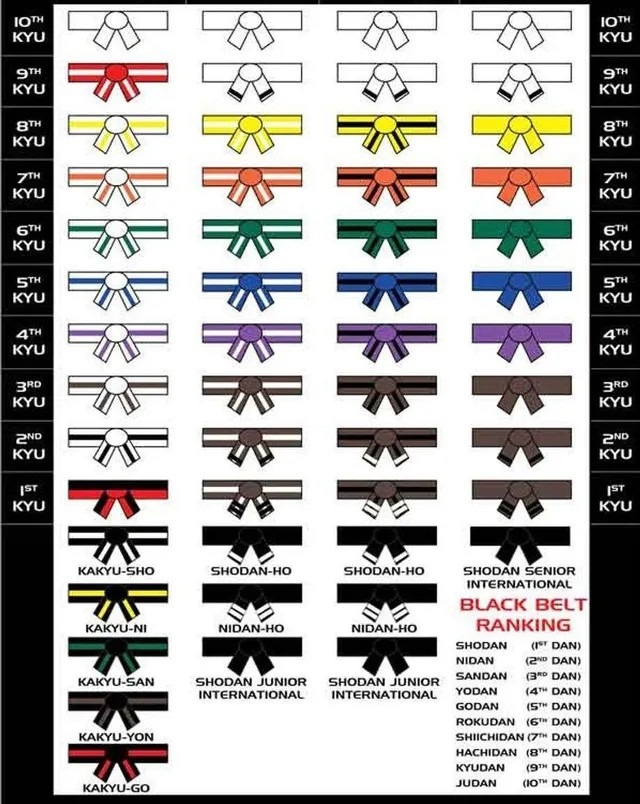
It would be a mistake to assume this is about making things easier. It's actually about keeping students motivated with visible progress and frequent milestones along the way.
It's about reducing drop-offs.
As an instructor, you're trying to get students to make it through their first year. Without these checkpoints, student motivation tends to drop quickly, especially in the first year.
Common kids karate belt progression
Here’s an example of a standard youth karate belt system.
BELT LEVEL | AGE RANGE | PURPOSE |
White | 4–6+ | Introduction to class structure |
Yellow | 5–7+ | Basic coordination drills |
Orange | 6–8+ | Technique competence |
Green | 7–9+ | Movement development |
Blue | 8–10+ | Skill application |
Purple | 9–11+ | Refinement stage |
Brown | 10–14+ | Advanced preparation |
Junior Black | 11–15+ | Pre-black belt phase |
Black Belt | 16+ (most systems) | Advanced training begins |
So kids’ belt systems often spread progress across more stages, even when the techniques are the same. Adding frequent promotions keeps students motivated without sacrificing the high technical standards you've set.
Stripe systems and micro-promotions
Another common belt strategy is using stripes between belt promotions. So instead of waiting months for the next belt, students earn:
- 1st stripe
- 2nd stripe
- 3rd stripe
- 4th stripe
Before advancing to the next color. From an instructor's perspective, belt stripes address two major problems:
- They give students frequent recognition
- They create short-term, bite-sized goals
Again, this helps to maintain engagement—especially during the critical early months when the dropout risk is highest.
This requires a bit of caution, though. Add too many promotions, and you start to look like a belt factory. This means it's important that you strike the right balance between recognition and skill development.
This brings us to the unspoken elephant in the room.
Age requirements for black belt
One of the most misunderstood topics in martial arts is black belt age requirements.
The minimum age for a black belt at most reputable karate schools is 16. Some schools allow junior black belts, but these typically convert to adult black belts only after students:
- Receive additional training
- Go through re-testing
- Meet maturity and leadership expectations
These standards protect the value of the black belt rank. Credibility takes a hit if your school promotes 11-year-old black belts.
Transitioning from kids to adult belt systems
At some point, your students will need to transition to your adult ranking system. This transition is usually handled in one of three ways:
- Method 1: Direct transfer. Students make a 1:1 transfer into the adult system at an equivalent rank—a junior purple moves to adult purple.
- Method 2: Skill-based adjustment. Students transfer based on demonstrated ability rather than belt color—a junior brown moves to adult blue.
- Method 3: Transitional rank. Some schools go with intermediate ranks during the switch. So junior brown moves to brown with a stripe, which becomes adult brown. This method produces the smoothest transitions and feels less like a demotion or loss.
What you'll find is that youth belt systems tend to align more closely with one method or another (e.g., fewer junior belts means a direct transfer or transitional rank works best).
Managing Separate Kids and Adult Curricula
Running parallel belt systems, kids and adult belt programs, creates administrative headaches—especially as student enrollment grows.
Here's what I mean. Take a look at the options below:
- Kids’ curriculum
- Adult curriculum
- Beginner classes
- Advanced classes
Each of these classes may have different promotion requirements. If you don't have the right systems in place, tracking progress becomes overwhelming.
That’s why many schools are switching to digital curriculum-tracking tools.
Digital platforms allow instructors to define the requirements for each program; this keeps everything consistent without relying on paper notes, spreadsheets, or memory. If you run separate kids and adult programs, you can set up each one as its own curriculum inside Gymdesk.
Here’s why this is a win.
When you use a gym management tool like Gymdesk to manage your curriculum and promotions, every instructor teaches towards the same checklist—no more paper binders, no more ‘which version is current.”
Looking to build or refine your student curriculum? Take a look at this guide; it shows you how to build a curriculum for your martial arts school.
How to Tell if Your Karate School Has Legitimate Belt Standards
Is This a Belt Factory?
Answer 8 quick questions to assess belt promotion standards.
Does the school promote students every month or more frequently?
Are belt testing fees over $100?
Are there written requirements for each belt level?
Does every student who tests pass?
Can students explain what they're working on for their next belt?
Is instructor feedback specific to each student's performance?
Are belt requirements the same across all instructors?
Is the curriculum published where parents and students can see it?
Belt systems are only valuable when they're trustworthy. Belt promotions, to be trustworthy, need to be in line with reality.
Standards are markers.
They tell you what competence, proficiency, and mastery look like. They're predetermined, hard-set criteria that students use to determine their position relative to the ideal you've set.
If promotions happen without those standards, students lose trust, parents lose confidence, and the value of every rank drops. The difference between strong schools and weak ones usually comes down to their clarity and consistency.
How many of their students match the standards you've defined?
Red flags that signal weak promotion standards
Most of the families that come to you don’t know what to look for.
As an instructor, you should be able to teach them about the indicators that show a program may not have strong belt standards.
RED FLAG | WHY IT MATTERS |
Promotions every month | Students don't develop fast enough to justify constant promotion |
Testing fees over $100+ | It creates a conflict of interest where instructors are tempted to prioritize revenue over development |
No written requirements | Creates confusion and inconsistency. No one knows what competence, proficiency, or mastery looks like |
Every student passes their belt test | This removes accountability and growth. Student skills aren't in agreement with reality, and people can see it |
Students can't explain what they're learning | This implies that your curriculum's structure is weak |
Remember, your students need to be able to carry their belt. If they're getting promotions before they're ready, it's obvious to everyone.
How do we know? Comparison. Your superstar students create a contrast that communicates a simple message.
Your belt is not like mine.
This slow realization is a retention killer. Students stay longer when progress feels meaningful.
Green flags that indicate strong standards
Strong programs usually share a few consistent characteristics.
GREEN FLAG | WHY IT MATTERS |
Published belt requirements | Sets clear expectations |
Rigorous testing every 3–4 months | Allows time for real development |
Occasional failed tests for poor performance | Reinforces accountability |
Instructor feedback is precise | Helps students improve faster |
Curriculum aligns across classes | Maintains consistency |
So what's the best way to achieve this consistency? Through standardized lesson planning and instructor training.
When every instructor teaches toward the same goals and outcomes, promotions become fair, defensible, and meaningful.
This is something we emphasize in our guide: Training instructors and staff for your martial arts school.
Common Misconceptions About Karate Belts (And How to Address Them)
Every karateka hears the same myths sooner or later.
Most of them aren’t malicious; they come from misunderstanding how student progression works in our martial art. Here are a few of the misconceptions I hear most often. Let's take a look at how we can address them.
Misconception #1: Faster promotions mean better training
This belief shows up constantly.
Parents see another school promoting students faster. They automatically assume that their training must be better.
Speed isn't a good measure; outcomes are.
It's important to explain that your goal isn’t to have students move through the belts quickly. It's to make sure each belt represents real skill, so that each student can carry their belt.
Can those students carry their belt?
Once families understand that belts represent ability, not attendance, expectations are much easier to manage.
Misconception #2: Black belt means mastery
This is probably the most common misunderstanding in martial arts. If you have a black belt, most people assume that this means you have:
- Expert-level mastery
- Completed your training
- Expert-level knowledge
- To register your hands as lethal weapons (lol)
That's not how this works.
In traditional karate, Shodan (first-degree black belt) literally means “first step.”
It’s the beginning of advanced study—not the end. That’s why instructors recommend continuing your learning and training after you achieve your black belt.
Students who understand this develop a healthier long-term mindset.
Misconception #3: Comparing progress between schools is fair
It's common for parents to compare the:
- Belt ranks
- Promotion speed
- Testing schedules
between different schools.
This isn't helpful at all. It's also not accurate. Remember how I said different schools use rankings? They have different:
- Curriculum structures
- Testing standards
- Pacing models
Comparing belts between schools is like comparing grade levels between countries. The structure may be similar, but there are huge differences between the two.
Misconception #4: Belt color matters more than skill
This is a burden that students have to carry. As a result, some students become overly focused on their:
- Next belt
- Next test
- Next milestone
They fixate on these areas, believing they will take them where they want to go. They forget that skill development is the way they get to where they want to go.
An instructor redirect changes this mindset. When students ask, “When do I get my next belt?”
Reframe the question by responding with, “Here's what you need to improve.” This mindset shift changes everything.
Final Thoughts: Belts Are a Journey, Not a Destination
In karate, the belt order isn't universal.
As we've seen, the belt order depends on your style, your organization, and how you’ve structured your curriculum.
The real value of karate belts isn’t the color—it’s the journey and growth behind it.
Every promotion represents:
- Hours of practice
- The challenges and struggles you've overcome
- The confidence earned through competence
- Discipline you've strengthened
The belt itself is just a marker. It's an indication of the growth your students have earned.
As a school owner, the goal isn’t simply to churn out promotions. It's to create a system where families understand:
- What each belt means
- What it takes to advance
- How progress is measured
- Why standards matter
When standards and expectations are clear from the beginning, everyone—students, parents, and instructors—is on the same page.
When everyone is aligned, retention improves. That matters in an industry where the first-year dropout rate is 40–90%.
Schools that succeed long-term:
- Make promotion criteria visible
- Communicate timelines to families clearly
- Set and maintain consistent standards
- Celebrate student progress and achievement meaningfully
When families know exactly where they stand and exactly what comes next, their training and struggle have purpose.
This is exactly what the karate belt ranking system was intended to do from the very beginning—help students to grow, one meaningful step at a time.
Gym management software that frees up your time and helps you grow.
Simplified billing, enrollment, student management, and marketing features that help you grow your gym or martial arts school.


FAQ
.webp)
Andrew McDermott is a gym owner, Brazilian Jiu Jitsu brown belt, and digital marketer. He’s on a mission to build premier, high-stakes grappling tournaments, world-class academies, and a championship team of high-level athletes.


