Shotokan vs Kyokushin: Which Karate Style Is Right for You?
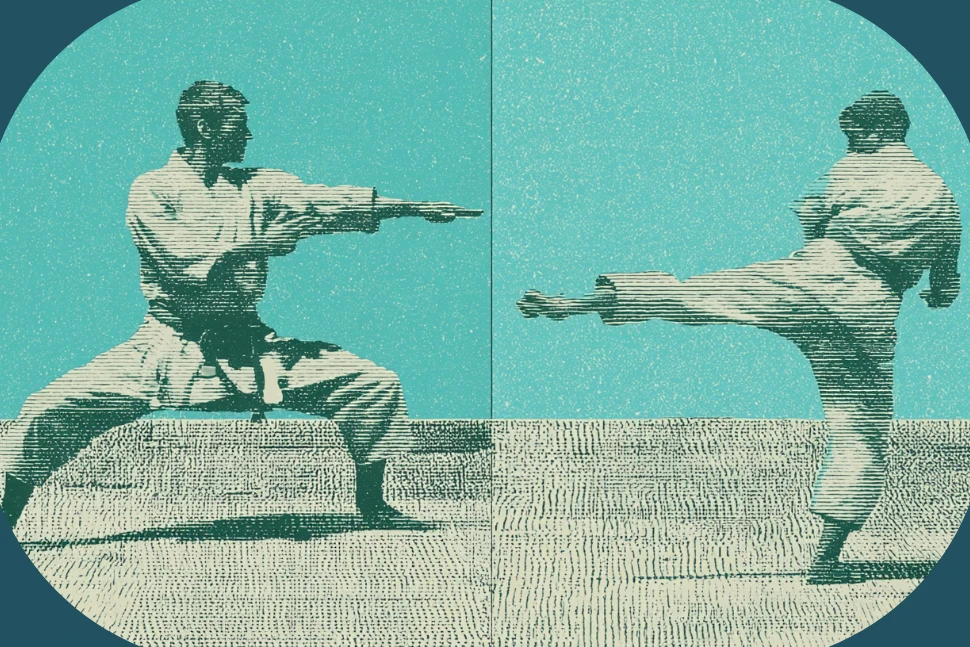
Shotokan and Kyokushin are among the world's most recognized karate styles. While these styles are both considered karate, they train the body for two completely different things.
Shotokan is semi-contact, controlled point sparring. This style is built on long stances, outfighting, precision, and technical proficiency. On the other hand, Kyokushin is a full-contact, knockdown style that’s built on physical conditioning, close-range power, and dealing damage.
Neither style is inherently better than the other.
The choice is based on what you want. Do you value technical precision and control or full-contact toughness and the ability to create damage?
Today, we’ll take a look at the differences between these two styles. We’ll weigh the pros and cons, compare kids' classes, and look at the paths to competition.
Not sold on karate? Take a look at our guide to the different types of martial arts.
How Funakoshi and Oyama Shaped Each Style
Both styles trace their roots to Okinawan karate; however, their founders' philosophies pushed them in different directions.
Shotokan Karate
Shotokan was founded by Gichin Funakoshi in 1936.
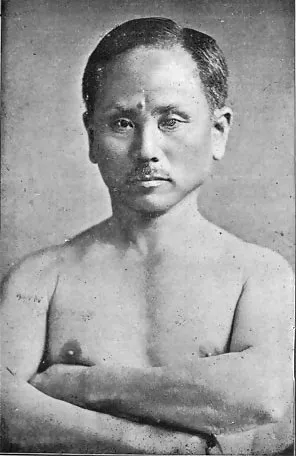
His teachings prioritized discipline, character development, and technical excellence.
Shotokan is well known for precise technique, deep stances, powerful linear movements, and a systematic refinement of kata and kumite. Funakoshi’s students would go on to establish the Japan Karate Association (JKA) in 1949.
This organization helped to solidify Shotokan with a standardized curriculum. With these standards in place, Shotokan would spread internationally.
Kyokushin
Kyokushin was founded by Masutatsu (Mas) Oyama in 1964.
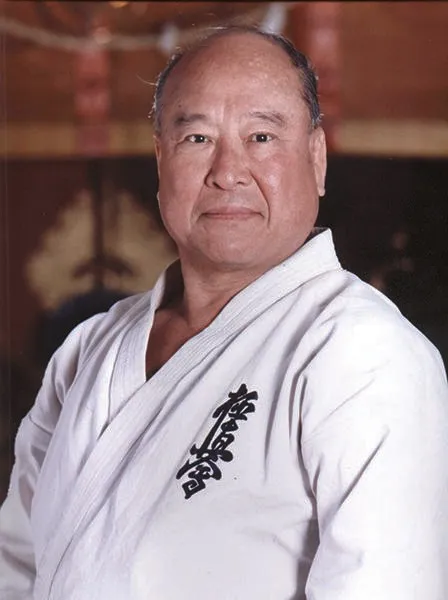
His goal was to create a karate style that could be tested through realistic, full-contact competition.
Kyokushin quickly gained a reputation for demanding physical conditioning, powerful striking, and challenging knockdown tournaments.
Today, Kyokushin is managed by the International Karate Organization (IKO) and other related organizations formed after Oyama's death.
Shotokan vs Kyokushin at a Glance
Here's how the two compare on founding, sparring rules (kumite), forms practice (kata), conditioning, and competition—including the World Karate Federation (WKF) point-karate lineage.
Kumite: Semi-Contact vs Knockdown Sparring
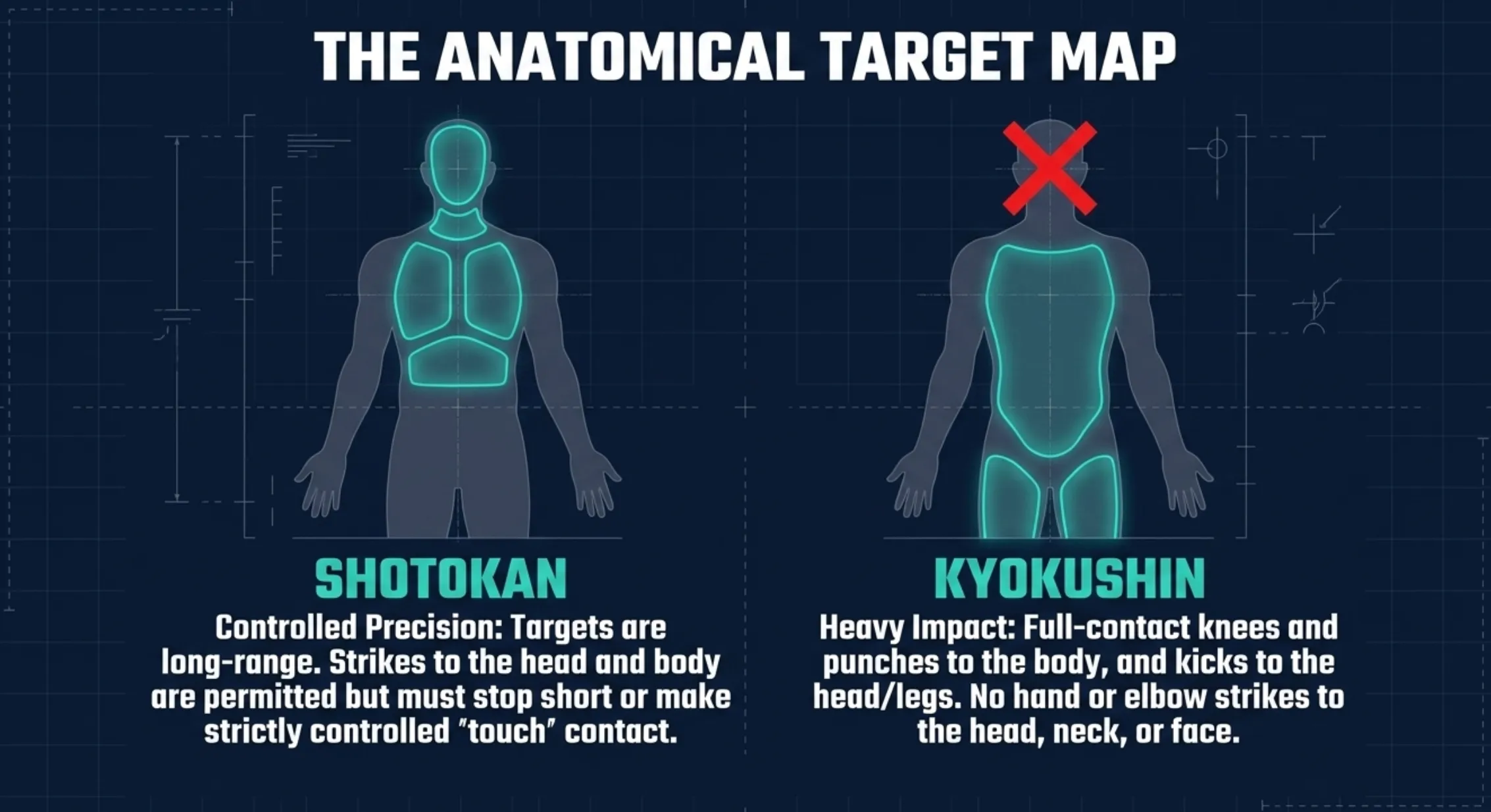
The biggest difference between Shotokan and Kyokushin isn’t so much about the curriculum (although there are differences); it’s how practitioners spar and compete.
Shotokan Kumite
Shotokan kumite prioritizes speed, timing, distance management, and technical precision.
Competitors are trained to be purists—they score points for clean techniques delivered with precise control. This is more about technical proficiency than it is about dominating opponents with power.
Control is heavily emphasized; strikes to the head are permitted under strict rules, but it’s closer to touch sparring—competitors are expected to stop short or touch the head.
It’s not a full, half, or even quarter power strike. This style of karate is all about accuracy, tactical movement, and decision-making over raw power.
This ruleset informs the competitive lineage used by the World Karate Federation (WKF).
Kyokushin Kumite
Kyokushin is full-contact, knockdown karate.
This means knees and punches to the body and kicks to your opponent's head, body, and legs. As you may already be aware, punches and elbow strikes to the face are not allowed.
Competitors win via knockdowns, clear physical dominance, or judges’ decision (based on effectiveness and fighting spirit).
This is why Kyokushin is such a physically demanding style—competitors are rewarded for conditioning, resilience, and forward pressure.
Distance vs Close-Range Power
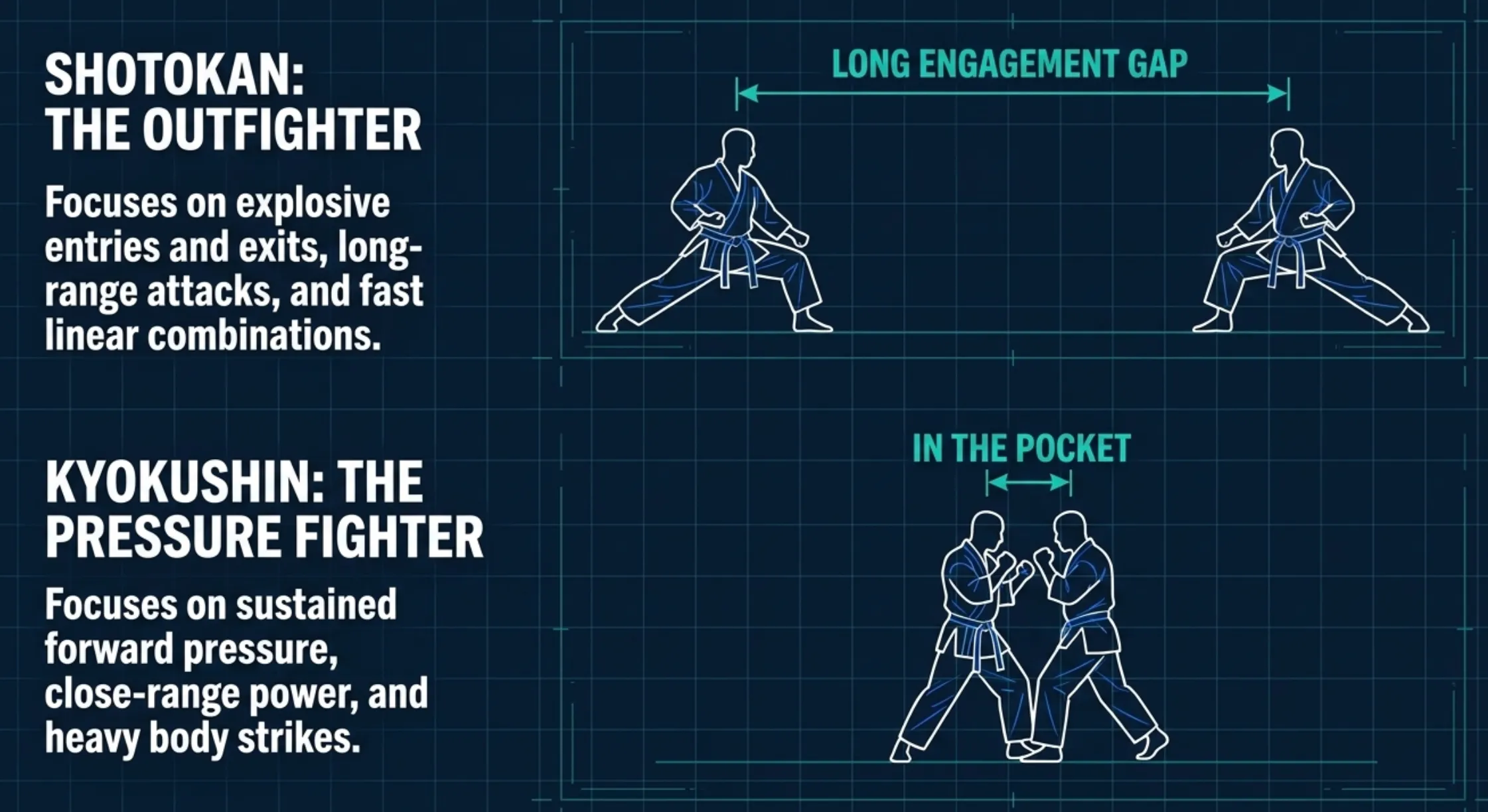
Shotokan and Kyokushin also train the body differently across many traits.
In Shotokan, there's not much in the way of clinch work (i.e., Muay Thai), as its focus is squarely on posture and precision. This makes Shotokan a highly technical and visually distinctive style.
Rather than avoiding contact like Shotokan, Kyokushin students gradually learn to take damage and dish it back out through progressive training.
Kata, Belts, and Conditioning
Although the two styles differ in sparring, they share much of karate's traditional structure.
Kata
Both styles teach kata inherited from earlier Okinawan traditions. These styles have gone in very different directions, so their forms are unique to the curriculum.
- Shotokan karatekas are technicians by design but they tend to lean harder toward technical proficiency than other styles. The priority is technical refinement and precision during kata performance.
- Kyokushin balances kata practice with extensive sparring, fighting, and conditioning. Practitioners are expected to demonstrate kata under the pressure of live sparring.
Belts
Both styles use the standard karate kyu and dan ranking systems, with colored belts that move students along as they work towards their black belts.
Remember, rank progression varies by school—some schools prefer to use stripes, others don’t; the belt color order can differ, too.
Looking for a full breakdown of karate rank and belt progression? Check out our guide on karate belt order.
Conditioning
Conditioning is absolutely a pillar of Kyokushin.
It's not uncommon for students to perform high-volume striking drills, body-conditioning exercises, endurance work, road work, and demanding fitness sessions designed to prepare them for full-contact competition.
Shotokan is a bit different in this regard. Yes, there's definitely an emphasis on developing fitness, but conditioning is generally a byproduct of their obsession with technical proficiency and rigorous practice rather than a primary training goal.
Point Karate vs the Knockdown Circuit
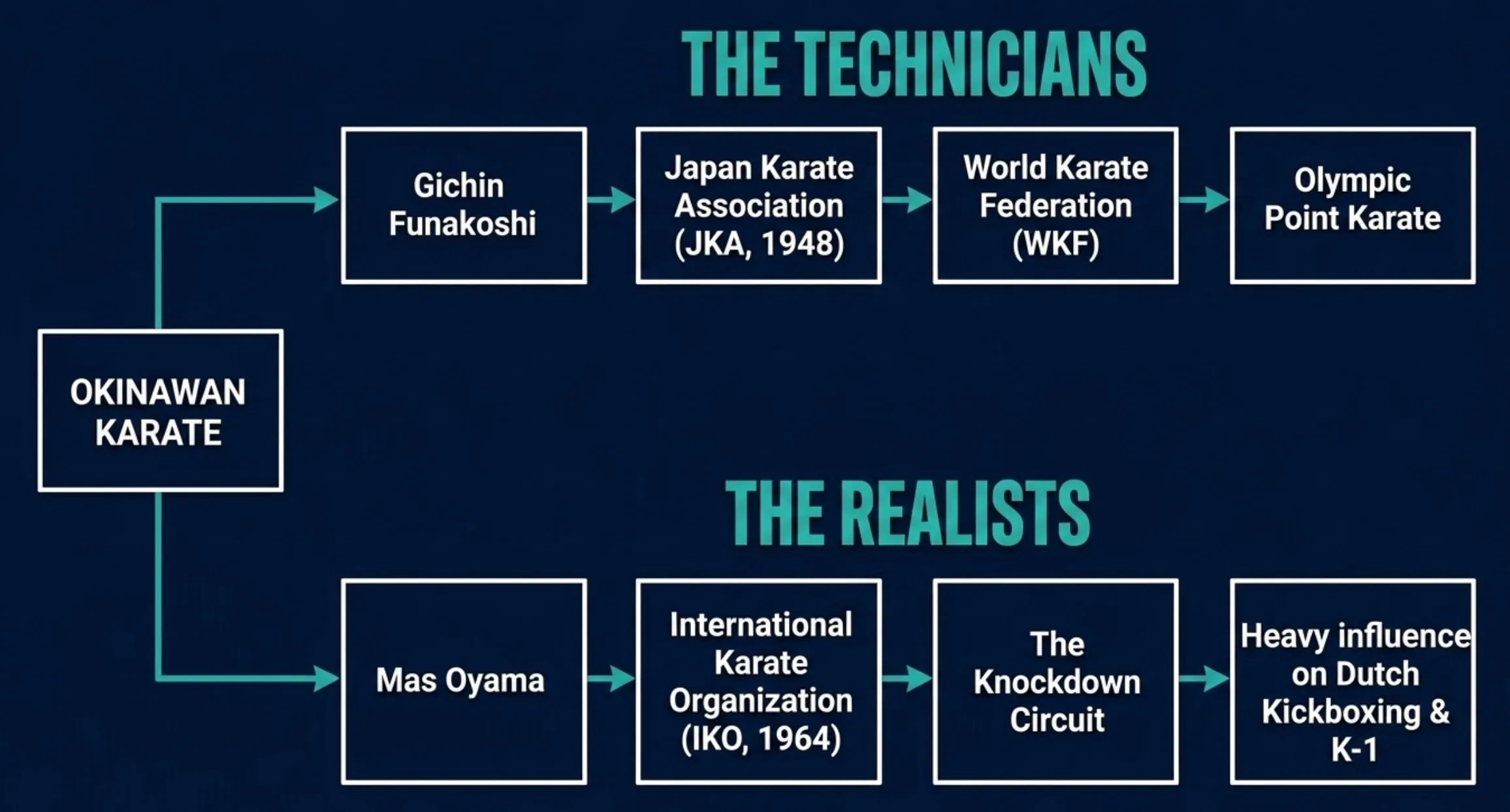
Karate competition splits into two separate worlds.
Shotokan and the WKF/Olympic lineage
Shotokan competitors typically compete under WKF-style point rules—speed, clean scoring, controlled execution.
Karate debuted at the Tokyo 2020 Olympics under these WKF point rules, but wasn't retained for Paris 2024.
It's a lineage connection, not an equivalence: Shotokan doesn't become Olympic karate, but the ruleset Shotokan competitors train under is the same one the Olympics used.
Kyokushin's knockdown tournaments
Kyokushin tournaments run under the IKO and related organizations that formed after Oyama's death.
Their ruleset focuses on continuous, full-contact fighting rather than the point-scoring rules common in Shotokan tournaments.
The tournament rules can vary slightly, as multiple organizations now oversee Kyokushin competitions. One theme remains the same in Kyokushin: the knockdown format is its defining feature.
Is Kyokushin Safe for Kids? (and Other Safety Questions)
As a parent, full contact sparring is the last thing I want for my six- or seven-year-old.
There’s absolutely no way I’m letting some other kid head kick my kindergartener; that’s not happening.
It’s a natural assumption for parents to make. Kyokushin is full contact, so this means kids spar full contact on day one, right? Reputable schools don’t train kids like this.
If you’re an adult, yeah, Kyokushin competition is full contact. But you just can’t run kids’ classes that way.
In a reputable school, instructors will scale contact according to each student’s age, experience, and maturity. If they’re working with beginners, instructors will spend a significant amount of time developing technique first, before any sparring takes place.
The instructors who run strong kids’ programs will tell you the same thing—they don’t teach kids the way they were taught.
Cautious instructors will want to see that:
- Students have the knowledge and skills needed to defend themselves
- Students have the character and temperament for full-contact sparring, i.e., good emotional control
- Their student is mature, trustworthy, and willing to follow the rules
- The lead-up to sparring is age-appropriate
Shotokan emphasizes less contact by default, making it an attractive option for families looking for a safe, structured, and more technical introduction to karate.
Whether you’re considering Shotokan or Kyokushin, you’ll want to ask instructors the following:
If you're comparing a variety of martial arts for kids, take a look at our guide to the best martial arts for kids. It’s a detailed comparison that gives you the tools you need to identify the martial art that’s best for your child.
Matching the Style to Your Goal
Neither style is universally superior. Your goals should guide your decision.
Not sold on karate yet? If you're still deciding, take a look at our guide on choosing a martial art. It's a must-read if you're trying to narrow down your options.
If you're comparing karate with other martial arts, you may also want to check out:
Remember, a great instructor, healthy gym culture, and a positive training environment matter more than the name of the style on the door.
If you want consistent progress, choose the environment that best fits your goal.
Pick the Karate That Fits Your Goal
So, Shotokan vs Kyokushin—what's the real difference? It comes down to focus.
Shotokan develops precise technique and controlled sparring, with a heavy focus on distance and timing. Kyokushin goes the other direction—resilience and conditioning, built through progressive full-contact sparring and knockdown competition. It's tough, but it builds battle-tested athletes.
Both styles work well for self-defense—practical striking, discipline, and situational awareness are core to each. What usually decides it is the student's comfort level: full-contact sparring or technical precision.
Neither style is objectively better. Choose based on your goals and the school you'd enjoy training at.
Running a karate school (of either style)? Modern karate school software can automate administrative to-dos like belt tracking, class scheduling, attendance, and membership management.
Sign up for a 30-day free trial; no contracts or credit cards—we'll earn your trust the old-fashioned way.
Gym management software that frees up your time and helps you grow.
Simplified billing, enrollment, student management, and marketing features that help you grow your gym or martial arts school.


FAQ
Karate Styles FAQs
.webp)
Andrew McDermott is a gym owner, Brazilian Jiu Jitsu brown belt, and digital marketer. He’s on a mission to build premier, high-stakes grappling tournaments, world-class academies, and a championship team of high-level athletes.