
The Best Martial Arts Tournament Software, Compared

Before Jorge Britto ran NextGen, his jiu-jitsu tournament in Toronto, he ran events the old way. Registration lived on a separate website that didn't talk to anything else, and the brackets were his job, personally. Both jobs now belong to martial arts tournament software.
"I did all the brackets by my hand," he said in his Gymdesk Originals episode. Today NextGen fills fourteen mats with more than a thousand people. He opens registration for a new event "in maybe 30 minutes, boom, tournament's out."
For most grappling and judo opens, the answer is a per-athlete platform such as Smoothcomp or MartialMatch.
DISCLOSURE:
Gymdesk and Smoothcomp are now one company. You can read the announcement. Smoothcomp is judged here the same way as every other tool, weak spots included.
Smoothcomp is also increasingly where karate, taekwondo, and wrestling events run. Some karate and taekwondo directors still prefer a tool built just for forms, staging, and point fighting.
Federations need memberships and rankings on top, and a small club event can run on a free bracket tool.
What Martial Arts Tournament Software Has to Handle
A tournament usually breaks at the handoffs.
Registration data has to reach the divisions, then the brackets, then the mats, then the results page. Every time someone retypes a name or a weight, something can go wrong.
So when you look at a tool, count how many of those handoffs it covers without you in the middle.
Registration, waivers, and payment
Good tournament registration software captures belt, age, weight, and team once, with a liability waiver signed in the same step.
Payment should happen in that flow too, with early and late pricing, refunds, and coupons handled by the software.
When Britto talks about what changed, the money comes up as often as the brackets. Payments, refunds, and scheduling were all manual before.
Divisions and brackets
Good software builds divisions from the registration data.
Belt-gated divisions and BJJ weight divisions shouldn't need a person with a highlighter, and neither should IBJJF belt requirements if you run under that ruleset.
Look for the bracket formats your sport actually uses: single and double elimination, round robin, and some sensible handling of the three-person bracket. Club separation matters too. Nobody drives four hours to fight their training partner in round one.
Mats, scoring, and the day itself
On the day, you need a schedule that updates when mat 6 runs 40 minutes behind, and tablet scoring that feeds the bracket directly. Check-in and weigh-ins shouldn't turn the lobby into a queue.
Athletes, coaches, and parents also need to see when they're up. Otherwise they ask you. All of them, over and over.
Results, rankings, and what comes after
At minimum, you want a public results page, medal and team-points tables, and an export. Circuits and federations also need rankings, season points, and membership or licence checks at registration.
Reach: Getting athletes to the event
This is the one people skip when they compare tools, and for an independent promoter it's often the hardest job.
Does the platform list your event somewhere athletes and coaches already look, or does every registration come from your own Instagram?
The pool of potential competitors is bigger than the regulars. In a self-selected Gold BJJ survey of about 1,950 practitioners, 66% of white belts had never competed. Where your event is listed decides whether any of them hear about it.
Job | What good looks like | Red flag |
Registration | Belt, age, weight, team, and waiver captured once, paid in the same flow | Payment on a separate site you reconcile by hand |
Divisions and brackets | Divisions built from registration data, club separation, your sport's formats | Someone re-sorting a spreadsheet the night before |
Mats and scoring | Live schedule, tablet scoring tied to the bracket | Paper score sheets carried to a laptop |
Results | Public results, medal and team tables, exports | Results posted as a photo of a whiteboard |
Reach | Your event listed where athletes already browse | Every entry depends on your own marketing |
We'll keep you in the loop with fresh content, podcasts, how-to guides, tool reviews, and product exclusives.
How This Comparison Was Built
The approach is the same one we used for martial arts management software.
Every price below was read from the vendor's own pricing page on October 6, 2026, in the currency the vendor publishes. That's why Smoothcomp and MartialMatch are in euros.
A tool made the list if it publishes features you can check, and either publishes a price or is the standard tool in its sport. Every tool was judged on the five jobs above. Where another tool is cheaper or better at something, the list says so.
Two groups are left out.
One is organizations that run events but don't sell software, such as IBJJF, NAGA, and Grappling Industries. The other is tools whose sites didn't hold up when we checked them.
Prices change, so check each vendor's page before you commit.
The Best Martial Arts Tournament Software in 2026
The multi-sport platforms come first, then the tools built around one or two sports. After those come studio software with a tournament module and the generic tools.
Smoothcomp
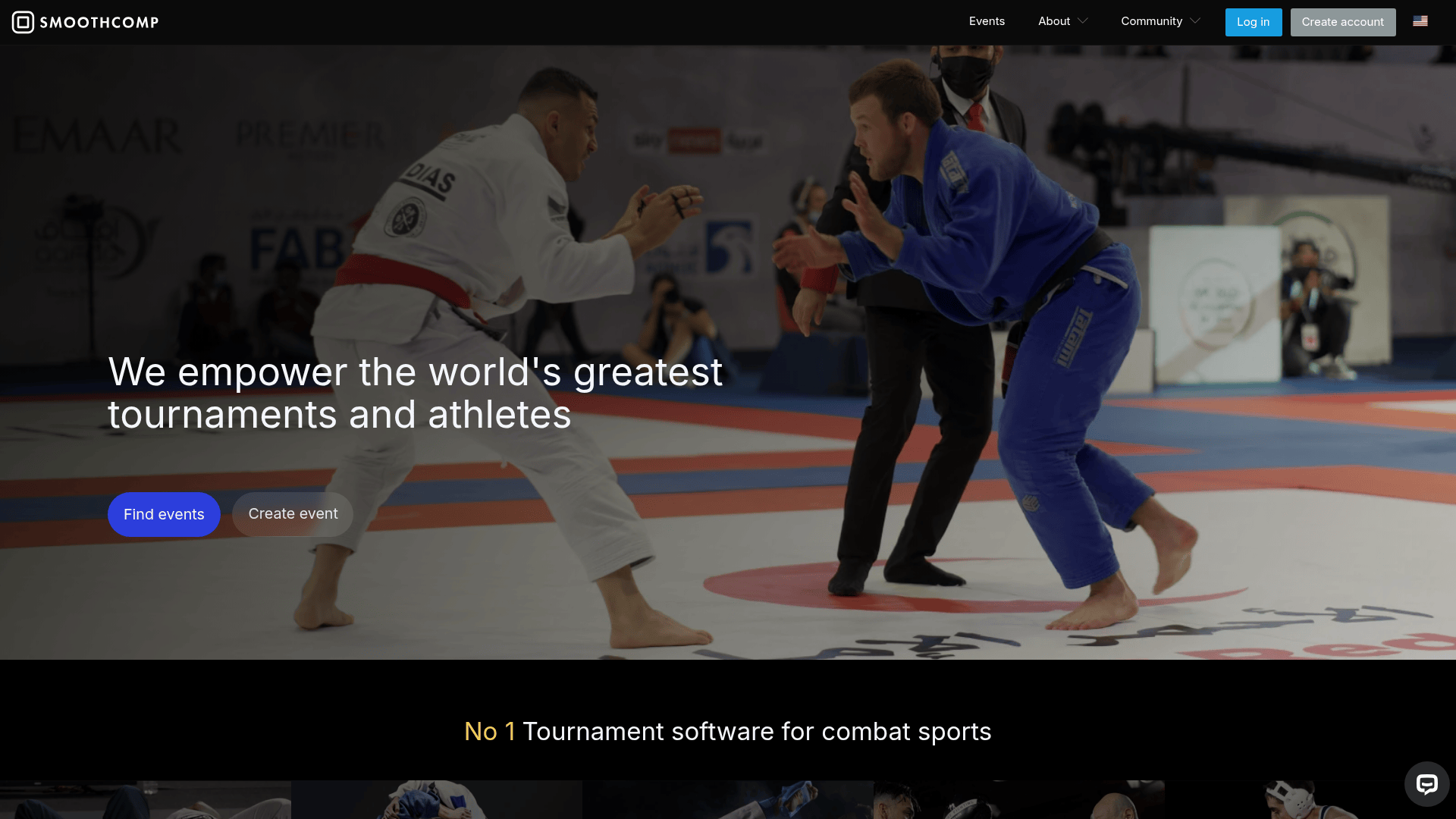
Smoothcomp has the widest list of combat-sport scoreboards of any tool here, and more bracket formats than any other.
Its scoreboards run from BJJ and judo to karate (WKF and Kyokushin), taekwondo (ITF and WT), MMA, sambo, kickboxing, and Thai boxing. For wrestling, it has wrestling, folkstyle, and UWW grappling scoreboards.
Grappling and judo are its longest-standing base, and karate, taekwondo, and wrestling make up more of it each year.
On top of brackets, you get smart-scale weigh-ins, QR check-in, tablet scoring with a TV mode, livestreaming with scoreboard overlays, and pay-per-view revenue share. Federations get memberships and rankings.
The bigger difference shows up if you coach a team as well as run events. Smoothcomp connects to Gymdesk through Smoothcomp Connect, so your competition team runs from the same gym software as your classes, billing, and belts.
Three pieces make that work:
- Your team in your gym software. Smoothcomp events show up in the Competitions tab in Gymdesk. You can endorse an event, register members from their Gymdesk record with the academy already filled in, see who has paid, and get results back on each member's record.
- Coach Companion for tournament day. It's a free app on iPhone and Android for any coach with a Smoothcomp account. Your athletes arrive in match order from their registrations, you put a coach on every match, and the Matches screen shows any match with nobody in the corner. If your academy runs on Gymdesk, the notes you write after a match land on that member's record.
- Smoothrecorder for match video. It's a free iPhone app from Smoothcomp that films a match with the live score on the video. The athlete tagged in the clip decides whether it gets published, and it lands on their Smoothcomp profile.
Smoothcomp's pricing works on credits, and one credit covers one athlete: €1.25 pay-as-you-go, €0.90 each if you buy 1,000, and €0.60 each at 5,000. At the 5,000 pack, it undercuts MartialMatch's €0.70.
The Starter organizer plan is €0 a month plus a one-time €12.50 starting fee when you open an account. An athlete entered in gi and no-gi still counts as one credit.
The limitation: prices are in euros only, and on pay-as-you-go a small event costs more per head here than on MartialMatch.
Best for: organizers running several sports on one platform, events that want weigh-ins, streaming, and federation tools in one place, and gyms that want their competition team run from Gymdesk.
MartialMatch
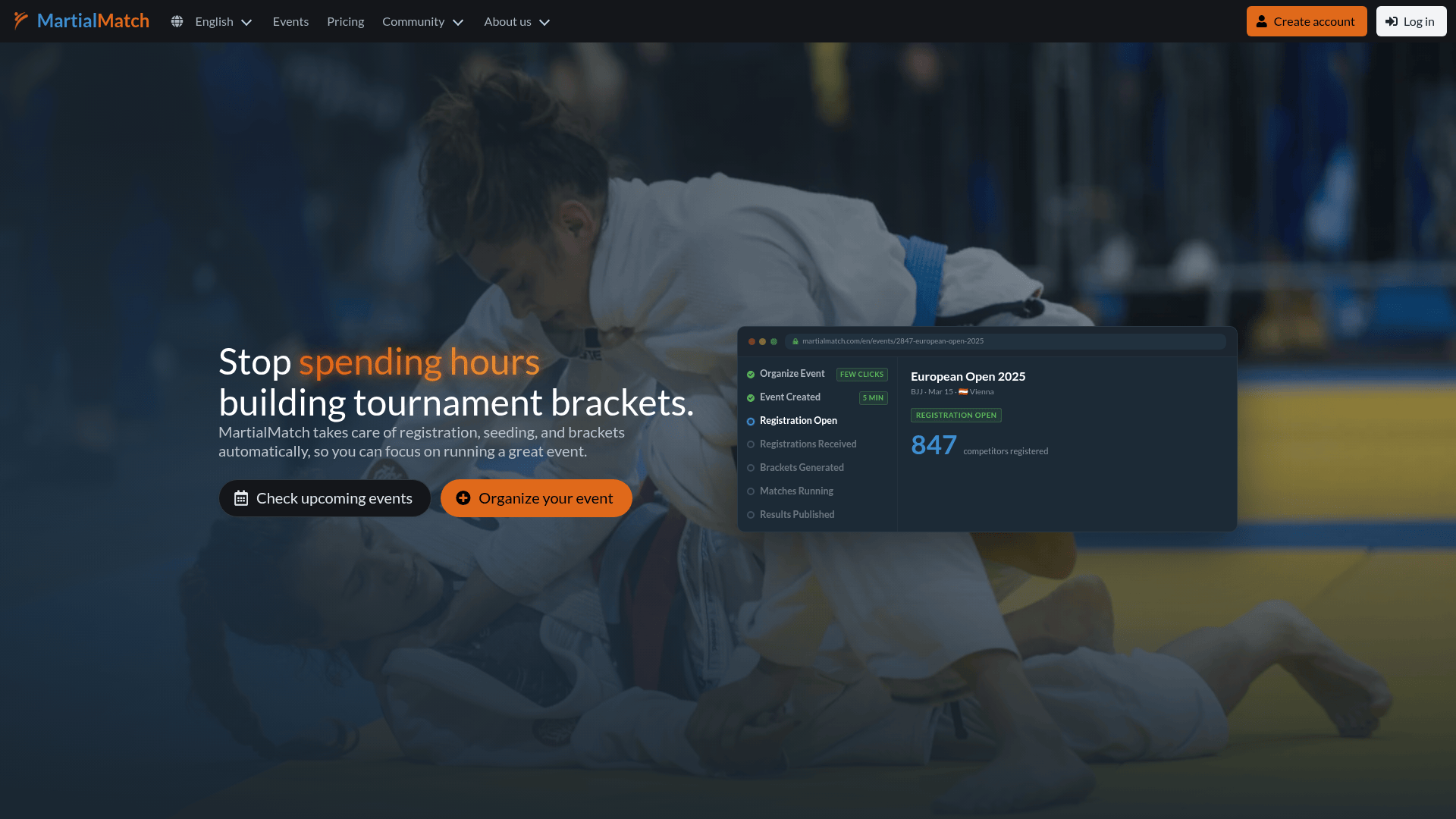
MartialMatch covers BJJ, ADCC, wrestling, judo, kickboxing, Muay Thai, and taekwondo.
You get registration with entry-fee collection, automatic brackets and seeding, a schedule builder, a live scoreboard and results, and free BJJ, ADCC, and judo scoreboards.
It charges €0.70 per confirmed registration, invoiced after the event. That's the lowest per-head price of any martial arts platform here that asks for nothing upfront. It reports 700+ events and 80,000+ competitors run on the platform.
The limitation: its pricing page doesn't list streaming, weigh-ins, or memberships. Its payment options (Stripe and Przelewy24) point to a European home base.
Best for: price-sensitive grappling and judo organizers.
Fitofan
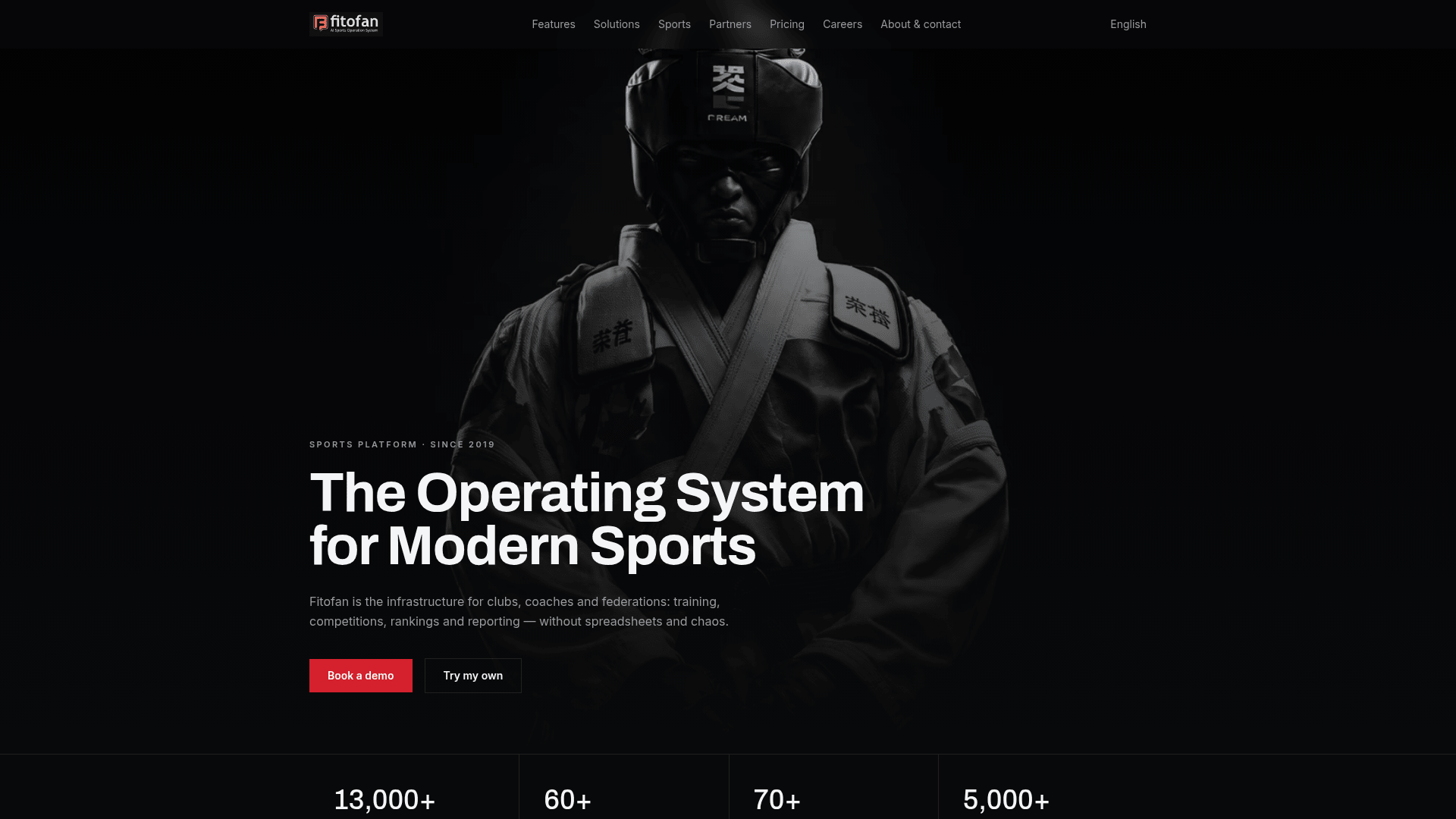
Fitofan covers karate, taekwondo, judo, jiu-jitsu, kickboxing, sambo, wushu, and capoeira.
It builds divisions from belt or grade, age, and weight, and runs forms and sparring in one event. It also handles pools and repechage, panel or points judging, video review, rankings, and licence checks.
The organiser plan is listed at "$1–3 per athlete" with a request for pricing. Club plans start at $99 a month, billed annually.
The limitation: it's sales-led, and the same pricing page's FAQ says it doesn't charge per athlete. Get the quote in writing.
Best for: federations and multi-sport organizers.
Kihapp
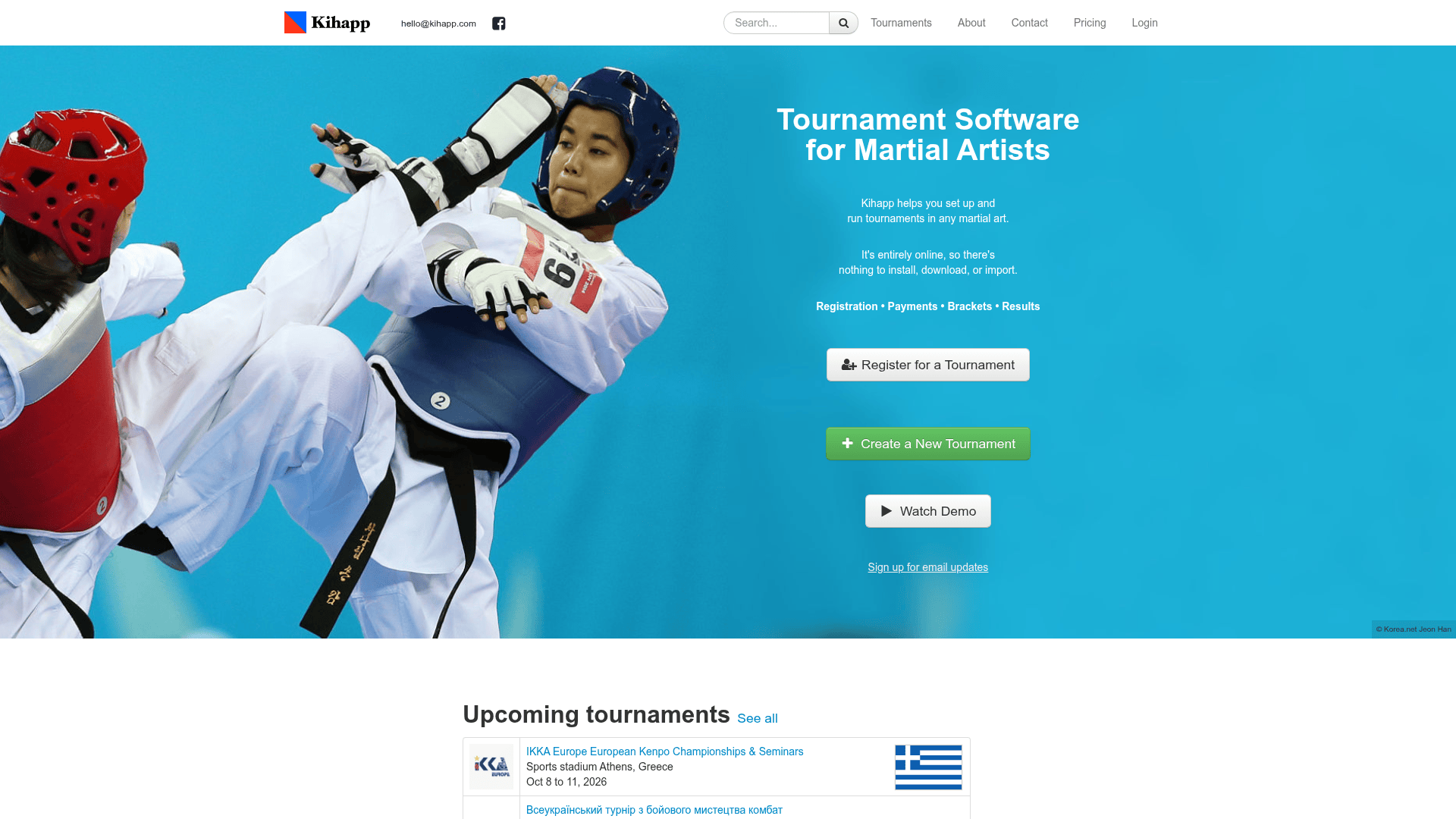
Kihapp says it runs tournaments in any martial art, and the events on its site are mostly karate and taekwondo. Its pricing page lists registration, payments, draw generation, wireless scoring, and streaming graphics.
Pricing is 5% of gross entry fees, charged after the tournament. It applies to cash entries on the day too, and there's a satisfaction guarantee: if you're not happy, you don't pay.
The limitation: a percentage grows with your entry fee. At $60 a head, that's $3 per competitor. The updates feed on its homepage was last updated in early 2022.
Best for: karate and taekwondo opens that want zero upfront cost.
NinjaPanel
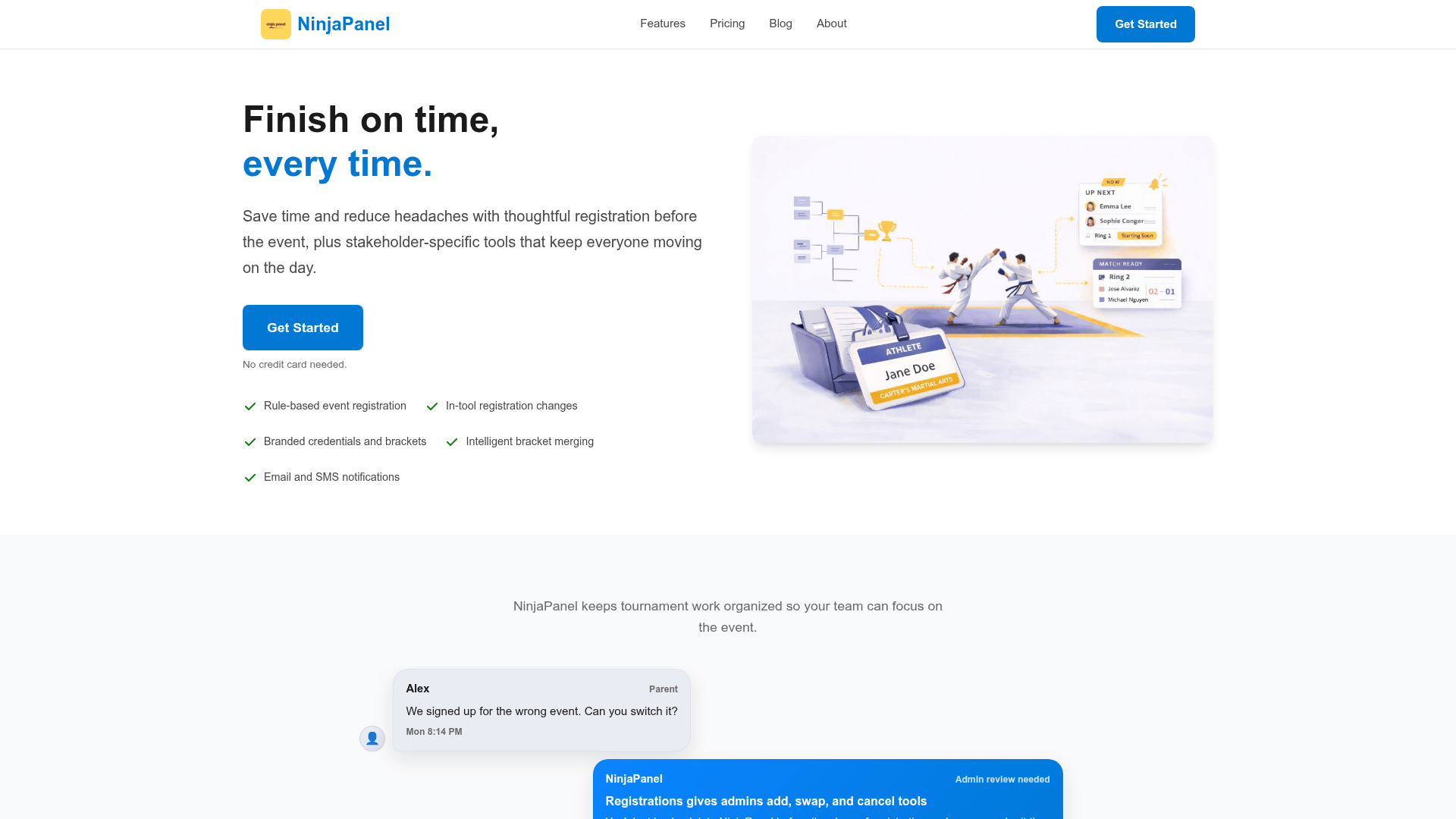
Registration and the operational side of the day are NinjaPanel's focus: family accounts, kata and kumite eligibility rules, and credentials. It also handles staging, ring assignments, and athlete-call emails and texts.
It charges $2, $3, or $5 per athlete depending on tier, plus Stripe fees. Your first 15 registrations are free.
The limitation: none of the tiers lists live match scoring.
Best for: point-fighting and forms opens where staging is the headache.
Taikai
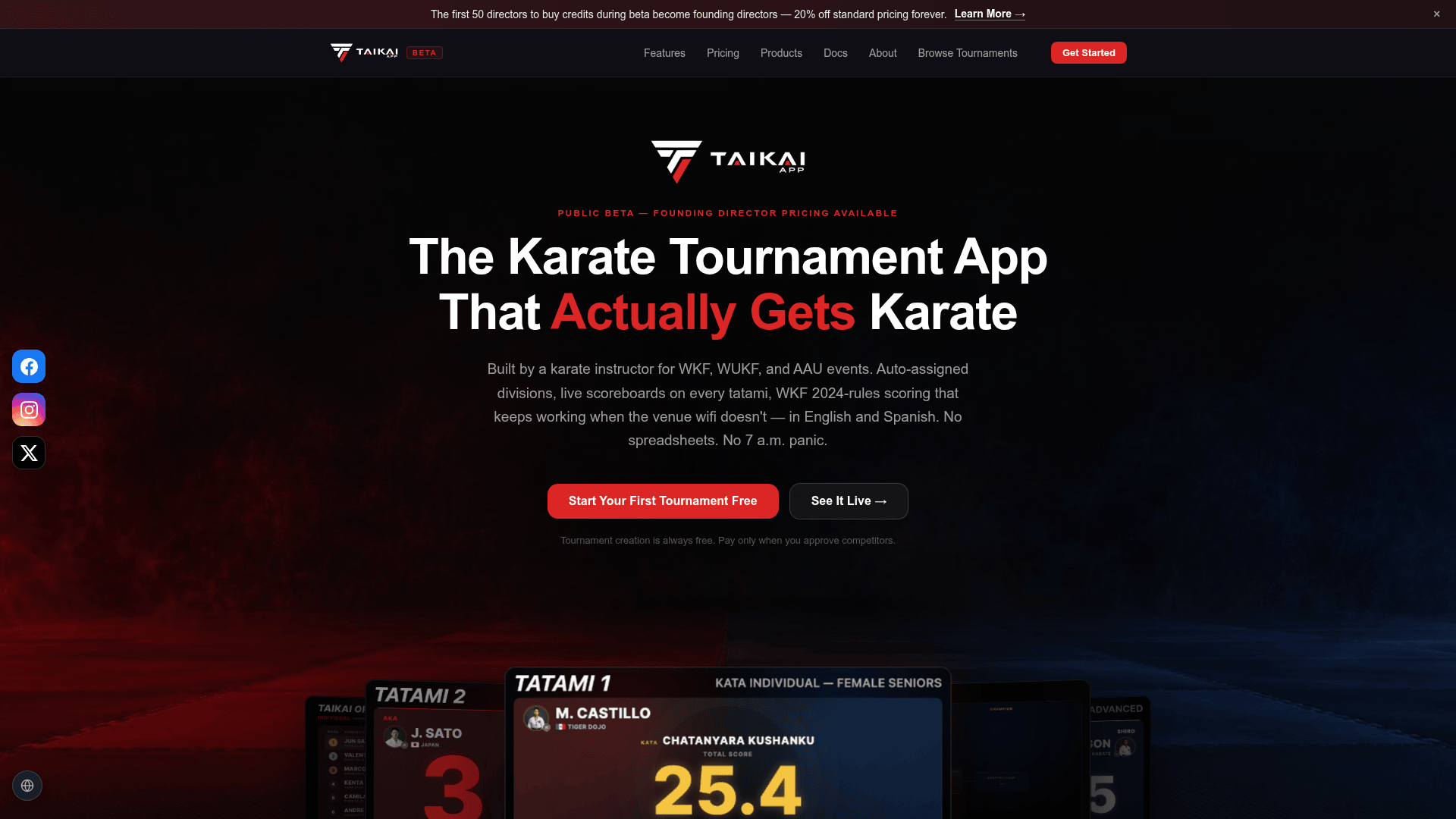
Still in beta, and karate only. Taikai has WKF kumite and kata scoring, automatic division assignment, and QR check-in.
You pay per approved competitor with credits. Beta pricing runs from $1.00 down to $0.25 per competitor, depending on pack size. After beta, the standard price will be $2.00 down to $1.00.
The limitation: it runs one tournament per date during the beta.
Best for: karate directors comfortable on an early product.
MyDojang
MyDojang is studio management software with a tournament module built in.
The module covers registration and Stripe payments, QR spectator tickets, brackets, ring assignment, live scoring, and check-in.
Its pricing table lists studio plans at $79, $149, and $249 a month, though the page title still advertises plans from $49. The pricing table doesn't say which plans include the tournament module, so ask before you pick a tier.
The limitation: you're buying a studio platform to get the tournament tool.
Best for: a school already on MyDojang hosting a club or guest-school event.
R2 Sports

R2 Sports is generic multi-sport software with a jiu-jitsu page. It covers registration, director-set matchups and times, live results, and a scorecard app.
The price is $30 per tournament, plus $1 per player and $0.50 per player division in the US, Canada, and Europe. Card processing is optional at 5.5%.
The limitation: there's no martial-arts division logic on show.
Best for: budget organizers who are fine with generic tools.
Challonge
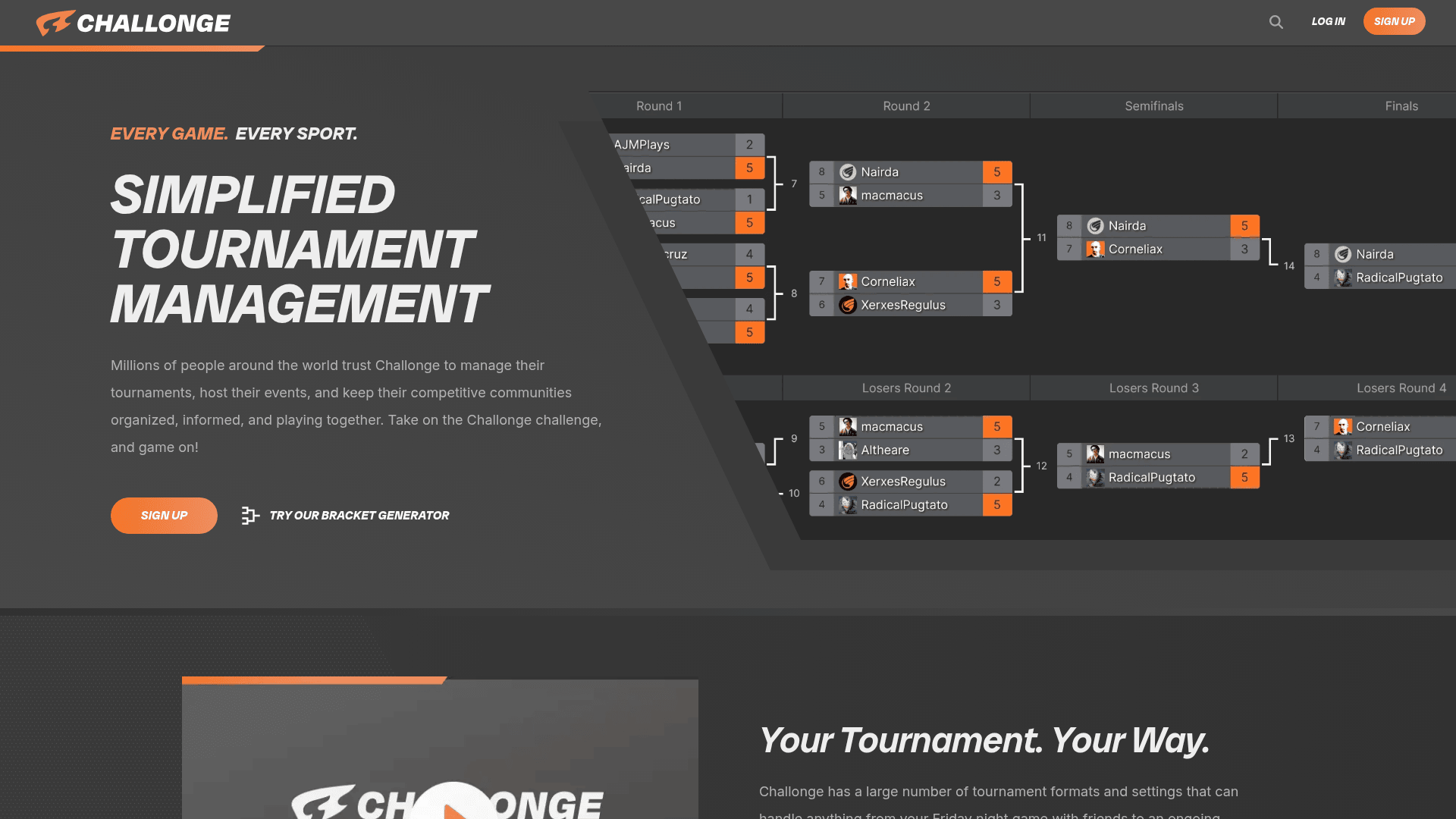
The cheapest way to draw a bracket on this list is Challonge, a free generic bracket tool.
The Standard plan is $0 (ad-supported, up to 256 participants), with $0.75 per order if you take paid registration through it. Premier is $12 a month, or $6.99 a month billed yearly, and raises the cap to 512.
The limitation: no weight, belt, or mat scoring.
Best for: a club bracket night or a small kids' event.
All nine tools side by side
Here's the short version, in the same order as the list above.
Tool | Sports | Pricing model | Published price | Live scoring | Weigh-ins | Best for |
Smoothcomp | BJJ, judo, wrestling, karate, TKD, MMA, more | Credit per athlete | €0.60–€1.25 per athlete; one-time €12.50 starting fee | Yes | Yes (smart scale) | Multi-sport events, federations, Gymdesk gyms |
MartialMatch | BJJ, judo, wrestling, striking | Per confirmed registration | €0.70 | Yes | Not listed | Budget grappling, judo |
Fitofan | Karate, TKD, judo, more | Quoted per athlete | $1–3 per athlete | Yes | Not listed | Federations, multi-sport |
Kihapp | Any martial art (mostly karate, TKD) | % of entry fees | 5% of gross | Yes | Not listed | Karate, TKD, no upfront cost |
NinjaPanel | Martial arts (karate, TKD focus) | Per athlete | $2 / $3 / $5 | Not listed | Not listed | Forms opens, staging |
Taikai | Karate | Credit per competitor | $0.25–$1.00 (beta) | Yes | Not listed | Karate, early adopters |
MyDojang | Studio software + module | Monthly plan | $79–$249/mo | Yes | Not listed | Schools already on MyDojang |
R2 Sports | Multi-sport | Per event + per player | $30 + $1/player + $0.50/division | Scorecard app | Not listed | Budget generic events |
Challonge | Generic brackets | Free or monthly | $0 or $12/mo | Not listed | Not listed | Club bracket nights |
Prices as published on each vendor's site, October 6, 2026. "Not listed" means the vendor's public pages don't mention it.
A few tools are the standard in their sport but don't publish organizer prices. Trackwrestling is built for wrestling, from bout sheets and scramble pairings to streaming.
Sportdata's SET Pro is built for sanctioned karate and taekwondo and invoices per event. DojoDraw handles WT taekwondo events on electronic body-protector scoring. If that's your world, start the conversation with them.
What a Tournament Actually Costs on Each Platform
Pricing models look similar until you put real numbers through them.
Here are two events: a 150-athlete local open and a 1,000-athlete regional. Both assume a $60 entry and one division per athlete, before payment processing fees, which every platform adds on top.
Platform | Pricing model | 150 athletes | 1,000 athletes |
Smoothcomp | Credit per athlete | €187.50 (pay-as-you-go) | €900 (1,000-credit pack at €0.90) |
MartialMatch | Per confirmed registration | €105 | €700 |
Kihapp | 5% of gross entry fees | $450 | $3,000 |
NinjaPanel | Per athlete, by tier | $300 / $450 / $750 | $2,000 / $3,000 / $5,000 |
R2 Sports | $30 + $1 per player + $0.50 per division | $255 | $1,530 |
Fitofan | Quoted, $1–3 per athlete | $150–$450 | $1,000–$3,000 |
Challonge | Free (Standard) or $12/mo (Premier) | $112.50 on Standard with paid registration ($0.75 per order) | Over the 512-participant cap |
Euro prices are as published, not converted. Smoothcomp's one-time €12.50 starting fee isn't included. MartialMatch quotes €0.70 net of VAT, and NinjaPanel waives a new customer's first 15 registrations.
To run your own event through the same prices, change the numbers in the calculator below.
Tournament software cost calculator
What will your event cost on each platform?
Enter your event. Costs use each vendor's published price, in the currency it publishes.
Individual competitors
Per athlete, first division
e.g. gi and no-gi
For 150 athletes at a $60 entry, the platforms below range from free brackets to $750.
| Platform | Your cost | How it's priced |
|---|---|---|
| Smoothcomp | €187.50 | €1.25 per athlete pay-as-you-go (€0.90 at 1,000+, €0.60 at 5,000+ credits), plus a one-time €12.50 starting fee when you open an organizer account. One credit per athlete, however many divisions. |
| MartialMatch | €105.00 | €0.70 per confirmed registration, invoiced after the event. |
| Kihapp | $450.00 | 5% of gross entry fees. |
| NinjaPanel | $300 / $450 / $750 | $2, $3, or $5 per athlete by tier, plus Stripe fees. |
| R2 Sports | $255.00 | $30 per tournament, $1 per player, $0.50 per player division. |
| Fitofan | $150–$450 | "$1–3 per athlete." Request a quote. |
| Challonge | $112.50 | Standard: free brackets up to 256 participants, $0.75 per paid registration order. |
Prices as published on each vendor's site on October 6, 2026. Euro prices aren't converted. Card-processing fees aren't included, and every platform adds them on top. Smoothcomp's €12.50 starting fee is a one-time charge when you open an organizer account, so it isn't counted per event. How MartialMatch counts a second division isn't published, so ask.
Percentage pricing gets expensive fastest. Raise your entry fee to $90 and Kihapp's cut at 1,000 athletes goes from $3,000 to $4,500, while nobody else's moves.
Double divisions matter too, since plenty of BJJ athletes enter gi and no-gi.
That's still one credit on Smoothcomp, while R2 Sports charges the $0.50 division fee twice.
PRO TIP:
Per-registration pricing depends on how the vendor counts a registration, so ask before you sign.
Which Tournament Software Fits Your Event
Here are five common kinds of event and the tools to start with for each.
A BJJ, grappling, judo, or wrestling open or circuit
For BJJ tournament software, the choice is mostly Smoothcomp or MartialMatch.
Pick Smoothcomp if you want weigh-ins, streaming and pay-per-view, and your event listed where a large athlete base already looks. Pick MartialMatch if you want the lowest per-head price with nothing to buy upfront.
NextGen runs on Smoothcomp. Britto is a gym owner who became a promoter, and his thousand-person tournament handles registration, brackets, and payments in one system. For an event that big, reach and day-of features decide the pick more than the per-head gap.
USA Wrestling set its fourth straight membership record in April 2026, with more than 374,000 members.
For wrestling tournament software, Smoothcomp has wrestling, folkstyle, and UWW grappling scoreboards, and Trackwrestling is the wrestling-only specialist.
A karate or taekwondo point-fighting open
Forms, eligibility, and staging are the hard parts here.
Smoothcomp has WKF and Kyokushin karate scoreboards and ITF and WT taekwondo scoreboards.
For karate tournament software built around forms and point fighting, Kihapp and NinjaPanel lean toward karate and taekwondo, and Taikai is karate only.
DojoDraw is the taekwondo tournament software specialist for WT events on electronic body-protector scoring. Fitofan covers both if your event mixes styles.
A national championship, series, or federation
At this level, memberships, licence checks, and rankings matter as much as the brackets.
Smoothcomp's federation plans are €20 a month (basic, with your own subdomain) and €90 a month (premium, with memberships and rankings), billed yearly. Fitofan and Sportdata also do federation-grade work, depending on sport.
See how the main BJJ organizations differ before you build a ruleset.
A sanctioned kickboxing, Muay Thai, boxing, or MMA card
A fight card runs on fewer bouts and higher stakes: sanctioning, officials, and live scoring on one ring. Smoothcomp's scoreboards include boxing, WAKO kickboxing, Thai boxing, and MMA, and MartialMatch covers kickboxing and Muay Thai.
On a fight card, the venue can cost more than the software ever will.
Master Donnie Mignon runs cards of 14 to 18 fights in his own building at Doggpound MMA, including WAKO-sanctioned kickboxing, and he put it this way:
At that level, pick on scoring for your ruleset and support for your officials.
A local club or in-house event
Club events need the least software. A free bracket tool like Challonge plus a sign-up and waiver form is enough for a kids' friendship night.
RPMA Jiu-Jitsu in Rochester runs a free kids' friendship league where the kids choose how many matches they want. Lion's Heart Family Martial Arts in Ontario runs its own events twice a year and has started inviting other studios. At that size, the event's format does most of the work.
If you're planning one, the in-house tournament guide covers the run of show, and the tournament ROI calculator models the money.
Event type | What matters most | Start with | Why |
BJJ, grappling, judo, or wrestling open | Brackets, weigh-ins, filling divisions | Smoothcomp, MartialMatch, or Trackwrestling (wrestling) | Reach and features, or the lowest per-head price with nothing upfront |
Karate or TKD open | Forms, eligibility, staging | Kihapp, NinjaPanel, Taikai, DojoDraw, Smoothcomp | Sport-specific scoreboards; staging and electronic scoring |
Championship or federation | Memberships and rankings | Smoothcomp federation, Fitofan, Sportdata | Memberships, licences, rankings |
Sanctioned striking or MMA card | Ring scoring, officials | Smoothcomp, MartialMatch | Ring scoring for the sport's ruleset |
Club or in-house event | Low cost, low setup | Challonge or a free-to-start platform | Low stakes, low cost |
Where Gymdesk Fits
Gymdesk handles the gym side of these events, through Smoothcomp Connect.
Brackets, mats, and scoring stay with the tools above, and everything around them (finding events, registering your team, tournament day, and results) can run from your gym software.
For organizers, that means reach.
Smoothcomp events show up inside the Competitions tab for Gymdesk martial arts gyms, where coaches use it for competition planning. A coach can endorse an event. Their members then see it marked Academy Approved in their own Competitions view, on the web and in the member app.
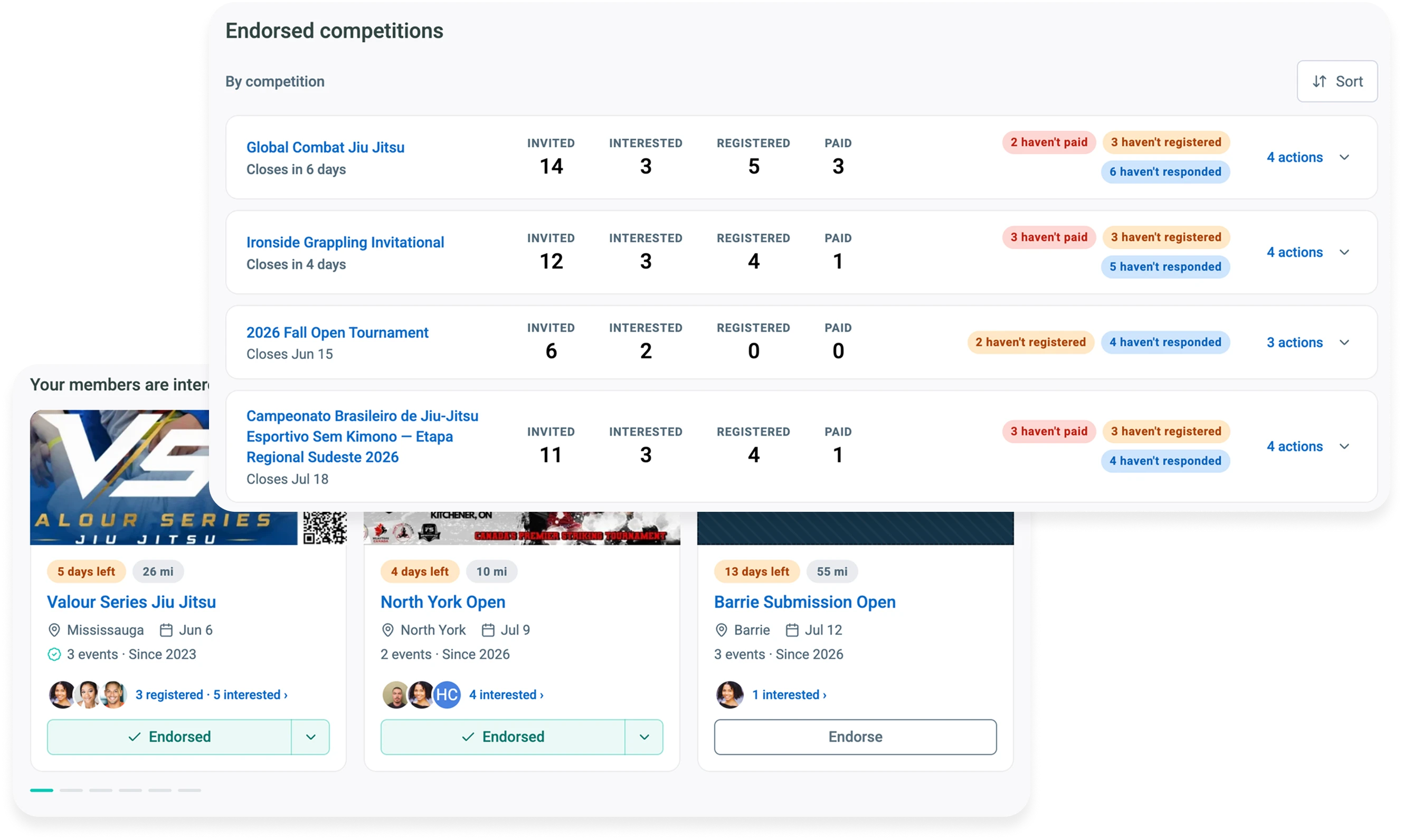
For gym owners, the benefits of competing are why you push members toward events, and registration is where it gets messy. Members sign up under the wrong academy or division, and nobody's sure who has paid.
The same tab handles tournament registration from the member's record, with the academy already filled in. Events that require a federation membership finish registration on Smoothcomp for now.
On the day, Coach Companion keeps every athlete cornered, and the notes your coaches write land on the member's record.
Afterwards, results come back onto each member's competition record, so you can see who competed and how they did.
Pick the Tool That Fits the Tournament You Actually Run
A thousand-person grappling open, a WT taekwondo championship, and a 40-kid club night belong on different software, and that's fine.
If your events run on Smoothcomp, or your members compete on it, see how Smoothcomp Connect works for organizers and gyms.
FOR ORGANIZERS AND GYMS
If your events run on Smoothcomp, or your members compete on it, Smoothcomp Connect puts those events in the Competitions tab for Gymdesk martial arts gyms. Coaches register members from their record, Coach Companion keeps every athlete cornered on the day, and results come back onto each member’s record.
See Smoothcomp ConnectGym management software that frees up your time and helps you grow.
Simplified billing, enrollment, student management, and marketing features that help you grow your gym or martial arts school.


FAQ
Martial Arts Tournament Software FAQs
Prices below are as published on October 6, 2026.

Sean has spent the last decade creating content that helps businesses—small and not so small—grow smarter to allow operators to do more of what they love. You know, the fun stuff.
From shipping and international logistics to web development and marketing, he's done the work (not just the words) to scale retail and service businesses efficiently.
You can find his work at Sendle, Shogun, The Retail Exec, Gymdesk, and more.