
IBJJF Belt Requirements Explained: Promotion Eligibility vs Competition Belt Rules

Your students come to you with a question.
“Coach, can you explain the IBJJF belt requirements to us? How does their system work?”
Their question seems pretty straightforward, doesn't it?
That's a problem because the phrase “belt requirements” can mean two completely different things:
KEY TAKEAWAY:
"Belt requirements" means two unrelated things, and most of the confusion in your gym comes from mixing them. Promotion eligibility is age plus minimum time-in-rank. Uniform compliance is what the belt physically has to look like to pass a Gi check. This guide separates them.
We're going to separate these two topics and then discuss them in detail. We'll show you how to manage both without spreadsheets, notecards, or complex tracking tools.
What “Belt Requirements” Really Means
When combat athletes enter “IBJJF belt requirements” in Google, nine out of ten times, they usually want to know:
- Am I old enough to be promoted?
- Have I been at this belt/rank long enough?
This is what the IBJJF calls “graduation eligibility.” It sits on top of the broader BJJ belt system every academy already runs. However, there's a second meaning at play here. It's uniform compliance:
- Is my belt the right width?
- Am I using the right color mix for my rash guards?
- Is my belt too short or long after tying?
Let's take a closer look at these issues so we're crystal clear on both.
The IBJJF Belt System: Graduation and Promotion Eligibility
These are the criteria that determine whether a student can be promoted under IBJJF standards.
They’re the minimum standards for the IBJJF. Just because students meet these criteria doesn’t mean they’re automatically promoted.
Let’s take a look at what the IBJJF requires:
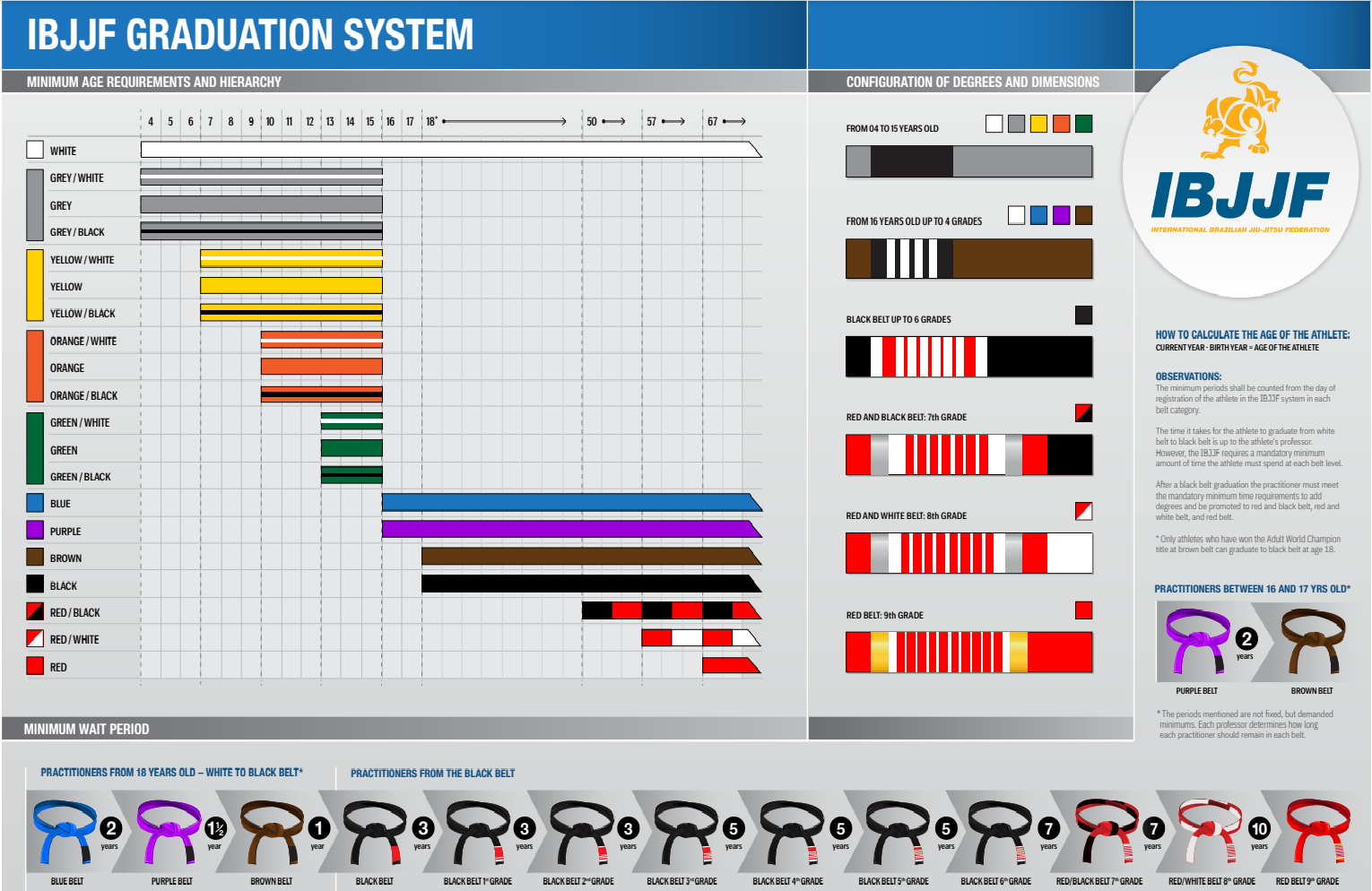
If this looks like visual gibberish, don’t worry. I’ll break this down in the details below.
Adult & Masters Belts (18+)
Here’s a breakdown of the age and time-in-rank requirements for each belt:
Belt | Minimum age | Minimum time-in-rank | Coach note |
Blue | 16+ | — | Skill readiness still matters |
Purple | 16+ | 2 years as blue | Waived for adult World Champions at blue |
Brown | 18+ | 1.5 years as purple | Waived for adult World Champions at purple |
Black | 19+ | 1 year as brown | Waived for adult World Champions at brown |
Here are some important requirements from their graduation system:
- Minimum age for blue belt: 16 years old
- Minimum age for brown belt: 18 years old
- Black belt at 18: Only if the athlete is an Adult World Champion at brown belt
Minimum time-in-rank (adult/masters):
- Blue » Purple: 2 years
- Purple » Brown: 1.5 years
- Brown » Black: 1 year
- Black Belt degrees: 1st degree after 3 years of proven IBJJF black belt activity
Each of those belts asks something different of a student. The guides to purple belt requirements and brown belt requirements break that down belt by belt.
These time requirements are why you need clear, precise records. A generic “promoted in 2022” isn't enough to satisfy the IBJJF.
It's common for gym owners to use custom fields or member history logs via tools like Gymdesk’s rank tracking to store important student data. This typically includes:
- Promotion date
- Your student’s time-in-rank
- Instructor notes or eligibility flags
It's a simple and efficient way to answer the “am I eligible?” question in seconds.
We'll keep you in the loop with fresh content, podcasts, how-to guides, tool reviews, and product exclusives.
Kids' Belts vs Adult Belts: Differences That Matter
Kids' belt systems are flexible.
Adult belts? Not so much.
Kids’ belts are designed for 4-15-year-olds, so under IBJJF rules, there's a promotion ceiling for kids. A 14-year-old with nine years of mat time still can't receive their blue belt. (If parents ask you how early is too early, that's a separate conversation—see when to start BJJ.)
Experienced gym owners use a transition policy to prepare their young athletes for promotion. Here are three common steps gym owners follow:
- Kids stay in the kids program until they're 16.
- As soon as they're 16, they're eligible for their blue belt.
- Once they're promoted to blue belt, time-in-rank tracking begins at their new rank.
You continue to promote students under the kids’ belt system until they're 16, then they join the adult ranking system. That sounds simple, doesn't it?
But wait, there's more.
The IBJJF suggests three types of graduation systems for kids, based on degrees (stripes on their belts). They encourage gym owners to choose the one that best fits their academy or school program. All three run on the same underlying stripe system—what changes is how often you award them, and how the full kids' BJJ belt system maps onto it.
Let's take a look at each of these three options:
Option 1: The monthly system
Here's how the IBJJF monthly promotion system works:
“For the academies that adopt the degree graduation every month, the IBJJF suggests 11 degrees for each belt. The 12th degree will be graduating the athlete to the next belt color. The first four degrees are white, the next four will be red, and the last three will be the color of the next belt, as shown in the image below.”
So instead of the standard four stripes per belt, students would receive:
- Four white stripes then
- Four red stripes over their white stripes, then
- Three yellow stripes over red
Here's what that looks like:
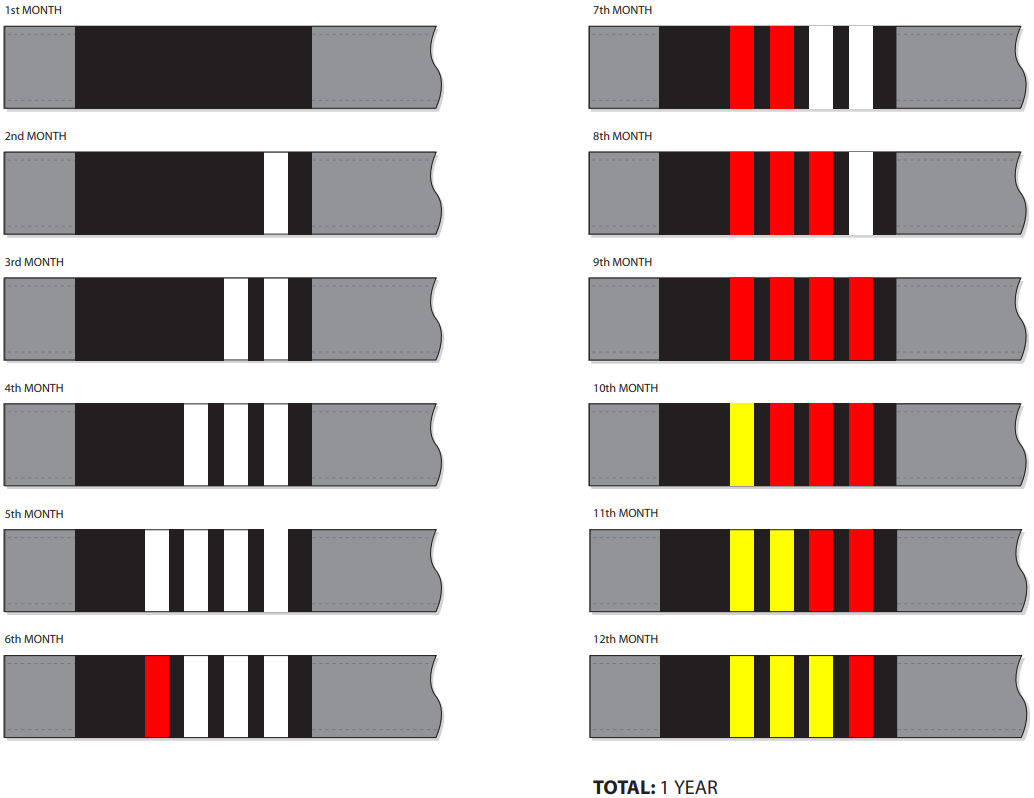
So lots of student recognition over a very short period of time.
Option 2: The triannual system
In this promotion system, the rewards are less frequent.
Here’s how the IBJJF lays it out:
For the academies that provide degree graduations every four months, the IBJJF suggests two degrees for each belt. The third degree will graduate the athlete to the next belt color according to the images below.”
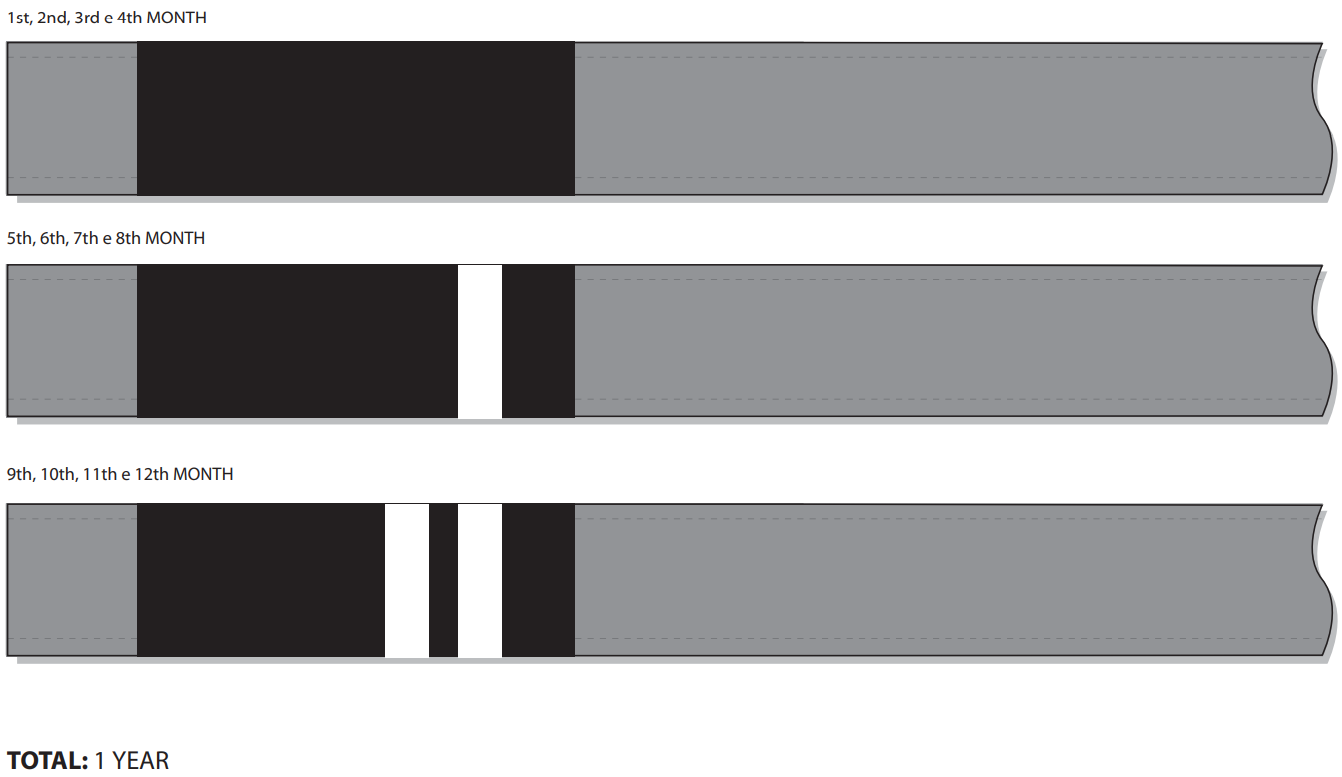
This program works particularly well for competition-focused academies.
Why does this work so well? Students at these schools compete regularly. They understand the high stakes involved with competition, so they’re much more likely to stay focused and sharp.
There’s always another competition they’re working towards; they’re moving slowly but surely towards elite-level promotions (PGF, WNO, ADCC, etc.).
It’s not uncommon to see these students receiving their next promotion on the winner’s podium. As a result, it’s easier to keep these students engaged.
You just need to provide them with consistent feedback, showing them what they need to improve.
Option 3: The quarterly system
According to the IBJJF, “for the academies that provide the degree graduation every three months, the IBJJF suggests three white degrees for each belt. The fourth degree will be graduating the athlete to the next belt color according to the images below.”
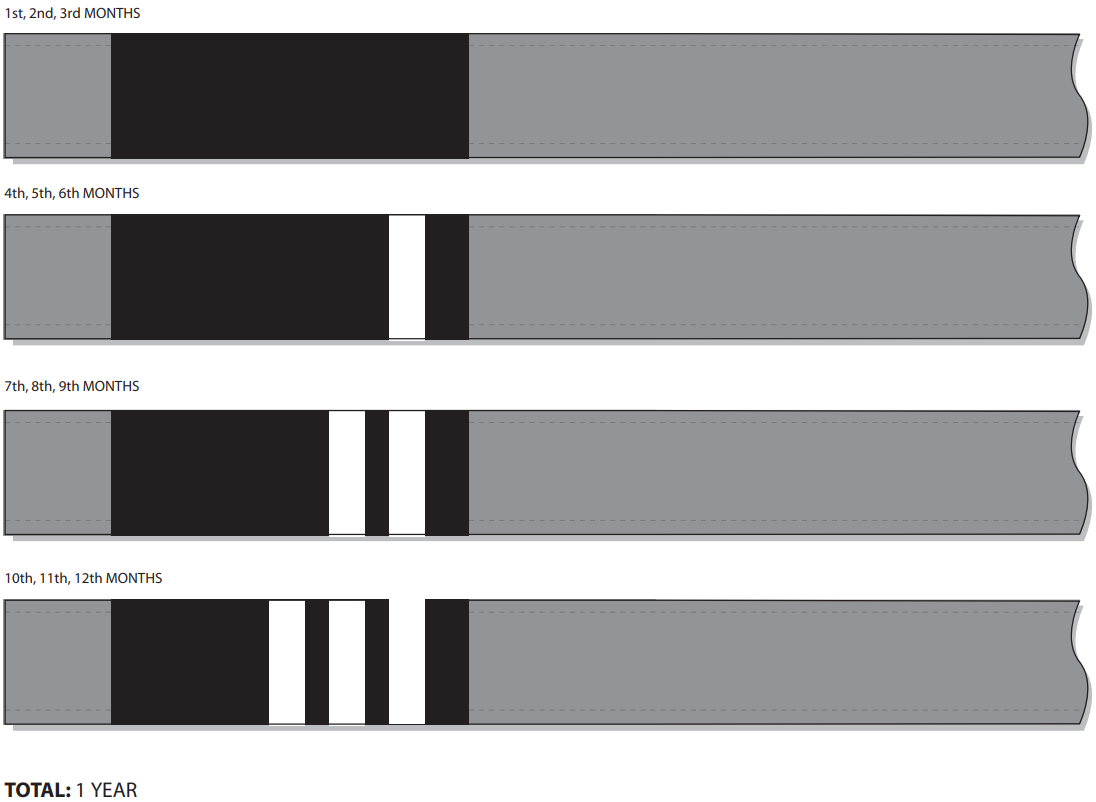
The quarterly system runs for the better part of a year; students spend a year at each belt.
Kids are promoted every three months, while the triannual schedule provides promotions every four months.
These “graduation” systems are designed for kids ages 4–15. As I mentioned earlier, kids 16+ are eligible for their blue belts; they won't qualify for their black belts until they're adults.
The World Champion exception
The IBJJF waives the minimum graduation period at blue, purple, and brown for adult World Champions. Win adult Worlds at any of those three belts and you no longer have to serve a minimum at that belt.
These details are essential to remember—the IBJJF is a stickler for rules. If you want your gym to remain in good standing, it's important to follow them.
What IBJJF Doesn’t Measure: Knowledge, Skills, and Experience
Remember, IBJJF sets the minimum standards for promotion.
WARNING:
Minimum time-in-rank is not code for automatic promotion. Students who read the graduation requirements sometimes arrive believing they are entitled to the next belt. As the instructor you have the final say—and written standards are what make that call defensible.
Most academies use the following steps:
- Time-in-rank aligned with the IBJJF
- Attendance consistency (i.e., mat time)
- Technique mastery (via drilling and positional rounds)
- Proficiency in live performance (positional rounds, rolling, competing, etc.)
This keeps promotions fair and defensible. Written standards protect trust—and they make it far easier to prepare students mentally for the promotions they don't get as much as the ones they do.
If you’re using tools to help you track these four areas, look for ones that combine attendance history and skills tracking—see Gymdesk’s skills and attendance update for an example.
Tracking Belt Requirements Without Spreadsheets
This is essential training you’ll want to go over with your instructors. It’s vital that you create a workflow that facilitates belt tracking—without spreadsheets.
Here’s a simple workflow you can use:
- Set belt promotion date
- Use your attendance tracker to auto-track students in-app or via kiosk
- Log student stripe dates and add important coach notes
- Run a monthly “payment due” report to determine who’s current on their membership
- Sit down with instructors and discuss individual student promotions before the big day
Less is more here.
A two-hour meeting is miserable—work to trim things down considerably. You can discuss each of these points in 2-3 minutes. You can do this monthly or quarterly, just make sure you’re consistent. This approach ensures no students are left out of promotion and that there are no last-minute emergencies (e.g., shipping belts overnight).
IBJJF Competition Belt Requirements: Uniform Standards
When searchers enter the phrase “IBJJF belt requirements” into Google, they’re often looking for information on uniform standards and requirements.
IBJJF belt width, length, and rank bar rules
Here’s a short breakdown of the details referees watch for on competition day.
Referees verify:
- Accuracy: The belt is the correct color for your student’s rank.
- Width: 4–5 cm
- Rank bar: Black for kids and adults, red or white for black belts.
- Length: The belt should be long enough to be wrapped around the body twice, leaving 20–30 cm tails after tying.
- Condition: Not excessively worn or faded.
Common failures:
- The belt is too short after tying
- The rank bar is the wrong color, too short/long, or completely missing
- Off-shade color (especially blues and purples)
- Wearing a belt that no longer clearly shows your student’s rank
PRO TIP:
Three things in every competitor's bag, checked the night before:
- Competition belt packed
- Backup belt packed
- Belt tied once at home to verify length after the knot
Uniform requirements: Gi
The IBJJF has a strict but reasonable dress code for its Gi tournaments. Here’s a list of their requirements, taken directly from their website. If your students are still choosing a competition kimono, the BJJ gi guide covers what to look for before they spend the money.
Gi material:
- Gis should be tailored using cotton or cotton-like fabric only.
- The fabric should not be so thick or stiff as to impede an opponent from gripping it.
- A Gi fashioned from woven fabric is mandatory for all age divisions.
- A kimono with EVA or similar material inside the collar is allowed, if the measures of size and rigidity regulations provided in the IBJJF Rules Book are followed.
Gi color and patches:
- Gis must be of uniform color
- The following colors are permissible: white, royal blue, or black.
- Gis with tops and pants of different colors are not permitted.
- Gis with a collar in a color different from the rest of the top are not permitted.
- Painted Gis are forbidden, unless the paint is designed in the form of an academy or sponsor logo, and only on regions of the Gi where patches are permitted.
- Even when permitted, the athlete will be obliged to change Gis if the paint marks the opponent's Gi.
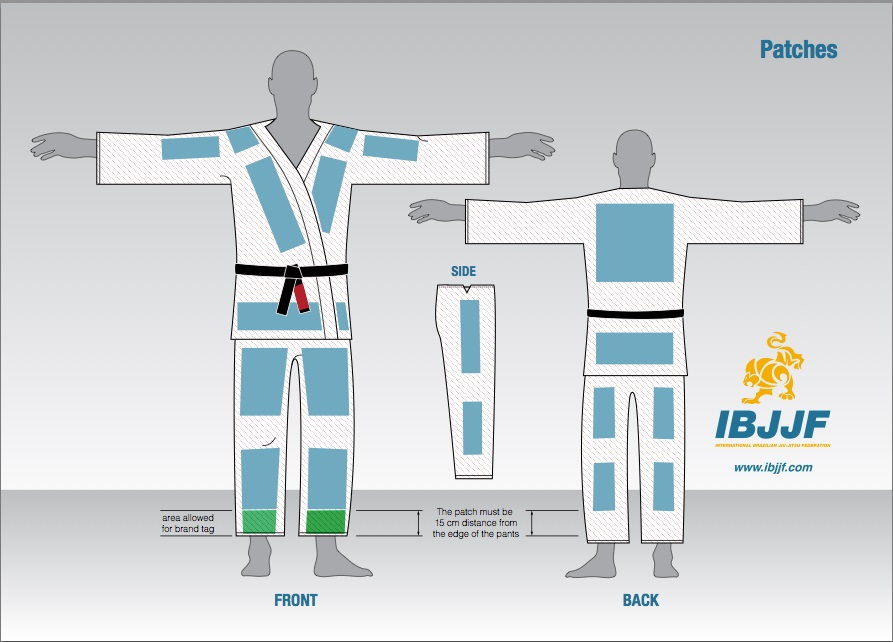
- Patches may only be affixed in authorized regions of the Gi, as depicted in the IBJJF Rules Book. They should be made of cotton fabric and properly seamed.
- All patches unseamed or in unauthorized regions of the Gi will be removed by the Gi inspectors.
Gi measurements:
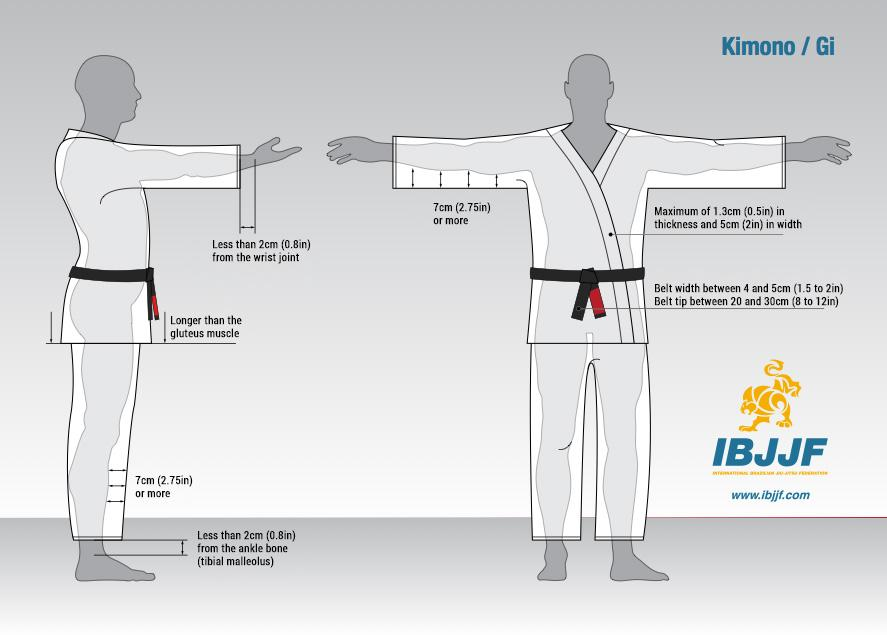
- The Gi top should reach the athlete’s thigh, and the sleeves should come to no more than 2 cm from the athlete’s wrist when the arm is extended straight, parallel to the ground.
- Gi pants should reach no more than 2 cm above the tibial malleolus (ankle bone).
- The inspection will verify whether the following official measurements are met: Gi lapel thickness (1.3 cm), width of Gi collar (5 cm), and opening of sleeve at full extension (7 cm).
Other requirements:
- Use of a shirt under the Gi top is prohibited, except for women.
- In the female divisions, it is mandatory to use a stretchy or elastic shirt that hugs the body beneath the Gi.
- Shirts can be short- or long-sleeved, without having to follow the color requirements.
- Athletes may also use a one-piece swim garment (bathing suit) or a gymnastics top.
- Wearing pants of any kind under Gi pants is prohibited, except for women, who are permitted to use pants made of elastic fabric (clings to the body) under the Gi pants, as long as these pants are shorter than the Gi pants.
- Athletes must use undergarments. The use of thong-type undergarments is not permitted; only brief-type undergarments are permitted.
- Gis may not exhibit mending or tears, be wet or dirty, or emanate unpleasant odors.
Uniform requirements: No-Gi
Believe it or not, the IBJJF has strict requirements for rash guards, leggings, and shorts as well.
For shirts and rash guards:
- Both genders must wear a shirt made of elastic material (skin-tight), long enough to cover the torso from the waist to the shorts' waistband.
- The rash guards must be colored black, white, or black and white, and with at least 10% of the rank color (belt) to which the athlete belongs.
- Shirts that are 100% the color of the athlete’s rank (belt) are also permitted.
Note: For black belts, a small red area will be tolerated, but must not decharacterize the athlete’s rank color. This means no outlandish designs or changes that make your athlete’s rank unclear.
Shorts for men:
- Board shorts that are colored black, white, black and white, and/or the color of the rank (belt) to which the athlete belongs.
- No pockets, or with the pockets completely stitched shut.
- No buttons, exposed drawstrings, zippers, or any form of plastic or metal that could present a risk to the opponent.
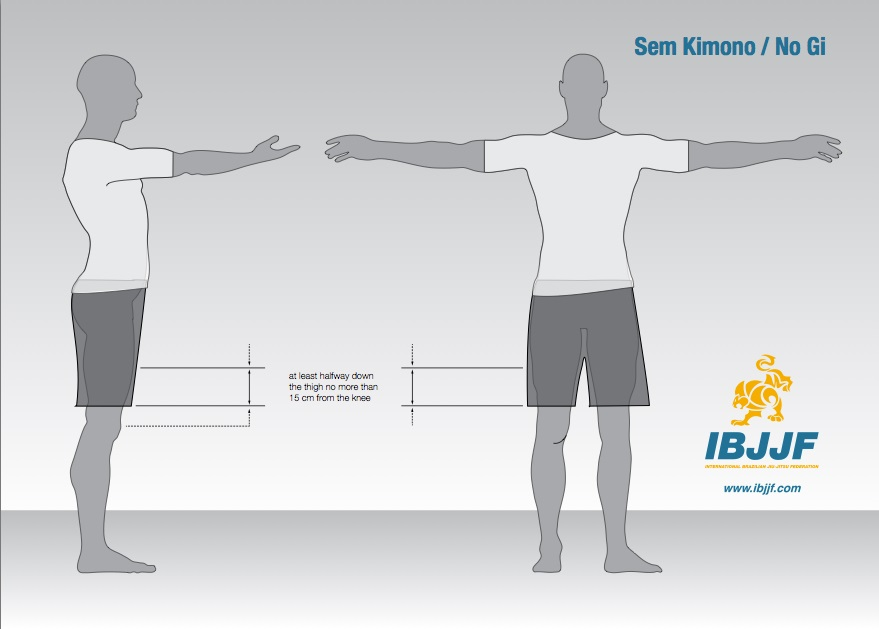
- Long enough to cover at least halfway down the thigh, and no longer than the knee.
Also permitted:
- Compression shorts made of elastic material (skin tight) worn beneath the shorts, in the colors black, white, black and white, and/or the color of the rank (belt) to which the athlete belongs.
For Gym Owners: Creating a Promotion Policy That Works
As a gym owner, it’s incredibly important that you build a strong promotion policy.
This policy serves as guardrails, protecting students so they can meet the IBJJF's dress code and performance standards.
A firm policy includes:
- IBJJF-aligned minimum time-in-rank
- Attendance expectations
- Technique benchmarks
- Performance standards
- Promotion cadence (monthly, quarterly)
- How stripes are managed
- How exceptions are documented
Repeat these requirements often.
It’s a good idea to keep your active competitors in the loop; you’ll want them to be fully aware of what’s expected. If you post these requirements publicly and reference them consistently during your fight camps, you’ll find your athletes are better prepared.
If you run an affiliate school, your policy also has to sit inside whatever your affiliation already requires—Gracie University CTC management is one example of a curriculum structure that carries its own promotion standards alongside the IBJJF's.
When students have a clear understanding of your expectations, their performance improves.
IBJJF Standards are Strict and Reasonable
If you take the time to align your gym’s belt requirements with them, you’ll:
- Have fewer awkward conversations (i.e., when will I be promoted?)
- Avoid competition-day surprises
- Avoid the “I thought they were ready” debates
- Spend more of your time coaching, less time administrating
The IBJJF is the organization we love to hate.
Their rules aren’t meant to punish athletes—they’re designed to enforce high standards for our sport and to provide gym owners with a framework for developing top-performing athletes. Use these rules to build a path for students that’s fair, transparent, and consistent.
When your students know the path, they’ll walk it with confidence.
FOR BJJ ACADEMIES
Time-in-rank only answers the "am I eligible?" question if someone wrote the date down. Gymdesk tracks promotion dates, time-in-rank, and attendance together, so the answer takes seconds instead of an evening with a spreadsheet.
See Gymdesk for BJJGym management software that frees up your time and helps you grow.
Simplified billing, enrollment, student management, and marketing features that help you grow your gym or martial arts school.


FAQ
.webp)
Andrew McDermott is a gym owner, Brazilian Jiu Jitsu brown belt, and digital marketer. He’s on a mission to build premier, high-stakes grappling tournaments, world-class academies, and a championship team of high-level athletes.