The Man Who Runs a Thousand-Person Tournament—and Tells You Not to Run One in Your Gym
Jorge Britto founded a tournament that fills fourteen mats with more than a thousand people. Ask him whether gym owners should run their own in-house events and he pushes back—the room where your students feel safe is worth more than the couple hundred dollars a bracket makes you.
Starring
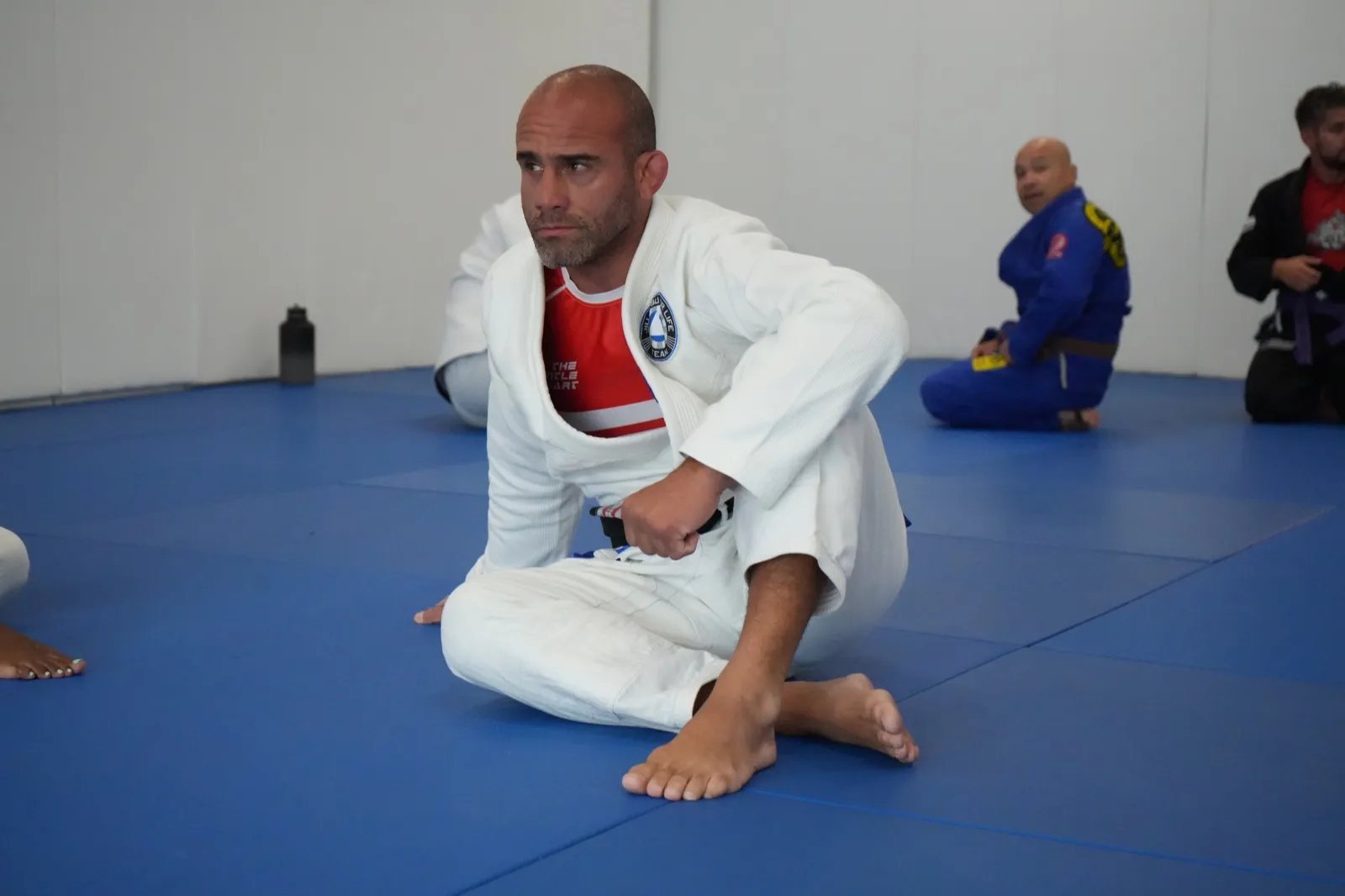
Jorge Britto is a Brazilian jiu-jitsu black belt, promoted by Saulo Ribeiro and Vinicius "Vini" Aieta at Gracie Tijuca in Rio. He has a degree in physical education, fought professionally in MMA, and won the ADCC European Trials in 2010. He has taught in Toronto since May 2008, co-founded the Jiu-Jitsu For Life Team in 2016, and runs NextGen.
About the Gym
Etobicoke BJJ is a Brazilian jiu-jitsu academy on Lake Shore Blvd West in Etobicoke, Toronto, training about 250 members. Jorge Britto opened it around 2023 alongside Toronto BJJ, the Bloor Street flagship where he's been head instructor since May 2008 and still teaches. Both belong to the Jiu-Jitsu For Life Team, co-founded October 2016 with Josh Rapport.
Programs cover adult gi jiu-jitsu with a competition team, kids' classes, and a light-touch self-defense component—Britto holds that consistent training and the emotional control competition builds protect a student better than a self-defense curriculum.
Britto founded the NextGen tournament, and asked whether competition works as a retention tool, he answers "100%." His measure of success is students who arrive as white belts, leave as black belts, and open their own academies—two were doing that within two months of filming.
📍 Address: 2918 Lake Shore Blvd West, Toronto, ON M8V 1J4, Canada
📞 Phone: (647) 983-7108
Summary
This one starts off the mats. Gymdesk CEO Alex Cuevas entered his first jiu-jitsu tournament at 49, alongside his son, at the tenth anniversary of Britto's NextGen event—and won his division. Days later he sat down with the man who built it.
Britto grew up in Rio de Janeiro and landed at Gracie Tijuca, a Gracie Humaitá branch he calls "the Disneyland of Jiu-Jitsu." As a teenager he washed visiting athletes' gis at Worlds camps to pay his own membership. He reached Toronto in May 2008, has taught at Toronto BJJ for the seventeen years since, and opened Etobicoke BJJ about three years ago.
The interview lands somewhere counter-intuitive. Britto ran in-house tournaments himself, but only as rehearsals to train his event staff before going public. Turning your gym into a competition venue, he argues, costs more in comfort than it earns in entry fees.
What They Told Us
Jorge Britto on telling his mother he was quitting school at sixteen, why he refuses to run in-house tournaments, and what 900 members felt like before software.
He decided at sixteen and never revisited it
Britto grew up in Rio de Janeiro and started jiu-jitsu in the early nineties. The moment he points to is standing in a room where Carlos Gracie Jr. told the staff that this was only the beginning—that one day the sport would be far bigger, and would live outside Brazil.
"And I go home and, like, mom, I'm not going back to school. I'm going to be a jiu-jitsu professor. I'm going to leave out of Brazil. I'm going to move to California. She got crazy. As a single mom, I lost my dad. I was eight. She got crazy. But I, here I am."
—Jorge Britto, owner
He paid his own way in. His mother worked in a laundry, so during the camps that brought foreign athletes to Brazil for Worlds, he washed and charged for their gis. He later worked tournament staff, got his university tuition largely covered as a competitor, and finished a degree in physical education.
The case against in-house tournaments
This is the most contrarian thing he says, and he says it as an operator, not a purist. Asked whether he grew the gym by running its own events, he argues the opposite—that the revenue is trivial and the cost is to the room itself.
"I feel like, uh, the student retention is your key to be successful in your gym. So sometimes you go and you run, uh, uh, in-house tournaments and you make a couple, a hundred dollars extra on that month, they will not be worth it because you're now transforming the space where they are comfortable in a environment that people feel a little bit more hostile."
—Jorge Britto
His stated worry is rivalry between students who otherwise train together. He will happily support external tournaments in a city that already has good ones—the objection is specifically to turning the home gym into the venue.
Jiu-jitsu is swimming, not a sport
For kids, Britto reframes the whole question away from whether they compete or engage—which he says is what parents worry about most.
"Look, you have to see Jiu-Jitsu as just swimming for a kid right now. In my home, like, it's non-negotiable until they're 16. Swimming and Jiu-Jitsu. Because in the pool of life, you need to learn, you need to know how to swim."
—Jorge Britto
The same realism runs through how he talks about adults. He is blunt that the competitive tier is not a living, and that the gym is carried by the people who train for their own reasons.
"Jiu-jitsu is not a professional sport at all. … You make some money with competition, but what's really going to pay your bills is like you have your own gym. You teach classes, you teach seminars, you teach privates."
—Jorge Britto
900 members, and every promotion written out by hand
Before Etobicoke, Britto was head instructor at Toronto BJJ. Belt promotions at that scale were a manual exercise, and his description of it is the most vivid operational passage in the episode.
"We had a point that we have like 900 members. … And every time that I come back on my promotions, it was a nightmare. This is before Gymdesk. … I have to go to each student, write down each name, Jesus Christ. And then like promotion and you miss some student, right on the spot, you see the guy there, sad because you forgot him and then you message him later. That was terrible."
—Jorge Britto
Opening his own gym with software already in place is the contrast he draws—not against a competitor product, but against paper.
"If your gym don't have it, like, you should consider that highly because it just takes, I would say, 75% of the whole work. … The most is they're already organized for you. So you have way less, way, way less headaches."
—Jorge Britto
What Etobicoke BJJ runs on Gymdesk
Member records with photos, attendance and class counts feeding belt promotions, and automated payments.
Read the full transcript
Lightly edited for readability. Speaker labels are omitted because the source recording is not diarised; quotes attributed elsewhere on this page were verified against context.
We'll be right back. Behind every gym, there's a story, a mission, a spark of passion that started it all. This is Gymdesk Originals. Real owners, real struggles, and the communities they've built from the ground up. They had no idea that you had to put your gi on and weigh in. I'm not even sure how much this gi weighs. I weighed in before, and I was fine. But I don't know if this thing weighs two pounds, three pounds, five pounds. So I hope I make the weight.
I'm a little bit nervous now. But I've been trying not to drink or eat much today. And I'm going to do the weigh in. Let's go find out. Rushing up the stairs. Going upstairs right now, right? Yeah. Didn't go weigh in. How cool is that, dude? Is that the most mats you've ever seen? This looks exactly like, um, in Karate Kid. Weigh in with the gi. Again, that was news for me. I blew it on that one. But I think you're fine, you know. Me? I only have, like, maybe two pounds.
So we'll see how much this gi weighs. Under what? I made it even with this thing on. Right now I'm with Ren because Nioh got a little injured. His mom thinks she's a physical therapist, so she thinks he rotated his hips. We're not sure if he's going to be able to do the last match. Already kicked the can on at least two opportunities, but he's on the finals. We'll see. Fingers crossed. See how he comes out. Well, we got a little injured, huh? We're going to get Alex's medal.
Here we go. We're both competed today. My arms are so burnt. When I got up here, I felt like I had just done a one-hour training session, even though I only did two matches. I felt like I was pacing myself to that last one, really gassed me out, really intense in the beginning. I was trying to not play into that. First guy I know showed on me. Come on, dude. What happened to that guy? I was waiting for him down there, and then it was a full start.
I felt all right in the first round. I mean, the first match. I felt like I was relaxed. The second one hit me like out of nowhere. I was trying to listen to music, and then all of a sudden, we went up like 10 minutes. That's true. I'm talking to you, so. Wow. But overall, I mean, I did it. Finally, I competed. Feels different. Glad I did it. My boy did it with me today. It's a long day. We started early. Did you have fun? Yeah.
Did you have fun? Yeah, did you have fun? Yeah, did you have fun? I did. I had a lot of fun. Hey, what's up, everybody? I'm in the car. Looking forward to seeing Jorge Britto. Last weekend, or this past weekend, rather. A few days ago, I was at the competition. Next Gen. First tournament ever. And now I'm going to his dojo. It's in a town of, let's see if I pronounce it right. Ibita Choke. Or Coke. Ibita Coke. Something like that. In Canada. Near Toronto. And, yeah, I'm looking forward to jumping into class.
And, yeah, let's go. Oh, boy. It's so yellow out here. So, right now, there's all kinds of fires that are happening in Canada. So, I'm in the Toronto area. And I think the fires are like six, seven, eight hours away. Something like that. If you drove there. But, man, it is gray. Kind of scratchy throat. I've just been here for just a few seconds. It's like that back in the Buffalo area, too. So, anyways, hopefully indoors we won't get too much of this smoke. There he is.
How are you, Professor? Nice to see you. Nice to see you, brother. Yeah, nice to see you. Do you know how it goes? Yes, sir. I'm Alex. Nice to meet you. All right. Please. Bye. Bye. Bye. Bye. Bye. Bye. So, I made it here. And I just a second ago said it wrong. Is it Ibita Coke? Ito Bico. Ito Bico. Okay. All right. So, I'm sure I'll forget it again. But I was saying, I'm just now coming back. I was in Toronto this weekend with the family.
And my son went to his third competition. It's my first. Next Gen. 10th anniversary, right? Yes, 10th anniversary. Amazing. So, my son, I got to tell you my son's expression. When we walked in, his eyes opened up like he was, you know, like he's never been to Disneyland, but I'm sure he would be like, he's like, wow, dad, look. There's 14 mats, was it? Yeah, 14. 14 mats. Free show, IBJF sites. Yeah. It was, I mean, good job. Thank you. That was amazing. I appreciate it.
As, you know, a first-time competitor for me and as my son who's done it before, it was an amazing experience. So, I want to say congratulations. I'm so curious to, like. That's exactly what we want. Yeah. I want this kind of reaction, you know. Yeah. When we set up the event, the idea is that we give everybody a wow in all aspects, not just in the visual, but also in the experience overall. Hope you guys have enjoyed. Absolutely. Yeah, it was great. It was a great experience.
And I love that right next to our booth, we had an acai place. Yeah. Yeah. It was awesome. The complete thing, right? Yeah. Complete, complete. Well, I mean, there's so much to talk about here. I just had an amazing class and, you know, sweating a lot. And I'd love to unpack all of that. I mean, get into your school, your history, time in Toronto. That's cool. But we were talking about the competition earlier. And maybe we can start with that. Like, let's go into your history with jiu-jitsu.
You're from Rio originally? Rio de Janeiro, yeah. Born in Rio de Janeiro. I started training jiu-jitsu, early 90s. I started in a small academy from a Carson Gracie black belt named Fernando Nutri Baby. He's in the list of the Carson Gracie black belts. Very faithful for his master, like Professor Nutri Baby. He initiated me on the art. And it was a very small academy. I even competed some tournaments representing Carson Gracie. I made some trials at Money Mile Academy. Money Mile is another Carson Gracie black belt.
I never had the pleasure and the honor to have any class with him. But I remember to go in some classes at Figueiredo Magalhães, which is the famous Copacabana gym. And got some classes with Ricardo Liborio. If you guys know, like Ricardo Liborio, also one of the greatest ones back in the day. And the Belle Duarte. This all as a kid, as pretty much juvenile. And at some point, my professor has to move estates for his work. And I was kind of like on the loop without finding a gym.
And in my neighborhood, we had like this biggest branch from Gracie Maita, which is Hoyler Gracie and Holker Gracie Overview. Sons of Hélio Gracie, which is the Gracie Tijuca. And the Gracie Tijuca was a very natural fit for me because I knew already one member who was a cousin of one of the professors. Vinicius Aieta, still today the head instructor of Gracie Tijuca. And we had this friendship for years and years. And he just invited me over. And as soon as I walk in, back in the day, we were in a big club.
And it was one of the biggest dojos in Latin America. As soon as I walk in, I probably had the same kind of feeling as your son. Like, wow, that's the Disneyland of Jiu-Jitsu. Yeah. A lot of people training. And coming from a small gym, I was like, I'm here. And then right there, I got to meet some of my heroes, like Salo Ribeiro. And Vinicius Aieta became some sort of like a huge mentor in my life. And Hoyler Gracie, which was like a role model.
You know, in all, like in all views, we look up to him as the way he conducts himself as an athlete, as a man, and as a fighter. Because a lot of people don't see that much. And it might sound biased because I come from his lineage. But Hoyler, like, he faced everything. He faced a lot of, like, tough guys in MMA, vale tudo, fights on the street. He won ADCC. He won several times IBJJF World Championships. I feel like Hoyler was a man. You know, of course, the proximity with Rickson Gracie and the family was such an advantage that I had.
I tell people a lot of times I was in the right place at the right time. And I got to experience jiu-jitsu in the beginning of the explosion, you know. So, I was not first or second generation, maybe third generation of practitioners that got to experience the beginning of the CBJJ, which is the IBJJF today. And all the settings, like, very early I started to compete and to work in tournament. And with 16-year-olds, as I was telling you, I decided to dedicate my life to jiu-jitsu, to become instructor.
And thanks to another mentorship from one of my, of a great role model, like, you know, Megaton Gius? Megaton Gius today is the only guy who competed every single World Championship, like, edition. He's, even though he's a coral belt now, he competed in the last one and he's a legendary one. You guys hear me, you guys know who it is. He's the father of Mackenzie Dern, the UFC fighter. So, one day we were sitting down at the gym and my mom used to work in a laundry.
And I had some sort of sponsorship of the laundry that I could wash some geese and charge people. And when the World Championship was held in Brazil, a lot of, like, North American guys would come to compete. And then I was always, like, finding ways to hustle, to pay my membership, to be in the gym. So, I would offer myself to everything. And the camp runs, Roy de Gracie runs the camp all together with Saulo and it's always amazing training. And the gringos are there. And people don't have, like, places to watch the geese.
So, I took the opportunity and I started to offer the service. And Megaton was always helping me with translating. And one day he sits beside me and is, like, you see, do you like my lifestyle? Like, I train, I compete, you know, I can, you know, pay my bills, like, comfortably. But it's not just being a champion. Being a champion is part that you're going to enjoy and have fun. But if you learn how to speak English and learn how to teach, you're going to open way more opportunities for yourself.
And in that moment, it clicks. And then, all together, I went to work at the Second World Championships. And that was the first time that we were having, like, scoreboards. That was, like, some flipboards. And the first time that they were using the puzzle mats. And Grandmaster Carlos Gracie Jr., or Carlinhos, he walks in to talk to the staff and give us, like, some sort of motivation. And he started to talk that this was just the beginning. That one day we would be out of Brazil and that would be much bigger than what it was.
Because for now, that moment was, like, huge. And then I'm, like, yes. And I go home and, like, mom, I'm not going back to school. I'm going to be a jiu-jitsu professor. I'm going to leave out of Brazil. I'm going to move to California. She got crazy. As a single mom, I lost my dad. I was eight. She got crazy. But I, here I am. So, I invest everything I could in jiu-jitsu. And eventually, jiu-jitsu also through network helped me to, went to university, got my tuition pretty much paid by being a competitor.
And I finished my university degree in physical education, which helped me to be a coach, to be an instructor. And it's, like, I feel like God gave me jiu-jitsu as a gift. Not as a practitioner, but as someone who wants to receive and share with more people this beautiful art. That's kind of the beginning. Yeah. But it can be a long story. Yeah. No, this is, man, there's so many things to go after. Like, one thing you said about puzzle mats. So, what was in place before the puzzle mats?
Oh, there was the canvas mats. So, I still have some, like, a scheme, like a burn from the canvas mats. Because you get caught and you get burned on it. Yeah, yeah, yeah. There was, like, the old school, like, mats. They were, like, green and red. So, we all competed on those mats. Like, I kind of, I saw the transformation. I got the very end of the super old school. And I got the beginning of the kind of what, at that point, was a new school.
Yeah. And today is, like, such a beautiful martial arts that has the sport. You know, like, I feel like I embrace the mission to help people to see jiu-jitsu, not just as a sport, but as a tool of self-development. This is, I like to see jiu-jitsu that way. Yeah. Yeah. Well, a couple things just to mention here. By the way, the first jiu-jitsu I ever had was in 2008 or 2009 in San Diego. All right. Two Brazilian guys walked in to my judo school. Okay. Turns out it was Saulo Ribeiro.
Oh. That was, he introduced me to, I mean, I only trained there for like six months and I moved from San Diego, but I always remember that. He started the University of... University of Jiu-Jitsu. Yeah. That was the open door for a lot of people. Saulo brought me here to Canada. The first time I went to States, I went and I stayed at the university with Shanji. And it's like, I saw everything that Saulo has done for a lot of people. Yeah. You know, that gym opened door for a lot of people.
Like the jiu-jitsu in San Diego has a lot of like Saulo Ribeiro touch there. He always had like such a vision ahead of a lot of people. You know, he's, he's such a master. Yeah. That's pretty, small world, right? Yeah. So, um, that's, that's awesome. That's awesome. Yeah. Let's talk about the competition. So when I was young, um, you know, like probably everyone else in the U.S. and maybe other places too, because I think karate was very popular in Brazil also, but then UFC kind of changed everything, right?
So, but at the time when I was young, I was competing in tournaments. And I forgot what that was like. Um, and it's been, I'm almost 50 now. So this year I'll turn 50. And so I did my first competition this last weekend and I was trying to, uh, have a mindset of kind of like, I'm going to do a presentation. Like for me, like in the business world, in front of a bunch of people, just stay calm, breathe, relax, and do your thing and explode when you need to.
But, and that worked for me pretty well, but I still felt like tired and it showed me, you know, I want, and I'm happy about that, but it showed me all the things that I don't have. Like they were doing grip fighting and it was real. Like, unlike when I'm here in classes, everyone's kind of like nice about it. They were ripping the grips off and all. It's like, it opens up the holes in my game, which I was like unaware. It's kind of like a reviewing truth.
Exactly. Yeah. And it was a, it was a great experience. I feel like I got hooked cause then, you know, I want to go to another one. Like when you like genuinely want to get better and you can see that you want to do it more and more and sometimes it's a little dangerous to not get caught in that this is everything, but it's very important. Yeah. The competition, uh, makes you face yourself first. And it's like, uh, you as a high level entrepreneur, the, you kind of understand a lot about managing emotions and then jujitsu will become a warm or two.
You're going to use it. That's why you probably love it. But I see as every human being needs that. And some people are not aware. They just live through whatever life throws at them. And they don't understand that they can manage their emotions and do not change circumstances, but, uh, learning how to navigate through the circumstances. And jujitsu is a lot about that. Yeah. It's like, you can't control what your opponent does, but you must understand how to control yourself. Right. Because what is the main goal in jujitsu is submit somebody or control them totally.
Right. But you cannot do that if you don't control yourself first. And then starting with that point, it's a kind of an awakening. And this is what I feel the competition becomes a main point in every jujitsu program. Because a lot of, uh, the controversy about like self-defense, right? Self-defense. Jujitsu is self-defense. Like, I don't see how come I don't touch base on that in my school. But for some, uh, societies, it's such a waste of time with all the respect, all the teachers who highly defend to spend too much time on that.
On self-defense? Yeah. Because like, uh, we live in a society where the chances you're being attacked and you have to use the fight are very minimum. And if you train jujitsu consistently, every once in a while, touch base on some self-defense here and there, which I do in my program. I never forget about like, you know, headlocks, how to get out. Just the fact that you compete will make you emotionally prepare for a stressful circumstance. And you're probably going to make better decisions. And the best decision is not fight.
Period. Yeah. I know how to get out of the headlock. I know like, yeah, but like you cannot stop like a shotgun. That's it. Or a knife. You can't stop the knife. You don't even want to try that. So then you need a lot of emotional control sometimes to don't even get into a fight because somebody that cuts you down on a, on the traffic and then you go, Hey man. But you know, you cool with yourself. You know who you are. You know, you don't need to prove because jujitsu is going to smash your hair so many times that you're going to have to accept that you're not the best.
And if somebody in the street tell you not the best, you're going to, yeah, man, I know that already. Boom. Cool. Keep moving. You know, you're not going to need to prove like, you know, maybe at the beginning of jujitsu in your ignorance, you might do, but you're going to right away find out that is not worth it. And, uh, and then that's why, like, I feel like the competition compliments because it's kind of give you the real feeling of a real fight for some individuals that walk into a gym for the first time.
They train jujitsu. They never had an, uh, in a situation like that ever, not even in a high school, not even in a elementary school. Like they never had a, because especially I'm talking about here, I'm in Canada. It's like there's peaceful people, but there's Canadians. I'm in Toronto. People walk through you and if they get closer, they say, I'm sorry. You know, like it's very hard. So how I'm going to teach like a kids that how he's going to get in a stressful situation. Like the life is all designed for you have no stress.
So you end up getting a, such a comfortable zone that you don't even want to grow. You don't want to open a new business. You want to get out of that relationship that breaks you. You don't want to like, say, stop to somebody that do something that you just don't like it because nobody ever taught you that you can't stand for yourself. And when you go and you see yourself in that square with a lot of people watching you and all you need to do is to do your thing.
It wakes up a whole different world for you. Like, Oh my God, uh, this week, the same weekend, my daughter competes and she was few, uh, ages above and also wait by maybe two. You know, it was like, my wife was like, what are you doing with my daughter? I'm like, relax. So first match, she got destroyed and she came crying to me. I'm like, look, it's so good. I, we hate to lose, but you know, like she worked harder than you. Like she's better. Like the next match, she's competing against a boy, the boy taller, heavier.
And like, and she looked at me, I'm like, look, I just want you to understand that you can face the challenge. If we're going to win or not, we want to see there, how we're going to behave, but you are capable to face the challenge, win the challenge, achieve like the challenge is something that we're going to work after or at the moment. We can't preview that. And you're going to see what you're missing after. And then she went there. She beat the boy. Wow. Yeah.
But the main point was not that victory. And I went to finish the match. I want to make sure I would tell her, look, I want you to understand that you can face challenges. You don't need to shy away from it. The bigger it looks like, you know, when you feel like I can face that challenge, you already have like your own permission to be great because a lot of people like, we be thinking that somebody needs to tell you like, you know, Alex, for you to build your Gymdesk, you need to, you need the permission.
So no, you need like to say like, I'm going to do it. And then you deal with the challenge as a challenge. And sometimes you're going to achieve it. Sometimes you're going to shy away, but then we're like, okay, what I need to fix. And then I think like psychologically, this getting to your brain, and then you become a more virtuous person, like, because a lot of people don't really understand like what fear actually is. Fear is natural. Fear is fear will be always there. Never going to get out of the equation.
But what you cannot allow to be yourself is coward, cowardice. Like you've been a coward, somebody that doesn't face the fear, you know, it's not like, and then you become courageous. You start to like, okay, you know what? I'll go. Of course, with responsibility, not something like unreasonable, but some, some challenges are meant to be facing. And then you have like a, such a short life and people keep talking about that. And I feel Jiu Jitsu is one of the best tools you have to develop that.
Uh, mental fortitude and I, and that's what I live for, to try to show that to people, because Jiu Jitsu changed my life so much. If I go back here, it's like, I would not be here now talking to you. I know that even my, uh, meet, my God meeting, like finding God was through Jiu Jitsu, through that vehicle, you know? And so I truly believe in Jiu Jitsu as a vehicle of life transformation. Yeah. Yeah. And so, uh, going back to competition and how important it is, and especially like in a place like Toronto where people are just generally nice, there's not a lot of, you know, static you'll find out there and stress.
Um, but yet here you are 10 years later and you sold out over a thousand people. And I know you're saying it's just the beginning because you can go bigger, but what if you wouldn't go back 10 years ago or even before that, how did you start? Would you, did you do in-house tournaments first and then you kind of grew bigger and bigger? I, today, depending where I'm at, you know, uh, if I'm in a city that has already structure and tournaments are good, I will support those tournaments.
The problem is like a lot of people feel like, oh, it's worth it. I put my students to compete at my events and give me my money. Well, I disagree with that. I feel like, uh, the student retention is your key to be successful in your gym. So sometimes you go and you run, uh, in-house tournaments and you make a couple, a hundred dollars extra on that month, they will not be worth it because you're now transforming the space where they are comfortable in a environment that people feel a little bit more hostile.
You might create rivalism between your students that you, they're not necessary. I'm not protecting people because when they roll every day, they're going to face each other. They're always going to have those little beef here and there, and that's normal of human beings, but if you have a good guidance, you encourage them to achieve something real. The stress will be the same. But when they go in an outlet that is actually made for that, they are able to experience the full thing, not just that could be real, but that was not real.
And then when they see the real ones, they feel like they're so away from achieving. It's kind of like you're handicapping your students. With all due respect to everybody, if you're in the city that the only tournament is hundreds of thousands of kilometers of distance and your students have no way to go, you might want to do in-house. But then as soon as you build some structure, put that event outside because it's also going to bring people to watch and increase the quality of what you're doing so it will spread more so more people go to your gym.
And again, you're teaching people how to use jiu-jitsu as that tool of self-development will make them engage more with the arts. So they're going to train more. They're going to buy more gis. They're going to buy more privates. They're going to be more into it. I was using to you, talking to you, the example of marathons. You know, there's marathons that over 10,000 people run the marathon. Who's going to win the marathon? Three, four guys? They're at the top of the, but people want to be there.
People want to participate because that's a sport that they dedicate. If they complete the marathon, they're already very, very proud. And that's what kind of we want to do is jiu-jitsu, teaching the students. By any means, I'm going to say like, oh, that's okay to lose. No, we hate to lose. We want our students to win every single match. I'm very competitive. But we know it's impossible. But for some students, the fact that they went there and they overcome the fear to compete, that's already a big win.
And that doesn't mean they're going to have to train last. I'm going to protect them. No, go there. And then after, we're going to keep encouraging them to go back and understand that they can do better. And people will adapt their lives into that. But I put competition as one of the main important parts of my program. But competition is not the priority. You understand? Yeah. I don't prioritize competition, but it is very, very, very important to compete. And I make that very clear in most of my classes.
And I keep encouraging my students to compete. Do you think that the competition is going to help as a retention tool? 100%. Yeah. 100%. If your student is not engaged in the martial arts, you're going to have a way lower percentage of people that are going to be interested. So it's like sometimes just to be in an environment to see other people doing, you get inspired. You see like this tournament, this weekend, we have a guy that was amputee and he won his division. So how inspired is that?
And you see that like, you know what? So I'm going there, you know? The hard thing of jiu-jitsu is because jiu-jitsu is kind of such a, opens up your whole self to you. And a lot of people, and I'm including myself for that, love to like keep like putting the dirt, the dust under the rug. Instead, open up and like, okay, let's face that problem. You know? And then we keep fighting. Like it's not because I'm, oh, black belt, 50 degree. This guy might have no problem.
No, I have a lot of internal problems that I fight. And a lot of times when I'm here with my students, I'm sharing them Sunday, I'm talking to myself too. Because I want to like, no, no, I have to cut this BS. I have to go after this. And jiu-jitsu help me because you got to be very honest. When you finish the training, when you finish the tournament, you look yourself in the mirror, you know exactly what you miss. Nobody can lie to you. And the more you hide yourself, the more you don't want to face that, the more shame is going to be of you.
And the more chances you have to quit or to live a fake life. I don't know which one is worse. So I'd rather to lose a thousand battles than, you know, have the question mark that what if I had done, you know? I actually got this. I remember reading this at a legendary Muay Thai coach back home in Brazil when I started to train for MMA. And I really rely on that to keep thinking about this. It's better to lose, to experience defeat than join the crowd of the people who has dark spirits that doesn't feel the achievement or nor the losses, you know?
It's like, and jiu-jitsu is about that, you know? Like, yeah, you go there. Sometimes you win. Sometimes you won't win. You cannot win. You're not going to win at all. But this has nothing to be a loser. That I heard from Rickson Gracie. And those lessons are the lessons that we need to become better humans, you know? Yeah. Makes sense. Well, this location has been open for how long now? Three years. Three years. And you had, was it 10 years at? No more, 17. 17, okay.
I'm still there at Honolulu Jay. Yeah. So when you got here, you started training there? You started teaching there? May 2008, yes. And you did that for a while. And then you said, time to start over and you're here now? No, no, no. I was there. And when I started here, I was there way more. But I just saw that make sense to me because we built such great instructors there. And there'll do time. It's like everything in life is cycles, right? And I can easily be bored.
I love challenges. And I feel like, you know what? I think I can build another one. Yeah. And then we opened. And we're on this quest now where I have like the tournaments as well and the gym. So I want to build more structure. I want to reach more people. I want more people to train and jeep. So I don't want to like, you know, I want from here that other guys open the gym. So like Toronto BJJ became an association. So you have an IT.
So today we are all like over, I don't know how many gyms, to be honest. Like I have to sit down with my business partner, Josh, which is the owner of Toronto BJJ, and count exactly how many members we have at Jiu-Jitsu for Life Team Association. But easily we have more than 40. Probably in Ontario we have the most. But most of them, the vast majority of students who got their black belts. So now in two months, there's two of my black belts that I like promote from pretty much white to black open their own academies.
And that's what I really see, you know, multiply, you know, if you're good at multiply, you know, a good leader, like build other leaders. I always heard that. I read that. And I try to live up to that. You know, like I want my students to lead and to bring more people in. What can I do by myself? Not much. And then at this place here, I'm building great leaders. And I know we expand in the gym. We're bringing more people in. We're serving more our community.
More people are going to learn Jiu-Jitsu in the way that we believe is more beneficial. And which has nothing away from most people, you know. I'm just saying we have a particular way we see Jiu-Jitsu. And we want to share that. And I believe there's no right or wrong Jiu-Jitsu. Jiu-Jitsu taught me that. There's no right or wrong. There's what works for some people and what works from other people. And we find a way that works to a lot of people. And we want like more people to experience that.
We want more kids to get their education and use their life skill learning through Jiu-Jitsu. And as I tell some moms and dads, parents, sometimes they get too worried about like the kid compete or not, engage or not. And so, like, look, you have to see Jiu-Jitsu as just swimming for a kid right now. In my home, like, it's non-negotiable until they're 16. Swimming and Jiu-Jitsu. Because in the pool of life, you need to learn, you need to know how to swim. Yeah. The same thing as in the ocean and in the pool.
Like, the kid that doesn't know how to swim is vulnerable. It doesn't, like, you're in a big ship and the ship sink. You might be able to survive. You might die, but you have a chance. You go to school. There's a lot of bullying. You don't know how to fight. You have no chance. Your kid know how to fight. You have a chance. I have a girl. I want her to be able to have to beat up a guy or somebody to attack her, defend herself without me around, right?
And put her to fight, to compete, build that confidence that they need to face life. And all the other aspects that we already talk about, the challenge and everything else. So, swimming, jiu-jitsu until 16, non-negotiable. And I'm sure if they do until 16, they go all the way to the black belt. I might be wrong, but. Yeah. Yeah, I mean, I'm. There's no pressure. Yeah, yeah. And I'm no black belt, but I think in jiu-jitsu, but I think about it the same way. Like, I want my son to train.
I want him to go to competitions. I don't really want him to become a UFC fighter. I just want him to have the tools for life. Yeah. You know, and build a better human being. You know, that's kind of how I look at it. But both of my sons, my youngest one hasn't started yet. He's only four. So, challenges. And this is your second spot. Did you find it was easier? Like, what lessons did you come in with? It's like, oh, you already knew what to do.
Not because you're here, but just to have Gymdesk was already a huge step, right? If your gym don't have it, like, you should consider that highly because it just takes, I would say, 75% of the whole work, you have to do your homework. You got to go watch the numbers, you know, study here and there, but, like, answer the emails. But the most is they're already organized for you. So, you have way less, way, way less headaches. And, of course, with the experience of years and years working for somebody else that was not my gym, but I always treat as mine.
I was head instructor there, but I built the program. I pretty much certify every single instructor there. Maybe now there's one or two, but, like, most of my instructors went to a course. We have a instructor's course that I started back in 2017. And it's kind of, like, almost mandatory for all the instructors to do. I want, like, because there's not really a formation on that. It's like a lot of people just gird their black belts. They love jiu-jitsu. They have the best desires, but they go there and they make a lot of mistakes that we have done already.
So, you don't need to repeat those mistakes that take people away from jiu-jitsu. So, in this course, I try to comply as much as possible with information. The course is evolving, of course. It's not the same that I thought in 2016. It's not the one I teach now, 2024, 2026, actually. And I'm highly considering to kind of, like, open up, like, and have, like, different ways to see the course. And my priority is to build better instructors, people who are ready to serve better people when they walk in for the first time or whether they're already an experienced competitor, they walk into a gym and be able to provide the jiu-jitsu with quality.
But most important, teach them how to learn jiu-jitsu. It's particularly different than each other's sport. If you take jiu-jitsu just as a sport, in my point of view, it's a biggest failure because jiu-jitsu has so much more than just the sport. The sport, it's a short timeline. You can be an athlete for a little while and that's it. But the benefits of being a martial artist are for life. Right. Yeah. And earlier you were talking about, you know, how you build your business. I think we might have been on the wall, but it's the hobbyists that you need to make sure to stick around, right?
For your, you know. Yeah, because jiu-jitsu is not a professional sport at all. Yeah. It's like, well, now I'm a professional, I'm a competitor. No, you're not. You know you're not. You make some money with competition, but what's really going to pay your bills is like you have your own gym. You teach classes, you teach seminars, you teach privates. There will be some guys that have high, good sponsorship, but for how long? Would they have like 10-year contract with somebody paying them like $150,000 a year?
No, you don't. I know you don't. I've been there. I have over 20 professional MMA fights. Not a very successful guy, but, you know, I got some good wins here and there. I got some good shows. It's like, you can't rely on that. It's like, no, it's not, it's not. It's like you're a reward hunter. You're like pretty much a gladiator. And I like that, but until you have your kids or you decide that you want to have a different lifestyle, you're going to get old, you're going to get hurt.
I competed in an MMA fight in Ontario back in 2012. I broke my arm, literally broke. And I was doing well in a fight, but at some point I feel like sharp pain here and I feel like my bone was coming out. So, but the arm was kind of like going down. I hold my arm. I kept the fight until the round was over, but I could not move very well. So then I hold my arm. I said, look, I can't keep going. So I never even got a phone call from the promoter.
Do you understand? So there's no insurance for that. There's nothing. He's like, you own your own. Go to the hospital. You know, it's like, you see guys getting hurt in UFC. Oh, got five fights in the contract. So you get hurt, like a serious injury, it would take a year and a half to come back. You see how Conor McGregor, the top guy, but for him making $30 million for fights, how many guys do this? And if you want to do it, I admire that hustle, that desire, but you have to be a full-time athlete.
And not everybody want to pay that price. Like, for example, I didn't want to pay that price at all. I want to like keep going to school. I keep want to teach, but I want to also experience the fights. I went there and I have fun. And that's what most people want to do it, you know? Yeah. Yeah. Maybe we're going back to technology then again in Gymdesk. And what are the things that you use the most from that, from the product? The following up the memberships, you know, to be honest.
I'm not the one that handles this more. My front desk, Elisama, she's there. She handles a lot, but I keep following up on the track. I see like when the student is missing classes. I think like a lot of times like this, you need to follow up with your students, you know? Like if the guy misses one, two classes, this time to a phone call, to an email, say, hey, what's up? Is everything okay? Because like sometimes the student think that we don't notice them. And they need to understand that we notice you.
We want you to come going. Not just for the sake of the payment. That as well. But because like to me, like my success as a instructor is when people come here as a white belt and leave as a black belt. That's the highest achievement. Like you were able to get somebody from zero to black belt. And then when they go in and open their own gym, it's even better. But, you know, the kids, you know, following up, like see if the kid that's being like a positive for the kids.
And Gymdesk gives you that. You don't need to be going through much to paperwork or like hundreds of like Excel sheets. It's like just click the name, start the name, boom. The name is there. The photo is there. Like for the promotions, it's such a, like right now here is easier because like we restart in the gym. We have to be over 200 and something students, 250, 49 if I'm not wrong. But at Toronto BJJ, we had a point that we have like 900 members. Wow.
And every time that I come back on my promotions, it was a nightmare. This is before Gymdesk. Yeah. I have to go to each student, write down each name, Jesus Christ. And then like promotion and you miss some student, right on the spot, you see the guy there, sad because you forgot him and then you message him later. That was terrible. Oh, yeah. Gymdesk came, like set up the number of classes for the start comes up to promotion, up to promotion. You're like, just write it down.
Boom. Your promotion, like. These things are like fantastic. It takes so much out of your back and you must have that because this is the things that make difference. You know, it's like for you to control your gym, like control your program, know like who is in the class at the appropriate level and get to know your students. You know, sometimes when you have multiple instructors teaching, sometimes some students come more into the Tuesday and Thursday class and you don't see them as much as the guy that teach Monday and Wednesday.
So how are we going to promote this guy? And then eventually he's on Monday. So that makes things more synchronized. Yeah. It facilitates so much. And follow up the payments, right? You don't need to be hustling after people. The payments, they're pretty done. And so, you know, as long as the person doesn't favor anything, you don't need to be worried about it. It's like, you know, back in the day, there's people not paying training for three months. And like, oh man, it's like, how are you going to talk to the guy?
That's terrible. This kills everything. Well, while we're on the subject of software, I was changing for my match in the bathroom at NextGen. And I heard you speaking and like, I heard you on the mic thing and you were talking about our good friends of Gymdesk are the guys at Smooth Comp. Smooth Comp. Yeah. And I'd love to maybe share something, you know, what are your thoughts about their software? Oh my God, Smooth Comp. It was a revolution, right? It's like, I first got in contact with Smooth Comp when I was working with the UAEJJF that became the AJP.
And we had like to run a tournament and I went to Abu Dhabi and they introduced everybody. Like they talk about the Smooth Comp. The system was just for them. And I was like, wow, man, imagine if this is for everybody. And then eventually it was out. And then right away, I put in a NextGen. We're doing tournaments. We're there like maybe seven years, eight years. I don't know. And yeah, it makes the whole process so much easier. Brackets, payments, refunds. Like it's just incredible. Like how far, like the timing, the schedule.
Like I used to do brackets by my hand. Oh man. Yeah, the first tournament I made here in, because my first tournaments I made in Brazil. Like I used to have like a local tournament in Tijuca, which is my neighborhood, called Copa Tijuca. And did about three events, four actually. And then when I moved here, I wanted to do events right away. And we made the Copa Ontario in 2009, 2008, 2009. So first I ran an in-house, but my purpose to do the in-house was to build stuff to make the bigger one.
So I built an in-house just to like teach the guys how to re-coordinate, how to- Yeah, like dry run, getting used to it, practice. This is how you do, select people to do it. And we're going to do a real one. You guys already know. So I have a person to manage this, person to manage that. And I did all the brackets by my hand. I had the brackets. And I remember I put like, it was the first ever tournament in, probably in Canada, that was a pre-registration.
And to make the pre-registration in one different website, oh my God, everything was so hard. Yeah. And now it's like everything there. It's like today I open a restriction of one tournament. Just today, like in maybe 30 minutes, boom, tournament's out. We have the CCL, Jiu-Jitsu Life Team members registered now, August 30th in Cambridge, the summer one. Tournament that we, it's kind of like our in-house. It's only for the association. So our guys have like a small event, but it's not in a gym. It's out.
It's a different venue. It's not a smaller. So the expectation is like you go there, try yourself, put the feet in the water, because some people don't want it. So, and then that way you keep people like getting a little bit out of their comfortable zone. Other people want to more practice. And we keep like the environment always has to be around the tournaments because that's a place where people gather. That's the place that people see. So I believe a lot in tournaments. Yeah. Yeah. I mean, as a, you know, athlete this weekend and a dad this weekend, I felt that it was great to see, you know, my son is going to be fighting here.
There's five matches, four matches, you know, three. And then it's like, all right, you ready? You know, I'm giving him a massage and all that. And then he goes out and he does his thing. And for me, it's like, oh, then I had a huge gap from 10 o'clock to four o'clock for me. So I was like, okay, I'm going to relax a little bit. And then it was like a two o'clock. I had plenty of time. I just went and meditated. And, um, it was helpful because I didn't have to worry like, oh, do I have to be, you know?
And, uh, I just got down there like half an hour before the match. And it was just, you can follow up. Yeah, it was nice. Yeah. From my perspective as well, as an athlete, it was good. Um, but yeah, no, that was great. Um, I had a great time here today. I'm so happy that you had me come over. I'm glad we had spent a little time. Thank you so much. I appreciate, appreciate the support for the event too. As, uh, for those, uh, for the, this challenges, uh, support is very, very important and we appreciate it too.
And I appreciate everything you guys do for, with the Gymdesk. Cause awesome. It's amazing. Awesome. Cool. Well, thank you, professor. Thank you so much. Thank you. Thank you. All right. It's nice. Talk to you. All right. Well, my thoughts on visiting Jiu Jitsu for life. I'm still saying that wrong. That's too bad for me. Cause, uh, I can't get that in my brain. Uh, but I, yeah, man. So a couple of things I mentioned this in the episode. Um, I was very impressed with their ability for them in a close guard to just wreck my posture.
I was like, I couldn't hold them up, man. I feel like I'm pretty strong, you know, chest wise and all that. And, um, they, uh, were able to rip that down. Um, and it makes sense. I mean, that just completely blows up my base. Um, and for a team that's so good in competitions, uh, seems like a very, very useful skill. And, uh, yeah, no, I had a great time in the actual interview. Professor Jorge was, uh, extremely accommodating. And, uh, I love the class. And, uh, he kept doing that.
Okay. One more guys, one more guys. And, uh, you roll and you're like, okay, this is the last one. I'm going to give it my all. And then you're tired. You've been rolling. And then it's like, oh, actually there's one more after this. And he kept doing that. And, uh, I lasted about an hour and then I just couldn't do it anymore. So I missed out on the last, like two, two roles. But, uh, what a great way to build up your endurance and, uh, your skill, especially when you're tired.
Um, I think that's always the best time to learn is when you're, you've used all that gas and you're now relying on skill. No, it was good. I had a great time. Really insightful to hear his story about moving to Canada and then kicking off the first tournaments and how it evolved into what it is now. Also really cool to hear his thoughts about Gymdesk Software and how much he enjoyed and appreciates, uh, all of the things that our friends at Smooth Comp have, uh, done for him in his tournaments. So yeah, overall I had a great time. I'm glad I went out to visit. Can't wait to go visit again.