BJJ Student Retention: What Your Gym Actually Sells
Your jiu-jitsu is good and your black belts can teach. Somebody even mopped.
And students still drift off around month three, usually without a word. That's the BJJ student retention problem a lot of good gyms share.
Chris Wojcik has a theory about it.
Chris is a pro grappler who's opening El Camino Jiu-Jitsu Club in East Chula Vista in 2027. On a recent Gymdesk webinar, he talked about East Austin Jiu-Jitsu Parlor, a gym where he always felt at home. His estimate of how much of it was the actual jiu-jitsu:
He was talking to Bill Watts, co-owner of East Austin Jiu-Jitsu Parlor and author of The Jiujitsu Gym Operations Manual. Bill didn't argue. He called the technique table stakes and moved on to everything else.
If you haven't opened yet, you can build it in from day one. If you have, most of it is fixable this month. (The general fitness version lives in these gym retention strategies.)
Why Good Instruction Isn't Enough to Keep BJJ Students
Students leave good BJJ gyms all the time. Maybe yours.
It usually happens some Tuesday in February, when the drive across town stops feeling worth it for a hobby.
Technique is table stakes
"If your jiu-jitsu sucks, you're not going to make it a year," Bill Watts says.
Then he moves on. Every other gym in your zip code with a black belt on staff has cleared that bar too.
Jeff, one of the owners of Academia Jiu-Jitsu, has a food analogy for it:
A student who only came for technique, in his words, "can leave and go up the street and get it from different cheeseburger."
Jiu-jitsu is a hobby, and hobbies have to be fun
Bill figures most people will train about twice a week for life. That makes jiu-jitsu a hobby for nearly everyone on your mats, including the ones who talk about it like a religion.
"It's just a hobby for most people and hobbies need to be fun first."
He sees the payoff as a loop. "If you make it fun, people are going to come back more… they're going to get better faster, and then they're going to have more fun, and then they're going to want more people to be there."
A student who's having fun will put up with a lot of getting smashed.
What the numbers say about when students leave
The gym benchmark report pulls Gymdesk platform data from 4,594 martial arts gyms. The drop-off shows up early:
The attendance numbers line up.
Out of 801,000 memberships, people who rarely came in cancelled at 44.2% over two years. People training three or more times a week cancelled at 23.2%.
That's a correlation. People who are already fading also show up less, so it doesn't prove more classes make people stay. It does tell you where martial arts student retention breaks down: early. (The wider gym membership statistics show the same pattern across fitness.)
For contrast, a 2016 study of one unsupervised commercial gym in Rio found that "63% of new members will abandon activities before the third month" (Sperandei, Vieira & Reis).
That gym had no coaches and no classes.
The two numbers measure different things (no-shows there, cancelled billing here), so don't compare them head to head. Both still point toward coached rooms holding people better.
That's why Bill measures a gym by the second visit:
The money runs along the same line. Do the math on how much BJJ owners make and it keeps landing on members who stay.
(If your plateau feels bigger than a retention problem, read why your school isn't growing first.)
Sell the Room Before Class Starts
The first thing your students buy is the ten minutes before anyone slaps hands.
What a visiting grappler notices first
Chris figures he's been to about 50 gyms this year alone. Asked what he notices first:
"Something small that I always notice when I go to a gym is the way that the members are interacting with each other before the session starts."
If the room is tense and super serious (everyone knows violence is about to happen), he doesn't want to come back.
At East Austin, he remembers everyone on a very big lobby couch, laughing on the way to the mat.
You decide what that room feels like, and you decide it before the first class.
Give people a reason to arrive early
East Austin built for it. In the Gymdesk Originals East Austin episode, the tour stops at a lounge area where members can come in and hang out.
Fernando, who runs Renzo Gracie Niagara, grew up with that model in Rio de Janeiro:
"The BJJ gym is a space that you go, even if you don't want to train, you go to hang out with your friends, to have a conversation."
All it takes is a place to sit and a coach out front when people walk in. Put a coach at the door for the fifteen minutes before your busiest class, and watch who starts showing up early.
The shower question
Bill won't budge on one amenity.
"If you have a new gym and you don't have a shower… that is insane to me."
Chris promised El Camino will have one. It might be a bucket of water outside, he said, but there'll be a shower.
Make the First Handoff Warm
Chris started jiu-jitsu at 17, in a room of thirty-somethings with real jobs. He remembers "a lot of sitting in the corner by myself, wondering if my gi was tied properly."
Chris wasn't the only one in that corner.
A 2016 Ipsos survey for GoodLife Fitness (a gym chain) and ParticipACTION found that "Two in five (40%) Canadians find working out at a gym to be intimidating" (Ipsos).
Not knowing anyone was one of the top reasons, at 30%.
That survey covered general gyms. A room built around choking strangers is a harder first visit.
How the warm handoff works
Chris picked up the fix from Kyvann Gonzalez, co-owner and head coach of Bodega, a jiu-jitsu gym in Maplewood, New Jersey.
According to Chris, Kyvann worked at Apple for a long time. Genius Bar staff there don't walk away from a customer until they've passed them to the next person who can help.
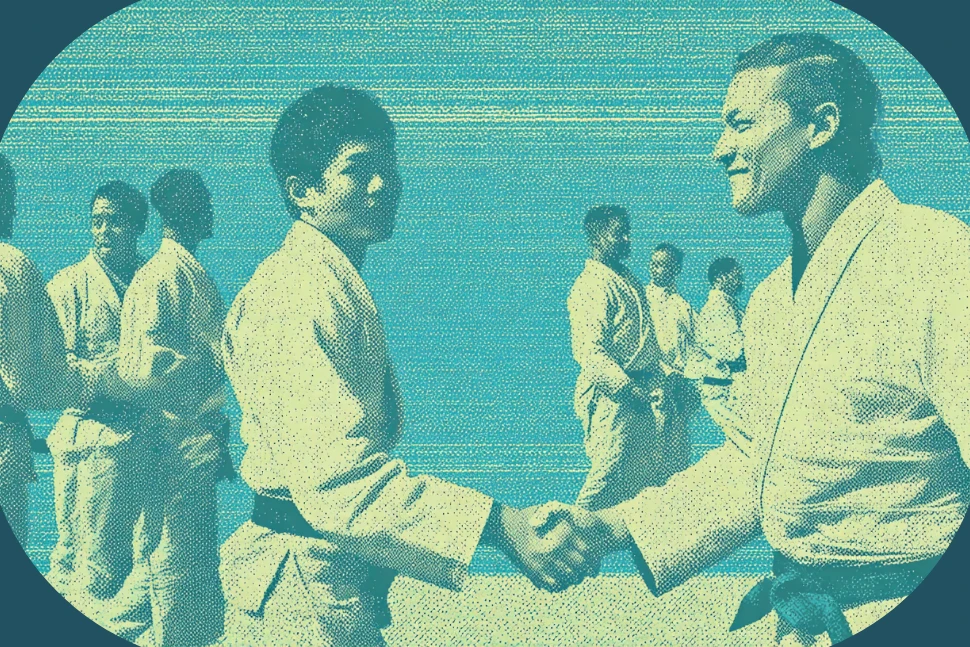
At Bodega, a first-timer gets a welcome from Kyvann, then an introduction to a named partner who stays beside the newcomer through class.
Bill runs the same play at East Austin, usually with fundamentals coach Tony Stolfa.
"Doing a warm handoff is preferred. And I try to do that directly with the coach."
He also passes along one detail about the new person: a wrestling background, say, or a friend in common with a member.
"This is Natalie. Natalie knows Jack." That's Bill's made-up example, and the conversation starts warm.
THE WARM HANDOFF:
Three steps for every first-timer:
1. Greet the newcomer. Welcome them by name when they walk in.
2. Learn one detail about them. They used to wrestle, say, or they share a friend with a member.
3. Hand them to a named person along with that detail. The conversation starts warm, and the newcomer has someone to train with.
On your own mat, that can be as simple as learning a trial student's name and one fact at the desk, then walking them to a partner who hears both.
Two Bridges Muay Thai in New York has a version it calls the three-friend rule.
The front desk is friend one. The front desk introduces a coach, friend two. The coach introduces a training partner, and that's three.
Once it's normal, members do it unasked. Fernando says his students at Renzo Gracie Niagara now greet newcomers without being asked: "Hey, are you new? I'm going to help you."
For what happens over the first 90 days after the handoff, see the BJJ student onboarding guide.
Take the Friction Out of Starting
"Just come in in your Lululemon shorts and a tight t-shirt, and you're good to go." That's what Bill tells a brand-new student at East Austin.
His beginner program has been entirely no-gi since day one, because "to get people in, you want to eliminate as many barriers as possible for them to… get in the sport."
The sport already involves strangers cranking on your arm. Everything else can be easy.
Show them it works, early
Bill wants new students to know "it works as quickly as possible."
So East Austin's fundamentals classes skip open sparring for positional sparring. A new student pinned on the bottom learns one way up and feels it work against real resistance.
Jason, who owns Nova Jiu-Jitsu, sees the opposite failure:
"They try to spar too soon. They don't have enough fundamentals… and so it's frustrating and they quit."
Nova's answer is dedicated fundamentals classes.
If your beginners wear a gi
Bill still thinks a beginners' gi class is a good thing to have. He'd add a no-gi intro alongside it.
If your program starts in the gi, you can still cut the cost. At Forte Jiu-Jitsu, new students get an Amazon link to a gi the coaches like, in any color, for about $50. Nobody has to buy a gym-branded gi, and the first jiu-jitsu class gets cheaper to say yes to.
Give Every Coach the Same Map
Bill joked on the webinar that "curriculum" is a dirty word to Chris. What he means by it is "having a plan."
Picture a student taking three classes from three coaches in one week. Armbars Monday, a leg lock Wednesday, some brand-new guard on Friday. Nothing connects, and by Saturday it all feels like noise.
Set a weekly theme
At East Austin, head coach Vince Barbosa sets the themes months in advance. One week might be a single passing theme that every coach teaches from the same starting position.
Each coach teaches a personal take and builds the rest of the class from what students are getting wrong. As Bill puts it, "you have room to deviate from there."
Students noticed. As Bill tells it, the feedback to the coaches was "It's really helpful that I can go to different classes and get different perspectives."
Shogun West BJJ runs something similar: a months-long curriculum where all the coaches study the same material.
As one of its coaches put it on the Gymdesk Originals episode: "We all kind of speak the same jiu-jitsu language, if you will, and it all compounds."
A shared theme gives a twice-a-week hobbyist the feeling of progress.
If your coaches teach on different nights, pick next month's four themes and send the list to every coach before the month starts.
Balance Games and Instruction
Games work, and paying beginners still want to be taught. Chris would split classes somewhere between 50/50 and 60/40, ideally 60/40 in favor of games.
Games here means the constraints-led approach, or CLA: partners play a positional goal with rules attached, and the technique comes out of solving it.
Paul Gilman, head instructor at Argyle Jiu-Jitsu, describes starting out "more classical" and moving to CLA over the last couple of years.
Chris trains almost entirely this way, about 95% games. Here's why he wouldn't run a gym on games alone:
Teach a little, then play
His seminar formula is the compromise.
"Teaching moves is a good way to… create context, and then doing games to actually build skill."
When he runs a full CLA seminar, he says, "the CLA diehards love it, and everybody else feels a little lost."
Bill agrees. He says brand-new students walk in thinking "you're the expert, tell me what to do."
In your own classes, that could mean ten minutes of technique that sets up the game, then the game.
What the research can and can't say
The research is thin here, honestly.
A 2025 review of team-invasion sports found that "Linear and nonlinear pedagogical approaches appear to achieve similar results with regards to technical skill development" (Bromilow et al.).
Games-based coaching did look better for tactical skill. The authors also call the evidence limited, and nobody has run a controlled BJJ study yet, let alone one on retention.
Cut the Rules That Push People Away
Chris once trained at a gym where nobody could step on an empty mat until the instructor said so.
Nothing was happening on it. People just had to wait for permission.
"A pet peeve, I would say is… weird rules," Chris Wojcik says. "I think that this just creates unnecessary friction."
Rules that cost you members
When Chris started, white belts trained gi only, you probably bought that gi from the gym, and sometimes you couldn't ask people to roll.
Each one is a small reason to stay home on a cold night. Hobbyists don't need many.
Keep what protects people
Some traditions do real work.
At ITC in New York, the team credits its judo roots, a "Japanese-style dojo mentality," for a room where people are respectful of the space and everyone cleans the mats after class.
Here's a test you can run on any rule you've got: does it protect safety or respect, or does it only protect habit? If it's habit, cut it.
Rule | Protects safety or respect? | Protects habit only? | Keep, change, or cut |
No stepping on an empty mat until the instructor says so | No | Yes | Cut |
Beginners can't ask people to roll | Rarely | Mostly | Change: anyone can ask, and anyone can say no |
White belts train gi only | No | Yes | Cut, or add a no-gi intro |
Gi must be bought from the gym | No | Yes | Cut |
No open sparring in fundamentals | Yes | No | Keep, with positional sparring |
Everyone cleans the mats after class | Yes | No | Keep |
Run your own gym's rules through the same test with the audit below.
Check the rules your gym has, add any we missed, and mark what each one protects. You'll get a friction score and a keep, change, or cut list.
Step 1: Check your rules. Step 2: Mark what each one protects.
How it scores. Every rule gets the same test: does it protect safety or respect, or does it only protect habit? Habit only means cut it (2 points). Partly habit means keep the reason and change how the rule works (1 point). Safety or respect means keep it (0 points).
The starter rules and their fixes come from the keep-or-cut table above. The bands are a rule of thumb, not a published benchmark.
Pay Attention to People
Make introductions on purpose
The handoff covers a newcomer's first night.
Bill keeps going with members who've been around for months. (The martial arts gym community guide covers the community-building side.)
He asks people what they do for work, and he remembers the answers.
That's how he figured out East Austin had two members with math PhDs. He introduced the two, and the conversation went straight to published research while he stood there with no idea what either PhD meant.
The reason he bothers: people can get jiu-jitsu anywhere.
"It's more about what else is going on in the gym. And most of that is just… showing people you pay attention to them."
What members don't use tells you what they're buying
East Austin also learned from what members ignored. The gym is open all day, so members can drill or lift solo. Fewer do than Bill expected.
"People don't self-organize their training," he says. "They want to know someone's going to be there to help them get better."
He also allows that people may just be busier than he thought.
The laundry membership was a miss too, even though Bill loved the idea himself. "I thought more people would want us to do their laundry, but no one does."
The evidence is for belonging
In a 2022 study of 278 exercise-class attendees, people "tended to be more likely to attend a given exercise class the following week to the extent that they reported a strong sense of social identification as a member of that class" (Stevens et al.).
People who felt part of the class came back.
Be careful with the broader claim. A 2026 meta-analysis of 71 studies found only "a small but non-significant advantage" for group-based exercise on physical activity (Kritz et al.).
Let Software Do the Remembering
Bill can remember what the math PhDs do. You can't hold 150 members' attendance patterns in your head, and that's the one part of paying attention software does better than a coach.
Most of the drift happens before month three, so the value is in reaching a student in week two, before the cancellation email.
- Absence flags. With attendance tracking, Gymdesk can start an automation once a member hasn't attended in a set number of days, so the "haven't seen you in two weeks" message goes out early. It stops on its own when they come back.
- Lead follow-up. Gymdesk's lead management turns a trial booking into a lead and runs the follow-up, so a trial student who didn't come back still hears from you.
- Skills on the schedule. Put the week's theme on every class, so members and coaches can see what's being taught and plan around it.
Bill uses Gymdesk at East Austin. On this Gymdesk-hosted webinar, he had little patience for owners still running on pen and paper or Excel. His math on gym software: "It'll cost one additional member."
And on Gymdesk specifically:
For belt tracking and the rest, see the BJJ features rundown.
Sell the Two-Thirds They Can't Get Anywhere Else
So, the short version of BJJ student retention: your jiu-jitsu gets people in the door, and everything else in this post keeps them there. Here's all of it on one page.
What students buy | Example from the webinar | One thing to try this week |
The room before class | East Austin's big lobby couch | Put a coach out front 15 minutes before your first class |
A warm first handoff | Bill hands first-timers to fundamentals coach Tony Stolfa, with one detail | Hand every trial student to a named partner |
An easy start | East Austin's all no-gi beginner program | Tell trial students exactly what to wear |
Coaches on the same map | Vince Barbosa's weekly themes, set months ahead | Pick next month's four themes and share them with every coach |
Some teaching with the games | Chris's teach-then-play seminars | Open one class with ten minutes of technique that sets up the game |
Fewer pointless rules | Chris's empty-mat pet peeve | Run your rules through the keep-or-cut table above |
Being noticed | Bill introducing two members with math PhDs | Learn one non-jiu-jitsu fact about three members |
Picture the student you want to keep.
Your student has a bad week. Work was rough, the shoulder's a little cranky, and skipping sounds great. They go anyway, because friends are going to be on the couch.
Chris described that exact feeling about East Austin:
A few months later, that student brings a coworker to your gym.
Still planning your gym? Read the guide to starting a BJJ academy and build the other two-thirds in from the start.
Already open and tired of tracking attendance in a spreadsheet? Try Gymdesk's martial arts software free.
Gym management software that frees up your time and helps you grow.
Simplified billing, enrollment, student management, and marketing features that help you grow your gym or martial arts school.


FAQ
BJJ Student Retention FAQs
The short versions, for anyone who skipped to the bottom.

Sean has spent the last decade creating content that helps businesses—small and not so small—grow smarter to allow operators to do more of what they love. You know, the fun stuff.
From shipping and international logistics to web development and marketing, he's done the work (not just the words) to scale retail and service businesses efficiently.
You can find his work at Sendle, Shogun, The Retail Exec, Gymdesk, and more.