
Best MMA Gym Software: What Mixed-Discipline Gyms Actually Need

An MMA gym isn't one gym. It's a BJJ school, a striking program, a wrestling room, and a strength-and-conditioning floor sharing the same mats—usually with a fight team layered on top.
That structure is the whole problem. Most MMA gym software was really built for a single kind of class: one schedule, one progression path. Drop a mixed-discipline gym onto it and the software starts to buckle in small, daily ways that cost you time you don't have.
This is a buying guide for that exact reality. Not a generic "best gym software" list with "MMA" pasted into the title. It's a look at what MMA gym software has to do when four programs and a fight team all run under one roof—and how the main options actually rank against that job in 2026.
Why MMA Gyms Break Generic Gym Software
KEY TAKEAWAY:
An MMA gym is really four gyms in one—BJJ, striking, wrestling, and S&C—plus a fight team layered on top. Single-modality software assumes one schedule, one progression path, and one rhythm, so it buckles in small daily ways for mixed-discipline gyms. The right tool is the one built for how your gym actually runs, not the one with the longest feature list.
Single-modality software assumes a single rhythm. A CrossFit box runs class after class off one template, and the tooling reflects that simplicity. For a box like that, it's a clean fit.
Your gym doesn't run on one rhythm. It runs on four, often at the same time.
Picture a Tuesday night. Kids' BJJ on the back mats, adult striking up front, the fight team drilling in the cage.
Three programs, three rosters, three attendance logs, one building.
Generic scheduling tools treat that as one calendar with overlapping events. That's exactly when double-bookings and "wait, which class did I check into" confusion start.
Then there's progression. Your BJJ students earn stripes and belts on one timeline; your Muay Thai students track shorts levels on another. A wrestler might not have rank progression at all.
Software built around a single ladder can't hold those side by side, so owners end up tracking belts in a spreadsheet the software was supposed to replace.
The revenue math is its own trap.
For many MMA gyms, most of your income comes from hobbyists—the 9-to-5ers who train three times a week and pay the bills. Your brand, though, is built by the fight team: a tiny slice of revenue and a huge slice of your attention.
You need a system that runs hundreds of recurring memberships and a roster of competitors with waivers, weigh-ins, and event schedules—without forcing you to pick which one to run well.
Underneath all of it sits liability.
Sparring and live rounds carry real risk, so waivers aren't a nice-to-have. Paper waivers in a binder don't survive a real claim, and they definitely don't keep up when a walk-in wants to try a class tonight.
That walk-in is the last piece. Martial arts has a trial-intimidation problem boutique fitness doesn't.
A first-timer walking into a room full of people choking each other is nervous, and a clumsy intake loses them before their first class.
The right software makes that first touch smooth instead of awkward.
None of these pains show up on a generic feature checklist. That's why the buying criteria for an MMA gym have to start from how your gym is actually built—not from whichever tool has the longest feature list.
What to Look for in MMA Gym Software (Buying Criteria)
The criteria get clearer once you stop shopping by feature count. These are the seven that actually matter for a mixed-discipline gym. They're weighted for how you operate, not for a boutique studio.
Criteria | Why it matters for an MMA gym |
Multi-program scheduling | Run BJJ, striking, wrestling, and S&C on overlapping calendars without double-bookings or merged rosters |
Rank and belt tracking | Hold separate progression paths per discipline—stripes, belts, levels—instead of one ladder or a side spreadsheet |
Billing flexibility | Handle recurring tuition, family plans, and fight-team arrangements, not just rigid class packs |
Lead and trial capture | Capture nervous walk-ins and web inquiries, then follow up automatically so trials don't leak |
Digital waivers | Collect and store signed liability waivers that hold up for sparring and live rounds |
Member app and check-in | Give members a simple way to book, check in, and track progress across programs |
Transparent pricing | Know your real monthly cost as you grow—no per-feature charges for the core operating features (rank tracking, multi-program scheduling, marketing) |
Notice what's not on the list: a marketplace app to "discover" your gym, or a fitness-class booking widget tuned for spin studios. Those are real features in other tools. They're just not what moves the needle for a fight gym.
Same features, different weights.
Get the weighting wrong and you've bought an expensive mismatch.
If you want the universal version of this framework across all gym types, the broader martial arts software guide covers the mechanics that apply to any school. The criteria above are the MMA-specific cut.
We'll keep you in the loop with fresh content, podcasts, how-to guides, tool reviews, and product exclusives.
How I Ranked These Nine
The order below ranks by fit for a mixed-discipline MMA gym. A first-year gym and a 400-member fight gym are buying different things, so each pick names the gym it fits.
Four things went into the order:
- Each tool was scored against the seven buying criteria above, weighted for a gym running several programs and a fight team. That means multi-program scheduling and per-discipline rank tracking count for more here than they would for a single-class box.
- The read draws on hands-on use of Gymdesk, plus each vendor's public documentation, pricing pages, and owner reviews for the rest.
- Pricing was checked against each vendor's live pricing page in September 2026. Tiers and promos change, so confirm current numbers before you sign.
- No vendor paid to appear or to rank. Gymdesk is our own product, ranked first for the mixed-discipline profile on the merits below. For other profiles, the pick changes, and the list says so.
The 9 Best MMA Gym Software Platforms in 2026
A feature-and-pricing snapshot first, then the ranked breakdown:
Tool | MMA-relevant strengths | Pricing model |
Gymdesk | Martial-arts-native; per-discipline rank tracking, multi-program attendance, digital waivers, member app, integrated payments | Banded monthly tiers by member count; all core features included |
Zen Planner | Explicit martial-arts focus; belt tracking and family memberships | Banded tiers by active member count |
Kicksite | Built for dojos; strong belt-rank and testing workflows | Published tiers by student count; all features included |
PushPress | Solid core gym management; CrossFit/functional-fitness lineage | Freemium plus flat paid tiers, some features as add-ons |
Mindbody | Large boutique-fitness platform with a consumer discovery app | Per-location pricing, higher tiers quote-based |
Wodify | Performance and workout-tracking depth for the S&C side; carries belt/progression tracking | ~$199/mo per location list, demo-led |
Martialytics | Martial-arts-native grading engine; deep belt-and-rank tracking | From $69/mo for 50 students, per active student; 30-day trial |
Spark Membership | Lead-gen and sales-automation focus for filling classes | $199/mo standard, demo-led (promos run lower) |
RhinoFit | Budget operational basics incl. rank tracking; genuine $0 start-up tier | ~$57/mo standard, plus a $0 start-up tier with limits |
1. Gymdesk: Best for mixed-discipline gyms running several programs and a fight team

If your defining trait is running BJJ, striking, wrestling, and S&C at once, with a fight team on top, you want software that treats multi-discipline scheduling and per-program tracking as the default.
That's the job Gymdesk was built for. It was built as a martial-arts-native platform, designed around belts, programs, and per-discipline attendance from day one, so a busy Tuesday night stays organized instead of merged into one messy calendar. Rank tracking runs per discipline, and digital waivers are collected at sign-up. Payments are integrated, so recurring tuition and fight-team plans run on the same predictable system.
For the fight team, Smoothcomp Connect comes with every Gymdesk plan at no extra cost, so you can find tournaments, register your students, and see their results come back to their member records without leaving Gymdesk. Gymdesk and Smoothcomp are now one company.
It's ranked first here for the mixed-discipline profile specifically—the gym running four programs at once in 2026. If your gym is a single-program boutique or a CrossFit-first box, one of the picks below fits better.
2. Zen Planner: Best for larger fight gyms wanting a heavier all-in-one platform
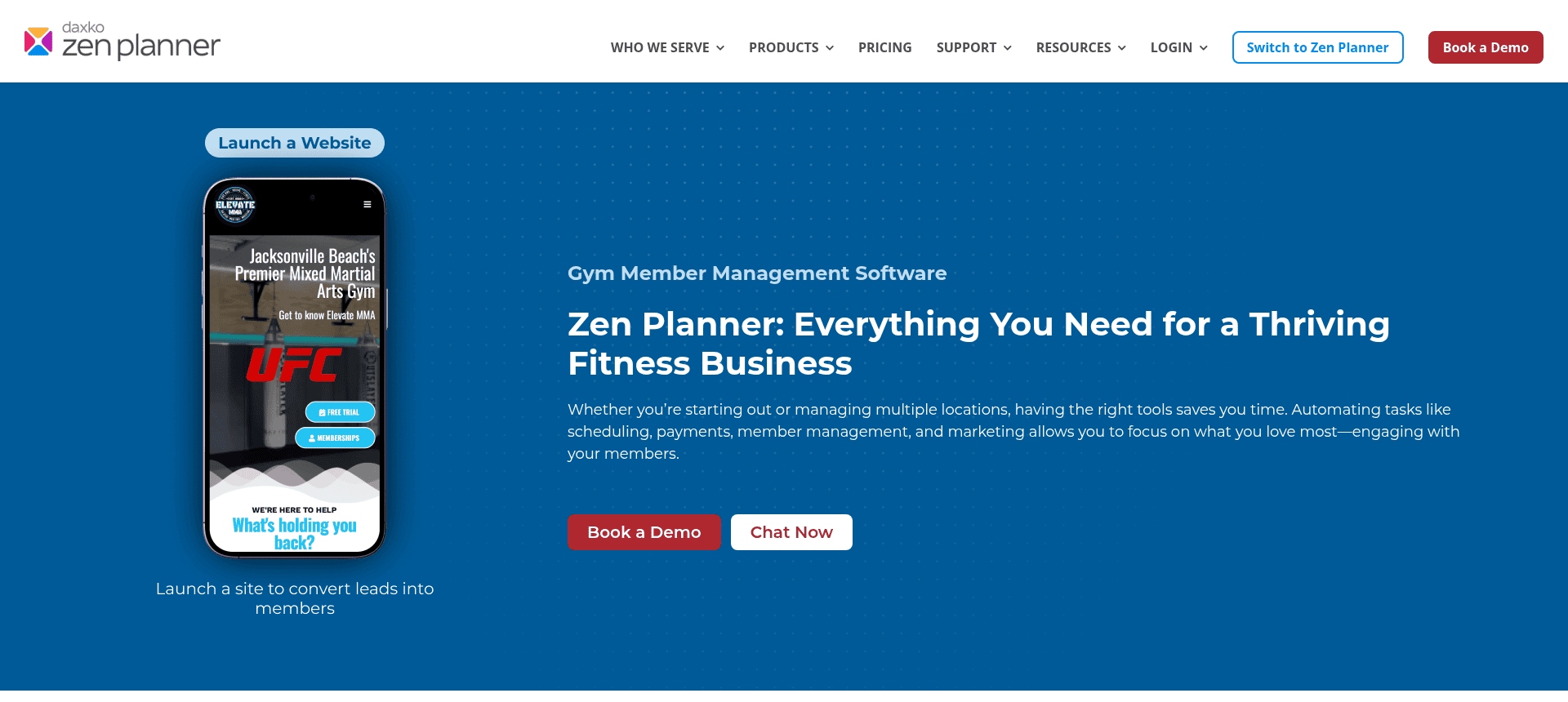
Zen Planner is a credible martial-arts option with belt tracking and family memberships, and it suits a bigger fight gym that wants a heavier, all-in-one boutique feature set around those basics.
The trade is weight. A larger gym with staff to run a bigger platform gets the most from it; a lean gym that just needs multi-program scheduling to stay out of the way may find it more than it needs.
3. Kicksite: Best for testing-heavy schools and fight-team roster management

What if your gym's identity rides on its competitors, or on a heavy testing calendar?
Kicksite is built for dojos, with strong belt-rank and testing workflows. That makes clean roster management and separating the fight team's tracking from the general membership feel natural—where functional-fitness software tends to flatten everyone into a single class-attendance model.
Its published tiers start at $49/mo for up to 25 students.
4. PushPress: Best for new gyms on a budget

In year one, the question is what you can run a real gym on without a per-feature bill that creeps every month.
PushPress's freemium tier can get a new box off paper, and its core gym management is solid. The friction is specific: its CrossFit-origin class-pack billing model fits functional fitness more naturally than per-discipline belt progression, which can feel like fighting the tool once you're running four programs.
If that's the wall you're hitting, read a focused comparison rather than take anyone's word for it. Is PushPress good for gyms and the broader PushPress alternatives roundup both walk through where it fits and where it doesn't.
5. Mindbody: Best for boutique-crossover gyms wanting consumer discovery reach

Mindbody's discovery marketplace is real reach. If a share of your members find you by browsing a consumer fitness app, that exposure has value.
It's built for consumer-fitness discovery. That reach is real, just not aimed at a fight gym filling its own mats. The per-location pricing and boutique-tuned feature set are a lot to carry for a mixed-discipline martial arts gym, and the multi-program, per-discipline workflows aren't its home turf. It earns a place for the boutique-crossover gym, and it's the least natural fit for a pure fight gym on this list.
6. Wodify: Best for MMA gyms built around serious strength-and-conditioning

The S&C floor is where an MMA gym looks most like a performance facility, and that's Wodify's home turf.
It came out of the CrossFit world, and its strength is workout programming and performance tracking—athletes logging sessions, coaches watching the numbers move. For a fight gym that treats conditioning as a real program instead of an afterthought, that depth is genuinely useful, and Wodify does carry belt-and-progression tracking for the martial arts side.
The catch is the center of gravity. Wodify is built around the workout, so the per-discipline rank tracking and multi-program scheduling that anchor a mixed martial arts gym sit lighter than they do on a martial-arts-native platform. Pricing starts around $199/month per location and runs demo-led.
If your gym's identity is barbells as much as belts, it earns its place. If you run on belts first, it's more performance tooling than you'll use.
7. Martialytics: Best for gyms where grading and belt progression are the whole game

What if the beating heart of your gym is the grading calendar—testing events, stripe-by-stripe progression, a promotion history that has to stay accurate for years?
Martialytics is the specialist's pick for that. It was built around the attendance-and-grading engine, and the rank-tracking depth is genuinely excellent. Pricing starts at $69/month for 50 students, scales per active student, and comes with a 30-day trial and no feature lockouts.
The trade is breadth. That depth is concentrated in rank and attendance; billing, CRM, marketing, and the member app are lighter than a full-platform competitor. For a gym running four programs and a fight team, that can mean running your marketing and heavier billing somewhere else. If grading is your priority and you're fine with that split, the trade is worth it.
8. Spark Membership: Best for MMA gyms where filling classes is the bottleneck

Some gyms don't have a back-office problem. They have an empty-mat problem.
Spark Membership leans hard into lead generation and sales automation—follow-up sequences, sales pipelines, and lead nurture as first-class features rather than afterthoughts. For an MMA gym whose growth is capped by trials that leak before the first class, that focus has a real story, and it aims straight at the trial-intimidation gap this guide opened with.
Where it comes up short is the operational core: rank tracking, scheduling, and billing feel secondary to the marketing engine. Standard pricing is $199/month and demo-led, priced like a marketing tool rather than a lean back-office one.
If your pain is "I can't fill classes," Spark is worth a demo. If it's "my Tuesday night is chaos," start with a platform built for the operations first.
9. RhinoFit: Best for the smallest budget-first gyms watching every dollar
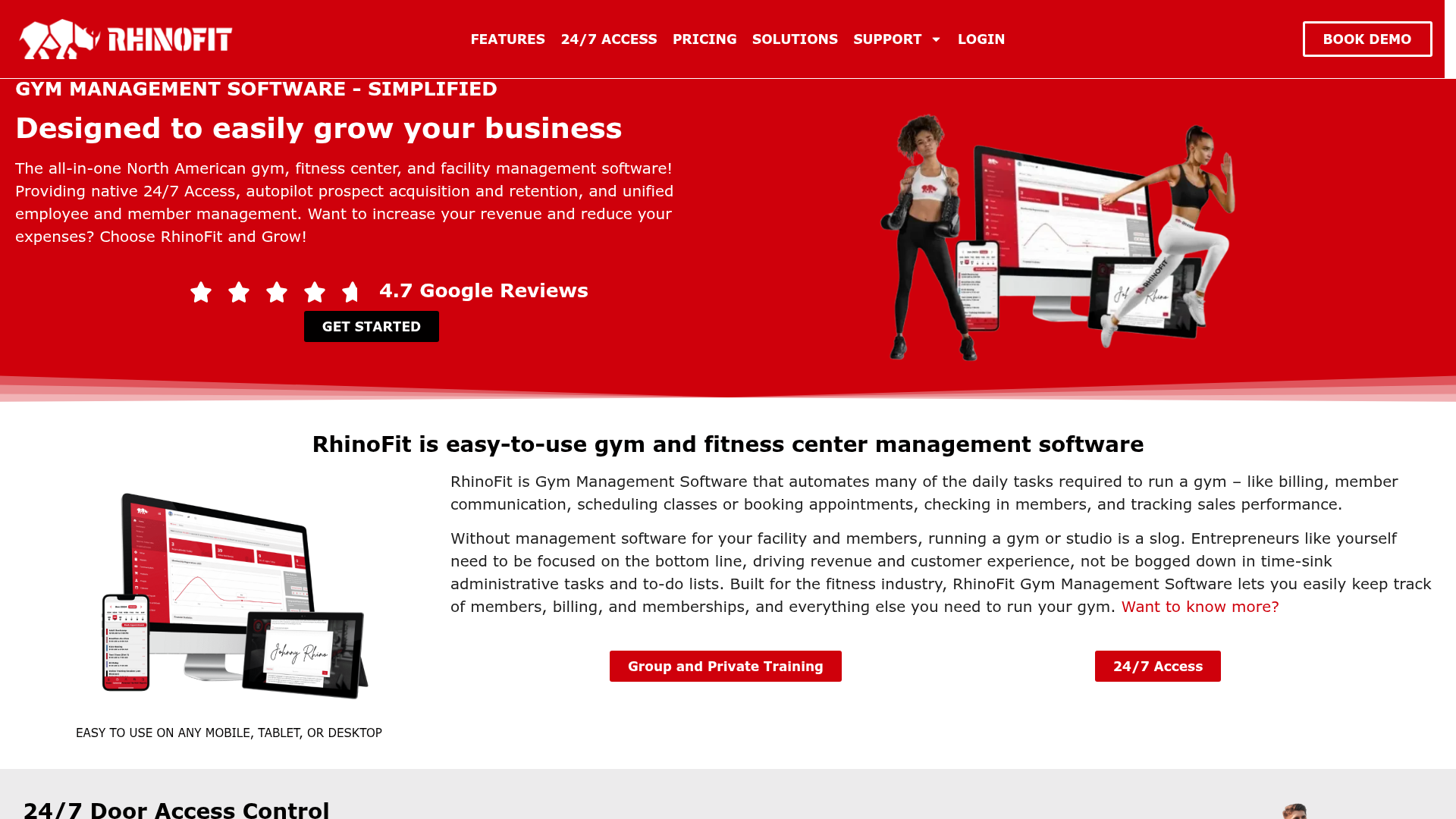
When the whole question is what you can run a real gym on for as close to nothing as possible, RhinoFit is the budget answer.
It covers the operational basics—membership management, scheduling, billing, and rank tracking—at a low price point. The standard plan runs around $57/month (pricing is promo-driven, so confirm the current rate), and there's a genuine $0 start-up tier for very small gyms—roughly 20 or fewer active users and under $2,500 processed a month, with feature limits.
You can feel the price. The member app and the automation are lighter than the mid-tier platforms, and the start-up tier's limits are real. It's leaner than PushPress's free tier on the extras, but it's a defensible starting point for a brand-new gym counting every dollar. Most gyms outgrow it once the programs stack up.
A fair note on the whole list: each tool has genuine strengths, and the "right" one depends on your gym's profile more than on any feature count. The through-line for a mixed-discipline MMA gym is fit for how you actually run—and that favors software built for martial arts first.
Best MMA gym software by gym type
Here's the fastest way to place your own gym in 2026:
Gym type | Best fit |
New or first-year gym | PushPress (free tier) or Gymdesk |
Rock-bottom budget, very small gym | RhinoFit or PushPress (free tier) |
Hobbyist-heavy, mixed-discipline | Gymdesk |
Growth capped by enrollment | Spark Membership |
Performance- or S&C-heavy program | Wodify or Gymdesk |
Grading- and testing-centric | Martialytics or Kicksite |
Fight-team-heavy or testing-heavy | Kicksite or Gymdesk |
Established larger gym wanting all-in-one | Zen Planner |
Boutique-fitness crossover | Mindbody |
Best MMA gym software by discipline
An MMA gym is several programs sharing one roof, and the tool that fits one room isn't always the one that fits the next. Here's the by-program cut:
Program under your roof | What it leans on | Best-fit picks |
BJJ (gi/no-gi) | Stripe-and-belt progression, family plans, open-mat scheduling | Gymdesk, Kicksite |
Striking / Muay Thai | Level tracking, multi-coach class capacity, drop-in billing | Gymdesk, Zen Planner |
Wrestling | Roster and attendance without a rank ladder | Gymdesk, PushPress |
Strength & conditioning | Workout programming and performance logging | Wodify, Gymdesk |
Fight team / competitors | Separate roster, weigh-ins, waivers, event sign-ups | Gymdesk, Kicksite |
Grading & testing events | Deep promotion history, testing workflows | Martialytics, Kicksite |
Kids programs | Family billing, minor waivers, milestone visibility | Gymdesk, Zen Planner |
How Much MMA Gym Software Costs in 2026
Sticker price is the wrong thing to fixate on.
The pricing model matters far more for an MMA gym, because a multi-program gym triggers exactly the kind of complexity that per-feature pricing charges extra for.
Think of the owner who signed at a low headline rate, then opened a much bigger invoice the month they added belts, an app, and marketing. That's the model trap. There are three common ones:
Pricing model | How it bills | What it means for an MMA gym |
Flat tiers | A predictable monthly rate, often set by member count, with features included | A predictable, banded monthly rate that rises in known steps as you grow, with features included—no surprise line items |
Per-member | Your bill scales with the size of your roster | Neutral for complexity, but it taxes the large hobbyist base that funds the gym |
Per-feature | Starts low, then adds line items—a branded app, rank tracking, marketing—on top | The add-ons aren't optional; they're the features you need on day one, and cost climbs fastest exactly when you run four programs |
Cost creep is the thing to watch: advertised entry rates can more than double once the required add-ons are included—and for a gym running four programs, those add-ons are day-one features, not extras. A flat, all-included plan usually ends up both cheaper and easier to forecast for a gym with your complexity.
If you want to model real numbers, the gym management software cost breakdown lays out the line items, and the PushPress vs Gymdesk cost calculator lets you compare two specific bills side by side.
Whatever you choose, price the model, not the headline.
Should You Switch? (Migration Reality)
The fear that keeps owners on software they've outgrown is data migration—the dread of moving hundreds of members, payment plans, and attendance history to something new.
It's real. It's also front-loaded. The slow tax of fighting the wrong tool every week costs more.
The trigger to switch usually isn't price. It's the moment the software stops fitting how your gym runs—when you're keeping belts in a spreadsheet, manually splitting fight-team billing, or losing trials because intake is clunky.
For MMA gyms, that moment is almost always "we outgrew single-modality tooling."
The usual move is off Mindbody (per-location pricing that adds up for a multi-program gym), PushPress (CrossFit-origin class packs), or Zen Planner, onto something built for martial arts. Most established platforms will import your member and billing data, and the good ones assign someone to help.
If you're weighing the timing, changing martial arts software walks through the signals that say it's time versus the ones you can wait out.
Switching mid-stream is survivable; staying on a tool that doesn't fit just compounds.
Running an MMA Gym on Gymdesk
Here's where the criteria from earlier turn concrete.
Gymdesk was built martial-arts-first—its original name was literally "Martial Arts on Rails"—so the features map onto MMA pains rather than fighting them.
Walk through a real week. BJJ, striking, wrestling, and S&C each get their own classes, rosters, and attendance tracking, so overlapping schedules don't collapse into one calendar. Belts, stripes, and levels track per discipline in the software, not a side spreadsheet.
Web inquiries and trial sign-ups get captured and followed up automatically, so the nervous first-timer actually books a class. Digital waivers are signed and stored before anyone spars. Member management keeps families, billing, and history in one place, with integrated payments for recurring tuition and fight-team plans.
For proof it holds up under a real fight gym's load, ITC New York and Team SMMA in Chula Vista are two MMA operations running their day-to-day on it.
Related reading: if you also run gi-only BJJ classes and want to compare that vertical specifically, the BJJ gym software comparison is the sibling guide.
Choosing the Right Software for Your MMA Gym
A well-run MMA gym's back office is quiet.
Schedules don't collide, belts update themselves, waivers are signed before anyone steps on the mat, trials turn into members without you chasing them, and the monthly bill is a number you can predict.
Getting there starts with one honest question: does this tool fit how my gym actually runs, or am I bending my gym to fit the software?
Weight the seven criteria for your situation. Price the model, not the headline. And lean toward tools built for martial arts rather than retrofitted from another sport.
FOR MIXED-DISCIPLINE MMA GYMS
Weight the seven criteria, price the model, and see how a martial-arts-native platform handles your busy Tuesday night—before you move a single member over.
Start Your Free TrialGym management software that frees up your time and helps you grow.
Simplified billing, enrollment, student management, and marketing features that help you grow your gym or martial arts school.


FAQ
MMA Gym Software FAQs
A few quick answers to the questions MMA gym owners ask most when comparing software.

Sean has spent the last decade creating content that helps businesses—small and not so small—grow smarter to allow operators to do more of what they love. You know, the fun stuff.
From shipping and international logistics to web development and marketing, he's done the work (not just the words) to scale retail and service businesses efficiently.
You can find his work at Sendle, Shogun, The Retail Exec, Gymdesk, and more.