A Luxury: What a Free Jiu-Jitsu Mat Is Worth in a Town Where a Family Makes $20 a Day
Starring
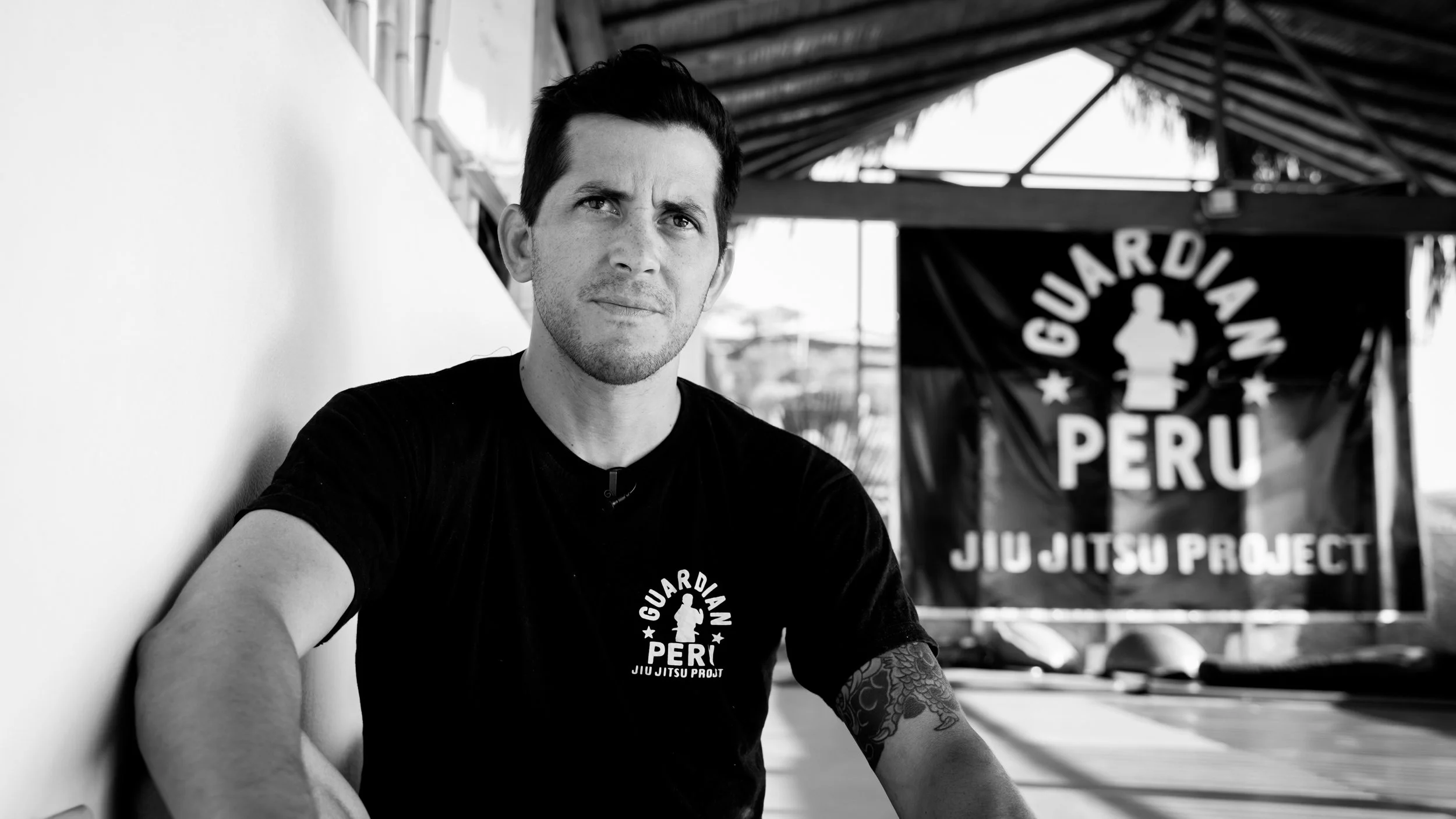
Salvatore Sanguinetti is a second-degree Brazilian jiu-jitsu black belt who founded and leads Guardian's Peru program in Máncora. Born in Lima, he started martial arts at age seven and trained in the United States under the Yamasaki team before returning to Peru. He frames the disruptive, aggressive kid not as a problem to remove but as one asking for limits, and points to former bullies in his program who now mentor younger kids and take them surfing.
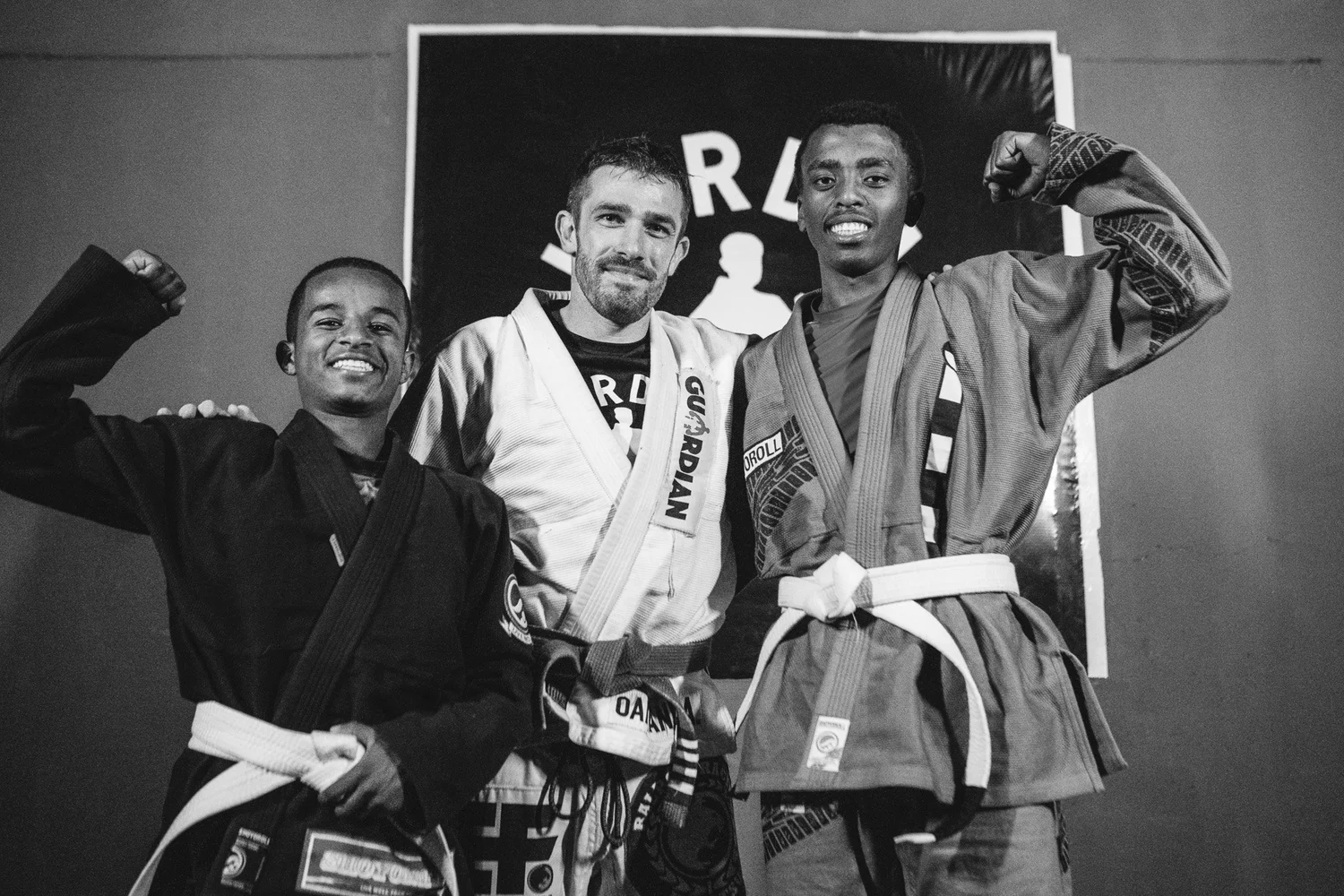
Calder Powers is the executive director of the wider Guardian Project. He came to jiu-jitsu at eighteen after a rough adolescence, and describes the art as a light switch that turned his life around, going from being told he wouldn't graduate to straight A's the next semester in community college. He now visits the Peru program regularly.
About the Gym
Guardian is a philanthropic 501(c)(3) program that brings Brazilian jiu-jitsu into under-resourced communities, with a focus on kids. Training is free. In Peru it runs six academies, with its new headquarters in Máncora in the Piura Region, and the wider Guardian Project counts 36 locations across Latin America, Africa, and Asia, including a program in Ethiopia where 35 of the kids who train are homeless.
Guardian Peru began with Salvatore Sanguinetti's mats. He started a social project in Piura around 2013, recruiting kids who cleaned windshields at the stoplights, moved north after the 2017 El Niño floods, and reopened in his own living room in Máncora after his newborn son recovered from pneumonia.
During the pandemic, Calder Powers tried to send him donated gear from Oakland and the two decided it made more sense for Guardian to fund the program instead. It was the organization's first international site; the ask was fifteen kids, and there were thirty or forty by the end of the first year. The current HQ was sponsored by the Fair Fight Foundation after a three-day visit.
Guardian covers its own overhead, so a donation goes to a program, and donors can choose which academy receives it. Calder's suggestion for anyone who wants to get involved is to visit Peru and see it.
Máncora (HQ), Piura Region
Av. Piura, Máncora, Piura Region, Peru, in the town center, about half a block off the Panamericana highway, across from Odisea Restobar (Av. Piura 501). Filmed in Máncora only, with a short walking recap in Lima.
Summary
Part 1 asked what the kids were carrying. Part 2 asks what the training costs, and who pays. Alex Cuevas rides a tuk-tuk out past the cemetery to the barrio where Lening lives, eats lunch at the house Lening's father keeps building, sits down with Oscar and Jeison at the same table, and ends the day at the key shop where Favio, 15, works with his family and lifts with weights he poured out of concrete into old paint buckets.
The number behind the title is Alex's own arithmetic at the key stand: twenty keys on a good day, about a dollar of profit each, twenty dollars for the whole family. A monthly dojo fee is not a stretch on that income. It is out of reach. Between the visits, Salvatore Sanguinetti and Calder Powers tell how Guardian Peru started—a pandemic gear donation that became a decision to fund the program Salvatore already had on his living-room floor—and how a donation can be pointed at one academy. The kids close their own film with a message to the world.
What They Told Us
Part 1 stayed on the mat. For Part 2, Alex Cuevas got in a tuk-tuk and left it. He rode out past the cemetery to the barrio where Lening lives, had lunch at the house Lening's father is still building one layer at a time, sat with Oscar and Jeison at the same table, and then went to the key shop where Favio, 15, works with his family. In between, he sat down with Salvatore Sanguinetti and Calder Powers to ask the question Part 1 never did: what does this cost, and who pays for it?
What jiu-jitsu is for
At the Máncora HQ, before the home visits, Alex said the program looked to him like a stable rock in the kids' lives. Calder, who runs the wider Guardian Project, put it in his own terms.
"It's way beyond jiu-jitsu, I'd say jiu-jitsu is the tool, the same way a piano is a tool to play music. jiu-jitsu is just the medium that all these other things come from. They come into training and now they have a place to go every day. They have the friendships they make through jiu-jitsu, they have the mentorship. jiu-jitsu is like probably, I would say like 10% of it."
—Calder Powers, Executive Director, Guardian Project
Mats in the living room
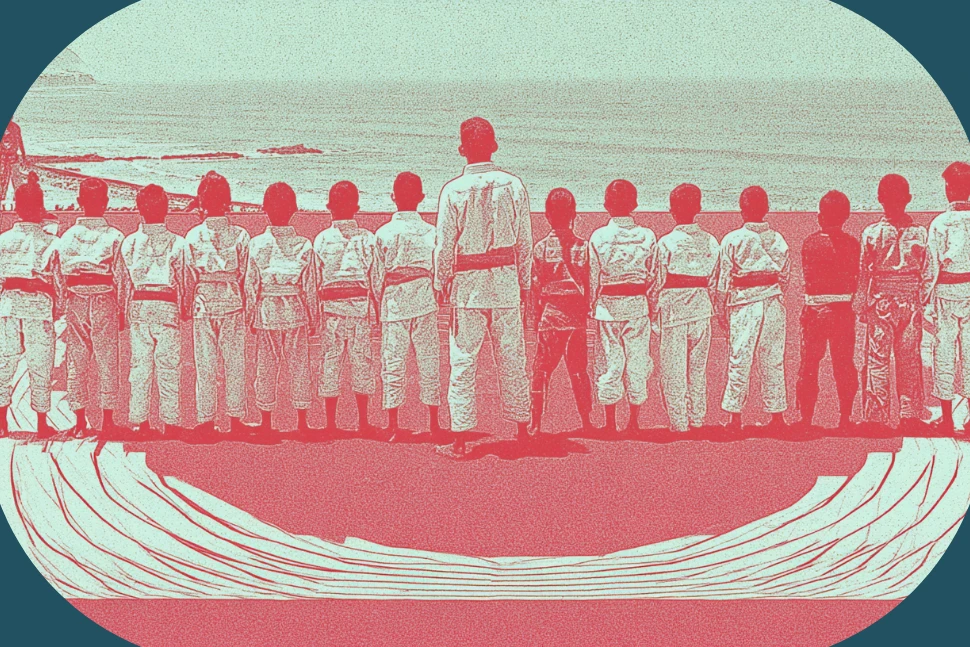
Salvatore, who founded and runs the Peru program, came back from the United States and started a social project in Piura around 2013, picking up kids who cleaned windshields at the stoplights. It grew to about fifty. Then the 2017 El Niño floods hit, and he moved north to Máncora. Then his newborn son got sick.
"He had pneumonia twice. So the first two years was tough. He almost died. So I had to stop everything and just focus on him. And, and after he got better, boom, I reopened again at my house because I had the mats."
—Salvatore Sanguinetti, Founder and Head Coach, Guardian Peru
Twenty keys on a good day
Favio trains at Guardian, competes, and lifts with weights he and his father poured out of concrete into old paint buckets. The rest of the day he cuts keys at the family stand. Alex did the arithmetic on camera.
"We were just doing some math, and he sells about 20 keys a day on a good day. He sells them for about four local dollars, which is about $1.30 or something like that, U.S. The key costs him about $0.30, but my math is right. So he makes about a dollar in profit a day. But his whole family's here working all day, so they take home on a good day $20, sometimes less."
—Alex Cuevas, CEO, Gymdesk
That is the number behind the episode's title. A monthly dojo fee is not a stretch on that income. It is out of reach. Guardian covers it.
Two fathers
The paint-bucket weights caught Alex somewhere he did not expect. His own father had built him something similar, and had died shortly before the trip.
"My dad built me a little wooden dummy, we didn't have any money, so I could practice Taekwondo on it. My dad just passed away, so I'm a little emotional about the memory, so it just kind of hit me hard."
—Alex Cuevas, CEO, Gymdesk
One seed
Guardian Peru started when Calder tried to ship donated gear to Salvatore during the pandemic and decided it made more sense to fund the program he already had. Six academies in Peru later, Calder talks about the growth in generations rather than head counts.
"Let's say we reach our goal and get 300 plus kids that are training. And then how many of them are going to become instructors? How many of them are going to sponsor other kids? It's not even, you know, like down generations down. It could be 10,000 more kids that have been touched with jiu-jitsu from that seed."
—Calder Powers, Executive Director, Guardian Project
What a visit changes
Asked afterward how the day had changed his view of the program, Alex went back to the phrase he had been using before he arrived.
"It's just jiu-jitsu for kids in poorer countries. That's not really, it doesn't do it justice, man. It doesn't. Because it's like, no, no, no. It's a framework for people to improve their lives, improve society. And, you know, I wouldn't have got that from just like, oh, here's the donation."
—Alex Cuevas, CEO, Gymdesk
Guardian is a 501(c)(3). Donations can be directed to a specific academy, and Calder's suggestion for anyone who wants to get involved is simpler than a cheque: come to Peru and see it.
Read the full transcript
Episode Transcript
Guardian Peru, Part 2: "A Luxury." Speaker labels are added from context; the host is Alex Cuevas, Gymdesk's CEO. Student answers are shown as the on-screen English from the episode.
Cold open
Oscar: It's hard for people to pay for the classes. For people without money, it's out of reach. It's more like a luxury, you could say. And that helped us a lot, because at the time… It's not like we had the money to pay a monthly fee at a dojo.
Máncora HQ
Narrator: Behind every gym, there's a story, a mission, a spark of passion that started it all. This is Gymdesk Originals. Real owners, real struggles, and the communities they've built from the ground up.
Carson Quinene: It just doesn't make any sense to me. You know what it is? Here's something that I've started realizing as I'm traveling and meeting all these different people all over the world is their jiu-jitsu really reflects their life, their personality, their temperament. You can learn a lot about a person by rolling with them because you'll see how they move, see how they react, and you'll kind of get a sense of who they are through jiu-jitsu, which I think is really cool. With these kids, they have so much heart. You can tell they come from nothing, but when they walk in the door, they're super respectful. You can tell how grateful they are. When you start rolling with them, you can tell how much heart they're putting into that round. They don't want to lose. It's not that they're spazzing out. It's not that they're trying to go crazy, but they don't want to lose. They don't want to give up because to them, they've been fighting their entire life for everything. When you roll with them, you really get a sense of who they are.
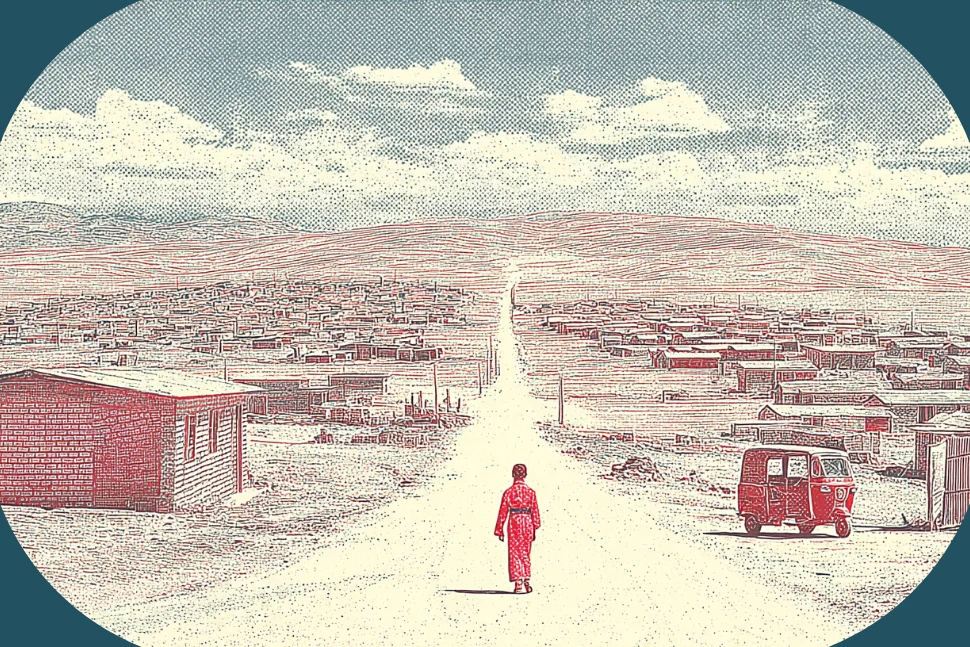
Alex Cuevas: Yeah, it's interesting you say that because I think about like, well, how do I roll? And I'm like the peaceful ruler, you know what I mean? Like, I don't go hard. One look at the elephant that's their lives and you're here in community and everyone's wearing a gi. It's kind of like, you almost can be like, oh, everything's great. But what I really want to do is uncover how they live. And that's what I think we're going to do today. Go follow them around. Let's see where they live, literally where they live. What's their day-to-day look like outside of here? Because I think that's the most important thing to understand, like, who Guardian is actually helping beyond, you know, having kids in here. Like, what's that life like outside? So I think what we're going to do is we're going to go to one of the restaurants over here, get some food, and then bring it back and kind of sit down and have lunch with Lening at Lening's Place. And I've been to Lening's Place before. It's really unique. It's nothing like the States. You wouldn't find a place like this in America. It's kind of put together, built with like bamboo, tin, wood. And it's all just kind of like a guy found a plot of land and was like, I'm going to build a fort here. That's what it would be like in America. It doesn't look like you walk by, like, you would think that that place is abandoned almost just because of how different it is.
Oscar at the door
Alex Cuevas: Here we are. I'll switch to Spanish so you can meet the guy they were just talking about—the legend, Oscar. Right here. Nice to meet you. And Guardian? How many years here?
Oscar: Three and a half years training here at Guardian.
Alex Cuevas: How has it changed your life—why is this program important to you, and to what you do?
Oscar: Well, it gives me a bigger, better-equipped place to train. And it helps the young people here in Máncora get away from the bad life you can see in some parts of town. It's also a place where we're safe—where we can socialize, talk, chat. And if we have something to share, good or bad, they help us with it.
Alex Cuevas: And for the people who've donated to the program, who've supported it—what's your message to them?
Oscar: First, I'd thank them. Thank you so much for everything you give to the Guardian project. Thanks to the donors we have gis, rash guards, the tatami—this space too. It's all thanks to the donations people make to the project. And I want to tell them the kids are making the most of every opportunity they're given.
Calder Powers: It's not just jiu-jitsu, it's just like a stable rock in their life, it seems like, and a model for good. It's way beyond jiu-jitsu, I'd say jiu-jitsu is the tool, the same way a piano is a tool to play music. jiu-jitsu is just the medium that all these other things come from. They come into training and now they have a place to go every day. They have the friendships they make through jiu-jitsu, they have the mentorship. jiu-jitsu is like probably, I would say like 10% of it. When you think about who these kids' friends are, the memories they're making, the dreams they have, the way they think of themselves, the confidence. I'd say jiu-jitsu, like the actual technique is just a very small part of it, but it's the medium we use to get everything else.
Alex Cuevas: I'm looking forward to seeing, you know, the other half. Like when the kids aren't in the class, what is that like? So that people get a better understanding of it and can appreciate how important the program is. So we're going to go do that now, right?
Calder Powers: Amazing, yeah. Yeah, we'll be seeing the neighborhoods, visiting Lening at his house, doing lunch, hanging out. But more also just seeing the town and kind of life outside.
Sit-down: how Guardian started
Calder Powers: I don't even think I was coaching when I started. I like sent him a DM of like, hey, how can I help? So I was like cleaning and coming in. And then I just kind of continued to take on more responsibilities there. But I continued my jiu-jitsu journey since I was 18. And I knew even when I was younger, I was like, I know I'm going to be a black belt. It kind of felt dumb to say at the time because it's like, oh, everyone says that. But I was like, this is my favorite thing. It's become more than a passion, more than a sport. It's become a lifestyle. And even when I'm not training, I feel like jiu-jitsu gives me so much to hold on to and to keep in terms of the friendships, in terms of something to focus on. And it's always there when you kind of can come back.
Alex Cuevas: So then let's talk about Guardian. So you're now in Oakland, you're training, and you first got exposed to Guardian because it was like a program that was in the gym at the time, right?
Calder Powers: So my friend Ben started it. And I was training with Ben at the gym that we both trained at, which is off Ralph Gracie Berkeley. And so I heard about it and I was like, it actually was about a year that it had been going. And I was like, man, that's really cool. You know, kind of thought about it. And I was like, I've been meaning to check that out. And there was one day that I was just like, I think I had some free time and I didn't want to get another job. So I was looking to do something more meaningful. And so I just, I texted him on Facebook Messenger and I was like, we were coordinating for some fight to win stuff to go to a fight together. And I was just like, hey man, if you ever need any help, you know, we'd love to get involved. And even when I went the first day and he was showing me around, I was like, ah, what did I get myself into? I really want to do this. But it was like, once I met the kids and kind of saw the mission, it really, you know, just, it was a no brainer.
Alex Cuevas: So you're the, the first anchor flagship was in Oakland. And in a like poorer area, right?
Calder Powers: It was in downtown Oakland. So it was actually really great because all of the, it was very central for transportation.
Alex Cuevas: So you had a hub there that made it easy for people to get to. And I think you guys mentioned, you mentioned earlier, you guys had some really good success with that first location, right? So then can you unpack what happened from there?
Calder Powers: So we, we actually were so successful that we wanted to expand and we moved into a bigger location and then COVID hit. And it was COVID that kind of turned what was the mission forward into kind of like an afterthought because we were doing socially distant classes outside. And Ben and I were just kind of like, this was always meant to be bigger than Oakland. And we were putting so much effort into just making this one Academy work. And I think that's when we decided to kind of pivot the model and start going into this larger direction worldwide. And it was when I connected with Salvatore, we had some gear that we were wanting to donate during the pandemic. We were just having a hard time figuring things out. I was coordinating to send him some gear. And then I was just like, man, this guy's awesome. He has a history. What are you going to send? Don't send me anything. So I think there's a lot of coordination to send something to Peru. So we actually started talking. And from there on, it was just like, it made a lot of sense that like, hey, this could be a really great partnership where we could, we could do the first expansion internationally. And why don't we fund this program and see what happens? And so then we, that was the origin of Guardian Peru. And I think at the time he had just restarted Drala, which was a social project that he was doing in Piura. So he was bringing Drala to Máncora at that time. It was in the very beginning stage. He might've had like five kids or something.
Salvatore Sanguinetti: We have, we have some people training, but when I moved to the, because I had it on my living room, my living room was the stage. And then I was told, I was like, I cannot do it anymore there. Cause I was almost like a year in my living room, the whole mat area. Then I took the mats and I found a roof on top. And then I just brought the mats and all the people that were in my house.
Alex Cuevas: So I'm going to pause. I'm going to go back in time and we're going to go back to DC. You're in DC now. You're training. Things are, you're in the U.S. for however long.
Salvatore Sanguinetti: I was there since 18 until 34.
Alex Cuevas: So then you got a black belt at this point.
Salvatore Sanguinetti: I got my black belt. 2019. And I went to, and I was going to school.
Alex Cuevas: I was working a lot, you know, so you're living, you know, training jiu-jitsu, competing. So you're living the life now, uh, the, you know, you're in the United States living that life. And then, so you're now in Peru.
Salvatore Sanguinetti: So I decided I, I, the system didn't click with me, you know, I was, I was up for something different. So I, and I love surfing. So I came back to, to Peru and because I saw people getting, getting better doing jiu-jitsu, many friends with a lot of problems. So I said, I'm going to start it in Piura back in the day. You know, like it was in, uh, 2013, maybe 14, 14, 15, I started in Piura. So how this, this, about these mats, you know, and then I started having kids. We ended up with 50 people, kids from, I used to pick up kids from the, from the lights. The day they want to clean the windshields and, you know, ask them to, to come, you know, find the ways to, to talk to the parents, you know, and, and then we spread the, the sea. And then after that, El Niño came and hit us 2017. So I moved to the North and I opened up another location here with the same concept. And then my kid got sick when he was born, the kid that you spar with. Oh yeah. He had pneumonia twice. So the first two years was tough. He almost died. So I had to stop everything and just focus on him. And, and after he got better, boom, I reopened again at my house because I had the mats. So I started bringing people, kids, you know, stuff.
Alex Cuevas: And where are you located when you're doing the mats here?
Salvatore Sanguinetti: Uh, here in Máncora.
Alex Cuevas: So you're in Máncora and you're like, I don't have a place, but I have my living room. I'm going to throw my mats in. You started doing the exact same thing you were doing.
Salvatore Sanguinetti: That was doing in Piura. Then I brought it, I brought it here, but some people were already there in Piura. Where I left, you know, training and doing the same.
Alex Cuevas: So you're looking for a little bit more substance out of life than what you were having in the U.S. You came back to, uh, to Peru, did that. Now there, then the interest comes in through that conversation and somewhere along the way, the idea is like, wait a minute, let's do something bigger and let's do Peru headquarters. So if you bring me back to that moment, um, what was it in that you, you, did you come down here? Like, wait, let's do something bigger.
Calder Powers: And, you know, we, we were already thinking of doing this expansion and kind of pivoting Guardian. And so I think that there was just something that was like, oh, this could be the opportunity to do that. I think it just kind of made sense. And, and I think we started and I was just like, well, how about, you know, we fund the rent, we fund this, we give you. We were trying, we were trying to figure out other ways to sustain the program.
Salvatore Sanguinetti: And then more kids came, more kids came, more kids came. And they came fast. They came fast. Like we, like, he talked about, like, hey, can you get 15 kids? And I was just thinking in the back of my mind, I was like, bro, 15 kids is going to be tomorrow. And then at the end, we had like 30, 40 kids the first, that first year, I think was mid-year to the end. We already have like some, a lot of kids. And then, you know, you have other people who are like, hey, that's a great idea. And now Guardian, you know, you guys joined forces and you have this. And then to know that you're doing this, not just here, there's many other places. Like, I remember I used to see the, the social projects in Brazil for jiu-jitsu, you know, tough, tough spaces, you know, like super dangerous and stuff. So I was like, wow, it would be cool one day to, to create something like that, you know? And then there's other people doing it all over. Like they were doing it. I was doing it. Carlos was doing it in Baltimore.
Alex Cuevas: That was the second, right?
Calder Powers: Carlos, right in Baltimore.
Salvatore Sanguinetti: I was doing it in Baltimore. 2020. And then I was like, oh, oh, my friend's doing it. I was like, oh, how these guys connected. And then everything, you know, we just got into the same page and let's fuse and let's open it up. Let's connect and help more, more kids. But then everything started to, to move on and to grow. And then when, when Seth and Craig came, you know, to, to Máncora, everybody came, Ben came, Calder, everybody came. And then they saw what you see, you know, they went to the house, the same experience they had. And then they were like, okay, let's do something bigger. Here we are. And they sponsored this.
Calder Powers: It was so super crazy too. Because it wasn't three days. They came for three days.
Salvatore Sanguinetti: Brother, it was like three days and it was enough to, to make the impact that the kids needed.
Alex Cuevas: You just go work at a gym somewhere, right? In the U.S. But obviously you're here for a reason. Maybe you can say it in your own words.
Calder Powers: Well, we have six academies in Peru and it kind of felt like a no brainer that if I was closer to Peru, I could, especially as we just built this new HQ, that I could be more involved with the kids. I mean, beyond the reasons for Guardian, which there are plenty. And I really love being here and seeing the different programs and visiting around and having these communities to be in and helping and kind of also experience, you know, not just helping the kids, but also get a vacation and kind of have a double impact of helping themselves and the community and seeing what a social project in action looks like.
The tuk-tuk
Alex Cuevas: Am I riding in here? Oh, I never rode one of these before. What are these vehicles called? All right, here we go. We're going on a tuk-tuk. That tuk-tuk? To the cemetery. To the cemetery. Hopefully we'll make it there alive.
Calder Powers: This is actually how a lot of the people make money. So this is one of the common jobs people do. This is like how a lot of, you know, what people might look forward to is buying a tuk-tuk and then being able to use it as a taxi, basically generate income. And I think that's, you know, another thing in Máncora is just there's so little opportunity. You know, this is one of the things people see as a viable option for a career path.
Alex Cuevas: We're in a tuk-tuk right now. And what are we doing? We are on our way to Lening's house. We're going to have lunch with him, kind of see what his life's about, kind of see the neighborhoods a little bit. Then we're going to go see Favio where he's working at his key stand. He'll give us a chance to kind of understand these kids' lives outside the academy and what they're looking like when they're not training. So, in fact, I've seen the other side of that where what you're saying is true. It's definitely a trait that's, I don't know if the word fungible is right, but that can be used to improve their lives and the people they're training.
Calder Powers: I mean, I think it's hard to even describe what this could be in the sense of you take a social project. Let's say we reach our goal and get 300 plus kids that are training. And then how many of them are going to become instructors? How many of them are going to sponsor other kids? It's not even, you know, like down generations down. It could be 10,000 more kids that have been touched with jiu-jitsu from that seed.
The barrio, and Lening's house
Alex Cuevas: Thanks, my friend. Have a good day.
Calder Powers: I was just going to say this is your first experience into the barrios. What is your sort of thoughts just kind of seeing, you know, some of the normal homes of Máncora?
Alex Cuevas: You know something? This, especially being here at this cemetery, it reminds me of being in Mexico. A little small town that my parents grew up in. There's no road here. So it's dust and dirt on the ground, which I'm sure is quite messy when it rains. All that that we traveled just now.
Calder Powers: Lening walks every day. And he walks that? Yeah, every day. And Lening, by the way, Lening, the kid that we're visiting, is one of the most consistent kids in the program. He's there day and night. The only reason he hasn't been training this week is he's actually hurt from overtraining. His hips are a little messed up, but he still comes. And he still helps out with the kids. He'll probably be there today helping. But this is one of the most consistent kids in the program, and we're going to see how he lives. This is also one of the kids that was impacted when we had a flood. There was a recent kind of natural disaster. Had water that came up to his bed.
Alex Cuevas: Hi! How's it going? How are you?—Good, thanks. How are you, my friend? Lening, are these all your dogs? Oh, oh, nice. How many dogs do you have? Nine. Nine? Hi, how's it going? Nice to meet you. Thanks for having us here at your home. This section over here is where he grew up. And then over time, his dad has been building it out, adding a little layer here and there. Now we're here where there appears to be like two building structures, two floors. There's a nice spiral staircase. It's quite amazing. I guess the idea is you continue to work, get a little bit more money to build on the project.
Oscar
Alex Cuevas: I'm here with Oscar Justin Amaya Purisaca. Thanks. Thank you for being here. First of all, how did you even find out about Guardian? Thank you for being here. First of all, how did you even find out about Guardian?
Oscar: Through my MMA professor. He took me and a friend who's also in the project to Guardian, because Salvatore had gotten in touch with him. Because he was offering this training for free, for kids under 16 years old at that time. It helps me for different reasons. It helps me stay well, physically and emotionally. It helps me develop my thinking capacity, my critical thinking. It also helps me to stay healthy, to stay strong as well. I started martial arts because back in elementary school… I got bullied a bit for being overweight. My brother, my cousin and my dad told me, Well, they took me to train martial arts… To defend myself and lose a bit of weight. Also because… Because the doctors had also recommended it. I was… 10 to 15 kilos overweight, more or less. Borderline obese.
Alex Cuevas: Ok, so, at 10 years old, you were around 30 pounds overweight. Doctors are telling you, you need to improve your health. You're being bullied about your weight and you're sort of feeling like lost or struggling. And Martial Arts was able to help you out to address all of these problems at once.
Oscar: Yeah.
Alex Cuevas: So you're training in the morning and then you're helping coach in the evenings with the kids.
Oscar: Here I get the chance… I help Professor Salvatore with the kids' classes. Over the break, I helped him in every kids' class. That's the 5 p.m. training. And besides that, I kept training in the morning and at night.
Alex Cuevas: Have you noticed and when you're teaching, what do you feel like, what's your experience? Like, are you thinking about how it's changed your life and you're just happy to give back because you're a bit, you're volunteering your time, right?
Oscar: Well, I feel happy to help. To contribute my small part to the project. Just as they supported me back then, I'm now supporting them too. Though they still support me with, for example, some donations… for gis… We also teach them to be aware, so they're not bullies. I mean, so they stand up for others. So if they see that kind of behavior at school, which does happen… that they step up and be guardians. Exactly.
Alex Cuevas: And so now you are, you're, you're, you're, you're a little different now than the kids that you're coaching. You're studying now in the university and would you credit the martial arts as having, giving you the framework to be able to make it to there?
Oscar: Partly, yeah. Because it's also thanks to martial arts that I discovered my career. Because back when I was training MMA, one time my brother got injured, and they took him to a specialist, a physical therapist, for his spine. And seeing that caught my attention. The act of giving to others, of helping people with their pain. Because my brother, at that point, could barely walk.
Alex Cuevas: Like, what about the kids that don't train, that aren't at Guardian, what are they doing every day?
Oscar: Some of them, depending on their age, who don't know about the project or anything like that, end up diving into alcohol, drugs, and other vices. Some of them, let's say, are extremely aggressive people because of an equally aggressive environment, whether for economic reasons or otherwise. The parents tend to fight, and being around that, let's say, the child sees that as something normal. He normalizes it, and in the same way becomes an aggressive person towards others. I've gone to school with people who did drugs, others who drank, others who did both, other people who, for example, had no vision for the future, didn't know what to do with their lives. There are kids who stay out, for example, in the street until late at night, with no adult supervision. I mean, I'm talking about kids of 10, 12 years old. Other kids doing dangerous things. For example, driving a mototaxi. Once I saw a kid, a little kid, driving a motorbike. More or less eight years old. For example, Some just play in the street. But others are stuck at home all day, on their phones. There are some mothers who give their kids the phone so they won't bother them, won't make noise, so they get distracted and don't bother their mom or dad. And I've realized it's leaving many kids with quite serious brain damage. They can't concentrate, they learn slower, and it's like their reality is a little distorted, with so much content they see on their phones. Plus some of them get way too, let's say, disrespectful, and so on. The project helps them to be respectful, have a hobby, have a vision for the future, improve physically and mentally. The Guardian project can help with all of that.
Alex Cuevas: There's a lot in there. Alcoholism, drugs, vagrancy, hopelessness, in troubled homes, without any guidance on how things should be or how life could be, without necessarily good role models in troubled families.
Lening
Alex Cuevas: Okay, I'm here with Lening, Israel Anquash Ladines. Nice to meet you. Thanks for letting us sit here in your house. How long have you been training martial arts?
Lening: Three tournaments now. And more than anything, I'm grateful to be here in this project.
Alex Cuevas: How did you know about Guardian?
Lening: I told my dad I wanted to train martial arts. But he didn't tell me which one. He just told Junior, a friend of my dad's, to take me. And I went. I thought it was MMA, but he said it was jiu-jitsu. I'd heard of jiu-jitsu, but didn't know what it was like. But I started, and I liked it, because... I liked watching how they did the locks and submissions that... looked amazing. Awesome to me. And I stayed. I liked it.
Alex Cuevas: And how has your life changed since you started?
Lening: Before I started training, for a long time, since primary school, I got bullied a lot. They called me names. They hit me sometimes. They hid my school stuff. Or sometimes they'd... They'd bully me. Three of them would grab me and beat me up. Almost all of my middle school years, all my years in school, I spent like that. Until in my last year of school I started training jiu-jitsu, and things changed. It wasn't the same again. Almost nobody... Nobody intimidated me anymore. Because I'd learned to be strong, and that people can't just come and hurt me. Because I have values and rights too. It's about defending myself. More than anything, it's totally changed my life. Before, almost nobody knew me. Now people know me.
Alex Cuevas: How do you feel, knowing Oscar's story? And how... ...it can change a life, what the future could look like for you? Is that an inspiration to you?
Lening: Of course. What he just told you is really something, right? A guy who was chubby, let's say, became what he is now. A great person who helps, and he's an example for a lot of the kids at the academy. An example for me to follow, because in jiu-jitsu they mostly tell beginners to pull guard, but he taught me judo, which is what I love now. And thanks to him I've learned better things, and I've gotten past some levels that were hard for me. Now I'm a little further along.
Alex Cuevas: He says that Oscar has been an inspiration, you know, with Oscar having a judo background that's been helpful. Now, what are you thinking about in the future? How do you feel with Guardian? And what do you want to do in the future?
Lening: Honestly, I don't know. It's my last year, because I also have to study. It's made me a lot stronger.
Alex Cuevas: So he wants to go and study astronomy in the university. If you can follow in his footsteps, that's his goal.
Alex, on being bullied
Alex Cuevas: This is the second young adult that I've spoken to about bullying and you hear that a lot. I remember being in second or third grade and I was walking home from school and these kids were throwing tanbark at me as I was going through like this playground. And I said, stop. I remember three or four of these kids that were a little bigger than me came over. What are you gonna do about it? And I got knocked to the ground. The kid like mounted me and I started getting choked and the kid was literally choking me like this. Then I remember his friends were like, hey, okay, okay, let him go. And I just thought like, man, I was completely defenseless. You know, that happened to me once. It like stuck with me. I remember that being a problem. Damn, I haven't even thought about that in a long time. You know, because I, you know, at the time I was just trying to defend myself. I said, hey, don't throw a tanbark at me. Then very quickly I got swarmed. And, you know, what would have been different if I was trained in martial art at that age? I don't know, but there are opportunities and moments where you have to defend yourself. And if you have no tools, that's really rough.
Jeison
Alex Cuevas: With Jeison Paul Fernández Duque. I got most of that, 75%. So you're the third young man that I've interviewed from Guardian. I just want to hear your background. How did you start martial arts? What's your journey?
Jeison: I started at Guardian two years ago, when I was 15. I have a friend named Irwin. He saw I was getting bullied by my group, a group of friends I used to have. They bullied me, and at the same time I did it too, to fit in with that group.
Alex Cuevas: This group was bullying you? And then you joined them—and started bullying others too?
Jeison: Yes. To fit in with that group. I started doing that. People who know me know I'm a calm person, but because of that group I was picking on other people. I felt bad. I told myself, I'm not like this. What am I doing? I was even scared to face it. Then I met Irwin and started hanging out with his group, and I'd already changed a bit. Then I asked Irwin to take me to train, because I already knew I wanted him to take me, I wanted to learn to defend myself and change my mindset a bit. Irwin took me. I discovered jiu-jitsu, I met great people. From the first training, my mind changed. I stopped picking on other kids. I pulled away from them. They kept bothering me, but I didn't pay attention anymore. I focused more. And today they don't bother me anymore. Maybe because they see I'm big now. I finish this year and I'm going to study law, to be a lawyer. In Piura.
Alex Cuevas: He says he's going to go to Piura and his intention is to become an attorney. And why? Tell me why that inspires you.
Jeison: For justice. So the truth comes to light. In Peru there's a lot of crime. Lawyers sometimes sell out for money. They basically don't defend the victim well. It's like the thief basically comes out ahead, and the victim doesn't. Nobody listens to them. And I'd like to always support victims. Get justice for them. And always bring the whole truth to light. That's it. It has nothing to do with jiu-jitsu.
Alex Cuevas: As someone from here, what have you seen happen to the ones who don't leave, or don't have jiu-jitsu? What is life like for them—the young people?
Jeison: Most of the young people I know get into alcohol, drugs. I see people my age, young people, going out drinking, using illegal substances, going out looking for trouble, fighting in the streets. Some even end up stealing. What those kids need is a change, a change in their lives. Someone to guide them, support them. Because they might also be going through hard times. Like abuse at home, for example. There are people who suffer abuse in the family, and to let it out, they use drugs, they fight, they drink. That's their way of letting it out. Of getting away. But it comes from my heart.
Alex Cuevas: did Guardian give you a little bit of that guide? Like, yeah. Because they teach jiu-jitsu. But how can you have lessons or directions to be able to be an lawyer? How do you make that connection?
Jeison: The professor always gives us good advice. He guides us to be good people. To do good, to treat people well. Not to lie to our families. Not to do bad things. That's kind of what pushed me to want to study that degree, to be a lawyer. The professor is basically what inspired me, because he always tried to instill respect in us, to be good people, always do good, try to be better people, to do good for other people. The professor is the one who instilled that in me.
Favio at the key shop
Alex Cuevas: Hola amigos, what's up friends? I'm here with Favio Rodrigo Chinguel Navarro, and we are at his key shop. And I was just talking to him earlier about how he makes keys and how his family makes money. And we were just doing some math, and he sells about 20 keys a day on a good day. He sells them for about four local dollars, which is about $1.30 or something like that, U.S. The key costs him about $0.30, but my math is right. So he makes about a dollar in profit a day. But his whole family's here working all day, so they take home on a good day $20, sometimes less. That's what this is. However, this is how they're providing for the family. And I had asked him earlier, if you didn't have the Guardian program, would you still be able to train martial arts? They said it'd be really hard, because on that salary, you can't necessarily afford to go out and do martial arts. But he's a bit of a legend in the gym. Can you tell us a little about your history... ...in martial arts, when you started? Then I'll ask about your schedule. When did you come to the Guardian program?
Favio: Well, it was after the pandemic. If I remember right, 2022. I was living over by my grandmother's, in Barrio Industrial. Back then Guardian was up there, in the old place. Some cousins told me to go. They said it was great, that they teach you to defend yourself. Well, I got so into the sport that I made it all the way to yellow belt. I've won a lot of competitions—ASC, AJP. I've also brought a lot of friends to Guardian, friends who had problems. And Guardian helped us stay calmer, and handle their problems. And he's brought friends along too, and we keep a chain going. In my class I've got several friends too, who go to Guardian. And they've thanked me so much for taking them, and that they've found a better path, a better life.
Alex Cuevas: Now can you tell me about your... your discipline, and... For example, I heard you built your own weights out of concrete. Can you tell me how that came about?
Favio: This year... I started... with my dad. He helped me make some cement weights out of paint buckets, and we got what we needed to fill them. I'd look at my body and, I don't know, it didn't look right. With my shirt half up like this, I didn't like my body. I wanted a better one. That's helped me in jiu-jitsu too. Better grip, more strength. My dad's also helped a lot with my discipline. Since I was little he taught me to train, train, train. In soccer. And he helped me have real effort. Dedication. In a sport. Being obsessed with something I love. Like soccer, like jiu-jitsu. A lot. My dad's helped me so much. He's taken me on trips with him. My mom's helped me too. So, I start... My routine is, I get up at six. Six, five past six. And I finish at seven. I work out. An hour, hour and a half. Then I come here to the shop. To help my dad. And at two-thirty I have to go to school. I finish at six-thirty, then I change and head to the gym. To the gym, where I can lift some weights after training ends.
Alex Cuevas: You hear this term, necessity is the mother of all invention, and he wanted to build it, you know, build his body, but there wasn't, you know, resources or what have you to buy weights, so his father helped him out, and they poured concrete into buckets, old paint buckets, and with that, had the structure for building weights that he could use, so he'd been using those. He's 15 years old, 15 years old. Okay, you're waking up at 530. That's discipline. No one's telling him to do it. He's trying to fit it all in. Okay. So, if that's not enough for you, so after his class, he usually goes upstairs and he weight trains again, or he goes to a soccer practice, just to vary things up. Two quick observations is, fourth, so 100% of everybody I spoke to today, part of the Guardian program, the student side, has been bullied, or knows someone who has been bullied, so obviously it's a big problem. Okay—and after class?
Favio: After class I stay upstairs half an hour. Then I go home, and sometimes I go train soccer.
Alex Cuevas: Big problem in the United States too, big problem in other cultures, but man, it sucks to hear that. But at the same time, the other thing that I got out of this, which was a little tiny bit of the story, is his dad helping him make weights with paint buckets, and that reminds me of my dad, makes me feel emotional. So, my dad helped me the same way. My dad helped me the same way. It's cool to see like a dad helping a kid, just trying to better their lives. My dad built me a little wooden dummy, we didn't have any money, so I could practice Taekwondo on it. My dad just passed away, so I'm a little emotional about the memory, so it just kind of hit me hard. It's just that my dad passed away recently. What do you want to do when you get out of high school? What's the difference?
Favio: My real dream is to make it to the UFC—the jiu-jitsu one, or the regular UFC. If it works out. And if not, I'd like to go study and become a professional.
Alex Cuevas: So, what he's inspired to, he's so inspired by his jiu-jitsu journey. His ultimate goal is to become a competitor. So, that's like his, that's what he's setting the bar, and he just wants to go do that. With the idea that you'll do this for 10, 15 years, and then be a professor after that—is that part of the plan? That with the idea that you're going to do it for 10-15 years, and you also want to be a professor after that? Is that part of the plan?
Favio: Yes, that's part of the plan.
Alex Cuevas: The plan is go be a champion in jiu-jitsu, and then get back afterward with all of his learnings, and become a professor and, you know, teach others. But beyond that, with jiu-jitsu, it's a little bit more sure-fed if we're going to go down the competition route. I think, as I have heard in my many conversations with people, is that the next path is professor and having a school. Because being a fighter, I'm almost 50 now. If I had chosen that path, there's no way I'm fighting anymore. So, what happens after your competition days? That's one of the things I'm just playing the seed, thinking about that and how that would go. It sounds like he wants to be a professor. You could take the skill of jiu-jitsu and the competition. Do you have a key? We've got a live customer here. We always want to make sure we're serving the customers. So, we're going to take a quick break and see this man in action right now.
Debrief
Calder Powers: Just having experienced going to the neighborhoods, meeting the kids, and actually interviewing and getting a chance to know them. How has your perspective changed on sort of just maybe the program, but also just the kids, the lives, and everything?
Alex Cuevas: I feel like it's a consummation of the thought process around wanting to be a part of what you guys are doing. Because it's, you know, again, for me, it's like, it's not, oh, jiu-jitsu. It's just jiu-jitsu for kids in poorer countries. That's not really, it doesn't do it justice, man. It doesn't. It's a framework for people to improve their lives, improve society. And, you know, I wouldn't have got that from just like, oh, here's the donation. You know, it's like being able to go down. How many people have the opportunity to go do this? And that's just, dude, I'm only in one place. And you guys have how many locations?
Calder Powers: 36.
Alex Cuevas: 36 locations and growing. And you're, all these stories are just amplified. And, you know, this is not like a, this is, you know, this is a poor area. I mean, I don't know how else to say it, there's dirt roads in it. But this isn't the worst, is it? And you've told me some stories. I'm sure we'll impact that later. It's like, this is bad, but there's much, much worse. And, and I think that the things that you're doing are just amazing. And they're, they're needed, unfortunately, in this world that we live in. It's, it's needed. And I'm happy to be here, man.
Sit-down: Ethiopia, and how to help
Alex Cuevas: There's like some sad stories here, but there's also very inspirational hope and structure. It's like, oh, there's this hope-for-humanity thing. And it's like, well, my frame is U.S. standard of living and what I've seen today. But this isn't the floor. Some of the stories you've told me are like, wait, but what? It gets worse. I think that's helpful, because you guys are making an impact there. Maybe you can talk about some of the things you've seen.
Calder Powers: Yeah, Ethiopia is interesting. We have the first youth social project in the entire country of 127 million people. We have 35 kids that are homeless that currently train with us. And seeing that situation, it was, I mean, it's the happiest kids I've ever seen in my life. When they're on the mats, these kids are so much happier. They feel genuinely, possibly more happy, if you measured it on a scale, than many of the kids that I've seen in the States. But when they leave, where they go, they're not even going home, is really rough. I was told by Leyk that after class they're going to go outside and they're going to beg. And just seeing a kid that we just gave a Guardian shirt, that we've been giving the free training to, now trying to sell gum or do these different things, or being out on the street alone. We're doing the best we can right now. So we feed them twice a day, we have their medical care costs, we're giving them the clothing, shoes, different things like that. We're actually now adding school, so we're paying for all of their tuition, we're giving them the supplies, and just trying to give as much as possible. I think we're even looking now into possibly some kind of better housing solutions. I kind of look at it like a social experiment. The reality is, though, when you go there it's really rough, because even though we have 35 in the program, I look at that as seeds. Hopefully we can make a change in their lives. But when you're there you're seeing thousands of homeless kids, and you're seeing all sorts of situations, one of which is glue. We actually have six kids in the program that are currently addicted to huffing glue, among some other substances, alcohol and other things. And these are children.
Alex Cuevas: Yeah, it's wild.
Calder Powers: And so we're working on a program to actually get them off of that. It's not as easy as just telling them not to do it. There's reasons they do it that might actually be helping them. So there's some really serious kind of things, but I think it's been interesting to try to fight this, and we'll see what happens. But we're doing our best. Leyk, who runs that program, is one of the best people I've met, and has a track record similar to Sal, doing this for the last decade, helping homeless kids. But he was finding that he'd help homeless kids and then he would basically lose touch with them, because he would stop seeing them. So the idea was creating, we talk about using jiu-jitsu as a tool. The kids that are coming here are getting the mentorship through Sal, because jiu-jitsu is the place they have to come all the time, and they're making friendships. I really don't feel like jiu-jitsu is the self-defense. Sure, it can help with some of those things, but it's the mechanism we can give all these other things to really break their limiting belief systems, and just give them something that they can look forward to, and a place to feel seen. All these little things that I think, when they compound, they make better decisions in their life. So many kids their age are drinking.
Alex Cuevas: I'm like, man, this is so crazy, what they see all the time. It's drinking in the neighborhoods.
Calder Powers: It's drinking, normalized for everybody here. I think when they meet the athletes that come here and the role models, and they see the coaches, they think, oh, but these people don't do that. We're fighters, we're gonna hold ourselves to a higher standard. So it's really exposing them to the healthy lifestyle and all these things. We talk about it all the time. Like, jiu-jitsu, we say, is a very, very small part of it. And Sal has an interesting thing that maybe he can share. He talks about, jiu-jitsu doesn't exist.
Salvatore Sanguinetti: Oh yeah, yeah. It's like, I feel it's just a term, you know, because we're doing this work, you do this work, everybody does this work. So jiu-jitsu is just a term. It's nothing tangible. You can't put anything and be like, oh, that's jiu-jitsu. This is a community experience that we have to build. We build these communities around, things will be better for everybody. More, I think, for the kids, but for the coaches too. Because the coaches, you take this away from you tomorrow and you'll get into a depression problem. You're like, what the hell, what am I going to do now? So for the coaches, for the people that are playing with the kids, all these kids now mentoring other kids younger than they are, like Oscar, like Lening, all these guys mentoring these kids, because they were kids before. So it's just a chain. But you have to be always with them, connecting with them, talking to them, talking to the moms, talking to their parents, seeing and listening to the problems. What happened here, what happened there. So it's a lot of sons and kids that are around you. And the example right now, you got kids going to college, and the others will follow. Like, that's the path, guys. It's this way, not the drugs and the alcohol and crime and all that.
Alex Cuevas: The next thing I want to ask: a customer out there, or anyone in an academy, who owns an academy or not, how can they give to Guardian if they want to participate?
Calder Powers: Yeah, I'd say there's a couple ways. If they want to donate, that's one of the best ways, and we actually have all of our overhead covered. So every dollar that they donate we can put exactly to a program. If they have a preference on which that program is, they can choose and select an academy and say, I want 100% of my money to go to Guardian Peru or Guardian Malaysia. And then I would also say that we're very approachable. So to get in touch with us, you can enter the website and send us an email of what you might be interested in connecting with. But I think there's plenty of seats at this table. There's so much help that we need everywhere. There's so many different spots that we can receive any type of help: volunteering, goods, things like that. I think visiting Peru is a great way to get started, because that's a way that they can actually see the program, interact, feel more part of it. I think sometimes people just feel so disconnected, and that's a big barrier. So I think Peru is a great entry point, because it's also a great vacation. Man, how's the food been?
Alex Cuevas: It's fantastic. Well, I'm a little bit more limited with my plant-based diet, but it's still been really good. All right, so that's awesome that people can get involved however they can. So if you're thinking about getting involved and you think you might be able to add to this story, make this part of your story, reach out to Guardian. We'll put some contact information and we'll go from there. One of the testaments to that is the will and the drive. When the kids are rolling, it feels like a different level. And we talked about this. I was rolling with this 11-year-old. We have to pull that b-roll in there. I had him in reverse kesa. I'm heavy, I'm almost 200 pounds, 190 because I'm cutting. He bucked me and he was launching me off. He's 11, and he just kept going. And I felt like, you know, it was like one of these machines. Strong, and the lion in the kid. And you helped me frame this. I understand, like, well, why are they like that? It's because, whether or not they want to disappoint, or within them, they're giving their all. And that's cool, because if they are applying themselves like that here, then you know they're going to apply the same everywhere else. And with the right direction and pointing, it could do a lot of change for society.
Salvatore Sanguinetti: Some of the kids come insecure, or kind of in a bad spot. But once they come here, within a week or two, the change is faster, because we have so many kids against one. It's like hugging them. It's like, hey, we're here, we're your friends, we got you. And the kids just start changing right away.
Calder Powers: I think about what jiu-jitsu did in my own life, and I really feel like I was at that fork in the road where I was going down a dark road, and I didn't see a good future in it. And I think jiu-jitsu completely gave me this alternative path. And I think of how meaningful it is to me, because it's everything. It's all my best friends, it's the work that I've done with Guardian, and it's this passion that I've had and this enjoyment of life. I think that every moment I've spent on the mat was time well spent. And I feel like that's our goal when we get older, is to look back at our lives and say that was time well spent. And every single day that I came to jiu-jitsu was like, I wouldn't change a thing. And I think that just when I see a kid trying that and learning it, and seeing those kind of emotions, feeling the same way I felt, laughing, having fun, getting driven, coming more, and then suddenly you have these kids that are coming really consistently and they're asking you, oh, how do I get stronger, how do I do this, and feeling that same feeling that I had. I think that's one of the most beautiful things, and it's something that is our goal to continue to replicate and grow as sustainably as we can. But it's really the reason that I'm passionate about this. And I feel like we always knew. We talk about this: there was times before we didn't know we were going to get as big as we were, but there was this belief system of, no, this is important, because I think that we are scratching the surface of what's possible as a sport. But basically, to help as many kids and people as possible, because I think it's really for everyone. But it's the kids that need our help. That's the only way to change the kids' mind, and then you change the whole thing later on.
Alex Cuevas: You guys are doing amazing work. It's an honor for me to be here. Thank you very much.
Salvatore Sanguinetti: Thank you very much.
Alex Cuevas: Thank you, amigos. All right, I guess it's time to train.
A message to the world
Rafaela: Try new things. Don't just stay where you are.
Yaret: Sad? Train. Angry? Train. Happy? Train. Tired? Train.
Gianfranco: Come to Guardian. Come train.
Patrick: Work hard. Don't be afraid of discipline. Success is in the pain.
Rafael: If you see someone who needs help, help them. We're brothers, not enemies.
Ian: Especially the young ones: train hard. Make the most of everything you have.
Grace: Jiu-jitsu isn't only for men. It helps the girls who come here feel safe.
Sebastián: Any discipline can help you a lot when you're down. Find a sport.
Miguel Ángel: If you get an opportunity, make the most of it. You only get one life.
Ali: Practice a sport. It doesn't have to be jiu-jitsu.
Romina: Follow what your heart tells you. Never follow the crowd.
Fabricio: Never be ashamed of what you want to do. Keep going, even if you fall.
Martín: If you ever feel like giving up, stay on your feet. I've fallen many times. Never give up.
Irwin: The people with the least will always be your best friends. Always, always, always.
Daira: Support the Guardian Project. It's not just saving lives—it's helping so many people.
Oscar: Help those you can help. Train, learn, and make this world a better place.
Lening: Have someone there to cry with, or to tell what you're going through. Never, never keep to yourself, because things can happen that you'd regret later. Falling into depression, or into drugs. That's why you always have that person who's there with you, someone you trust, who you can tell everything to, all your biggest secrets. So you're never, never alone at your worst moment. You always have someone there with you.
Jeison: I'd ask them to be good people, that they always try to do right by everyone, that they're honest, that they're always sincere with the people they love. And try And try to build a world where there's no bullying, no crime, and where young people don't go down the wrong path go down the wrong path too early.
Favio: And everything you'll have—I thank God a lot, and seek God, because He's the only one who has brought me to where I am. He's helped me have a very united family, He's helped me find Guardian, helped me make a lot of friends. Also, I'd suggest you get to know your friends. Choose your friends well. Be very disciplined in a sport. Be obsessed with it. And if you see a friend on the wrong path—into drugs, into alcohol—help them. Don't leave their side. They're the ones who need help the most. Even if he seems happy, inside he's falling apart. Keep going in your sport. Keep going for what you love.
Lima, the last morning
Alex Cuevas: This is my last morning in Peru, in Lima. It's been, yeah, I don't know. It's been great, but also, like, kind of emotional. There's a lot of people who need help. And I feel privileged to have been able to come out here and see what they're doing.