A Lease on a Napkin, a Check in 40 Minutes

Starring
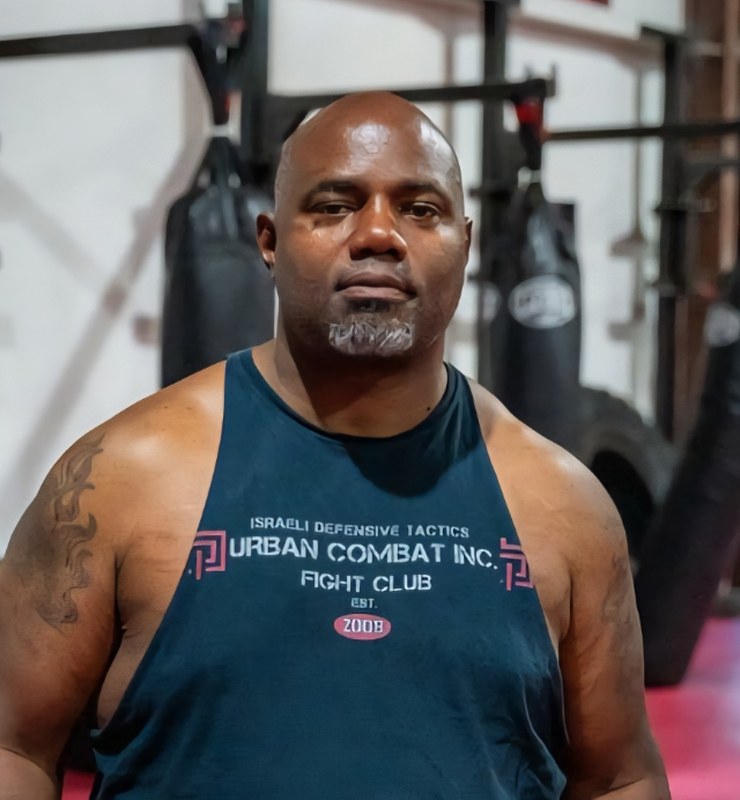
Donavin Britt owns Las Vegas Combat Academy and has been part of the gym since 2002. He is a 3rd-degree Krav Maga black belt under John Whitman of Krav Maga Alliance, a BJJ blue belt, and an Army veteran. He has cornered fighters in Bellator and the UFC.
About the Gym
Las Vegas Combat Academy is a Krav Maga and combat sports school at 1122 Vista Drive in Las Vegas. Krav Maga is the core program. It also teaches BJJ, MMA, Muay Thai, and boxing in about 10,000 square feet, and has a shoot house for home-invasion and scenario training.
Donavin Britt has been part of the gym since 2002 and has run it since 2008. It has been in its current building for about 10 years. He signed a second 10-year lease on the day the episode was filmed. He says everyone on his staff has been with him at least 10 years.
Every discipline warms up together, splits off to its own class, and comes back to bow out together. Nobody tests for a Krav Maga blue belt without at least a three-stripe white belt in jiu-jitsu.
📍 Address: 1122 Vista Dr, Las Vegas, NV 89102
📞 Phone: (702) 586-5728
🌐 Website: lasvegascombatacademy.com
📸 Instagram: @las_vegas_combat_academy
Summary
Alex Cuevas visits Las Vegas Combat Academy, a Krav Maga school that also teaches jiu-jitsu, MMA, Muay Thai, and boxing, and joins a no-gi class. Owner Donavin Britt found Krav Maga in the Army. He was part of the gym from 2002 and took it over in 2008, after the crash took his other businesses.
He talks about an $80,000 check a client handed him on his word, the lease he signed that day, why his Krav Maga students have to train jiu-jitsu, and the tourist economy he still can't control.
What Donavin Britt Told Us
Donavin Britt owns Las Vegas Combat Academy, a Krav Maga school in Las Vegas that also teaches jiu-jitsu, MMA, Muay Thai, and boxing. He was part of the gym from 2002 and took it over in 2008. Alex Cuevas visited on a no-gi day. Here is what came up about 2008, an $80,000 check, his lease, jiu-jitsu, and the tourist economy.
Krav Maga, by way of the Army
Donavin first saw Krav Maga in the Army, when he came across a few IDF guys training on post one morning. He showed up the next morning and joined in.
"I liked it because it was simple, it was linear, it was aggressive, and it was for the street. There's no nonsense. And so that fit my personality."
—Donavin Britt, owner
2008, and the last few hundred dollars
He apprenticed under his old instructor, then took over the gym in 2008. That was the same year the crash took his smoothie bars and his real estate business.
"But, you know, I've lost everything before. You know, I was in another business. 2008 came. … So with the last $400 or $500 in my pocket, I started what would become Las Vegas Combat Academy."
—Donavin Britt
"And by the way, I didn't want to become an instructor. That wasn't my, that wasn't my goal. But it was the one skill set that I had at the moment."
—Donavin Britt
An $80,000 check on his word
When he split with a business partner, he needed money for a build-out. He called the one millionaire among his clients, who drove over to the gym.
"Comes in, hands me an envelope with a cashier's check for 80,000."
—Donavin Britt
He paid it back in about 15 months. The client's reason went back to a day Donavin taught in the middle of having a wisdom tooth pulled, because the instructor covering for him had crashed his car.
"And I always ask him, I said, what made you give me that money? And he's like, I've never seen you dog it."
—Donavin Britt
A lease on a napkin
The school used to be up the street. Donavin kept looking at a white warehouse nearby, and a real estate broker he trained put him in touch with the owners.
"We literally negotiated our first 10-year lease walking around here and wrote it down like a napkin or something. And then we put it on paper. And we just signed our second 10-year lease today, actually."
—Donavin Britt
No Krav Maga blue belt without jiu-jitsu
"People think I hate jiu-jitsu. I don't hate jiu-jitsu."
—Donavin Britt
His students cross-train, and the belt test enforces it.
"You cannot get a blue belt from me in Krav Maga unless you wear at least a three-stripe white belt in jiu-jitsu. You can't even test. … Because Krav Maga's ground stuff at blue belt level is white belt jiu-jitsu. So go train jiu-jitsu."
—Donavin Britt
The friendliest place in the world
He has heard from people who waited outside a long time before they walked in.
"people come in this place and I've had them tell me. And I sat outside for like 20 minutes. … I'm like, no, this place should be the friendliest place in the world. It should be friendly. Smiling, laughing and making friends."
—Donavin Britt
Every discipline warms up together, splits off to its own class, and comes back to bow out together. He set it up after letting the groups drift apart once.
"Because I have to control the environment. Build the culture. Like the circle must be protected. You build this culture. You cannot allow things to try and tear it apart."
—Donavin Britt
Someone who looks like them
"But I want to show, maybe there's some other young kid out there who says, you know what? I can grow up and hold my own business. I can grow up and coach in the UFC. I can build champions, too, or I can become one myself, because they saw someone who looks like them do it."
—Donavin Britt
A tourist town
He says owning a gym is still tough, and Las Vegas runs on tourism.
"And then we're kind of at the mercy of the market sometimes, you know, especially in a town like Vegas. So tourist-driven, and a lot of people, a lot of these guys, they work in the industry. So, you know, they get laid off, and then we take the hit. You know, so it's tough. But we ain't going to give up."
—Donavin Britt
Read the full transcript
Episode Transcript
Las Vegas Combat Academy, Las Vegas, NV. Speaker labels are added from context; the host is Alex Cuevas, Gymdesk's CEO, and the guest is Donavin Britt, the gym's owner.
Opening
Narrator: Behind every gym, there's a story, a mission, a spark of passion that started it all. For a lot of these owners, it started on a mat, a weigh-in, a bracket with their name on it. This is Gymdesk Originals, real owners, real struggles, and the communities they've built from the ground up.
Arriving at Las Vegas Combat Academy
Alex Cuevas: We made it, Las Vegas Combat Academy, I'm going to go check out Donavin. And today we're doing no-gi, therefore, I'm all no-gi'd up. Let's go, come on in.
Donavin Britt: What's up, bud? You all right?
Taking over the gym
Donavin Britt: Back in 2008 when I started the place, first of all, I was part of the gym since 2002. Then my old instructor, I apprenticed under him for six years, and then I took over the gym, bought the gym from him, and then my vision was a little bit different. I wanted kind of something like this, where we could have multiple styles taught at a level that was, you know, higher than average. I never thought I'd be cornering fighters and all that, because that wasn't my thing. I was just, I didn't even have a kids program. I mean, I didn't want a kids program, which is stupid, right? But I was like, I don't want to teach kids. I'm going to teach adults how to survive.
Finding Krav Maga
Alex Cuevas: So I'm curious about Krav Maga. Like, how did you find Krav Maga? Like, where did that happen? That is crazy.
Donavin Britt: It's funny, because I was in, when I was still in the Army, I was still in the Army, and we would cross-train with the Israeli guys. So the IDF guys, we'd cross-train with them, or former guys would come in, because I was in the Intel, in Intel. So that was our thing. So one day, I got there, and there's like four or five of them there in the morning at post, and they were training. And I was like, oh, martial arts. I was taking, you know, Filipino martial arts, and I'm like, oh, cool. So I showed up the next morning, was waiting for them. And I joined in, they're like, yeah, come on in. Krav Maga, what is that? So once I learned about it, I started training in San Francisco, at the school in San Francisco. Then my instructor had just moved here to Vegas, and I was training under another guy. And so a year later, we ended up moving here to start training Krav Maga. I liked it because it was simple, it was linear, it was aggressive, and it was for the street. There's no nonsense. And so that fit my personality. Like, I could do those things. It's like, I can go angles, and I like all the dirty tactics and all the other stuff. Like, I'm like, oh, you mean I can kick someone in the groin and rip their face? This is great. Like, this is awesome. So that's where it came from. And then I didn't even want to be an instructor. I had no desire. And my instructor at the time was like, hey, you should think about being a coach. And I'm like, for what? He's like, no, you'd be good at it. And I'm like, so I apprenticed for like five years. Didn't pay me a dime, and I didn't want a dime. I just learned how to teach. And he's a really good instructor. Roger's a professional. And I learned under Darren Levine. He just passed away. And John Whitman, this gym exists in this building.
The building
Donavin Britt: I drove by this building probably for three years because our school used to be up the street. And I don't know what it was, but my head would always turn. I'd always see this big white box sitting here, and it had a bunch of Chinese writing on the outside of it. And I'm like, what the hell is going on in there? But I never see any cars there. Like, what's going on? So one day, one of my clients who's a broker, real estate broker, came to train. I said, hey, man, there's a white warehouse down the street. He's like, the one with the Chinese writing on it? I'm like, yeah. He goes, yeah, man. He goes, two guys have been trying to sell that building for a long time. And I'm like, yeah? He's like, yeah. I'm like, he's like, let me call the broker. He calls him. I said, he's like, the guy's over there right now. I said, oh. I said, I'm going to go by there. He goes, like, see it. Okay. I walk in, meet the landlord. Cool guy. And I call my wife. Hey, come here now.
Alex Cuevas: Why do you call your wife?
Donavin Britt: Because cultural, like, people connect with people who look and talk like them.
Alex Cuevas: Right, right.
Donavin Britt: And that doesn't make it racist. And I tell people, like, that's not a racism thing. That's a comfort level thing. And it just so happened, I knew how to make that happen. We literally negotiated our first 10-year lease walking around here and wrote it down like a napkin or something. And then we put it on paper. And we just signed our second 10-year lease today, actually.
Alex Cuevas: Congratulations.
Donavin Britt: Yeah, so we had a five and five. And initially, they wanted to go in a different direction. But then they're like, you guys have been with us 10 years. We'll stay with you guys, which is cool. So we've got a lot of work to do. Still got to get better. Still want to do a lot of different things in this business. You know, people always ask me, will I open another location? It's hard. It's hard to imagine doing that, to be honest with you, just because I know what it takes to run this place.
Alex Cuevas: How many feet is this place?
Donavin Britt: 10,000 square feet.
Alex Cuevas: 10,000.
Donavin Britt: Yeah, it's right at 10,000. So I've been as small as 1,200 and as big as 10,000. So we can scale it to anything. So that's been a blessing.
2008 and the $80,000 check
Donavin Britt: But, you know, I've lost everything before. You know, I was in another business. 2008 came. We all got murdered in 2008. Everybody got it. You know, I had a smoothie bar. I had smoothie bars at some locations around the country that we brought in from Canada that failed and all the real estate crashed. So I was in both of those industries at the time. So with the last $400 or $500 in my pocket, I started what would become Las Vegas Combat Academy. And it was kind of my way of saying, fuck you to the, you know, to the universe going, I'm not dead. Can't fucking kill me. And by the way, I didn't want to become an instructor. That wasn't my, that wasn't my goal. But it was the one skill set that I had at the moment. And I was able to get some favorable terms. And I got, I was blessed with, even when I split up with my then business partner, I had my one millionaire client that I literally called him up. I'll never forget this. I called him up. I made a decision. That was enough for the partner. I'm going to go my own way. And I called him up. I said, hey, man, I need a favor. And he's like, okay, this ought to be good. He's like, I said, what? He's like, I've known you for four years. You've never asked me for anything. And I'm like, nah, but I need a favor. He's like, what do you need? I'm like, money. He starts laughing. He's like, okay. He's like, why you call me? I'm like, you're my only millionaire client. So he starts laughing. He goes, well, how much do you need? And I said, like 80,000 to just build out and the whole bit. He's like, where are you right now? I said, I'm at the gym. He's like, okay, I'll be there in like 40 minutes. I thought he was going to come by and like, we're going to talk about this. Comes in, hands me an envelope with a cashier's check for 80,000. He goes, I got to go on vacation. I'll call me back. You know, when I get back in town, I'll call you back. We'll work it out. And we ended up doing that. And I ended up paying him back in like 15 months, paying him back. But that was all based off my word. And I always ask him, I said, what made you give me that money? And he's like, I've never seen you dog it. He's like, you came to class one day. And it's a true story. I was getting my wisdom tooth pulled. And my instructor, the instructor was supposed to cover me, got into a car crash. And he calls me and says, I can't teach. I got to just have a car wreck. So I tell the dentist, pack my gum with some gauze. I got to go teach.
Alex Cuevas: Oh, my gosh.
Donavin Britt: So I get out of the dental chair. And I'm literally spitting blood into a bottle, coaching and teaching. And then I went back and I finished taking the tooth out. And he was in that class. And he was like, anybody that's willing to do that? He's like, I'm dressed.
Alex Cuevas: Oh, yeah.
Donavin Britt: But listen. It's all, man. Dude, there's nobody else.
Alex Cuevas: Yeah.
Donavin Britt: Right? Like, that's the thing.
What the Army taught him
Donavin Britt: One thing, you know, lessons I learned in the Army was like, you know, once you're out there and you're in the shit, you're in the shit. Like, that's it. I don't care what your job is. You could be a cook in the Army. You're a soldier first. Right? And I wasn't a door kicker in the Army. I was an admin. I was an admin in a special operations unit. It just so happened I was in a special operations unit. And so I got exposed to a really high level of training. Like, tier one operators that were in and out all the time. And I'm getting to learn from them. So my experience in the Army was completely different than the average soldier. Because I'm like, I'm in headquarters command. I'm in a forward. Like, it was great. It was great. When I always talk about my service, not because of anything I do in a martial arts, nothing I did in the Army has anything to do with what I do now. Like, other than my mentality and learning how to be strategic, how to lead, and those kinds of things.
Alex Cuevas: Yes.
Donavin Britt: But as far as the physical stuff, no. None of that stuff. But when I train and I teach home invasion seminars, where I teach active shooter survival stuff, I've trained with some of the best people in the world in doing this. And I know these things. It hasn't been without controversy. It hasn't been without challenges. You know, when we had to shut down because of COVID and the whole bit and like all that stuff. But once you've been through the shit, it doesn't bother you anymore. I don't even blink anymore. Don't even flinch. Economy's crashing. The world's coming down. Don't even flinch. Shut up. Suck it up. Find a way. And if there's no way, we'll make a way. It's just that it has to be that way. It has to be that way.
Learning to coach MMA
Donavin Britt: One of my other instructors, he wanted to fight MMA. And he's like, I don't want anybody else to coach me but you. So then I'm like, okay, well, now I got to go learn how to be an MMA coach.
Alex Cuevas: Yeah.
Donavin Britt: Which I did. I studied under Kirian Fitzgibbons at CSA, Combat Sports Academy in the Bay Area. And then Dewey Cooper helped me out a lot. Just learning how to run a program, run a camp.
Alex Cuevas: Yeah.
Donavin Britt: But I find coaching MMA to be much easier than dealing with self-defense shit.
Alex Cuevas: Yeah.
Donavin Britt: Because there's nothing unknown in MMA here. Because I know where the guy trains. I watch video of the opponent. I know how much he's going to weigh. I know where his strengths are. I know way more shit than I know about anybody out there. So that's relatively easy coaching MMA. It's like, all right, we've come up with a game plan. Execute the game plan and go. Cornered in Bellator. Cornered in UFC. You know, I was in UFC last year in January, February last year when Adesanya fought. I was on Adesanya card in Saudi Arabia. So that was fun. That was a lot of fun. So I, myself and Kirian, as far as I know, Coach K and myself, were the only Krav Maga-based instructors to ever corner in the UFC. It was me and him. So when people were like, oh, you guys, you know, you hear all the bullshit all the time. I'm like, I have an over-the-door policy. Anybody can get it. Like, there's going to be a day where I'm too old to fight. It ain't today. So they want to come get it and get it.
"You guys don't do jiu-jitsu"
Donavin Britt: And then they were like, oh, you guys don't do jiu-jitsu. I'm like, I literally rolled off the couch. They were doing, we're doing NAGA here. I rolled off the couch. My jiu-jitsu coach at the time, Coach Art, he was still, he's still my coach now. I just showed up. He said, what are you doing? I'm like, I'm going to, I'm going to play jiu-jitsu with these guys. I'm like, what? I'm like, yeah. He's like, he's like, all right. He's like, just go on white belt because, you know, you don't, you know, you don't really roll. I'm like, all right. I won gold and no gi in there, right? Submitted a couple guys and I'm going to, he always, he always laughs when he tells a story. He's like, dude, you literally rolled off the couch. You don't train at all. Went in there and won. And I'm like, yeah, I, I know fighting. It's just fighting. Yeah. And then there's also too, I'm not losing this fucking guy. What are you talking about? You're not, you're not, you are not tough enough to beat me. It's that simple. I'm a better athlete. I'm bigger, stronger, faster. I'm going to fuck you up. And if you beat me, you beat me, but it ain't, you, I don't like your chances. Like, and that's what happens. So, and part of my ignorance, my buddy called me. He's like, dude, you entered a jiu-jitsu tournament. I'm like, yeah. He's like, you know what would happen if you would have lost? I'm like, well, first of all, I didn't even consider like that never even occurred to me losing. But secondly, what is it? They'd have been talking shit about whole, you know, that, that, that. So then I was like, oh yeah, is that what's going on in the jiu-jitsu community? They talk shit about Krav Maga. He's like, yeah. The next tournament we had Krav Maga all over our gis and you could, and then I saw it. I saw the guys like, well, like, yeah. Like, and then my guys started fucking them up. And I'm like, you don't think we'd show up at a jiu-jitsu tournament not knowing jiu-jitsu, right? Like you, you must know that we're training like every single day. Very, very hard. We have enough respect for the system. For the competitors and we want to win. Like, like that's ultimately what that comes down to. So we had, um, we had a few, a few, quite a few NAGA gold medals. Um, we have one of our, one of our students, Lance. He's an instructor now, uh, professor Lance. He's a black belt. He's won worlds. Um, so, so, and Miguel was one of the top fighters in the country right now at 170 pounds. He's a brown belt in jiu-jitsu. He's, his last three MMA fights, he's been in a cage about three and a half minutes total. All three fights. He's just destroying guys.
First class with Frank Mir
Donavin Britt: My very first jiu-jitsu class, my partner was Frank Mir.
Alex Cuevas: Oh my goodness.
Donavin Britt: Yeah. Like, I go to, I go to, I go to the gym and they're like, hey, go roll with him. And I look and I see Frank standing there and I'm like, who? Like him. I'm like, Frank Mir? They're like, yeah. I'm like, hey, this is my first day. Like, I just tied my belt like 10 seconds ago. What are you talking about? They're like, no, you can go with him. It's going to be Frank. Because I was a bigger guy. So they put me with Frank. Frank, you know, Frank was a sweetheart. He choked me a lot. But, but, but not in a way that was malicious. Not in a way that was, in fact, he was, he'd helped me and I was rolling at Drysdale. So I, you know, I didn't see him for like a couple of months and I'd been rolling. And the next time I roll with him, he's still choking me a lot. It's still, like he'd do whatever he wants with me. But he could, he's like, I can feel you're, you're starting to recognize what I'm going for. And I've had to change a couple of times. That's good. That means you understand it. I'm like, I can't, I still can't stop it. He's like, no, you'll, you'll get there. But at least you're recognizing what's going on. Some of the greatest days of my life I've had on the mat. You know, one of my favorite days ever was hanging out after class with Frank Mir and Robert Drysdale and just talking about martial arts. So those are the moments where I'm like, oh, this is pretty cool. You know, or getting to Saudi Arabia and cornering the UFC, you know, walking into the stadium and going out to the cage. And, you know, of course the UFC, you know, the organization that they are, a great organization. All the people that are from Vegas, they went, they go on the road trip and go and set up all the cages and stuff. So we, we see each other around, we see them at the PI, we see them at gyms and stuff, get to know them. And walking in there and they're like, coach, we've been waiting for you. Like, you know what I mean? Like that was a moment where it was really, really cool. Cornering at Bellator, getting to meet Fedor. You know, on his last card, we got the, you know, got the fight on that card to come away with the victory. All of my fighters have won ammy titles, all of them. We almost exclusively fight in Tuff-N-Uff, which is the, the biggest pro-am. But guys, we won the 125 championship, 135, 155 and 170. We won all those, all those belts there. And not bad coming from a Krav Maga school, right? The Krav Maga school. So we laugh at them all the time.
A fight on short notice
Donavin Britt: One of my favorite, there was used to be a, an organization called Real MMA. There's a local organization here. And we took a fight on very short notice. I think it was like six days against Wanderlei Silva's fight team. And Rudy took the fight. And when we got to the, to the venue, then they walked in and, you know, they got the sweatsuits on. And there's, there's eight or nine of them. And they just walked by like real cocky. And I was like, okay. So before we go out, they had this, you know, it was a big shindig. They had these, there was a, a Ninja Turtle movie had just come out. So they had these guys in the Ninja Turtle, like a full on Ninja Turtle thing. It was kind of like doing a promo for it. So right before we walk out behind the curtain, we like take a picture with the Ninja Turtles. And I'll never forget the guy that's open the curtain. He's like, what the fuck are you guys doing? I'm like, God, we're hanging. He's like, why are you guys so loose? He's like, nah, you guys are way too loose. What's going on? I'm like, nothing to be nervous about. It's just a fight. Right? And we went out and really beat the shit out of the guy.
Alex Cuevas: Oh, yeah?
Donavin Britt: Beat his ass. We went in the fight and the crowd goes silent. So the coach came up to me afterward and he's like, my guys were arrogant. They thought they were just going to run right through you guys. I'm like, I, he's like, you know, it's Krav Maga School. And people are like, oh, they don't fight. I remember he's like, I don't know. We fight.
Use jiu-jitsu, don't do jiu-jitsu
Donavin Britt: I had a student come to me years ago. He's a brown belt in jiu-jitsu. And before he became my student, he got into a fight in a bar with a guy. Shoots in, takes a guy, takes a guy's back. Locks up, we're a naked choke. Everything's going well. Dude's buddy comes up behind him, starts punching him, hitting him, hitting him. He gets up and he starts to go after the guy and he's queasy and he passes out. He got stabbed 14 times.
Alex Cuevas: Oh my.
Donavin Britt: Almost died. Almost bled out. And I told him, I said, it's not that.
Alex Cuevas: While he was choking, he didn't even feel it?
Donavin Britt: No, because when you get stabbed, it feels like a punch. You feel the knife go in. So all you feel is this.
Alex Cuevas: Wow.
Donavin Britt: And with your adrenaline up, you think you're getting punched. So meanwhile, he's like locked. He's locked like I am. And he finally realizes the guy's punching him. And he turns, lets the guy go and goes after him. He passes out because he took too many shots. And I told him, it's not that jiu-jitsu is wrong. Think about a tool. If the only tool I have is a hammer, every problem looks like a nail. You know what I mean? So I told him, I said, it's not that you use jiu-jitsu. It's just that you used it at the wrong time. Anytime you're dealing with multiple attackers, anytime you're dealing with an environment that's, you know, anybody else can come into it, probably don't want to commit to that grapple. You need to use jiu-jitsu. Don't do jiu-jitsu, right? So like, and that's kind of where, same thing. Maybe on an airplane, I'm in a situation of close quarters. There's no round kicks and all that stuff in that. Everything's got to be straight. Everything's got to be close quarters. So now I'm looking at elbows and clinch work, that kind of stuff. So who does that best? Muay Thai. So as a martial artist, I tell my guys, I want them cross-training martial arts, cross-training Muay Thai, cross-training boxing. You cannot get a blue belt from me in Krav Maga unless you wear at least a three-stripe white belt in jiu-jitsu. You can't even test. Why? Because Krav Maga's ground stuff at blue belt level is white belt jiu-jitsu. So go train jiu-jitsu. Like train it, understand it, learn it, and then add that to your mix.
Escrima and loss prevention
Donavin Britt: And then the other part of it is, it's part of our mentality from the street-based stuff. And I have a background in Filipino martial arts as well. Everything I ever did, I trained. Escrima, Arnis. Escrima, yeah, I was in Latosa, Escrima for years. But all the stuff that I learned was from Filipino dudes who were fighting in the street all the time. So it wasn't about the floretas and all that stuff. It was like, no, this is how you hit him and kill him and move on to the next guy. So then, you know, the aggression that I grew up with playing football, those systems like Escrima and like Krav Maga, the aggression in those systems, they went hand in hand with everything I did. So it was like, no, just run through the guy. Destroy him. Don't even give him any hope. Like in the street, I always tell guys all the time, in the street, I am not. I'm ruthless and aggressive. I worked loss prevention for 10 years. I used to go to work every single day and get into a fight. At least one fight every single day. I started in Oakland, in the grocery stores in Oakland, with plain clothes, catching shoplifters. That's where I started working. You know, I started in those environments. You go to work, you can get like, you know, in Oakland, people don't run, they fight. You know, so it's like, you know, you try to go up and stop someone for shoplifters and they're like, fuck you. I've had guys try and stab me, I've been shot at, had a guy try to hit me with crowbars, two by fours, axe handle, you name it. I worked in some tough environments. I worked right off the Hegenberger at a store called Home Base. It was like Home Depot back then.
Alex Cuevas: Okay, yeah, I remember Home Base, yeah.
Donavin Britt: So yeah, dudes would come in and they, you know, they're stealing shit, but they have an arsenal on them, man. Like they're stealing saws and axe handles and axes and like hatchets. And then I got to go out and go stop them. And the dude's like, fuck you, you're trying to help me. You know, I busted several people who were fresh out of San Quentin. One guy caught him. He was wanted for double homicide out of Louisiana. And these guys fighting like the third monkey trying to get on Noah's Ark when I stop him. Like they're trying to like, you know what I mean? So it was bad, like it was bad. And, you know, but there's a good training ground because you know what works and what doesn't work.
The friendliest place in the world
Donavin Britt: People think I hate jiu-jitsu. I don't hate jiu-jitsu. I do think jiu-jitsu has a shitty culture now. I don't know what is going on. So what that tells me is it comes from the top down. So the people of these schools, these jiu-jitsu instructors in these schools, you go to them sometimes. There's really, really good ones. And then there's really, really shitty ones. And it just becomes like this big dick measuring thing. And like, yo, I don't like it. I don't allow that shit in my gym at all. Not if I even get a whiff of it. I'm like, you get told once. And then after that, you can get dealt with. Like that's, we don't tolerate it. Like, because I don't think you need to give up your humanity to be tough. You don't need to do that. Like, you know, our job is supposed to be helping people. You know, people come in this place and I've had them tell me. And I sat outside for like 20 minutes. before I had the courage to come in here because they think we're going to like choke them and punch them and kick them when they come in the door. I'm like, no, this place should be the friendliest place in the world. It should be friendly. Smiling, laughing and making friends. And then I started training jiu-jitsu and understanding jiu-jitsu. And I'm only a blue belt in jiu-jitsu, but, you know, I always tell people I'm, I think it's made me a better Krav Maga practitioner, for sure. Jiu-jitsu certainly has. If for any, if for no other reason to be able to read and be a couple steps ahead of someone and kind of see where they're going and understand where they kind of, I can set a trap for them, that webbing. And, you know, I've always said jiu-jitsu is like a big spider web. You know, you get free and you think you're free, but you're only going into the next, into the next sticking point. And if you can keep your mind free and see it, it's better. Like I know my control points have gotten much better because of jiu-jitsu in Krav Maga. So, so there are a lot of Krav Maga practitioners, believe it or not, that are training in jiu-jitsu. A lot. Way more than people could possibly imagine. Way more. And I love it.
Blue and blue
Donavin Britt: Because I think, I have a concept called blue and blue. Blue and blue. Forget being a black belt. If you get a blue belt in jiu-jitsu and a blue belt in Krav Maga, you will, you will murder people. That's why I say blue and blue. A blue belt in jiu-jitsu and a blue belt in Krav Maga are very attainable for most people. If they, if they, I say in both systems, no bullshit, probably three years. You get to attain a blue belt in three years in jiu-jitsu and in Krav Maga if you're trained consistently on them. You do that against 99% of people out there, you will murder them.
Alex Cuevas: So, so what you're saying is blue and blue will keep me safe in the street.
Donavin Britt: 100%. Yeah. 100%. Because you've, you've been sparring. If it just means, I think more jiu-jitsu schools should do that. Sometimes when they're rolling, I'll take the knives to training and I'll just slide them out on the mat. Walk away. And they'll look at the mat. And finally someone's like, gets the knife and starts. And all of a sudden, the game changes. All of a sudden, it's not omoplatas and all of a sudden, they're just trying to survive. You're done. You're the fat kid at dodgeball at that point. You're going to get lit up. So I say train at all things, right? Be good at all things and do it. So we spend time on the range. We have, that's why we have a shoot house over there where we do that brown build over there. We have a shoot house over there. We do home invasion training and all kinds of stuff in there.
Alex Cuevas: Oh yeah.
Donavin Britt: It's all in there. I fill up that thing with smoke. I got smoke grenades. We fill it up. One of my favorite. Oh yeah. Oh yeah. We have a, there's a video. We'll do it. I take one of the students' cell phone and I go call their phone and I put it in the room and I fill the room up with smoke and I put people in their RedMan suits. I'm like, go get your phone. And they go in there looking for their phone, but they don't know how many people in there are attacking. But as soon as they get seen, it's on. It's on. I'm like, your job is to get your phone and get back into that room. Once you get back into the room, I'll stop the fight. Until then, the fight stays on. And it's all, it's all hell breaks loose. And what you're starting to find out is your martial mentality is more important than your martial skillset because you're not going to have the room and the freedom to kind of do all the stuff that you normally do. And that changes things. And the stress level is like, they can't breathe, they can't see. And like, those are the things that we want to train for because that's what it's like to survive out there.
Knowing when not to fight
Donavin Britt: I think we do have a responsibility to teach our students the difference between the two and understanding those. Because you don't want them flying off the handle and hitting the drunk guy at the bar because it's annoying. Like, well, was he really a threat though? Nah, he was just on my nerves. Okay, well, then you hit him. He falls and hits his head and he's dead. But if I need to grab him, maybe we just put him down and kind of hold him and show that I can control him using good jiu-jitsu technique, using good wrestling and grappling technique to get my point across to him without killing. Okay, good. Or maybe have the compensation to be like, hey, have a good night. I always tell my students, buy him a beer. I bought something, like, bought a dude a beer, was running his mouth. Hey man, what are you drinking? What? Whoa. Heineken? Give me two Heineken's. You want one for me? I'm a friend. What?
Alex Cuevas: Give him a beer?
Donavin Britt: Yeah. By the end of the night, his arms around me singing Sweet Caroline and I don't have to punch his ass and everybody's good.
Alex Cuevas: Is that self-defense?
Donavin Britt: Yes, it's just a different tactic. All of us, in a community of martial arts, we should hold each other accountable for professionalism. We should not allow our students to be going out and getting into fights and shit. And you've been around, you know. Like, you know, I hear certain gyms, their guys tend to get into shit all the time. And I'm like, that comes from the top down. Teams take the personality of its leader. And when you see the same guys getting into shit all the time, you're like, you know why that is? Because they're allowed to do it. And it's not okay. Like, I'm not okay with it. My guys can act like that. You know, I have a rule about my fighters. All of my fighters have to have a job. I will not train a fighter who does not have a job. Not because he can't pay me. I don't take any money from my fighters anyway. None. None of my guys that are ammys, never taken a dime from them. Even my guys that are young pros, I've never taken a dime from them. They're not making enough money for me to be in their pocket. So it's okay. It's good. Plus, they're representing a brand.
Staff, the circle, and coaching
Donavin Britt: And it's a hobby for me. Like, it's a passion for me. Loyalty is a big thing for me, right? People show me that kind of loyalty. There's nothing to do. And these fighters, my guys, all of them. Like, I don't have anybody on my staff that hasn't been with me at least 10 years. Nobody. That's Coach Ricky. He's been with me the longest, almost 20 years. There's Lance over there, Coach Lance and Miguel. Lance has won Worlds a few times. And then Desmond is sitting over there. He's one of my fighters. Sitting over there on the bench. He's going to teach the boxing class today. So what we do here, like what you're seeing right now, to keep unity. Because I don't want the gym to become, and I let this happen before, and it was my fault. Jiu-jitsu guys are doing this. The Muay Thai guys are doing that. Fuck that. We all warm up together. Everybody get your shit. We warm up together. Then you disperse to your thing. When I call class at the end, everybody comes back. We bow together. Jiu-jitsu guys go back and finish their last half-hour roll every night. That's how it is. And it has been phenomenal. Because I have to control the environment. Build the culture. Like the circle must be protected. You build this culture. You cannot allow things to try and tear it apart.
Alex Cuevas: I've never seen that before. That's awesome.
Donavin Britt: That's what they'll do anyway. So what are you worried about it for? But if you invest in people and earn the right to chew them out, right? I tell coaches this all the time. I just wrote a coaching book. And I tell coaches, you have to earn the right to chew someone out. You're like, what does that mean? You have to invest in them enough. They have to know that you love them enough to tell them the truth. And that after I'm done chewing your ass out, I'm not mad at you. I'm not leaving you because of it. I just want you to be better.
Martial arts and representation
Donavin Britt: And then being a student of martial arts, understanding the difference between Japanese jiu-jitsu, Brazilian jiu-jitsu. But then there is that connection because there's a lot of Japanese that went to Brazil and lived there. And that's what does that mix? And then I got to watch back in the day when I was in high school, Wally Jay, that small circle jiu-jitsu back in the day in Alameda. And just kind of become a student of martial arts. And martial arts has always been important to me culturally. In America specifically, there's a significant black history in martial arts. Most of the kickboxing champions back in the day, they were African-American. They were back in the day. And the Black Panthers, the Black Panther Party started in the Bay Area, right? One of the big tenets of the Black Panther Party was being able to defend yourself. So a lot of black people enrolled in martial arts schools. [A martial arts school] in Berkeley was like a headquarters for that. So there's definitely that history there. And that's important to me culturally. You know, I know there's a lot of people out there, and I call it an ignorant view, when they say, what does it matter what color someone is? That's not the issue. You won't know what it's like, because I've experienced this recently. A couple comes in to town for their 40th wedding anniversary, and the husband wants to come and say hello to me, because he saw Krav Maga on the internet. But they come in here, and they've got tears in their eyes, and they're hugging me, because they've never seen anybody who looks like me doing the things that I'm doing. For them, and that, especially that generation, they were told that, what? They couldn't do it. And here I am doing it. And so it is not because I'm black I'm better than anyone. It has nothing to do with it. But I want to show, maybe there's some other young kid out there who says, you know what? I can grow up and hold my own business. I can grow up and coach in the UFC. I can build champions, too, or I can become one myself, because they saw someone who looks like them do it. That's very, very, very important. And I don't care if people outside of our culture don't understand that. I don't give a shit. Maybe it's not for you to understand. But we understand it, and I get it. And I carry with that a responsibility. I have a responsibility to do it right. To do it right. And we're doing it right. We're doing it right. Because I know, for a fact, in this city at least, in Las Vegas, the fight capital of the world, when they say Las Vegas Combat Academy, everybody knows. They're like, oh, yeah, we know them. Yeah, yep, we know. Yeah, they know. We'll get it. They'll get it. And there isn't a gym that we can't go into in this city. I have a great relationship with John Wood and Syndicate. One of my fighters, they train over there. I've known him for, God, I've known John 20 years, 20 years now, even before it was Syndicate. And he's always been very kind to me and very, very warm. Some of my best friends are in this industry. Guys that can pick up the phone and call and just, hey, man, let me ask a question about this. And they're, like, more than happy to help. And so that is a gift that I think, after all the winning and all that other shit, that's what I remember the most. My friendships and connections I made with people through this thing we call martial arts, whether it be jiu-jitsu, muay thai, whatever it is, it's all part of it. And I think, you know, when I think of the responsibility that I carried to show the other kids, even the kids, all the kids, and it's not just black kids. I look at my gym. My gym is like my life. My gym is extremely diverse. My wife's from, you know, she's Chinese, Vietnamese. She came in from Vietnam, you know, to get out of the war. Our family is crazy, crazy diverse, right? My brother's half Japanese. He's married to a Puerto Rican woman, you know, so, like, you name it, it's in my family, I promise you, right? But it's cool, because it's like, my life is mixed, my martial arts are mixed, everything's mixed, and I love it. I wouldn't trade it for the world.
The bus, and what the gym means
Donavin Britt: Sometimes I'll stand in here, you know, at nighttime when nobody's here, and just listen to the echoes of the sweating and the pads, and, you know, it's good to sit back and go, okay, how can we make it better, right? How can we make it better? We're in San Francisco, my wife and my kids, we fold back, got on a bus, we were just there a month before. It's funny, there's one when we go home to the bay, we don't get a car, because we know how to get around on the trains and stuff. We were there a month before, and my daughter, she was like eight, and she saw a guy and recognized him the second time we went there. So, we're on the bus, and everybody's standing up, and the guy's in the back of the bus, and he's like, there's an old man sitting in front of me, I'll never forget. He looks at me, makes eye contact with me, and he looks over at the guy, and he looks at him, and he looks at me, and he looks at my wife's purse, and he points at my wife's purse, and I'm like, I look at him, and I'm like, oh, he's trying to, he's, he's, he's like the scout or something? No, that guy's seen this guy rob people.
Alex Cuevas: Oh, okay.
Donavin Britt: So, dude gets one, he walks past, and I move my wife like this, he walks past, gets to right where that bag is, and snatches this lady's purse. She clamps down on it, and is like, holding on for dear life. Now, there's like five or six dudes between me and them. They are like, newspaper, nobody's getting involved, they don't see shit, like, it's crazy. I'm like, home, I go, guy grabs her purse, and he steps off the bus, and I grab him by his dreads, had him by his head, and he pulls his neck, and I, like, let go of the purse. And he tries to pull away, and I pull, I tighten up on my grip, and I'm like, I'm going to punch you really hard. Often, it's going to hurt. Give me the purse, you lost. It's just not your day, homie. I take the purse, and I grab him, I'm like, go, go, he left. We got back to my wife's folks' house, and they were like, why'd you do that? And I'm like, my son and daughter are standing here, and they see me every single day talk about helping people who need help. And in that moment, if I choose not to do something, everything I've ever taught them goes out the window. And, I'm not a spiritual person, but I believe maybe we were all on that bus at the same time for a reason. This gym saved our life, man. It saved my family's life and provides food, and it is sometimes frustrating. You know, owning a gym is tough. It's tough. A lot of long nights. And then we're kind of at the mercy of the market sometimes, you know, especially in a town like Vegas. So tourist-driven, and a lot of people, a lot of these guys, they work in the industry. So, you know, they get laid off, and then we take the hit. You know, so it's tough. But we ain't going to give up. We've been doing it for too long.
Goodbye
Alex Cuevas: That's awesome, man. Thanks again. I appreciate you hosting today.
Donavin Britt: No, anytime.
Alex Cuevas: Thanks for letting me join. I appreciate it. Thanks for the roll.
Donavin Britt: No problem. Take care of me. Appreciate you. Take it easy. All right, man. Yeah, good luck to you. Thank you.
Alex Cuevas: Well, once again, thank you so much.
Donavin Britt: Thank you. Thank you.
Alex Cuevas: Thanks for having us.
Donavin Britt: Yes. Thank you.
Alex Cuevas: And thank you for being a Gymdesk customer. We're grateful.
Gym staff: Yes, yes.
Alex Cuevas: Everything's been going all right with you.
Gym staff: Yes. You know, and I like the fact that I can just email Kate. She's got Kate on speed dial. She's got Rachel on speed dial. Yeah. So thank you. Thank you. Thank you.