From the CEO’s Mat — The 99 Sheep: Why the Hobbyists Are the Ones Who Keep You in Business

I was in Orlando, back at Combat Sports Academy for the second time, when one of the coaches, Lakea, said something that stuck with me. He was talking about who actually fills his mats.
Competitors, he said, are maybe one to five percent of his members—sometimes as little as one percent.
Everybody else? He calls them "the 99 sheep."
People who come in after a nine-to-five, exhausted, and just want to train and put a smile on their face before they go home. The way he sees it, his job is to give them a sanctuary.
I told him, right there on camera, that I agreed completely.
It's the hobbyists who keep you in business. It's the kids who keep you in business.
The Pattern I Couldn't Unsee
I didn't always see that as clearly as I do now.
It came into focus over years of traveling and dropping into schools, and the pattern was consistent everywhere I went: the bigger, better-run gyms had lots of hobbyists.
The more hobbyists in the room, the better the school was doing—and the better the culture felt. A strong kids' program did the same thing; a school with a great culture for kids drives a ton of business.
A room full of killers is great to watch.
But there just aren't enough of those people to sustain a business—not unless you're a dedicated fight school sitting in a very dense population.
Here's how I've come to think about it. There's a relationship between two groups. The competitors put your school on the map. The hobbyists keep it afloat.
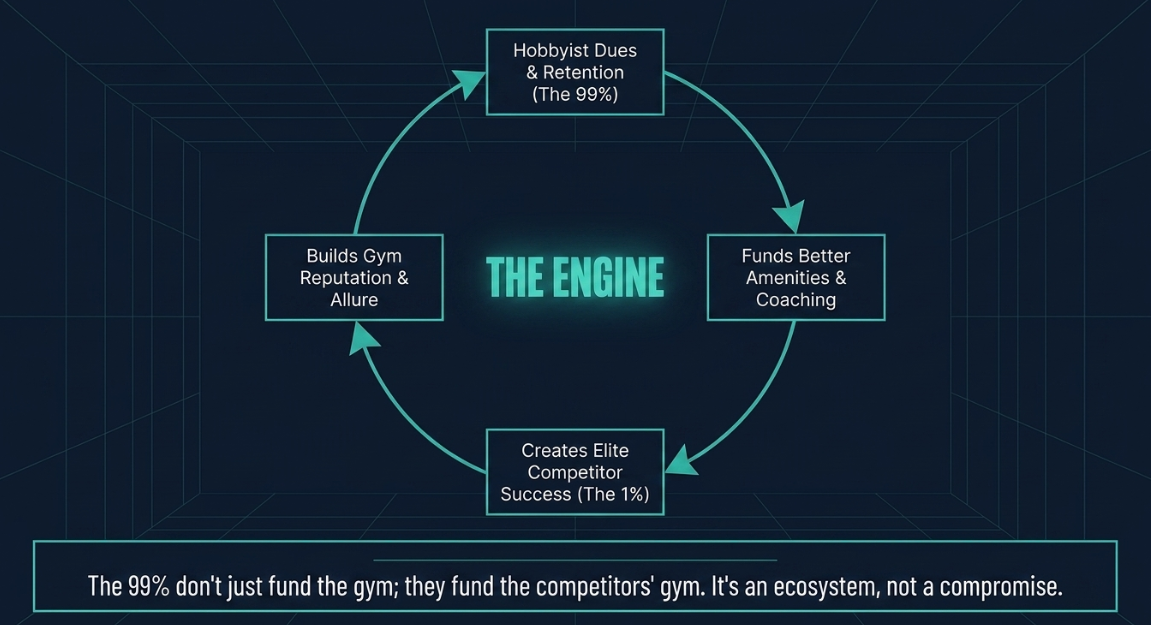
Both matter. But the sooner an owner internalizes that second half—that the hobbyists are the ones keeping the lights on, and that they need to feel good when they're there—the better off that gym is going to be.
Lakea put the same idea a different way, and it's stuck with me since. Talking about why he pushes everyone to train hard for the competitors, he said:
“Only 1% of us is going to be competing, but we need the whole 99 of you guys to start training us.”
— LAKEA VARGAS, Coach, Combat Sports Academy
The 1% can't get anywhere without the 99. It's not charity. It's the whole engine.
The Same Math, Even in a Fight Gym
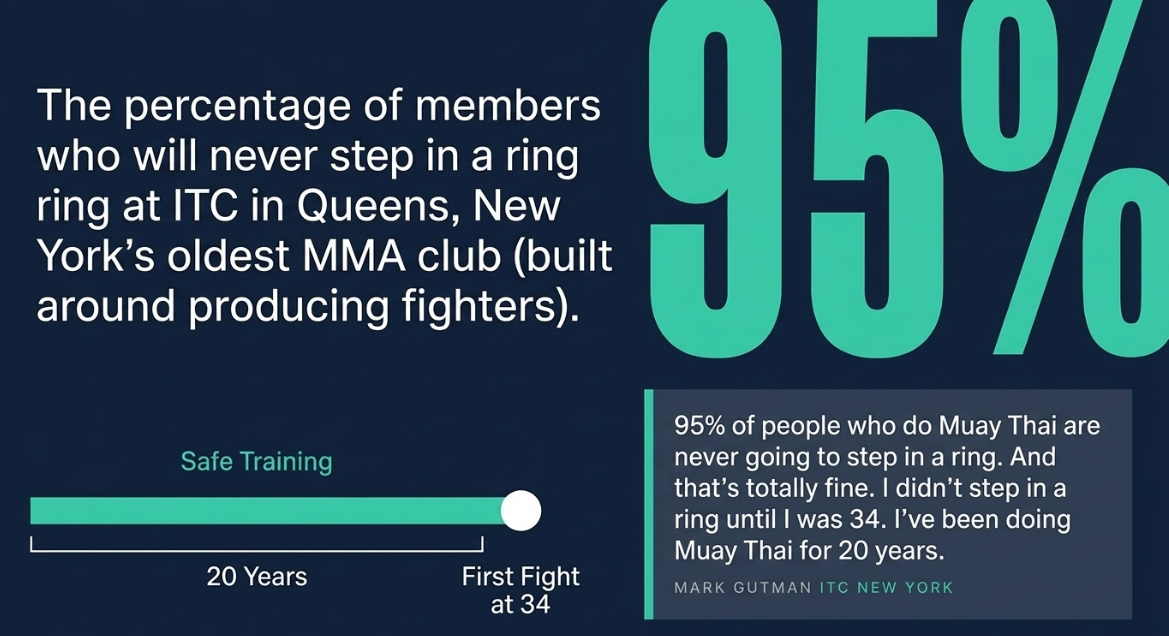
I heard the exact same math from a completely different kind of gym. Mark Gutman helps run ITC in Queens, New York—the city's oldest MMA club, a hardcore judo-and-Muay-Thai place his father started back in 2006.
This is a gym built around producing fighters. And yet Mark told me the same thing Lakea did:
“95% of people who do Muay Thai are never going to step in a ring. And that’s totally fine. I didn’t step in a ring until I was 34. I’ve been doing Muay Thai for 20 years.”
— MARK GUTMAN, Instructor, ITC New York
Twenty years of training before his own first fight.
And their sparring classes are packed—with people who never intend to compete—because that's how they learn real Muay Thai in a safe environment.
Two gyms that couldn't look more different on paper, and the ratio is identical.
The competitors get the highlight reels. The hobbyists pay the rent.
Once you start listening for it, owners say it everywhere. At Cornerstone MMA outside Chicago, the head coach put a number on it:
“Less than 1% of people ever get into an MMA cage. So that’s a pretty poor market to go after. Families, hobbyists, kids—they’re the ones who build the business.”
— MARIO GOMEZ, Co-founder, Cornerstone MMA
And then the part that ties the two worlds together—"the competitors benefit from better amenities due to those members." The hobbyists don't just fund the gym; they fund the competitors' gym.
At Carlson Gracie in Hackney, London, one of the senior instructors said it about as directly as anyone can:
“We need these amateurs, we need these hobbyists. They’re paying the bills for the gyms. If they’re not there, there’ll be no sport jiu-jitsu—because there’s no money in jiu-jitsu as a sport.”
— KONRAD PIOTROWSKI, Instructor, Carlson Gracie Hackney
The recreational members, he said, pay for everyone else to compete. "You've got to keep the lights on. If you don't have a gym, you cannot do jiu-jitsu."
Even the owner of Square One, who came up around some of the most serious competitors in the country, framed it as a good thing rather than a compromise:
“Jiu-jitsu needs hobbyists. That’s how the sport grows. That’s how the industry grows.”
— JOSH SMITH, Owner, Square One Jiu-Jitsu
The Hard Part: Competition Culture Without Casualties
So if the hobbyists are the foundation, the hard part becomes keeping a real competition culture alive without alienating the 99% who'll never compete.
The schools that manage it, in my experience, all share one thing: they take care of each other.
Even when they're going hard, there's a culture of trust and—this part matters—of fun. Especially with the kids. Kids have to have fun.
And if they're having fun and getting better and doing well in competition, that only compounds over time. Nothing brings in new families like a school with winning teams that people actually want to be around.
The best owners build that into the room's DNA. Cody Goodfriend at Shogun West said it as plainly as anyone:
“Jiu-jitsu is a one-on-one sport, but it takes a team to make you good. When they come in here, they’re part of a team, whether they’re in competition or they’re just hobbyists. There’s no room for ego. I don’t allow it on the mats. You come in here, you’re humble and you stay humble. And we’re always looking to make the people next to us better.”
— CODY GOODFRIEND, Owner, Shogun West BJJ
I saw the same thing at Academia BJJ in Canada. They run serious competition camps, but one of the owners, Steve, pointed out that half the guys in the camp aren't competing at all:
“They’re just there because they want to donate their body to the guys that are competing.”
— STEVE CAMARA, Co-owner, Academia BJJ
That doesn't make them lesser. "You could have a room full of high-level competitors," he told me, "but it doesn't mean the hobbyists aren't as tough. They just have better things to do than compete."
My favorite thing he said was about a middle-aged member on one of their training trips: a 40-year-old with two kids, taking a week off from his family just to come train. "Dude, that's a world champion right there. That's a world champion."
Separate the Intensity, Not the Worth
Other gyms build the two tracks right into the structure. At Two Bridges Muay Thai in New York, the owner told me he doesn't separate people by ambition—he separates by foundation:
“Every fighter was once a beginner. You need that foundation to even be a fighter. Everybody does the same thing whether you’re a beginner or a pro.”
— JUSTIN TROY, Co-owner, Two Bridges Muay Thai
He had the proof on the mat, too. A UFC pro who trained there—Khalil Roundtree—was, he said, "following the instructions more than some of our guys. Look, he's a pro fighter, and he's listening to the drill."
Same room, same drill, no hierarchy of worth.
And at Forte in the Phoenix area, the owner rejected the premise that you have to choose at all:
“We have a place for people who’ve never competed and never want to—they’re here for the fitness and the community. That’s as important to us as the people who every month are out there winning medals. Why would you sacrifice one for the other?”
— LUKE BOSTON, Owner, Forte Jiu Jitsu
If I had to hand an owner one concrete piece of advice, it'd be this: separate the intensity by time, not by worth.
Run a competition-focused class where the people who want to go hard can go as hard as they want, alongside others who want exactly the same thing.
And keep your regular classes a place where a nervous newcomer or a tired 35-year-old is insulated from all of that—unless they choose to walk into it.
You don't have to pick one identity for the whole gym. Done right, you get the best of both worlds: most of your schedule built for the hobbyists, and a protected space where your competitors get everything they need.
There's a line from Steve at Academia BJJ I keep coming back to, about what actually lasts in this sport:
“It’s not who’s good. It’s who’s left.”
— STEVE CAMARA, Co-owner, Academia BJJ
There's More Than One Kind of Champion
I've had a lot of conversations with owners who were serious competitors themselves, and who want to keep driving that—to build more champions—because, honestly, it feels good.
I understand it. There's nothing wrong with wanting that.
But I'd gently reframe it for anyone who feels like serving hobbyists is settling. There are other kinds of champions, and a lot of them are created just by existing in the sport.
The tired parent who keeps showing up. The anxious beginner who finally feels like they belong somewhere. The kid who walks a little taller.
Those are the unsung heroes of a school—and really, they're the reason the school exists: to help people build self-confidence and become better human beings.
Most of that work never happens at a tournament. So owners should feel genuinely good about doing it.
You hear this from the people who've actually made the shift.
Alma Fight Club is run by a retired pro MMA fighter, and he was honest about how hard it was to let the competitor in him go: he'd watch guys spar and think, "Yo, I could get in there and do these guys in," and it took a year or two for that urge to finally fade.
What he replaced it with was a duty to his students:
“They come here after a long day of work, or after some stressful thing happened in their life. They come here to de-stress and have fun and get energy. So if I’m all face-sunken-in, dehydrated—that ain’t good for business.”
— GRANT BOGDANOVE, Owner, Alma Fight Club
At Shogun West, the number-one value on the mats, for kids and adults alike, is to stay humble; one of the partners told me the real lesson took him years—"Run it like a business, but slowly realize it's not about the business, it's about the people."
And at Gracie Jiu-Jitsu in Singapore, the owner said the compliment he's proudest of isn't "you guys are killers." It's "you guys are so nice, you take care of each other." He calls it camaraderie instead of competition.
I'm One of the 99
I can say all of this because I'm one of them. I'm a hobbyist.
I train around my travel, and I try to visit schools whenever I can—often with no camera, no episode, nothing to film. I just enjoy training.
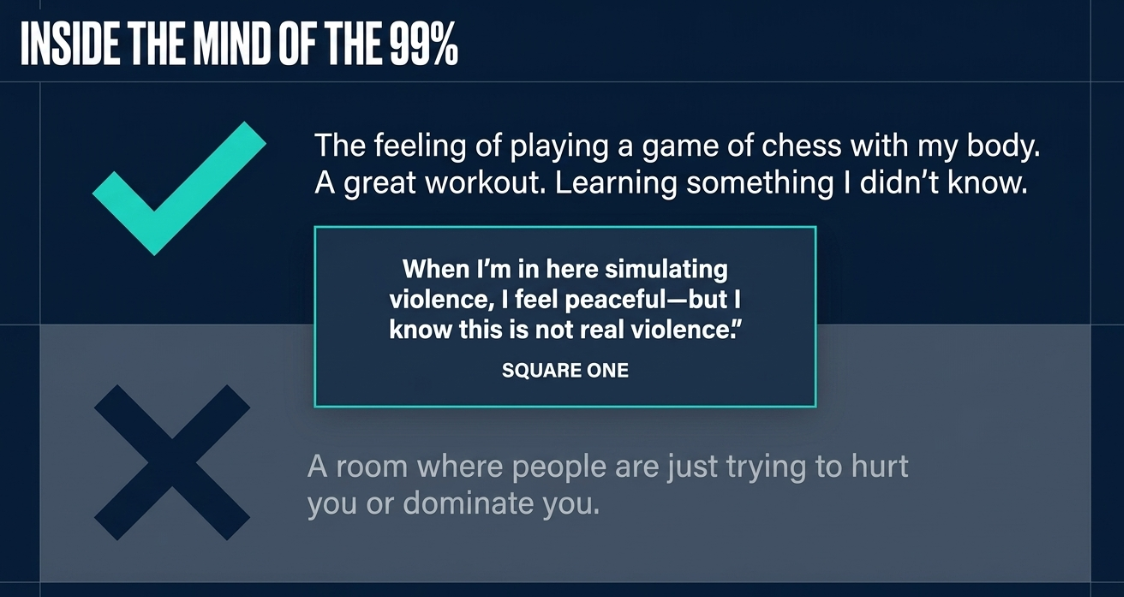
When I drop into an open mat somewhere new, here's what I'm actually after: the feeling of playing a game of chess with my body. A great workout. Learning something I didn't know. Getting caught in something and then figuring out how not to get caught by it the next time.
That's the whole draw for me.
What I'm not after—and what quietly makes me decide not to come back—is a room where people are just trying to hurt you or dominate you.
I've been to gyms like that. It doesn't feel good, and I don't return.
Which is the entire point Lakea was making about a sanctuary. The owner of Square One—the same one who told me jiu-jitsu needs hobbyists—once put that feeling into words for me:
“When I’m in here simulating violence, I feel peaceful—but I know this is not real violence.”
— JOSH SMITH, Owner, Square One Jiu-Jitsu
That's what a room is supposed to give people. If the person paying to be there doesn't feel good being there, they leave.
And most of the people paying to be there are hobbyists. One of the instructors at Carlson Gracie Hackney gives beginners the simplest version of this advice:
“Find a place you feel good and stay there.”
— KONRAD PIOTROWSKI, Instructor, Carlson Gracie Hackney
Your job as an owner is to be that place.
So here's where I've landed. The competitors and the hobbyists aren't at odds—they're in a partnership, whether they realize it or not.
The competitors put your school on the map. The hobbyists keep it afloat.
Your job as an owner isn't to choose between them. It's to build a room where the tired nine-to-five crowd feels welcome and unintimidated, protect them from an intensity they didn't sign up for, and give the people who do want that intensity their own time and space to chase it.
Take care of the 99, and the 1 takes care of itself.
Gym management software that frees up your time and helps you grow.
Simplified billing, enrollment, student management, and marketing features that help you grow your gym or martial arts school.


FAQ

Alex has spent over a decade leading SaaS companies through growth stages—from scaling sales and customer success teams to running the whole show as CEO. He's held executive roles at GoSite, Kaseya, and Yodle, building a track record of turning customer-focused strategy into real revenue.
A lifelong martial artist, Alex holds a black belt in taekwondo and actively trains Brazilian Jiu-Jitsu and judo. That "white belt mentality"—always learning, always adapting—shapes how he leads Gymdesk and connects with the gym owners the platform serves. When he's not in the office, you'll find him on the mats or visiting gyms across North America to film Gymdesk Originals, the company's documentary-style video series.