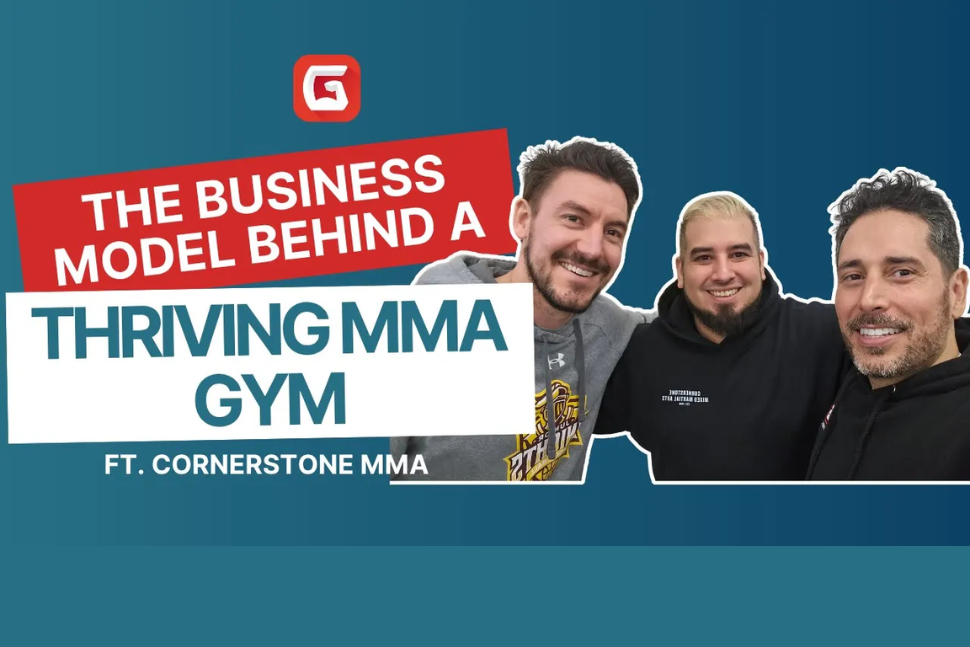
The Business Model Behind a Thriving MMA Gym

Starring

Mario began his martial arts journey under the tutelage of Justin Hanlin in 2009. A co-founder of Cornerstone MMA, Mario has helped train individuals ranging from fitness enthusiasts to competitive athletes and those just looking to learn something new.
About the Gym
Cornerstone Mixed Martial Arts, founded in July 2019, is located in Deerfield, Illinois. The gym offers training in kickboxing and Brazilian Jiu Jitsu for adults and kids, with programs for all skill levels, from beginners to competitors. Facilities include mat space for striking and grappling classes, and a variety of training equipment. The gym is affiliated with Molinaro Jiu Jitsu and offers both gi and no-gi classes, as well as fitness-focused kickboxing sessions and dedicated competitor classes.
📍444 Lake Cook Rd #27, Deerfield, IL 60015
📞 224-284-2911
Summary
In this episode, we visit Cornerstone Mixed Martial Arts in Deerfield, Illinois, co-owned by Mario Gomez. He shares the gym’s journey from humble beginnings—moving between locations and personal training sessions—to opening a dedicated space just before the COVID-19 pandemic hit. Mario discusses how community and organization have been key to their resilience. He emphasizes the importance of structured training and building a welcoming environment for families and beginners, rather than only targeting serious fighters.
On the business side, he explains how implementing Gymdesk transformed their operations—from handling paperwork to managing memberships, class check-ins, and payments—allowing the team to stay organized and better serve their growing community.
What They Told Us
Mario Gomez co-owns Cornerstone Mixed Martial Arts in Deerfield, Illinois, a North Shore suburb north of Chicago. He and his longtime coach trained gym to gym for years before opening their own space in July 2019—months before COVID nearly ended it. Sitting down after a morning kickboxing class, he walked through what actually keeps a martial arts gym alive, and it turns out not to be the fighters.
Opening right before COVID
Cornerstone opened in July 2019. Within half a year the gym was weighing its options against shutdown orders, moving classes to Zoom, and digging through stored paper waivers to put member credit cards on hold. Mario is candid that they were not sure they would make it—but grants, loyal members, and a willingness to follow every guideline carried them through.
"We had difficulty managing it, but we got some grants, had loyal members, and we got through it. And then, once it ended, just off and running where we left off."
—Mario Gomez, Co-owner, Cornerstone Mixed Martial Arts
The 1% nobody should build a gym around
Asked what he would tell his younger self after five years in business, Mario went straight at a mistake he sees other gyms make—building the whole operation around competitors. Almost nobody actually steps into a cage, so treating fighters as the core market is, by his math, a losing bet. The people who pay the bills are the ones who never compete.
"Less than 1% of people ever get into an MMA cage. So, that's a pretty poor market to go after. If I'm just going for 1% of people, I'm not going to be very successful. So, families, hobbyists, kids, they're the ones who build the business, and the competitors benefit from better amenities due to those members."
—Mario Gomez, Co-owner, Cornerstone Mixed Martial Arts
Community before curriculum
His other piece of hindsight was organization and community—keeping members engaged through email and social media, and making the room a place people genuinely want to come back to. A strong program, he argued, counts for nothing if the classes are not fun and nobody stays.
"Without building a community of people that enjoy training together, it doesn't matter how good your program is."
—Mario Gomez, Co-owner, Cornerstone Mixed Martial Arts
Learn each art before mixing it
Cornerstone teaches kickboxing, Brazilian jiu-jitsu, and MMA, and beginners routinely want to spar MMA on day one. Mario pushes back on that instinct: someone who rushes straight to mixed rounds never learns to throw a proper kick or defend a takedown, and by his account nobody gets good that way. The discipline is to build the pieces separately first.
"The philosophy should be that you should get good at every martial art first, and then bring it together, not try to do it all at once."
—Mario Gomez, Co-owner, Cornerstone Mixed Martial Arts
One bigger room, not many
Looking three to five years out, Mario is deliberately wary of a second location. Handing someone else the reins to run a gym to his standard—even with periodic visits—strikes him as the harder road. His preference is to consolidate: hit the threshold, move to a larger space with more mat, locker rooms, and showers, and pull the whole community under one roof.
"I feel multiple locations are very hard because you have a vision of how you want to run it. And giving somebody else the reins to run it, even if you're visiting periodically, is very difficult. So I think having a larger location where we could bring more community together is our ultimate goal."
—Mario Gomez, Co-owner, Cornerstone Mixed Martial Arts
From pen and paper to software
The gym started on paper—a waiver form and a membership form, signed at the desk and filed away. COVID exposed how fragile that was, when freezing members meant hunting through a stack of forms to find every card on file. Cornerstone compared platforms and settled on Gymdesk, then still named Martial Arts on Rails, and found it did more than they had gone looking for.
"We cross-referenced different programs and everything that we felt we needed was in Gymdesk. And once we started utilizing it, we found that there was more than we needed."
—Mario Gomez, Co-owner, Cornerstone Mixed Martial Arts
Read the full transcript
Lightly edited for readability. Speaker labels are omitted because the source recording is not diarised; quotes attributed elsewhere on this page were verified against context.
and we're doing kickboxing today. Behind every gym, there's a story, a mission, a spark of passion that started it all. This is Gymdesk Originals. Real owners, real struggles, and the communities they've built from the ground up. Alright, what are we doing today, Brian? We're doing kickboxing today. Kickboxing. Boxing class. This is in Northbrook, actually around Deerfield Illinois, north suburbs of Chicago, and it's 8 a.m. Get the day going. Alright, Cornerstone Mixed Martial Arts, man. Let's see what we're going to do today. Looking forward to it.
Come on in. Hi, my name is Mario. I'm a co-owner here at Cornerstone Mixed Martial Arts, located in Deerfield Illinois. We teach kickboxing, Brazilian jiu-jitsu, for both adults and kids. Whether you're a beginner, intermediate, advanced, somebody looking to compete, you can come and join our classes. I'm getting ready here for this class. First time I've ever worn these before. Warm-up time. I'm exhausted. I'm exhausted. I mean, look at my shirt. I'm sweating down to my stomach. Sitting here with Mario, our coach of the morning. We did a kickboxing class, but it was also a fitness kickboxing class.
Is that right? Yeah. So, more of a morning class is our fitness-oriented. So, this one's called Kickboxing Circuits. It pretty much has people running through different combinations on bags, along with calisthenics and other exercises. Yeah. Awesome. So, here we are, Cornerstone Mixed Martial Arts. Deerfield. It's a northwest suburb of Chicago. Deerfield. Okay. It's like north of the city, right? Yeah. This would be considered the North Shore. North Shore. All right. Cool. I'd love to know more about Cornerstone and tell us how you guys started this gym.
Yeah. My coach, I've been training with him since 2009, and we would just be moving around from gym to gym. He would sublease some locations. He's an instructor at a rec center, and we'd go there to train every now and then. And then, it got difficult to get consistent training in. So, even after I was done competing, I had started personal training, and I still had a passion for martial arts. So, we decided to open up a physical location in July of 2019. Yeah. So, your career in competing, was it strictly kickboxing?
No, it was MMA. Oh, okay. Yeah, yeah. I started kickboxing training with him, but I always had an affinity for grappling. Yeah. So, I mixed the two, and it was early on enough in mixed martial arts that nobody was very advanced. So, like in 2009, everybody was still figuring stuff out. So, you could jump in there with a year's experience and be pretty successful. I just fought at the amateur level, but I did go undefeated at four. Oh, very nice. And were these all local tournaments here, or did you...
Yeah, everything was either in Chicago. I did one match in Wisconsin. Everything's pretty close. So, when you walk into these competitions, you're like UFC style, you got gloves, that's it? Yeah. So, amateur rules are very similar. The only thing that they don't allow, especially in Illinois, elbows, knees to the head, but everything else is pretty close. Yeah. And as a kickboxer, do you feel like some of your weapons are taken away when you can't do that, or you're still... I would still consider myself more of a grappler, so it wasn't that big of a deal.
Yeah. But anytime that you're doing MMA, some of your weapons are taken away because you run the risk of running into something that, in your sport, isn't allowed. Got it. Yeah. All right. And so, your story of before the gym is you were basically part-time in different venues. Yeah. And you got busy enough to where you said, hey, we should do our own thing, and you decided to open up this one. Oh, yeah. Like, we had a small team, and it was always small because we didn't have a physical location.
Okay. So, committing to a specific location allowed us to really begin to build a group of competitors, and honestly, the most important thing are hobbyists, and that's really where the passion of the business is anyway. Yeah. When you guys opened this place, it was right before COVID. Yeah. And so, tell me about that. That must have been nerve-wracking. You finally get it off the ground, and then, oops, right? Yeah. We opened in July of 2019, and then within half a year, we were looking at, all right, so what are the options here?
How are we going to be able to survive this? And we moved on to online, like Zoom, but it's not as effective of a workout as being in person. You don't have partners, but we did the best we could. And then, when they opened up, we followed all the guidelines, had six feet of separation and all that. But it was very difficult, because they kept going masks on, masks off, separation. So, we had difficulty managing it, but we got some grants, had loyal members, and we got through it.
And then, once it ended, just off and running where we left off. Yeah. Yeah. So, I get how you could possibly do a class like this with six feet of separation, grapple like that. We couldn't. Okay. So, grappling's off the table. Yeah. It was off the table. We were really trying as hard as we could to follow all the guidelines. I know, in hindsight, maybe we could have been a little bit more lenient with following or not following, but that's just what we decided to do at the time.
And it still ended up paying off. Yeah. That's nice. And so, right now, this is a mixed martial arts gym. We did kickboxing, but you offer a lot of other programs. Can you tell us a little bit about that? Yeah. So, we do Brazilian Jiu-Jitsu. We're affiliated with my black belt instructor, Molinaro Jiu-Jitsu. He's in the city, and we run his Jiu-Jitsu program out of here. We actually just started formal Jiu-Jitsu in the Gi last May. Before that, we were doing only no Gi. Okay. So, that actually brought a lot more people in because the traditional Gi Jiu-Jitsu is actually picking up in popularity, and it gives us more legitimacy being affiliated.
Our kickboxing program is a mixture of a lot of striking styles. So, we'll take elements from Muay Thai, Dutch kickboxing, Taekwondo, Western boxing, and incorporate it into the Cornerstone style. And my coach has a background in more American traditional kickboxing, but he went to Thailand, trained there. So, we have a diverse kickboxing program. Other than that, if you're looking to do MMA, we have competitor-only classes where you blend everything together. But the philosophy should be that you should get good at every martial art first, and then bring it together, not try to do it all at once.
Yeah. So, you would recommend somebody, Brian here, who came into his first kickboxing class, actually, his first kicking. We did a Muay Thai class yesterday, and if he wanted to sign up, you would say, hey, dude, just stick to something for, I don't know, six months, a year, and then switch? No, you could train it all at once. Yeah. But if you're in a kickboxing class, you're focusing on kickboxing. If you're in a jujitsu class, you're focusing on jujitsu. If you're in a class that has wrestling focus, then you're working on wrestling.
The mistake a lot of people make is they want to do MMA right away. So, they want to spar MMA right away. So, they'll be like, let's just do MMA rounds. But they don't know how to throw a proper kick yet. They don't know how to defend a takedown properly. So, they're just incrementally improving, but not at the arts themselves. Yeah. And honestly, nobody gets good that way. Yeah. Yeah. That makes sense. All right. Then maybe we can transition into, let's say, you can go back in time.
Obviously, you couldn't predict COVID. But you've had five, almost five years, or yeah, five years of experience with the gym. If you go back in time and tell yourself something, or your business partner, what would you say with all this experience now? Organization is key. So, having an organized way of keeping members engaged through emails or social media, along with building the community. Without building a community of people that enjoy training together, it doesn't matter how good your program is. If they don't have fun in the classes, they're not going to want to continue counting.
And the other thing is not focusing on competitors, because less than 1% of people ever get into an MMA cage. So, that's a pretty poor market to go after. If I'm just going for 1% of people, I'm not going to be very successful. So, families, hobbyists, kids, they're the ones who build the business, and the competitors benefit from better amenities due to those members. Yeah, that makes sense. Because you've got guys like Brian and I, who are keyboard junkies. We're not trying to go into a cage.
We're the guys, guys like us, and kids keep the business afloat. So, it's a big thing that some places miss, not focusing on that element. So, when you develop your programming, is that how you think about it? Yeah, so, my goal and my passion is to teach people martial arts. And it doesn't matter whether you're going to compete or not. If you have the confidence in the techniques that you're learning. And we only teach stuff that is proven. We don't try to teach anybody that hasn't been effective at the highest level.
So, if a hobbyist wants to be able to defend themselves, they come and take our program. If a competitor wants to get better, they come and take our program. If a parent wants their child to gain confidence and be able to defend himself against a bully, you come and take our program. It's a catch-all. We don't really teach anything that's not necessary. And everything that we do is so that people can improve. Got it. Cool. Maybe you can tell me a little bit about, you know, when you did open.
Did you start paper and pen? Did you start with software? Yeah, so... And how you found Gymdesk, really? Yeah, so we started with, yeah, just forms. A waiver form and a membership form. And hand people the pen here, so here. Sign there, check that. Then we'd store it away. And maybe we would scan it and have it on file, like in a laptop or a computer. But when COVID hit, we had to go through all those papers to put a hold on all those credit cards.
And so it dawned on us, like, this is not a very efficient way to go about this. So, yeah, we were looking through vast different programs that we could utilize. And Gymdesk was one of them. I believe it was called Martial Arts on Rails. Yeah, that was the original name, yep. Yeah, so that's what we ended up going with. We cross-referenced different programs and everything that we felt we needed was in Gymdesk. And once we started utilizing it, we found that there was more than we needed.
And we started utilizing all of the things within the program. And it made our lives a lot easier. Yeah, when you think about the things that maybe you weren't expecting or maybe things that you use on a regular basis or that the product does on its own, what are some of those things that you think are like, oh, this is a great feature. I love this part. Yeah, so I really like the idea of the check-in process. It obviously helps us know which classes are popular, which ones we need to maybe remove or replace with something else.
The organization of being able to say a membership is perpetual or it stops at the end of it allows us to modify our contracts to specify, hey, at the end of your 12-month contract, this will just keep going month to month until you tell us to cancel. Or at the end of your 12-month contract, you have to renew it again because it will cancel. And it makes it a lot easier to organize how we sell our programs and having the ability to have the card on file and make family memberships.
All that sort of stuff is very good. Yeah. What do you think about your future with respect to the business? Are you looking to expand more locations or get a bigger? So when you think about where do you want to be with the business in three to five years, what's your vision there? Yeah, so we have a threshold that we need to hit before we could consider moving. But that is something achievable within the next two years. And we want to expand to a larger location.
I feel multiple locations are very hard because you have a vision of how you want to run it. And giving somebody else the reins to run it, even if you're visiting periodically, is very difficult. So I think having a larger location where we could bring more community together is our ultimate goal. Obviously, you want to increase the mat space, offer more amenities like locker rooms and showers. So that's what we're looking for next. Yeah, that makes sense. We've heard that a lot from people who are very passionate about why they're doing what they're doing.
It's because they want to teach and it's not really a money-making thing. Of course, you can make it about you have to make money. Of course. It is a business. Yeah. But that's not the primary driver for it. And expansion, sometimes people are reticent because they're not going to be able to be there. Yeah. You know, what I've heard a lot is, I'd rather have a bigger space that we could keep doing what we're doing and just max it out there. We're honored that you let us come by and train with you today.
And we're grateful that you've chosen Martial Arts on Rails and Gymdesk as your software. We also have our executive team watches these. Anything you want to say that maybe we haven't asked? As far as things to improve on Gymdesk? You could talk about things to improve or your experience with it. Do you like support when you call in? Yeah. Like the support is very personalized. Like normally if you call like a support from a company that manages a lot of gyms or facilities or whatever it may be, whatever business, you get a lot of automation first.
Where I feel like with Gymdesk, if there's a problem that needs to be addressed, that needs a conversation to be had, like we immediately get a response, which is very good. Yeah. We're happy with it. There's not much else to say. Like it's a pretty good program and we're going to stick with it for a long time. Cool. Awesome. Then maybe I'll just ask you one more thing. You got a lot of flags up here. You have military flags up there. We have what looks like Brazilian, Japanese, American, Mexican.
Is that Puerto Rico, right? Puerto Rico, Ireland. Yeah. Is that all of the instructors? Yeah. So the bottom row is instructor based and the top row is obviously you have to have the U.S. flag up. And the other ones are where the martial arts that we teach originate from. Okay. What is that? Thailand. Oh, okay. I didn't recognize that one. Got it. Awesome. Yeah. Thanks very much. Thank you. We're here at Cornerstone Mixed Martial Arts located in Deerfield, Illinois. Teach kickboxing, Brazilian Jiu-Jitsu for both adults and kids. Whether you're a beginner, intermediate, advanced, somebody looking to compete, you can come and join our classes.
.webp)