

Your joist mount has a 120-pound rating, buuuut your commercial 125-pound heavy bag can exceed those limits. That's a problem. Your heavy bag is heavier than your hardware can support.
These can lead to costly mistakes.
This guide focuses on these decisions—what to buy, how to spec it out, how many stations you'll need, and what your building can/must support.
If you're looking for startup budgeting, check out what it costs to open and start a boxing gym. If you're looking for general startup or facility planning, take a look at general gym equipment.
A Striking Build Is a Structural Problem
Your facility's dimensions—the space you're working with—are essential details.
The ceiling height, joist construction, wall clearance, and flooring aren't just secondary considerations. They determine your equipment specs and loadout well before you place an order.
It's supposed to anyway.
Ignoring this means you may order products you can't use, or have to make expensive adjustments to compensate for products that aren't a great fit for your building.
Rich Beaupit of Straight Blast Gym Niagara chose his facility partly because of its ceiling height and bay-door access.
St. John's Boxing had the opposite problem: their gym's ring is too close to a wall; that's a no-no if they want to host a sanctioned event.
That's the question gym owners should be asking. What sort of constraints am I working with?
The constraints owners don't budget for
You'll want to document the following before you start shopping for equipment:
What to measure | The number that decides it |
Ceiling height | 16 ft clear if you ever want to host a sanctioned bout; lower is fine for bag work |
Ceiling construction | Wood, steel, or concrete—decides which mount exists for you at all |
Joist or beam type and spacing | Identify the member itself, not the drywall under it |
Mount capacity | 120 lb on a standard joist mount; the commercial bag is 125 |
Wall construction and clearance | 2 ft minimum beyond the ropes on every side if a ring is going in |
Available floor area | 1,296 sq ft for the smallest complete competition ring |
Walkways and emergency access | Local code, and it comes out of your station count |
Don't assume that a commercial building can support a hanging bag simply because it supported previous tenants' equipment.
You'll want a clear sense of what you're working with well before you start shopping.
What You Can Actually Hang, and From What
Load ratings are specifications; they're not suggestions.
FirstLaw Fitness lists its standard Joist Mount at 120 pounds, while its Joist Mount 200 is rated for 120–200 pounds. That detail matters if you're looking to buy a commercial 125-pound heavy bag.
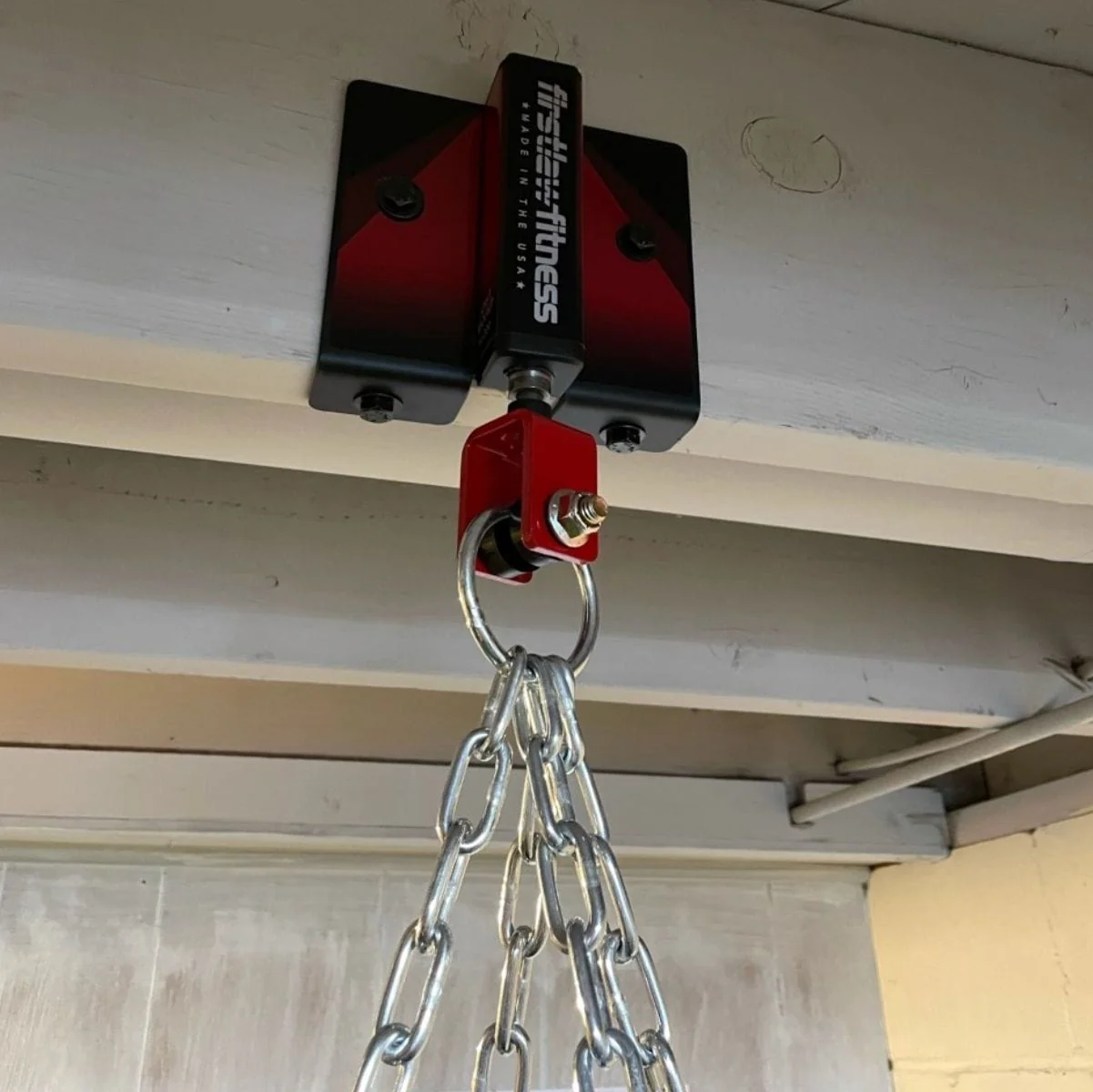
Source: FirstLaw Fitness
Here's the other point about your heavy bag. The load is also dynamic.
When you hit a heavy bag, it swings, twists, turns, and pulls. MMA Warehouse specifically warns against copying anchor types, bolt sizes, or load ratings from generic installation advice.
If you run into specific problems, they encourage gym owners to hire a qualified installer.
WARNING:
Stop and use a qualified installer if you cannot identify the structural member, do not know what is behind the finished wall or ceiling, see rot or cracking, live in a rental that restricts structural changes, or find any conflict between the bag and mount instructions.
The important question isn't "How do I install this?" It's "What does the manufacturer require?" and "Who is qualified to verify what our building can/cannot support?"
Method | Published rating | What your building needs | Where it fails |
Ceiling or joist mount | 120 lb standard; 120–200 lb heavy-duty | An identified structural member, not drywall | The 125 lb bag everyone buys is over the standard mount |
Wall mount | Per model—it's on the product page | A structural wall you've verified | Masonry, metal stud, anything you can't open up |
Freestanding stand | Most don't publish one—get it in writing | Floor area and a level surface | Takes floor a mounted bag wouldn't |
Rack system | Per system, not per bag | Anchored to floor or rated structure | The rating is the whole rack loaded, not each station |
Hanging hardware carries its own rating, separate from the mount—TITLE's Professional Heavy Bag Spring and Platinum Pro Chain & Swivel are each rated to 250 lb. A 120 lb mount with a 250 lb swivel is still a 120 lb setup.
If mounting isn't feasible or you find it structurally unsuitable, consider freestanding equipment.
We'll keep you in the loop with fresh content, podcasts, how-to guides, tool reviews, and product exclusives.
Spec the Floor Before the Gear
Spec out your floor before you begin shopping for equipment.
If your training room will be primarily used for boxing footwork and bags, rolled rubber flooring is an option worth considering.
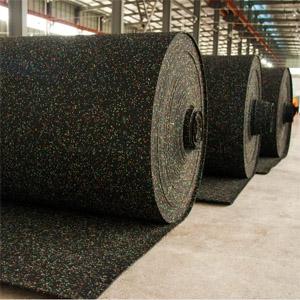
Source: AmericanFloorMats.com
What if you're dealing with Muay Thai, kickboxing with takedowns, mixed martial arts (MMA) and grappling? Roll-out martial arts mats may be a better option, especially if you opt for the spring floor system.
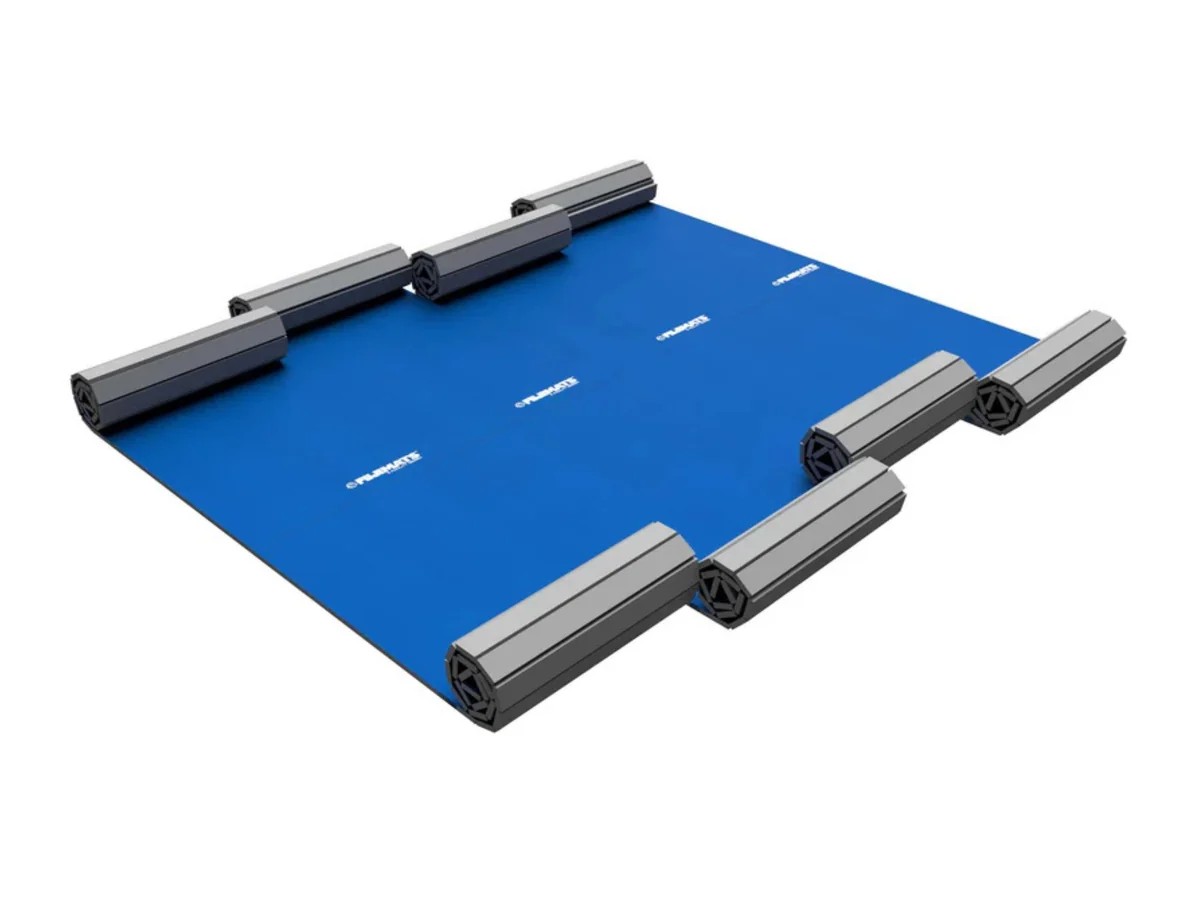
Source: Fujimats.com
Here's what the difference looks like: American Floor Mats lists retail pricing for standard 3/8-inch commercial rubber rolls typically between $2.09 and $10.00 per square foot. A key factor driving price is color percentage, not volume. According to Great Mats, 1.25-inch roll-out martial arts mats are roughly $5 per square foot.
That said, home-grade roll-out mats turn up in plenty of commercial gyms—they're common at open-mat academies and even at tournaments. If your budget is tight, they're a legitimate option; what the commercial rolls mainly buy you is longer service life under daily use.
Here's the thing about mats. The important specification here isn't just thickness.
You'll need to consider factors such as impact absorption, traction, cleaning requirements, seams, installation method, and the activities to be performed in each zone.
Mats are also a lead-time issue. Triple Seven Jiu-Jitsu opened for business once their mats arrived; it's not uncommon for other academies to receive their mats a few days before opening for business.
That's the problem, though, isn't it? You can't install equipment on a floor that isn't ready. Another important question to ask is: "Can the floor come up?"
Donnie at Doggpound runs four or five fight cards a year because the mats lift out and 500 chairs go down. That removable floor is what makes the ring in the next section pay for itself.
Boxing, Muay Thai, and Kickboxing Don't Buy the Same Room
These are all striking arts, but the equipment requirements are not the same. Yes, these disciplines overlap, but their equipment categories differ significantly.
Gear | Boxing | Muay Thai | Kickboxing | MMA |
Heavy bag | Essential | Essential | Essential | Essential |
Banana bag | Optional | Essential | Useful | Useful |
Speed bag | Common | Optional | Optional | Rare |
Double-end bag | Common | Useful | Useful | Useful |
Focus mitts | Essential | Useful | Essential | Useful |
Thai pads | Optional | Essential | Useful | Essential |
Belly pad | Rare | Common | Optional | Common |
Wall padding | Useful | Useful | Useful | Essential |
Here are the training room specifications for each martial art:
Room spec | Boxing | Muay Thai | Kickboxing | MMA |
Floor | Rubber, rated for footwork | Rubber, or mats if you clinch to the floor | Rubber | Mats, full coverage |
Open space beyond the bags | Footwork lanes | Paired standing room for clinch | Kicking range—more per pair than boxing | Ground space, most of anything here |
Wall clearance | Bag swing arc | Swing arc, plus clinch drifting into walls | Kicking arc | Takedowns end at walls—padding isn't optional |
Ring or cage | Ring, if you run shows | Ring | Ring | Cage |
This table indicates whether the equipment above is required for training. It doesn't establish a universal standard.
If you're looking for additional tips or advice on planning, see starting a Muay Thai gym and starting a kickboxing gym.
How Many Stations Does the Room Need
So there's obviously no definitive bags-per-student standard to refer to here. A common norm is one heavy bag for every two students.
Treat this as a starting point for planning purposes—it's not a universal rule. You do need to define your preferences ahead of time.
Start with the class you plan to run. If 20 of your students need to work on the bag simultaneously and your format requires two students per bag, you'll need at least 10 heavy bag stations.
Here's a starting point you can use for your boxing gym layout.
Space | Minimum | Better |
Station | 100 sq. ft. | 120–144 sq. ft. |
Station dimensions | 10' × 10' | 11' × 11' to 12' × 12' |
Main walkway | 4' | 5'–6' |
Clearance between active zones | 0' | 1'–2' buffer |
This table assumes a student movement radius of 5 feet (6 feet would be more conservative). Here's an important note: if two students are simultaneously moving around opposite sides of a bag, you may not need a 10' radius around the entire bag for each student.
This is because their movement envelopes, the three-dimensional physical space they occupy, overlap spatially around the bag.
If you can spare the floor space, I'd actually recommend a buffer of 12' × 12' per station. That would be 144 sq. ft. × 10 = 1,440 sq. ft. That's before accounting for additional circulation, walls, storage, coaching space, etc.
Can your location, schedule, and format support that?
This is where gym management software comes in. Your on-hand equipment is a scheduling to-do. Your booking/scheduling system should reflect the room's actual capacity.
Don't accept an unlimited number of bookings and new students if you don't have the equipment, resources, or manpower you need.
The Used-Equipment Discount Doesn't Apply to You
You can get deep discounts on used commercial equipment. It's not uncommon for dealers to advertise this. Gym Pros mentions savings ranging from roughly 40% to 70% off retail.
Here's the problem. Used boxing gym equipment is hard to find—most of the time, your product options are limited to cardio and strength training equipment.
Search through dealer catalogs, and you're more likely to find plyo boxes for "boxing" or bumper plates for heavy bags rather than actual commercial heavy bags, rings, or rubber/tatami mats.
The advice to buy used isn't all that useful if you're shopping for boxing gym equipment.
Titan Fitness has a scratch-and-dent section where they list deep discounts on "slightly marked but fully functional" gear.
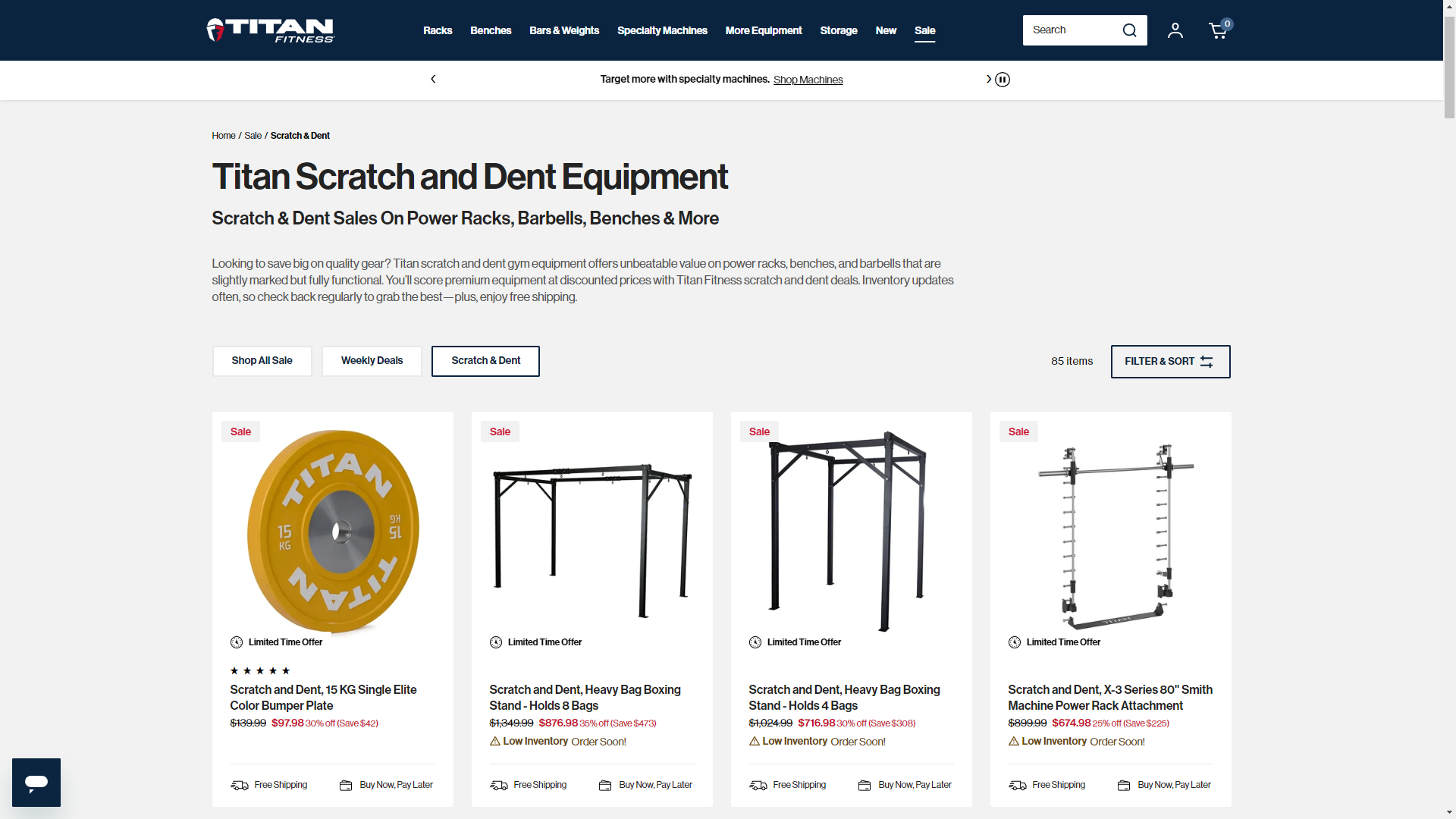
Source: Titan.Fitness
If you're in the market for gear, reach out to dealers and manufacturers directly. Ask them about their pricing on returned/refurbished products.
They'll be able to tell you (a.) whether you can purchase used or refurbished equipment, (b.) how to go about purchasing the equipment you need.
If you're purchasing cardio or conventional strength equipment (assault bikes, treadmills, dumbbells, etc.), check out our post on general gym equipment.
What Wears Out, and What the Warranty Won't Cover
Commercial use significantly changes the warranty conversation. Fairtex excludes commercial or gym use from its limited warranty; this is common for many manufacturers.
Manufacturers typically exclude commercial/gym use from their warranty programs because high-frequency use in these environments accelerates normal wear and tear.
There are anomalies; for example, Zebra Mats publishes a 15-year product life expectancy that's backed by a 10-year mat warranty. Century offers a prorated warranty for their facility rollout mats.
So far, I haven't come across any comparable, manufacturer-stated, service-life figures for equipment like heavy bags, focus mitts, or gloves. What does that mean?
For starters, any claim that gyms should replace boxing gear on a fixed schedule (e.g., every six or twelve months) can be traced to affiliate or marketing content instead of any stated manufacturer specs.
A better option for boxing gyms?
Track product purchase dates, warranty terms, damage over time, and replacement decisions instead. Build this process into your maintenance protocols—cleaning your equipment and your gear and merchandise procedures.
Buy the Ring Last, and Only for a Reason
A boxing ring is a requirement for training, right?
I'm going to go full contrarian on this one and say no, it's not a requirement. It's useful for training, but you don't need a ring to become a great boxer.
Okay, what does that mean? A boxing ring is an enormous expense—it's an event asset before it's a training necessity. It's the place where you put fight cards, amateur bouts, and exhibitions.
Used properly, your ring draws spectators, photos, social content, and revenue in a way that a set of heavy bags and focus mitts can't.
Donnie Mignon of Doggpound MMA talks about having the space needed to make an event ring economically useful.
The physical specification is key here: boxing rings are usually sold by platform dimensions, not by the area inside the ropes.
This means a 24-foot platform has 20 feet of usable space inside the ropes, a 20-foot platform has 16 feet, etc.
That distinction can create a serious facility problem.
Lisa Titan, gym owner at St. John's Boxing, has first-hand experience with these headaches. She purchased a boxing ring with the intention of running her own events.
These in-house tournaments were how her old gym marketed itself (invite the neighborhood, hundred chairs, match by weight, run a show). Not being able to sanction cost her a marketing channel, not just an event.
This is why the specifics of your physical location need to be verified before making a purchase decision.
Boxing can also be structured as a tiered add-on. For example, Shogun West BJJ is a grappling facility that added striking as its program developed, while Fit and Fight began renting space in an existing martial arts school.
Ring | Price | Room it needs | What it lets you host |
Complete Floor | $3,250–$4,750 | Platform plus a 2 ft apron every side, at floor level | Training, sparring, in-house work |
Folding & Collapsible | $4,499.99 | Same, and it packs back down | Training in a room with another job |
Freestanding Floor | $6,950–$8,150 | Same footprint, nothing to build around it | Training, sparring, exhibitions |
Streamliner (raised) | $7,250–$8,425 | 1,296 sq ft and 16 ft ceiling for a full setup | Ticketed shows with seating |
Drop & Lock Competition | $8,575–$10,100 | 1,296 sq ft, 16 ft ceiling, plus officials' space | Sanctioned bouts |
Buy the Room You Can Hang Things In
These specifications help you to avoid the 120 vs. 125-pound gap I mentioned in the beginning of this post. When you lead with specifications, you'll find your boxing equipment works within your limits.
Outline the specifics of your location—the building, flooring, class requirements, etc.—before you settle on products or brands.
Verify the structural capacity, floor requirements, wall clearance, station count, and discipline-specific needs of your location first—before you decide to commit to a specific equipment set.
This will establish your training room's true capacity—something your schedule and membership system can support. You set the cap; your martial arts software holds it once it exists.
Want to run the numbers or create a budget? Use our startup cost calculator to avoid mixing cost planning into equipment specification.
You just worked out your room's real capacity—stations, ceilings, floor, and whether a ring fits. Your booking and membership system should hold that number, not fight it.
See Gymdesk for martial artsGym management software that frees up your time and helps you grow.
Simplified billing, enrollment, student management, and marketing features that help you grow your gym or martial arts school.


FAQ
Boxing Gym Equipment FAQs
.webp)
Andrew McDermott is a gym owner, Brazilian Jiu Jitsu brown belt, and digital marketer. He’s on a mission to build premier, high-stakes grappling tournaments, world-class academies, and a championship team of high-level athletes.