
Every commercial gym has a cleaning protocol of some kind. The problem is that most of them live in one person's head, not on a clipboard.
The closer knows to wipe the cardio consoles; the morning lead knows the showers need a scrub on Tuesdays. Then someone calls out, a new hire takes the shift, and the gaps start to show—right about the time a member complains, an inspector walks in, or your insurance carrier asks how you document the work.
This guide is for commercial gyms, fitness centers, 24-hour clubs, and CrossFit boxes—rubber-floor cardio rows, plate-loaded machines, free weights, lockers, and showers.
If you run a martial arts school, the mat-cleaning playbook is different; see the martial arts gym cleaning checklist instead.
By the end, you'll have four things you can put to work today: a cleaning cadence, a buyer's guide to what actually disinfects each surface, a checklist you can post on the wall, and a way to assign the work so it survives a staffing change.
Why Cleanliness Is a Retention and Liability Problem
Ask experienced operators where cleanliness sits on the priority stack, and you'll hear a version of the same answer: it ranks below sales and customer service, but it's real, and it's higher than most owners treat it.
It almost never tops the list. It also almost never shows up as the reason on an exit survey—which is exactly why it's dangerous.
Dirty equipment and a neglected locker room rarely generate complaints. They generate silent cancellations.
A member doesn't file a ticket about the stale smell near the rowers or the grime in the showers; they just stop renewing, and you never trace it back. Cleanliness is a retention lever disguised as a chore, which is why it belongs in the same conversation as your other gym retention strategies.
Then there's the liability side.
If a member picks up a skin infection on your premises and can tie it to a documented hygiene failure, you're looking at a premises-liability claim—and a clean-looking gym with no cleaning records is a weaker defense than you think.
This is where liability waivers and the right gym insurance matter, but the first line of defense is a protocol you can actually point to.
The Daily, Weekly, Monthly, and Quarterly Cadence
A documented cadence is the difference between a cleaning protocol and a cleaning habit. A habit depends on the right person being on shift.
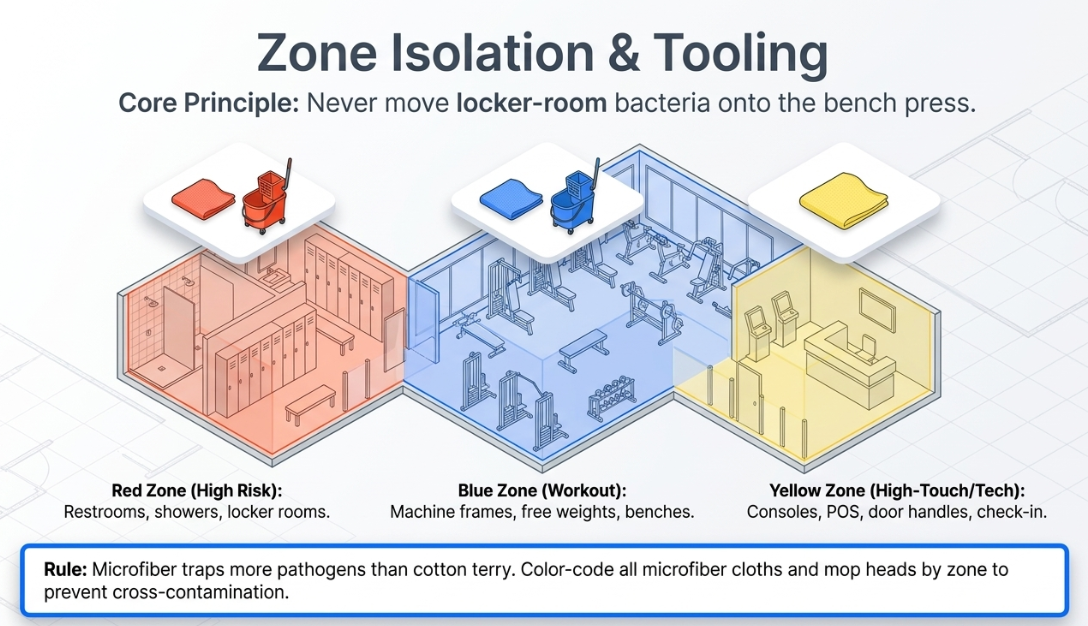
A protocol works regardless. The trick is to segment the work by zone—workout floor, cardio and strength, locker rooms—not just by frequency, because each zone fails differently.
Here's the at-a-glance model. Steal it, adapt it to your floor plan, and post it where the work happens.
Cadence | Workout & free-weight floor | Cardio & strength machines | Locker rooms & restrooms |
Daily | Spot-clean spills, wipe high-touch points, restock wipe stations | Disinfect consoles, handles, seats, and pads between peak waves | Restock supplies, mop floors, wipe benches, clean toilets and sinks |
Weekly | Deep-clean rubber flooring, dust racks and shelving | Detail machines, clean upholstery, vacuum dust from cardio units | Scrub grout and tile, clear drain hair, disinfect showers |
Monthly | Move equipment and clean underneath; retire damaged gear | Cable and strap inspection, treadmill belt and deck check | Mold inspection, ventilation and humidity audit |
Quarterly | Refinish or deep-treat flooring, full equipment audit | Professional belt/deck service, hardware tightening | Drain camera, re-grout as needed, deep tile treatment |
Most competitors stop at monthly. Quarterly is where the expensive, easy-to-forget work lives—drain cameras, HVAC duct inspection, equipment cable audits, grout you can't save with a weekly scrub.
Put it on the calendar now or it won't happen until something breaks.
The cadence is only half the job. The other half is staffing it—assigning each row to a named role so it doesn't quietly become nobody's job. We'll come back to that.
Daily Cleaning: After Every Shift, or Every Few Hours at Peak
Daily cleaning is where the protocol earns its keep or quietly collapses.
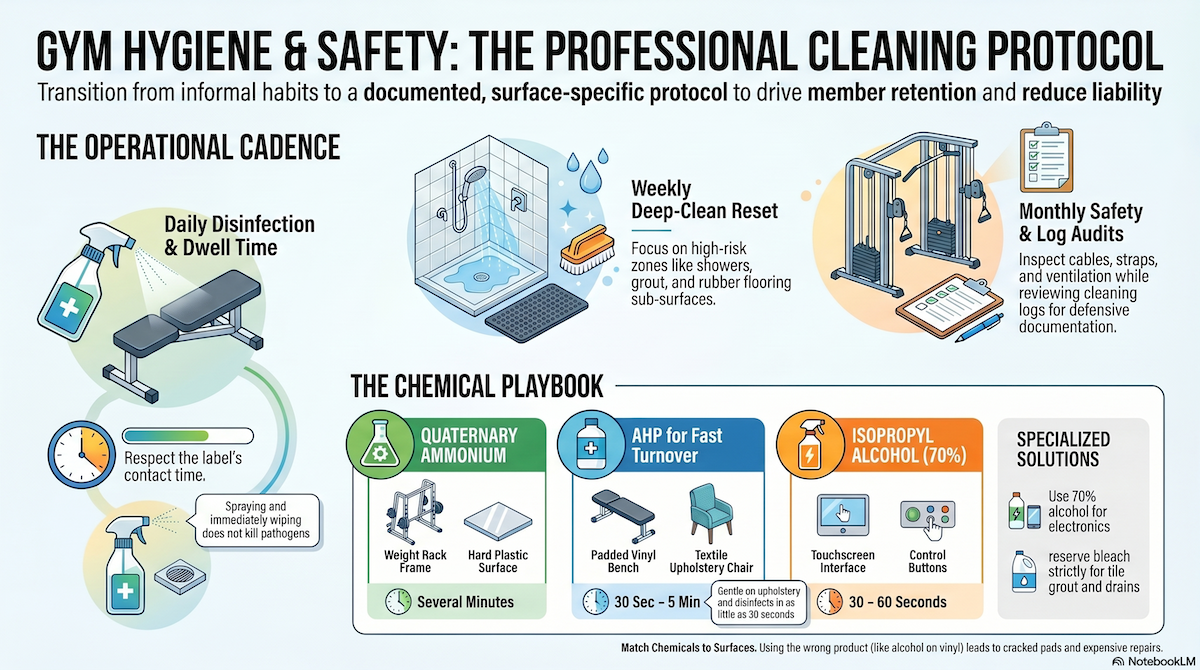
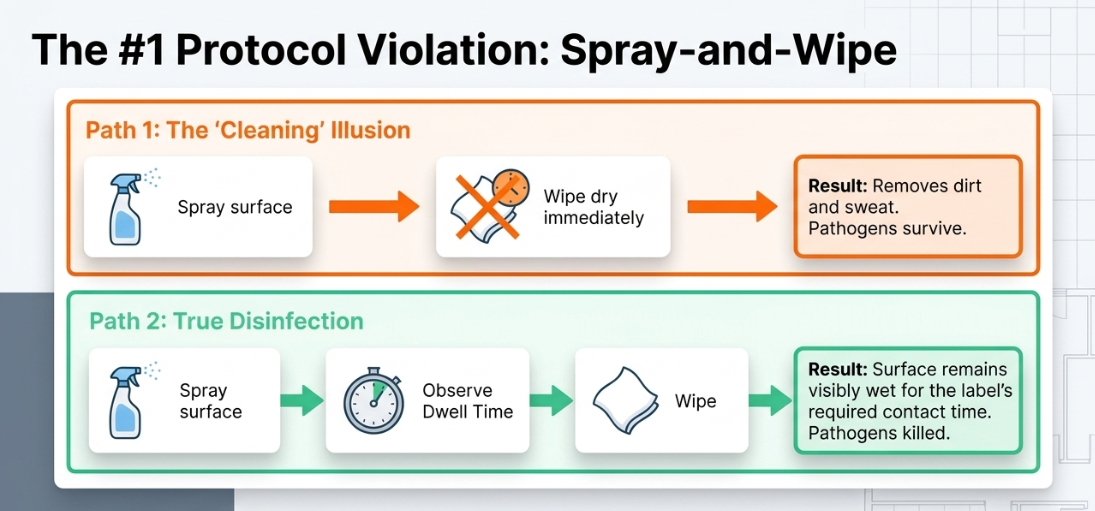
And the most common failure isn't skipping it—it's doing it wrong. Spraying a disinfectant and immediately wiping it off does almost nothing, because the surface has to stay visibly wet for the product's full contact time to actually kill anything.
Wipe it dry in three seconds and you've cleaned the surface, not disinfected it.
That distinction matters. Cleaning removes dirt and sweat. Disinfecting kills pathogens—but only if you respect the dwell time printed on the label.
WARNING:
Spray-and-immediately-wipe is the most common cleaning protocol violation in commercial gyms—and the fastest way to fail a health inspection. A disinfectant only works if the surface stays visibly wet for the product's full contact time. Wipe it dry in three seconds and you've cleaned the surface, not disinfected it.
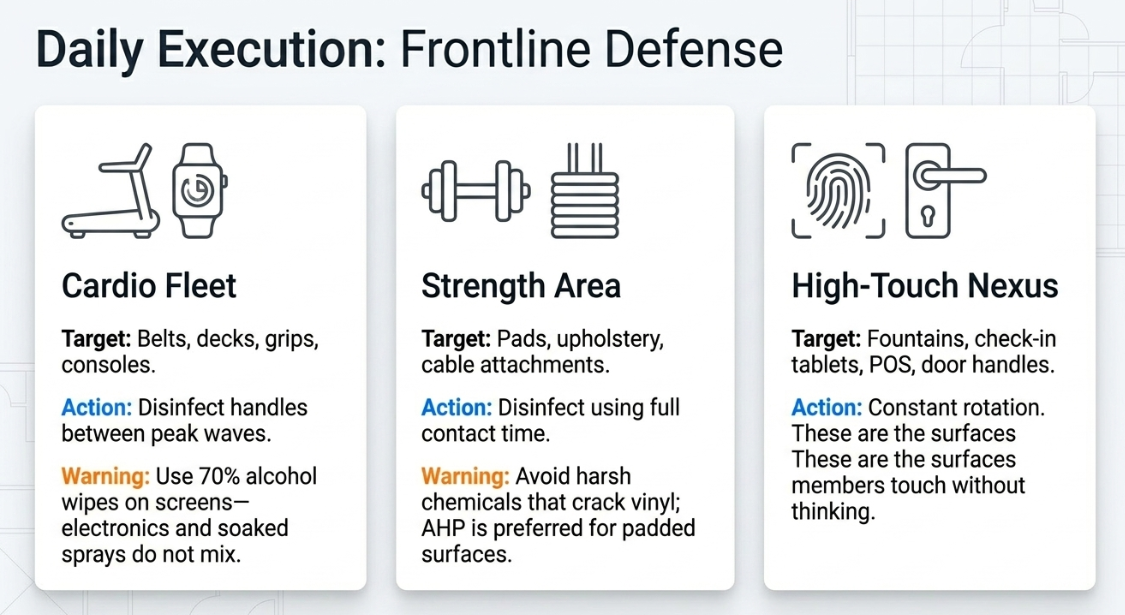
Cardio floor
Treadmill belts and decks, console screens and buttons, handlebars and heart-rate grips, rower seats and rails, bike saddles and adjustment levers.
These get touched constantly and sweated on directly. Disinfect handles and contact points between peak waves, not just at close. Screens and buttons need an alcohol-based wipe, not a soaked spray—electronics and standing liquid don't mix.
For the machines worth maintaining this way, see our guide to the cardio equipment gyms actually need.
Strength area
Cable handles and attachments, machine pads and upholstery, plate-loaded grips, bench seats and backs.
Upholstered pads are the weak point—they hold moisture, and the wrong chemical cracks the vinyl. Match the product to the surface (more on that below) and give pads the full contact time.
Free-weight area
Dumbbells, barbells, and plates take a wipe-down too, especially knurled handles where chalk and sweat collect.
Rubber-coated weights tolerate most disinfectants; bare metal handles can take alcohol for a quick pass. Don't soak anything that has to be gripped.
High-touch surfaces between zones
Water fountains, door handles, check-in tablets, POS terminals, and lobby seating are the surfaces members touch without thinking.
They belong on the daily list even though they aren't gym equipment in the usual sense.
Weekly Deep Clean: The 60–90 Minute Reset
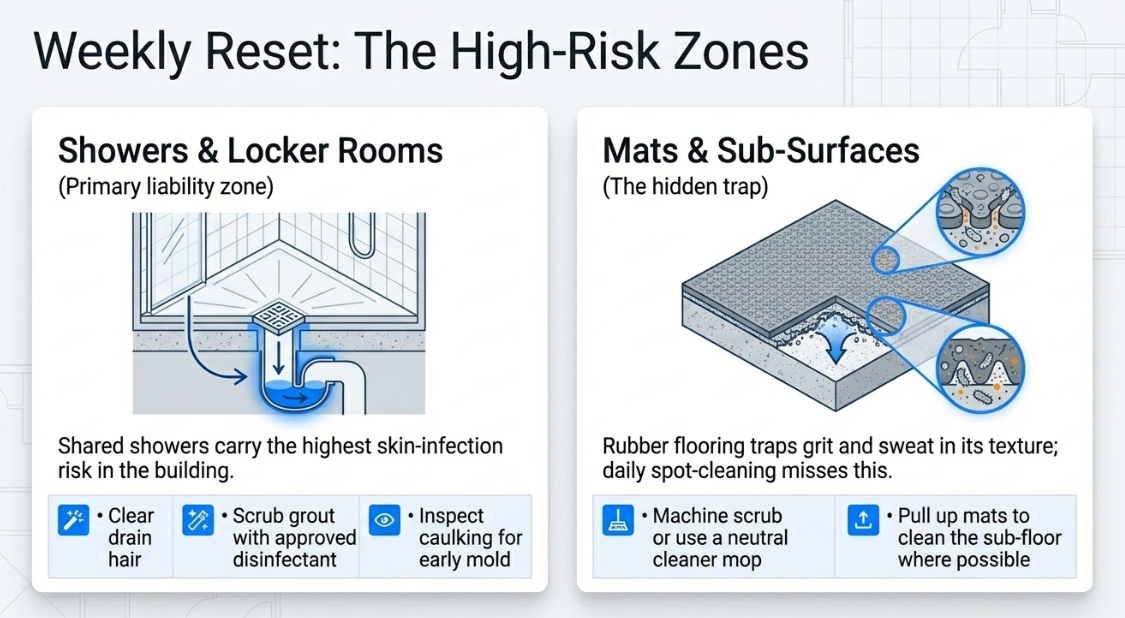
Weekly cleaning catches what the daily wipe-down misses.
And the highest-risk zone isn't the workout floor—it's the locker room and showers, where warm, wet, shared surfaces do exactly what you'd expect.
Mats, rubber flooring, and sub-surfaces
Rubber flooring traps grit and sweat in its texture. A weekly machine scrub or a mop with a neutral cleaner pulls out what daily spot-cleaning leaves behind. Pull mats where you can and clean the sub-floor underneath.
Locker rooms and showers
Clear drain hair, scrub grout and tile with an appropriate disinfectant, and inspect caulking and corners for the first signs of mold. Shared showers carry the highest skin-infection risk in the building, so this is not the corner to cut.
Equipment upholstery and padded surfaces
This is where accelerated hydrogen peroxide beats quats—it's gentler on vinyl and sensitive finishes while still disinfecting. Pair the weekly upholstery pass with a material-compatibility check so you're not slowly destroying your own pads. Treat it as part of your broader gym safety best practices, not a cosmetic nicety.
Monthly Audit: Inspection, Not Scrubbing
Monthly isn't about cleaning more. It's the inspection-and-assessment layer—you're auditing what daily and weekly cleaning have missed, and replacing what can't be cleaned anymore. Frame it as risk management, because that's what it is.
Task | Responsible party | Time |
Cable and strap inspection (frayed cables, worn straps) | Maintenance lead | 30 min |
Treadmill belt service / deck wax check | Maintenance or vendor | 45 min |
Locker room ventilation and humidity audit | Owner / manager | 15 min |
Drain camera (showers, mop sinks) | Vendor | 30 min |
HVAC filter replacement | Staff or vendor | 15 min |
Loaner gear retirement audit | Staff | 20 min |
Cleaning log review (gaps, anomalies) | Owner / manager | 10 min |
Incident log review | Owner / manager | 15 min |
Supply audit and reorder | Owner / staff | 10 min |
The log reviews at the bottom are the ones owners skip.
They're also the cheapest insurance you have—a thirty-day cleaning record with a gap you caught and fixed is worth more in a dispute than a spotless floor with no paper behind it.
Cleaning Supplies Buyer's Guide: What Commercial Gyms Actually Use
Search "cleaning supplies for gyms" and you get vendor catalogs and Amazon results—nobody writes the actual buyer's guide. So here it is.
Four chemical classes cover almost everything a commercial gym needs, and each one has a job it does well and a surface it ruins. Get the match wrong and you'll spend more replacing yellowed pads and cracked vinyl than you ever saved on chemicals.
Chemical class | Best for | Avoid on | Typical contact (dwell) time |
Quaternary ammonium ("quats") | Hard plastic, metal, painted frames, most vinyl pads | Some rubber finishes can yellow over time (product-dependent) | Several minutes—verify on the label |
Accelerated hydrogen peroxide (AHP) | Upholstery, sensitive surfaces, fast turnover | Bare aluminum and other soft metals (brass, copper, zinc) | 30 seconds–5 minutes |
Isopropyl alcohol (70%) | Touchscreens, console buttons, metal handles | Vinyl, leather, and painted finishes (dries and cracks them) | 30–60 seconds |
Diluted bleach (sodium hypochlorite) | Tile grout, drain disinfection, outbreak response | Mats, equipment finishes, any soft goods | 1–10 minutes (up to ~15 for grout and mold) |
The four classes and where each one belongs
Quats are the workhorse for hard surfaces—machine frames, plastic shrouds, metal, and most vinyl pads.
They're broadly compatible, though some formulations can yellow certain rubber finishes over time, so spot-test a new product before you commit your whole floor to it.
Accelerated hydrogen peroxide (AHP)—sold under names like Oxivir and Virox—is the upholstery and fast-turnover choice.
It disinfects in as little as 30 seconds to a few minutes and is gentle on the soft surfaces quats and bleach degrade. Keep it off bare aluminum and other soft metals.
Isopropyl alcohol at 70% is for electronics: touchscreens, console buttons, and metal handles where you need a fast pass and no residue.
It evaporates quickly—which is why it's better thought of as a quick sanitizing wipe for screens than a label-grade disinfectant for big surfaces—and it will dry out and crack vinyl, leather, and painted finishes if you use it there.
Diluted bleach is the heavy artillery for tile grout, drain disinfection, and outbreak response.
It's the wrong tool for anything you grip, sit on, or roll on—it corrodes metal and degrades rubber, vinyl, and soft goods. Reserve it for hard, water-tolerant surfaces.
Every one of those dwell times is a starting point, not gospel: the authoritative reference is the EPA's List N and the product label, and contact time is specific to the product and the pathogen.
The rule that doesn't change: the surface has to stay visibly wet for the full contact time.
What to avoid
Bleach on mats and equipment finishes. Ammonia or alcohol on upholstery. Abrasive scrubbers on vinyl and painted surfaces.
And any disinfectant used as a spray-and-immediately-wipe—the single most common protocol violation in the building.
Microfiber, mops, and applicators
Microfiber traps and removes far more than cotton terry, and it's worth color-coding by zone—one color for restrooms, another for the workout floor, another for high-touch surfaces—so you're not moving locker-room bacteria onto the bench press.
The same logic applies to mop heads and buckets.
What it costs
There's no published industry benchmark for what a commercial gym spends on cleaning supplies, so don't trust a round number you see quoted.
Estimate it from the bottom up instead: take your daily disinfectant use (wipes or concentrate per zone), multiply by frequency, add microfiber and mop replacement, and add restroom consumables.
A mid-size facility running a real daily protocol typically lands in the low hundreds per month on supplies alone—but build the estimate from your own usage rather than copying someone else's figure.
Locker Rooms: The Zone That Can Cap Your Membership
Here's the part most owners underweight: the locker room is the one zone where cleanliness can cap your member count.
Floor space sets one ceiling; showers and locker rooms set another. One multi-location operator we've profiled caps membership around 450–500 in part because past that point, classes, locker rooms, and showers start to feel crowded—and a crowded, under-maintained shower is a churn engine.
The protocol that keeps that zone from becoming a liability:
- Daily: restock soap, paper, and sanitizer; mop floors; wipe benches; clean and disinfect toilets and sinks.
- Weekly: scrub grout and tile, clear drain hair, disinfect showers and curtains.
- Monthly: inspect for mold in corner caulking and behind benches; audit ventilation and humidity.
- Quarterly: run a drain camera and re-grout where tile treatment can't keep up.
It cuts the other way too.
When members can train at 6am, shower, and head straight to work, a clean locker room stops being a back-of-house cost and becomes part of why they renew.
Operators who treat amenities as part of the product—down to whether the bathrooms are stocked and pleasant—tend to set member expectations they can actually keep.
Air Quality, HVAC, and the Smell Test
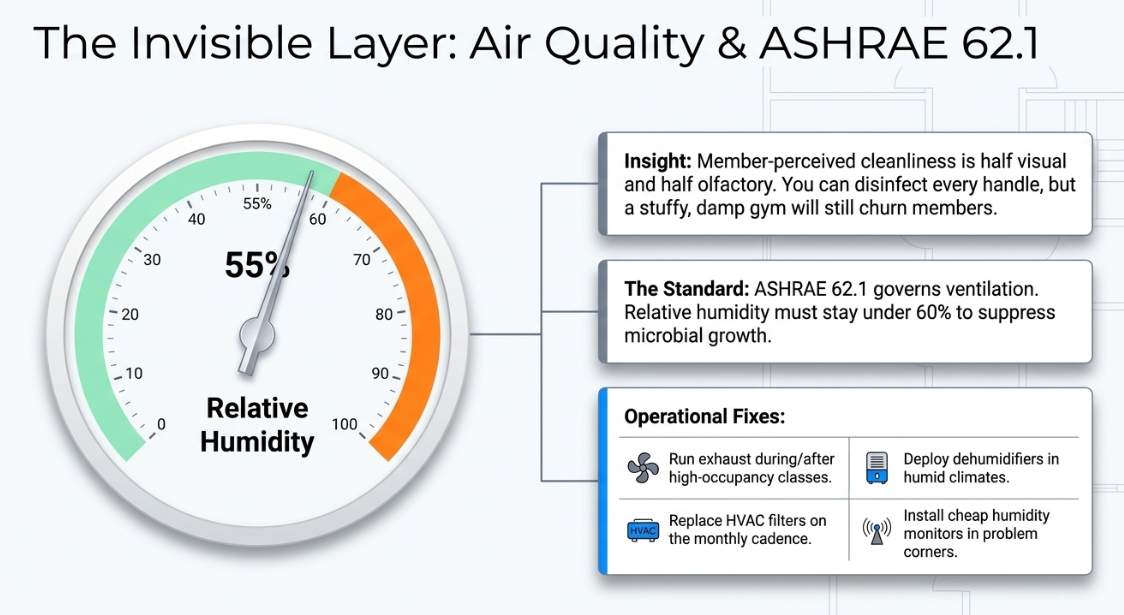
Member-perceived cleanliness is half what they see and half what they smell—and the smell half is mostly air, not surfaces.
You can disinfect every handle in the building and still lose members to a gym that feels stuffy and damp.
Ventilation is governed by ASHRAE Standard 62.1, which is about moving enough fresh air and keeping relative humidity low enough—generally under 60%—to suppress microbial growth.
(The familiar 30–60% comfort range comes from ASHRAE Standard 55, the thermal-comfort standard.)
Practically: run exhaust during and after high-occupancy classes, add dehumidifiers in humid climates, replace HVAC filters on the monthly cadence, and put a cheap humidity monitor where the air goes worst. Don't ignore the air.
Special Cases: 24-Hour Gyms, CrossFit Boxes, and Studios
Three formats break the standard model. Each needs an accommodation, not a copy-paste of the cadence above.
24-hour unstaffed gyms
The obvious question: who cleans at 2am? The honest answer is a combination—member self-service wipe stations stocked and visible, an overnight or early-morning contractor window for the deep work, and a clearly posted "wipe down what you use" policy.
Members can carry the between-uses load, but they can't replace a real daily disinfecting pass, so don't let "members are the cleaning crew" become an excuse to skip it.
If you're weighing the model, the 24-hour gym tradeoffs go well beyond cleaning.
CrossFit boxes
Chalk is the variable that breaks everything else—it coats barbell knurling, settles into rower drums, and films every surface in the room.
Add barbell and plate management, rig hardware inspection, and rower drum cleaning to the cadence.
The high-intensity, high-contact nature of the workouts also means handles and shared bars need more frequent disinfecting than a globo gym's. CrossFit gym software can help you keep the operational side organized even if it won't scrub the chalk for you.
Small-group and studio formats
The constraint here is turnaround—tight gaps between classes, shared equipment rotating through many hands, and an owner who's often also the cleaner.
Build a fast between-class reset (high-touch points and shared gear) and a separate end-of-day deep pass, and be realistic about what one person can do in a ten-minute changeover.
Staff vs Member Cleaning Responsibilities
A cleaning protocol that depends on "whoever's around" fails the moment your closer calls out.
The work has to be assigned to a named role, with members carrying the share they realistically can.
Staff responsibilities | Member responsibilities |
Daily disinfecting of machines, handles, and high-touch points | Wipe down equipment and benches after each use |
Restocking wipe stations and restroom supplies | Return weights, bands, and shared gear |
Weekly deep cleans, locker rooms, and showers | Report spills, broken equipment, and empty dispensers |
Monthly inspections and the cleaning log | Use chalk and food only in designated areas |
Outbreak and spill response | Re-rack and reset shared stations |
The failure mode is predictable: in small and mid-size gyms, cleaning silently degrades because no single person owns it. Members can't fix that—only a named assignee can.
Documenting and Assigning the Work
A cleaning log isn't paperwork for its own sake.
It's the artifact that makes your protocol defensible when a member, an inspector, or an insurance adjuster asks—and it's the only way to know the work actually happened instead of assuming it did.
The pain is familiar: clipboards walk off, paper logs end up in the trash, and opening-to-closing shift handoffs drop tasks.
A defensible record needs three things—a named assignee, a completed-at time, and a sign-off—whether that lives on a posted sheet at each zone or in your software.
This is where running your operation in one system helps.
When member management, check-in, and billing already live in your gym management software, staff are in the same tool every shift—so a posted cadence and an assigned owner have a home next to the rest of the work, instead of on a clipboard that disappears.
Keep the cleaning log itself simple and physical if that's what gets filled out; the goal is a record you can hand to whoever asks, not a perfect app.
Six Mistakes That Quietly Break a Cleaning Protocol
Almost every protocol that exists on paper but breaks in practice fails one of these ways. Each has a one-line fix.
Mistake | Why it breaks the protocol | The fix |
Spray and immediately wipe | No dwell time means you cleaned, didn't disinfect | Leave surfaces visibly wet for the full contact time |
Bleach on equipment finishes | Corrodes metal, degrades rubber and vinyl | Reserve bleach for grout and drains; use AHP or quats on equipment |
"Whoever's around" cleaning | No named owner means it becomes nobody's job | Assign every cadence row to a specific role |
Reactive locker-room cleaning | Mold and mildew set in before the first complaint | Put showers and drains on a fixed weekly schedule |
Never retiring damaged gear | Worn pads and frayed straps can't be cleaned or made safe | Audit and retire on the monthly pass |
Members clean and you skip daily disinfecting | Wipe stations don't equal a real disinfecting pass | Do both: member wipe-downs plus a staffed daily protocol |
Put the Protocol on the Wall and Run It for 30 Days
The protocol that works is the one that's visible.
Print the cadence tables, post them at the entrance to each zone, assign every row to a named role, and track a full thirty days of completion before you change anything. You'll learn more from one month of honest records than from any amount of planning.
If running your gym in one place sounds easier than running it across a clipboard, a spreadsheet, and three apps, you can try Gymdesk free for 30 days—no credit card required.
And if you picked up the wrong playbook: running a BJJ, MMA, or martial arts school? The mat-cleaning protocol is different—see our martial arts gym cleaning checklist.
Gym management software that frees up your time and helps you grow.
Simplified billing, enrollment, student management, and marketing features that help you grow your gym or martial arts school.