

Say it's a Thursday, the fans are on, and a message comes in.
Someone is in town for a week. This traveler trained at a camp in Thailand last year, owns a pair of shin guards, and would like to come Tuesday through Saturday. Can that person just pay at the door?
That same evening, the 6pm class is full of people who will never step into a ring. Three fighters are working on the bags in the corner, six weeks out from a card. And a member at the desk wants to know if she can rent a locker by the month.
That's four kinds of people: fitness members, fighters, travelers, and members who want extras.
Your Muay Thai gym software has to sell to all of them.
One Thursday, four kinds of customer
01
The traveler
Buys
A week pass, Tuesday through Saturday, paid before the first class.
Where software breaks
No online waiver, or the visitor gets counted as a member on your bill.
02
The fitness member
Buys
A monthly membership and the 6pm class. Will never step into a ring.
Where software breaks
It doesn't. Every system handles this one fine.
03
The fighter
Buys
Fight-team training and privates on the pads, six weeks out from a card.
Where software breaks
No separate program, so fighters and the fitness class share one schedule.
04
The member who wants extras
Buys
A locker by the month, on top of a membership. Maybe gloves at the desk.
Where software breaks
Only one recurring charge allowed per member.
Most gym software was built for the member who buys one plan and comes to one class. It handles her fine. The traveler, the fighter, and the locker are where it starts to break.
The short version
- An independent Muay Thai or kickboxing gym: Gymdesk.
- A small gym on the lowest flat price: MatGoat, at $40 to $60 a month.
- A new gym under 50 students that wants to start at $0: Gym Admin.
- A fitness-kickboxing studio that runs on class packs: TeamUp.
- Why Gymdesk for most gyms: drop-ins, privates, a locker on top of a membership, armbands or no ranks at all, and gear at the desk, all in one system that doesn't count your travelers as members.
Every price below came off the vendor's own pricing page on November 9, 2026.
What Muay Thai Gym Software Has to Handle
A Muay Thai gym sells more kinds of things than a typical membership gym, to more kinds of people.
Drop-ins, week passes, privates, lockers, gloves, and a fight team, sold to fitness members, fighters, travelers, and kids.
And the software has to do it without forcing a belt system on an art that often doesn't use one.
Drop-ins, week passes, and travelers
Cross-trainers and tourists are a real revenue line, especially in a city gym.
The basics are a drop-in or week pass the visitor can buy online, with a signed liability waiver collected before the first class. A clipboard at the desk works until the day it rains.
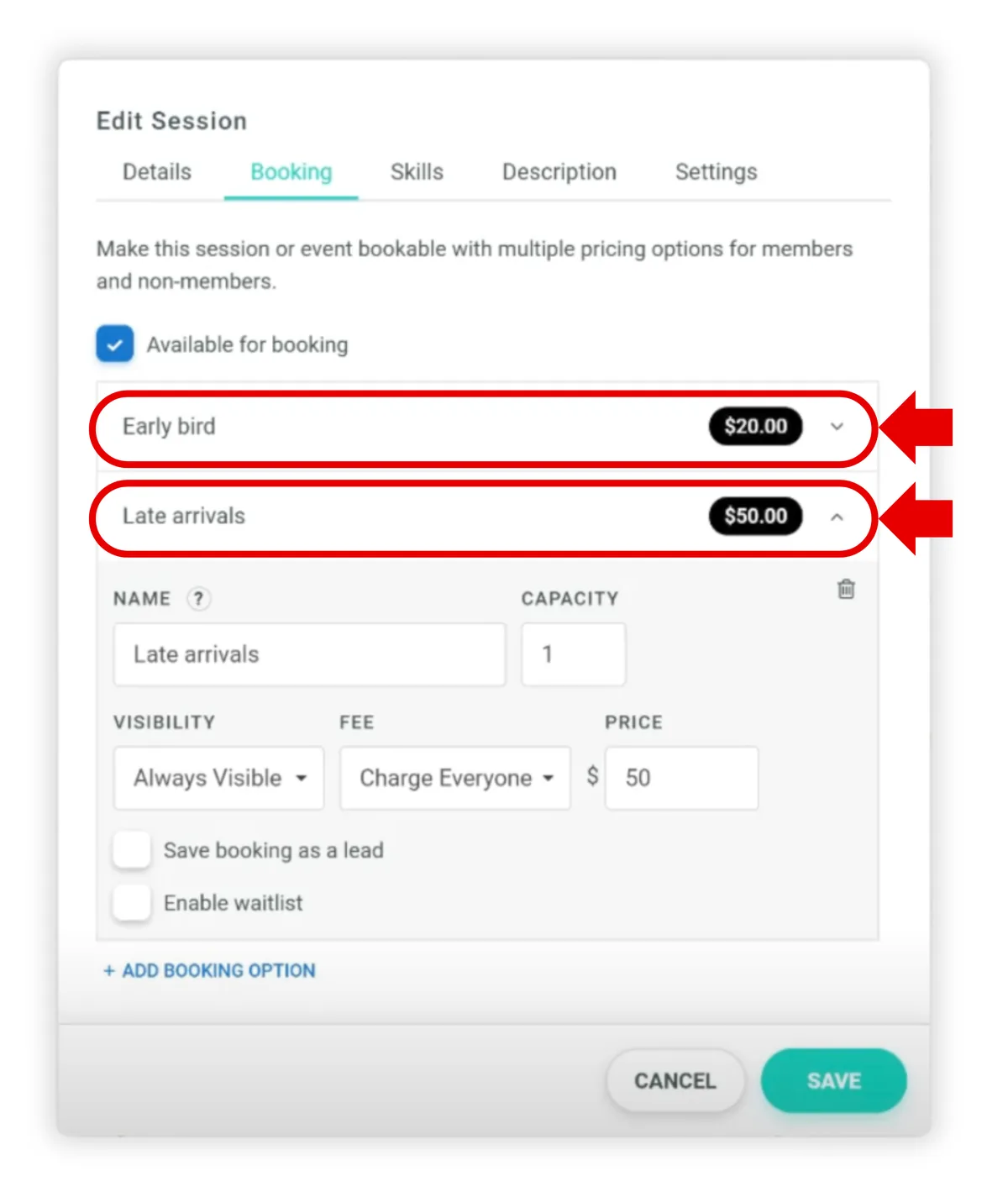
Then ask how the tool counts a visitor.
Some vendors count anyone who booked or bought anything last month, so a busy travel season can bump you up a price tier.
More than one recurring charge per member
A membership plus a monthly locker. A membership plus a monthly block of privates.
It sounds simple, and some systems can't do it.
One of the co-owners of Two Bridges Muay Thai in Manhattan hit that wall on a system the gym was using:
"We couldn't charge them monthly for a locker as well, right? Only one thing was allowed to be reoccurring."
If your members ever pay you for two things on a schedule, make sure the software can bill both. More on this in martial arts billing software.
Armbands, khan, or nothing
Some gyms grade with pra jiad (the colored armbands).
Some use a khan system, a ranking system of grades that comes from Thai camps. Plenty of gyms don't grade at all, and the members like it that way.
Good software lets you build your own levels, or skip them.
Software that ships with karate belts baked in will have your fighters "earning" a yellow belt. Nobody in the fight team will enjoy that.
If you're building levels from scratch, start with a Muay Thai curriculum.
The fight team inside a fitness business
Your fighters and your 6pm fitness class share a room, but not a schedule.
The fight team needs its own program, its own classes that fitness members can't book, and a roster that shows who's training for which card.
The only card a fighter should be thinking about is the one on the poster, not the one on file.
A competition team carries the gym's name, so it shouldn't live in a group chat.
Privates on the pads
Privates pay well, and plenty of them get booked over Instagram DMs.
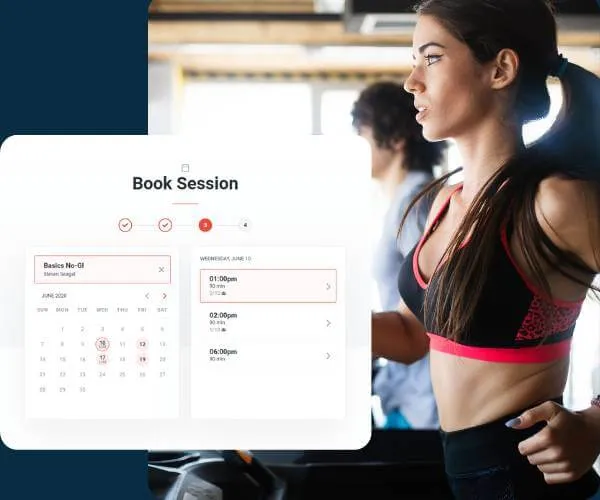
Privates belong on their own calendar, tied to a coach's availability, and paid at booking. A DM doesn't send a reminder.
Your coaches signed up for pad work, not paperwork.
Gear at the desk
Gloves, shorts, and wraps go out the door at plenty of gyms on an IOU.
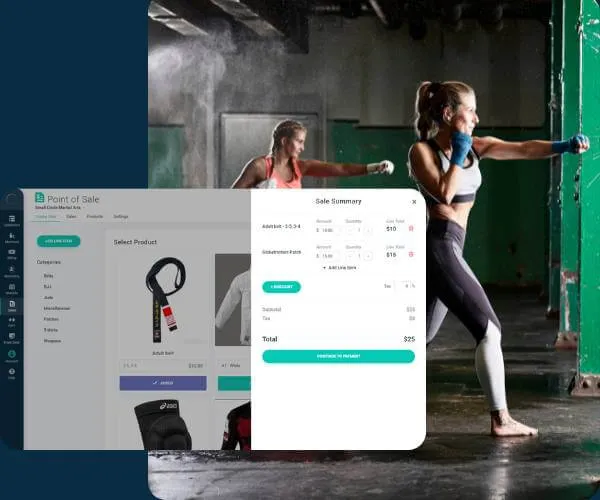
A point of sale that puts the gloves on the member's card settles the charge before the member leaves the desk.
Leads and the first class
Someone books a trial, comes once, and disappears.
For a kickboxing school owner, the software that helps manage leads and convert leads to students does three things.
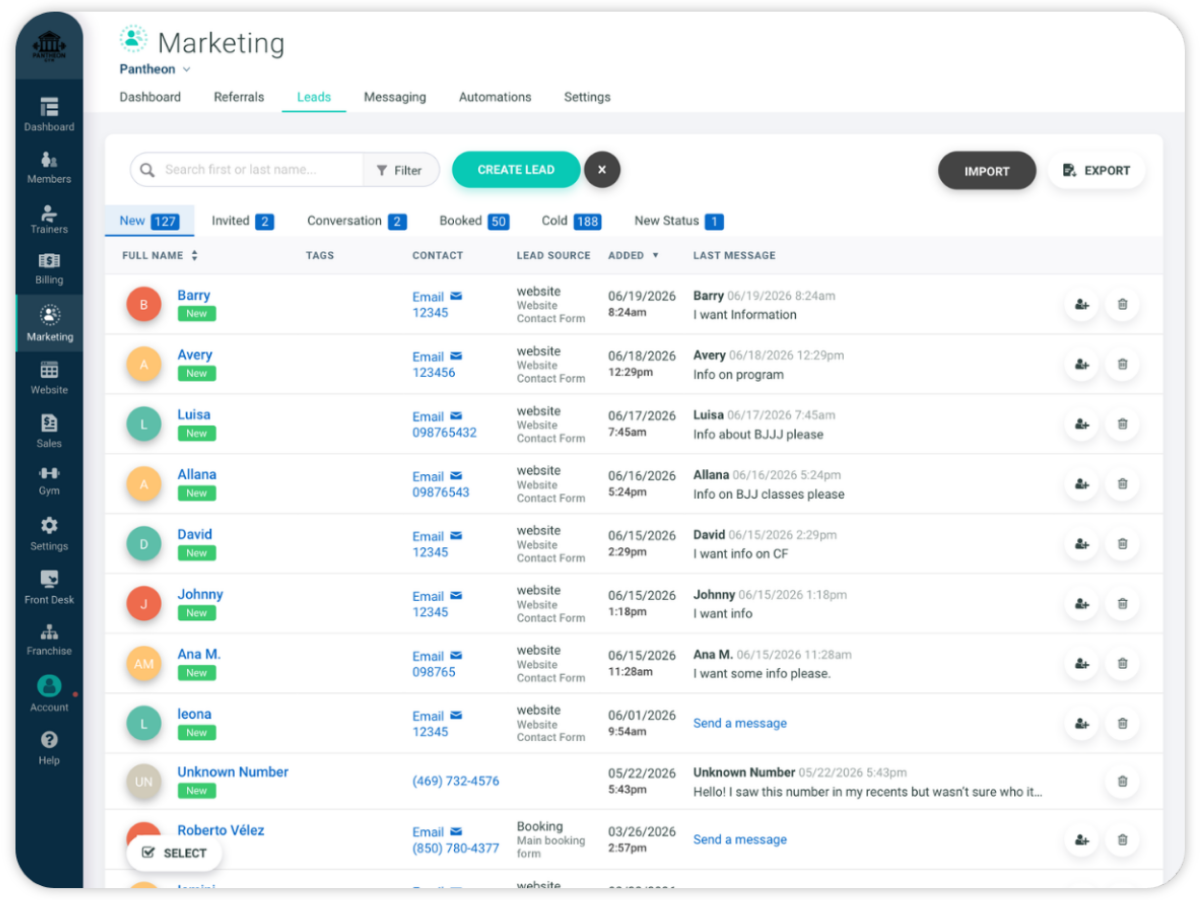
It books the trial from your website, sends follow-up messages without you remembering, and keeps a list of who came once so a coach can follow up. The rest is in Muay Thai gym marketing.
Kids' classes
A parent signs the waiver. Siblings share one bill, which may be the only thing they share without a fight.
Without family accounts, a kids Muay Thai program turns into a stack of separate invoices.
Here's the checklist in one place:
Need | What good looks like | Red flag |
|---|---|---|
Drop-ins and travelers | A week pass sold online, waiver signed before arrival | Visitors counted as members on your bill |
Lockers and extras | A monthly locker added on top of an existing membership | "Only one recurring item per member" |
Armbands or levels | Custom levels you build, or none | Belts you can't rename |
Fight team | A separate program and schedule, plus a roster | Fighters booking the fitness class by mistake |
Privates | A coach's calendar, paid at booking | Booked in DMs, paid in cash, maybe |
Gear | Gloves on the member's card | A cash box and an IOU |
Leads and trials | Self-booked trials and automatic follow-up | Trial names on paper behind the desk |
Kids | Family accounts, one bill, a parent's waiver | One invoice per kid |
How This Comparison Was Built
This is Gymdesk's blog, Gymdesk is on the list, and Gymdesk goes first.
You'd have worked that out by the next heading anyway. Every tool got measured with the same yardstick.
Gymdesk got the same treatment, gaps included.
I read every price off the vendor's own pricing page on November 9, 2026.
A tool made the list if it shows up where Muay Thai and kickboxing owners compare software (the tools ChatGPT and Google's AI Overviews name, the "best software" lists, and the Reddit threads) and is built to run a gym's memberships and classes.
Each one was judged on the needs above.
Some popular names didn't make it, and here's why.
Trainerize is a coaching app priced by number of clients. Acuity and Vagaro are built around appointments, with no class memberships, programs, or ranks for a gym.
Momence and ABC Glofox only quote a price.
If your gym grades with belts across several arts, martial arts management software gets its own comparison. This one is Muay Thai gym management software for striking gyms.
The Best Muay Thai Gym Software in 2026
The right tool depends on whether you run a fighter's gym, a fitness-kickboxing studio, or a small room with one coach.
And the pricing model (flat, per member, or a cut of every payment) matters as much as the headline price.
These aren't ranked.
Gymdesk goes first for the reason already confessed above. The rest are grouped by the kind of gym they suit: small and new gyms, larger multi-program gyms, kids-heavy schools, fitness studios, then regional and marketplace tools.
Here's how the nine compare at a glance:
Tool | Best for | Starting price | Drop-ins | Armbands or levels | Privates |
|---|---|---|---|---|---|
Gymdesk | Independent striking gyms | $75/mo ($100 own processor) | Yes | Custom ranks or none | Yes |
MatGoat | Small gyms on a flat price | $40/mo (up to 50) | Not listed | Khan, prajied, or none | Not listed |
Gym Admin | New gyms under 50 students | $0 (up to 50) | Yes | Pra jiad via belt module | Not listed |
Zen Planner | Larger multi-program gyms | From $99/mo | Not listed | Belt and skill tracking | Not listed |
PushPress | Gyms buying into its app and CRM | $0 Free; ranks from $159 | Yes | Pro and Max only | Yes |
Spark Membership | Kids-heavy schools | $199/mo | Not listed | Belt history | Not listed |
TeamUp | Pack-heavy fitness studios | $119/mo (0–100) | Packs, yes | Not listed | Yes |
Clubworx | Australian and NZ gyms | Free (up to 20) | Class passes | Style and belt tracking | Not listed |
Mindbody | Studios that live on discovery | From $79/mo | Not listed | Not listed | Not listed |
Prices from each vendor's own pricing page, November 9, 2026. "Not listed" means the vendor's page doesn't say.
Gymdesk

Gymdesk is built for independent martial arts and combat-sports gyms.
It was started by a BJJ black belt, and it's now led by a taekwondo black belt who trains BJJ as a white belt.
Every plan includes all features, unlimited staff accounts, and a gym website. A branded app, door access, and extra locations are add-ons.
For a Muay Thai gym, that covers drop-ins and class packs on any class, privates booked against a coach's calendar, and waivers signed before the first class.
Gear goes through the point of sale, trial follow-up runs itself, and members get an app.
Ranks are custom, so armbands or khan levels work, and so does no grading at all.
The fight team gets its own program and schedule. A member can also carry a recurring locker charge on top of their membership.
Price: active-member pricing that costs less when you process through Gymdesk Payments, and you can still bring your own processor.
- Micro (up to 50 active members): $75/mo with Gymdesk Payments, $100 with your own processor
- Small (51–100): $100 / $125
- Medium (101–150): $150 / $175
- Large (151–250): $200 / $240
- Enterprise (251+): quoted
Visitors, frozen and canceled members, and prospects don't count toward the active total, which matters in a gym full of travelers.
There's a 30-day free trial with no card and no contract. Card processing is billed separately on every tool here, Gymdesk included.
Limitation: it isn't the cheapest base price here. MatGoat and Gym Admin publish lower base prices, and so does DojoMesh (in the also-rans below).
A branded app in the app stores is a $100/mo add-on, though the standard member app is included.
Gymdesk Payments runs in the US and Canada, so a gym in Thailand or Europe processes through an approved partner to get the lower price.
Ask us: Can you move my members' saved cards over from my current system? Yes. Saved cards can move over, so members don't have to re-enter them.
Best for: an independent Muay Thai or kickboxing gym that sells memberships, drop-ins, privates, and gear.
MatGoat

MatGoat is a newer combat-sports platform, and it publishes the lowest flat price among the tools here built for combat sports.
Its Muay Thai page promises "Khan and prajied systems, or none at all," plus kiosk check-in and a private video library for technique.
Gear or event-ticket charges go on the member's profile.
Price: $40/month for up to 50 members and $60/month with no member limit, with no commission on direct debit payments. There's a 30-day free trial and a 30-day money-back guarantee. VAT isn't included.
Limitation: it's a newer vendor, and most of its site is written for BJJ academies. The Muay Thai page doesn't mention drop-ins or private sessions.
Ask them: Can a traveler buy a week pass online and sign a waiver before arriving? Can members book a private with a coach?
Best for: a small striking gym that wants the lowest flat price and is comfortable with a newer company.
Gym Admin

Gym Admin is a free-to-start app with its own Muay Thai page.
Its belt tracking adapts to pra jiad, so armbands work like belts.
It has a drop-in flow and digital waivers for visiting cross-trainers, kiosk check-in, and notifications when a student is ready for the next level.
Price: free for up to 50 active students. Pro is $59/month for unlimited students, plus a 1% transaction fee on top of Stripe's processing fees.
Limitation: the 1% platform fee grows with your revenue, so $59 is only the starting point. The cost section below works the math.
Ask them: What will I pay in total once my monthly dues pass $10,000? Can I bring a processor other than Stripe?
Best for: a new gym under 50 students that wants to start at $0.
Zen Planner

Zen Planner is established software for multi-program gyms, sold in packages.
It covers belt and skill tracking, scheduling across programs, attendance, and staff payroll.
You pay by active member, and pay-per-session attendees aren't counted, so a true pay-per-visit drop-in doesn't move your bill.
Price: packages start at $99/mo for Studio, with Essentials from $198 and Ultimate from $348. A website starts at $99 extra, Engage at $249, and a branded app is $39/mo.
Limitation: every price says "starting at," and the per-member bands aren't published. You'll need a demo to get your real number.
Ask them: What's the price at my member count? Does a week pass count as an active member?
Best for: a larger multi-program striking gym that wants to buy modules.
PushPress
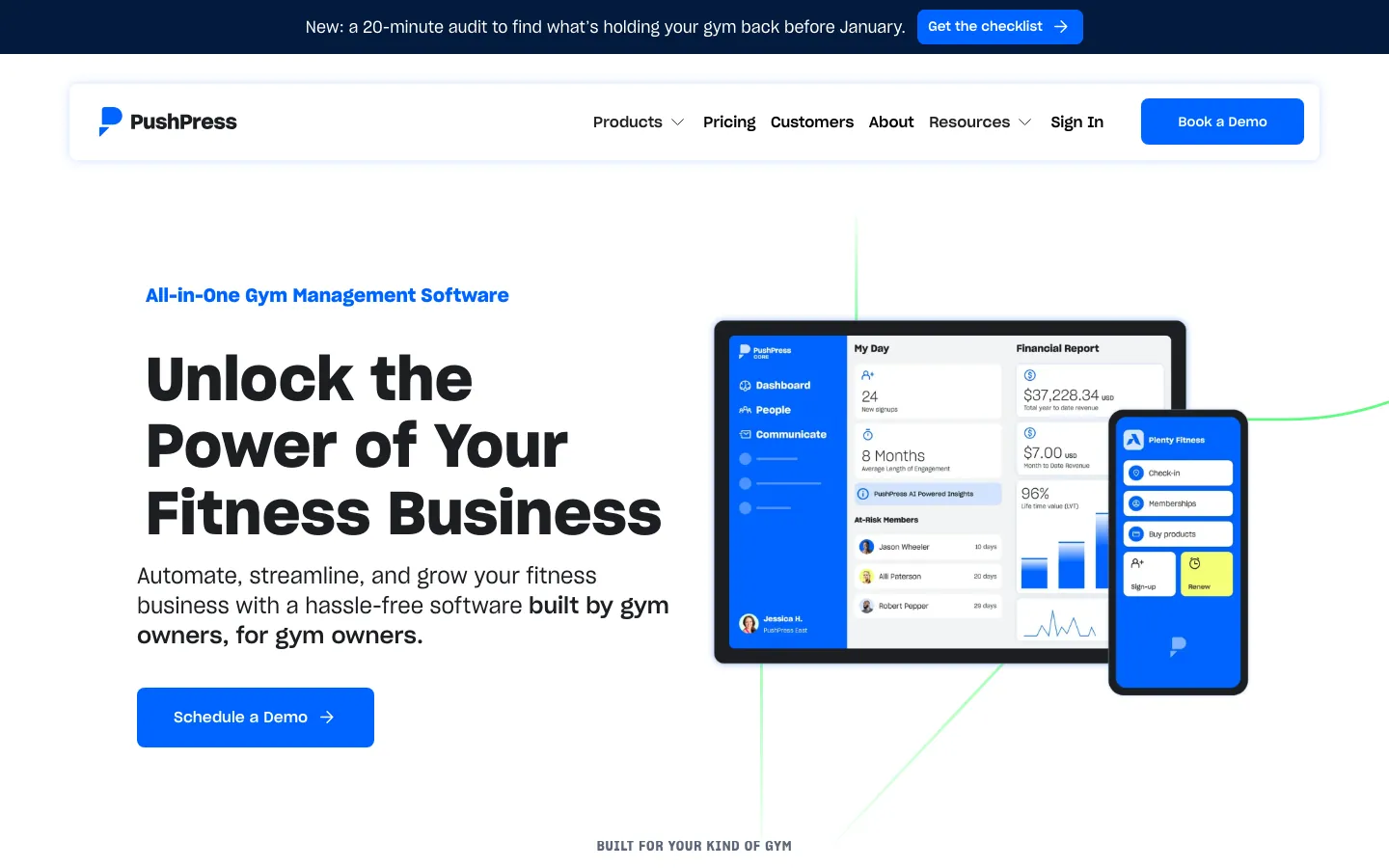
PushPress started in CrossFit and has a free plan.
It handles personal-training appointments, drop-ins and class packs, digital waivers, and purchase limits that stop someone buying your free trial five times. Rank tracking, with custom ranking criteria, is on the paid plans.
Price: Free is $0 a month with card processing at 4.99% + $0.30. Pro is $159/mo and Max is $229/mo, both with lower processing rates. A branded app is $97/mo and the Grow CRM is $329/mo.
Limitation: rank tracking isn't on Free, so a gym that grades with armbands starts at $159. And the free plan carries the highest processing rate on the page.
Ask them: At my monthly card volume, what would Free really cost compared with Pro? Which features I need sit in Grow?
Best for: a gym that wants PushPress's app and CRM and will pay for Pro.
Spark Membership

Spark Membership is a martial arts CRM built around belt-based schools.
It has student profiles with belt history, family accounts, attendance trends, and free data migration.
Price: one plan, an eight-week free trial, then $199 a month.
Limitation: it leans toward kids' programs, and there's no smaller tier. A 40-member striking gym pays what a 400-member school pays.
Ask them: How would I set up a fight team that fitness members can't book into? Is there a lower price under 50 members?
Best for: a kids-heavy martial arts school that added a Muay Thai program.
TeamUp
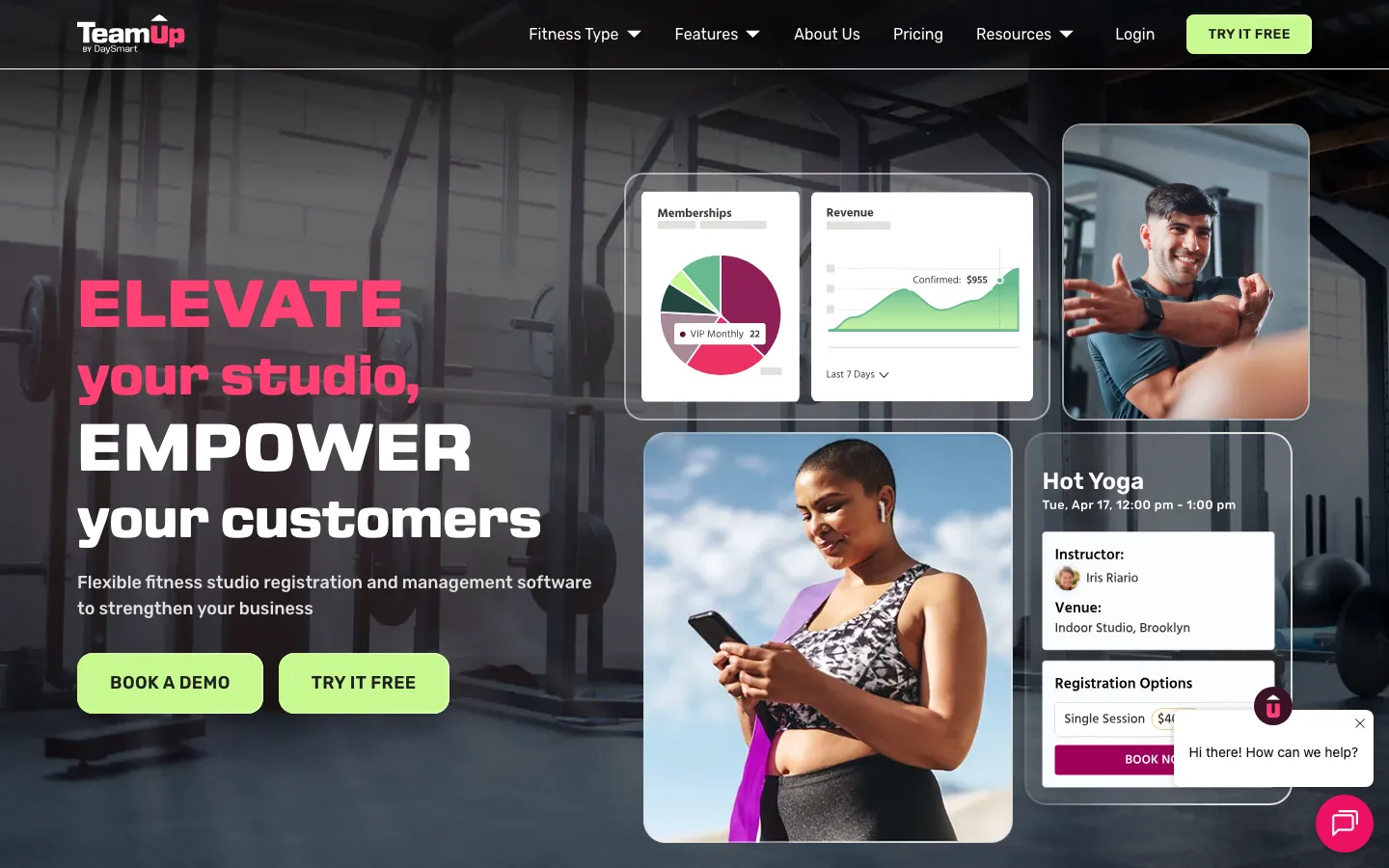
TeamUp is fitness-studio booking software built around packs and appointments.
It sells memberships and packs, books appointments against instructor availability, and handles waivers, a point of sale, a no-show penalty system, and family accounts.
Price: TeamUp bills by active customer: 0–100 $119/mo, 101–200 $189, 201–300 $219, 301–400 $249, 401–500 $289, and 501+ $379. It prices in pounds too, and it's month to month.
Limitation: an active customer is anyone who booked or bought something in the previous month, so a busy month of travelers can push a tourist-heavy gym up a band.
Your best travel month can also be your priciest software month.
The pricing page doesn't mention armbands or levels.
Ask them: Does a one-week visitor count the same as a member? Can I track armband grades?
Best for: a fitness-kickboxing studio that runs on class packs.
Clubworx

Clubworx is an Australian martial arts and fitness platform that prices in Australian dollars.
It has belt and grading tracking, grading events, class passes, automatic payments, and a self check-in kiosk. A retail point of sale starts on Growing, and online forms and waivers start on Accelerating.
Price, in Australian dollars a month: free for up to 20 active members, Growing AUD $109 (up to 100), Accelerating AUD $149 (up to 250), and Established AUD $169 (unlimited).
Annual billing is lower. The mobile member app is +AUD $100 a month, and a custom-branded app is +AUD $200.
Limitation: the member app is a paid add-on on every tier, and online waivers don't start until Accelerating.
Ask them: Can a casual visitor sign a waiver online on Growing? What's my total with the member app?
Best for: an Australian or New Zealand Muay Thai gym.
Mindbody

Mindbody is the big consumer marketplace, which helps when travelers look for classes through its app.
It has booking widgets, room and resource scheduling, and consumer discovery through the Mindbody app.
Price: "Starting at $79 USD/month per location," and every tier card above that reads "Let's talk." That's a lot of conversation to get to a number.
When the app sends you a new client, Mindbody takes 20% of their first purchase, capped at $30.
Limitation: only the entry price is public, and the pricing page doesn't mention armbands or a fight team. Two Bridges left Gymdesk for Mindbody when its programs got complicated, then came back. A co-owner explained why:
"It cost a lot, an arm and a leg… We just felt like we were paying too much for not enough."
Ask them: What does the tier with the features I need cost for one location? How do you decide a new client came from the app?
Best for: a city studio that lives on marketplace discovery.
Also worth a look
These didn't get a full review, but each one comes up in the same searches.
- DojoMesh: $50 a month flat, unlimited students, with a combat round timer built in and a 60-day free trial. It shows up in Google's AI answer for kickboxing gym software.
- Arbox: the free and Basic tiers cap you at five and 20 weekly sessions. Standard is $99 a month billed annually, or $129 monthly.
- GymMaster: USD $89 to $209 a month per site, built around 24-hour gym access.
Kickboxing Gym Software: What Changes
Most of the Muay Thai criteria carry straight over to kickboxing gym software. Two things change.
Fitness-kickboxing studios run on class volume and packs, with almost no sparring and no grading. And kickboxing styles (Dutch, K-1, American) mostly don't use armbands.
If the difference between the two arts matters to your members, kickboxing vs Muay Thai covers it.
The fitness-kickboxing studio
Packs, intro offers, class capacity, and waitlists do most of the work. Nobody needs a rank.
TeamUp and Gymdesk both fit. Mindbody makes sense if marketplace discovery is worth its new-client fee, covered in the Mindbody review above.
The kickboxing school or club
A kickboxing club with kids' and adult programs and a competition squad looks a lot like a Muay Thai gym.
Doggpound MMA in Brampton runs its own kickboxing shows, with the bigger fights sanctioned by WAKO Canada (the kickboxing federation). That means a competition squad with its own schedule and roster on top of regular classes.
The best student management software for a kickboxing school keeps kids, adults, and the squad in separate programs on one member record, with a kickboxing curriculum you can track if you grade. Gymdesk does that, with family billing on every plan.
Any tool here sets up automated billing for kickboxing studio members on a monthly plan.
The test is the second charge: a locker, a squad fee, a block of privates. Gymdesk bills those on top of the membership.
What Muay Thai Gym Software Actually Costs
Muay Thai gym software prices look close until you put a member count next to each one.
A percentage fee grows with your dues, and a tool that counts visitors as members charges you for your travel season.
Here's what each tool costs a month for a 60-member gym and a 180-member gym:
These are each vendor's lowest published plan at that size, before card processing. Features like waivers and ranks vary by tier, so check each tool above.
Each vendor's own definition of an active member applies.
Tool | Pricing model | 60 members | 180 members | Note |
|---|---|---|---|---|
Gymdesk | Active members (visitors not counted) | $100 with Gymdesk Payments / $125 own processor | $200 / $240 | All features included |
MatGoat | Flat | $60 | $60 | 0% commission on direct debit; VAT extra |
Gym Admin | Flat plus 1% of transactions | $59 + 1% | $59 + 1% | The 1% sits on top of Stripe fees |
Zen Planner | Active members, modules extra | From $99 | Band not published | Website +$99, Engage +$249 |
PushPress | Tiers (ranks from Pro) | $159 | $159 | Free plan has no ranks |
Spark Membership | One flat plan | $199 | $199 | Eight-week trial |
TeamUp | Active customers (drop-ins count) | $119 | $189 | Branded app +$99 |
Clubworx | Active members, AUD | AUD $109 | AUD $149 | Member app +AUD $100 |
Mindbody | Per location | From $79 | Higher tiers quoted | 20% fee on marketplace first purchases |
DojoMesh | Flat | $50 | $50 | Processing terms not shown |
Prices from each vendor's own pricing page, November 9, 2026.
Three things the table won't tell you.
First, Gymdesk sits in the middle on base price.
MatGoat, Gym Admin, and DojoMesh all publish lower numbers, and for a 40-member gym that's a real saving.
What the extra money buys is everything at the top of this post in one plan.
Second, a percentage fee looks cheap until your dues grow.
If 60 members each pay $150 a month, that's $9,000 in dues and $90 in Gym Admin's 1% fee, so Pro really costs about $149. At $20,000 in dues, the fee is $200 on top of the $59.
Percentage fee vs flat price
Watch the 1% Grow With Your Dues
Drag the sliders. It starts on the example above: 60 members paying $150 a month.
Monthly dues coming in: $9,000
Gym Admin Pro, real monthly cost
$149
The 1% adds $90 a month, or $1,080 a year, on top of the $59.
Software price only, before card processing (Stripe's fees sit under Gym Admin's 1%). Prices from each vendor's own pricing page, November 9, 2026.
Flat prices don't move with dues. The 1% does.
Third, check who counts as active.
TeamUp counts anyone who booked or bought something last month, so the week-pass visitor counts too. Gymdesk leaves visitors and prospects out.
Here's what that does to a made-up 90-member gym, Teep Thoughts Muay Thai, when 20 travelers buy week passes in its busiest month.
Same gym, two months
What 20 Week Passes Do to the Software Bill
Quiet month
90 members, no travelers
Travel month
90 members + 20 week passes
Teep Thoughts Muay Thai is a made-up gym. Prices are each vendor's own, November 9, 2026, before card processing. TeamUp counts anyone who booked or bought something in the previous month.
In a quiet month, both tools count 90 active. TeamUp bills $119 and Gymdesk bills $100.
In the travel month, TeamUp counts 110 and moves up to its 101–200 band, at $189. Gymdesk still counts 90 and stays at $100.
Teep Thoughts is made up; the prices are each vendor's own, November 9, 2026, before card processing.
To run your own numbers, try the gym software cost calculator. The breakdown of what Muay Thai gym owners make shows how software compares with rent and coaching costs.
We'll keep you in the loop with fresh content, podcasts, how-to guides, tool reviews, and product exclusives.
Which Muay Thai Gym Software Fits Your Gym
Start with the gym you actually run. The table at the end of this section sums it up.
An independent Muay Thai gym with a fight team
This is the most common setup: fitness members, fighters, privates, gear, and travelers.
Start with Gymdesk, which handles all five in one system and doesn't count travelers as members.
A small coach-run gym under 50 members
MatGoat or Gym Admin, on price. Both are honest options at this size.
Gymdesk Micro makes sense if you'd rather not switch systems when you pass 50.
A tourist-heavy gym
Pick a tool that doesn't count visitors as members and takes the waiver before arrival.
Gymdesk does both: visitors and prospects don't count toward the active total, and the waiver is signed in the booking form.
Flat-price tools (MatGoat, DojoMesh, Spark) don't count heads at all, and Zen Planner leaves pay-per-session attendees out of its count.
Mindbody is a separate reason to look. Its marketplace sends travelers your way, for the new-client fee covered in its review above.
A fitness-kickboxing studio
TeamUp or Gymdesk. The kickboxing section above has the detail.
Muay Thai plus BJJ or MMA under one roof
If Muay Thai is one program in a mixed gym, the comparison you want is MMA gym software. It's judged on running several arts on one schedule. A BJJ gym that adds a kickboxing program is the same case.
A brand-new gym
Price the first year with card processing included. If you're still at the planning stage, here's how to start a Muay Thai gym.
Then start with Gym Admin if $0 matters most, or Gymdesk Micro if you'd rather not switch systems at 50 members.
The short version, by gym type:
Gym type | Size it fits | Start with | Why |
|---|---|---|---|
Independent gym with a fight team | 51–250 members | Gymdesk | Drop-ins, privates, lockers, and gear in one system |
Small coach-run gym | Under 50 | MatGoat or Gym Admin | Lowest published price |
Tourist-heavy gym | Any size | Gymdesk, or a flat-price tool | Visitors don't raise the bill |
Fitness-kickboxing studio | Any size | TeamUp or Gymdesk | Built around packs and capacity |
Muay Thai inside an MMA gym | Any size | See the MMA comparison | Several arts on one schedule |
Brand-new gym | Under 50 | Gym Admin or Gymdesk Micro | Low start, room to grow |
Running a Muay Thai Gym on Gymdesk
This is the part where Gymdesk gets to talk about itself. Each need from the top of the post maps to something specific in the product.
Here's how each one works:
- Travelers and drop-ins. Any class can carry a drop-in price, sold through online booking with the waiver signed in the same form. Visitors and prospects don't count toward your active total, so a busy travel season doesn't move your bill.
- A locker on top of a membership. Add a custom recurring charge to the member's profile next to their membership, and both bill on schedule.
- Fight team and fitness. Separate programs, separate schedules, one member record. Armbands go in as custom ranks, or you skip ranks entirely.
- Gear. Gloves and shorts go on the member's card at the point of sale.
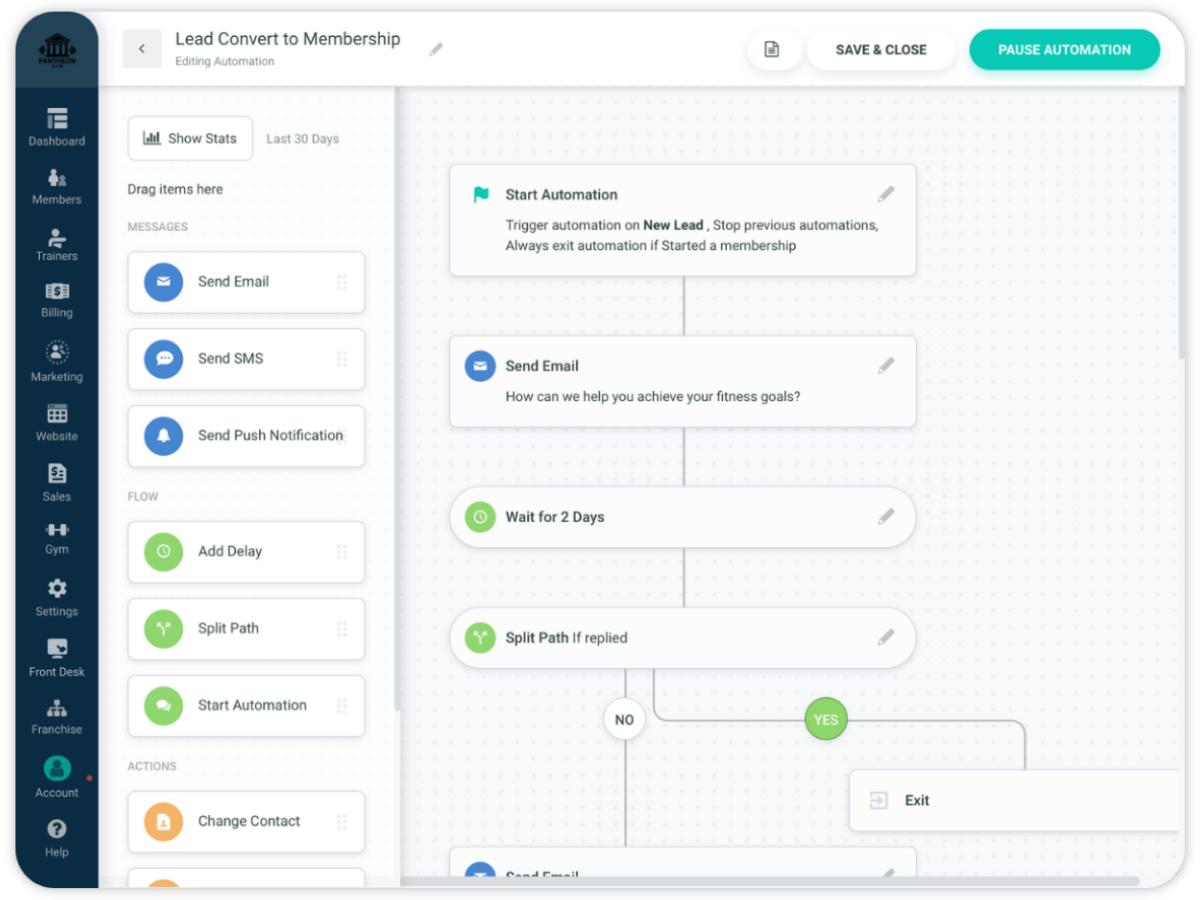
- Trials. A booking form takes the trial, lead management tracks it, and an automation sends the follow-up.
That last one is what Two Bridges Muay Thai leans on. Asked what the gym relies on, a co-owner said:
"Definitely, like, the automations with, like, you know, the emails… helping us convert… prospects into actual members with a membership."
Billing is the other half, once members carry a locker or a squad fee on top of a membership.
Donnie Mignon ran Doggpound MMA on paper and pen before Gymdesk, and here's what he checks now:
"Now I can check everything. How many students? Who's coming to class? How much money are we making? Where are we losing money? Who's overdue?"
Count Your Revenue Lines Before You Sign
Count the kinds of people you sell to first: fitness members, fighters, travelers, and members who want extras like a locker.
Whichever Muay Thai gym software makes your shortlist, ask every vendor three things:
Ask every vendor before you sign
- 1How does it count a drop-in?Your travel season shouldn't be your priciest software month.
- 2Can a member carry a locker charge on top of a membership?Two things on a schedule means two recurring charges.
- 3What will a year cost with fees included?A 1% fee grows with your dues. A flat price doesn't.
If you'd rather take those into every demo on paper, the buyer's checklist below has them all, with a column for each vendor.
If you want one system that handles all four kinds of people, start a free 30-day trial of Gymdesk's martial arts software. If it doesn't fit, no hard feelings.
FOR MUAY THAI AND KICKBOXING GYMS
Fitness members, fighters, travelers, and members who want a locker. Drop-ins, privates, gear, and recurring extras in one system that doesn't count your visitors as members.
- No credit card required
- No contracts
Gym management software that frees up your time and helps you grow.
Simplified billing, enrollment, student management, and marketing features that help you grow your gym or martial arts school.


FAQ
Muay Thai Gym Software FAQs
Short answers to the questions owners ask most.

Sean has spent the last decade creating content that helps businesses—small and not so small—grow smarter to allow operators to do more of what they love. You know, the fun stuff.
From shipping and international logistics to web development and marketing, he's done the work (not just the words) to scale retail and service businesses efficiently.
You can find his work at Sendle, Shogun, The Retail Exec, Gymdesk, and more.