
Kickboxing vs Muay Thai: 8 Limbs, 4 Weapons & Which to Choose

So your students are looking at your class schedule.
The 5pm slot says Kickboxing. The 6pm slot says Muay Thai.
These classes are back-to-back—same instructor, same price, but your students have no idea what the real difference is. They want to ask, but they're embarrassed.
"I should know this," they tell themselves.
They finally work up the courage to ask. "What's the difference between kickboxing and Muay Thai?" You start to explain, but you realize you're rambling; your answer is way longer than it should be. It shouldn't be this hard.
Most explanations oversimplify things ("uh… one has elbows") or overcomplicate things with history lessons nobody asked for.
Today, we fix that.
At the end of this post, you'll be able to explain the differences between kickboxing and Muay Thai to incoming students. After speaking with you, they'll come away with a clear understanding of both and realistic expectations.
Quick Answer: Kickboxing vs Muay Thai at a Glance
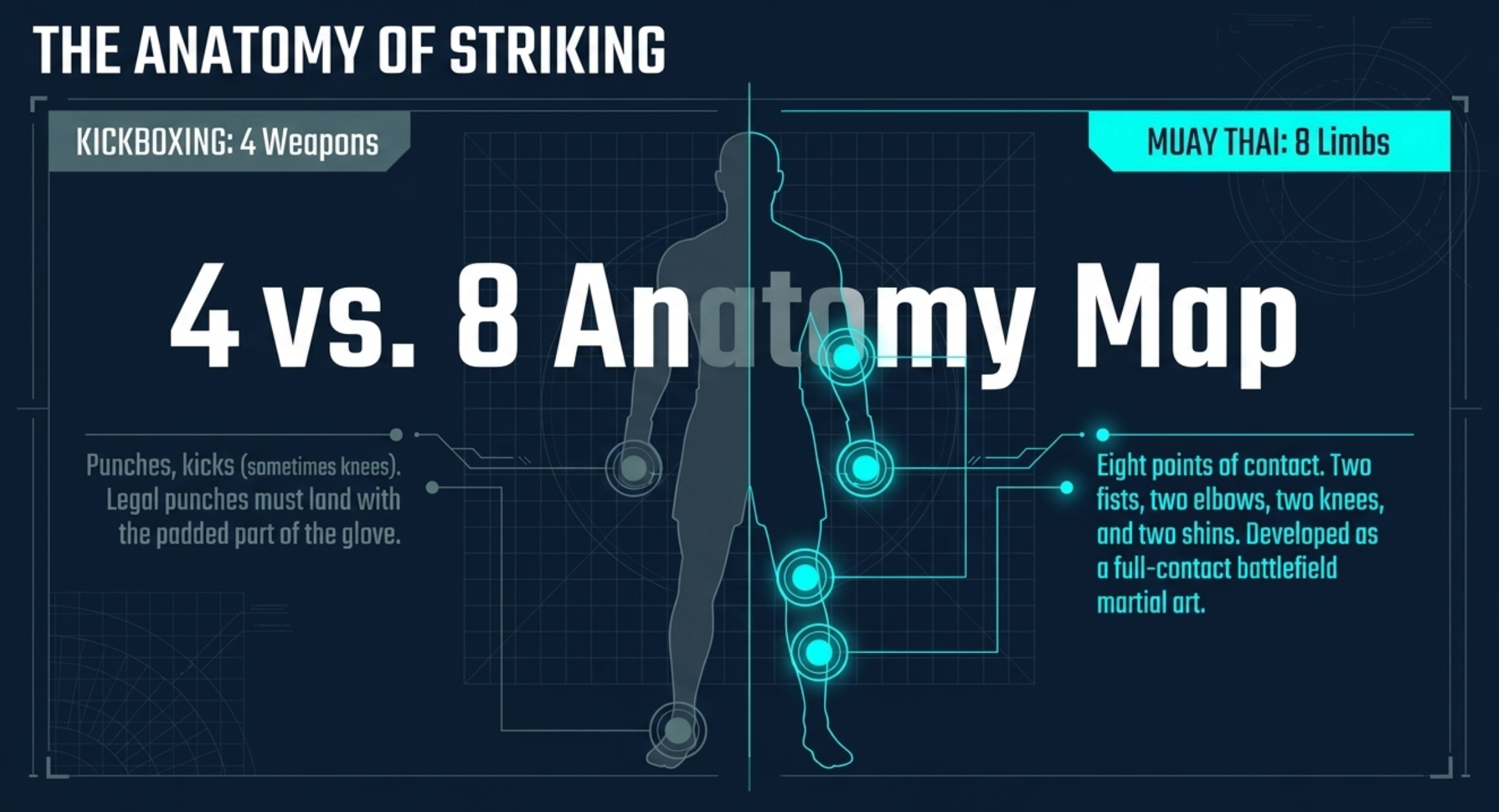
Muay Thai uses eight offensive tools, whereas kickboxing uses four. This is the biggest difference (more on this later).
Here's a brief, no-nonsense summary and comparison of both arts. Use this comparison table to explain things quickly to your students.
Aspect | Kickboxing | Muay Thai |
Offensive tools | Punches, kicks (sometimes knees) | Punches, kicks, elbows, knees |
Clinch | Minimal, broken quickly | Core part of fighting |
Scoring | Volume, combos, activity | Clean, powerful strikes |
Class style | Often cardio + combos | Pad work, clinch work, conditioning |
Self-defense | Strongest at distance | Strongest in close range |
Equipment | Gloves, bags, mitts | Adds Thai pads, shin guards |
Students | Broad, fitness-heavy | More committed practitioners |
This comparison table can be printed off on small comparison cards, posted as a sign at the front desk, or shared on your website.
What is kickboxing?
Kickboxing is an umbrella term. Depending on the gym, it could mean:
- American kickboxing is a blend of western boxing with full-contact karate. It includes punches and kicks (no low leg kicks, elbows, knees, or clinching allowed). Rick Roufus and Benny "The Jet" Urquidez are legendary examples of American kickboxers.
- Dutch kickboxing is a blend of Muay Thai, Kyokushin karate, and Western boxing. It uses heavy boxing combos and low kicks. Ernesto "Mr. Perfect" Hoost and Nieky Holzken are legendary examples of Dutch kickboxers.
- K-1 style uses punches, kicks, limited knees, and no elbows. Mirko "Cro Cop" Filipovic and Ernesto "Mr. Perfect" Hoost are legendary K1 fighters. Hoost is on our list twice because he has competed (and won championships) in both styles.
The style of kickboxing isn't as important as the core idea. Clean, powerful punches and kicks, precise footwork and mobility, and high-volume striking combinations.
Here's an example of two heavyweight kickboxers in action.
If you're building a striking program, kickboxing is something that can be standardized and taught—even if you're working with instructors with different backgrounds.
It's also adaptable; the same kickboxing curriculum can be taught in a variety of training contexts—competitive fight training to high-energy fitness classes.
What is Muay Thai?
Muay Thai is known as the "art of eight limbs." It's a devastating and powerful striking system that uses the standard jab, cross, and hook, along with kicks in kickboxing, but also adds a variety of elbow and knee strikes to the mix.
What separates Muay Thai from kickboxing is the clinch—a standing position where fighters secure a double collar tie.
They use this clinch to:
- Deliver short-range strikes like elbows and knees,
- Use the position to off-balance the opponent with trips, sweeps, and dumps, and
- Drain their opponent's energy and control their posture.
Here's an intense Muay Thai fight between two catchweight fighters demonstrating these differences:
One thing that sets Muay Thai apart from other striking arts is the fact that clinchwork is encouraged. In kickboxing, fighters clinch briefly and are immediately separated by the ref. In Muay Thai, fighters can throw strikes in the clinch, sure, but they're also able to use trips, sweeps, and dumps.
Here's a showcase of ONE Championship's best Muay Thai trips, sweeps, and dumps:
Muay Thai has deep roots in Thai culture, with traditions like the wai kru ritual before fights.
WHAT IS THE WAI KRU?
The Wai Kru Ram Muay is a sacred pre-fight ritual in Thai boxing. Fighters perform a ritual dance to pay their respects to their teachers (Kru), trainers, family, and their gym. It's a culturally appropriate way for fighters to show their gratitude. This ritual is believed to protect the ring against negative energy and to focus fighters before battle.
The curriculum isn't standardized and often depends on the instructor's lineage and coaching style.
This comes with significant pros and cons—gyms can create true competitive advantages; however, managing skill progression is much more difficult.
This isn't all bad, as it makes tools that offer detailed skills tracking more valuable, especially when managing progression across students and instructors.
Here's a short list of some well-known Muay Thai practitioners (known within the style as Nak Muay):
Key Differences Between Kickboxing and Muay Thai
These striking arts may look similar on the surface, but the rules, strategies, and tactics behind them are very different.
These key differences dictate how you train, how you'll score in a competition, and what happens when a fight gets close.
Kickboxing: Which techniques are allowed?
In kickboxing, your tools are limited to punches, kicks, and the occasional knee (if the ruleset allows it).
Legal punches must land with the padded part of the glove.
Kicks can target the legs, body, and head. The goal in modern formats is straightforward—promote fast-paced striking while limiting grappling "stalling."
Muay Thai: Which techniques are allowed?
Muay Thai is significantly more permissive than kickboxing. Fighters can use eight points of contact: two fists, two elbows, two knees, and two shins.
Why so generous? Muay Thai was developed as a battlefield martial art, so its ruleset encourages "full-contact."
That means they allow strikes and complex grappling that would be penalized in other striking arts (e.g., karate, boxing, kickboxing, etc.). Kickboxing refs instantly break up a clinch; however, the clinch is an essential pillar of Muay Thai.
With Muay Thai, fighters can:
- Throw strikes, including punches, kicks, elbows, and knees.
- Catch and sweep: Fighters can catch an opponent's kick, take several steps, and then strike or sweep them. They can also push the opponent's leg backward to disrupt their balance. You can sweep the standing leg while holding the other, or use "boot-to-boot" sweeps during a transition.
- Fight from the plum: Fighters can use a double-collar tie to break or control their opponent's posture. They can throw an unlimited number of knees or elbows in the clinch, so long as they stay active. Fighters can also use their bodyweight and leverage to trip, sweep, or dump an opponent from the clinch to the floor.
How these differences show up in real life
Step into a class for either art and the rule differences become real fast—in the pace, the contact range, and what the judges reward when those rules get tested in competition.
Here's how each one plays out side-by-side:
Aspect | Kickboxing | Muay Thai |
Class feel | High volume, fast combos, lots of movement | Heavier shots, slower pace, heavy clinch work |
Clinch in practice | Broken quickly, used briefly | Full system for control, knees, sweeps, and dumps |
Real-world advantage | Strong at long range and in open exchanges | Strong when fights get messy, close, or tied up |
Scoring emphasis | Volume, combinations, forward pressure | Clean, powerful kicks and knees, later rounds matter |
Training focus | Output, conditioning, combination drilling | Timing, balance, posture control, impact |
One quirk worth flagging on the scoring row: traditional Muay Thai weights the later rounds heaviest.
Round 1 is often a feeler—fighters test range, read habits, score lightly—and round 4 or 5 is where the verdict actually gets decided. That's why Muay Thai bouts can look slow early to viewers used to kickboxing's go-from-the-bell pace. It's not low effort. It's a different scoring model.
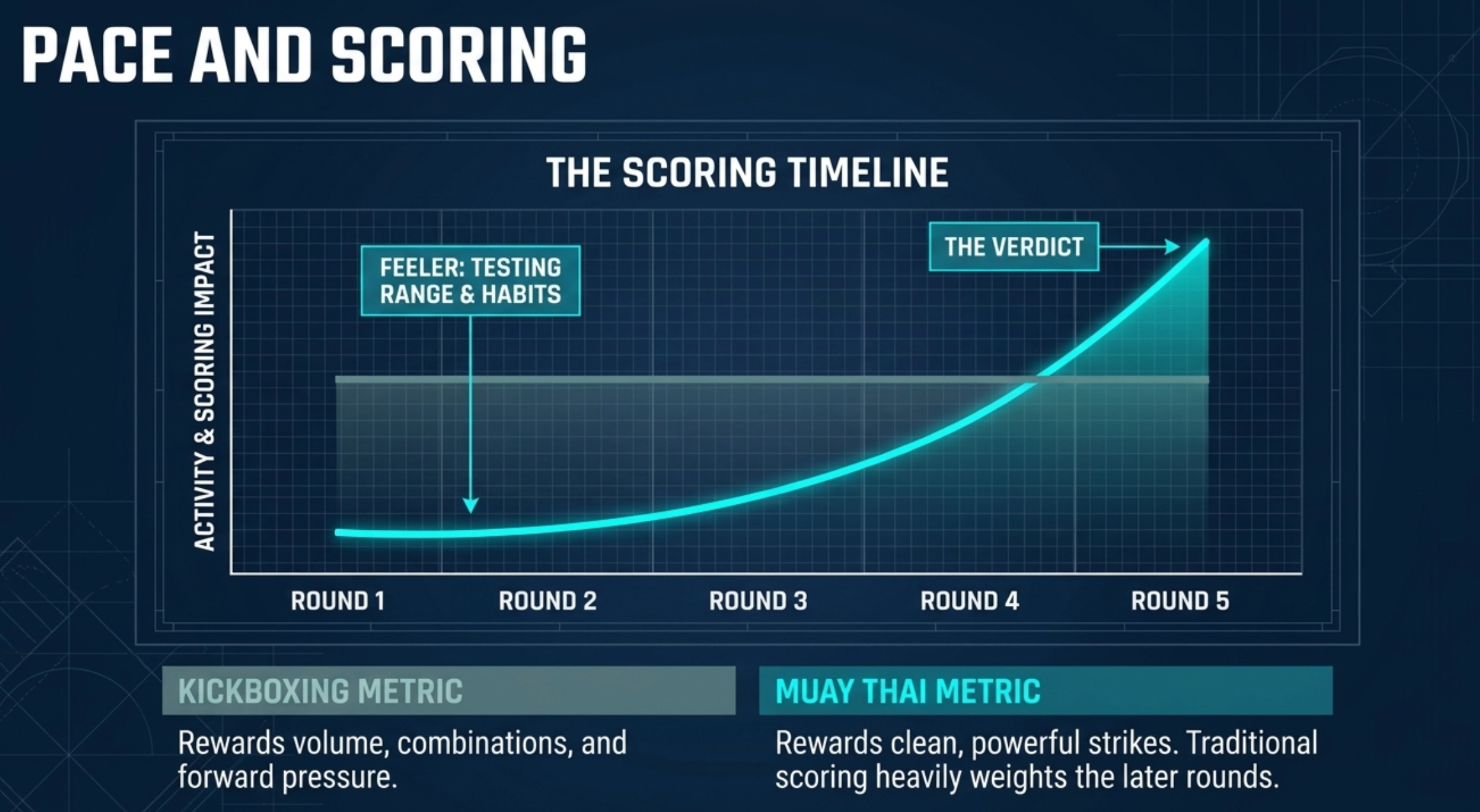
The cumulative result: if a fight gets aggressive, messy, and close, Muay Thai fighters have more answers.
What a typical class looks like
Here's what the typical class looks like for kickboxing and Muay Thai:
Class phase | Kickboxing | Muay Thai |
Warm-up | Cardio + shadow boxing (10-15 min) | Run/skip + shadow boxing + light stretching (15-20 min) |
Technique | Punch/kick combinations on pads | Strikes + clinch entries + elbow/knee technique on Thai pads |
Drilling | Partner combos, footwork | Pad rounds with kru, clinch sparring |
Conditioning | Bag rounds, intervals | Heavy bag, kicking drills, neck/core work |
Sparring | Light to moderate, gloves | Variable—light technical to hard clinch sparring |
Kickboxing classes, especially the cardio fitness variety, lean toward accessibility and calorie burn. Muay Thai, on the other hand, is physically demanding and more technical.
Scheduling both arts as a gym owner
As a gym owner, scheduling plays a significant role.
If you're running cardio kickboxing, beginner kickboxing, advanced Muay Thai, and hybrid classes, the structure depends on it.
This is where using gym management platforms to schedule gym classes efficiently and track attendance becomes a game-changer.
Want to see this in action? Here's how Two Bridges Muay Thai built their gym into a successful community, growing their gym without ads or investors.
Kickboxing vs Muay Thai: A side-by-side comparison
Here's a comparison of the various aspects of both kickboxing and Muay Thai.
Aspect | Kickboxing | Muay Thai |
Weapons | Punches, kicks (some knees) | Punches, kicks, elbows, knees, clinch |
Clinch rules | Broken quickly | Full clinch fighting |
Stance | Upright, mobile | Square, grounded |
Scoring | Volume, activity | Clean, powerful strikes |
Forms/kata | None | Wai kru (ceremonial) |
Competition path | ||
Curriculum | Moderately standardized | Lineage-dependent |
Kickboxing is easier to scale across instructors.
The principles are consistent across the various styles of kickboxing. Muay Thai requires deeper coaching expertise. This is often lineage-dependent, but it develops students quickly, producing an experience that's more technical.
Which Is Better for Self-Defense?

The most effective martial art for self-defense is the one you practice.
An analysis of CCTV footage shows that traditional martial artists, MMA fighters, boxers, kickboxers, Nak Muays, and grapplers have all been successful in self-defense situations.
So any striking or grappling arts work? Absolutely, so long as you avoid the weak points of your art.
Every martial art has its weaknesses—even MMA. This means you'll need to work on the gaps in your martial art.
If you're a striker, work on takedown defense, pin escapes, and standing up. If you're a grappler, focus on striking—distance management, footwork, head movement, and timing.
Kickboxing vs Muay Thai for self-defense
Aspect | Kickboxing | Muay Thai |
Range strengths | Strong at long range and in open exchanges | Strong in close range and clinch scenarios |
Power & volume | Fast, high-volume combinations | Heavy, fight-ending knees, kicks, and elbows |
Clinch & control | Weak in the clinch | Strong clinch, posture control, trips, and dumps |
Against grappling | Vulnerable to takedowns and ground fighting | Also vulnerable to takedowns and extended grappling |
TL;DR: If you're at range, kickboxing is ideal. If the fight moves to the clinch, Muay Thai has the edge. If you're dealing with takedowns or grappling, arts like judo, BJJ, wrestling, or sambo are essential add-ons.
For a deeper breakdown, take a look at this comprehensive guide: the best martial art to learn for self-defense.
What Gym Owners Need to Run Both Arts Well
If you're offering kickboxing or Muay Thai classes, you'll need three things dialed in: equipment, instructors, and structure.
Get these wrong, and you'll have frustrated students, uneven classes, and programs that quietly bleed money instead of grow.
1. Equipment and space
Equipment for striking arts is mostly the same across styles—what changes is how much space you need, what's on the floor, and a few Muay Thai-specific items that boost your startup cost.
Here's a short list of the minimum equipment requirements for running kickboxing or Muay Thai classes:
Equipment item | Purpose |
Gloves | Hand protection and a fighter's striking surface |
Hand wraps | Stabilize wrists and knuckles under the glove; non-negotiable for sparring and bagwork |
Mouthguards | Standard sparring requirement; protects teeth and reduces concussion risk |
Focus mitts | Used to develop speed, accuracy, combinations, and response |
Body protector | Protects the torso from injury. Allows fighters to throw full-power body shots with confidence |
Thigh protector | Allows fighters to throw full-power kicks to the thigh without injury |
Heavy bags | Used to develop power, condition limbs, and facilitate solo drilling |
Here are the Muay Thai-specific requirements you'll need:
Equipment / requirement | Purpose |
Thai pads | Better at absorbing heavy kicks, knees, and elbows than focus mitts |
Shin guards | Protects the tibia during sparring and leg-kick drills |
Clinch space | Open area to practice clinchwork, stand-up wrestling, and neck wrestling |
Mats | Springboard flooring to give fighters safe landings during sweeps and takedowns |
Most of the equipment costs overlap, but startup costs tend to be slightly higher for Muay Thai.
2. Space management
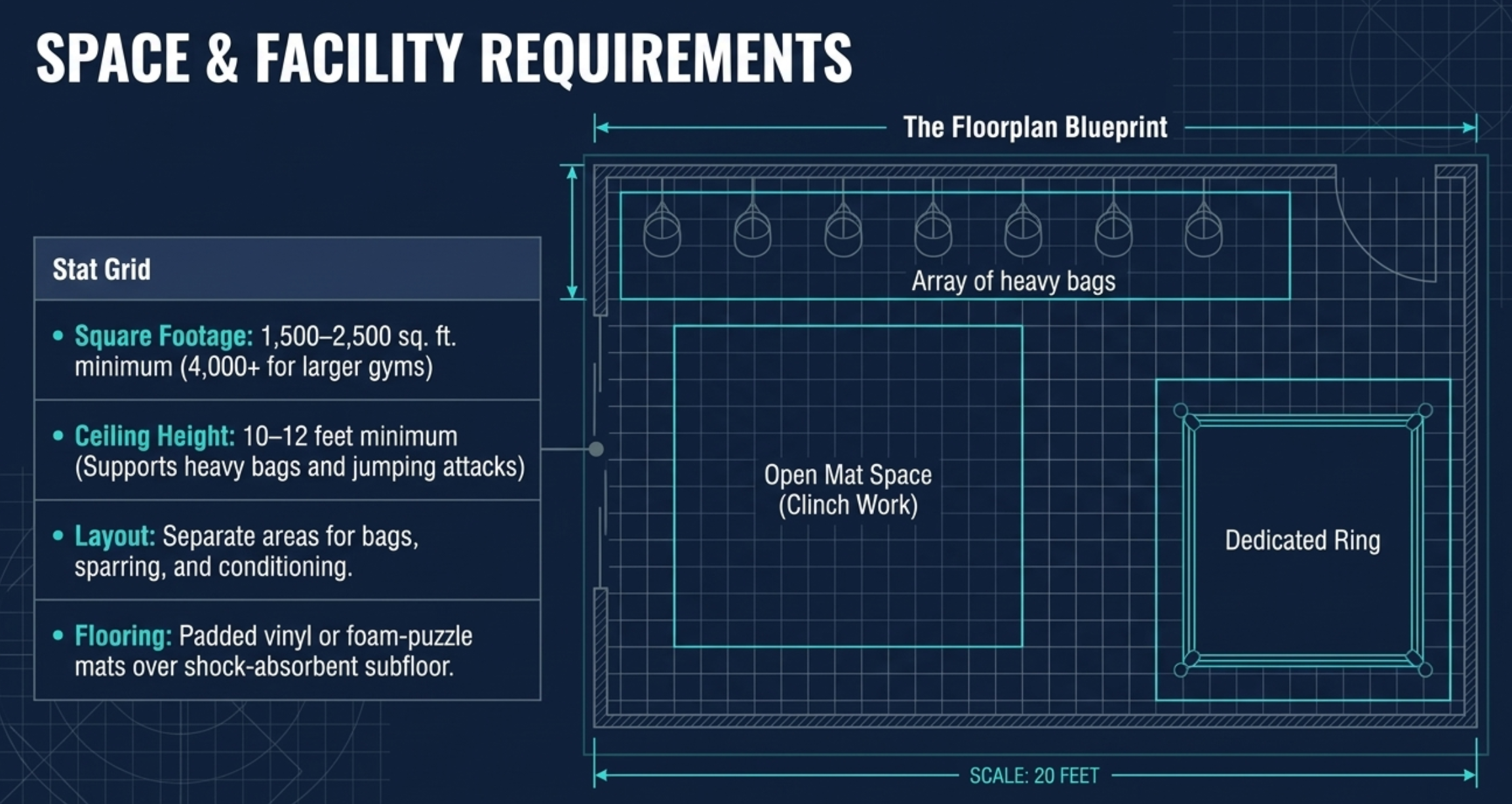
Fighters need a certain amount of space to perform well.
Both kickboxing and Muay Thai require training environments structured around movement, safety, and equipment-intensive workouts.
There's definitely some overlap between the two sports; however, Muay Thai gyms tend to need more open space (for clinch work, tech sparring, and heavy bag workouts).
Requirement | Recommendation | Why it matters |
Square footage | 1,500–2,500 sq. ft. minimum; 4,000+ for larger gyms | Adequate room for workouts, sparring, and equipment storage |
Ceiling height | 10–12 feet minimum | Supports heavy bags, kicks, jumping attacks, etc. |
Layout | Separate areas for bags, sparring, and conditioning | Improves safety and training flow. Students won't run into each other |
Flooring | Padded vinyl or foam-puzzle mats over shock-absorbent subfloor | Reduces impact and injury risk, giving students a safe landing |
Ring space | Dedicated ring (with clearance area) | Important for sparring and fight preparation; develops ring generalship |
Ventilation | Strong HVAC and industrial fans | Controls heat, humidity, and odor; this helps to minimize infections |
Storage | Wall racks and organized gear areas | Keeps equipment accessible and floors clear |
Safety access | Wide walkways and emergency exits | Improves safety and ease of movement, especially during peak hours |
Space plays an important role in your gym's overall success. It's something that's taken for granted, but it's an important part of your gym's safety plan.
3. Instructor qualifications
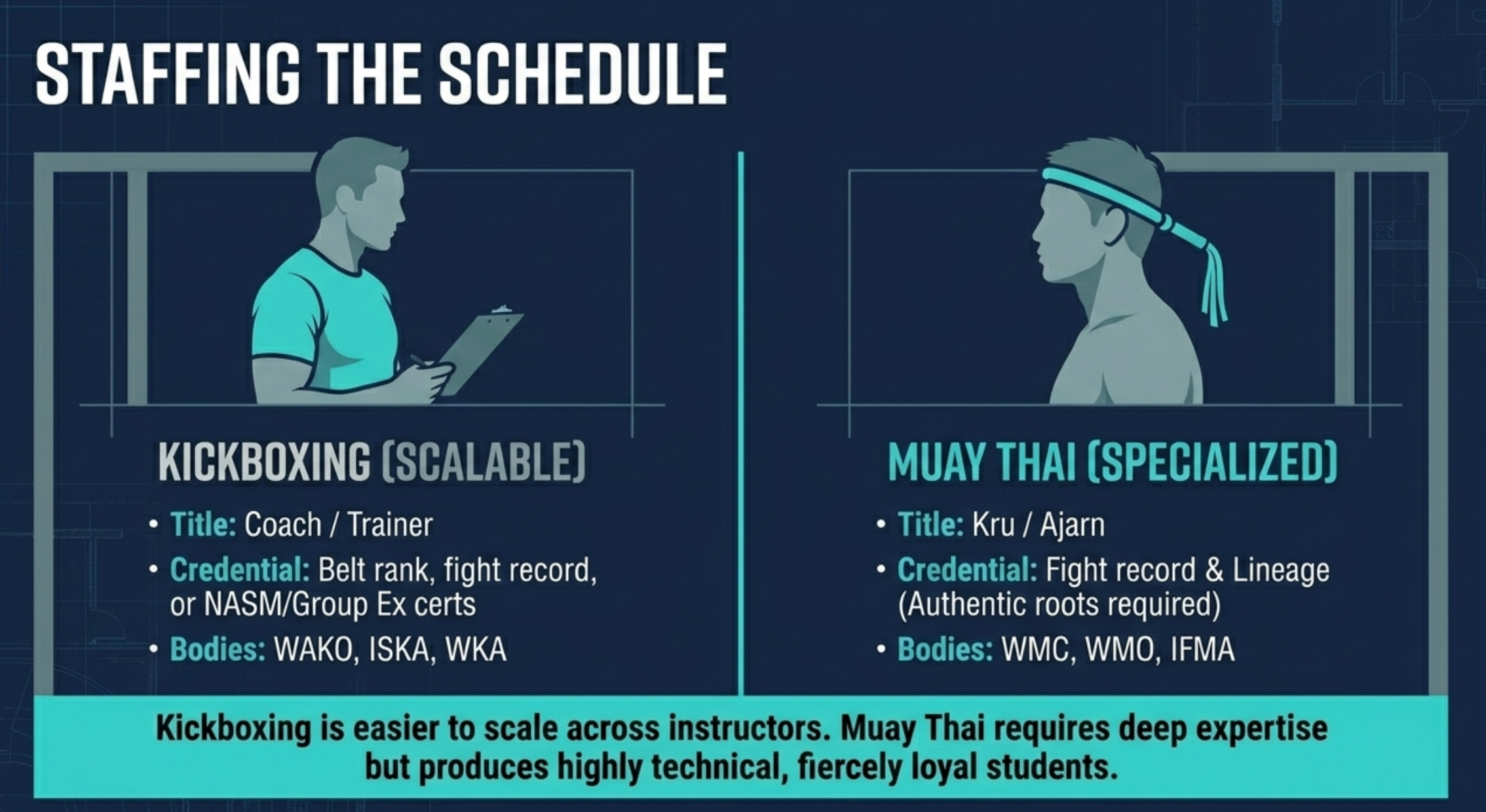
As a gym owner, you'll eventually need to bring more instructors on to grow. If you're looking for instructors, you'll find key hiring differences between the two styles.
- Kickboxing instructors are easier to staff and find. There are more generalist instructors.
- Muay Thai requires experienced coaches with legitimate clinch and padwork expertise.
Here's a list of the qualifications you should look for when hiring instructors.
Requirement | Kickboxing | Muay Thai |
Primary credential | Belt rank or fight record | Fight record & lineage |
Common title | Coach / Trainer | Kru / Ajarn |
Governing body | WAKO, ISKA, WKA | WMC, WMO, IFMA |
Fitness route | NASM / Group Ex certs | Generally requires "authentic" roots |
These requirements are often the limiting factor—it's not space or equipment, it's access to the right people.
4. Scheduling and student management
Which martial art should you offer in your gym? Believe it or not, running both programs is a powerful growth option for your gym—if they're structured the right way.
Here's how you do it:
- Step 1: Offer kickboxing as an entry point for those interested in learning striking. Students begin with the fundamentals, then progress to deeper training.
- Step 2: Muay Thai serves as the upgrade, the progression for advanced practitioners who are ready for the next step.
If this is going to work, you're going to need clear class structures, attendance tracking, and progression systems—semi-automatic systems that can run multiple programs without adding manual tracking or administrative overhead.
5. For gym owners, here's the business case for both
First off, it's a lot of work; here's why it's a great idea to offer both.
If you offer both kickboxing and Muay Thai classes, your gym attracts a wider range of members. Your gym appeals to beginners, experienced athletes, and professional athletes.
This student mix is ideal because it attracts more students over time.
- Kickboxing produces a wider funnel that attracts a wide variety of students (typically beginners)
- Muay Thai fosters deeper retention with students as they move into an advanced martial art that requires more commitment and focus
Offering both is the best model for many gyms because kickboxing feeds Muay Thai; Muay Thai retains long-term students.
If you need to choose between kickboxing and Muay Thai, here's a helpful decision guide you can use to determine which martial art is best for you.
Factor | Kickboxing | Muay Thai |
Fitness focus | Higher but still accessible | High, more technical |
Injury risk | Lower | Moderate |
Barrier to entry | Low | Higher |
Students | Broad demographic | More dedicated |
Revenue per student | Moderate | Higher retention |
Startup cost | Lower | Higher |
Hiring instructors | Easier | Harder (difficult to find) |
6. For students picking a first striking art
This is where education plays an important role. It's important that you teach potential students how to identify what they want and what to look for in a martial art.
You want… | Start with | Why |
To learn how to hit hard, fast | Kickboxing | Faster ramp, simpler ruleset |
A complete striking system across all ranges | Muay Thai | 8 weapons + clinch covers more ground |
Cardio and conditioning, not competition | Kickboxing (cardio format) | Lower impact, group-friendly |
To eventually compete | Either, but commit to one for at least a year | Sport-specific training matters early |
Both | Start kickboxing, transition once basics are solid | Avoids confusion between rule sets |
Common Mistakes When Choosing a Striking Art
Don't choose a gym based on your commute time. Instead, focus on the school that's the best fit for your goal or why (e.g., self-defense, fighting professionally, training for work, etc.).
Here are a few of the more common mistakes:
- Choosing based on UFC highlights. Real classes feel very different from fights. Those UFC highlights come from consistent drilling, lots of conditioning, and precise sparring. For example, Capoeira looks amazing on screen, but it requires a gymnastics background and a willingness to improve flexibility.
- Ignoring values and culture. Every striking art has a distinct personality that dictates how each class feels.
- Avoiding pressure testing. Hitting a heavy bag or air-punching in a boxercise class won't teach you how to defend yourself. If your goal is competition or self-defense, verify that the gym you select has supervised, technical sparring.
- Assuming one is harder. Both of these arts are challenging; they're just challenging in different ways.
- Blending both into one vague, striking class. This is confusing and frustrating for students; it weakens positioning. Mixing these two striking arts into a single vague class that you call "Striking" or "Thai Kickboxing" creates major problems. While these arts look similar, they are mechanically and strategically opposites.
- Dismissing kickboxing as just cardio. Done properly, it's a legitimate fighting base as we've seen from the legendary kickboxers listed above. Ask yourself the question. Are you focused on cardio or combat? Are you looking for a striking art that's more technical, or are you looking for something that prioritizes athleticism, conditioning, and competition?
Kickboxing vs Muay Thai: The Differences Make Both Stronger
This is the most obvious difference, but the differences between kickboxing and Muay Thai aren't just a list of techniques—it's experience.
As we've seen, kickboxing is faster to learn, easier to scale, and more accessible for beginners. Muay Thai is deeper, more complete, and more physically demanding. Both of these are extremely strong in self-defense, competitive, and hobbyist contexts.
Which one should your students try? Try both; the best choice is the one you'll stick with over the long term.
What about gym owners? The strongest model is the one where you don't have to choose. When you offer kickboxing and Muay Thai, you cast a wide net. You attract more students who are at various stages of their martial arts journey.
This is why structure plays such a significant role.
If your schedule involves cardio kickboxing, beginner kickboxing, advanced Muay Thai, and hybrid classes, you'll need structure that creates balance.
This is where using gym management platforms like Gymdesk to schedule gym classes efficiently and track attendance becomes a game-changing decision. Try it free, no credit card required.
Gym management software that frees up your time and helps you grow.
Simplified billing, enrollment, student management, and marketing features that help you grow your gym or martial arts school.


FAQ
Kickboxing vs Muay Thai FAQs
.webp)
Andrew McDermott is a gym owner, Brazilian Jiu Jitsu brown belt, and digital marketer. He’s on a mission to build premier, high-stakes grappling tournaments, world-class academies, and a championship team of high-level athletes.