
Pilates Marketing: The Ultimate Guide

Updated August 2026
KEY TAKEAWAYS:
- Over five years, US Pilates and yoga studio revenue grew at an 11.1% annual clip while the number of studios grew 0.0%. Revenue dipped in the most recent year and margins tightened, but the share point survives it: the money moved between the studios that were already there.
- Most Pilates marketing advice is generic business advice with the word "Pilates" pasted on top. The parts that move a studio are local and specific.
- Your niche is the whole strategy. "Pilates for everyone" loses to "Pilates for people whose backs hurt at desks" every time.
- Fast lead response beats almost every clever campaign you could run instead. The research measures hours; in a studio you can answer in minutes.
- Retention is marketing. A member who can point at a documented result brings you the next member.
Everyone will tell you the Pilates market is booming, and that Pilates marketing is harder than ever because of it.
They're half right.
The money did boom. According to IBISWorld, the US Pilates and yoga studio industry grew revenue at a compound rate of 11.1% a year between 2021 and 2026, reaching $19.2 billion as of its latest published figures.
The same report is much less quoted on the rest of it.
Revenue dipped 2.0% in the most recent year, and IBISWorld notes that many studios watched their profit shrink as rent, wages, and inflation ran ahead of what they could pass on to members.
So it isn't a story about easy money. It's a story about where the money went.
Here's the number nobody quotes. Over that same five years, the count of businesses in the industry grew at a compound rate of 0.0%. There are 37,317 of them, and there were about that many before.
The pie got bigger. The number of people holding forks did not.
INDUSTRY SNAPSHOT
IBISWorld reports Pilates and yoga studios as a single combined category. Every figure below covers both. None of them is a Pilates-only number.
$19.2bn
Category revenue, latest published figures
37,317
Businesses in the category
11.1%
Revenue CAGR, 2021–2026
0.0%
Business-count CAGR, 2021–2026
−2.0%
Revenue change in the most recent year
Same pie,
more slices sold
Growth went to studios that already existed, not to new entrants
Source: IBISWorld, US Pilates & Yoga Studios, latest published figures. Combined Pilates and yoga category — not Pilates alone.
So where did the growth go? It went to studios that already existed.
Some of them got a lot bigger, and some stayed exactly the same size while the market grew around them, which in real terms means they shrank.
IBISWorld describes competition in the category as "moderate and increasing," which is analyst language for your neighbors are getting better at this.
The difference between those two groups is rarely the quality of the teaching.
I've talked to a lot of studio owners and I have yet to meet one who thinks their instruction is the problem. The difference is that one group has a way of reliably getting strangers through the door, and the other group has a really nice Instagram grid.
This guide is the first group's playbook: twenty pilates marketing ideas, ordered the way a person actually moves toward you, from never having heard of you, to following you, to booking an intro, to staying. No agency required.
One quick note on scope. Paid advertising gets a short section here and a link out, because it's a big enough topic to deserve its own room.
Everything else lives on this page.
Positioning: Decide Who You're For
Before a single tactic matters, you have to know who you're talking to. Every other piece of your Pilates marketing gets easier or harder based on this one decision.
Strategy #1: Pick a niche narrow enough to feel uncomfortable
The instinct is to market to everyone, because everyone could theoretically benefit from Pilates. That instinct is why so many studio websites read like a brochure for the concept of exercise.
"Pilates for everyone" is not a position. It's an absence of one.
Pick the person you're best at serving. Not the person you wish you served. Some niches that work, because someone is already underserved in your zip code:
- Desk workers with back pain. Enormous, well-funded, and permanently in mild discomfort. They don't want fitness. They want to stop hurting.
- Postnatal recovery. High intent, high urgency, and a referral network of other new parents that runs on its own.
- Adults over 55 who want to keep their balance. An aging, growing segment whose members rarely appear in a studio's marketing photos.
- Athletes doing prehab. Runners, lifters, golfers, grapplers. People who already train and are tired of getting hurt.
- Beginners intimidated by reformer classes. This is bigger than people think. A room full of springs and straps is alarming if you've never seen one.
You do not have to turn anyone else away. Nobody checks IDs at the door.
Niching down changes your marketing, not your class roster. It changes the language on your website, the people in your photos, and the problems you name out loud.
Milad Moghaddam runs ActiveRange Method in Newmarket, Ontario, with his wife Ella—a studio he built to run at 200-plus members.
They decided early who they were for: people who want a diagnosed problem fixed, rather than a class to attend.
That decision is why every member starts with a body scan and a biomechanical movement screen before anyone programs anything for them.
The assessment is the proof of the position.
Someone shopping for a pleasant Tuesday class works out in the first ten minutes that this isn't it, and the person with a shoulder that's been wrong for two years leans in.
If you're still working out what you're best at, the different types of Pilates is a decent place to start.
The modality you teach shapes who you can credibly serve.
⚡ QUICK WIN:
Open your homepage. Read the first sentence out loud. If you could swap "Pilates" for "yoga" or "barre" and it would still make sense, you don't have a position yet. Rewrite it so it names a specific person and a specific problem.
Strategy #2: Position against the chains, not the studio down the street
If there's a Club Pilates within a few miles of you, you're not competing with the studio across town. You're competing with a franchise that has a national ad budget and a standardized product.
Good news: standardized is beatable.
The chains win on convenience and price. You will not out-spend them and you should not try.
What you can do is be the thing they structurally cannot be: small and specific. A franchise cannot promise that the same instructor will know your name and your left shoulder for three years running. You can.
KEY TAKEAWAY:
You will not out-spend a franchise on convenience or price, and you should not try. Compete on the thing a standardized product structurally cannot offer: the same instructor knowing your name and your left shoulder three years running.
Say it plainly in your marketing rather than as a dig at them. "Classes capped at eight. Same instructor every week. We'll know your history."
Say it out loud in your marketing.
Not as a dig at them, which reads as insecurity, but as a plain description of what you offer. "Classes capped at eight. Same instructor every week. We'll know your history."
The big operators are worth understanding before you position against them. Club Pilates' business model covers the mechanics.
We'll keep you in the loop with fresh content, podcasts, how-to guides, tool reviews, and product exclusives.
Awareness: Get Found by People Who Don't Know You Yet
Most Pilates studio digital marketing lives here: the work that puts you in front of someone who has no idea you exist. It's local, it compounds slowly, and that slowness is why so few studios do it properly.
Strategy #3: Build a website that answers the four questions
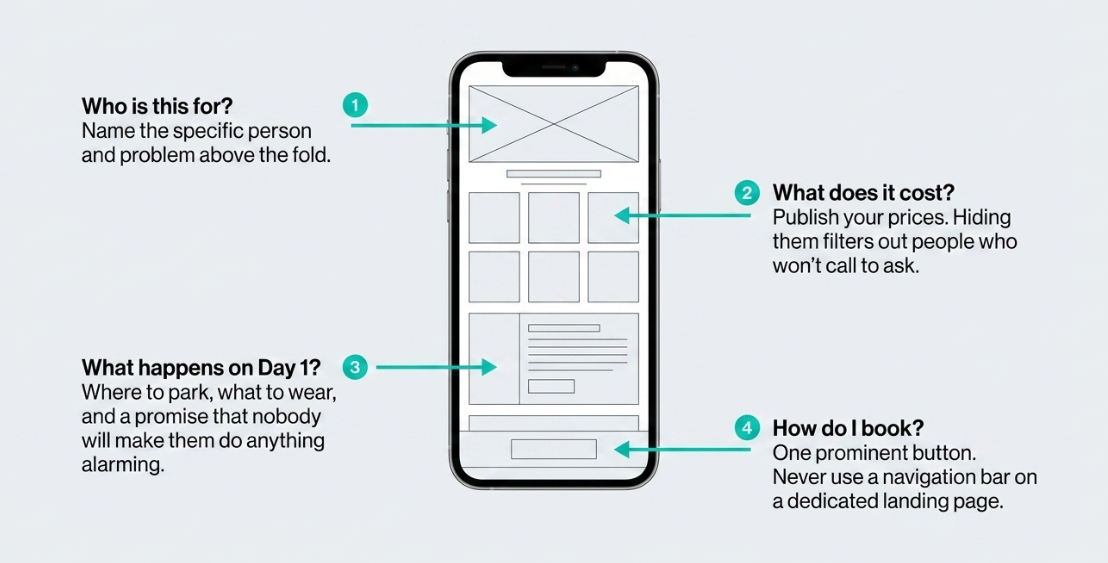
Your website has one job: convert someone who's mildly curious into someone who books. Most studio sites fail because they're built like a portfolio instead of a decision tool.
Answerable in under thirty seconds, without scrolling forever:
- What is this and is it for me? Above the fold. Name the person.
- What does it cost? Publish your prices. Hiding them mostly filters out the people who won't call to ask, and if your pricing needs defending, the fix is the pricing. How to price Pilates classes walks through it.
- What happens on my first visit? The most under-written page on Pilates websites. New people are nervous. Tell them where to park, what to wear, that they don't need to bring anything, and that nobody will make them do anything alarming on day one.
- How do I book? One button. Visible from everywhere.
Then make it work on a phone, because that's where most of this traffic is coming from.
⚡ QUICK WIN:
Ask someone who has never done Pilates to find your prices and book an intro class on their phone while you watch. Say nothing. Every place they hesitate is a leak.
Strategy #4: Own "pilates near me" in your local search results
SEO for a Pilates studio is mostly unglamorous admin, and it pays back longer than anything else on this list. Most of us put it off for exactly that reason.
Start with your Google Business Profile, which matters more than your website for local discovery:
- Fill in every field. Hours, services, attributes, booking link, description.
- Upload real photos of your actual space. Twenty-plus. Not stock. People want to see the room they'd be walking into.
- Post updates weekly. Google reads activity as a liveness signal.
- Pick your categories carefully. "Pilates studio" as primary, then secondary categories for what you offer.
On your own site, build a real page for each thing you want to rank for: reformer classes, mat classes, private sessions, prenatal. One page per intent, each with location language in the title, the H1, and the body.
A single "Classes" page listing everything will rank for none of it.
The mechanics are the same ones that work for any local fitness business, and local SEO for gyms covers the full checklist.
⚡ QUICK WIN:
Search your main service plus your city in an incognito window. Wherever you land in the map pack, look at the three above you and count their reviews. That number is your target.
Strategy #5: Treat reviews as the ranking factor they are
Reviews do two jobs at once. They're one of the biggest levers on local map rankings, and they're the last thing someone reads before booking.
The numbers here are brutal if you're short on them.
BrightLocal's 2026 Local Consumer Review Survey found that 97% of consumers read reviews before choosing a business, 47% won't use a business with fewer than 20 reviews, and 68% will only use one rated four stars or higher.
Recency matters too: 74% specifically look for reviews written in the last three months.
So a studio sitting on eleven reviews from 2023 isn't neutral. It's losing people who never contacted you and never will.
Most of us ask badly, when we ask at all—rarely, and at random.
Make it systematic instead.
Ask right after a moment of visible progress, not at a random point in the month. The member who just held something they couldn't hold six weeks ago is the one who'll write you three sentences that sell.
Then respond to all of them. Every single one, within a day.
In the same BrightLocal survey, 37% of consumers said an owner response was one of the factors they weigh. A thoughtful reply to a three-star review does more for a browsing stranger than the three-star review costs you.
⚡ QUICK WIN:
Pick the ten members who've been with you longest and text them individually today. Not a blast. Individually. Ten personal texts will out-perform any automated review campaign you set up this year.
Strategy #6: Make Instagram do the job it's actually good at
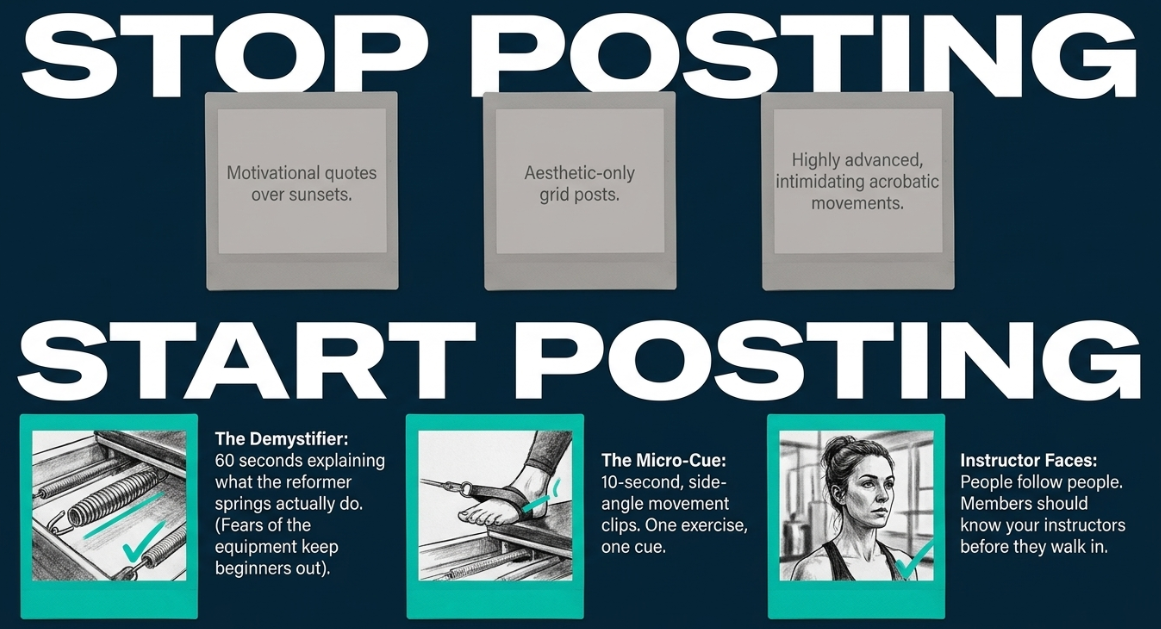
Pilates is one of the few fitness categories where the teaching is photogenic, and studios still mostly waste it on quote graphics.
What works is not complicated:
- Movement clips, shot from the side, ten to twenty seconds. One exercise, one cue. No music you don't have rights to.
- The scary-equipment demystifier. Walk someone through what a reformer is and what the springs do. In my experience talking to owners, the machine itself is what keeps a lot of beginners out, which makes this one of the most useful things a Pilates studio can post. If you need the technical grounding, the guide to Pilates reformers covers the machine itself.
- Instructor faces. People follow people. Your members should be able to name three of your instructors from Instagram before they ever walk in.
- Member results, with permission, with specifics. "Six months, went from not being able to sit through a workday to running again."
What doesn't work: aesthetic-only grid posts, motivational text over a sunset, and reposting the same reel to three platforms with a TikTok watermark on it.
Post consistently rather than frequently. Three good posts a week beats daily filler, and you can sustain three.
⚡ QUICK WIN:
Film one instructor explaining what the springs on the reformer do, in plain language, in under sixty seconds. That single video will out-perform a month of your grid.
Strategy #7: Write the things people search before they're ready to buy
Content marketing for a studio means answering the specific, slightly embarrassing questions people type in before they'll commit.
- "Is reformer Pilates good for lower back pain."
- "What do I wear to Pilates."
- "Is Pilates enough exercise on its own."
- "Do I need to be flexible to start Pilates."
Answer those honestly and locally.
Each one is a person about eight weeks from booking something, and almost nobody in your market is talking to them.
Video does the most work here, because it doubles as social content. Film the answer once, put it on your site and on Instagram, and you've served search and social with one take.
If you already run online classes, that library is a ready-made answer bank, and building online Pilates classes covers turning it into revenue as well.
Either way the job on this page is the same: be the studio that answered the question first.
Lead Generation for Your Pilates Studio: Turn Attention Into Contact Details
Attention you can't follow up on is just applause. These are the pilates marketing moves that turn a stranger's interest into a name and a reason to talk again.
Strategy #8: Give people a reason to hand over an email
Most studio websites offer visitors exactly two options: book a class, or leave. For someone who isn't ready yet, that's leave.
Put something in between.
A free resource that solves a real, small problem for the exact person you're targeting:
- A five-minute desk mobility routine, for the back-pain niche
- A "what to expect at your first reformer class" guide, for nervous beginners
- A postnatal return-to-movement timeline, reviewed by someone qualified
The resource has to be useful on its own. A PDF that's really a sales brochure trains people to ignore your emails forever.
Strategy #9: Run email like a person, not a newsletter platform
Email tends to out-convert social for studios, mostly because your list is made of people who already raised a hand.
The sequences that do the heavy lifting, and you can build all of them in an afternoon:
- The welcome sequence. Someone downloads your guide or books an intro. Four emails over ten days: what to expect, who you are, a member story, an offer. Written like you'd write to one person.
- The nurture sequence. For people who joined the list but haven't booked. Once a week, useful, no hard sell. Most of them convert in month three or four, not week one.
- The win-back sequence. For members who stopped coming. This is the cheapest membership you will ever sell, and almost nobody runs it.
Keep it plain.
A text email from you personally will beat a beautifully designed template with your logo in the header, every time.
⚡ QUICK WIN:
Write one email to every lead from the last ninety days who never booked. Subject line: "still thinking about it?" Two sentences and a booking link. That's the entire campaign.
Strategy #10: SMS and text marketing for Pilates studios
Text messages get opened. That's the whole advantage, and it's also the trap. The same thing that makes SMS effective makes it intrusive when you overuse it.
Three legitimate uses:
- Class reminders and waitlist openings. Time-sensitive, genuinely useful, and the reason people opt in.
- Speed-to-lead follow-up. A text within minutes of an inquiry (more on this below).
- Occasional, specific offers. Not monthly. Occasionally.
Get explicit consent, honor opt-outs immediately, and check your obligations around business messaging registration before you start sending at volume. The rules are real and the penalties are annoying.
A studio that texts twice a month gets read. A studio that texts twice a week gets muted.
Strategy #11: Build a referral program that rewards the right thing
Word of mouth brings most studios more members than any channel they pay for, and most owners treat it as weather: something that happens to them rather than something they run.
The fix is mechanical. Two rules:
- Reward the signup, not the lead. "Bring a friend and get a free class" produces friends who come once. "Get a free month when your friend joins" produces members.
- Reward both sides. The referrer gets a credit, the friend gets a better first-timer offer than a stranger would. It removes the awkwardness of feeling like you're selling to your friends.
Then ask.
Most referral programs fail because they exist on a poster nobody reads. Ask at the moment of highest goodwill, right after someone tells you they feel better.
Word of mouth is the reason ActiveRange Method exists at all. Before there was a studio on Yonge Street, there was a single reformer in the Moghaddams' basement:
Basement wasn't working economically, but it worked in a result base. It gave me a small sample of: this works… That was enough for me to gamble. I go all in.

That was word of mouth doing its unstructured best. Strong enough to justify betting everything on, and never systematized—which is the gap the two rules above close.
Strategy #12: Pilates event ideas that end with contact details
A workshop converts better than almost anything else you can put in front of a stranger, because it lets someone experience you without committing to you.
Formats that work:
- The beginner's intro workshop. Ninety minutes, equipment explained, no pressure. Aimed squarely at the reformer-intimidated.
- The problem-specific workshop. "Pilates for lower back pain." "Pilates for runners." Charge a small amount. Free events have brutal no-show rates, and $20 fixes that.
- The bring-a-friend day. Existing members get a guest spot. Easiest event you'll ever run.
- Local partner pop-ups. Your instructor teaching a short mat class at a running store or a physio clinic.
If you run programming through school holidays, Pilates summer camp is another event format that builds a list of local families.
The one non-negotiable holds for all of them: capture contact details at every single one. An event with forty attendees and no sign-in sheet was a nice afternoon, not marketing.
⚡ QUICK WIN:
Put one beginner workshop on the calendar for six weeks out. Right now, before you finish this article. The deadline is what makes the rest of it happen.
Strategy #13: Build partnerships with people who already have your members
Somewhere within two miles of you, a physiotherapist is finishing a course of treatment with someone whose next question is "so what do I do now to stop this happening again."
You are the answer to that question. They don't know you exist.
The partners worth pursuing, roughly in order of value:
- Physios, chiropractors, and massage therapists. Highest-intent referrals in the category. These people send you someone who is motivated and already sold on the value of movement.
- OB-GYNs and postnatal groups. Worth pursuing if you serve that niche.
- Running clubs and local sports teams. Prehab is an easy pitch.
- Corporate wellness programs. Companies with a wellness budget and desk workers with backs.
Make the first move generous and specific. Not "let's cross-promote."
Offer their staff a free month, or run a free lunchtime session at their office. Reciprocate when they send someone.
If you also teach yoga, combining Pilates and yoga programming opens a second set of local partners. Whoever you approach, go in with something to give first.
Strategy #14: Pilates print marketing still works
Print is unfashionable, which in a category where everyone is fighting over the same Instagram impressions is what makes it interesting.
Every Door Direct Mail to the specific carrier routes around your studio is the obvious one.
Pilates is a proximity business, and most owners I've talked to find their members clustered within about a ten-minute trip of the front door.
Then the small stuff.
Well-designed flyers in physio waiting rooms, coffee shops, and running stores. An A-frame if you're on a street with foot traffic, because without one you're paying rent for visibility you aren't using.
Business cards for your instructors, who get asked "where do you teach" constantly.
Print is measurable if you make it measurable. Put a distinct offer code or a dedicated landing page URL on each piece, and you'll know within a month whether it's working.
Strategy #15: Paid ads, briefly
Paid advertising works for Pilates studios.
It is also the one channel where you can lose real money quickly, and it deserves more room than a subsection.
The short version: Google Ads captures people already searching "pilates near me," which is the highest-intent traffic you can buy. Meta ads are better for introducing yourself to people in a tight radius who weren't looking yet.
Start with a small geographic radius, send traffic to a dedicated landing page rather than your homepage, and track cost per booked intro rather than cost per click.
For budgets, targeting, creative, and measurement, the full breakdown is in our guide to Pilates advertising.
Don't start with ads, though.
Ads amplify whatever your booking and follow-up already do, so if your intro offer doesn't convert and your replies are slow, paid traffic just makes you lose money faster.
Conversion: Turn Interest Into a First Class
You can do everything above well and still lose people at the last step. Conversion is where most studios quietly leak the majority of their marketing spend.
Strategy #16: Design an intro offer that filters for the right people
Your intro offer is the most important pricing decision you'll make, and most studios get it wrong in one of two directions.
Too cheap, and you fill your intro classes with deal-hunters who vanish the moment full price appears. A $10 unlimited month is a great way to be very busy in March and empty in April.
Too expensive or too committal, and nervous beginners never take the first step.
The shape that tends to work: a small number of sessions, at a real but discounted price, with one of them being a private or small-group assessment.
The assessment does the heavy lifting.
It turns a class purchase into a relationship, and it gives you something specific to say in the conversion conversation.
Then make the path from intro to membership explicit. Someone should know, before their last intro session, what happens next and what it costs.
Strategy #17: Answer leads fast—minutes, not days
This is the least glamorous strategy on this list and probably the most valuable.
Someone fills in your contact form at 8pm. If you reply the next afternoon, you're competing with the three other studios they messaged and with the erosion of their motivation.
Reply while they're still on the couch and you're usually the only one who did.
Speed is one of the better-measured effects in sales.
A 2011 Harvard Business Review study of 1.25 million sales leads found that firms contacting a lead within an hour were nearly seven times more likely to have a meaningful conversation with a decision maker than firms that waited just one hour longer.
Wait a day and the gap widened to more than 60 times. Of the 29 B2C and 13 B2B companies audited, 23% never responded at all.
That research measured corporate sales teams, not fitness studios, and its shortest bucket is an hour. Which is the good news for a studio: an hour is the fastest thing the study can see, and a person with a phone can beat it by fifty minutes.
"Reply" means a human-sounding message, not an autoresponder. Text is better than email. A phone call is better than a text, if you can manage it.
We all know why this doesn't happen.
You cannot personally answer a form while you're cueing a class, which is where automation earns its place: automated first-touch follow-up, lead tagging so nothing falls through, and a record of who's been contacted.
This is the gap Pilates studio management software is meant to close.
Gymdesk sends the first follow-up the moment a lead comes in, tracks where every inquiry sits, and keeps the trail visible so you can see which channels produce members instead of guessing. You teach the class; the follow-up already happened.
⚡ QUICK WIN:
Submit your own contact form right now and time how long it takes for something to reach you. Whatever that number is, it's the number your prospects are experiencing.
Retention Is Marketing
A member who stays for three years is worth more than any campaign you'll run this year, and they bring their friends. That makes retention the cheapest marketing you own.
The mechanics carry over from any membership business, and gym retention strategies covers the general version.
What follows is the part specific to a Pilates room.
Strategy #18: Make progress visible
Most studios miss something about retention.
People don't quit because the classes are bad. They quit because they can't tell whether it's working.
Pilates has a specific problem here. The results are real, but they're subtle and internal.
You don't watch your deadlift go up, you just gradually stop noticing your back. That's a hard thing to feel proud of, and pride is what keeps people paying.
So document it.
ActiveRange Method runs a body scan and a movement assessment on every new member, then keeps notes, photos, and video of range-of-motion progress attached to the member's profile.
Six months in, a member doesn't have to feel like they've improved. They can see the before.
Milad's framing of why this matters is blunt.
He describes most boutique fitness as service-oriented rather than result-oriented: the class happens, everyone leaves, and nobody can tell you what changed.
A member who can point at their own progress does two things. They renew, and they tell people in specific terms, which is the only kind of word of mouth that converts.
Strategy #19: Build the community, then get out of the way
The strongest retention mechanism in any studio is that a member has friends in the 6am class who'll notice if they're not there.
You can encourage that without forcing it.
Consistent class times with consistent people. Instructors who learn names in week one. A members' group chat, and the occasional social thing that isn't a class.
If you want the longer version of this, building member engagement goes deeper on the mechanics.
What doesn't work is manufactured community: the forced icebreaker, the hashtag nobody uses. People make their own friends if you give them the same room at the same time often enough.
And the friendships pay you twice.
A member with three friends in the room stays longer, and those are the friends she brings in the first place.
The Segment Nobody Else Is Marketing To
Every strategy up to here competes for the same people your neighbors are competing for. This last one doesn't.
Strategy #20: Market to the people everyone else ignores
Ask most studio owners about their gender mix and you'll hear some version of the same ratio.
Milad puts the industry's organic split at roughly 80/20 women to men, and describes it as what the category does on its own if you let it.
Most studios respond by marketing harder to women, which is reasonable and also means every studio in your area is fishing in the same pool.
Milad went the other way.
About four months before we filmed with him, he rebuilt ActiveRange Method's marketing specifically to bring men in:
I actually recreated the marketing in particular to target men… when a man comes to a class, if a man is comfortable, all of those female are comfortable too.
His point is more interesting than "we wanted more men."
He'd noticed that the room's comfort level runs in both directions.
A man who walks in and feels out of place makes everyone around him aware of it. A man who's relaxed does the opposite. The goal was a room where nobody is the exception.
He's since considered running a few men's intro classes purely to lower the barrier on that first visit.
The transferable idea: your underserved segment is cheap to reach because nobody's competing for it. Depending on your area, that might be men, or people over 60, or plus-size beginners, or shift workers who can't make a 9am class.
Look at your current member list.
Whoever's conspicuously missing is probably the cheapest growth available to you.
How to Market Yourself as a Pilates Instructor
Everything above assumes you own the studio.
If you're an instructor building your own client base, whether that's teaching at someone else's space, doing privates, or working toward your own place, the strategy is different in a few important ways.
You are the brand. Your name, your face, your specific approach. People book you, not a room.
That makes a personal social media presence more important for you than it is for a studio owner, not less.
Specialize harder than a studio can. A studio has to serve a mixed roster to fill classes. You don't.
Being the person in your city who works with post-surgical shoulders, or with rowers, or with hypermobility, is a viable and defensible position for one person. It's much harder for a studio.
Referrals from practitioners are your best source of new people. A physio who trusts one instructor will send you people for years. Build three of those relationships and you have a practice.
Get your rates straight early. Know what your time is worth and what the market pays. What Pilates instructors earn has the ranges.
Keep your own list. Not the studio's. Your own contact details, your own booking history, your own emails.
If you ever move or go independent, that list is the business.
If you're earlier than that and still working out certification and the path in, become a Pilates instructor covers the groundwork.
What Milad Moghaddam Knows About Marketing
Milad and Ella Moghaddam did not open ActiveRange Method the normal way.
They emigrated from Iran, where they'd run a small gym, and spent their first Canadian years working for larger fitness companies with their own plans on hold.
Ella had been teaching Pilates for about fourteen years; Milad trained as a civil engineer, which is why he talks about bodies the way you'd talk about a structure, in levers and load and failure points.
In 2023 they put one reformer in their basement.
It didn't make money, and Milad is direct about that. What it produced instead was results and members who talked, which was the whole proof he needed.
Steal three things from how they market.
- Sell the assessment, not the class. Every member starts with a body scan and a movement screen. That changes your first conversation from "come try a class" to "let's find out what's going on with your shoulder," which is a much harder thing for the studio down the road to copy.
- Watch who isn't in the room. The men's marketing rebuild came from noticing an absence, not from a growth target. Run the same audit on your own roster this week.
- Put the systems in before you need them. Milad refused to open and figure out software later, on the grounds that a business planning for 200-plus members can't retrofit its systems at year-end. The marketing payoff is that he can tell you where his members came from and which channel produced them, which is the difference between running a plan and guessing at one.
If it wasn't because of Gymdesk, we weren't here… it made my life so much easier in many ways.
They're now planning a second location. They still own the basement reformer.
Measure the Four Numbers That Actually Matter
We all end up tracking vanity metrics, because vanity metrics are the ones the apps hand you for free. Instagram tells you your follower count. It will never tell you whether those followers pay you.
Four numbers tell you almost everything about your pilates marketing. You can keep them on one page.
1. Cost per booked intro. Not per click, not per lead. Take everything you spent on a channel in a month and divide it by the number of people who got on the schedule because of it.
This is the only number that lets you compare a $300 ad spend against a workshop that cost you a Saturday.
2. Intro-to-member conversion rate. Of the people who took your intro offer, what percentage bought a membership? Track your own number month over month rather than against someone else's benchmark. If it's sliding while your intro bookings climb, more traffic is just sending more people through a step that isn't working.
3. Lead response time. Median minutes from inquiry to first human contact. Track it weekly. It will be worse than you think, and it's the cheapest thing on this list to fix.
4. Where members actually came from. Ask every new member, in their own words, and write it down. Not a dropdown on a form. The actual sentence.
"My physio told me about you" and "I saw you on Instagram" point to completely different investments next quarter.
The trap is that these numbers are easy to collect badly.
If attribution lives in your head and a spreadsheet you update when you remember, you'll end up making next year's budget on a hunch and whichever channel you happened to enjoy most.
This is where having your bookings, payments, and lead tracking in one system stops being an admin convenience and starts being a marketing decision.
Pilates studio software that records where each lead came from, whether they converted, and what they've paid since turns two of these four into a report you pull instead of a spreadsheet you maintain.
The other two stay yours. Cost per booked intro needs your ad spend, which lives with you, and the verbatim sentence in number four only exists if you ask for it.
Review them monthly. Change strategy quarterly. Anything faster and you're reacting to noise.
⚡ QUICK WIN:
Go find your last ten members and write down, in one sentence each, how they found you. Ten minutes of work, and it's probably the most useful marketing data you'll have all year.
Your First 90 Days
If you're starting from roughly nothing, don't run twenty strategies at once. Here's the order.
YOUR FIRST 90 DAYS:
Days 1–30: fix the foundation.
- Claim and fully complete your Google Business Profile
- Get twenty real photos up
- Publish your prices
- Write the "your first visit" page
- Time your own lead response and fix whatever that reveals
- Ask your ten longest-standing members for reviews, individually
Days 31–60: build the front door.
- Pick your niche and rewrite your homepage around it
- Set up the welcome email sequence and the win-back sequence
- Launch a referral program that rewards signups
- Put one beginner workshop on the calendar
- Start filming one movement clip a week
Days 61–90: open the second channel.
- Approach three physios or chiropractors within two miles
- Run the workshop and capture every attendee's details
- Review which channels produced members, not leads, members
- Put next quarter's effort into the two that worked
Only after all of that should you consider paid ads. Ads pointed at a leaky booking process are a subscription to disappointment.
If you're not open yet, sequence this against the build itself. Starting a Pilates studio and Pilates studio startup costs cover what comes before marketing does.
The Bottom Line
Put the two IBISWorld numbers next to each other: 11.1% annual revenue growth over five years, against 0.0% growth in the number of studios.
The most recent year was harder than that headline suggests. Revenue dipped 2.0% and margins tightened as costs outran what studios could pass on.
But the share point survives it.
The same rough number of studios split a much bigger pot over five years, which means the studios that didn't grow lost ground to studios that did.
Not to newcomers. To the place across town that started answering its phone faster and finally filled in its Google listing.
Almost none of the pilates marketing on this list is clever.
Publishing your prices isn't clever. Asking ten loyal members for a review, one at a time, by text, is the opposite of clever.
That's why it works. Most of the gap between studios is follow-through, and follow-through is available to everyone reading this.
Pick three strategies. Not twenty.
Do them properly for ninety days and measure what happened. Then pick three more.
Do that for two years and the problem changes shape entirely. At that point you're reading about opening a second Pilates studio instead of wondering where next month's members are coming from.
And when the admin starts eating the hours you meant to spend on marketing—which it will, because it always does—that's the point to get the operational side off your desk.
Gymdesk handles the billing, booking, lead follow-up, and reporting so the marketing work gets done instead of postponed. Pink Pilates runs four women-only El Paso locations—Pilates alongside cycling and strength—on it.
Less admin, more members, zero guesswork.
FOR PILATES STUDIOS
The marketing on this list only happens if you have the hours for it. Gymdesk handles billing, booking, lead follow-up, and reporting, so the follow-up already happened by the time you're off the floor.
See Gymdesk for PilatesGym management software that frees up your time and helps you grow.
Simplified billing, enrollment, student management, and marketing features that help you grow your gym or martial arts school.


FAQ
Pilates Marketing FAQs
Common questions from studio owners.

Sean has spent the last decade creating content that helps businesses—small and not so small—grow smarter to allow operators to do more of what they love. You know, the fun stuff.
From shipping and international logistics to web development and marketing, he's done the work (not just the words) to scale retail and service businesses efficiently.
You can find his work at Sendle, Shogun, The Retail Exec, Gymdesk, and more.