
How Much Does It Cost to Open a Pilates Studio in 2026?

After years of teaching, you know the method inside and out—but opening your own studio brings a question you can't avoid: How much is this actually going to cost?
The honest answer is... it depends.
A mat-only studio in a small town might come together for $30,000. A fully equipped reformer studio in a major city could push past $250,000. Most new Pilates studios land somewhere between $50,000 and $150,000 in total startup costs.
This guide breaks down every expense you'll face, from reformers to rent to the software that keeps your schedule from falling apart.
Whether you're bootstrapping your first space or planning a premium boutique studio, you'll walk away knowing exactly where your money goes.
KEY TAKEAWAYS:
- Total startup cost ranges from $50,000 to $250,000+ depending on format, location, and equipment choices.
- Equipment and lease deposits are your two biggest upfront expenses.
- Many new Pilates studios break even within one to two years.
- Three budget tiers—budget, mid-range, and premium—let you plan for the studio you actually want to build.
Pilates Studio Startup Costs at a Glance
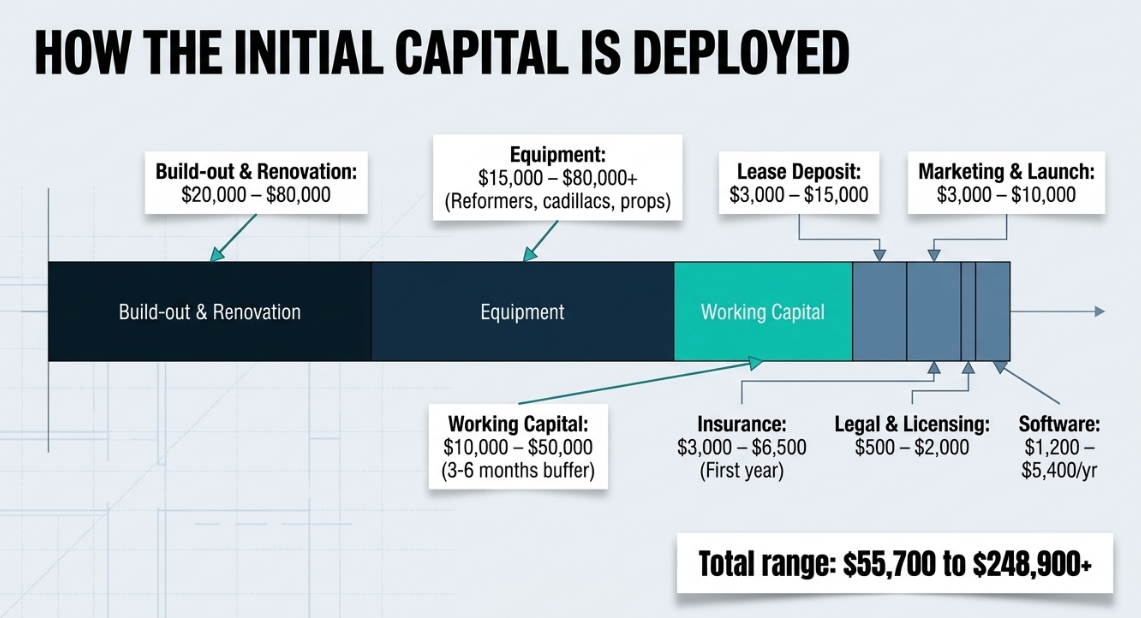
Before you dive into details, here's the full picture. This table covers every major line item you should plan for:
Expense Category | Low Estimate | High Estimate |
Equipment (reformers, props, mats) | $15,000 | $80,000+ |
Lease deposit (first/last + security) | $3,000 | $15,000 |
Build-out and renovation | $20,000 | $80,000 |
Insurance (first year) | $3,000 | $6,500 |
Legal and licensing | $500 | $2,000 |
Marketing and launch | $3,000 | $10,000 |
Studio management software | $1,200 | $5,400/yr |
Working capital (3–6 months) | $10,000 | $50,000 |
Total | $55,700 | $248,900+ |
Pilates Studio Startup Cost Calculator
Pick your format, location, and build-out. We'll size your all-in startup range and an estimated monthly operating cost — built from the figures in this guide.
| Line item | Low | High |
|---|
Studio management software is one line you can lock in today — scheduling, billing, and class booking from one place.
Start a 30-day free trialPlanning estimate only. Ranges are derived from the cost tables in this guide and assume a roughly 1,000–2,000 sq ft studio; your actual numbers depend on local rent, equipment grade, and how much build-out you take on. Confirm with vendor and landlord quotes before you commit.
Budget tiers explained
Not every studio needs $200,000 to open the doors. Here's how the numbers shake out across three common paths:
Budget ($30,000–$60,000): Mat-based classes, a sublease or shared space, minimal build-out, and you're the only instructor. You'll need mats, props, a sound system, and some basic branding. This is the leanest way to test your concept.
Mid-range ($75,000–$150,000): A dedicated studio with four to eight reformers, professional build-out, a small front desk area, and one or two additional instructors. This is the most common tier for new studio owners.
Premium ($150,000–$300,000+): A full-service boutique with 10+ reformers, Cadillacs, chairs, a designed reception area, high-end finishes, and a team of instructors. This is the "dream studio" build—and it can absolutely be worth it if your market supports premium pricing.
PRO TIP:
You don't have to start at the top. Many successful studio owners start mid-range and add equipment as revenue grows.
Equipment Costs
Equipment is usually your single biggest capital expense—and it's the one that varies the most depending on the type of Pilates you teach.
Reformers
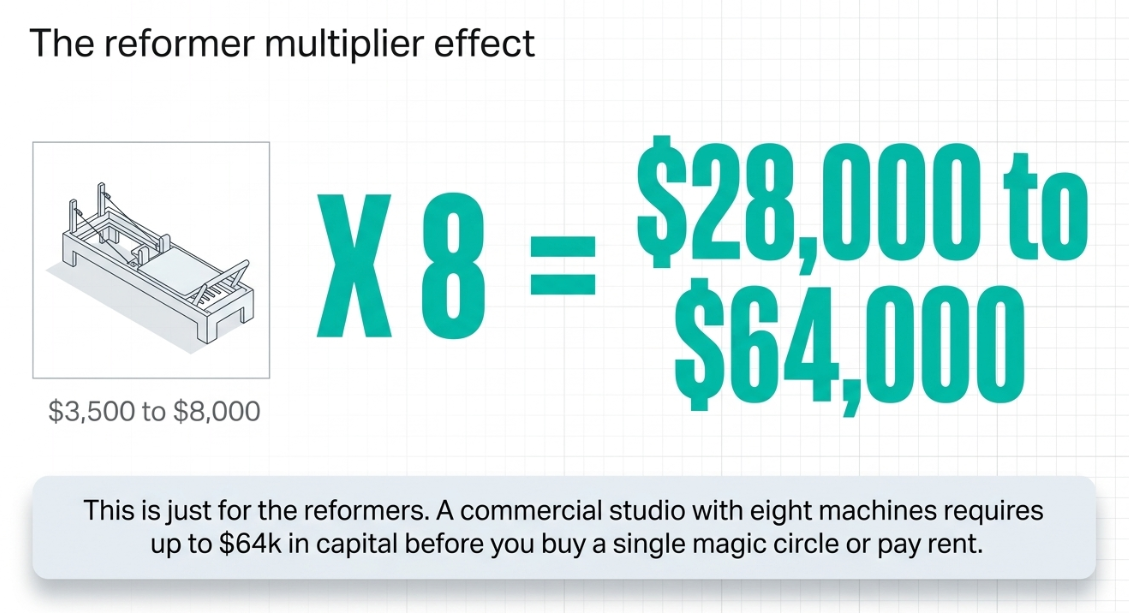
Commercial-grade reformers run $3,500–$8,000 each. If you're opening a group reformer studio with eight machines, that's $28,000–$64,000 just in reformers. Brands like Balanced Body, Stott/Merrithew, and Peak Pilates are the most common in commercial studios.
Cadillac and tower units
A full Cadillac costs $3,500–$6,000. Wall-mounted tower units are a more space-efficient option and run $2,000–$4,000 each. Most studios start with one or two for private sessions.
Chairs and barrels
Wunda chairs cost $1,200–$2,500 each. Ladder barrels and arc barrels range from $800–$1,500. These are often phase-two purchases unless you're running a comprehensive apparatus studio.
Mats, props, and accessories
Budget $1,500–$3,000 for mats, resistance bands, magic circles, foam rollers, small balls, and straps. Don't forget a sound system ($300–$800) and mirrors if your build-out doesn't include them.
Total equipment budget by studio type
Studio Type | Equipment Budget |
Mat-only studio | $2,000–$5,000 |
Small reformer studio (4–6 units) | $18,000–$50,000 |
Full reformer studio (8–12 units) | $35,000–$80,000 |
Comprehensive apparatus studio | $50,000–$100,000+ |
SAVE MONEY HERE:
Buy certified pre-owned reformers. Balanced Body and other manufacturers offer refurbished units at a significant discount. Just make sure any used equipment comes with a warranty or has been inspected by a certified technician.
Location and Lease Costs
Your lease is the other big number—and unlike equipment, it's a recurring cost that follows you every month.
Rent by location type
Location Type | Rent per Sq Ft (Annual) | 1,200 Sq Ft Studio (Monthly) |
Urban core | $25–$50 | $2,500–$5,000 |
Suburban | $15–$30 | $1,500–$3,000 |
Secondary market | $8–$20 | $800–$2,000 |
Upfront lease costs
Most landlords require first and last month's rent plus a security deposit. In a suburban location, that's $4,500–$9,000 before you've turned on the lights. In urban markets, expect $7,500–$15,000.
Build-out and renovation
This is where costs can spiral if you're not careful. A basic build-out—paint, flooring, mirrors, lighting, a small reception area—might cost $20,000–$40,000. A premium build-out with custom millwork, spa-like finishes, and a dedicated changing area can push $60,000–$80,000.
Pilates students notice the space. Clean lines and natural light matter to this audience—the space communicates the practice. But you don't need marble floors to create a beautiful studio—smart design choices go a long way.
Space requirements
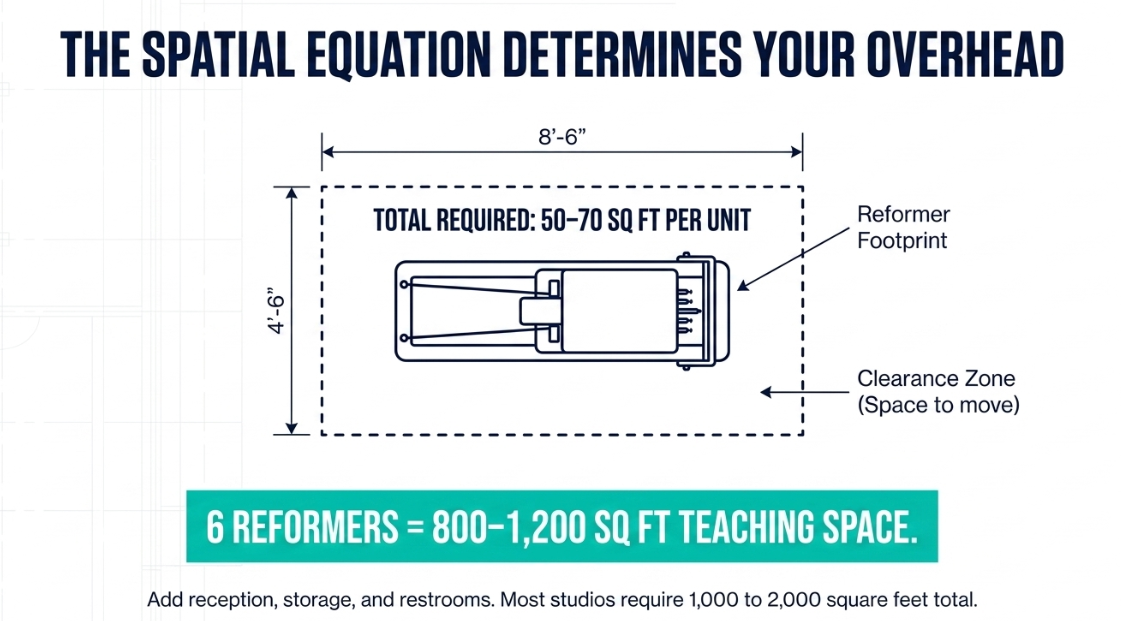
Plan for 50–70 square feet per reformer (including space to move around it). A six-reformer studio needs 800–1,200 square feet of teaching space, plus reception, storage, and a restroom. Most studios are 1,000–2,000 square feet total.
PRO TIP:
Negotiate your lease. Ask for a rent-free build-out period (one to three months is common), a tenant improvement allowance, or a graduated rent schedule that starts lower in year one.
Licenses, Legal, and Insurance
This isn't the exciting part of opening a studio, but skipping it can cost you far more than doing it right.
Business formation
Forming an LLC costs $500–$2,000 depending on your state and whether you use an attorney. Many studio owners handle this through an online service for $100–$300 plus state fees.
Licenses and permits
Requirements vary by state and city. At minimum, you'll need a general business license, a certificate of occupancy, and potentially a health department permit. Budget $200–$800 for permits and fees.
Insurance
Insurance is non-negotiable. Here's what you need:
Insurance Type | Annual Cost |
General liability | $500–$2,000 |
Professional liability | $500–$1,500 |
Property/contents | $500–$2,000 |
Workers' compensation | $1,500–$3,000 |
Total | $3,000–$6,500/year |
Professional liability (sometimes called "errors and omissions") covers you if a student is injured during a session. General liability covers everything else—slip and falls, property damage, and so on.
Instructor certification
If you're not already certified, comprehensive instructor programs—the ones that cover reformer, Cadillac, chair, and barrels—typically cost $4,580–$7,550 in tuition and run 450 to 500-plus hours. Programs that bundle a mandatory training package run higher still.
Budget another $300 for the Nationally Certified Pilates Teacher (NCPT) exam, paid to the National Pilates Certification Program and rarely folded into tuition.
Most lenders and landlords want to see a certified instructor on staff.
Staffing Costs
Unless you're running a solo practice, you'll need to budget for instructors and possibly an admin or front desk person.
Instructor pay
Pay Structure | Typical Range |
Group class rate | $30–$60 per class |
Private session rate | $50–$75 per session |
Full-time salary | $40,000–$65,000/year |
Most new studios start with part-time instructors paid per class. This keeps your fixed costs low while you build your schedule.
Administrative staff
A part-time receptionist or studio manager costs $15–$30 per hour. Many studio owners handle front desk duties themselves in year one—or use online class booking tools to let students self-schedule.
Freelance vs. full-time
Independent contractor arrangements are common in Pilates, but be careful with classification. The IRS has specific rules about when you can classify someone as a contractor vs. an employee. Misclassification can lead to penalties. Talk to an accountant before making this call.
KEEP IT LEAN:
Start as the sole instructor. Add teachers only when your schedule is consistently well-filled. This keeps payroll from eating into your margins before revenue catches up.
Marketing and Launch Costs
You need people to know you exist before you open—and a strong pre-opening campaign sets the tone for everything that follows.
Pre-opening budget
Plan to spend $3,000–$10,000 in the two to three months before your doors open. That covers:
- Website: $1,500–$5,000 for a professional site with booking integration
- Branding and logo: $500–$2,000
- Social media ads: $500–$2,000 for pre-launch awareness
- Grand opening event: $500–$1,500 for a launch party, free classes, or community event
Ongoing marketing
After launch, budget $500–$1,500 per month for social media content, local SEO, email marketing, and occasional paid ads. Word of mouth is powerful in Pilates, but it takes time to build. You need consistent visibility while your reputation grows.
Grand opening promotions
Founding member rates (10–20% off the first three to six months) are a proven way to fill your early schedule. Offer a free intro class or workshop to get people through the door and experiencing your teaching firsthand.
PRO TIP:
Partner with local businesses—coffee shops, wellness brands, physical therapists—for cross-promotions. A shared email blast or in-store flyer costs almost nothing and puts you in front of the right audience.
Technology and Software
Running a studio without management software is like teaching without a mat—technically possible, but you're making everything harder than it needs to be.
Studio management software
Studio management platforms typically cost $100–$450 per month. The right software handles scheduling, automated billing, member management, and online class booking—so you're not buried in spreadsheets when you should be teaching.
Pilates studio management software like Gymdesk handles the specifics of running a Pilates studio without workarounds. It's simple enough to set up in minutes and manages class packs and drop-in pricing out of the box. The reporting actually makes sense too. If you want to see how much it costs compared to alternatives, check out this studio management software cost comparison.
Start a 30-day free trial to see if it fits your workflow before you commit.
Other tech costs
- Payment processing: 2.5–3.5% per transaction (Stripe, Square, or your software's built-in processor)
- Music streaming: $15–$30/month for a commercial license
- Wi-Fi and internet: $50–$100/month
- Security system or smart locks: $50–$150/month
Ongoing Monthly Expenses
Once you're open, here's what your monthly operating costs typically look like:
Monthly Expense | Low | High |
Rent | $1,000 | $5,000 |
Instructor payroll | $2,000 | $10,000 |
Utilities | $200 | $600 |
Insurance | $250 | $700 |
Software and tech | $200 | $600 |
Marketing | $500 | $1,500 |
Supplies and maintenance | $100 | $400 |
Accounting and bookkeeping | $200 | $500 |
Total monthly | $4,450 | $19,300 |
Your actual number depends on your studio size, location, and staffing model. A solo instructor in a suburban sublease might run at $3,000–$4,000 per month. A fully staffed urban reformer studio could hit $15,000–$20,000.
How to Open a Pilates Studio on a Budget
Not everyone has $150,000 sitting in a savings account—and you don't need it to get started. (For the full launch process beyond cost, see our guide to starting a Pilates studio.)
Start with mat classes
A mat-only studio requires almost no equipment. Mats, props, a good sound system, and a clean space are all you need. You can add reformers later once revenue supports the investment.
Sublease or share space
Rent a room inside a yoga studio, wellness center, or physical therapy office. You'll pay a fraction of what a standalone lease costs, and you'll benefit from built-in foot traffic.
Phase your equipment purchases
Buy four reformers instead of eight. Start with the essentials and add apparatus as your schedule fills up. Phased purchasing keeps your upfront costs manageable and lets your cash flow fund future equipment.
Run a solo-instructor model
Every instructor you hire adds $2,000–$5,000 per month to your costs. Start by teaching every class yourself. Hire your first instructor only when you physically can't cover the demand.
BOTTOM LINE:
The best studio you can open is the one you can afford to keep open. Starting small doesn't mean thinking small—it means being smart about when and where you invest.
What Your Studio Earns Back
Startup cost is only half the equation—the other half is what the studio returns once it's running.
Most established Pilates studio owners pay themselves in the range of $50,000–$150,000 per year, typically once the studio matures after year two. And many studios recoup their startup investment within one to two years, faster if they launch with strong pre-sales and consistent marketing.
The full picture—owner salary by studio size, profit margins by service type, and revenue you can model per class—is its own subject. For the detailed breakdown, see our Pilates studio earnings guide. What matters for your startup budget: plan for three to six months of working capital so you can cover expenses while revenue ramps toward break-even.
Build a Studio You Can Afford to Keep Open
Opening a Pilates studio is a real investment—but it's one that pays off when you plan well and stay focused on the experience you want to create. Whether you're starting with a handful of mats in a shared space or building a full-service reformer studio from scratch, the key is knowing your numbers and building the studio you actually want to run.
Start with the budget tier that fits your reality. Plan for three to six months of working capital. Invest in the tools that save you time—like Pilates studio management software that handles the billing, scheduling, and booking so you can focus on your students. And don't let the big numbers scare you. Plenty of studio owners have started small and built something beautiful.
Ready to take the next step? Start a 30-day free trial of Gymdesk and see how much easier studio management can be.
Gym management software that frees up your time and helps you grow.
Simplified billing, enrollment, student management, and marketing features that help you grow your gym or martial arts school.


FAQ
Frequently Asked Questions

Sean has spent the last decade creating content that helps businesses—small and not so small—grow smarter to allow operators to do more of what they love. You know, the fun stuff.
From shipping and international logistics to web development and marketing, he's done the work (not just the words) to scale retail and service businesses efficiently.
You can find his work at Sendle, Shogun, The Retail Exec, Gymdesk, and more.