From the CEO's Mat: The Day I Pulled My Son Out of His Final
My son Neo competed at 10 in the morning. I competed at 4 in the afternoon. It was my first jiu-jitsu tournament.
He won his match on a takedown. He hit an o goshi, a real hip throw, on a live resisting opponent, and then he got stuck in a long-legged guard he couldn't pass and rode out the clock. Somewhere in that scramble he tweaked his back trying to escape.
He had a final. I pulled him out of it. He was disappointed and sad.
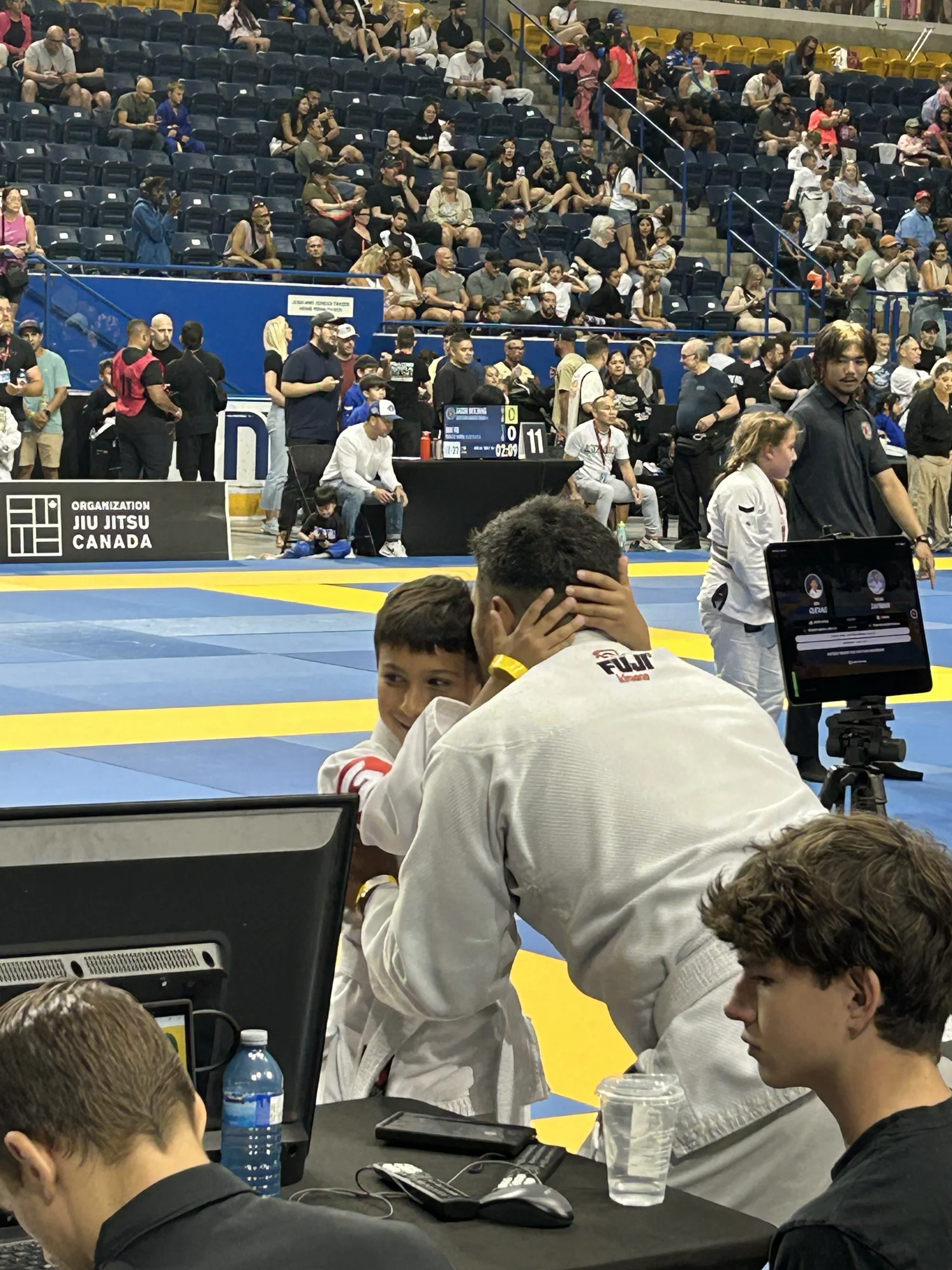
He was fine within a few hours. It turned out to be nothing serious. But standing there in that moment, I didn't know that, and I wasn't going to find out the hard way for the sake of a bracket.
He is going to have a hundred more tournaments. He gets one back.
I've thought about that decision more than I've thought about my own matches, and it's the reason I wanted to write this. Because if you had asked me a year ago what competition was for, I would have given you a vaguely correct answer about testing yourself.
Now I've done it, I've watched my kid do it, and I've made a decision that cost him a medal. And I have a much sharper answer.
And it started with a day that looked nothing like a highlight reel.
The Day Nobody Posts About
It started going wrong on Thursday, and it wasn't an opponent. It was a mattress.
I got into an Airbnb Thursday night and woke up Friday with my back feeling strange. I hadn't trained, hadn't lifted, hadn't done anything, so I assumed I'd strained it somehow, took some Advil, and kept Friday light.
Then I slept on that same bed again and woke up on tournament morning worse. The bed had no support at all. That was the whole story.
I spent Saturday morning on Advil and stretching, trying to unknot my own back, and I drove to that venue not feeling right and genuinely irritated that a bad bed was about to show up in my performance.
Somewhere in there I also learned that you weigh in wearing your gi. It was not entirely obvious to me that I would have to wear the gi and I had not noticed it in the rules, and a gi is not weightless.
And the Airbnb had no scale, so on tournament morning I had no way to check where I actually was. Ugh. No choice, so I went in blind.
Skipped breakfast, barely sipped water, and spent the drive doing weight math in my head about a number I thought I had comfortably handled, with no way to confirm it until I was standing on the official scale with everything on the line.
I made weight fine—PHEW!
But the hours of not knowing were entirely avoidable, and they cost me energy I would have liked back. A five-dollar travel scale would have bought me a normal breakfast and a calm morning.
Watching Is Harder Than Competing
I was at the venue from before 10 in the morning. My match was at 4.
Neo went first.
I watched my son get thrown at, throw back, get stuck, and fight his way to a win with that great takedown. Then, right at the end of the match, pretty much after he won, I watched him get hurt, and I made the call to pull him.
If you have ever coached your own kid, you know that watching is harder than competing. I spent a full tank of nervous energy before I ever put my own gi on.
Flat by 2:30
By 2:30 I was flat. Tired. Like I'd left my edge somewhere back in the parking lot.
I had eaten at noon; I'd been sitting for hours; I'd been up since early; my back was still complaining; and my kid was hurt (luckily feeling better by then).
That's the part that surprised me. Not the nerves—waiting around.
What fixed it was mundane. Get up. Move. Get a carb in. Then warm up hard and on purpose for about thirty minutes out, because a cold body reads as "I have nothing left" and a warm body reads as "I'm ready," and they feel almost identical from the inside.
The other thing that fixed it was lying down with meditation music on and my eyes closed, running the match in my head before it happened.
I put my white belt across my eyes to block the light and headphones on to drown out the world.
Not psyching myself up. The opposite. Getting quiet, breathing out long and slow, and picturing exactly what I was going to do when the match started. It cleared the fog. That weird all-day exhaustion lifted, and what lay beneath it was calm rather than frantic.
I walked out to that mat with one decision already made and nothing rattling around behind it.
If you're sending students to compete, that is the day they'll have. A bad bed, a rule they didn't know about, a long wait, a body that doesn't feel like it belongs to them, and six hours of trying not to burn out before their name is called.
I had not prepared for that.
Two Matches
The first one went exactly the way I drew it up in my mind countless times.
I got my grip. He was hunched over. I pulled him forward, slid into a kata guruma, and hit it clean. Mount.
But it wasn't smooth from there. We tussled, my foot got jammed in half guard, and I spent real time trying to unstick it before I could throw my leg over and rip the armbar. He tapped.
I should have felt great. Instead, I noticed I was exhausted in a way I have never been exhausted in a gym.
The second match I wasn't even ready for. I had my headphones on; I thought I had another 10 minutes before my next match, but they called my name.
I had to drop everything and go.
As the match started, my opponent was stiff, scrunched down, folded over, and ripping my grips off the second I got them. I could not establish anything. I could not throw him, because everything I own wants a guy who is upright.
So, I pulled guard, worked positions, took points where they were, threatened a submission he saw coming every time, and ran out of clock right before I was about to use a classic gi choke with my own lapel.
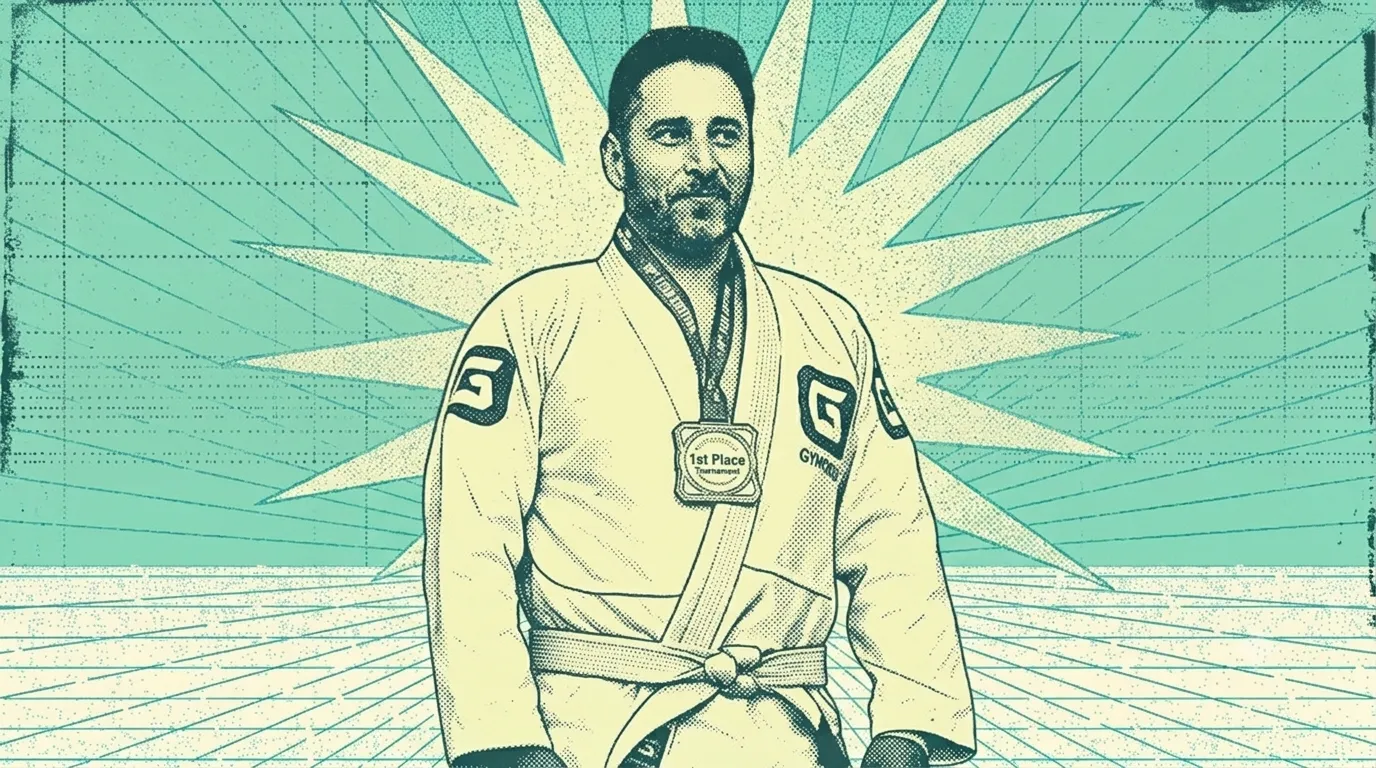
I won on points. That made it two matches, one submission, one points win, and gold in my division.

I'm 49. Next year I'm 50.
I competed in the 40-and-over master's bracket, and it turned out I was the oldest guy in it, which wasn't what I expected when I looked around that room and sized everybody up.
What Competition Showed Me That Training Never Did
Here's the honest part. I walked out of there with gold and a longer list of things I need to fix than I walked in with.
That's not a complaint. That's the entire value.
I roll hard. I have partners who are better than me. And because of what I do for a living, I get to train all over the world.
I drop into beloved customer academies in different countries, I show up at open mats where I don't know a single person, and I roll with strangers who have no reason to be nice to me.
If variety of training partners were the answer, I would have been covered.
I found three gaps in about eleven minutes of competition anyway.
- Grips. Nowhere I have trained, my own academy or anywhere else, has anybody stripped my hands off the way that second guy did. Training partners work with your grips. Even the strangers do. There's no medal on the line to make them mean about it, so I had no idea how thin that part of my game was.
- Gas tank. Competition adrenaline burns fuel at a rate that training rounds simply do not simulate. I was moving slower than I wanted to, and I felt every second of it.
- Takedowns. My standing game is kata guruma and o goshi, and both require an opponent who is upright and reaching. Give me a guy bent in half, and I don't have an answer. In match two, I didn't have one, and pulling guard wasn't part of the plan. It was a workaround. It worked, and I know exactly what it was.
You cannot get any of this from rolling. I don't care how hard your gym rolls or how many gyms your students roll at.
Nobody is going to rip a student's grips off with a referee watching and a medal on the line, and nobody is going to show them what their gas tank does at minute two of a match that actually counts.
Competition is the only honest audit of a student's game, and it hands them their next three months of homework for free.
The other thing it does is bind people together. I had people from my team in that room.
My son watched me compete, and I watched him. That is not something a good Tuesday night class produces. That is what a shared hard day produces, and it is the strongest culture-building tool sitting unused in most academies.
So push it. Not for the medals but for the culture.
Back to Neo
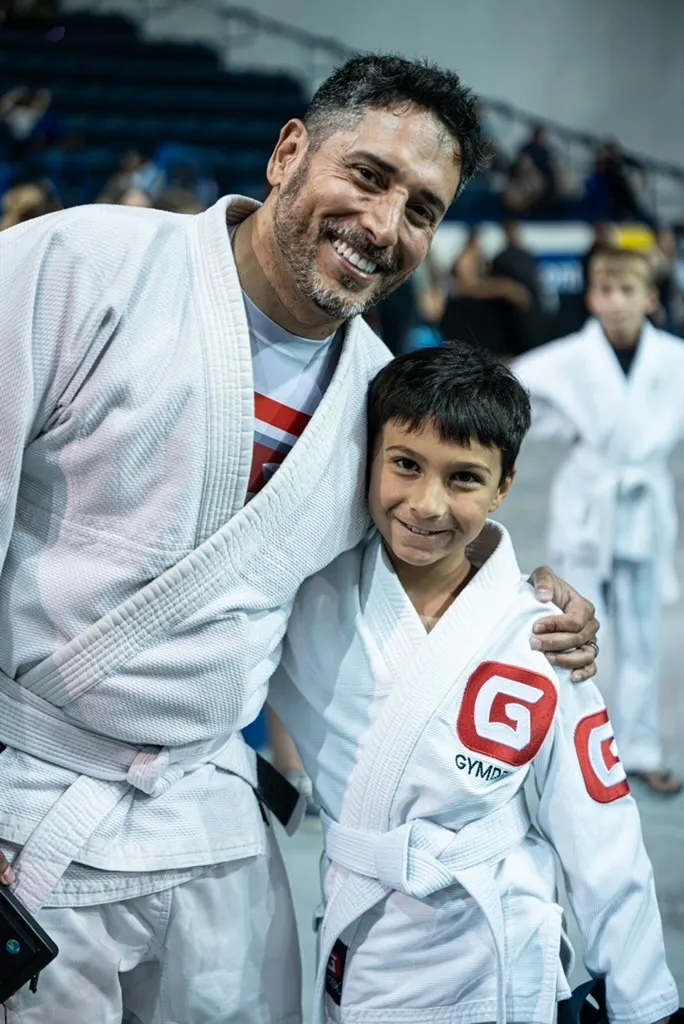
Here's the thing about pulling my son out of his final.
If I believed competition was about the medal, I would have let him fight. He wanted to. It was right there. Instead, I pulled him, and I want him to remember that his dad did that because it shows him the point.
The point is that you showed up, put yourself in front of a stranger who was actively trying to beat you, and discovered something true about yourself that you could not have found out any other way.
Neither of us needed the hardware to have gotten what we came for.
The Man Who Paid for It
I dedicated that tournament to my father, who passed away not long ago.
I said at the top that Saturday was my first jiu-jitsu tournament. It was not my first tournament. I competed as a kid, and I earned a black belt in Taekwondo, and I did all of that because my father put me in martial arts when we did not have the money for it.
I want to be clear about what that means. It was not a spare expense. There was nothing spare. He found the money somewhere and kept finding it, and I have no idea what he went without to do it.
Everything downstream of that decision is my whole life. The TKD black belt. The tournaments I fought as a boy while my mother watched from the bleachers, because my father was working.
That's the detail I keep coming back to. He never saw me compete. Not once. He was always at work, and the work paid for the lessons.
The absence and the gift were the same thing.
The habit of getting up after somebody puts me on my back came from those years too. And now, four decades later, I run a company that builds software for martial arts academies, which is not a coincidence and never was.
He never got to see me compete. Not as a boy, and not on Saturday. That's what I was carrying around that venue all day, and I'm not going to try to turn it into a lesson, because it isn't one.
But there is something in it for you, and it's the real reason I'm telling you.
Somewhere in your academy right now, there is a parent stretching to make tuition work. Maybe you know who they are, and maybe you don't. They are not thinking about it as an investment, and neither are you. It just looks like a membership.
You have no idea what you are forty years upstream of.
My father couldn't afford it. He did it anyway. And on Saturday his grandson hit a hip throw at 10 in the morning, and his son won a gold medal at 4 in the afternoon, and the man himself has been gone for a few weeks now and never saw a second of it.
So get your students on the competition mat. Not to collect medals. To find out what's real, and because you have no way of knowing which of them you are changing.
I'll see you at the next one. I'll be the guy working on his grips, throws and gas tank. Oss!
Gym management software that frees up your time and helps you grow.
Simplified billing, enrollment, student management, and marketing features that help you grow your gym or martial arts school.


FAQ
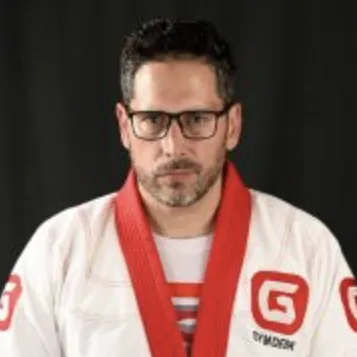
Alex has spent over a decade leading SaaS companies through growth stages—from scaling sales and customer success teams to running the whole show as CEO. He's held executive roles at GoSite, Kaseya, and Yodle, building a track record of turning customer-focused strategy into real revenue.
A lifelong martial artist, Alex holds a black belt in taekwondo and actively trains Brazilian Jiu-Jitsu and judo. That "white belt mentality"—always learning, always adapting—shapes how he leads Gymdesk and connects with the gym owners the platform serves. When he's not in the office, you'll find him on the mats or visiting gyms across North America to film Gymdesk Originals, the company's documentary-style video series.