
Martial Arts for Toddlers: How to Pick the Right Class (and Spot a Bad One)
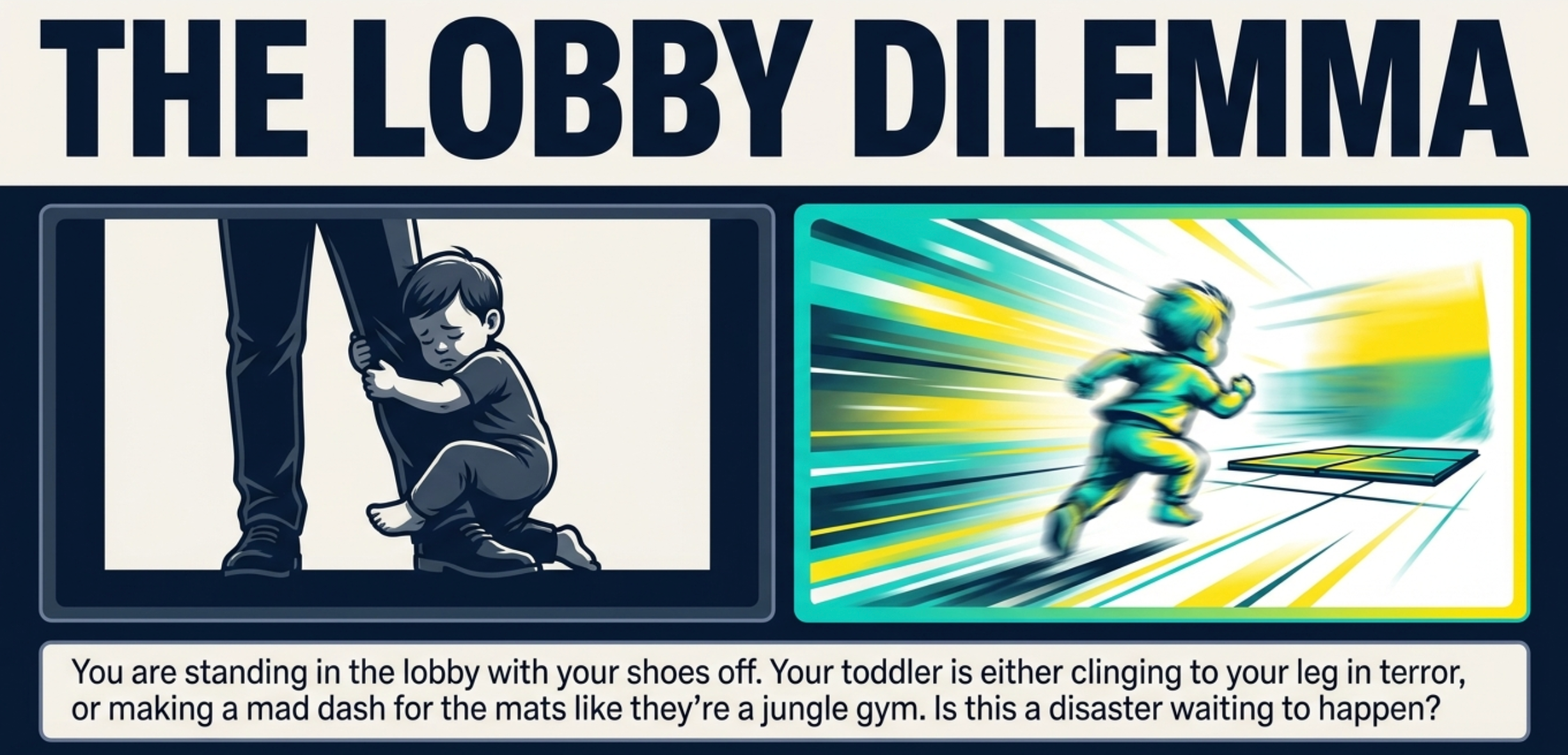
Is this going to work? You're standing with your toddler in the lobby. Your shoes are off, and both of you are watching the kids in class. This interaction generally goes in one of two ways.
Your toddler is either clinging to your leg or they're making a mad dash toward the mats like it's a jungle gym.
Is this a disaster waiting to happen?
It's the question every parent in that lobby is trying to answer. Is my toddler ready for martial arts? This guide gives you a clear, honest answer—and what to look for once you step onto the mats.
Can a Toddler Actually Do Martial Arts?
At age three, most toddlers are capable of participating in a martial arts program, so long as it's specifically designed for their age group.
It all comes down to two variables—the martial arts program and the toddler. Long, regimented classes are generally way too much for two-year-olds.
The training options open up around ages four and five, but they're still really dependent on the class structure.

Let's take a look at what happens developmentally with toddlers.
AGE |
DEVELOPMENTAL REALITY |
WHAT THIS MEANS FOR CLASS FORMAT |
2 |
Runs, climbs, mimics—but can't follow structured instruction yet |
Skip formal martial arts. Try parent-and-me movement classes instead. |
3 |
Short bursts of focus (3–6 min), basic imitation, limited sequencing |
30-min max, games-based, one concept per class |
4 |
Follows simple two-step directions, takes turns, basic motor control |
30–45 min, rotating activities every 5–7 min |
5 |
Better coordination, can hold a routine, early self-discipline emerging |
Up to 45 min, can handle simple sequences and light repetition |
Research from the CDC's milestone tracker backs this up—skills like hopping, balance, and coordination develop rapidly between the ages of three and five.
Combine that with attention spans of roughly two to five minutes per year of age, and you understand why toddler classes must look very different from older kids' programs.
What Each Martial Art Looks Like for Toddlers
There are obvious differences among the martial arts. That's not as important as an individual school's approach.
MARTIAL ART |
BEST STARTING AGE |
BEST FOR |
KEY WATCH-OUT |
BJJ |
3+ |
High-energy, tactile kids who love rough-and-tumble play |
Confirm play-first structure—not techniques or submissions |
Karate |
3+ |
Kids who do better with structure and routine |
Quality varies wildly—vet the program carefully |
Taekwondo |
4–5 best |
Coordination-focused kids who like movement |
Limited curriculum depth at age 3–4 |
Judo |
5–6 best |
Kids who already love rough-and-tumble play |
Ask about mats, instructor ratios, fall-training progression |
Striking arts (MMA, boxing, Muay Thai) |
Not for toddlers |
N/A |
Hard pass at this age; revisit at 6–8 |
BJJ for three to five-year-olds
Brazilian Jiu-Jitsu (BJJ) works surprisingly well for three- to five-year-olds. BJJ classes are ground-based, low-impact, and primarily focused on play.
At this age, the focus isn't on techniques or submissions; it's on movement, falling safely, and learning to interact with other kids.
At Renzo Gracie Niagara, Fernando teaches the 3-to-5 cohort break falls and chin-tucks specifically as winter safety—the BJJ application is hidden inside the play:
We pretend to not do BJJ… especially in Canada, we are in a very cold country. If they fall, they will not hit the back of the head.

Kids learn simple movements like bear crawls, log rolls, forward and backwards rolls. They spend most of their time in class playing games.
For a lot of three-year-olds, the class is also their first real time outside the family. Joe Garino at Unlimited Jiu-Jitsu designed his "Tiny T-Rexes" program around that reality:
For many of these children, it's their first social setting.
Here's what this looks like in action:
These classes are especially fun for kids because there's a significant amount of activity and interaction. It's easy to keep kids engaged because there's so much to do.
More on the play-based approach in 15 kids games that teach BJJ.
Karate for three to five-year-olds
Karate is an accessible entry point for parents who are interested in martial arts for their kids. At this age, the curriculum is simple. The focus is less about forms and more about:
- Building listening skills
- Learning to follow instructions
- Basic motor patterns
- Simple routines (e.g., bowing, lining up)
Good toddler karate programs look nothing like traditional adult classes. The pedagogy itself has to change—Mersina at Lion's Heart Family Martial Arts is direct about why:
If I taught the way I was taught growing up, I probably wouldn't have a studio. These kids would not be here.

Here's what these karate classes look like in action:
Depending on the program, some toddlers will spar or compete. This sounds horrifying, but toddlers are typically covered in protective equipment, and the judges are ready to step in if needed.
Taekwondo for three to five-year-olds
Taekwondo is very similar to karate—many schools offer a "Lil' Dragons" program for toddlers. Like karate, these programs are focused on structure, following instructions, and building routines.
Taekwondo is kick-heavy, so their program may be more dependent on line drills, movement, balance, and coordination. Here's what that looks like in action:
There's a downside here. The curriculum depth tends to be limited, which makes sense—most toddlers aren't ready for a full curriculum.
Taekwondo kids programs tend to hit their stride at around age five.
Judo for three to five-year-olds
Falling body weight is one of the biggest injury risk factors. Judo isn't as common in the United States because it involves foot sweeps, throws, and slams.
Toddlers aren't all that coordinated.
You'll want to verify that instructors have safety protocols in place and soft mats to ensure kids are safe.
Judo isn't an immediate dealbreaker, but parents interested in it need to ask detailed questions. Get detailed answers to questions about:
- Safety protocols (what they are)
- Mat quality (springboards or styrofoam support for mats is ideal)
- Instructor ratios
Most judo programs hit their stride at ages five to six.
The striking arts that aren't for toddlers
Kickboxing, boxing, Muay Thai, and MMA are not appropriate for toddlers.
Toddlers don't have the coordination, control, or emotional regulation for contact-heavy striking arts—even when programs claim to scale them down. If you see heavy bags, focus mitts, and glove work for three-year-olds, that's a deal breaker.
Your toddler shouldn't be worried about head kicks.
That said, most striking arts become appropriate around ages 6–8, once kids have the coordination and emotional regulation to handle controlled contact.
FOR GYM OWNERS READING THIS:
When a parent walks in, they've already filtered out anything that looks unsafe. They're not choosing between BJJ and karate—they're choosing between environments.
Your trial class needs to feel calm, structured, and enjoyable inside 30 seconds, because that's how fast the decision gets made.
What a Good Toddler Class Actually Looks Like
A good toddler class follows a set structure, working with child development stages.
This is a crucial detail. Many schools attempt to force kids into a predefined structure—the same one used in their teens and adult classes.
That's no good.
Experienced instructors create age-appropriate classes that accommodate toddlers' short attention spans and compensate for emotional volatility.

Paul Gilman at Argyle Jiu-Jitsu—who taught kindergarten in South Korea for six years before opening the school—runs his Little Eagles class on a tight rotation:
Every six minutes, we are pretty much changing what we're doing. So, the kids get used to that.
Here's a brief breakdown:
ELEMENT |
WHAT GOOD LOOKS LIKE |
RED FLAG |
PRIORITY |
Class length |
30 min (age 3), 45 min max (ages 4–5) |
60-minute classes |
Critical |
Activity rotation |
New activity every ~6 minutes |
One long drill that runs the whole class |
Critical |
Curriculum |
One simple concept per class |
Multiple techniques crammed into one session |
High |
Teaching style |
Games-based throughout the whole class |
"We play games at the end" |
High |
Class size |
10–20 students with assistant instructors |
One instructor for 20+ kids |
Critical |
Parent visibility |
Clear policy (watch from lobby or not) |
Vague rules, parents pulled in randomly |
Medium |
None of these are optional. They're how toddler brains are designed to work—and the "What Good Looks Like" column is what separates a program built for three-year-olds from one that just allows them in.
Toddler classes, if they're done well, are consistently in a state of change. This isn't optional—it's how toddler brains are designed to work.
If you want to keep toddlers engaged, you'll need to work with their attention spans.
FOR GYM OWNERS READING THIS:
If your toddler program loses students continually after month two, you're probably dealing with an attention or structure problem. Consistently rotating activities, teaching a single concept per class, and a 30-minute ceiling are requirements.
You can use martial arts software like Gymdesk to manage family scheduling, ensuring that classes are segmented by age.
Red Flags Parents Should Watch For in a Trial Class
What does a bad martial arts program look like? What are the odds that parents know what a bad program looks like?
You can spot a bad program in 30 minutes (or less) if you know what you're looking for.
Here's a short list of red flags to watch for:
WHAT YOU SEE IN THE TRIAL CLASS |
WHAT IT ACTUALLY TELLS YOU |
A single drill that runs 20–30 minutes |
The instructor doesn't understand toddler attention spans |
Toddlers forced to hold rigid stances for long stretches |
Adult curriculum being applied to kids who can't physically sustain it |
Any form of sparring or hard contact |
Either dangerous or the instructor confuses "tough" with "good" |
Yelling or verbal abuse used as primary discipline |
Likely culture problem; will get worse over time, not better |
One instructor alone in a room of 20+ kids |
Safety issue; no way to give individual attention |
Belt promotions in the first month |
"Belt factory" school—promotions are revenue, not progress |
"Testing" of any kind on day one |
The school is selling rank, not teaching skill |
Toddler classes shouldn't feel like boot camp—you're not whipping these young kids into shape. You're giving them a gentle, nurturing, play-driven introduction to martial arts.
If classes feel like chaos, it's a problem. Okay, well, how do parents choose the right class for their toddlers?
How to Pick the Right Class for Your Toddler
Here's a simple action plan for parents. This will teach you how to choose the right class for your toddlers.
- Match the kid, not your expectations. Kids with a lot of energy tend to do well in movement-intensive classes (e.g., BJJ programs). Sensitive or more introverted kids may prefer the structure offered in environments like karate or taekwondo.
- Always start with a trial first. Instructors are asking parents to take a risk with their child. A trial period gives parents the time they need to evaluate a martial arts program to see if it's right for their child. No trial = no sign-up.
- Ask about student retention. A good toddler program can keep students past the second month. Encourage parents to ask instructors about this directly.
FOR GYM OWNERS READING THIS:
Take some time to think through the logistics. Have parents in your classes enrolled two or more kids? Are they dealing with a busy schedule? Look for ways to offer sibling discounts, back-to-back class times, and simple scheduling.
Though they'd hesitate to admit it, convenience matters a lot to parents.
The Right Class Beats the Right Art
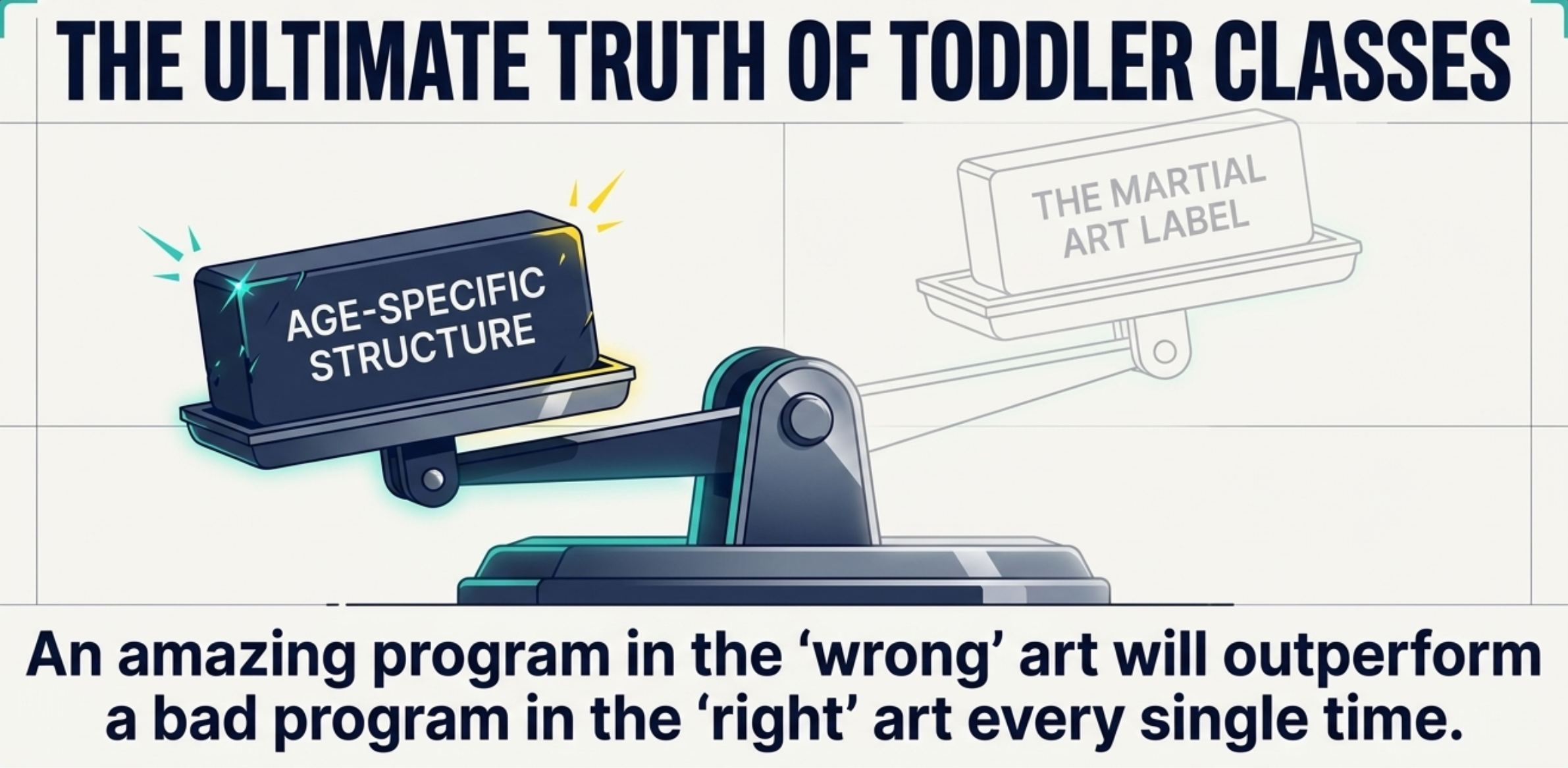
If your toddler is at least three, the question isn't which martial art.
It's whether the program is built for three-year-olds—short classes, rotating activities, one concept per session, instructors who teach through play.
An amazing program in the 'wrong' art will outperform a bad program in the 'right' art every time.
The right class is out there. You'll recognize it in the first 30 minutes.
FOR GYM OWNERS READING THIS:
Toddler programs are hard to run—segmented age groups, family scheduling, parent communications, trial conversion. Gymdesk handles the operational layer so you can focus on the teaching. Free 30-day trial, no credit card.
Gym management software that frees up your time and helps you grow.
Simplified billing, enrollment, student management, and marketing features that help you grow your gym or martial arts school.


FAQ
Toddler Martial Arts FAQs
.webp)
Andrew McDermott is a gym owner, Brazilian Jiu Jitsu brown belt, and digital marketer. He’s on a mission to build premier, high-stakes grappling tournaments, world-class academies, and a championship team of high-level athletes.