

There's a particular kind of Sunday that gym owners know about. You've got a notebook, a card reader, a bank statement, and a growing suspicion that at least four people haven't paid you since spring.
Steve at Academia Jiu-Jitsu ran his gym that way for a while. He was handwriting invoices and asking his own students to remind him to collect payment.
That's the job billing software for gyms is supposed to take off your hands. It charges members automatically on their renewal date, retries the cards that fail, and tells you who's behind before it becomes a conversation you dread.
For most owners this lands as a relationship problem before it lands as a money problem.
Jorge Britto at Etobicoke BJJ put the before-and-after plainly.
Before automated billing:
there's people not paying, training for three months... how are you going to talk to the guy? That's terrible. This kills everything.
And after:
you don't need to be hustling after people. The payment's there, pre-done.
That's the real stake. Not the money you lose, though you do lose it. The student you can't look in the eye at the door because you're three months into pretending you didn't notice.
KEY TAKEAWAY:
For most owners this lands as a relationship problem before it lands as a money problem. Not the money you lose, though you do lose it. The student you can't look in the eye at the door because you're three months into pretending you didn't notice.
So here are ten platforms that handle gym billing, chosen for reach and depth—everything from the incumbents most owners already know to the specialists that own their niche. Every price below was pulled from the vendor's own pricing page in August 2026, because half of what's written about this category is quoting 2023.
A note on who this is for. Everything here is weighed for an owner with 50 to 400 members and no finance staff, running the business between classes. If you manage forty locations, the answers change.
What Actually Goes Wrong With Gym Billing
Billing fails in three distinct places, and they need different fixes. Owners tend to solve the first one and assume they're done.
Nobody got charged. The membership was never set to renew, or it lapsed, or it was a cash arrangement someone forgot. This is the one automation fixes outright.
The charge was attempted and failed. Expired card, insufficient funds, a bank that flagged it. The member still wants to train.
They have no idea anything went wrong.
Somebody's behind and nobody's chasing. The system knows. It just isn't telling you in a way that prompts action.
The scale of the third one is worth sitting with. In QuickBooks' 2026 Small Business Late Payments Report, nearly 3 in 5 businesses (59%) said at least some of their invoices were overdue by 30 days or more—up from 47% the year before. That's a nine-point jump in twelve months.
The same report found 74% of small businesses still aren't fully automated when it comes to managing and paying bills, and named manual processes the number one internal reason payments run late. It surveyed roughly 5,000 small business owners and decision-makers.
Those numbers cover small business broadly, not gyms specifically. But a gym collecting recurring dues from 150 households is about as exposed to manual billing drift as a business can get.
We'll keep you in the loop with fresh content, podcasts, how-to guides, tool reviews, and product exclusives.
What to Look For in Gym Billing Software
Five things separate a billing system from a card reader with a nicer app. Read the reviews further down against this list.
Automated recurring billing
The baseline. Every member has a plan, a rate, and a renewal date, and recurring billing charges them without you opening anything. Gym membership billing software lives or dies on this feature.
What to check is whether it handles the messy cases.
Mid-month joins, family plans with different rates, a member who pays quarterly, someone frozen for eight weeks with a shoulder injury. Those are the ones that push owners back into manual workarounds.
Mark Gutman runs ITC New York around a full-time job as an attorney. One of his daily habits is pulling the list of members billing that week to project incoming revenue—no spreadsheet export, just the list.
That's the tell of billing that's actually working. It becomes something you read, not something you do.
Failed-payment recovery
This is the leak most owners never see, because it doesn't look like a leak. It looks like churn.
Recurly's churn benchmarks put involuntary churn—members lost to a failed payment rather than a decision—at 20% to 40% of total churn across subscription businesses. Those are people who wanted to stay.
KEY TAKEAWAY:
Involuntary churn—members lost to a failed payment rather than a decision—accounts for 20% to 40% of total churn across subscription businesses. The recoverable share is high when something's actually trying. Timing decides it: a system that waits a month has already lost most of what it could have saved.
The recoverable share is high when something's actually trying.
Recurly's failed-payment recovery data shows 72% of at-risk subscribers recovered through retry and dunning tools, with recovered subscribers staying a median of 141 additional days.
Timing decides it. 90% of recovered transactions happen within the first ten days of the failure. A system that waits a month has already lost most of what it could have saved.
So look for automatic retries, automatic card updating, and a member-facing nudge that doesn't require you to send it.
Ask one more question that most feature lists won't answer: does it tell you why a payment failed?
Mark's past-due view at ITC distinguishes a declined card from a removed card from a charge that was never attempted. Three different problems, three different fixes, and only one of them needs a phone call.
ACH and direct debit, not just cards
Cards are the default and the expensive option. A platform that only does cards is quietly charging you for the privilege.
The cost gap is large enough to matter at 100 members, and it gets its own section below.
A way to chase arrears that isn't you
Overdue members are a workflow, not a report. The question is whether the software runs the first three steps of that workflow—notice, reminder, escalation—before it lands on your desk.
Most platforms will show you a past-due list. Fewer will work it.
PCI compliance you inherit
If you take cards, PCI DSS applies to you. It's the card industry's security standard, and your processing agreement requires it. Opting out isn't on the menu.
The practical upshot: let the software hold the card data. A spreadsheet of card numbers on the front-desk laptop is the version of this that ends badly.
What Gym Billing Software Actually Costs in 2026
Half this category doesn't publish a price. That's the first useful finding.
Here's every platform in this comparison, sorted by published entry price rather than by preference. Every figure in this table and in the reviews below was read off that vendor's own public pricing page on 5 August 2026—no third-party roundups, no cached numbers. Prices move, so check the source before you sign.
Platform | Published price | Model | All features included? |
Vagaro | $30/mo list ($23.99 promo) | Per bookable calendar | No |
Gymdesk | $75–$200/mo with Gymdesk Payments | By member count (up to 250, then by quote) | Yes |
CrossHero | $99/mo | Flat | Yes |
Mindbody | From $79/mo per location (quote-only) | Per location, tiered | No |
Zen Planner | Studio from $99/mo | By member count + add-ons | No |
PushPress | $0 / $159 / $229/mo | Tiered + modules | No |
Gymflow | $159/mo | Flat, unlimited users | Yes |
Glofox | Not published | Demo required | n/a |
ABC Fitness | Not published | Demo required | n/a |
LegitFit | Not published | Demo required | n/a |
Three things fall out of that table.
"Free" and "starting at" are doing work. PushPress publishes a $0 plan. It carries a card processing rate of 4.99% + $0.30, against 2.89% + $0.30 on the $159 Pro tier.
On $15,000 of monthly card volume, that spread is roughly $315 a month. More than the paid plan costs.
Call it free if you like. The cost just moved into processing.
Add-ons are where the real number hides. Zen Planner's Studio plan starts at $99, and its CRM and marketing module (Engage) is a separate $249, with a branded app at $39. PushPress lists Grow at $329, Train from $79, and a branded app at $81–$97, with a full stack around $559. If you price only the base tier, you're pricing a fraction of the product.
Per-what matters more than how-much. Vagaro charges per bookable calendar, which is cheap for a solo trainer and awkward for a gym with eight coaches who all teach. Mindbody charges per location. Gymdesk and Zen Planner scale on member count.
A $30 entry price and a $99 entry price can invert completely once you plug in your actual roster.
If you want a number to compare against, work out what you're losing now. Multiply your monthly rate by the members you suspect are behind, then add the hours you spend on it.
Quick check: estimate your billing leakage
The right billing software can help you plug up leaks in your process. It means: revenue delayed or missed when payments fail, plus hours spent chasing down follow-ups.
Check to see how much you may be losing:
Card vs. ACH: Where the Money Actually Goes
Every payment method has a cost, and at 100-plus members the difference compounds into something you'd notice.
Card processing runs most small businesses 1.5% to 3.5% all-in, plus a fixed fee of roughly 10 to 30 cents.
The largest slice of that is interchange—the portion paid to the card-issuing bank—which accounts for 70% to 90% of total processing cost. Visa and Mastercard's average combined credit interchange hit 2.36% in 2025.
ACH, which is a bank-to-bank transfer, runs 0.5% to 1.5%, or a flat $0.25 to $1.50 per transaction. Most small businesses land around 50 to 75 cents. Across the board it's 50% to 90% cheaper than card.
There's a fuller breakdown of gym payment processing fees separately, including what to look for in a payment processor agreement.
Put a roster against it. A hundred members at $150 a month is $15,000 of monthly volume. At a 2.9% card rate that's about $435 in processing.
Move even half those members to ACH at a flat 75 cents and the same month costs you roughly $255.
That's a little over two thousand dollars a year, for a change your members will not notice.
One thing worth watching if you're signing a multi-year deal. In April 2026 a federal judge granted preliminary approval to a revised $38 billion Visa and Mastercard settlement that drops average credit interchange by 0.10% for five years and caps standard consumer card rates at 1.25% for eight.
Card costs are moving. Ask any vendor whether your rate is contractual or whether it follows the market down.
The practical move is to make ACH available and make it the easy choice at signup. Offer it as the default on the membership form and card becomes the exception rather than the norm.
The Best Gym Billing Software, Compared
Ten platforms. Gymdesk is ours and it's first: it's the best fit for an owner-operated gym or martial arts school, and its section says plainly where it isn't. The other nine follow, each with what it does better than Gymdesk does.
Gymdesk

We built this for martial arts academies, gyms, gymnastics clubs, Pilates and yoga studios, and dance schools.
On billing specifically: recurring, scheduled, and on-demand payments through Gymdesk Payments, automatic overdue notifications, a past-due view that distinguishes a declined card from a removed one from a charge never attempted, and revenue reporting that projects what's coming in this week.
Every plan includes every feature, so you never pay extra for a feature. Optional extras like additional locations, door access, and a branded app are priced separately.
Rank and belt tracking, attendance tracking, point of sale, marketing automation, and a gym website builder come with the plan rather than as modules, which is the design decision most of this comparison turns on.
KEY TAKEAWAY:
The design decision most of this comparison turns on: everything included at every tier (billing, attendance, rank tracking, marketing, website) versus features priced separately as modules. If module math is what's been burning you, the flat-price options change the entire shortlist.
Owners who've switched tend to talk about it in workflow terms.
Maria at Alliance Fort Mill had "10 different pages and tabs open" before, collecting and hand-entering paper attendance cards. She calls the switch "probably one of the best decisions within the academy."
Joey at Roll Society describes billing that "goes from point A to point C".
Misho Ceko runs two Chicago MMA locations around a university operations job. As he puts it, "my nine to five and then my five to nine".
That's the constraint the product is really designed for.
Where it's a weaker fit: the native integration library is shorter than Mindbody's or PushPress's, there's no consumer marketplace sending you bookings, and if you need enterprise multi-club billing operations, ABC is built for that and we're not.
Published pricing: $75/mo Micro, $100/mo up to 100 members, $150/mo up to 150, $200/mo up to 250, all with Gymdesk Payments and all on the pricing page. Past 250 members, you talk to us for a price. Use your own payment processor instead and it's $25 a month more ($40 on Large). 30-day free trial.
Best for: Owner-operated gyms and martial arts schools with up to 250 members that want billing, attendance, and rank tracking in one system without module math.
PushPress
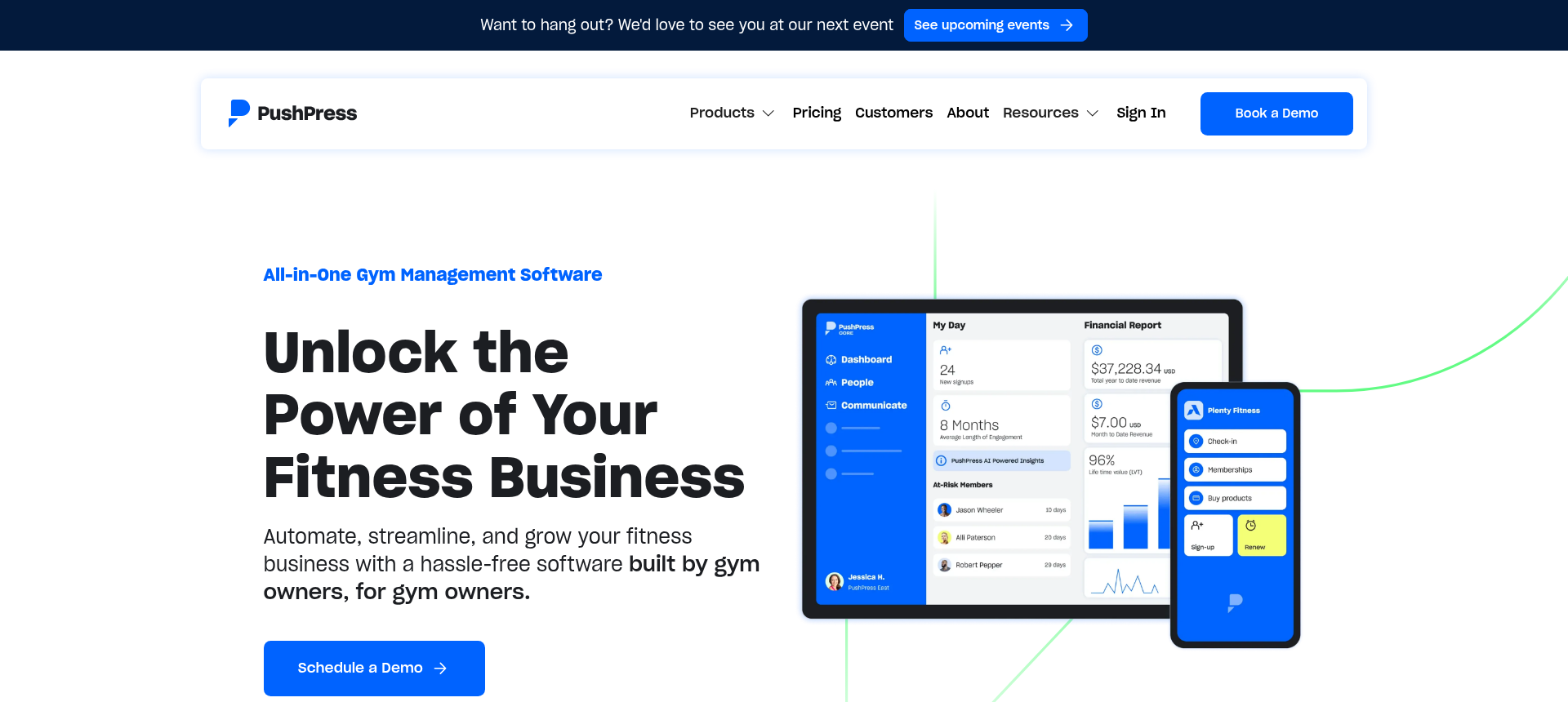
PushPress is built for CrossFit boxes and functional-fitness gyms, and it's the most modular product in this group. Core handles billing, scheduling, and members; Grow is the CRM; Train handles workouts; the branded app is separate again.
Billing is solid and the free tier is genuinely usable for a small operation, with the processing-rate caveat above. Payments run through Stripe.
The thing to model before you commit is the stack. Core Pro at $159 plus Grow at $329 plus a branded app puts you north of $550 a month, and several of the features owners assume are standard sit above the free tier: rank tracking, integrations, kiosk mode.
Published pricing: Free $0 (4.99% + $0.30 card), Pro $159/mo (2.89% + $0.30 card, 0.79% + $0.30 ACH), Max $229/mo (2.75% + $0.30), Grow $329/mo, Train from $79/mo, branded app $81–$97/mo, full stack ~$559/mo.
Best for: CrossFit and functional-fitness gyms that want deep workout tracking and will pay for the full stack.
Zen Planner
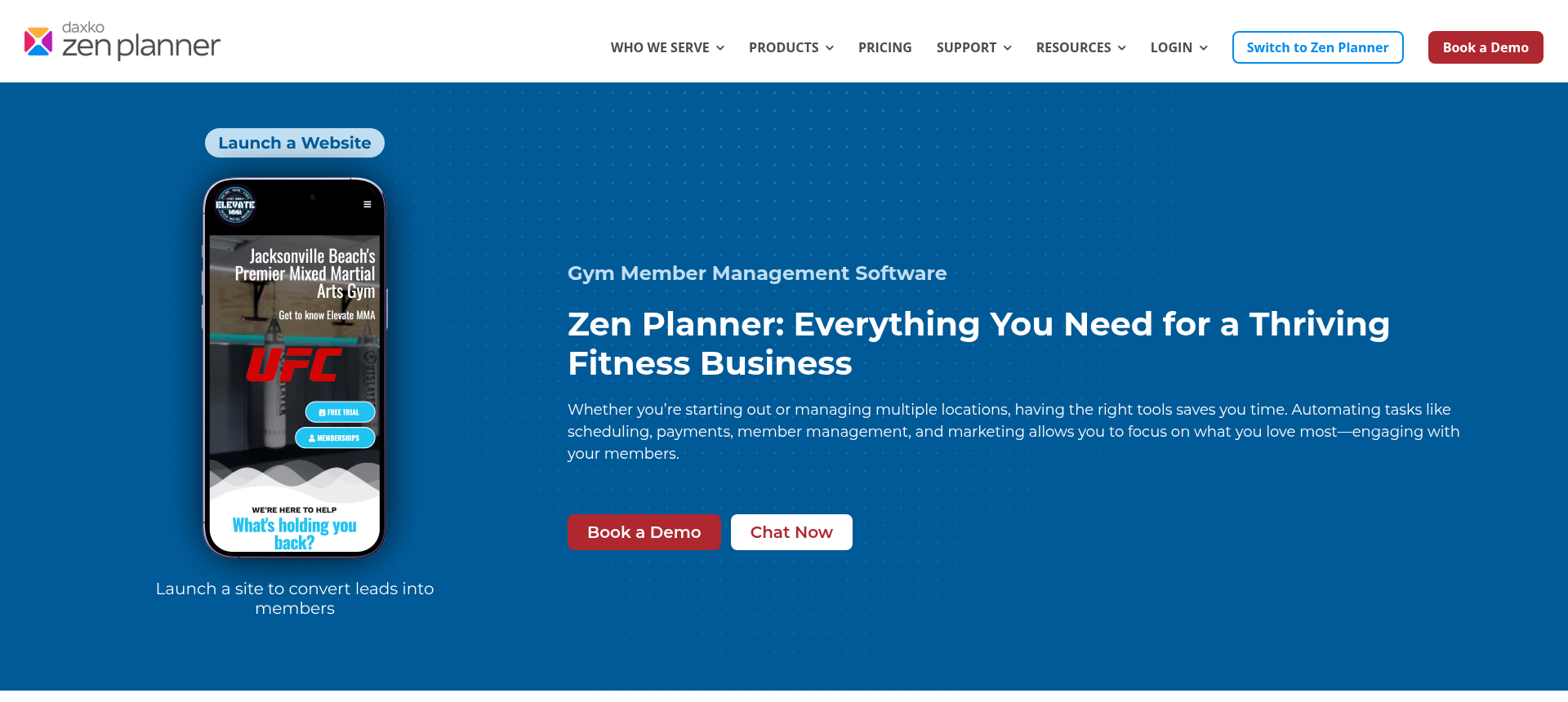
Billing does what you need it to do, but the friction is structural: the base Studio plan is the scheduling and membership core, and the pieces most gyms consider essential are priced separately.
Zen Planner has been in martial arts and functional fitness a long time, and it shows in the depth: belt and rank tracking, workout tracking, and a genuinely deep reporting set. Its SugarWOD integration is a real advantage for CrossFit programming.
Published pricing: Studio from $99/mo, scaling with member count. Engage (CRM and marketing) $249/mo. Branded app $39/mo. The full member-count ladder isn't published.
Best for: Established martial arts schools and boxes that want depth and have budget for the modules.
Glofox

Glofox, now part of ABC Fitness, targets boutique studios and has the slickest member-facing app in this group. The booking and class experience is strong.
Pricing isn't published. The page advertises transparency and then asks for a demo, which is a combination worth noticing.
The specific thing to test if you're evaluating it: ask what happens when you change the price of a membership that existing members are on, and whether that change cascades to all of them.
Published pricing: None. Demo required.
Best for: Boutique studios that prioritize member app experience and are comfortable negotiating price.
Mindbody
Mindbody is the biggest name here and the one your members may already have on their phone. Its consumer marketplace genuinely sends bookings, which no other platform on this list offers.
For a gym, the fit question is whether you want to be in a marketplace that also lists the studio down the street. Some owners love the discovery. Others find they're paying to be comparison-shopped.
Billing is capable and the product is broad. It's also priced per location and built for a wider set of businesses than gyms. Salons and spas are core customers, and the workflows reflect that.
Published pricing: Starter from $99/mo per location (the pricing page currently shows a $79 promotional rate). Accelerate and Ultimate are quote-only.
Best for: Studios that want marketplace discovery and don't mind sharing the shelf.
ABC Fitness
ABC Fitness plays at the top of the market. It claims to serve 40% of US clubs, and its billing operation, including full-service collections, is the most industrial in this comparison.
That's the fit signal, in both directions. If you run multiple high-volume clubs with a real back office, this is a serious option. If you're one gym with 120 members, you'll be buying an enterprise implementation to solve a problem a $99 product solves.
Published pricing: None. Demo required.
Best for: Multi-location clubs and high-volume operators with staff to run the system.
Vagaro
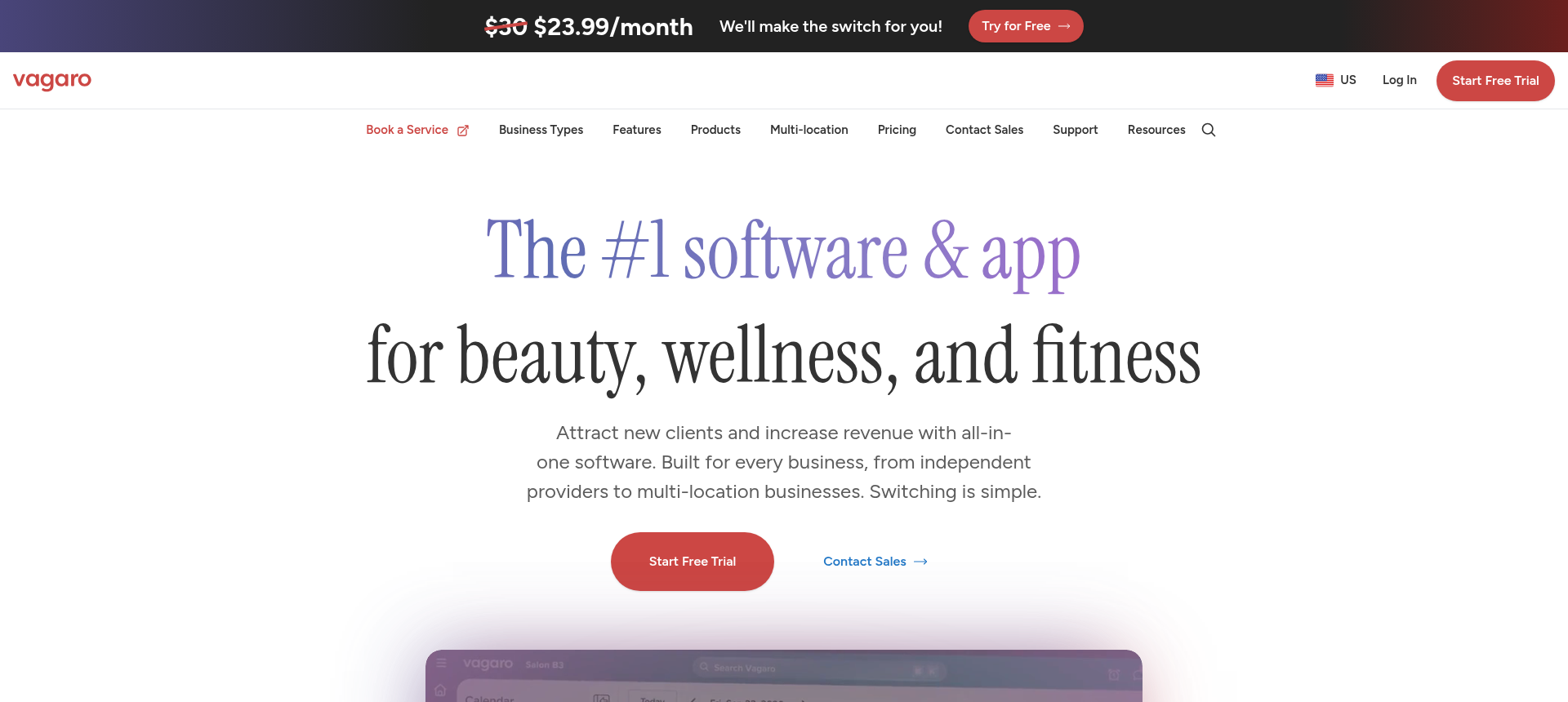
Vagaro is the broadest product here by industry coverage: salons, spas, medical spas, barbers, and fitness all run on it. You get booking, payments, memberships, a website builder, an online store, and inventory.
The breadth is the draw and the catch. Nothing in it is built around how a martial arts school or a box actually operates, and there's no rank or belt tracking.
Pricing is per bookable calendar, meaning per person who needs their own schedule. Cheap at one, less cheap at seven.
Published pricing: $30.00/mo list, currently $23.99/mo promotional, for one bookable calendar. Scales through 7+ calendars.
Best for: Owners running a mixed business under one roof, or a studio with one or two instructors.
Gymflow
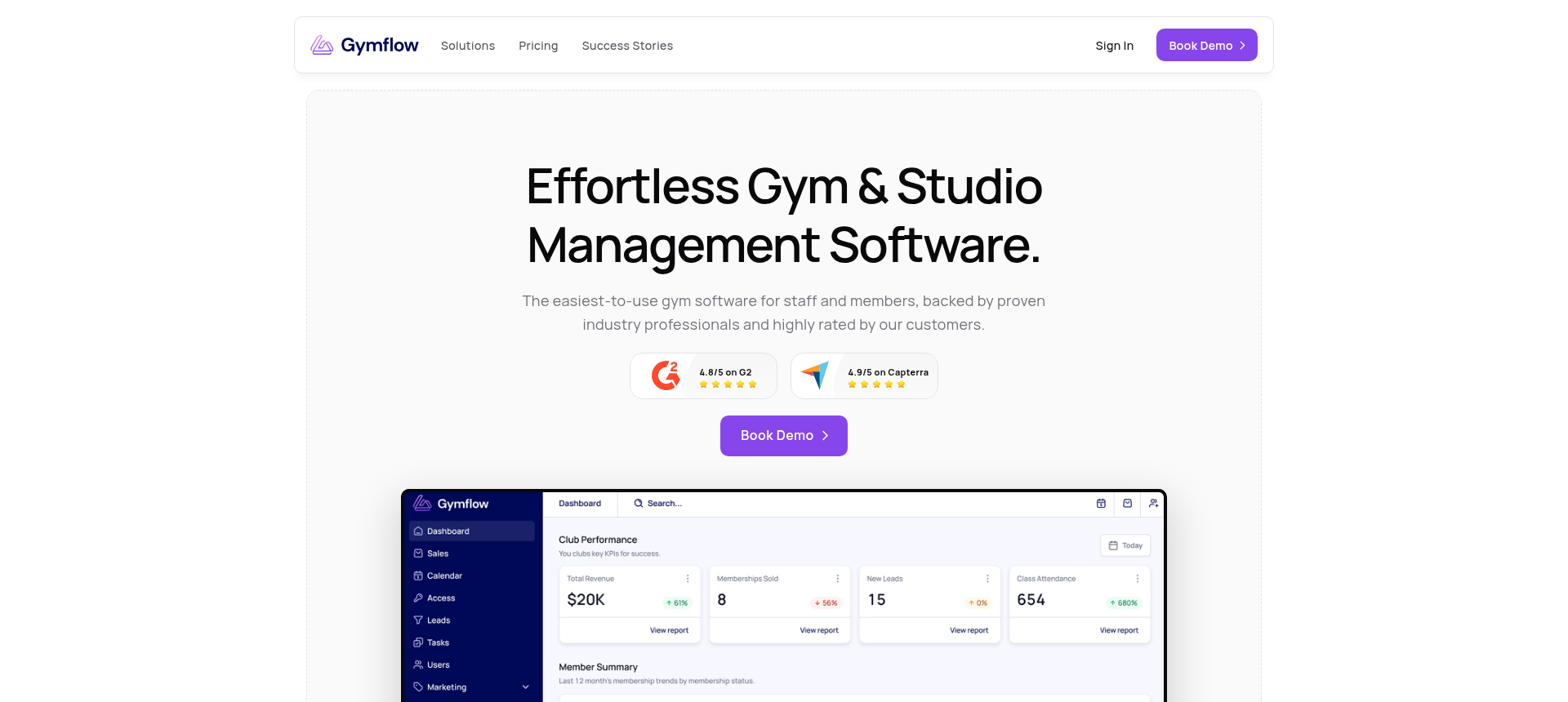
Gymflow has done something the rest of this category hasn't: it charges one price for everything. One plan, $159 a month, all features, unlimited users and staff, no contracts, 30 days free.
If you've been burned by add-on math, that's a real proposition. There's no tier to get upgraded into.
It's a newer product and the native integration list is short, though Zapier and access-control integrations are there. Payments run through Stripe.
Worth flagging: older comparisons of Gymflow, including the earlier version of this post, describe a three-tier plan at $103, $150, and $199 with a per-transaction fee on top. That model is gone. Anything still quoting it is out of date.
Published pricing: $159/mo, single plan, unlimited users, 100 SMS included.
Best for: Gyms that want everything included and hate pricing surprises.
LegitFit

LegitFit keeps the feature list deliberately short, which is the point. Member management, booking, payments, reporting, a website builder, branded apps, and not much else to learn.
For an owner who has bounced off two platforms already because they were too much, restraint is a feature.
There's no published price. You get a demo and a custom quote.
Published pricing: None. Demo required.
Best for: Owners who want the smallest workable tool and don't need a deep integration library.
CrossHero
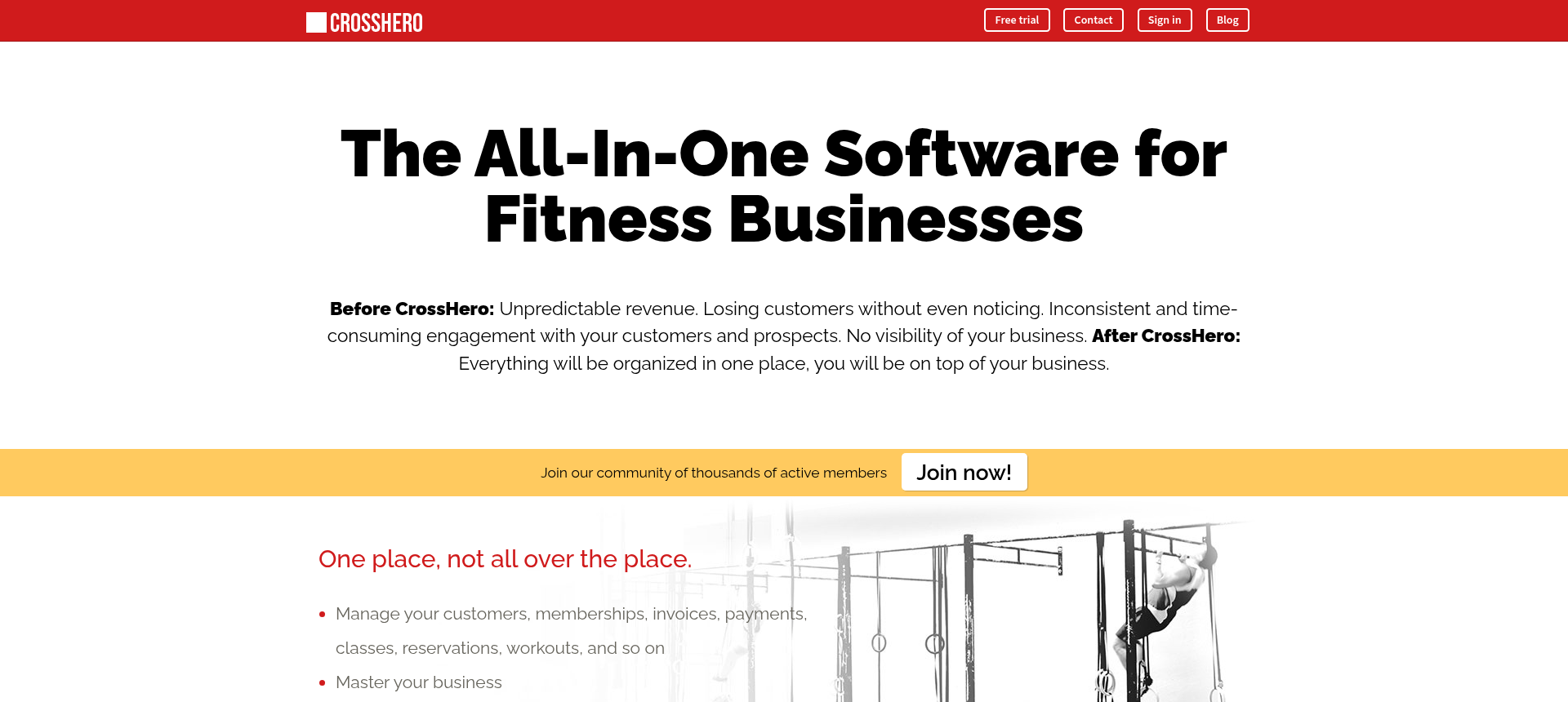
CrossHero is aimed at functional fitness and includes a workout whiteboard, membership enforcement, digital waivers, and live classes. Its roots are in Spanish-speaking markets and support is strongest there, though the product runs in English.
It has also moved to flat pricing: $99 a month, every feature included, no add-ons, free trial without a card. That's a change from how it used to sell, and it makes CrossHero one of the two genuinely all-in prices in this comparison.
Published pricing: $99/mo, all features included.
Best for: Functional-fitness gyms that want everything for one flat price and don't need US-hours phone support.
Billing Software for CrossFit and Functional Fitness Gyms
Boxes have a billing profile that class-based studios don't, and it changes the shortlist. Here's what shifts.
Punch cards, drop-ins, and open gym live alongside memberships. A box typically sells unlimited memberships, 3x-a-week memberships, 10-packs, drop-ins for travelers, and open-gym-only access. Billing has to handle a member who's on a plan and buys a 10-pack for their spouse, without you creating a duplicate membership to do it.
Workout tracking is usually a separate purchase. This is where the module math bites hardest. PushPress prices Train from $79 on top of Core.
Zen Planner includes workout tracking in Studio and integrates with SugarWOD. CrossHero puts the whiteboard in its $99 flat plan. Same capability, three very different bills.
Nutrition and coaching add-ons multiply the line items. If you sell nutrition coaching or personal training alongside class access, check whether those bill through the same system or land in a second one.
Annual competition and event fees are lumpy. An in-house throwdown or a team registration is a one-off charge to a subset of members. On-demand charges to a filtered group is the feature that makes this painless.
For the flat-price route, CrossHero at $99 and Gymflow at $159 both include everything. For depth of programming, Zen Planner's SugarWOD integration is the strongest tie-in. PushPress has the largest CrossFit install base and the most modular bill.
If you're specifically shopping for billing software for crossfit gyms, there's a fuller breakdown of CrossFit gym management software.
How to Chase Overdue Members Without Losing Them
This is the part of billing nobody wants and every gym needs. Jorge's line about people training for three months unpaid is the failure state—by the time it's a conversation, it's already damaged something.
The fix is a sequence that runs before you get involved.
Day 0: the retry. The card failed. Good software retries on a schedule rather than once, and attempts to update the card automatically. Most recoverable failures resolve here, and the member never learns anything happened.
Day 1 to 3: the automatic notice. A short message to the member, sent by the system, saying the payment didn't go through and here's the link to fix it. Not from you.
This matters more than it sounds—when the software sends it, it's administrative. When you send it, it's personal.
Day 7 to 10: the second nudge. Recovery odds drop sharply after ten days, so this is the last cheap attempt. Still automated.
Day 14: your list. Now it's yours, and it should be short. This is where the why matters. A removed card is a different conversation from three failed retries, and a charge that was never attempted is your setup error, not their problem.
Day 30: the policy decision. Suspend access, move to a payment plan, or write it off. Whatever you choose, choose it in advance and let the system apply it. Deciding case by case at the door is how gyms end up with people training free for a quarter.
Two things to check in any platform you're evaluating. Can you see past-due members grouped by reason rather than one undifferentiated list? And can the reminders go out automatically, without you approving each one?
If you want the fuller version of this, the guide to streamlining gym billing covers the policy side in more depth.
How to Test Gym Billing Software in Two Weeks
Demos show you the happy path. Two weeks with real data shows you what you're buying.
Load ten real members, not clean ones. Include a family plan, a mid-month join, someone on a freeze, and someone who pays quarterly. The awkward cases are the whole test.
Run a full billing cycle. Let it charge. Watch what the money looks like on the other side and how long it takes to arrive.
Break a payment on purpose. Use a test card that declines. Then time the system: when does it retry, when does the member hear from it, when does it reach your past-due list, and does it tell you why it failed?
Do one refund and one proration. These are the two operations owners perform under time pressure with a member standing in front of them. If either takes more than a minute, you'll feel it weekly.
Price your actual stack. Write down every module you'd need and total it. Then add processing on your real monthly volume at the rate that tier gives you.
Ask about your data. Can you export members, payment history, and attendance yourself, without asking support? The answer tells you how the next switch will go.
How to Choose
Match the tool to how you actually run the day, not to the longest feature list.
If you want billing, attendance, rank tracking, marketing, and a website in one bill that doesn't move when you turn a feature on, that's what Gymdesk was built to be. For an owner-operated gym with up to 250 members, that's the shortest path to getting paid on time.
Where something else fits better, take it. If module math is what's been burning you, the two flat-price options are CrossHero at $99 and Gymflow at $159, both all-in.
If you want depth in martial arts or functional fitness and will pay for modules, Zen Planner and PushPress are the serious contenders. If you want marketplace discovery, that's Mindbody and nothing else here. If you run multiple high-volume clubs, ABC.
Whichever way you go, do the two-week test with a broken payment in it. The platform that handles a declined card gracefully will save you more money and more relationships than the one with the better demo.
Start a 30-day free trial and run a real billing week through it.
Gym management software that frees up your time and helps you grow.
Simplified billing, enrollment, student management, and marketing features that help you grow your gym or martial arts school.


FAQ
Gym Billing Software FAQs
The questions owners ask most often when they're shopping this category.

Sean has spent the last decade creating content that helps businesses—small and not so small—grow smarter to allow operators to do more of what they love. You know, the fun stuff.
From shipping and international logistics to web development and marketing, he's done the work (not just the words) to scale retail and service businesses efficiently.
You can find his work at Sendle, Shogun, The Retail Exec, Gymdesk, and more.