
How to Manage a Gym: The 2026 Operator's Playbook

More Americans belong to a gym than ever.
A 2025 Health & Fitness Association report counted 81 million US fitness-facility members—an all-time high, up 5.2% over the prior year, with roughly seven billion visits logged across the year.
That is great news and a warning at the same time. A growing market pulls in more operators, more boutique studios, and more competition for the same members down the street.
The gyms that win the next few years won't be the ones with the shiniest equipment.
They'll be the ones run well—where onboarding is deliberate, the numbers are visible, the busywork is automated, and the owner spends their attention on people instead of paperwork.
This guide is how to do that. It's built around six disciplines every gym manager has to run, plus the modern stack—AI, hybrid programming, member apps, and the handful of metrics that actually predict whether your gym grows.
Where it helps, you'll hear from real operators pulled from dozens of gym-owner interviews, because the best playbooks come from people doing the work, not from theory.
One quick distinction before we start: a gym manager runs the day-to-day; a gym owner owns the outcome. Sometimes they're the same person, sometimes not.
This guide serves both—the difference mostly shows up in which decisions you own versus execute.
What "Managing a Gym" Actually Means in 2026
A decade ago, managing a gym meant keeping the lights on, the equipment working, and the front desk staffed. That's table stakes now.
Today the job is closer to running a small, data-driven service business than tending a facility.
The shift is visible in the numbers. The share of members who pay but never show up has fallen from roughly 10% to 4.6%—an all-time low, per the Health & Fitness Association's 2025 data.

Members are using their memberships more, comparing experiences more, and leaving faster when the experience is thin.
So the modern manager's job splits into six disciplines:
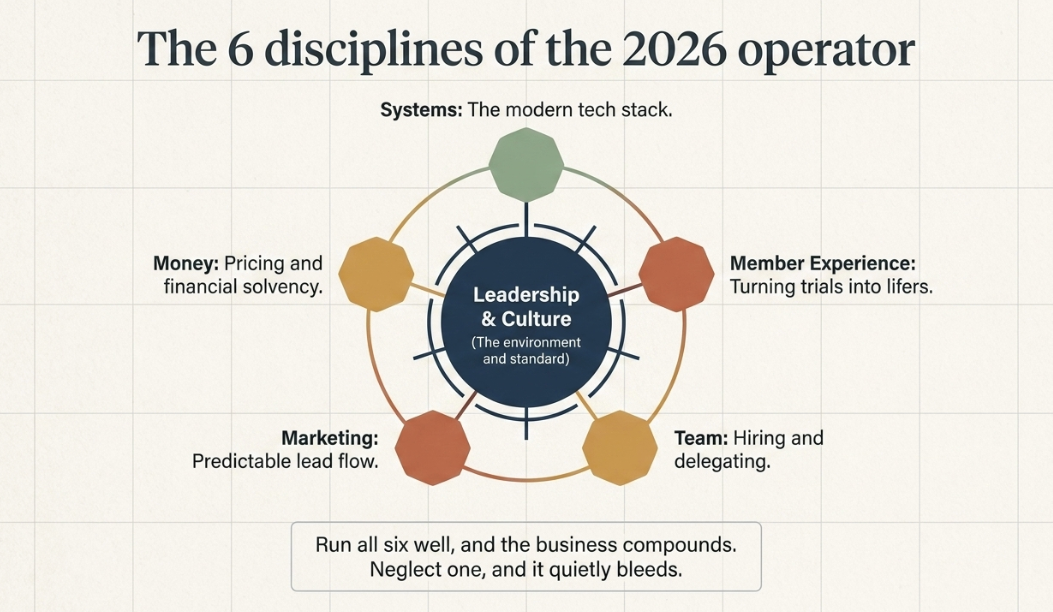
- Leadership and culture. The environment you build and the standard you set.
- Member experience and retention. Turning trials into members and members into long-timers.
- Team. Hiring, training, and delegating so the gym runs without you in the room.
- Marketing and growth. A predictable flow of the right new members.
- Money. Pricing, revenue, reserves, and the financial numbers that keep you solvent.
- Systems and the modern stack. The software, automation, and data that do the repetitive work.
KEY TAKEAWAY:
Managing a gym in 2026 comes down to six disciplines—leadership and culture, member experience and retention, team, marketing, money, and systems. Run all six reasonably well and the gym compounds. Neglect one—usually money or retention—and it quietly bleeds.
The rest of this playbook takes them in turn.
Lead With Culture and Community (Not Equipment)
Ask a struggling owner what they need and they'll often say new equipment or a bigger space. Ask a thriving one what keeps members and they'll say the people. Culture is the product, not a perk you add later.
The data agrees. ABC Fitness's 2025 member report named community the single strongest predictor of retention, with one in three members interacting with a fitness community daily—and nearly half of Gen Z members saying community is the reason they stay.
Even good operators guess wrong about what members want. East Austin built a laundry membership and an open-all-day space for solo drilling and lifting. Almost nobody used either. "People don't self-organize their training," Bill says. "They want to know someone's going to be there to help them get better."
Mike O'Hara, who runs South Austin Fitness, puts the priority order plainly:
"Here, we lift each other up and them weights. The weights is a second. The people come first."
— MIKE O'HARA, South Austin Fitness
That isn't soft talk—it's a competitive moat.
Bill Watts, co-owner of East Austin Jiu-Jitsu Parlor, did the math on why that holds during a Gymdesk webinar. Most members will train "on average twice a week for their entire life," which makes it a hobby, and "hobbies need to be fun first. And if you make it fun, people are going to come back more… they're going to get better faster, and then they're going to have more fun."
Jeff at Academia Jiu-Jitsu calls it the "hamburger theory": commodity training is available on every corner, so don't sell the cheeseburger. What keeps a member driving past three closer gyms is the experience and the people they'd miss.
The strongest cultures tend to come from a clear "why."
Mersina Giampapa at Lion's Heart Family Martial Arts named her gym after a volunteer trip and made community its non-negotiable priority—and the result is a gym that has never lost a single black-belt student.
Her rule of thumb captures the mindset:
"Make money to do karate, don't do karate to make money."
— MERSINA GIAMPAPA, Lion's Heart Family Martial Arts
As a manager, culture is something you operate, not something you hope for.
Set the tone at the door, train staff to learn names, design events that get members talking to each other, and protect the standard when a toxic member threatens it.
The cost of getting this wrong is real—owners who take on bad-fit members out of desperation consistently report that one poisonous personality does more damage than an empty spot ever would.
(For tactics that build day-to-day belonging, see our guide on member engagement in your gym.)
Make Member Experience and Retention the Core Metric
If you only fix one discipline, fix this one.
The Health & Fitness Association's 2025 benchmarking report put the median member retention rate at 66.4%—meaning a typical gym loses about one in three members a year. Our member retention calculator shows what each point of retention is worth to your gym.
The 2026 Gymdesk Benchmark breaks that down further with observed data on where members actually go, and when.

And research on new joiners is harsher still: an academic review found nearly half of new members quit within the first six months (Sperandei et al., 2016). Acquisition gets the attention; retention pays the bills.
Retention is mostly won in the first few weeks.
Two Bridges Muay Thai in Manhattan systematizes it with what they call the "Three Friend Rule"—every newcomer meets three people before touching a mat: the front desk, a coach, and a training partner. Nobody wanders a strange gym alone, and first-visit conversions climb.

The other early-churn killer is throwing beginners in too deep.
When 10th Planet Long Beach added a dedicated beginners class, membership at one location jumped from 6 to 40—a single schedule change. A clear on-ramp keeps the people who would otherwise quit frustrated.
A repeatable first-month sequence does most of the heavy lifting. It doesn't have to be elaborate—just deliberate:
- Before day one: a warm confirmation, what to expect, and what to bring, so the first visit feels handled.
- First visit: a greeter, a brief tour, and an introduction to at least one coach and one member—nobody left standing alone.
- First two weeks: a scheduled check-in (in person or automated) to catch friction early.
- First month: a milestone moment—a small win, a progress note, a "glad you're here"—that turns a trial into an identity.
A few retention levers worth building into your operation:
- Structured onboarding. A defined first-visit and first-month experience, not an organic introduction. (More in our member onboarding guide.)
- Proactive outreach to the quiet ones. Members who stop showing up rarely announce it—they fade. Staff communication is one of the highest-leverage retention tools there is; older HFA research found nearly 90% of members value contact from staff, and every two staff interactions in a month produced an extra visit the next.
- Group and small-group programming. That same research found members who don't train in groups carry a 56% higher cancellation risk.
Don't lose sight of the front of the funnel either. Conrad at Carlson Gracie Hackney argues the real crisis isn't churn at all—it's declining new-member acquisition—which reframes retention as one half of a two-sided number you have to watch. (When members do leave, our breakdown of why members leave your gym covers the recoverable cases.)
Build and Keep a Team That Runs Without You
A gym that only works when the owner is on the floor isn't a business—it's a job with overhead. The goal of team management is to make yourself replaceable in the day-to-day.
That starts with hiring for fit and training for consistency, then writing down how things are done so quality doesn't live only in your head.
Clear roles, simple SOPs, and a few documented procedures let a new hire deliver the same member experience you would. (Our guides on hiring gym staff and staff policies and procedures go deep here.)
Good systems are what let leadership scale past the owner's personal reach.
Luiz Costa runs seven Octa Jiu-Jitsu locations and still makes a point of knowing names—something only possible because the operational load is carried by software and a trained team rather than his memory and a clipboard.
A few things are worth documenting before you hire your next person:
- The member journey: how a lead is greeted, onboarded, and followed up with.
- The opening and closing routines: what gets checked, cleaned, and locked.
- The "if this, then that" calls: how staff handle a complaint, a billing dispute, or an injury.
The other half of building a durable team is growing leaders from inside.
Alliance Fort Mill turned kids it taught years ago into blue-belt teenagers who now help run the kids' classes—a student-to-instructor pipeline that keeps quality high and turnover low.
The members who already love your culture make your most reliable future staff.
It's also worth knowing who actually runs your tools. Across dozens of gym interviews, a clear pattern emerges: the owner coaches, and a spouse, front-desk lead, or general manager runs the management platform day to day.
At Renzo Gracie Niagara, the front-desk lead proactively audits attendance to catch members who forgot to check in—and processes their payments for them.
Train that person well—they're your real operations engine. And know when to stop doing it all yourself; our guide on when to outsource gym management duties maps the line between delegating and abdicating.
Market the Gym Like It's Part of Operations
Marketing isn't a separate department you visit when membership dips—it's a system that runs alongside operations.
The fitness market is actively growing into your funnel: ABC Fitness counted 7.2 million new US gym joins in 2025, 47% of them Gen Z.
The members are out there; the job is being findable and worth choosing.
Word of mouth remains the consensus number-one channel among gym owners—but the owners who rely on it most are also the ones who obsess over the product experience that generates it.
Referrals are a byproduct of a gym worth talking about.
The reliable second wave is search. NEO Martial Arts ran on roughly 90% word of mouth until they put up a real website—then Google leads turned into near-daily trial bookings. As co-owner Patrick Teruel describes the shift:
"Every time I answer a call, it's like, 'How did you hear about us?' And it's like, 'Through Google, through Google, through Google.'"
— PATRICK TERUEL, NEO Martial Arts
Community events are one of the most underrated funnels because they convert without a hard sell.
Academia Jiu-Jitsu's annual "Spring Smash" grew from a casual barbecue into a sponsor-backed gathering of 140 to 150 people—and because every visitor signs a digital waiver on arrival, each event quietly adds hundreds of contacts to a database that makes the next promotion easier.
The event sells the gym; the system captures the lead.
Beyond referrals and search, the highest-ROI moves are usually unglamorous: pick a location that markets for you (near schools, inside a complex, in an underserved pocket), run community events as low-pressure funnels, and capture every visitor's contact info so a single open house feeds months of follow-up.
Build it into a repeatable plan rather than a panic response—start with our gym marketing plan guide and the broader fitness marketing playbook.
Run the Money With Real Numbers
Plenty of likable gyms close because the owner never got comfortable with the finances. You can't manage what you won't look at—and money is the discipline owners avoid most.
The good news: a well-run gym is a genuinely viable business.
In the Health & Fitness Association's 2025 benchmarking data, the median operator grew revenue 9.9% and net membership 5.5% in 2024, and 91% of operators expected further revenue gains the following year. The opportunity is real; the discipline is what captures it.
A handful of financial fundamentals separate the solvent from the strained:
- Keep pricing simple and transparent. Confusing tiers and hidden fees erode trust before a prospect even joins. If you're setting or resetting rates, our membership pricing calculator helps you sanity-check the tiers.
- Use founder or graduated pricing as a loyalty lock. 10th Planet's Inland Empire location climbed from $79.99 to $140 as it filled, with early members keeping their rate—a reward for early risk that also reduces churn. Octa locked in pioneer members the same way.
- Diversify revenue beyond the base membership. Personal and small-group training hit historic-high participation in 2024 (22.6% and 32.3% of members)—both are margin you may be leaving on the table. After-school programs, camps, and merch are others. Model what a new stream does to the top line with our gym revenue calculator.
- Hold a reserve. Equipment breaks and rent rises; a cushion keeps a bad month from becoming a crisis.
- Don't run cash-only. More than one owner has openly regretted skipping real payment processing—it costs members and revenue.
Two numbers deserve special attention.
The first is your breakeven—the member count and revenue at which the gym pays for itself. Knowing it turns every decision from a guess into a calculation, and our gym break-even calculator gets you the number in a couple of minutes.
The second is your target size, and bigger isn't automatically the goal.
Plenty of well-run gyms deliberately cap growth—one judo club holds around 150 members on purpose—because past a certain point the intimacy and quality that retain members start to erode. Decide what scale you actually want before you chase it.
You don't need a finance degree, but you do need your key numbers in front of you.
Patrick at NEO Martial Arts describes the entire job in one glance at his dashboard:
"I see the numbers right in front of me. What's due, what's outstanding, what's projected, what's been paid. And I'm like, that's all I need."
— PATRICK TERUEL, NEO Martial Arts
For the deeper mechanics, see our guides on pricing your gym programs and the bookkeeping metrics that drive growth.
Put Your Systems on Autopilot
Every discipline above generates repetitive work—billing runs, missed-class follow-ups, attendance logs, birthday messages.
The managers who stay sane don't do that work faster; they stop doing it manually. Your software should run the gym's routine so you can run its relationships. Not sure how many hours the busywork is costing you? Our gym admin time calculator puts a number on it.
The biggest unlock is automated communication.
Marty Herrick runs Adayama Jiu-Jitsu around a full-time job and leans on automated emails for retention—missed-class nudges, milestones, birthdays—to the point that members reply to messages he didn't know went out:
"It makes it look like you are much more omnipresent than you actually are."
— MARTY HERRICK, Adayama Jiu-Jitsu
There's a threshold to respect, though.
Below roughly 100 members, personal outreach beats automation—Matthew at Triple 7 Jiu-Jitsu still texts anyone who's been gone two weeks. Above it, you can't sustain that by hand, so the trick is automation that sounds human.
As Jeff at Academia frames it, your systems should "emulate the one-to-one experience" rather than read like a corporate blast.
None of it works without clean attendance data, which means making check-in frictionless. Misho Ceko installed a check-in kiosk at Chicago MMA for a blunt reason:
"One of the hardest parts is getting people to check in for class. Everyone's trying to sneak in."
— MISHO CEKO, Chicago MMA
Get check-in right and everything downstream—retention flags, coaching conversations, revenue projections—runs on real numbers.
A purpose-built platform like Gymdesk ties attendance tracking, billing, and automated marketing into one system, which is what lets a single operator run what used to take a front-office team.
(If you're still evaluating, start with our overview of the best gym management software and what it costs.)
Manage the Modern Stack—AI, Hybrid, Wearables, and Data
This is where most "how to manage a gym" advice stops short, and where you can get ahead. Members already live in a connected, AI-assisted, app-first world—managing a gym in 2026 means meeting them there.
Where AI actually helps (and where it doesn't yet)
AI isn't a gimmick at the member level anymore—ABC Fitness found 61% of members already use AI-driven fitness-tracking tools and nearly half use AI wellness apps daily.
On the operations side, the realistic wins are narrow but real: drafting member communications, scoring and routing new leads, flagging churn risk from attendance patterns, and speeding up scheduling.
The churn-flagging piece doesn't even require fancy AI to start—it requires watching the data your retention software already collects.
Shogun West BJJ uses attendance tracking proactively, spotting who has gone quiet and reaching out before a lapse becomes a cancellation.
That's the pattern to automate: let the system surface the at-risk member, then have a human make the call. Keep AI and automation on the repetitive and predictive work; keep human judgment on culture, coaching, and the hard conversations.
Hybrid and on-demand as an operating model
Hybrid—in-person training plus digital or on-demand content—is now a management decision, not just a product.
The global fitness-app market is projected to grow from about $12 billion in 2025 toward $34 billion by 2033 (Grand View Research), and members increasingly expect something between classes.
You don't need a production studio; Neo Martial Arts films short content on a set day each week and pushes it through their member app. Treat digital touchpoints as a retention and reach lever, not an afterthought.
Wearables and the member app
The member app is becoming the front door to your gym—announcements, check-in, content, and progress all in one place.
Connected devices and wearables raise the baseline of what members expect to see and track.
You don't have to integrate every device on the market; the higher-value move is making the app the one place a member checks in, books a class, reads your announcements, and watches their progress, so the relationship lives on their phone between visits.
Decide deliberately how your gym engages with the rest; our piece on fitness trackers in your gym weighs the tradeoffs, and a real member app turns the phone in every member's pocket into your most-used touchpoint.
The KPIs every operator should watch
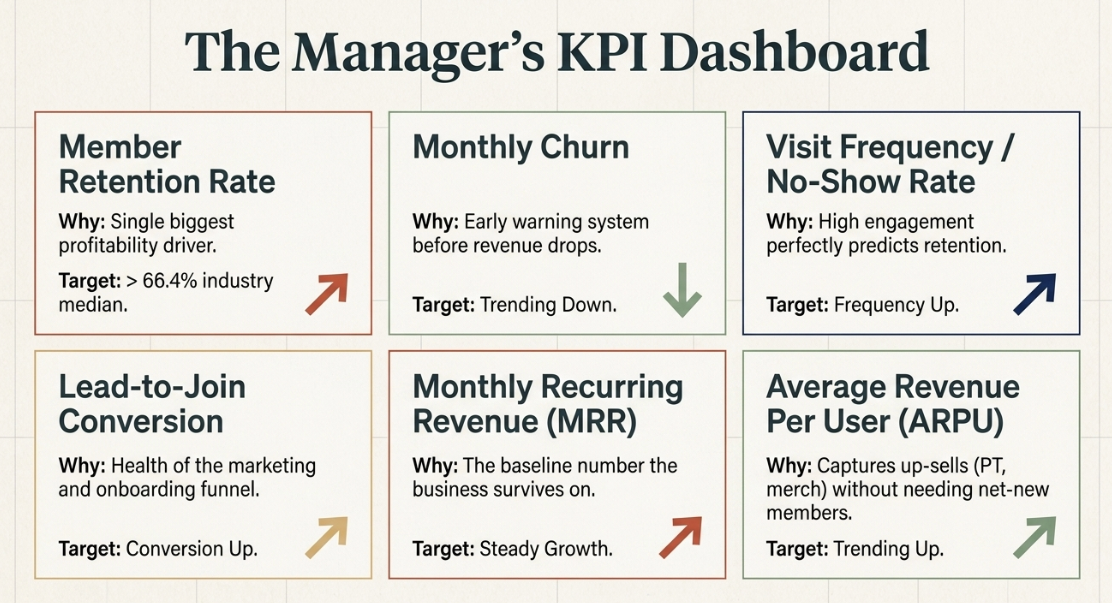
You can't manage the disciplines above without measuring them. A practical management dashboard tracks a handful of numbers:
Metric | Why it matters | Healthy direction |
Member retention rate | The single biggest driver of profitability | Above the ~66% industry median |
Monthly churn / cancellations | Early warning before it shows up in revenue | Trending down |
Visit frequency / no-show rate | Engagement predicts retention | Frequency up, no-shows down |
New leads → trials → joins | Health of the growth funnel | Conversion rate up |
Monthly recurring revenue (MRR) | The number the business runs on | Steady growth |
Revenue per member (ARPU) | Catches pricing and upsell slack | Up via add-ons, not just rate hikes |
Most of these come straight out of your management platform's reporting if your data is clean.
For industry baselines to compare against, our gym membership statistics roundup and the real-owner numbers in gym growth from eight owners are useful yardsticks.
Common Gym Management Mistakes to Avoid
Most gyms don't fail from one big blunder—they erode from a handful of avoidable habits. The patterns that show up again and again across struggling operations:
- Skipping the beginners' on-ramp. Throwing newcomers into advanced classes is the fastest way to lose them in month one.
- Taking bad-fit members out of desperation. Short-term revenue, long-term culture damage—and far harder to undo than to prevent.
- Over-scheduling. Twenty classes for twenty members spreads attendance thin and makes the gym feel empty. Match the schedule to the demand.
- Running cash-only or on manual systems. It costs revenue, hides your numbers, and breaks the moment you try to scale.
- Guilt-tripping members who leave or pause. A graceful exit brings people back; a guilt trip guarantees a bad review.
- Flying blind on the finances. The owners who avoid their P&L are the ones surprised by a bad quarter. Look at the numbers before they force you to.
Notice the throughline: almost every one is a management failure, not a coaching or facility one. That's the point—the gym lives or dies on how it's run.
The Gym Manager's Operating Rhythm
Knowing the six disciplines is one thing; running them on a schedule is another. The managers who stay ahead don't rely on memory—they run a cadence, so nothing important waits until it becomes a fire.
Martial arts gyms make that rhythm harder, because the day comes in bursts—"there's class and everyone's gone. Class and everyone's gone," as Bill Watts puts it. Leave that time unplanned and it will run you over. Block it well and, in his words, it can "make it seem like you don't even have a job."
Here's the rhythm in brief:
- Daily: review check-ins, clear billing flags and failed payments, respond to new leads fast, walk the floor.
- Weekly: call or text the members who've gone quiet, glance at your KPI dashboard, hold a short staff huddle, schedule next week's classes and content.
- Monthly: review the P&L and MRR, run one-on-ones with staff, audit retention and churn, ship the month's marketing push.
- Quarterly: revisit pricing, run a deeper churn and acquisition review, plan the next big community event, reassess what to automate next.
That cadence is exactly what we've turned into a free, ready-to-use Gym Management Operating Checklist—a daily/weekly/monthly/quarterly task list across all six disciplines that you can hand to a manager or work from yourself. See for yourself:
| Metric | Healthy direction |
|---|---|
| Member retention rate | Above the ~66% industry median |
| Monthly churn / cancellations | Trending down |
| Visit frequency / no-show rate | Frequency up, no-shows down |
| Leads → trials → joins | Conversion rate up |
| Monthly recurring revenue (MRR) | Steady growth |
| Revenue per member (ARPU) | Up via add-ons, not just rate hikes |
Build the rhythm once and the gym stops surprising you—even on your busiest days. If your problem is specifically volume, our guide on managing a busy gym goes deeper on peak-hour operations.
The Gym Manager Role: Who Actually Runs All This
Everything above assumes someone is running the six disciplines day to day.
Sometimes that's you.
Eventually—if the gym is working—it's a person you hire and hand the keys to. Either way, it's worth being clear about what the role actually is, what it takes, and what it costs, because you're either filling it yourself or paying someone to.
A gym manager runs the operation; a gym owner owns the outcome.
The manager handles the day to day—staff, schedules, member experience, the cleaning and the check-ins, the complaints, the billing runs—inside the policies and budget the owner sets. In an owner-operated gym those are the same person wearing both hats.
In a larger club they split, and the split is exactly the "make yourself replaceable" move from the team section: the owner steps back to strategy and the number, the manager runs the floor.
What the job requires is mostly not on paper.
You don't need a degree to manage a gym, and you don't need a personal-training certification—both help, neither is the point.
What actually separates a good manager from a warm body at the front desk is operational: can they lead a small team, hold a standard, read a P&L without flinching, and handle an upset member without making it worse.
Industry experience matters because it compresses the learning curve, not because of the credential. If you're hiring, weight the interview toward "walk me through how you'd handle a failed-payment run and a member threatening to quit in the same afternoon," not toward the resume.
What it pays depends on the gym, not the title.
A gym manager in the US averages around $70,000 in total pay—roughly $63,000 base plus commissions and bonuses—on a range that runs about $54,000 to $92,000 (our gym manager salary breakdown has the full picture).
Gym owners mostly clear $50,000 to $86,000, but the range is far wider—$30,000 to $242,000+—because an owner's take follows the gym's profit, not a salary line (how much gym owners make breaks it down by gym type and margin).
That's the whole difference in one number: a manager is paid for the work, an owner keeps what's left after everyone—including the manager—is paid.
Which is the argument for running the six disciplines well in the first place. The better the gym is managed, the more there is left over for whoever owns the outcome—and the easier it is to hand the day-to-day to someone else and still trust it runs the way you'd run it.
Manage Less, Lead More
The throughline of every well-run gym is the same: the owner automated the repetitive disciplines so they could spend their attention on the human ones.
The numbers stay visible, the busywork runs itself, and the manager is free to do the thing software can't—build a community people don't want to leave.
You don't have to fix all six disciplines this week.
Pick the one that's leaking—usually retention or money—tighten it, then move to the next. Put a real operating rhythm in place, let your systems carry the load, and lead from the floor instead of the back office.
When you're ready to put the systems half of that on autopilot, Gymdesk brings attendance, billing, automated marketing, reporting, and a member app into one platform built for gym operators—with a free trial so you can run your gym easier before you commit.
Gym management software that frees up your time and helps you grow.
Simplified billing, enrollment, student management, and marketing features that help you grow your gym or martial arts school.


FAQ
Frequently asked questions
The questions gym owners and managers ask most often when they're trying to run a tighter operation.

Sean has spent the last decade creating content that helps businesses—small and not so small—grow smarter to allow operators to do more of what they love. You know, the fun stuff.
From shipping and international logistics to web development and marketing, he's done the work (not just the words) to scale retail and service businesses efficiently.
You can find his work at Sendle, Shogun, The Retail Exec, Gymdesk, and more.