Jiu-Jitsu for Law Enforcement: Safer Control, Less Force

Most American police officers get somewhere between four and eight hours of hands-on defensive tactics training a year. That's the entire annual budget of mat time for the part of the job most likely to injure them.
A single jiu-jitsu class runs 60 to 90 minutes. One session a week at a local gym gives an officer more hands-on repetitions in a month than a lot of departments provide in a year.
That's the case for jiu jitsu for law enforcement in one sentence, and two departments have now put numbers on what closing the gap is worth.
What the Numbers Say Up Front
Two agencies have published usable before-and-after data on jiu-jitsu-based defensive tactics. They ran different programs, in different states, over different windows, and landed in the same place.
Sources: Marietta Police Department BJJ Training Program Data and the Sgt. Sean Zauhar's St. Paul PD analysis, reported by the Pioneer Press.
One detail in the St. Paul data does more work than any of the headline percentages.
Over the same period that force went down across the board, the department recorded a 29% increase in people showing aggressive or assaultive behavior toward officers, and a 15% increase in people carrying a weapon.
Force dropped while resistance rose. Hard to write that off as a quiet few years.
Chief Todd Axtell said the training changes had "been good for our community and our officers."
The city's misconduct settlement costs fell alongside the injury numbers, down to $24,000 in 2019 and $5,000 the year after.
What Is Brazilian Jiu-Jitsu and Why It Fits Policing

Brazilian Jiu-Jitsu is a grappling art that controls a person through position and leverage instead of strikes.
Restraint is the entire point of it, which is also the entire point of an arrest.
Where boxing and Muay Thai train you to hit someone, BJJ trains you to hold someone still. That distinction is why it comes up so often in comparisons of martial arts for self-defense.
A smaller, technically skilled practitioner can control a larger, stronger person using position and weight distribution instead of raw force. It's one of the Brazilian jiu-jitsu benefits that draws people of any size.
That principle is close to a job description for police work. Officers are not paid to win fights. They are paid to put handcuffs on someone and get everybody home.
The art traces back to Japanese jūjutsu and judo, which the Gracie family in Brazil adapted in the early 20th century.
Helio Gracie, smaller than most of his training partners, refined techniques for people who couldn't rely on strength. That same lineage later produced tailored curricula for the U.S. Army and for law enforcement.
Positions that map directly to suspect control
Four positions carry most of the load in an arrest:
- Mount. Sitting on a prone subject's torso, weight centered, hands free for handcuffing.
- Side control. Pinning from the side, which keeps the arms controlled and the hands and waistband visible.
- Back control. Prevents a subject from accessing a weapon or generating any real strike.
- Knee-on-belly. A transitional position that holds dominant control while allowing rapid disengagement if a second threat appears.
None of these require striking. That matters twice: once on body-worn camera, and again in a courtroom. A controlled hold and a flurry of punches can end the same encounter, and they don't read the same way to a jury.
For the mechanics behind them, our breakdown of core BJJ moves covers the fundamentals.
How BJJ entered law enforcement training
Agencies started looking seriously at grappling in the mid-1990s, and the reason usually cited is a 1991 LAPD analysis by Sgt. John Dossey, who reviewed 5,617 use-of-force narratives from 1988.
Roughly 62% of those altercations ended with the officer and the subject on the ground.
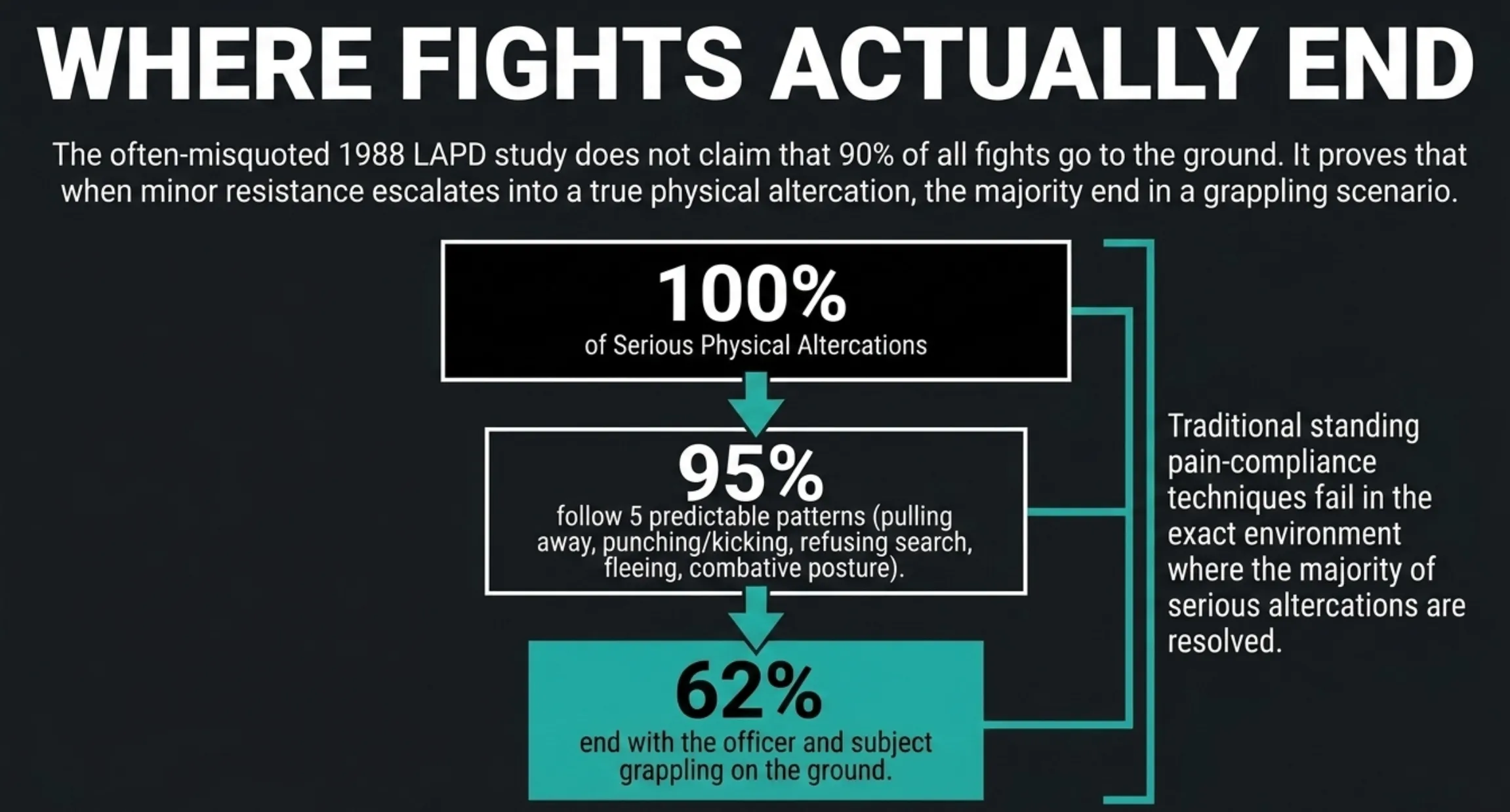
That figure gets repeated as "90% of fights go to the ground," which isn't what the study said and isn't what it measured.
It looked at police arrests, not street fights, and the number was 62%. The original finding has been traced and corrected repeatedly by people who went back to the source.
The real version is still a strong argument. An officer whose defensive tactics curriculum is built around standing techniques and pain compliance is unprepared for the majority of the physical encounters the job produces.
Adoption accelerated through the 2000s and 2010s, driven hard by high-profile use-of-force incidents and the reform conversation that followed them.
Gracie University reports that its Gracie Survival Tactics program now runs through more than 500 affiliates nationally.
Most of that training happens at civilian gyms rather than in department facilities, which matters later if you own one.
How Jiu-Jitsu Improves Safety and Decision-Making on the Street
Officers who train reach for a weapon less often, and the reason has more to do with what happens in their heads than what happens with their hands. That's the mechanism underneath the Marietta and St. Paul numbers.
Every shift carries the possibility of a physical confrontation: someone clamping their arms shut in a cramped hallway, a ground fight where a subject's hand keeps drifting toward their waistband, a struggle with an intoxicated person in a bathroom barely big enough for two people.
None of it looks like a training video. It's fast, and it happens at conversational distance.
Officers who have spent months drilling control techniques stop having to think about them.
The technique runs on its own while the conscious mind handles radio traffic, backup timing, and threat scanning. Trainers call this unconscious competence, and it's the entire point of repetition.
The effect on decision-making is bigger than the technique itself.
An officer confident in their ability to handle a physical altercation makes different decisions before anything physical happens.
They can hold the legal standard in mind while engaged—Graham v. Connor, department policy, or plain proportionality—instead of operating in the tunnel vision that panic produces.
Less force gets used overall, and not because officers hold back.
They never needed to escalate. They can give a subject more time to comply, run verbal techniques longer, and wait for backup without feeling like the situation is getting away from them.
Regular practice also builds comfort with discomfort. Getting tangled up with another person, managing your breathing under load, working from a bad position.
All of it becomes familiar instead of terrifying. Familiar is calmer.
Universal respect, ego control, and professional demeanor
The most useful thing jiu-jitsu does for a cop happens before they ever set foot on the street.
In any decent gym, there's a 130-pound practitioner who can systematically dismantle much larger training partners.
Size matters. Technique matters more. Every white belt learns it by getting taken apart by someone they assumed they could handle.
The rookie who thought his size guaranteed dominance finds out otherwise, repeatedly, in a room where the consequence is a tap instead of a lawsuit. The automatic assumption that they can physically manage anyone fades.
What replaces it is a more honest read on situations: more willingness to wait for backup, to talk longer, to choose positioning that doesn't force a confrontation.
Gym culture reinforces it. Tapping early and often is expected, because it's how everyone stays healthy enough to keep training.
Mutual respect across sizes, genders, and skill levels is the default. Officers carry that out the door with them.
Skill under pressure and stress inoculation
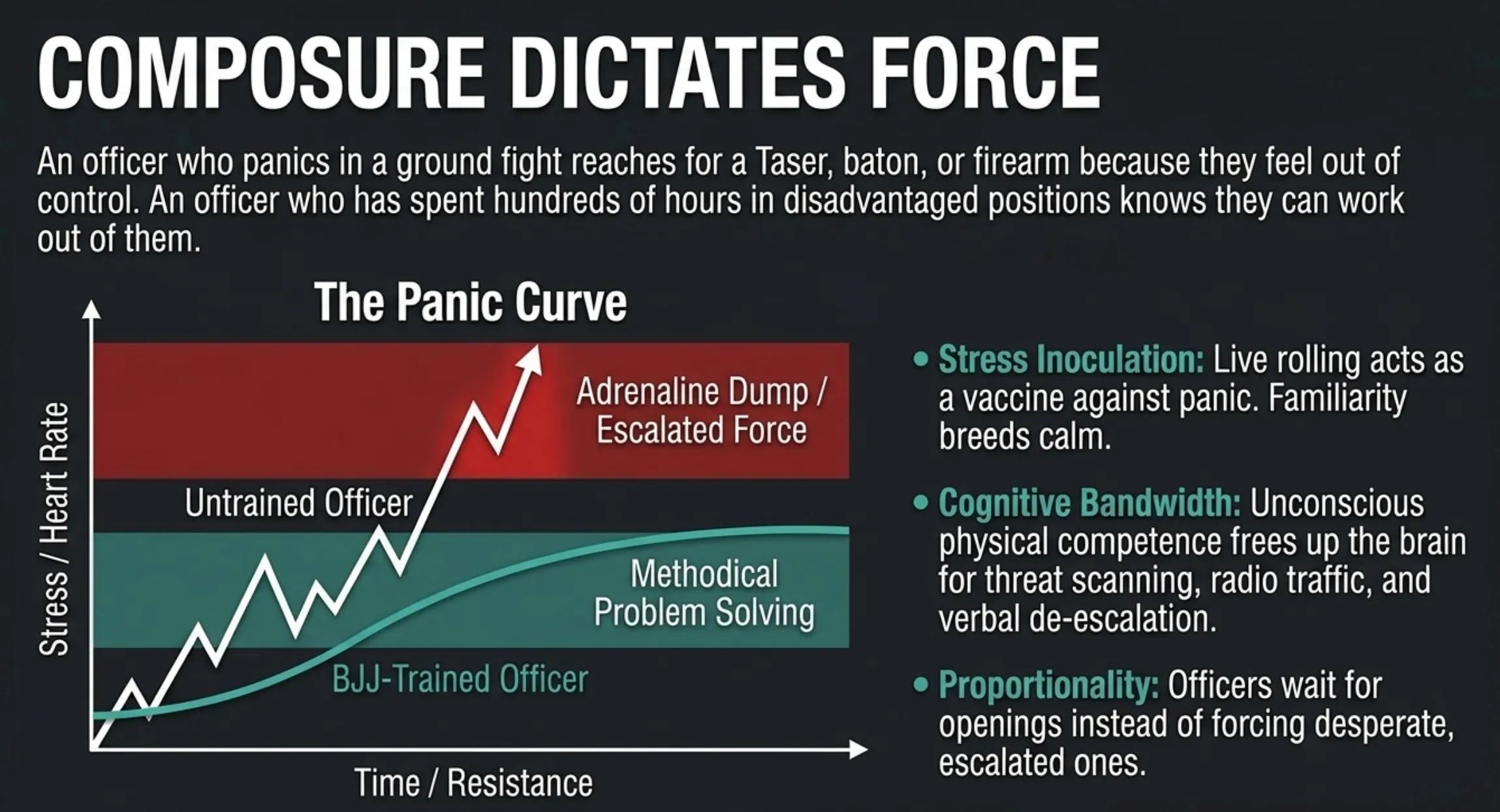
Live sparring, called rolling, puts a practitioner across from someone actively trying to control and submit them, several times a week.
Heart rate spikes. Muscles burn. The brain has to solve problems in real time against a person who isn't cooperating.
It's as close to a real fight as you can get without violence.
That's stress inoculation, and it works by accumulation. The first few months involve moments of genuine panic when you get caught in a bad spot.
With consistent practice, the panic gives way to methodical problem-solving. Breathe, assess, work toward a better position, even when things look bad.
Composure determines force proportionality. An officer who panics during a ground fight reaches for a Taser, a baton, or a firearm because they feel out of control.
An officer who has spent hundreds of hours training from disadvantaged positions knows they can work out of one. They pick control holds over strikes. They wait for an opening instead of forcing a desperate one.
The Marietta Taser numbers are that difference, measured. Untrained officers reached for a Taser in 77% of use-of-force incidents. BJJ-trained officers, in 54%.
Accelerating experience for young officers
Hiring pools have shifted, academy time is finite, and a lot of recruits reach the street having never been in a serious physical confrontation. That's a real gap, and it's getting wider.
St. Paul's chief estimated applications were down 75% compared to five years earlier. A thinner applicant pool means more officers reaching the street with fewer physical reps behind them.
Consistent training compresses the gap. Two classes a week for six months gives a new officer more physical reps than many used to get in years. And a mistake on the mat produces a lesson, not an injury or a funeral.
The drills can be job-specific: weapon retention when someone grabs for the gun, wall pins in narrow hallways, ground scrambles where the goal is standing back up rather than chasing a submission.
None of it depends on overtime budgets or a limited in-service calendar. An officer can train at a local gym on their own time.
Freeing up attention for situational awareness
Attention is finite. An officer consumed with figuring out how to control a resisting subject has less of it for everything else: weapon threats, bystanders, radio traffic, approaching vehicles, a second party.
Drilling core control until it's reflexive gives that bandwidth back.
An officer holding top control can monitor the subject's hands, scan for weapons, talk to backup, and track what's happening around them. That division of attention is impossible when every ounce of focus goes to basic control.
Picture a takedown in a parking lot. The subject keeps resisting while the officer works toward handcuffs.
With reflexive control skills, the officer holds position and notices the subject's friend coming from a parked car twenty feet out. Without them, the second threat arrives unannounced.
Rolling with multiple partners builds the habit underneath that: constant re-evaluation. Every few seconds the situation changes.
New grips, new positions, new angles of attack. You learn to keep asking what matters most right now.
Real incidents are rarely one static threat either. Domestic calls, bar fights, and traffic stops all put extra people inside the same few feet.
The practitioner who fixates on one training partner's arm while another passes their guard learns that lesson fast and cheap.
Fights over a holstered weapon happen at contact distance. At that range, instinctive defensive skill is the difference between controlling a gun grab and losing the fight entirely, and an officer fighting for their gun has to track who else is approaching at the same time.
Command Presence: What Changes Before Anyone Touches Anyone
An officer steps out of the car, and before anybody says a word the person on the sidewalk has already decided something about them.
Command presence gets used constantly in law enforcement training and defined almost never.
It's the impression an officer creates in the first two seconds: posture, movement, voice, and whether all of it says this person is in control of themselves.
Citizens read it instantly and mostly unconsciously. An officer who shifts weight constantly, talks fast, and avoids eye contact signals vulnerability.
An officer who moves deliberately and speaks clearly signals something else. Resistance tends to follow the first one. Compliance tends to follow the second.
Training improves every physical component of that. Officers who train move differently: more grounded, more balanced, less wasted motion.
Their nervous systems have already met physical confrontation, so their baseline on a tense call sits lower than an untrained officer's.
Take a bar fight call. Combatants still agitated, alcohol involved, a crowd watching.
The officer who knows they can handle it physically walks in differently. They separate people calmly, because they aren't operating from fear.
Voice stays steady. Positioning shows awareness without aggression. That kind of confidence, rooted in real ability rather than bravado, often keeps the fight from restarting.
Fighting as a professional skill, not an emotional reaction
"Fighting" carries baggage in law enforcement. For a cop it means control tactics, weapon retention, vehicle extractions, and ground survival. Not punching someone.
It's a professional skill, like driving or marksmanship, and it decays the same way.
Jiu-jitsu supplies a technical sequence that crowds out emotional reactivity. Establish base, secure grips, advance position, control the limbs, apply handcuffs. A procedure keeps the encounter professional instead of personal.
Skill decay is the underrated problem here. An agency relying on academy training plus an annual recertification produces officers whose defensive tactics erode in between. Ongoing training is maintenance, the same way a range day maintains marksmanship.
What Jiu-Jitsu Training Will Not Fix
Grappling fills one specific gap, the one between verbal commands and intermediate weapons, which most curricula have historically left open.
It sits alongside firearms, less-lethal options, communication, and tactical decision-making, all of which still matter as much as they ever did.
More martial arts training won't fix excessive force, bias, or weak oversight. Physical skills are tools.
In the hands of ethical officers they reduce harm. In the hands of abusive officers they're one more instrument, the same as any other.
The St. Paul training is "a step in the right direction," Maria Haberfeld said, though she cautioned that it can't stand on its own.
Haberfeld chairs the criminal justice department at John Jay College.
She told the Pioneer Press that training alone cannot carry reform. Her point was about hiring. Train someone who can't control himself under stress and the curriculum won't save you.
So training has to be paired with clear policy, active supervision, body-worn cameras, and meaningful community oversight. An agency that invests in grappling while neglecting oversight has bought a capability, not a reform.
There's also an overconfidence risk program designers should take seriously. An officer who feels highly capable might choose engagement when disengagement or waiting for backup was the better call.
Good instruction addresses that head-on. Aim for the minimum necessary force, and remember that the highest skill in the discipline is not having the fight at all.
The techniques themselves need scrutiny.
Neck restraints that are safe in a controlled gym have proven deadly in street applications, where subjects may be intoxicated, in medical crisis, or restrained in positions that compromise breathing.
Agencies have to line the curriculum up with local policy and current case law, and cut what carries unacceptable risk.
Designing a Jiu-Jitsu Program for Your Agency
Building a program takes more than finding a gym and signing officers up.
The decisions that shape your outcomes get made before the first class: voluntary or mandatory, minimum monthly hours, and how grappling fits the defensive tactics curriculum you already run.
Marietta's structure is a useful reference point. Mandatory for new hires, optional for existing officers, which got them 95 of 145 sworn officers participating without a fight over the schedule.
Vet the instructors first. Run background checks, brief them on your use-of-force standards, and look for demonstrated experience adapting sport technique to duty application.
Not every black belt makes a good law enforcement instructor. You want people who understand the legal and tactical context your officers work inside.
Train in the gear. Put officers in belt, vest, and holster periodically, because fighting encumbered is a different activity than fighting in a rash guard. Scenario work should include stairwells, hallways, parking lots, and vehicle extractions.
Keep the schedule survivable. One to two sessions a week, 60 to 90 minutes each, gives you real training volume without wrecking the lives of people already working demanding shifts. Training credit, shift adjustments, or other incentives signal that you mean it.
Training for the street, not the competition mat
Sport jiu-jitsu runs on rules: points for positions, weight classes, prohibited techniques, time limits. Street encounters have none of that. No referee, no mat, no guarantee it stays one-on-one.
Some habits that score well in competition are actively bad on duty:
Build the curriculum around high-percentage control instead: mount, side control, knee-on-belly, and back control. Then drill the transitions into handcuffing under live resistance.
If you're starting from a blank page, our guide to building a curriculum covers how to sequence and phase it.
Scenario training built from real incidents transfers best. Body-worn camera and dashcam footage makes excellent teaching material. A working drill list:
- Weapon-retention rounds where partners attempt to access a holstered training gun
- Fighting from standing against walls, simulating hallways and doorways
- Handcuffing transitions from dominant positions under resistance
- Ground-to-standing drills that emphasize disengagement when threats multiply
Mat safety protocols are not optional. Controlled intensity, a real tap-respect culture, and explicit rules on neck and spine pressure keep a program from producing the injuries it was built to prevent.
The same habits that make a safe gym culture work for civilians work here. Marietta logged one training injury across roughly 2,600 classes, which is the bar to hold your program to.
Before the first session, read up on injury prevention and decide who is responsible for calling a round off.
Policy integration, legal considerations, and documentation
Techniques have to connect to your written use-of-force continuum. Ambiguity creates liability. If an officer uses something your policy doesn't clearly authorize, the officer and the department both carry unnecessary risk.
Training records become evidence. Keep attendance logs, curriculum outlines, and periodic skill assessments in a form you can produce in court.
Those records show that you provide ongoing, modern, tested control training, which is exactly what a defense against an excessive force claim has to establish.
Officers who understand ground fighting also write better use-of-force reports, because they can name what they did and why. Reports like that hold up in internal review and in courtroom testimony.
Have your city or county attorneys review the curriculum before rollout, and again on a schedule after. Neck restraints, positional asphyxia, and local statutes prohibiting specific techniques deserve particular attention.
What's lawful and appropriate varies by jurisdiction. Run policy reviews informed by new case law, research, and incident reviews, because a technique that was best practice five years ago may carry unacceptable risk today.
Measuring outcomes and continuous improvement
Programs that get funded past year two are the ones that measured something. Track:
- Officer injury rates during arrests
- Suspect injury rates during arrests
- Workers' compensation claims tied to physical confrontations
- Citizen complaints regarding force
- Overall use-of-force incident counts
- Taser and baton deployment rates
Marietta added a line most agencies forget: net cost. After training expenses, the department reported a net savings of $40,752, driven by the drop in injuries and the workers' comp claims that came with them.
A program that pays for itself is a much easier budget conversation.
Give before-and-after comparisons at least 12 to 24 months. Shorter windows miss seasonal variation and produce incident counts too small to say much.
Anonymous officer surveys before and after can track confidence, perceived preparedness, and mental health indicators. Those subjective measures complement the incident data rather than substituting for it.
Regular debriefs using recent body-worn camera footage refine the curriculum. When something works in the field, reinforce it. When something causes problems, cut it.
Training as an Individual Officer
Plenty of officers work for agencies with no formal program and no plans for one. Training on your own still works, and it's the most accessible version of everything above.
Start by picking a reputable gym. Check instructor credentials, watch a class to read the safety culture, and be open about your profession. Good gyms welcome law enforcement and will accommodate what you need.
Red flags: a steady stream of injured members, unwillingness to scale intensity for beginners, or dismissiveness when you raise duty-specific concerns.
One to two classes a week for the first three to six months is the right starting dose.
Jumping straight to daily training produces burnout and injury. Your body needs time to adapt to movement patterns it has never performed.
Talk to your coaches about duty gear and about techniques that conflict with your department's policy. Most experienced instructors will happily point you at high-percentage control positions instead of sport-specific material that won't transfer.
You'll still learn the sport curriculum, and you should. Our guides to BJJ guard positions and jiu-jitsu submissions cover material every white belt drills, and BJJ for self-defense covers how the art works outside a duty context.
Just know which parts of it you'd actually use on shift.
Mental health and resilience
The fitness benefits are obvious. The mental health case deserves as much attention.
Police work delivers trauma, chronic stress, irregular sleep, and the accumulated weight of seeing people at their worst. Burnout and cynicism are occupational hazards, not character flaws.
Training gives you a structured place where rank disappears, the job stays outside the door, and the only thing to focus on is the person in front of you.
Officers who train tend to describe lower stress and higher job satisfaction, though nobody has run the kind of study that would settle it. People who like training are the ones who keep training. Take the direction of that, not the size of it.
Confidence in physical ability also cuts down on unnecessary adrenaline dumps. An officer who knows they can handle themselves doesn't spike to maximum stress every time a call gets tense.
That physiological stability shows up as better sleep and a longer career.
And there's a community in it. Training partners become friends. A gym offers structure and belonging outside the insular world of law enforcement, which matters most for the officers most at risk of isolation.
Injury prevention and career longevity
Starting slow and tapping early is what protects your ability to work. Ego-driven refusal to tap produces the injuries that end careers, and it produces them in a room where nothing was at stake.
A short warm-up addresses the specific wear pattern of the job: tight hips from a patrol seat, stiff shoulders from carrying gear. Five minutes of hip circles, shoulder rotations, and light movement prevents a lot of what puts people on the shelf.
The common injuries are finger sprains, knee tweaks, and shoulder strains. Prevention is unglamorous:
- Tape your fingers before training
- Skip explosive movement until you're actually warm
- Tap early to joint locks, because the tap is information, not a loss
- Avoid the training partners who keep hurting people
Coordinate with your healthcare provider and agency medical unit so training lines up with fitness-for-duty requirements. If you're carrying a pre-existing injury, get clearance and modify. The goal is a long career, not proving something on a Tuesday night.
For Gym Owners: Running a Law Enforcement Program
If you own an academy, the demand described above is a program waiting to be built, and the departments near you may not know it's available.
Marietta's officers trained at civilian gyms. So do most officers whose departments have no formal curriculum.
Cops make good students. They have a professional reason to show up, an employer who might cover the bill, and they stick once the habit forms.
It also comes with administrative requirements a normal membership doesn't, and this is where most first attempts fall apart.
Departments need documentation you probably aren't producing. An agency using your gym as its training provider needs per-officer attendance records that hold up in a deposition: who trained, on what date, for how long, over what period.
If you're still running a paper sign-in sheet, start with the attendance tracking methods that actually produce a record. Handing a training sergeant a spreadsheet you assembled by hand the week their attorney asked for it isn't a good look, and it isn't defensible.
Billing an agency is not billing a member. A department paying for twelve officers wants one invoice, not twelve separate card charges.
Shift work breaks a normal schedule. Officers coming off a night shift can't make your 6 PM class. A LEO program usually needs a morning and an early-afternoon slot to catch both rotations, which is its own scheduling problem once you add it to an existing timetable.
If you're already juggling several programs, our guide to managing multiple class schedules covers the mechanics.
Software handles the parts of this that are pure record-keeping. In Gymdesk, attendance tracking logs every check-in against the member automatically.
Gym reporting turns that history into the per-officer training record a department can actually file.
Membership billing includes an invoice option, so you can bill an agency directly instead of running its officers through individual card charges.
What you're after: a training sergeant who can pull a clean report in thirty seconds, and a program you aren't reconciling by hand every month. Get that right and the LEO track stops being a favor you do for the local PD and starts being a line of business.
A few things to sort out before you pitch a department:
- Know your policy exposure. Ask what techniques their policy prohibits, and be prepared to teach a modified curriculum. Don't assume your competition curriculum transfers.
- Vet who teaches it. The instructor needs to understand duty gear, use-of-force standards, and why "just take his back" isn't always the answer. Our guide to becoming a self-defense instructor covers the credentialing side.
- Get the waivers right. Officers training on-duty or on department time raise questions your standard membership waiver wasn't written for. Talk to your insurer first.
- Start with individuals. The officers already training at your gym are your way in. A sergeant who trains with you will make the introduction that a cold email won't.
Where This Goes
The evidence points one direction.
Departments that added jiu-jitsu-based defensive tactics are reporting fewer injuries on both sides of an arrest, less reliance on intermediate weapons, and lower settlement costs, provided the training sits next to real policy and real oversight.
That last clause is the whole caveat. A capability inside a broken system just makes the system more capable.
But officers in those departments also report feeling more able to do the physical part of the job without escalating. Every agency says it wants that.
The move is the same whether you're command staff sizing up a pilot or a patrol officer looking at a first class.
Train realistically, then let what actually happens on the mat and on the street change what you teach. And if you own the academy those cops train at, you're in the same position one step earlier.
Run an academy with a law enforcement track? The curriculum is the easy part. The work is producing per-officer training records a department can actually file, and invoicing an agency instead of chasing twelve separate card charges. Gymdesk keeps attendance, reporting, and billing in one place, so a training sergeant gets a clean report and you aren't rebuilding it by hand every month.
Gym management software that frees up your time and helps you grow.
Simplified billing, enrollment, student management, and marketing features that help you grow your gym or martial arts school.


FAQ
Jiu-Jitsu for Law Enforcement FAQs

Josh is a martial arts educator and coach who bridges live training on the mats with evidence-based teaching. A 4th degree Taekwondo black belt and dedicated Brazilian Jiu-Jitsu practitioner, he’s spent years running classes, mentoring students, and helping instructors move beyond rote drills to training that actually works under pressure.
He holds a Master of Education in Teaching & Learning from Liberty University and runs Combat Learning, where he breaks down ecological dynamics, constraints-led coaching, and games-based training for combat sports. Through his writing and podcast work with Gymdesk, Josh turns coaching science and gym-owner stories into practical ideas you can use to run better classes and build a stronger martial arts school.