Brazilian Jiu-Jitsu Moves: A Beginner's Guide to Essential Techniques
Brazilian jiu-jitsu has a lot of moves. Hundreds, really. But you don't need to know all of them to start—you need to know the right ones in the right order.
That's what makes BJJ different from most martial arts—technique and leverage matter more than size or strength. A smaller person who knows the right moves in the right positions can control and submit a bigger opponent.
This guide covers the essential BJJ moves every beginner should learn—submissions, sweeps, guard passes, and escapes—organized by difficulty so you know what to focus on first.
What to Learn First: Position Before Submission
Before you dive into individual techniques, there's one principle that will shape everything: position before submission.
In BJJ, dominant position comes first. From there, submissions follow naturally. A beginner who understands positional hierarchy—mount, back control, side control, guard—will outpace someone who just collected techniques without a framework to hang them on.
The moves below are organized by where most beginners actually learn them: white belt fundamentals first, then intermediate techniques you'll pick up at blue belt, then advanced moves that take years to safely develop.
For a primer on the basics of the art itself, start with what Is BJJ. For technique expectations at each belt level, see our IBJJF belt requirements guide.
BJJ Moves Quick Reference
Move | Category | Difficulty | When You’ll Learn It |
Rear Naked Choke | Submission | Beginner | White belt, month 1 |
Armbar | Submission | Beginner | White belt, month 1–2 |
Triangle Choke | Submission | Beginner | White belt, month 2–3 |
Kimura | Submission | Beginner | White belt, month 2–3 |
Guillotine | Submission | Beginner | White belt, month 3–6 |
Americana | Submission | Beginner | White belt, month 1–2 |
Cross Collar Choke | Submission (Gi) | Beginner | White belt, month 2–3 |
Hip Escape (Shrimp) | Escape/Movement | Beginner | White belt, week 1 |
Bridge and Roll | Escape | Beginner | White belt, month 1 |
Scissor Sweep | Sweep | Beginner | White belt, month 2–3 |
Hip Bump Sweep | Sweep | Beginner | White belt, month 2–3 |
Flower Sweep | Sweep | Beginner | White belt, month 3–6 |
Toreando Pass | Guard Pass | Beginner | White belt, month 3–6 |
Butterfly Sweep | Sweep | Intermediate | Blue belt |
Over-Under Pass | Guard Pass | Intermediate | Blue belt |
Knee Slice Pass | Guard Pass | Intermediate | Blue belt |
Omoplata | Submission | Intermediate | Blue/purple belt |
Darce Choke | Submission | Intermediate | Blue/purple belt |
Berimbolo | Sweep/Back Take | Advanced | Purple belt and up |
Heel Hook | Leg Attack | Advanced | Varies by gym |
Calf Slicer | Leg Attack | Advanced | Varies by gym |
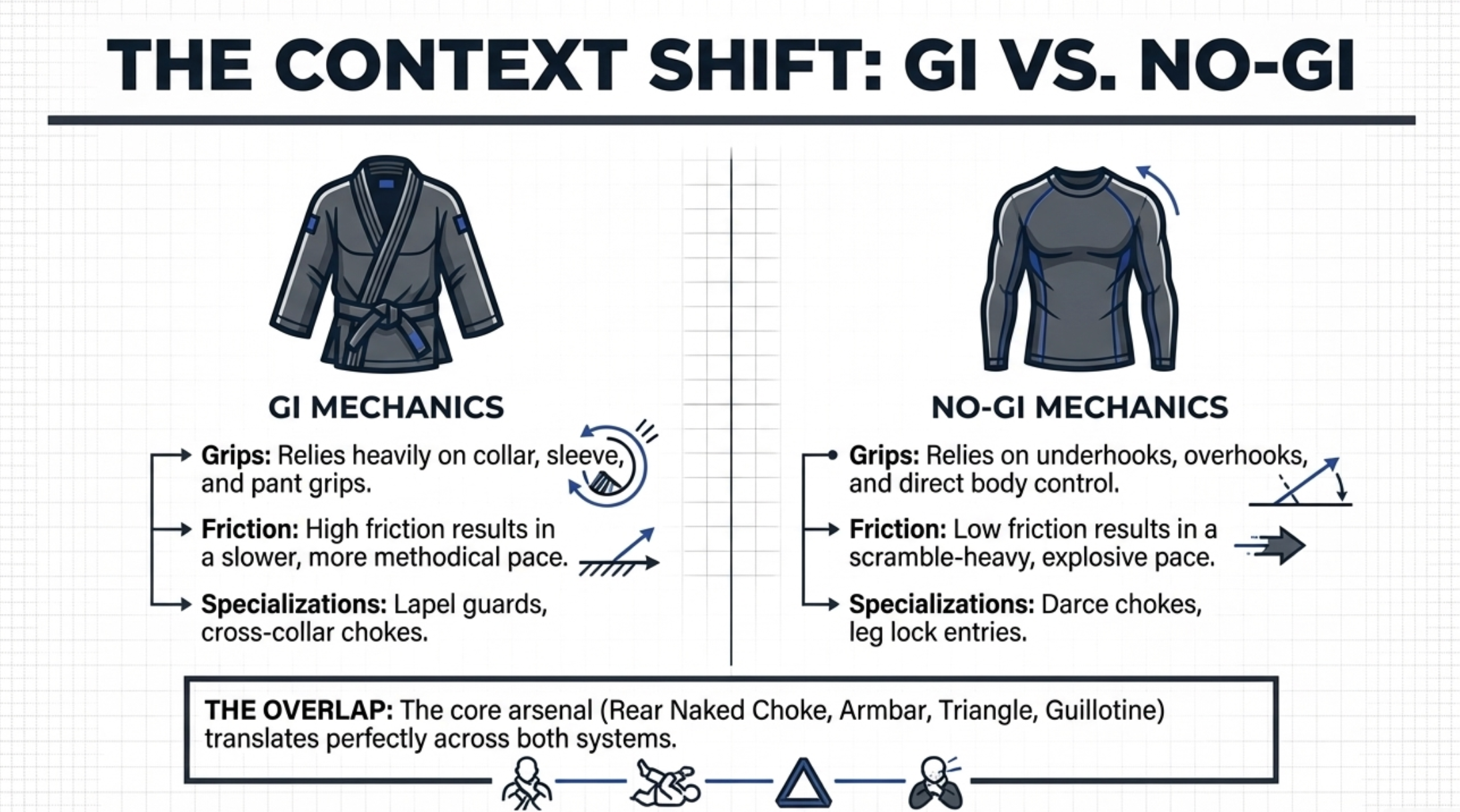
Beginner BJJ Moves
These are the techniques your coach will drill on day one. Not because they're simple—there's real depth here—but because everything else builds on them.
The hip escape: your most important non-submission
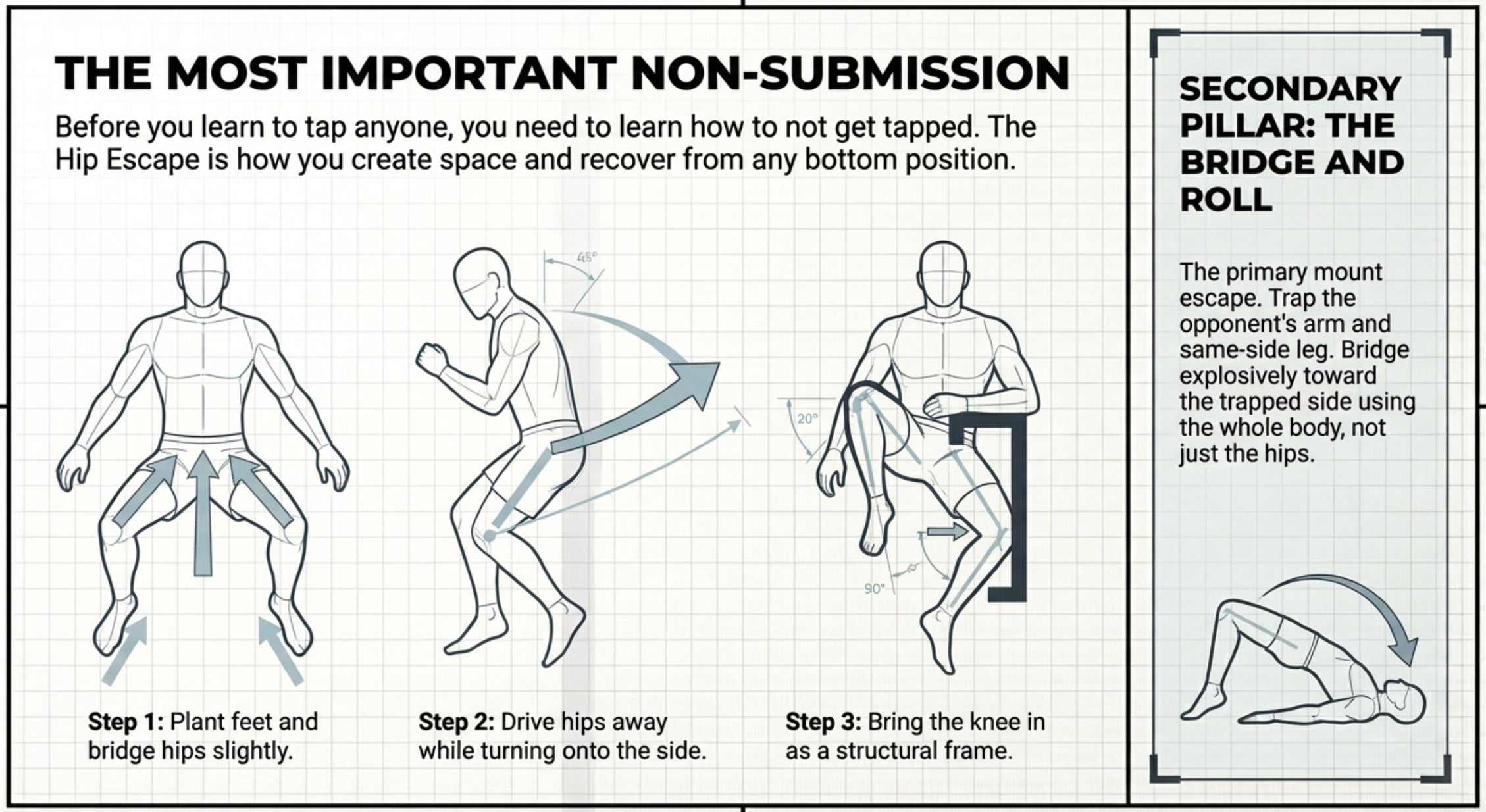
Before you learn to tap anyone, you need to learn how to not get tapped.
The hip escape (shrimping) is the most fundamental movement in BJJ. From any bottom position—side control, mount, someone passing your guard—this is how you create space and recover.
Plant your feet, bridge up slightly, then drive your hips away while turning onto your side. Your knee comes in as a frame. Repeat. It's not glamorous, but you'll use it in every single roll for the rest of your BJJ life.
Drill this even at home. Shrimp down the length of a room, then back. Your body needs to learn this movement before your brain has to think about it.
The rear naked choke
The most common submission finish in MMA competition—and one of the first you'll learn in class.
Applied from back control (your chest to their back, legs hooked in front of theirs), the rear naked choke cuts off blood flow to the brain, not the airway. You don't need to squeeze hard if the mechanics are right.
Seatbelt grip first: one arm over the shoulder, one under the arm. Slide the top arm across their neck until your forearm bone is against their carotid. The bottom arm comes up to grab your top bicep. Top hand goes behind their head. Now squeeze your arms together and create backward pressure with your body.
Common mistakes:
- Arm riding up onto the skull instead of across the neck
- Attempting the choke before establishing solid back control
- Squeezing with arm strength alone instead of using backward body pressure
The armbar
The armbar is everywhere—from guard, from mount, from side control. Learning it early gives you a submission to work toward from almost any position.
From closed guard, isolate one of their arms. Control the wrist and elbow, pivot your hips 90 degrees, swing your leg over their head, and pinch your knees together around their shoulder. Both hands on the wrist, hips extend upward.
Common mistakes:
- Rushing the extension before you have full control of the arm
- Not pivoting the hips far enough—the angle is what makes it tight
- Knees spreading apart instead of pinching around the shoulder
The triangle choke
BJJ's signature submission. Your legs form a triangle around their neck and one arm. Applied correctly, it cuts blood to the brain the same way the rear naked choke does—and you're doing it with your legs.
From closed guard, break their posture. Push one arm across and pull the other tight to your chest. Shoot your leg over the back of their neck. Lock your shin behind the knee of your opposite leg. Now adjust: your hips need to be at an angle, not square. Pull their head down.
Common mistakes:
- Attempting the triangle without breaking their posture first
- Staying square instead of cutting an angle—a flat triangle is a weak triangle
- Not pulling the head down to finish
BEGINNER TIP:
The triangle and armbar are best learned as a combination. If they defend the triangle by posturing up, the armbar opens. If they defend the armbar by pulling their arm out, the triangle tightens. Work them together from the start.
The kimura
Named after Japanese judoka Masahiko Kimura, who used it to defeat Helio Gracie in 1951—one of the most famous matches in grappling history.
The kimura attacks the shoulder with a figure-four grip. From side control, control their near wrist. Step over their body, apply the figure-four (your hand grabs your own wrist while controlling theirs), and rotate their arm away from their body at 90 degrees.
Beyond being a submission, the kimura is a control position. You can use it to move people, set up sweeps, or transition to back control. Learn it early and you'll keep finding new ways to use it for years.
Common mistakes:
- Letting them straighten their arm—once it's straight, you've lost the figure-four
- Applying force too fast without securing proper control first
- Losing body position by reaching too far for the grip
The guillotine choke
The second most common finish in UFC competition. It catches people who shoot in with their head down—which describes most beginners most of the time.
When someone shoots or lowers their head, wrap your arm around their neck (across the front of the throat, not the skull). Control their near arm's tricep. Fall back to guard. Your legs splay wide or pull together depending on the variation—but both use your chest and hips to create pressure, not just your arms.
Common mistakes:
- Wrapping around the back of the head instead of the front of the neck—that's a headlock, not a choke
- Using only arm strength instead of chest and hip pressure to finish
- Not controlling their body with your legs after falling to guard
The bridge and roll (mount escape)
Getting mounted is going to happen a lot early on. The bridge and roll is your primary escape.
Trap their arm and the same-side leg. Bridge explosively toward the trapped side—use your whole body, not just your hips. They roll. You follow on top.
Common mistakes:
- Forgetting to trap the arm and leg—without it, they just post and stop the roll
- Bridging straight up instead of toward the trapped side
- Not following through to establish top position after the roll
The americana
The americana works in the opposite direction of the kimura—and it's often the first submission you'll hit from mount or side control. When someone defends the kimura by straightening their arm, the americana is right there.
From mount, pin their wrist to the mat near their head. Apply a figure-four grip (your hand grabs your own wrist while controlling theirs) and slowly push their arm toward their head, rotating the shoulder. Maintain your weight throughout—if you lift up to crank, they'll escape.
Common mistakes:
- Lifting your weight off them while applying the lock
- Not pinning the wrist close enough to their head before starting
- Letting them bench-press their arm free by not securing the figure-four grip early
The cross collar choke
A gi fundamental. This is one of the first submissions that teaches you how grip fighting works—and it stays dangerous at every level.
From closed guard, get a deep grip on their collar with one hand, knuckles facing you. Your second hand grabs the opposite collar, creating an X across their neck. Break their posture forward and squeeze your elbows together while pulling.
Common mistakes:
- Grips not deep enough—shallow grips mean no choke
- Failing to break their posture before attempting the finish
- Letting them get their hands inside your grips to defend
Beginner Sweeps and Guard Passes
Submissions get the attention. Sweeps and passes win the match.
Why sweeps matter (and how they work)
A sweep reverses position—you go from bottom to top.
SWEEPING PRINCIPLES
- Timing. Sweeps work best when your opponent shifts their weight or adjusts their base. Learning to feel those moments comes from mat time.
- Off-balancing. Before you sweep, you need to disrupt their base. Grip fighting, creating movement, or forcing weight shifts all set it up.
- Leverage over strength. Proper fulcrum placement and angle let a smaller person reverse a bigger one. If you’re muscling through sweeps, something’s off mechanically.
The best practitioners chain sweeps together—defending one opens the door to another. Think of them as combinations, not isolated moves.
Scissor sweep
One of the first sweeps most coaches teach, and one of the most reliable. From closed guard, establish a grip on their collar and sleeve while opening your guard. Place one leg across their waist (the scissor blade) and extend the other to hook behind their leg. Pull with your grips and execute the scissor motion simultaneously.
It works best when they lean forward. The scissor sweep and triangle are a natural combination—use them together.
Common mistakes:
- Not scooting your hips out to create the proper angle
- Trying the sweep when they're sitting back on their heels—it works when they lean forward
- Weak grips that let them post a hand to stop the roll
Hip bump sweep
For opponents who sit up and post in your guard. From closed guard, bring them forward into your chest. Plant your outside foot on the mat. Explosive hip thrust toward their posting arm—they go over.
If they post with the free arm to stop it, you've just set up the kimura. The sweep and the submission feed each other.
Common mistakes:
- Not bringing them forward first—you need their weight loaded over their arms
- Planting the wrong foot, killing your angle
- Giving up when they post, instead of transitioning to the kimura
Flower sweep
The flower sweep uses pendulum motion from closed guard to land directly in mount—which makes it one of the highest-value sweeps a beginner can learn.
From closed guard, control their sleeve and collar while opening your guard. Rock your legs like a pendulum to one side while pulling with your grips. The momentum carries you through to mount.
The key is committing to the pendulum. Half-hearted leg movement won't generate enough force. The sweep rewards full-body coordination—your grips, hips, and legs all working together.
Common mistakes:
- Not generating enough pendulum momentum with the legs
- Releasing grips during the sweep and losing control
- Settling for side control instead of following through to mount
Toreando pass (bullfighter)
Your first proper guard pass. Grip both pant legs (or ankles in no-gi) from standing, pin their legs down, then quickly redirect them to one side and step around to side control in the same motion.
The speed matters. A slow toreando gives them time to recover. The misdirection—push their legs one way, step the other—is what creates the opening.
Common mistakes:
- Moving too slowly and letting them recover guard
- Losing your grips mid-pass
- Not establishing side control immediately after clearing the legs
Intermediate BJJ Moves
You're a few months in. The beginner moves are starting to feel like home. Now you start building layers.
Butterfly sweep
Popularized by Marcelo Garcia, the butterfly sweep uses hooks under your opponent's thighs to lift and reverse them. Sit facing them with feet hooked under their legs, control their upper body with underhooks or collar grips, choose a direction, and lift while driving forward.
The mechanics are unusually clean: you're removing one of their contact points with the ground while driving their weight past it. Size matters less here than in most techniques.
Common mistakes:
- Not coordinating the leg lift with the upper body drive—both need to happen together
- Choosing a direction without first off-balancing them that way
- Falling backward instead of driving forward through the sweep
Over-under pass
A pressure pass. One arm goes over their leg, one goes under—hence the name. You drive forward with low posture and heavy bodyweight, smashing through their guard rather than redirecting it.
Slower and more methodical than the toreando. Works especially well against flexible guard players who keep creating angles on you.
Common mistakes:
- Posture too high—you lose the pressure advantage that makes this pass work
- Not establishing the over-under configuration before driving forward
- Stalling momentum and letting them re-guard
Knee slice pass
Your knee cuts across their body toward the opposite shoulder while your upper body controls them from above. One of the most versatile guard passes in the game—works against open guard, half guard, and various modern guard systems.
The key is keeping your knee going and your chest heavy. If you stall in the middle, they'll recover.
Common mistakes:
- Stalling the knee halfway across—commit to the cut
- Not keeping your chest heavy on top of them
- Letting them get a knee shield in before you complete the pass
Omoplata
A shoulder lock from guard that does triple duty: it can finish as a submission, convert to a sweep if they roll, or set up a back take if they try to pull away.
From guard, use your legs to isolate one of their arms and lock it across your hips. Sit up and rotate their shoulder into the lock. The submission comes from rotating their arm past what the shoulder allows.
The omoplata rewards patience. Don't rush the finish—many of the best entries happen when they try to escape.
Common mistakes:
- Rushing the finish instead of securing control first
- Not sitting up fully—the submission needs you upright, not on your back
- Ignoring the sweep option when they roll to defend
Darce choke
A no-gi favorite that works well from side control and turtle position. Thread one arm under their neck and over their arm while the other completes the choking grip. The finish comes from shoulder pressure and angle, not just squeezing.
The darce is reliable in scrambles and against turtled opponents—situations where other chokes are hard to set up.
Common mistakes:
- Trying to finish with arm squeeze alone instead of using shoulder pressure and angle
- Not threading the arm deep enough under the neck
- Losing the grip during transitions
Advanced BJJ Moves
These techniques take years to develop safely. They're not secrets—you'll encounter them in class—but they require a foundation of body awareness, positional understanding, and mat time that genuinely can't be rushed.
Heel hook
SAFETY WARNING
Heel hooks can cause serious, sudden knee ligament damage. The danger isn’t that the tap comes slowly—it’s that it often comes too late. Practice these only with experienced partners who communicate clearly and tap early.
The heel hook attacks the knee by applying rotational force to the heel, stressing multiple structures simultaneously including the ACL, MCL, and meniscus.
Under IBJJF rules, heel hooks are prohibited for white, blue, and purple belts. Many gyms restrict them to advanced classes regardless of competition format. If your gym teaches them, you'll learn the safety protocols alongside the technique—that's not optional, it's the technique.
Berimbolo
The berimbolo changed modern BJJ competition when the Mendes brothers popularized it in the early 2010s. It's a back-taking system from De La Riva guard that involves rolling underneath your opponent while maintaining hook control and ending in back control.
Requires genuine hip flexibility, excellent spatial awareness, and comfort being inverted. Most coaches won't teach it until blue or purple belt, and rushing it produces bad technique and potential injury.
Calf slicer
A compression lock that traps the calf muscle against your shin or forearm. It creates pain through muscle pressure rather than joint stress, making it different from most submissions you'll learn.
Legal in competition above certain belt levels depending on the ruleset. Less dangerous than heel hooks but still requires controlled application—compression locks can cause muscle injury if cranked suddenly.
Escapes Deserve Their Own Section
Escapes are often taught alongside guard passes but deserve separate attention. Getting out of bad positions is arguably more important than attacking from good ones, especially early in your training.
Guard replacement
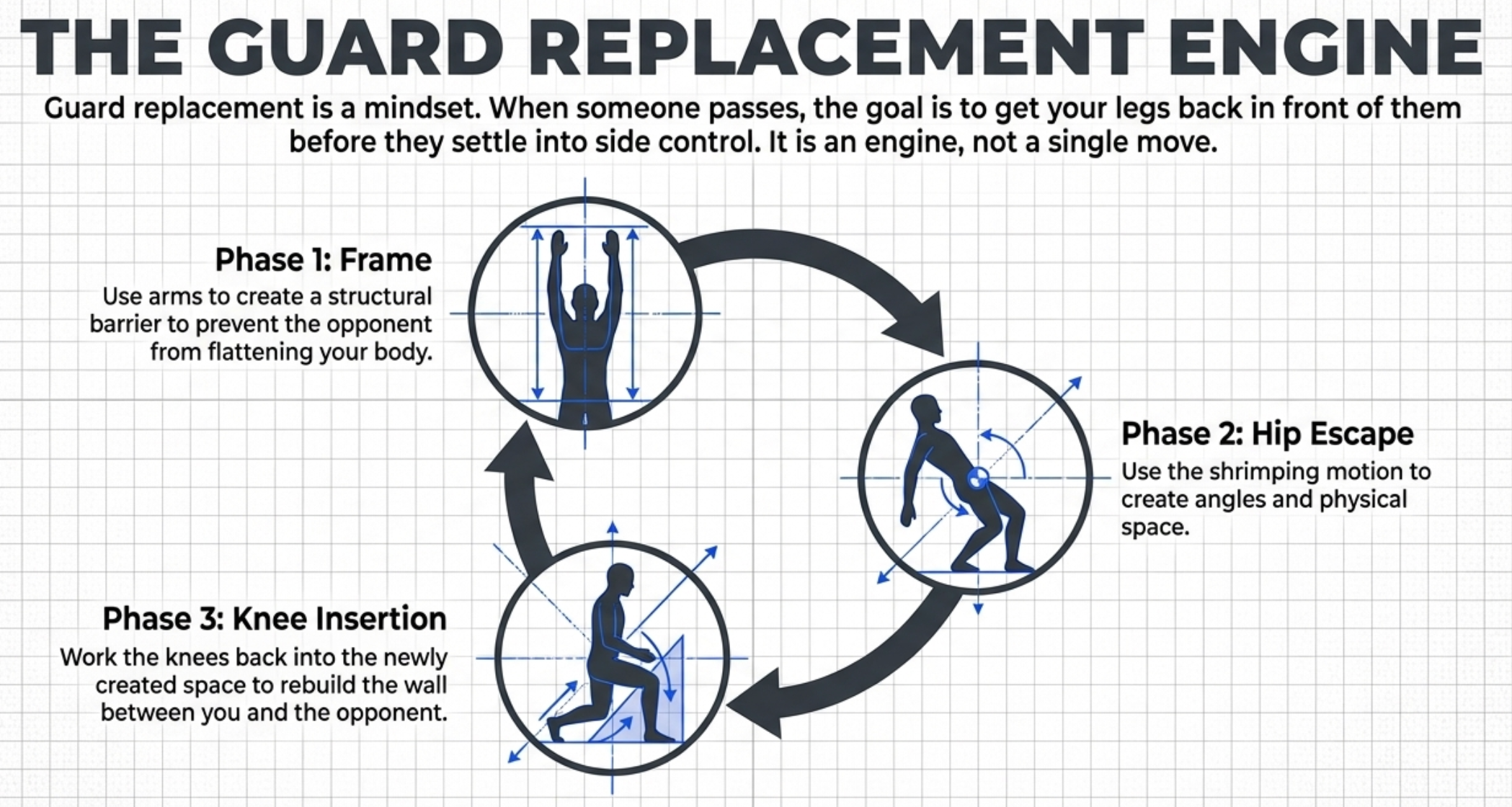
Guard replacement is a mindset as much as a technique: when someone is passing your guard, your goal is to get your legs back in front of them before they settle into side control.
The mechanics vary depending on what they're doing—but the principle is constant: create a frame with your arms to prevent them from flattening you, use hip movement to create angles, and work your knees back between you and them. Shrimping (there it is again) is the core movement.
Hip escape from side control
Same hip escape movement from earlier, applied specifically to side control. Frame on their hips and their neck. Bridge to create space. Shrimp your hips away, bring your knee in as a frame, and work back to guard.
The bridge is easy to skip but important—it creates the initial space your hips need to move.
Your Learning Path
Here's an honest roadmap for the first few years:
White belt (months 1–12): Focus on survival and fundamentals. Hip escapes, bridge and roll, basic submissions from closed guard (armbar, triangle, kimura). The toreando pass. One sweep—the scissor or hip bump. You don't need to know everything. You need to deeply know a few things.
Early blue belt: Add the butterfly sweep, over-under pass, and knee slice. Explore open guard. Start working submission combinations rather than isolated techniques. This is also when you'll encounter leg locks in many gyms—train them carefully.
Mid-blue through purple: Your game starts to reflect your body type and preferences. Some people become passers, some become guard players. You'll develop go-to techniques that work for you specifically. The advanced moves above become relevant here.
Gymdesk's belt requirement guide breaks down what's expected at each belt under IBJJF standards if you want a more formal reference.
The Bottom Line
THE BOTTOM LINE:
- Start with movement, not submissions. The hip escape is the first skill that actually matters.
- The beginner submissions are beginner for a reason—they work at every level. Black belts still use the rear naked choke, armbar, and triangle.
- Advanced techniques aren’t secrets—they’re just later. Don’t rush toward heel hooks and berimbolo at the expense of your hip escape.
- Consistency beats volume. Three classes a week for two years beats six classes a week for six months and burning out.
Want to go deeper on guard work specifically? Our BJJ guard positions guide breaks down every guard system and which ones to learn first. And if you're training in the gi, the complete BJJ gi guide covers everything about choosing and caring for your first gi.
If you run a BJJ gym and want to track technique progression by belt level—or organize classes around beginner vs. advanced curriculum—Gymdesk's skills tracking and curriculum tools let you see where each student is and what they should be working on next.
Gym management software that frees up your time and helps you grow.
Simplified billing, enrollment, student management, and marketing features that help you grow your gym or martial arts school.

FAQ
BJJ Moves FAQs

Josh is a martial arts educator and coach who bridges live training on the mats with evidence-based teaching. A 4th degree Taekwondo black belt and dedicated Brazilian Jiu-Jitsu practitioner, he’s spent years running classes, mentoring students, and helping instructors move beyond rote drills to training that actually works under pressure.
He holds a Master of Education in Teaching & Learning from Liberty University and runs Combat Learning, where he breaks down ecological dynamics, constraints-led coaching, and games-based training for combat sports. Through his writing and podcast work with Gymdesk, Josh turns coaching science and gym-owner stories into practical ideas you can use to run better classes and build a stronger martial arts school.