BJJ Guard Positions: Every Guard Explained (and Which to Learn First)
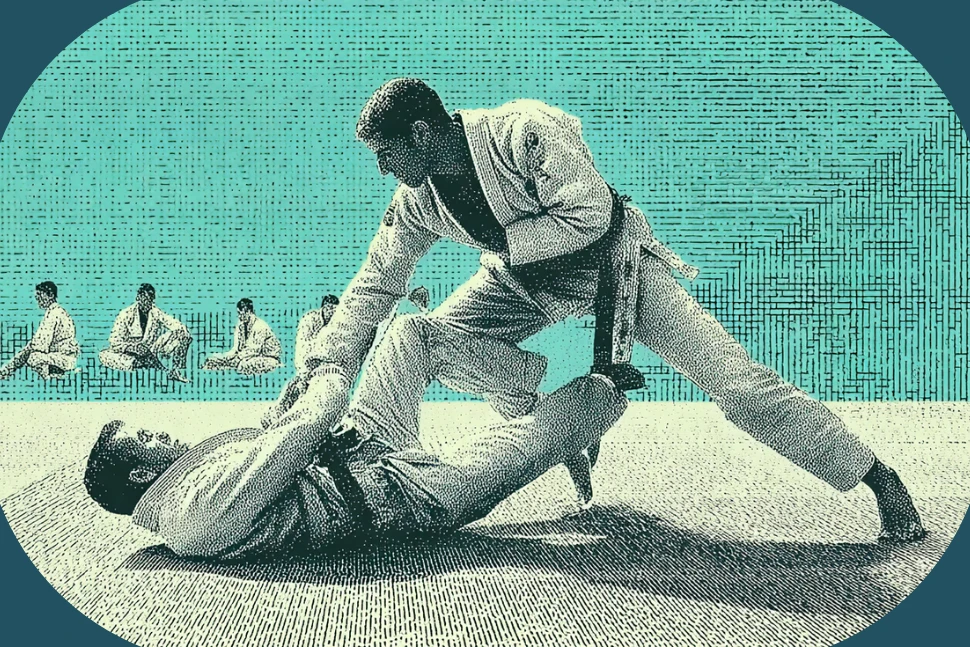
One of the most radical ideas in all of martial arts: you can be on your back, a bigger person on top of you, and still be the one in control.
That's the guard. In Brazilian Jiu-Jitsu (BJJ), the guard isn't a defensive last resort—it's a weapons system. The bottom fighter uses their legs to control, off-balance, sweep, and submit whoever's on top. If you want to understand what BJJ is, you have to understand the guard. It's the idea the whole art is built around.
This guide covers every major guard position, what makes each one work, and—importantly—which ones you should actually focus on first.
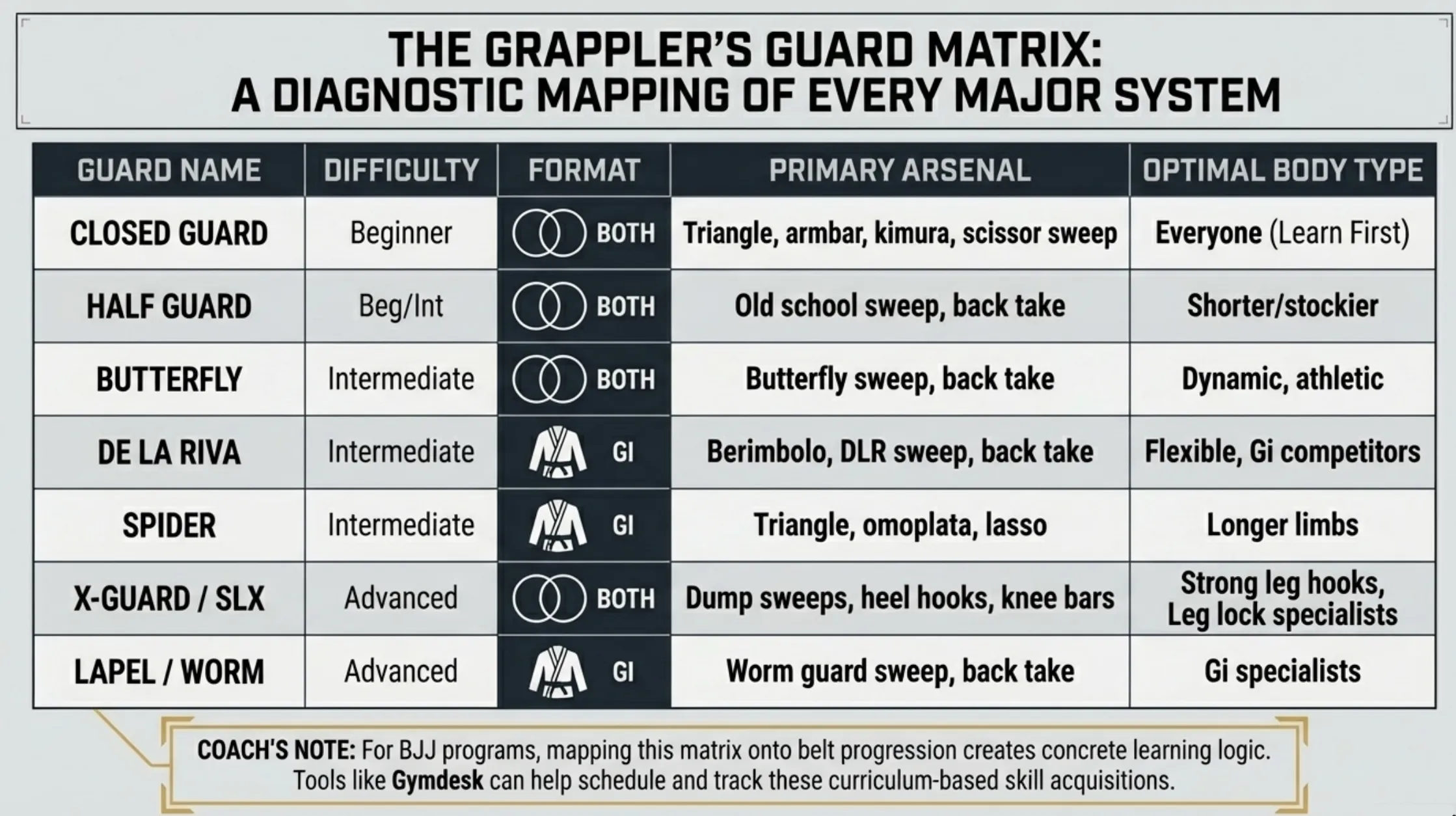
Guard Positions at a Glance
What is the Guard?
The guard is any position where you're on the bottom using your legs to control an opponent between or above you. What separates BJJ from other grappling arts is that this isn't just survival—it's offense.
Your legs act as barriers, levers, and hooks. By manipulating your opponent's posture and controlling where their weight goes, you can prevent them from passing to a better position while setting up sweeps and submissions of your own. Technique replaces strength. A lighter, smaller grappler can neutralize a heavier opponent's weight advantage through hip movement and leverage.
The guard became BJJ's defining innovation in the 1930s when Hélio Gracie developed it into an offensive system—not just a way to survive on your back, but a way to win from there. That idea reshaped the entire art, and it's why the guard remains central to what BJJ is today.
Guards break into two broad families: closed guard (legs locked around the opponent's body) and open guard (legs unlocked, using dynamic hooks and frames).
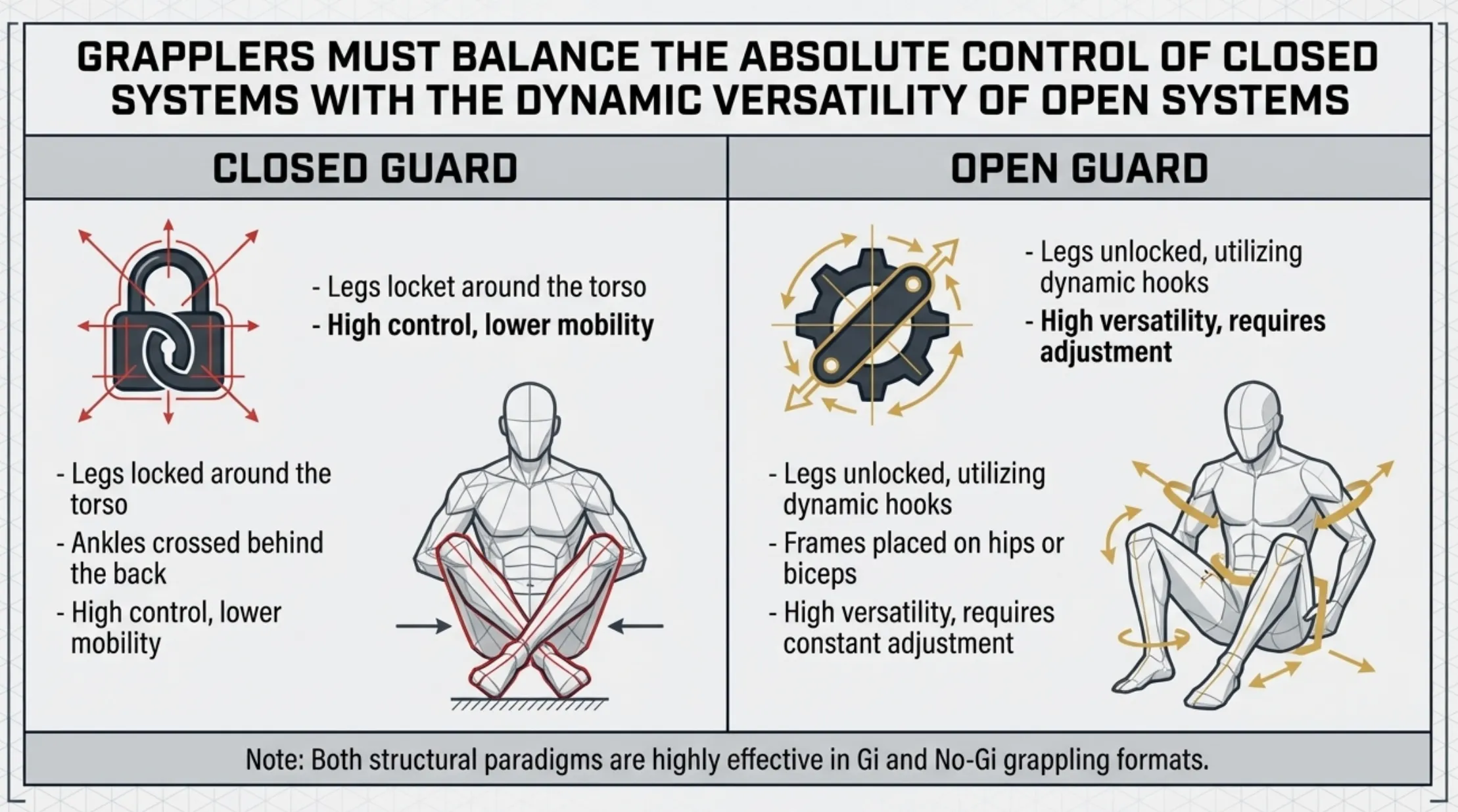
Closed guard gives you more control. Open guard gives you more options. Most grapplers build their game around one closed-guard base and one or two open-guard systems that suit their body type and style.
Essential Guard Positions
These are the guards you'll encounter in your first year or two of training. Each one teaches different principles—and understanding even one of them deeply will make your entire ground game sharper.
Closed guard
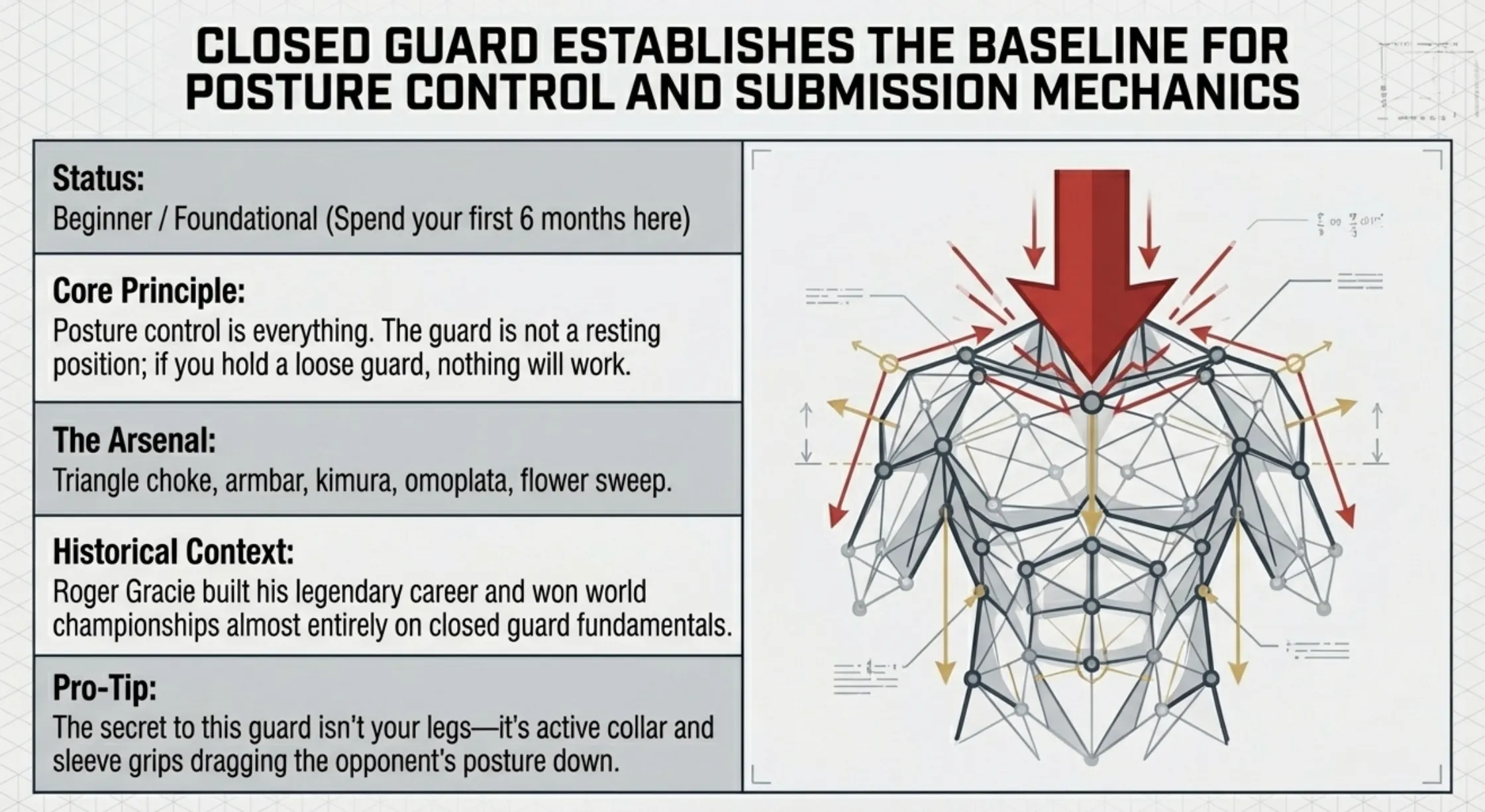
Closed guard is where every BJJ journey should start. Your legs are wrapped around your opponent's torso, ankles crossed behind their back—a tight lock that keeps them in your range and limits what they can do.
The first thing to understand: posture control is everything. Using collar and sleeve grips, you drag your opponent's posture down toward you. When their posture breaks, their ability to defend collapses with it. From there, you have a menu: triangle choke, armbar, kimura, omoplata, scissor sweep, flower sweep.
The biggest mistake beginners make is holding a loose closed guard and wondering why nothing works. You have to be active—constant grip pressure, constant posture disruption. The guard isn't a rest position.
Roger Gracie, widely considered the greatest BJJ competitor of all time, built his entire game around closed guard fundamentals. He submitted world champions with the triangle and armbar from closed guard at the highest level—proof that this "basic" position never gets outgrown.
Common mistakes:
- Holding a loose, passive guard—closed guard requires constant grip pressure and posture disruption
- Letting your opponent posture up unchallenged instead of immediately breaking them back down
- Crossing your ankles too low on their back, which weakens the lock and gives them space
Start here. Spend six months here before you look at anything else.
Half guard
Half guard happens when you've trapped one of the opponent's legs between yours. For a long time, it was considered a step on the way to getting your guard passed. Modern BJJ completely changed that.
The core principle: don't get flattened. Your outside leg hooks over the opponent's hip, your inside leg traps their leg, and you fight for the underhook on the trapped side. That underhook is the difference between half guard and bottom-side-control. Without it, you're just surviving. With it, you're attacking.
From the underhook position, you can hit the old school sweep (underhook the leg, roll them over your shoulder), take the back, or transition into other guards. Half guard has several important variations:
- Z guard adds a knee frame across the opponent's body that buys you additional space and slows their passing.
- Knee shield uses your top knee as a barrier against their chest—it's the most common way to prevent them from flattening you while you work for the underhook.
- Lockdown (popularized by Eddie Bravo) locks your feet together around the opponent's trapped leg for maximum control. Strong no-gi option.
Bernardo Faria won five World Championship titles running almost exclusively through half guard—often against opponents who were bigger, faster, and more athletic. The guard works at any level.
Half guard is forgiving for beginners because even if you lose the underhook briefly, the leg trap keeps you in the fight. It's also one of the best options for shorter, stockier grapplers who have a lower center of gravity.
Common mistakes:
- Getting flattened on your back without fighting for the underhook—that's not half guard, it's almost-passed
- Holding the leg trap passively instead of using it to create angles and attack
- Ignoring the knee shield when you can't get the underhook right away
Butterfly guard
Butterfly guard is a seated position where you sit up into your opponent and place your feet—your butterfly hooks—underneath their thighs. From there, upper body grips (underhooks or collar-and-sleeve) give you steering control.
The hooks do the work. When your opponent moves, you use one hook to lift and off-balance them while pulling with your grips in the opposite direction. The timing of that coordination—hook up, grips pull—is the butterfly sweep. Done right, it's one of the most explosive sweeps in BJJ.
Marcelo Garcia built one of the most successful competition careers in grappling history on butterfly guard. His system showed how the position transitions seamlessly into X-guard, single leg X, and back takes—making it a hub for an entire attacking game, not just a sweep.
Butterfly guard is better in no-gi than most open guard systems. It doesn't rely on sleeve or lapel grips, so it transfers directly to wrestling and MMA contexts.
Common mistakes:
- Leaning back instead of sitting up tall into your opponent—the second you lean back, you lose the leverage
- Not coordinating the hook lift with the upper body pull—both need to happen together
- Letting your opponent sprawl their hips back without adjusting your hooks
De La Riva guard
De La Riva guard is built around one hook: your foot wrapping behind the opponent's leg from the outside, with your same-side hand controlling their ankle. That hook makes it mechanically difficult for a standing or kneeling opponent to step away from you. Your other hand controls their sleeve or collar, and suddenly you're controlling a much bigger person from the bottom.
Ricardo De La Riva developed this system in the 1980s to deal with opponents who were difficult to control with standard open guard approaches. The DLR hook gives you a structural advantage that doesn't depend on strength.
Basic sweeps from De La Riva involve using the hook as an anchor while your grips pull the opponent off-balance. The back take—where you invert underneath the opponent by using the DLR hook to roll under and behind them—has become one of the signature sequences in modern sport BJJ.
Reverse De La Riva places the hook on the inside of the leg instead of the outside, which changes the attacking angles. It works particularly well in no-gi, where the grip options are more limited.
De La Riva is a gi-specialized guard. Without sleeve and lapel grips, the control breaks down. If you're primarily a no-gi grappler, butterfly guard and single leg X will serve you better.
Common mistakes:
- Letting the DLR hook slide to the calf instead of staying behind the knee—you lose all control
- Not controlling the ankle on the hooked side, which lets them step free
- Trying to play DLR without sleeve or collar grips in no-gi, where it doesn't have enough control
Spider guard
Spider guard is a gi-only system where your feet rest on the opponent's biceps while your hands control their sleeves. Push with the feet, pull with the hands—you create a frame that holds the passer exactly at the distance you want.
The setup requires good sleeve grips and active feet. As your opponent moves, you reposition your feet to stay on their biceps. Let your feet slip to the forearms and you lose the frame; your opponent can collapse forward or spin through.
From that frame, the triangle choke is the primary attack. One arm is already being pulled across their body—you're most of the way there. Omoplata and lasso guard transitions also set up naturally.
Leandro Lo used spider guard as a central weapon during his run to multiple World Championships, combining it with knee shield and lasso to create a guard that was nearly impossible to pressure through.
Spider guard favors longer-limbed grapplers who can maintain bicep contact while sitting back. If you have shorter arms or legs, you may find the frame harder to maintain against aggressive passers.
Common mistakes:
- Feet slipping to the forearms instead of staying on the biceps—you lose the frame entirely
- Grips not strong enough to maintain constant tension in the push-pull
- Staying flat on your back instead of angling your hips for attacks
Advanced Guard Systems
Once you've built a solid closed guard and one open guard system, these are the positions that open up the next level of your game. They require more timing and body awareness—but they also give you access to attacks that simpler guards can't reach.
X-guard and single leg X
X-guard puts you underneath a standing opponent with your legs forming an X shape across their hips—one leg controlling their far hip, the other their near leg. That configuration creates a powerful lever that lets you dump opponents in either direction with relatively little strength.
Entries typically come from butterfly guard: you use your hooks to elevate the opponent as they try to disengage, then thread underneath to establish the X. The sweep mechanics follow the lever—tilt them to one side, extend, and they go over.
Single leg X isolates one of the opponent's legs between yours, controlling their hip and knee simultaneously. In modern no-gi grappling, single leg X is primarily an entry point for leg attacks.
It's worth noting: single leg X and ashi garami are not the same thing. Ashi garami is a broader category of leg entanglements that includes single leg X as one configuration—alongside outside heel hook position, saddle/inside heel hook position, and others. The terminology gets loose on social media; be precise.
Garry Tonon and Gordon Ryan showed how X-guard and single leg X feed directly into leg lock sequences—and built world-class careers doing it.
Lapel guards and worm guard
Modern lapel guard systems use your opponent's own gi against them. The most sophisticated version is the worm guard, developed by Keenan Cornelius: you feed your opponent's lapel under their leg and back to your own hand, creating a loop that severely restricts their movement while you attack from multiple angles.
Lapel guards are a gi-only and highly specialized system. They require significant mat time to develop and can be frustrating to learn early—opponents who've never seen them often move in unpredictable ways that expose your entries. That said, a well-developed lapel guard is genuinely difficult to deal with for anyone who hasn't spent time defending it.
Learn lapel guards after you have a solid foundational guard game. They're excellent additions to a mature system, not a starting point.
Other Guards Worth Knowing
- Rubber guard: A high-guard system developed by Eddie Bravo that uses your own leg to control the opponent's posture. Requires significant hip flexibility. Strong no-gi option for the right body type.
- Williams guard: Uses a palm-to-palm grip while wrapping the arm around the opponent's head to control posture and protect against strikes. Particularly relevant for MMA.
- Seated guard / combat base: Less a formal guard and more a dynamic transitional position—sitting up with one knee raised. Common starting point for guard pulling and half guard entries.
Guard Retention: Keeping What You've Got
Building an attacking guard means nothing if you can't maintain it when someone tries to pass. Guard retention is the skill of recovering before the pass completes.
The engine is hip movement. When you feel a pass developing, you're not defending with your arms—you're creating angles with your hips. Hip escapes, frames, and knee-to-elbow connections reset the position before your opponent can settle.
Specific drills that build retention faster than anything else:
- Hip escape (shrimping) drills—50 reps at the start of every open mat
- Knee-to-elbow connection against a passer applying pressure
- Torreando defense: reacting to the hands-only grip with hip movement
Understanding common pass attempts lets you position your frames proactively instead of reactively.
The goal of retention isn't just to survive. It's to get back to an offensive guard and attack again.
Which Guard Should You Learn First?
Closed guard. Full stop.
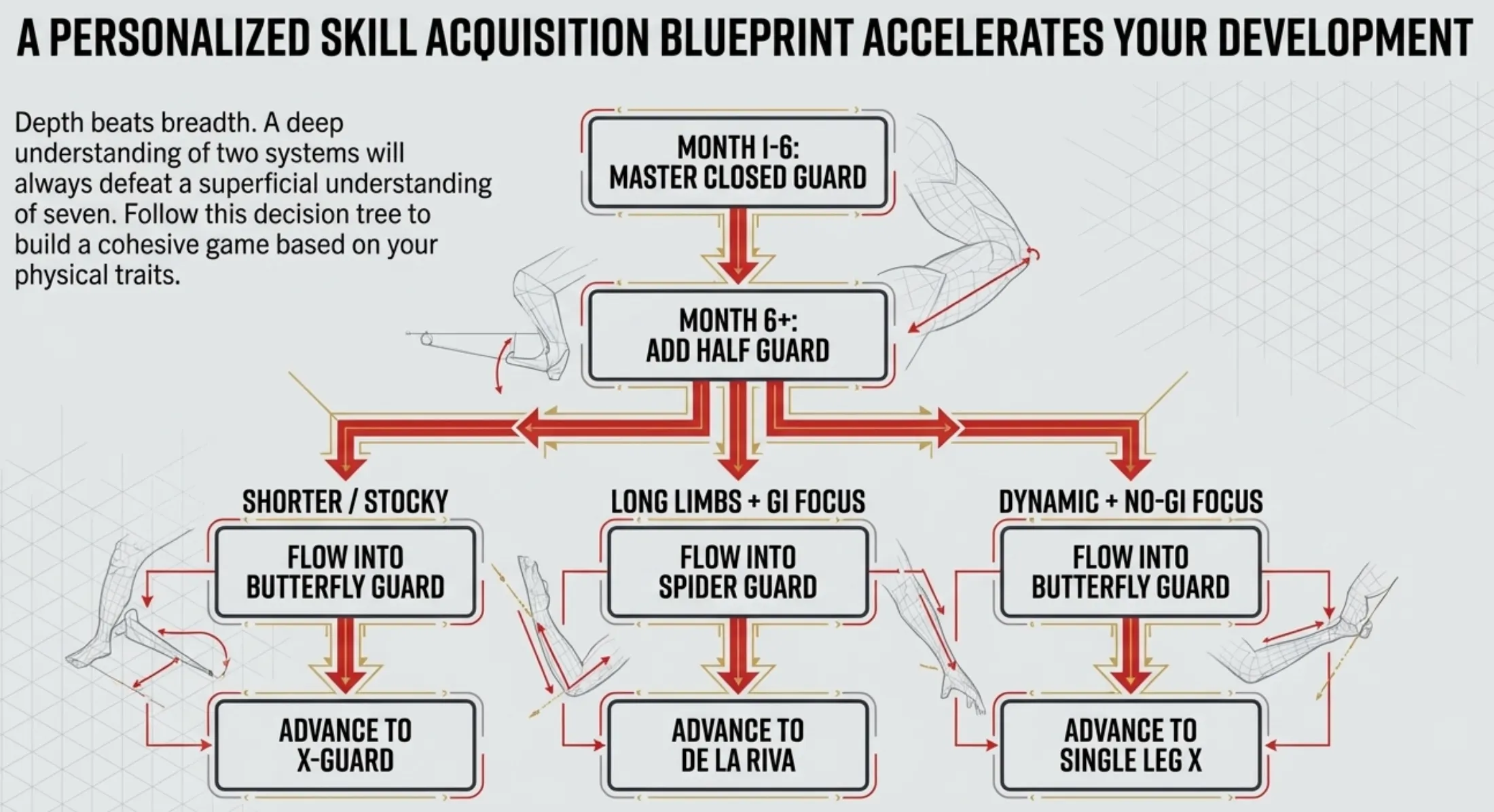
It teaches the foundational concepts that make every other guard make sense: posture control, breaking balance, grip fighting, and attacking combinations. Most open guards are easier to learn after you understand why closed guard works.
After six months of closed guard work, add half guard. It's the most forgiving open guard system for beginners—the leg trap keeps you safe while you develop your underhook instincts.
From there, your body type and goals should guide you:
- Shorter or stockier? Half guard and butterfly guard reward lower centers of gravity.
- Longer limbs? Spider guard and De La Riva give you more reach to work with.
- No-gi focus? Butterfly guard and single leg X transfer the best.
- Gi competitor? De La Riva and spider guard open up the widest range of attacking options.
Build depth in two or three guards before you expand. A strong closed guard and one open guard system will take you further than a surface-level understanding of seven guards.
The Bottom Line
Curious about why people get hooked in the first place? Check out the benefits of Brazilian Jiu-Jitsu. For a breakdown of the specific techniques you'll learn from each guard, see our BJJ moves guide. And if you're training in the gi, our complete BJJ gi guide covers everything you need to know about choosing and caring for your first gi.
Gym management software that frees up your time and helps you grow.
Simplified billing, enrollment, student management, and marketing features that help you grow your gym or martial arts school.

FAQ
BJJ Guard Positions FAQs

Josh is a martial arts educator and coach who bridges live training on the mats with evidence-based teaching. A 4th degree Taekwondo black belt and dedicated Brazilian Jiu-Jitsu practitioner, he’s spent years running classes, mentoring students, and helping instructors move beyond rote drills to training that actually works under pressure.
He holds a Master of Education in Teaching & Learning from Liberty University and runs Combat Learning, where he breaks down ecological dynamics, constraints-led coaching, and games-based training for combat sports. Through his writing and podcast work with Gymdesk, Josh turns coaching science and gym-owner stories into practical ideas you can use to run better classes and build a stronger martial arts school.