What Is BJJ? A Complete Guide to Brazilian Jiu-Jitsu
When someone walks into your academy for the first time and asks "What exactly is jiu-jitsu?"—what do you tell them?
You could explain the history. You could talk about the Gracies. But what they really want to know is simple: What am I getting into?
Here's a clear answer you can give them—and they can pass along to friends and family wondering why they're suddenly obsessed with "rolling around on the ground."
What is BJJ? The Simple Definition
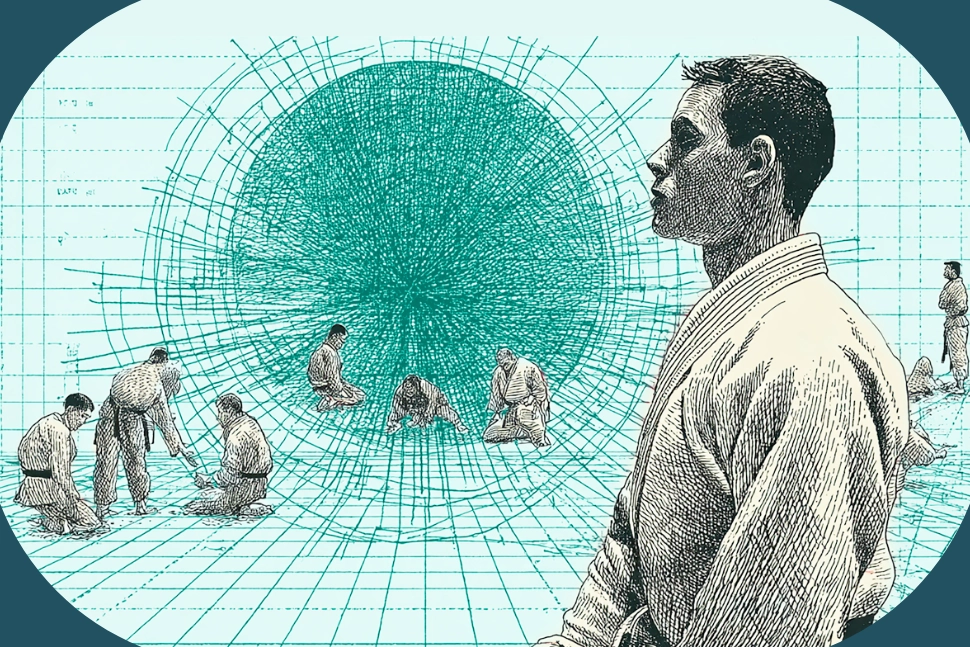
Brazilian Jiu-Jitsu is a grappling-based martial art focused on ground fighting and submission techniques. Unlike striking arts where bigger and stronger usually wins, BJJ is built on one core principle: proper technique and leverage can overcome size and strength.
That's why a 140-pound practitioner can control and submit someone twice their size. It's not magic. It's physics, timing, and thousands of hours of practice.
The Gracie family developed BJJ in Brazil so that a smaller person could defend against a larger attacker.
The art has evolved significantly since those early days, but most of the action still happens on the ground. While wrestling focuses on takedowns and pins, and judo emphasizes throws, BJJ specializes in what happens after the fight hits the mat. (For a deeper look at how these arts compare, see our guide to the different types of martial arts.)
The goal isn't to knock someone out—it's to use positioning and technique to make your opponent give up.
BJJ works as a self-defense system and a competitive sport. Tournaments run worldwide under organizations like the International Brazilian Jiu-Jitsu Federation (IBJJF), and the art is now a core part of mixed martial arts training.
Your new students don't need to be strong or flexible to start—they build those attributes through training. People begin BJJ in their 40s, 50s, and even 60s, and still become skilled practitioners. Technique matters more than athleticism, and that's what makes the art so accessible.
The Core Principles
When you're explaining BJJ to new students, these three concepts help them understand what makes the art different:
Leverage over strength
When a larger opponent pushes, you redirect their momentum. When they pull, you use their energy against them. Every technique is built around mechanical advantage. A properly applied armbar doesn't require strength—it uses body positioning to create pressure that even powerful opponents can't resist.
This is why drilling proper technique matters. Students aren't building muscle memory for athletic moves. They're learning to use their bodies as lever systems.
Position before submission
BJJ has a hierarchy of positions, and the fundamental rule is: establish a dominant position first, then attack. Jumping for submissions from bad positions is how you get reversed and end up worse off.
You're always thinking two or three moves ahead—how to improve your position, anticipate your opponent's escapes, and set up attacks. That's why people call it "human chess."
The tap (controlled resistance)
The "tap" is sacred in BJJ. When you're caught in a submission, you tap your partner (or the mat), and they release immediately. This lets you train hard against fully resisting opponents without serious injuries.
Live sparring—called "rolling"—is central to BJJ. Students test everything against real resistance from day one. If a technique doesn't work against someone actually trying to stop you, you find out fast.
PRO TIP:
New students often worry about getting hurt. Explain the tap early and often. Once they understand that they control when to stop, the fear drops significantly.
The Four Fundamental Positions
When students watch their first class or competition, these are the positions they need to recognize:
Guard
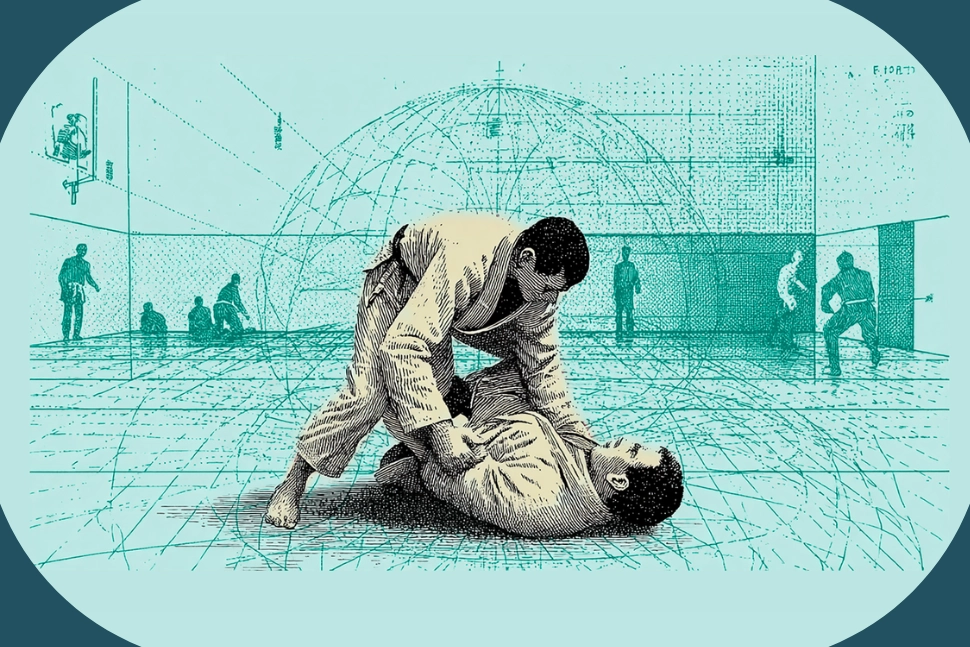
Being on your back isn't losing in BJJ—that's the counter-intuitive part you'll need to explain. Guard is when the bottom person uses their legs as a barrier and weapon against the person on top.
In closed guard, your legs wrap around their waist, controlling distance and limiting their movement.
From here, you can sweep them (reverse positions), submit them, or stand back up. Guard is an offensive position—the person on top often needs to work hard just to escape.
Mount
You're sitting on your opponent's torso with your knees beside their ribs. Gravity works for you. They're carrying your weight while you have both hands free to attack.
Mount is one of the most dominant positions. The mounted person is defending armbars, chokes, and transitions while you're conserving energy.
Side control
You're on top, perpendicular to your opponent, with your weight on their chest. They can't use their legs against you, and you can apply crushing pressure while working for submissions or transitions to mount.
Side control is where you catch your breath, slow the pace, and work toward better positions or finishing holds.
Back control
Back control is the most dominant position in BJJ. You're behind your opponent with your hooks in (legs wrapped around their waist). They can't see you, can't easily defend, and the rear naked choke—one of the highest-percentage submissions—is right there.
Getting to someone's back and controlling it is the ultimate goal in many BJJ exchanges.
How BJJ Differs From Other Martial Arts
Your students will ask how BJJ compares to other arts they've heard of. Here's a quick breakdown:
Aspect | BJJ | Judo | Wrestling |
Primary focus | Ground submissions | Standing throws | Takedowns & pins |
Win condition | Submission or points | Throw, pin, or submission | Pin or points |
Uniform | Gi or no-gi | Gi (judogi) | Singlet |
Ground time | Extensive | Limited | Limited |
BJJ vs judo
Both descend from Japanese jujutsu, but they emphasize different phases of a fight.
Judo focuses on standing techniques—throws and trips that score points or end matches when your opponent's back hits the mat. BJJ starts where judo often ends, specializing in ground control and submissions.
A clean throw wins in judo competition. In BJJ, the fight continues on the ground until someone submits or time runs out.
BJJ vs wrestling
Wrestling emphasizes takedowns and pins—holding your opponent's shoulders to the mat. BJJ allows more ground fighting time and focuses on submissions rather than pins. Wrestling tends to be more explosive; BJJ can be more methodical and patient.
Many BJJ practitioners cross-train wrestling for better takedowns, and many wrestlers add BJJ for better ground finishing skills.
BJJ vs MMA
MMA combines multiple martial arts, including BJJ. The ground grappling you see in UFC fights is largely BJJ technique—but mixed with strikes and the constant threat of being punched.
Pure BJJ has no striking. You're only grappling. Many MMA fighters train BJJ extensively because getting taken down without ground defense is a fast way to lose.
Gi vs No-Gi: What's the Difference?
Another common question from new students. BJJ is practiced in two main formats:
Gi training
In gi training, you wear a heavy cotton uniform called a gi (or kimono). The fabric becomes part of the fight—you grip lapels and sleeves, use the gi for chokes, and control your opponent through their clothing.
Gi training tends to be slower and more methodical. The friction from the fabric makes escapes harder and gives both players more gripping options.
No-gi training
In no-gi, you wear a rash guard and shorts. No grabbing clothing—only the body. Everything is faster and more slippery. No-gi translates more directly to MMA and self-defense situations where attackers aren't wearing a gi.
Which should beginners start with? Most academies teach both. Many instructors recommend starting with gi because it slows things down and helps beginners learn proper technique. But either works—whatever your program offers is fine for day one. If you want a practitioner's honest, side-by-side breakdown, here's no-gi vs gi BJJ.
RUNNING A BJJ ACADEMY?
Tracking attendance, managing belt promotions, and handling billing shouldn't eat into your mat time. Modern gym management tools handle the admin so you can focus on teaching. See how Gymdesk works →
Why People Call It "Human Chess"
The chess comparison comes up constantly in BJJ—and for good reason.
Every position has attacks, defenses, and transitions. You're problem-solving in real time against someone trying to outsmart you.
Anticipating your opponent's moves matters as much as executing your own. Technical knowledge can overcome physical attributes. And there's always something new to learn, even after decades of training.
This is what keeps students training for years. Every roll is a puzzle to solve, and the solutions change based on your opponent, your body, and the position you're in.
Tell new students that feeling lost and confused is normal at first.
The complexity is the point—it's what makes the art endlessly engaging. That intellectual depth, combined with the bonds formed through training culture and community, is what keeps people on the mats for decades.
What Training Actually Looks Like
For students wondering what they're signing up for, here's a typical class:
- Warm-up (10–15 minutes): Movement drills specific to grappling—shrimping, bridging, technical stand-ups. These feel awkward at first but become essential for effective ground fighting.
- Technique instruction (20–30 minutes): The instructor demonstrates techniques, then students drill them with partners. You repeat movements dozens of times, building the muscle memory to execute under pressure.
- Live sparring/rolling (20–30 minutes): Students grapple with training partners at varying intensities. This is where you test everything. Beginners often start from specific positions or roll lighter while they learn the basics.
Most academies recommend training two to three times per week to make steady progress. Consistent attendance also helps students build relationships with training partners who push them to improve.
The Bottom Line
Here's the summary you can share with anyone asking "What is BJJ?":
THE SHORT ANSWER:
A grappling martial art focused on ground fighting and submissions
Technique-based, so smaller practitioners can defend against larger opponents
Practical for self-defense, since most real fights end up on the ground
Both a sport and a lifestyle, with competitions worldwide and a strong community culture
Accessible to anyone—age, size, and starting fitness level don't determine your potential
Once they understand the basics, most students want to know what they'll actually gain from training. The physical and mental benefits of martial arts training go far beyond techniques—and that's often what turns a curious visitor into a committed student.
CLEAR STUDENT PROGRESSION:
The belt system gives students a framework for their journey. A good skills tracking system shows them exactly what to work on—and shows you who's ready for promotion. No spreadsheets, no guesswork. Learn more →
For gyms that want to manage their operations right (i.e., without having to think about admin all the time), Gymdesk is the way to go. Built for BJJ gyms from the start, it has everything you need. Try it free for 30 days, if you don't believe it.
Gym management software that frees up your time and helps you grow.
Simplified billing, enrollment, student management, and marketing features that help you grow your gym or martial arts school.


FAQ
BJJ FAQs
Let's do a few more questions, then you can go sign up for BJJ.

Josh is a martial arts educator and coach who bridges live training on the mats with evidence-based teaching. A 4th degree Taekwondo black belt and dedicated Brazilian Jiu-Jitsu practitioner, he’s spent years running classes, mentoring students, and helping instructors move beyond rote drills to training that actually works under pressure.
He holds a Master of Education in Teaching & Learning from Liberty University and runs Combat Learning, where he breaks down ecological dynamics, constraints-led coaching, and games-based training for combat sports. Through his writing and podcast work with Gymdesk, Josh turns coaching science and gym-owner stories into practical ideas you can use to run better classes and build a stronger martial arts school.