
Is Your Kid Ready to Compete? A Parent and Coach Guide

"There's a tournament in four weeks," the coach says at the end of kids' class. It's mostly aimed at the kids, and a little at you.
Your eight-year-old is still pink in the face, the lobby smells like a laundry hamper somebody forgot about, and his eyes have gone very, very wide.
You start doing math.
Is my kid ready to compete? What does a tournament even cost? Does he own a mouth guard that hasn't been chewed into modern art?
That kid is Theo, and he's made up. So is his gym, Sweep Dreams Martial Arts.
Theo, age 8
Kids' program, Sweep Dreams Martial Arts
The moment is real, though.
It happens in kids' programs every week, and the question lands on two people at once: the parent holding the car keys and the coach who brought it up.
This guide is for both of you.
Quick disclosure: I'm a marketing guy, so think of me as the scribe here. Most of what follows comes from coaches who send kids to tournaments every season, mainly Solana Be, whose gym we filmed for Gymdesk Originals, and Smoothcomp co-founder Martin Janson.
The health and survey numbers belong to the pediatricians and the Aspen Institute. My part, besides the typing, is that I have young kids of my own, so I know the face.
Old Enough and Ready Are Two Different Questions
The tournament will tell you whether your kid is old enough.
Kids' divisions are split by age, so the event page settles that one in about 10 seconds. Ready is harder, and nobody prints it on the registration page.
The pediatricians are more cautious than the brackets.
The American Academy of Pediatrics says competition should be avoided before age six, when most kids don't have the motor skills for organized sports yet.
From six to nine, it wants the focus on learning new skills, with less attention on keeping score.
Even at 10 to 12, when most kids can handle complex sports, the AAP says most experts want the emphasis on skill development, fun, and participation.
Kids under 10 still step on tournament mats every weekend, and plenty have a great time. At that age, the point of the day is the experience.
The medal is a bonus, and it's usually about the size of a cookie.
Solana Be co-owns NEO Martial Arts and coaches its competitors (also, she's my colleague). She doesn't think anyone ever really feels ready.
In her guide to preparing athletes for competition, she put it this way:
“What our team can actually give someone isn't the feeling of being ready, it's being prepared.”
Her reasoning: if you lose while you felt ready, you may never feel that way again.
So that's the working definition for the rest of this guide. Ready means prepared, and the signs below are what prepared looks like from the outside.
Signs Your Kid Is Ready to Compete
You can spot most of these at pickup, and a coach sees the rest in class. Most prepared kids check most of the list, and nobody checks all six on the first try.
Here's what to look for, and what to ask the coach about each one:
Sign | What you'll see | Ask the coach |
|---|---|---|
Your kid's idea | Your kid brings it up again a week later, unprompted | "Has she asked you about it, too?" |
Steady attendance | Twice a week for months, belt-test season or not | "Is his attendance where it needs to be?" |
Knows how a match ends | Can explain the points, the tap, and what's off-limits | "Has she done a practice match under the real rules?" |
Can lose in class | Gets swept, tapped, or scored on and goes right back in | "How does he handle losing a round?" |
Listens when tired | Hears the coach mid-round and actually does the thing | "Does she follow instructions at the end of class?" |
The coach agrees | The coach can say why, in specifics | "What would you want to see first?" |
A few of these deserve more than a table row.
Whose idea was it?
This is the one parents skip, because it's the one about us.
The Aspen Institute surveyed nearly 4,000 kids aged 10 to 17 who play organized sports and published the results in April 2026.
Among kids who'd quit, 21% said a parent pressured them to play when they didn't want to. Among kids still playing, it was 9%.
So if the tournament is mostly your idea, find that out before you pay the entry fee.
Every parent has bought gear for a hobby that lasted two weekends. That's a cheap mistake. A first tournament your kid didn't want is a pricier one.
Can your kid lose a round and come back next week?
Kids lose all the time in class.
Yours gets swept, tapped, and kicked in places the pads didn't cover. Watch what happens the next week.
The AAP's own test for win-or-lose sports is whether your kid understands that self-worth doesn't ride on the result. A first tournament puts that to the test fast.
When the same Aspen survey asked former players to name the worst part of sports, the top answer, at 29%, was feeling "not good enough."
Does your kid show up?
At NEO, Solana says the read on a competitor starts with attendance.
Theo trains twice a week, every week, so he's been stuck in enough bad spots to stay calm in one. He's also been stuck under a kicking shield, which he insists counts.
If your kid comes when it's convenient, a tournament is a strange place to find out what all those skipped Tuesdays cost.
Signs It's Not Time Yet
Not yet
"Not yet" means the next step is something smaller than a tournament.
That's all it means.
A few signs say wait:
- You want it more than your kid does. If you've brought it up three times and your kid has brought it up zero, that's your answer.
- The first question is "Will I win?" Solana hears this a lot: many people who ask that are really asking, "Will I win everything?"
- Losing a drill ends in tears most of the time. Every kid has a bad day. A pattern is different.
- Your kid started a few weeks ago. The basics come first, and the bracket isn't going anywhere.
- Your kid has never seen a tournament. The noise, the waiting, and the crowd at the edge of the mat surprise a lot of kids. The waiting surprises the parents.
Two easy steps sit between "not yet" and a real event.
Go watch one first. An hour in the stands shows your kid the whole day with nothing riding on it, and you get to learn where the parking is without a clock running.
Bring a cushion. Nobody who designs gym bleachers has ever sat on one for six hours.
Or ask whether your gym runs an in-house tournament.

Martin Janson, a Smoothcomp co-founder who runs an academy in Sweden, says an in-house event gets far more of a gym's members to say yes:
“But if we launch an in-house tournament, we will get a much higher percentage of participants. Everyone will feel like, oh, this is easy and accessible for me. I can now try my wings on the competition land.”
Your kid already knows the mats, the coaches, and where the water fountain is.
Questions to Ask the Coach Before You Sign Up
Once your kid is prepared and the coach agrees, you still have a pile of logistics.
Coaches field these questions every season, so asking early won't annoy anyone. Asking in the parking lot on the day might.
Six questions cover most of it:
- Which event, and why that one? Coaches weigh the organizer, the ruleset, and the practical stuff like distance and cost. Martin Janson's guide to choosing a tournament walks through how coaches pick.
- What are the rules for my kid's age group? Rulesets change by organizer and by age, so the coach should know which techniques are allowed in your kid's division.
- Which division will my kid enter? Most kids' divisions are set by age, weight, and belt or rank. Ask how the weigh-in works, too.
- Who will be in my kid's corner? At most tournaments Solana's team goes to, kids' divisions allow one coach per team on the mat, which surprises a lot of parents. Her tournament-day guide explains who can be mat-side and why.
- What will it cost, all in? The entry fee, plus gas, food, maybe a hotel, and a whole Saturday, most of it spent waiting for a bracket listed at 10:40 that starts at 1:15. Martin's guide notes that most organizers raise fees closer to the event, so early registration saves money.
- What happens if my kid loses? A good coach has a plan for the Monday after. If yours doesn't, start with this guide to a student's first tournament loss.
A good coach will have answers to most of these. A great one handed you a sheet before you thought to ask.
For Coaches: How to Answer "Is My Kid Ready?"
You'll hear this question every season, usually at pickup, usually while you're holding a stack of kicking shields.
Parents trust a consistent answer more than a gut feeling. So answer it the same way every time.
Three habits make the answer consistent:
- Use the same signs for every kid. The table above works, or write your own. When a parent hears the same kids' competition readiness criteria you gave the family before them, "not yet" lands as fair.
- When it's a yes, name the event and the division. "Yes" makes a parent nervous. "The small local event in March, eight-to-nine, yellow belt" gives a parent something to plan around.
- When it's a no, give a next step and a rough date. "Let's get her through two in-house matches first, then look at the spring."
Once the answer is yes, three more help first-timers:
- Send first-timers where the team is going. Pick an event the rest of the team is entering, so there are teammates in the stands and a coach in the corner. One coach can corner the whole group.
- Brief the parents before the day. Cover arrival time, what to bring, the weigh-in, and who can be mat-side. Otherwise you'll answer the same text from 14 parents on Friday night. The parent table in Solana's tournament-day guide is a good starting list.
- Plan the first class back. The kid who lost needs a coach who saw the match and has one thing to work on.
If a lot of your answers are "not yet," an in-house event gives those kids a next step.
Gymdesk ran a webinar on running in-house competitions with Smoothcomp. One catch if you run it that way: an in-house event shows up in Gymdesk only when it's set to public on Smoothcomp.
Keeping Track of Who's Ready
A readiness read works better when it lives somewhere besides one coach's memory.
At Sweep Dreams, the read on Theo lives in the head coach's head. That works with 15 kids. It gets shaky at 60, and it's gone the week that coach moves to Denver.
Theo's mom asks at pickup whether he's ready.
The coach remembers that Theo was tired and grumpy in March but can't remember if that was before or after the growth spurt. (With eight-year-olds, it's always during a growth spurt.)
Is Theo ready? Two ways to answer
The coach's memory
- "He's been coming a lot. I think."
- "Grumpy in March. Growth spurt, probably."
- "Did he do the takedown drill, or was that Leo?"
- "Ask me after the belt test."
The record
- Twice a week, every week, since September
- Skills logged on each check-in, match rules included
- Yellow belt, with the date he earned it
- No missed weeks in the run-up to the event
Theo is made up, and so is his record.
Software can carry some of this.
Before a kid's first event, the signs live in your training records.
Attendance tracking shows who's been coming twice a week for months. If you assign skills to your classes, each check-in logs those skills to the member's record, so "knows how a match ends" has something behind it.
After the first event, competition history joins it.
Gymdesk and Smoothcomp are now one company. If you run a martial arts gym on Gymdesk, you already have a Competitions tab.
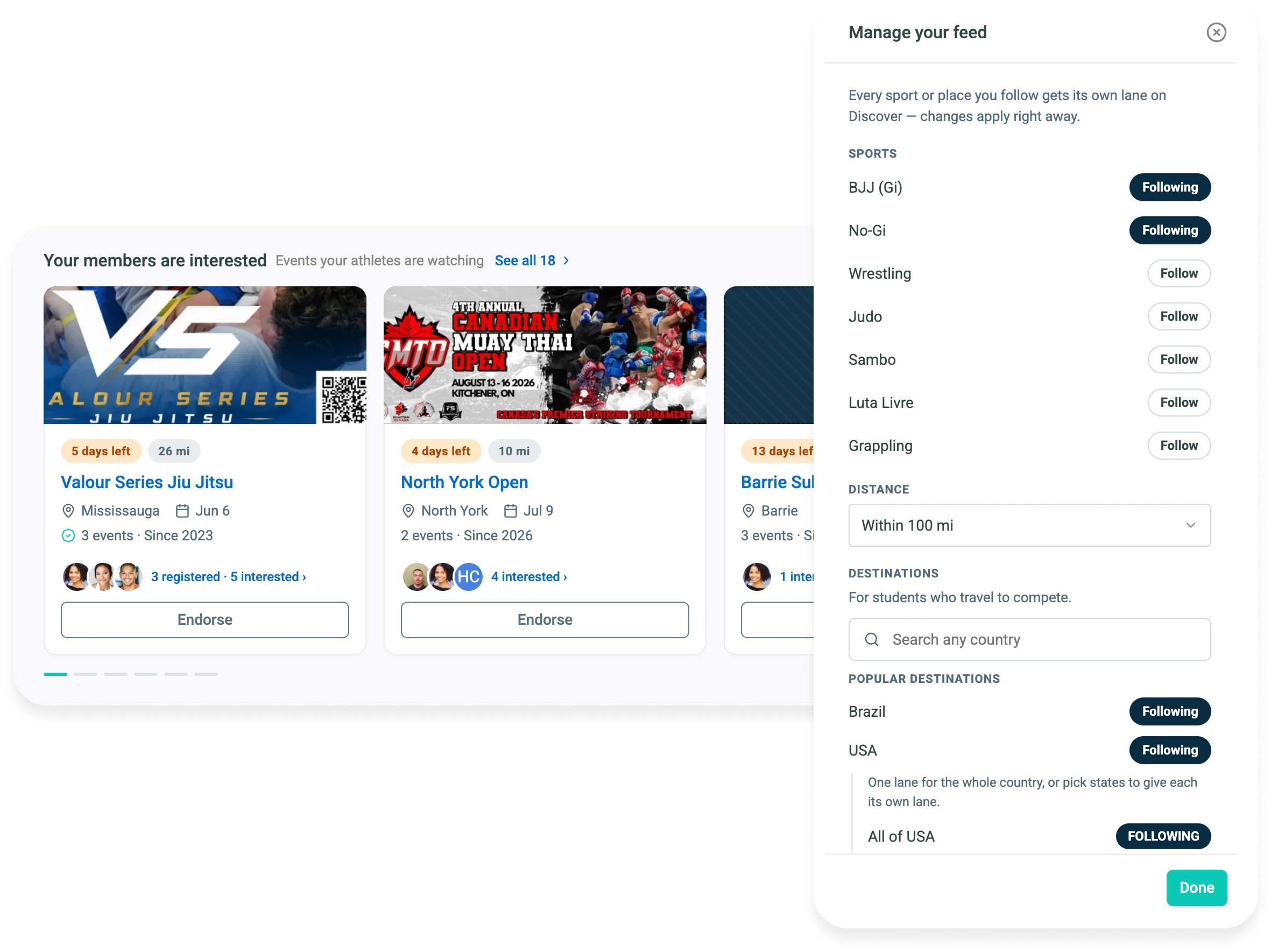
It's part of Smoothcomp Connect, included in every Gymdesk plan, and it works once your academy is linked to Smoothcomp. When you endorse an event, your roster shows which kids are Interested, Registered, and Paid, and the endorsement note is a handy place for the parent briefing.
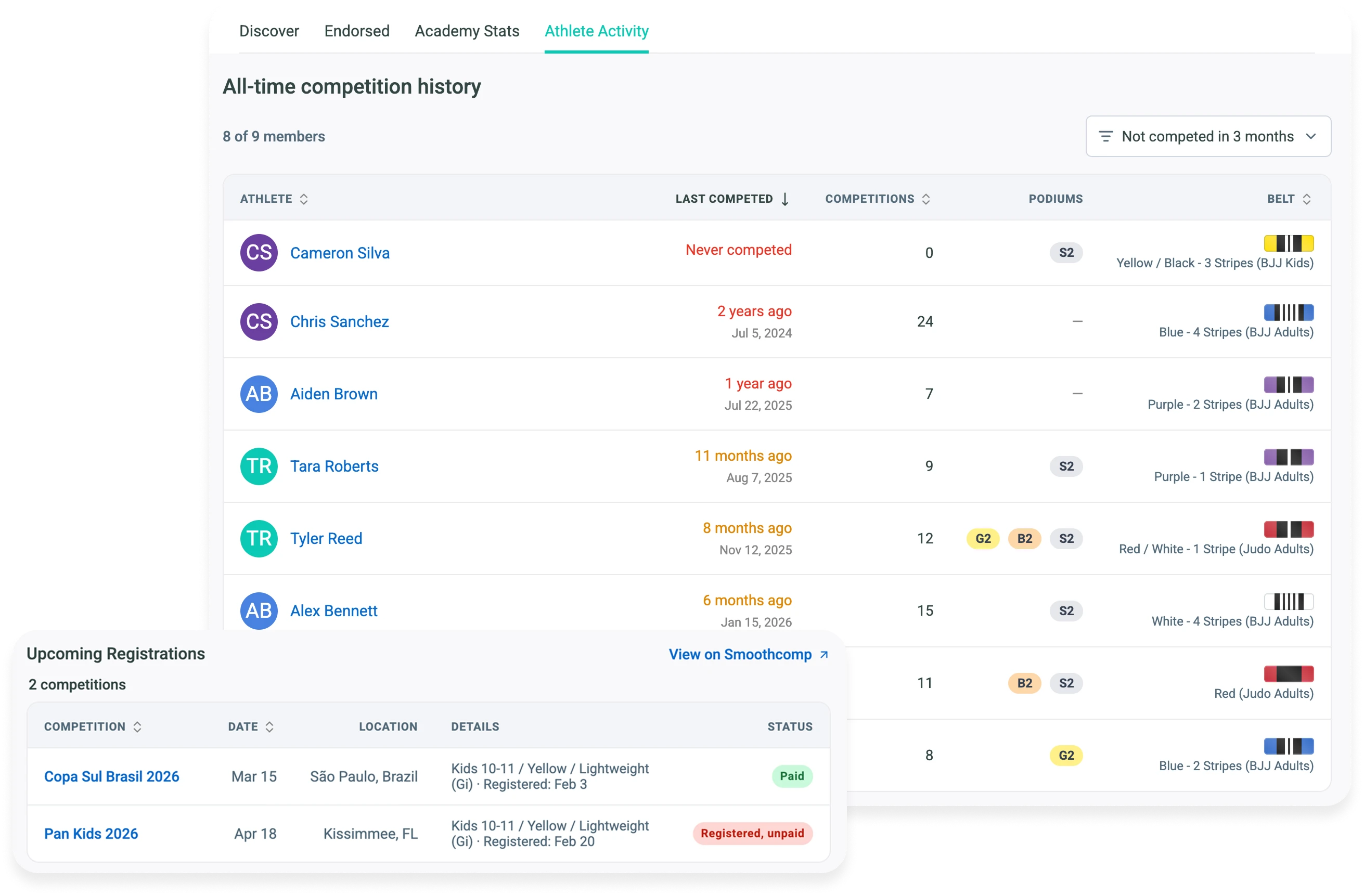
After each event syncs, results come back to the member's record.
Each member's competition record shows the last event, every event entered, and each placement, next to the attendance that shows who's still training.
Notes from the Coach Companion app on the day land on the same record.
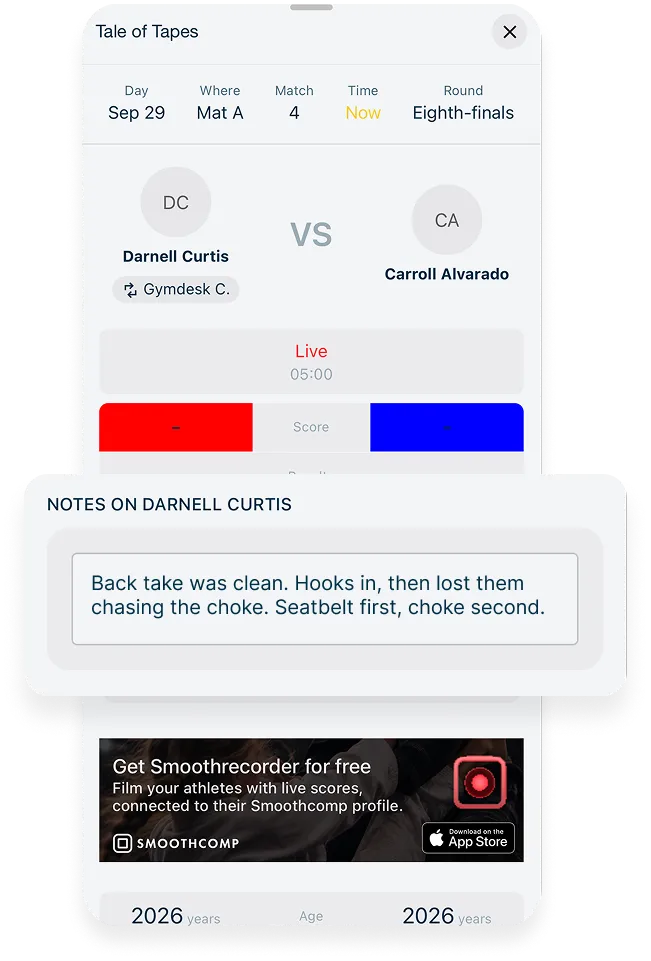
So the first time Theo's mom asks, the coach has his attendance and his skills. The second time, there's a match to talk about, too.
For the full picture, see how competition management software works for your gym.
FOR MARTIAL ARTS GYMS
If you run a martial arts gym on Gymdesk, you already have a Competitions tab. Smoothcomp Connect is included in every Gymdesk plan, and it works once your academy is linked to Smoothcomp.
Back to Theo
If Theo asked twice, trains twice a week, and can get tapped in class and laugh about it, he's prepared.
Sweep Dreams Martial Arts · Kids' team
Theo's readiness check
- ✓Your kid's ideaAsked twice. The second time, unprompted, in the car.
- ✓Steady attendanceTwice a week since September.
- ✓Knows how a match endsCan explain the points and the tap. Explains them at dinner, too.
- ✓Can lose in classGot tapped on Thursday and laughed about it.
- ~Listens when tiredMostly. Depends how close it is to snack time.
- ✓The coach agrees"The small local event in March, eight-to-nine, yellow belt."
Prepared. Pack snacks.
Theo is made up. The six signs are the ones in the table above.
Sign him up for the small one. Bring snacks. Bring more snacks than that.
If he isn't there yet, take him to watch one this spring. The tournament will run again next season.
It always does.
Gym management software that frees up your time and helps you grow.
Simplified billing, enrollment, student management, and marketing features that help you grow your gym or martial arts school.


FAQ
Is Your Kid Ready to Compete? FAQs
Short answers to the questions parents ask most.

Sean has spent the last decade creating content that helps businesses—small and not so small—grow smarter to allow operators to do more of what they love. You know, the fun stuff.
From shipping and international logistics to web development and marketing, he's done the work (not just the words) to scale retail and service businesses efficiently.
You can find his work at Sendle, Shogun, The Retail Exec, Gymdesk, and more.