
Brazilian Jiu-Jitsu Workout Ideas That Make You Better on the Mat

Rolling harder and longer is what separates the people who finish matches from the ones who gas out and tap early. You already know that.
What you might not have connected: the gains that make it possible are mostly built outside the academy—in the gym, on the track, and through structured solo drills that give your technique something to run on.
The research backs this up. In a randomized study of competitive BJJ athletes, adding a short maximal-strength block—heavy squats, bench, and pull-ups three times a week—on top of normal training raised squat and bench 1RM by 11–15%, vertical jump by 9%, and muscular endurance by 13–33%.
The group that only trained jiu-jitsu improved on none of it.
A complete Brazilian Jiu-Jitsu workout isn't about getting jacked or crushing yourself with heavy weights until you can barely grip your steering wheel.
It's about building a body that can survive 5-10 minute competition rounds, power through 60-90 minute academy classes, and keep showing up healthy for decades.
But there's a catch. Most people train BJJ 2-4 nights a week, and their workouts have to support that schedule, not compete with it.
Your gym sessions should make you better on the mats—not leave you too gassed to finish your last roll.
This guide breaks down the three pillars of effective BJJ training: strength, cardio and conditioning, and skill-based mat work. You'll get sample weekly templates, concrete exercise examples, and programming you can put to work this week.
What Makes a Great Brazilian Jiu-Jitsu Workout?
Forget aesthetics. The point is rolling harder, longer, and safer.
A truly effective Brazilian Jiu-Jitsu workout blends strength training that builds pulling power and hip drive, conditioning that matches the demands of grappling, and mat-specific drills for both gi and no-gi.
These three elements build the complete athlete—someone who can finish submissions in the fifth round just as easily as the first.
This is also the honest answer to the oldest argument in the sport: does strength matter, or is it all technique? Steve Camara, co-owner of Academia Jiu-Jitsu in Beamsville, Ontario, frames it about as well as anyone:
"When skill matches skill, then your attributes come into play… Attributes are strength, conditioning, flexibility, dexterity, agility, speed—and more often than not, those are developed from cross-training and off the mats: weight training, functional movements, things like that."
— STEVE CAMARA, co-owner, Academia Jiu-Jitsu
Technique gets you to parity. Attributes break the tie.
That's the whole case for cross-training for combat sports in one sentence.

Think about what actually happens during a roll. You explode for a takedown (alactic power), grind through a guard pass (lactic capacity), recover your breathing before the next exchange (aerobic endurance), and repeat this cycle for 5-10 minutes straight.
Your workouts need to train all three energy systems, not just one. And don't let "recovery" undersell that last one—across a full match, your aerobic system is actually the biggest energy contributor. It's the base everything explosive sits on top of.
One rule holds all of this together: if your strength and conditioning work leaves you too exhausted to train technique, you're doing it wrong.
The best practitioners structure their gym work around their mat time, treating supplemental training as exactly that—supplemental.
The rest of this article expands on each pillar:
- Strength training that builds power without unnecessary bulk
- Cardio and conditioning that matches the demands of live rolling
- Mat-specific workouts using solo drills and partner work
You'll also get a sample weekly template and guidance on adjusting your training for competition seasons versus off-season development.
Strength Training Fundamentals for BJJ
There's a difference between brute-force lifting and smart, BJJ-focused strength work.
Brute-force lifting builds muscle you might not need while creating fatigue that ruins your evening rolls. Smart strength training supports guard retention, explosive takedowns, and powerful escapes—while leaving enough gas in the tank for technique work.
For most white through brown belts training 3+ times weekly, 2-3 strength workouts per week at 45-60 minutes each is plenty. More than that, and you're likely cutting into the recovery your body needs for mat training.
Primary movement patterns to prioritize
Your strength program should cover these fundamental patterns:
Movement Pattern | Example Exercises | BJJ Application |
Squat | Front squat, goblet squat | Base for passing guard, standing up in guard |
Hip Hinge | Romanian deadlift, conventional deadlift | Bridging, guard retention, takedown defense |
Horizontal Push | Bench press, floor press, push-ups | Framing, creating space, top control |
Horizontal Pull | Barbell row, single-arm row | Guard pulls, finishing submissions, clinch work |
Vertical Pull | Pull-ups, chin-ups | Back control, climbing, grip endurance |
Loaded Carry | Farmer's walk, suitcase carry | Grip strength, core stability under fatigue |
Rep and set ranges for BJJ
Focus on 3-5 sets of 3-6 reps for building raw strength without excessive fatigue. This range develops the neural adaptations you need for explosive movements without the metabolic stress that leaves you wrecked for training.
Avoid the bodybuilding trap of 4 sets of 10-12 reps on everything. That volume creates soreness and systemic fatigue that can impair your mat sessions for days.
Progressive overload matters more than any single workout. Add small amounts of weight (2.5-5 lbs) or an extra rep each week rather than grinding yourself into the ground with ego lifts.
Compound vs isolation work
Big compound lifts like deadlifts, squats, and bench press should form the backbone of your program. They train multiple muscle groups at once and build the functional strength that transfers to ground fighting.
That said, isolation work has its place for addressing common weak points:
- Neck: Neck curls and isometrics to handle frames and guillotine defense
- Rotator cuff: External rotations to protect shoulders from kimuras and armbars
- Grip: Wrist curls, farmer's holds, and gi pull-ups
Save isolation exercises for the end of your session, and keep the volume modest.
Building Functional Strength for Grappling
Functional strength isn't a buzzword. It's resistance training that mimics the pulling, twisting, bridging, and posting you do in common BJJ positions.
When you're stuck in closed guard, you're not performing a textbook bench press. You're posting, framing, creating angles, and driving through your hips.
Your strength work should reflect those demands, training the whole body to work as a coordinated unit rather than isolated muscle groups.
Grappling-style lifts and tools
These exercises build explosive power and core strength that transfer directly to the mats:
- Kettlebell swings: Hip explosiveness for bridging, sweeps, and scrambles. The hinge pattern is identical to a powerful hip escape.
- Turkish get ups: Core stability and the ability to stand up under load. This trains the same pattern as a technical standup.
- Landmine presses: Rotational power for framing and creating angles from bottom positions.
- Sandbag shouldering: Awkward-object strength that mimics grappling a resisting opponent who doesn't cooperate like a barbell.
Pairing movements to simulate BJJ sequences
One effective method is pairing a heavy strength movement with an explosive bodyweight drill.
This mimics live rolling, where you might hit a heavy frame and immediately need to explode into a scramble.
Example pairings:
- Deadlift + sprawls: Mirrors takedown defense where you absorb a shot and immediately sprawl
- Heavy rows + clapping push-ups: Simulates pulling guard and immediately posting to prevent a pass
- Goblet squats + jump squats: Builds the posterior chain for explosive stand-ups
Sample functional circuits
Circuit A (20-second work periods):
- Kettlebell swings x 20 seconds
- Turkish get ups (alternating) x 20 seconds
- Sandbag bear hug carry x 20 seconds
- Rest 60 seconds, repeat 3-4 times
Circuit B (30-second work periods):
- Landmine rows x 30 seconds
- Medicine ball slams x 30 seconds
- Farmer's carry x 30 seconds
- Rest 90 seconds, repeat 3-4 times
Focus on quality and smooth transitions rather than racing through movements. These circuits should still use progressively heavier loads over time—functional training isn't just "movement for the burn."
Cardio and Conditioning for BJJ Rounds

A 5-minute BJJ round doesn't feel like a 30-minute jog. You're exploding for takedowns, grinding through passes, recovering in closed guard, and repeating the cycle until the timer sounds.
For reference, IBJJF adult matches run from 5 minutes at white belt up to 10 at black belt. So "conditioning for a 5-minute round" is a moving target that gets longer as you rank up.
Your conditioning work needs to match that reality: the anaerobic bursts that power scrambles and submissions, and the aerobic base that helps you recover between exchanges.
High-intensity interval training (HIIT) for rolling
HIIT mimics live rolling intensity. These sessions should be short, brutal, and leave you with the same breathless feeling you get after a hard round.
Concrete HIIT examples:
- Air bike intervals: 30 seconds all-out / 30 seconds easy, repeat 8-10 times
- Sprint intervals: 10 x 100m sprints with 60 seconds rest between efforts
- Rowing machine: 1:1 work-rest intervals (e.g., 45 seconds hard / 45 seconds easy) for 15-20 minutes
The key is matching your work periods to competition demands. If you compete in 5-minute rounds, your conditioning should include 5-minute blocks of sustained effort.
Steady-state cardio for aerobic base
Steady-state work builds the aerobic foundation that powers recovery between explosive efforts. This is your "gas tank" for long academy sessions and tournaments with multiple matches.
Steady-state options:
- 30-40 minute easy jogs at a pace where you could hold a conversation
- Cycling at 60-80% max heart rate
- Brisk walking on non-sparring days
- Swimming (especially good for active recovery)
Schedule steady-state work on non-sparring days. You build the endurance you need for competition without beating up your joints or eating into mat time.
Adjusting volume around BJJ classes
During heavy sparring weeks with lots of hard rounds, reduce HIIT and prioritize aerobic work. Your body is already getting plenty of high-intensity stimulus from live rolling.
During lighter technique-focused weeks, add more intense intervals since your nervous system has capacity to handle the extra load.
Weekly conditioning framework:
- Heavy sparring week: 1-2 steady-state sessions, minimal HIIT
- Moderate week: 1 steady-state session, 1 HIIT session
- Light technique week: 2-3 HIIT sessions, conditioning emphasis
Train the time domain you compete in. If your matches are 5-10 minutes, design your conditioning around that duration with controlled rest intervals.
Mat-Specific Brazilian Jiu-Jitsu Workouts (Solo & Partner)
Mat-specific workouts are the most overlooked—and highest-value—conditioning for grapplers when they're planned correctly.
Solo drills and partner conditioning train the exact movement patterns you use in competition while building sport-specific endurance.
No amount of running or kettlebell work replicates the feeling of shrimping across the mats or hitting hip escapes under fatigue.
Key BJJ solo drills
These solo drills form the foundation of any mat-based conditioning session:
- Shrimping and reverse shrimping: The fundamental escape movement for guard retention and creating space
- Bridges and hip heists: Power movements for escaping mount and bad positions
- Technical standup: Standing up safely from a seated position while maintaining base
- Sprawls: Takedown defense that trains the posterior chain and hip drive
- Sit-outs: Escape from turtle and bottom positions
- Granby rolls: Inversion movements for guard recovery and scrambles
These common movements should feel automatic before you add them to conditioning circuits.
Turning solo drills into workouts
Use timers to turn BJJ solo work into legitimate conditioning sessions:
15-Minute Solo Drill Circuit:
- 45 seconds shrimping / 15 seconds rest
- 45 seconds bridges / 15 seconds rest
- 45 seconds technical standup / 15 seconds rest
- 45 seconds sprawls / 15 seconds rest
- 45 seconds sit-outs / 15 seconds rest
- 45 seconds hip escapes / 15 seconds rest
- Repeat 2-3 times
Focus on quality—these movements should look like your mat technique, not sloppy flailing. If your form degrades under fatigue, extend the rest periods.
Partner-based conditioning
When you have a training partner, add these conditioning elements:
- Positional sparring: Start from specific positions (mount, back control, guard) and work for sweeps, escapes, or submissions
- Takedown entry chains: Penetration step → finish → reset, repeated for 2-3 minute rounds
- Grip fighting rounds: Stand-up grip fighting for time, simulating judo-style exchanges
Shark tank rounds vs standard sparring:
Shark tank—fresh partners rotating in while you stay on the mat—creates more conditioning stress than standard sparring because you're constantly facing fresh opponents.
Use shark tanks for competition prep when you need to build mental and physical toughness. Your gym's open mat is the natural place to run them: more bodies, more rounds, no class structure to work around.
Standard sparring offers more technical development, since both partners fatigue together and create more realistic match conditions.
GYM CHECK:
Not sure your gym is set up for this kind of training? A few good signs: open mats you can actually make, a bit of floor space or equipment for movement and strength work, and coaches who talk about recovery and longevity—not just the next stripe.
You don't need a full weight room on-site. But a gym that makes room for supplemental work, and makes its schedule easy to plan around, is one you can train at for years instead of months.
For grapplers without gym access
If you can't get to a gym, 1-2 structured mat-based conditioning sessions per week can maintain your fitness level:
Sample 25-Minute Home Session:
- 10 minutes of solo drills (circuit format above)
- 10 minutes of movement flows (guard transitions, stand-up to seated position, etc.)
- 5 minutes of bridging and inversion work
This won't replace heavy strength work, but it keeps your movement patterns sharp and your baseline conditioning up.
Sample Weekly Brazilian Jiu-Jitsu Workout Plan
This template is built for an intermediate practitioner training at the academy 3-4 days per week. Adjust it to your schedule and recovery capacity.
Day | Morning | Evening |
Monday | Strength (Lower focus) – 45 min | BJJ Class – technique + 4-6 rolls |
Tuesday | — | BJJ Class – sparring emphasis |
Wednesday | Steady-state cardio – 30 min jog or bike | Rest or light mobility work |
Thursday | Strength (Upper focus) – 45 min | BJJ Class – technique + drilling |
Friday | — | Rest |
Saturday | BJJ Class or Open Mat | — |
Sunday | Active recovery – walking, stretching | Rest |
Notice what makes this plan actually work: it's built around fixed class times, not in competition with them.
The lifting lands on mornings before technique-focused evenings. The hard sparring night has no morning session stacked on top of it.
FOR GYM OWNERS:
The reason members don't follow a plan like this usually isn't motivation—it's friction. If they can't see when open mat runs or book a strength slot without texting you, the supplemental work is the first thing to drop.
A schedule members can see and book from removes that excuse—and members who train twice a week stick around a lot longer than members who make it once.
Sample strength sessions
Monday (Lower Focus):
- Front squats: 4 x 5
- Romanian deadlifts: 3 x 6
- Goblet squats: 3 x 8
- Single-leg hip thrusts: 3 x 10 each leg
- Farmer's carries: 3 x 40 meters
Thursday (Upper Focus):
- Pull ups: 4 x 5 (add weight if needed)
- Bench press or floor press: 4 x 5
- Single-arm rows: 3 x 8 each side
- Push-ups: 3 x 12-15
- External rotations: 2 x 15 each shoulder
Managing double days
When strength training and jiu-jitsu happen on the same day, keep the morning gym session lower in volume and higher in intensity. Don't grind yourself with conditioning finishers—save that energy for evening rolls.
Hydrate through the day between sessions, and eat a small meal with protein and carbs 2-3 hours before your evening class.
For beginners training BJJ 2x per week
If you're only on the mats twice a week, you have room for more supplemental work:
- 1 full-body strength workout (covering all major patterns)
- 1 conditioning session (HIIT or steady-state, based on energy)
- 1 solo drill session at home (15-25 minutes)
This keeps you building strength and conditioning without overloading recovery from limited mat time.
Important: Adjust volume based on age, belt level, and life stress. A 25-year-old purple belt can handle more than a 45-year-old white belt with a demanding job. Don't copy templates blindly—use them as starting points.
Off-Season vs Competition-Season BJJ Workouts
Your training should look different 8 weeks out from a tournament than it does in a relaxed off-season with nothing on the calendar.
Get this wrong and you peak at the wrong time, burn out before competition day, or never build the strength base your BJJ game needs.
Focus | Off-Season (8+ weeks out) | Competition-Season (4–8 weeks out) |
Primary goal | Build maximal strength & lean muscle | Maintain gains, sharpen the edge |
Strength load | Heavy, 3–5 rep range | Maintain, sets cut 30–40% |
Strength sessions/week | 3 | 2 |
Conditioning | Experiment with formats | Sport-specific: positional, hard rounds |
Technique | Develop new, experiment freely | Refine your A-game |
Gym session length | Longer, more frequent | ~30 min, still intense |
Off-season priorities (no tournament for 8+ weeks)
This is your time to develop. Focus on:
- Building maximal strength: Heavy lifts in the 3-5 rep range
- Adding lean muscle: Especially hips, back, and legs that power your grappling
- Fixing mobility issues: That right shoulder that gets sore, or the tight hips limiting your guard
- Experimenting with conditioning formats: New HIIT protocols, different steady-state modalities
Off-season strength sessions can be heavier and more frequent. You might train strength 3 times weekly while slightly reducing sparring intensity to allow recovery.
This is also when you develop new technique and experiment with your game—no competition pressure looking over your shoulder.
Competition-season priorities (4-8 weeks before event)
Now you shift to maintaining gains while sharpening your competitive edge:
- Maintain strength with lower volume: Drop to 2 sessions weekly, reduce total sets by 30-40%
- Sport-specific conditioning: More positional sparring, hard rounds, scenario training
- Technical refinement: Sharpen your A-game rather than adding new movements
- Scenario training: Start from bad positions you might face in competition
Your gym sessions get shorter but stay relatively intense. A 30-minute strength session covering the major patterns is enough to maintain what you've built.
Sample competition-camp week (4 weeks out)
Day | Focus |
Monday | Strength maintenance (30 min) + Hard sparring (6-8 rounds) |
Tuesday | Positional sparring from mount/back (opponent's advantage) |
Wednesday | Light drilling only – active recovery |
Thursday | Competition-pace rounds (5-min rounds, short rest) |
Friday | Light technique + visualization |
Saturday | Moderate sparring + game plan review |
Sunday | Complete rest |
Tapering for competition
In the final 7-10 days before competition, overall volume drops while intensity stays relatively high until the last few days:
- 7 days out: Normal training but reduced volume (fewer rounds, shorter gym sessions)
- 4-5 days out: Technique drilling, light movement, no hard sparring
- 2-3 days out: Very light drilling or complete rest
- Day before: Rest, hydration, mental preparation
The goal is arriving at competition fresh, sharp, and confident—not exhausted from "getting one more hard week in."
Injury Prevention, Recovery, and Longevity on the Mats
Here's the honest context most workout guides skip.
BJJ is easier on the body than many combat sports—competition injury rates run around 9 per 1,000 exposures, far below judo—but "lower risk" isn't "no risk." The elbow is the most commonly injured joint, usually from armbars.
And every experienced grappler accumulates a list of nagging issues: sore elbows from gripping, neck strain from frames, knee problems from guard work, and lower-back tightness that never quite goes away.
You can prevent most of these injuries and extend your BJJ career by treating prehab and recovery as seriously as your strength and conditioning work.
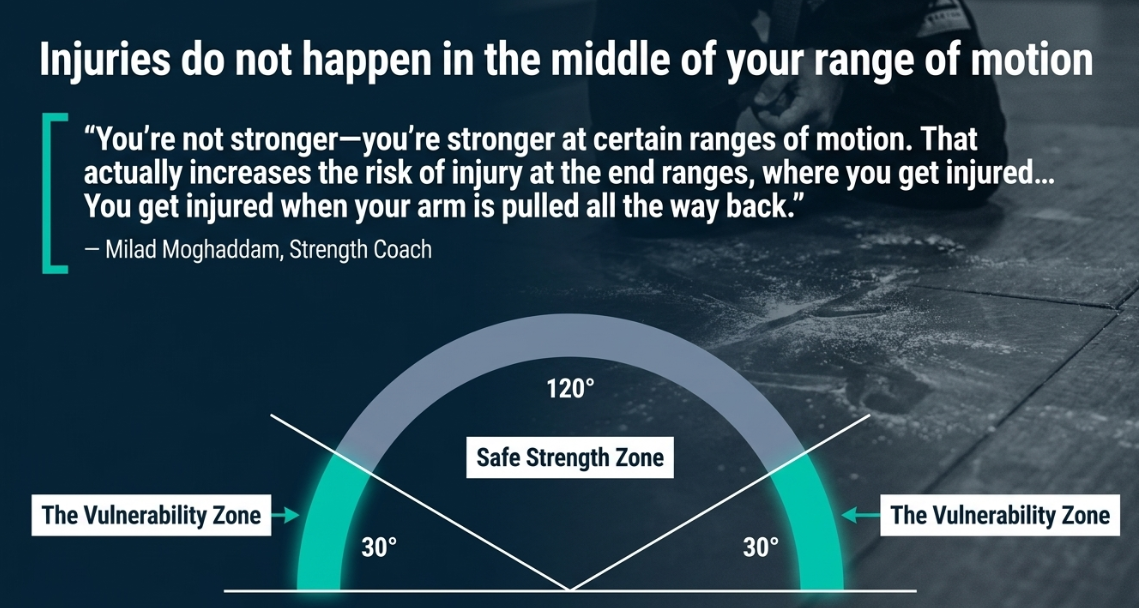
Milad Moghaddam, a strength coach and co-founder of the ActiveRange Method, explains why so many grapplers get hurt doing the exact training that's supposed to protect them:
"You're not stronger—you're stronger at certain ranges of motion. That actually increases the risk of injury at the end ranges, where you get injured. Nobody gets injured in the middle of the range. You get injured when your arm is pulled all the way back."
— MILAD MOGHADDAM, strength coach & co-founder, ActiveRange Method
The takeaway: train your full range of motion, not just the middle where you're already strong. The end ranges are exactly where an armbar or a scramble will find you.
Common overuse problems and prehab exercises
Problem Area | Cause | Prehab Exercise |
Shoulders | Kimuras, armbars, grip fighting | Band external rotations, face pulls |
Groin | Guard work, triangles | Copenhagen planks, adductor stretches |
Neck | Guillotines, frames, stacking | Neck isometrics, neck curls |
Lower back | Guard retention, bridging | Bird dogs, dead bugs, McGill curl-ups |
Knees | Guard play, leg locks | Terminal knee extensions, single-leg balance |
Spend 5-10 minutes on targeted prehab work before or after training. This small investment prevents major setbacks.
Non-negotiable warm-ups and cool-downs
Warm-up elements (5-10 minutes):
- Light cardio (jogging, jumping jacks) to raise body temperature
- Dynamic stretches: leg swings, arm circles, hip circles
- BJJ-specific movement: shrimping, bridges, technical standups
Cool-down elements (5-10 minutes):
- Breathing drills to downregulate the nervous system
- Static stretching for hips, hamstrings, shoulders
- Mobility work for any problem areas
Skip these and you're gambling with your ability to train consistently. If you want the physiology behind why they matter, here's how to warm up and cool down properly.
Tracking training load
Sudden spikes in training volume cause most non-traumatic injuries. Sports scientists track this with the acute:chronic workload ratio—this week's total load compared to your rolling four-week average.
Risk stays low when this week looks a lot like the last few weeks. It climbs when you jump much above roughly 1.3 times your recent average.
In plain terms: if last week was three nights on the mat and this week you jump to six nights plus a brand-new lifting program, you've spiked. That's where people get hurt.
Track the simple stuff:
- Number of hard sparring rounds
- Heavy lifting sets
- HIIT sessions
Build volume gradually over weeks, not days.
Recovery basics
These fundamentals matter more than any supplement or recovery gadget:
- Sleep: 7-9 hours as a baseline—hard-training athletes often need nine or more. This is when your body repairs tissue damage from training.
- Hydration: A common starting point is roughly half your bodyweight in ounces of water—but treat that as a rough guide, not a rule. Let thirst, urine color, and how much you sweat on the mat set the real target.
- Protein: 0.7-1g per pound of bodyweight (about 1.6-2.2 g/kg) to support muscle repair; the higher end matters most when you're cutting weight for a division.
- Light days: At least one session a week focused on drilling only, no hard rolls
Training smart over decades
The goal isn't to train as hard as possible right now. It's to keep training for the next 20, 30, or 40 years.
That means:
- Reducing intensity and volume during high-stress life periods
- Taking deload weeks every 4-8 weeks (drop training volume 40-60% for a week to let accumulated fatigue clear)
- Listening to your body when something feels off
- Prioritizing technique development over constant hard sparring as you age
A personal trainer might push you to grind harder. A smart grappler knows that backing off today means showing up healthy tomorrow.
FOR COACHES:
The members who quit rarely quit because they stopped loving jiu-jitsu. They quit because something hurts and never got better. Programming that protects joints—prehab, real warm-ups, sane load management—is a retention strategy, whether you think of it that way or not.
Grapple Zone's Courtney Anderson makes it the whole organizing principle: "Longevity, I preach that all the time here in the gym. Longevity, longevity, longevity." The members you keep for a decade are the ones you taught to train sustainably in year one.
Final Thoughts
The best Brazilian Jiu-Jitsu workout supports your mat training without competing with it.
Build strength through compound movements like squats and pull-ups. Develop conditioning that matches the demands of live rolling. Sharpen your movement through solo drills and partner work.
Start simple. Add one strength session and one conditioning block to your current schedule, track how your body responds, and adjust from there.
The jiu-jitsu journey is measured in decades, not months. Train hard enough to improve, smart enough to prevent injuries, and consistently enough to still be rolling when your training partners have long since quit.
Your technique grows on the mats. The body that supports it is built in the gym. Invest in both.
Coach a jiu-jitsu program? Half the battle with supplemental training is friction—members skip strength and open mat when the schedule is a hassle to find. Gymdesk puts your timetable and class booking in a member app, so "I didn't know it was on" stops costing you second sessions. Less admin, more mat time.
Gym management software that frees up your time and helps you grow.
Simplified billing, enrollment, student management, and marketing features that help you grow your gym or martial arts school.


FAQ
Brazilian Jiu-Jitsu Workout FAQs
A few of the questions that come up most often once grapplers start programming their training around class.

Josh is a martial arts educator and coach who bridges live training on the mats with evidence-based teaching. A 4th degree Taekwondo black belt and dedicated Brazilian Jiu-Jitsu practitioner, he’s spent years running classes, mentoring students, and helping instructors move beyond rote drills to training that actually works under pressure.
He holds a Master of Education in Teaching & Learning from Liberty University and runs Combat Learning, where he breaks down ecological dynamics, constraints-led coaching, and games-based training for combat sports. Through his writing and podcast work with Gymdesk, Josh turns coaching science and gym-owner stories into practical ideas you can use to run better classes and build a stronger martial arts school.