

Members don't cancel. They disappear.
There's no exit interview. No angry email. No cancellation form on a Tuesday afternoon.
There's just a name on the mat that stops showing up, and a payment that keeps running until it doesn't. By the time you notice the leak, the member has been gone for weeks—and the window to do something about it closed long ago.
Right now the software category is racing to sell you the fix. "AI-powered churn prediction." "Our platform sees the patterns you can't." At-risk dashboards, engagement scores, risk tiers—a whole second product to tell you who's about to leave.
Here's the part nobody selling the black box says out loud.
The signal is already sitting in the check-in report you can run today. It isn't proprietary, it isn't mysterious, and you don't need a second system to see it.
You just need to know where to look. And the data points to a single, memorable threshold.
The 5th-Class Cliff: Retention Is Decided in the First Five Visits

The most useful retention number you'll read this year isn't about the six-month mark or the annual renewal.
It's about visit number five.
In Xplor Mariana Tek's 2026 Boutique Fitness Trends Report, retention climbs steadily between a member's first and fourth visit, then holds above 90% once they hit their fifth.
Mariana Tek calls it "the money visit"—it's also the most common point in the U.S. where a trial or drop-in converts into a paying membership. Even getting someone to their second class nearly doubles their odds of converting.
That's boutique visit data, not class data, so read it as directional rather than a promise: the earliest visits are where loyalty is won or lost, and the slope is steepest before you've had a real chance to build a relationship.
For a school, the fifth class is the moment a new white belt stops being a visitor and starts being a member—in their own head, not just your billing system.
Which means your job isn't to save members at month six. It's to get them to class five.
Why the fifth visit matters
Habit is the whole game, and the research is unusually specific about what it takes.
In Kaushal and Rhodes's 2015 study, roughly four workouts a week for six weeks was the minimum to actually establish an exercise habit. Consistency—not intensity, not motivation—was the single strongest predictor of whether that habit stuck.
A member's first handful of visits is the down payment on that habit. Miss it and you're not fighting a scheduling problem later; you're fighting the fact that the behavior never took root.
The fifth visit matters because it's the earliest visible sign that a habit is forming instead of fading.
The first 90 days are the kill zone
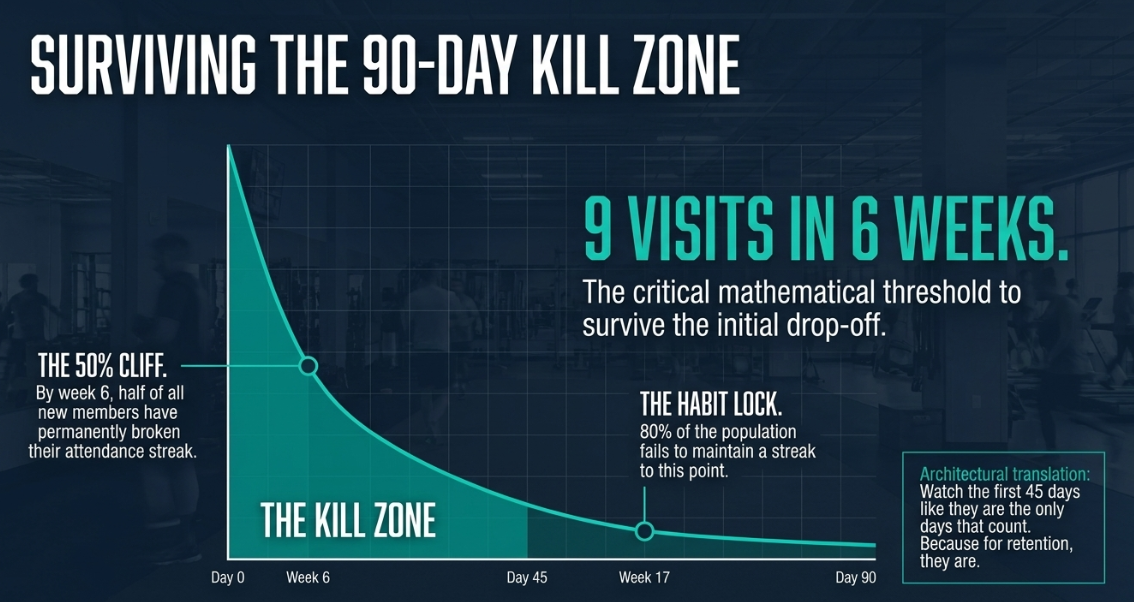
Everything dangerous happens early.
An analysis of gym attendance patterns found that about half of new members had already broken their workout streak by week six—and to survive that stretch, a member needed roughly nine visits, about two sessions a week.
In one data scientist's churn model of around 4,000 members, more than half of all the members who quit did so in their first two months.
So the drop-off isn't spread evenly across the year. It's front-loaded into the exact window most owners are too busy onboarding to watch closely.
The wider benchmarks on how memberships behave over a full lifecycle live in our gym membership statistics roundup. But the operational takeaway is simpler than any chart: watch the first five classes like they're the only ones that count, because for retention, they mostly are.
That's also why a deliberate onboarding sequence for new members does more for your numbers than any win-back campaign aimed at people already halfway out the door.
| Milestone | What the data says | Source |
|---|---|---|
| Visits 1–4 | Retention climbs steadily, visit to visit | Xplor Mariana Tek 2026 |
| Visit 5 ("the money visit") | Retention holds above 90%; most common U.S. conversion-to-membership point | Xplor Mariana Tek 2026 |
| Week 6 | ~50% of new members have already broken their attendance streak | Attendance-pattern study, arXiv 2025 |
| Months 1–2 | Over half of all churn happens in a member's first two months | Bolotov churn model (~4,000 members) |
The "AI" Sees Three Things—And So Can You
Open up an actual churn model and the mystery evaporates.
The #1 Google result for "can attendance data predict who quits" is literally a data scientist's portfolio piece—Random Forest models, precision-recall curves, the works.
Strip away the vocabulary and look at what the model leaned on. In that analysis of roughly 4,000 members, the top predictors were how long someone had been a member, how recently they'd attended, and contract timing—tenure, recency, and the calendar.
Not demographics. Not some variable only an algorithm can see.
The members who stuck around stabilized at about two classes a week. The ones who left telegraphed it through their attendance long before they stopped paying.
That's the whole trick. The pattern recognition vendors are packaging as "AI" is real—but it isn't proprietary, and it runs on data you're already collecting every time someone checks in.
The platform holding your check-in log is holding the prediction. If your software already logs attendance, you can read the same three signals by eye. Good attendance tracking is the only prerequisite.
Signal 1: No rhythm by week five
The single most reliable early warning isn't a member missing class. It's a member with no pattern.
Dr. Paul Bedford's retention research, drawn from more than a million North American members, found that predictable low-frequency members out-retain sporadic high-frequency ones. Someone who comes twice every week is safer than someone who comes four times one week and vanishes the next.
By week four or five, a member who hasn't settled into a weekly rhythm is telling you something.
The absence of a pattern is the pattern.
Signal 2: The strong start that stops
The second signal looks, at first, like your best-case member: a hot first week, five sessions, all-in energy.
Then a sharp drop-off.
That trajectory reads as enthusiasm, but it's often the shape of burnout or intimidation. In Bedford's IHRSA research, getting new members to four sessions in the first four weeks lifted retention by around 12%—the goal is a sustainable cadence, not a heroic opening week that collapses.
It's a member who tried to sprint a marathon and quietly decided it wasn't for them.
Signal 3: The gap plus the failed payment
The third signal is the one that costs you money twice: a ten-to-fourteen-day gap in check-ins, sometimes paired with a payment that quietly bounced.
Owners describe this in their own forums—running on gut feel and a whiteboard until a weekend audit surfaces a stack of failed payments nobody was watching.
The gap and the bounce reinforce each other. A member who's stopped coming won't notice a lapsed card, and every day it goes unflagged is revenue you're not recovering and a relationship you're not repairing.
| Signal | What it looks like in your report | When to act |
|---|---|---|
| No rhythm by week 5 | Visits happen, but there's no steady once- or twice-a-week pattern; gaps widen | Weeks 3–4, before the fifth class decides |
| The strong start that stops | Heavy first week, then a sharp fall-off in attendance | The moment cadence drops after a hot start |
| The gap plus the failed payment | 10–14 days since last check-in, sometimes with a bounced payment | At the two-week mark—filter weekly and reach out |
What High-Retention Gyms Do When the Data Flags Someone
Spotting the signal is the easy 90%.
The gyms that actually keep members do one unglamorous thing with it: a filter, plus a human.
At South Austin Fitness, the rule owner Chris Fey describes is almost aggressively simple.
The mechanism isn't the call itself. It's that members know the call is coming.
Being noticed is the retention strategy. A member who believes their absence will be felt behaves differently than one who assumes no one's keeping track.
That reframes the data from surveillance into coaching intelligence. At Carlson Gracie Hackney, the attendance report surfaces the frustrated student who's slipped to training twice a month before that student ever says a word—so the conversation happens on the mat, coach to student, while there's still something to save.
The two-week rule

Two weeks is the number worth building a habit around, because it's early enough to matter and late enough to mean something.
A single missed class is noise. A fourteen-day gap is a decision in progress.
Run the filter every Monday: who hasn't checked in during the last two weeks? That list is your entire retention program for the week.
It doesn't need to be long, clever, or automated to start. A text that says "haven't seen you on the mat, everything good?" recovers members that no algorithm could have saved—because the intervention was never the hard part.
Noticing was.
Fix the cliff structurally, not reactively
Calls catch the members already drifting. The bigger win is redesigning the early experience so fewer of them reach the edge in the first place.
The most common cause of the early cliff in martial arts is putting beginners in situations they're not ready for.
Jason at Nova Jiu-Jitsu points to sparring too early: a new student who gets smashed in week two gets frustrated and quits, and the attendance curve just records the damage after the fact.
The structural fix is a real beginners track. 10th Planet Long Beach grew from 6 members to 40 to 90 over two years after adding a dedicated beginners class—a curriculum that lets people succeed early instead of surviving early.
The social version works too. Two Bridges built a "Three Friend Rule" around getting new members connected to training partners fast—a member with friends on the mat has three more reasons to show up than one with none.
Our gym retention strategies guide covers the full playbook, but almost all of it comes back to helping people clear those first five classes.
Set the System Up in the Software You Already Have
Here's the honest limit of the manual approach: it works right up until it doesn't.
Under a hundred members, one owner running a Monday filter and sending texts can hold it together by hand. Around that hundred-member mark—a pattern that shows up across gyms again and again—personal outreach starts needing automation behind it, or things slip through.
This is where the platform you already run earns its keep. It's also the honest answer to everything the "AI retention" category is selling: the at-risk dashboard the market is shopping for runs on data you're already capturing at the front desk.
So set it up.
An absence filter that flags any member past a two-week gap, so the list builds itself instead of depending on you remembering to look. Missed-class and milestone automations, so recognition fires on schedule.
At Adayama Jiu-Jitsu, default messages go out at 30 and 90 classes attended, and owner Marty's members reply as if he wrote each one by hand:
"It makes it look like you are much more omnipresent than you actually are."
That's the leverage—outreach that scales without sounding like it did.
None of it works on empty data, though. A churn model, human or automated, is only as good as your check-in log.
That's why the compliance piece matters more than it seems. Misho Ceko installed a check-in kiosk because "everyone's trying to sneak in"—and every skipped check-in is a blind spot in the exact report you're using to catch churn. Clean attendance data is the foundation the whole system stands on.
One note on the "AI" question, since it's the loud part of the market right now: automation is the foundation AI builds on—evaluate the platform, not the buzzwords.
The gyms winning at retention aren't the ones who bought the smartest-sounding algorithm. They're the ones whose everyday software reliably tells them who hasn't been in for two weeks.
Start there.
The Cliff Is Visible—Catch Them Before the Fifth Class Decides
The comforting thing about the 5th-class cliff is that it's predictable. And predictable problems are solvable ones.
You don't need a data science team or a second software subscription to see who's about to leave. You need to run one filter every Monday, know that the first five visits decide most of it, and be willing to send the text.
The members who hear from you come back. The ones who don't, don't.
That was never a technology gap. It was a noticing gap.
Run the report you already have this week. See who's on the edge of the cliff. Then go get them.
Gym management software that frees up your time and helps you grow.
Simplified billing, enrollment, student management, and marketing features that help you grow your gym or martial arts school.


FAQ
Gym Member Retention FAQs

Sean has spent the last decade creating content that helps businesses—small and not so small—grow smarter to allow operators to do more of what they love. You know, the fun stuff.
From shipping and international logistics to web development and marketing, he's done the work (not just the words) to scale retail and service businesses efficiently.
You can find his work at Sendle, Shogun, The Retail Exec, Gymdesk, and more.