

I don't want to get hit.
I really don't want to get knocked out or end up with CTE.
This is the biggest barrier that boxing gyms face in their marketing. It's a legitimate concern.
This is why marketing a boxing gym today is so different. Organizations like the UFC and ONE have shown us what happens to the human body when someone's injured or knocked out.
This is the biggest fear you'll have to overcome—even when people are interested in the training you have to offer.
Today, we'll show you how to overcome the common objections people have to training. We'll also show you how to fill your classes without franchise resources.
Why Marketing a Boxing Gym Is Different
With most gyms, they're focused on their competition—how do we win more students? With boxing gyms, their circumstances are different.
They face fear and intimidation.
When people think of boxing, they (rightfully) assume that this means getting punched. This is intimidating. When someone drops in, they're not sure what will happen.
Many assume that they'll be forced to spar.
They're afraid they'll be beaten up by someone who's technical, highly skilled, and out for blood. Here's the terrible part about this assumption.
It's (partially) true.
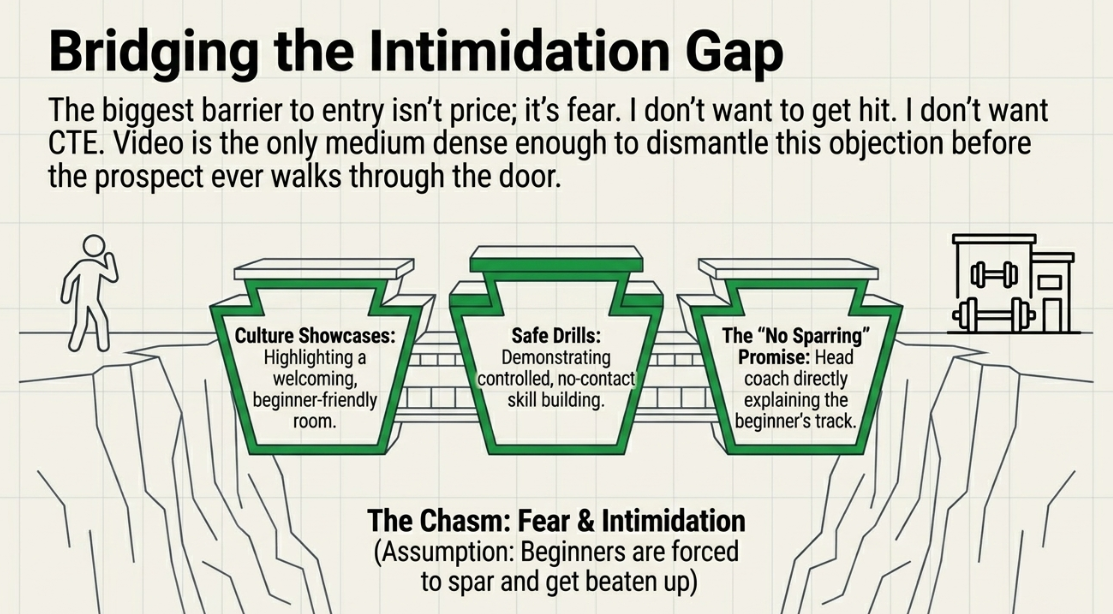
If you attend a fight-focused boxing gym with a strong brawler culture, there's a really good chance that you'll end up dealing with this. This common assumption keeps would-be boxers out of the gym.
Does it have to be that way? Nope!
Believe it or not, you can build high-level skills as a casual, without the risk of CTE. Here's an approach Erik Paulson uses to build defensive skills quickly.
Notice that Kevin isn't getting hurt in this drill. He's building real skills without risking injury.
If you're looking to attract hobbyists and fitness-focused members, this is a great way to steer them toward sparring without risking more injury.
This completely defangs students' fears of injury—if you train responsibly, the risks decrease significantly.
Here's another problem for gym owners. Franchise competitors have already packaged their cardio boxing programs into a polished workout plan. Their programs cater to the people who are simply interested in getting in shape.
If you want to win, you'll need to approach this with a clear, high-level plan.
Your goal is not to convince everyone to become a pro boxer. Your goal is to make boxing approachable and accessible to everyone.
OWNER TAKEAWAY:
Your job in a prospect's first 30 days is to make training feel safe and be safe. That means a real beginner's track, controlled contact, and no live sparring until the student asks for it. Do that, and you've answered the injury objection before it's even raised.
Get Clear On Who You're Actually Marketing To
Combat Sports Academy (CSA) head coach Lakea Vargas has a memorable way to frame this—what he calls "the 99 sheep". Here's the idea:
- The math is lopsided. Only a small minority of a martial arts gym's members—Lakea pegs it at roughly 1–5%—are active, competitive fighters. The rest, "the 99 sheep," are hobbyists who train to stay in shape, blow off steam, and have fun. They're also the members who pay your bills.
- Coach for the 99, not the 1. Hobbyists want a welcoming, injury-conscious room. Gyms that aim every class and every ounce of coaching attention at the fight team quietly burn out their actual revenue base. A recreational focus simply acknowledges the obvious: most of your long-term members will never compete.
This means it's important to get your messaging right. Take a look at the messaging for each student segment:
Segment | What they want | Where to reach them | Messaging that works |
Fitness adults | Weight loss | Facebook, Google | Burn calories, build confidence |
White-collar professionals | Stress relief | LinkedIn, referrals | Train like a boxer |
Kids and families | Discipline | Schools, community events | Confidence and structure |
Competitive athletes | Performance | Local fight scene | Serious coaching |
Kickboxing members | Fitness variety | Existing members | Add skill-based training |
If you're looking to expand your boxing program, kickboxing may be a natural fit for your gym. Here's a detailed breakdown showing you how to launch a kickboxing program.
Position Your Boxing Gym So It Can't Be Commoditized
This is a really important point.
Some gyms sell their programs as a commodity—you give members access to heavy bags, the ring, and other programs, and they pay you.
If you sell this way, cheaper competitors will win.
The good news is, you're not a commodity—if your boxing program is any good, you bring a significant amount of knowledge, skills, experience, and resources to the table.
Sell all of that.
Sell your team's credibility, your safe gym culture, and the transformation students experience. Show students that you're offering champion-level coaching, a recognizable gym identity, and a fitness-first message that removes the fear of injury (but preserves authenticity).
PUT IT TO WORK:
Put it on your About page and say it on every tour. Name your head coach's record. State your beginner-safety rules out loud. Show one member's before-and-after. That's what a franchise's polished landing page can't fake.
Feel like you're in over your head? This guide breaks down the key principles you'll need to follow to build a successful boxing gym.
Own Your Local Market

Boxing memberships tend to be hyper-local. Most of your members will be people who live or work nearby. This means you'll want to focus your attention on:
- Google Business Profile optimization: This is one of the biggest local ranking factors. It isn't an optional detail; it's an essential part of local rankings.
- Local keywords: Use keywords that convey local intent. These include "near me" searches (e.g., boxing gym near me) and your standard organic keywords (e.g., boxing gym programs).
- Consistent review generation: Online reviews are another important ranking factor; Google uses these reviews in its local rankings. What's worse, people tend to discount reviews older than a few months. This means review requests should be an ongoing to-do; you're never done.
- Local citations: Citations include your name, address, and phone number—Google wants to see consistency across the web. Citations become problematic when there's significant disagreement or conflict about your gym's location data.
- Community partnerships: Google uses these partnerships as "geo-validation." It's a signal that demonstrates (to Google) that your boxing gym is a legitimate, embedded, and trusted part of your community.
- Local advertising: There are plenty of low-cost, locally available advertising channels you can use. These include indoor, outdoor, and direct-response advertising. You can usually find them in businesses you already frequent.
Local SEO task | Why it matters | Priority |
Claim + fully optimize your Google Business Profile | One of the strongest local-search signals; non-negotiable | CRITICAL |
Target "near me" + program keywords ("boxing gym near me," "boxing classes [city]") | Captures high-intent local searchers | HIGH |
Request reviews continuously | Both Google and prospects weight recent reviews more heavily—it's never "done" | HIGH |
Keep name, address, phone identical everywhere online | Inconsistent listings confuse Google and drag your rank down | MEDIUM |
Build community partnerships | Earns the local links, citations, and mentions that lift local visibility | MEDIUM |
Run low-cost local ads | Flyers at the PT next door, a rec-center banner, a postcard drop in nearby ZIPs | LOW |
If your gym sits on a high-traffic street, you've got a free channel most owners ignore: people who see athletes hitting bags through the window. Make the front of your gym part of the marketing.
For more low-cost member growth ideas, check out this comprehensive guide.
Make Social Media Pull Its Weight
With boxing, content production is natural; it's almost automatic. As you train your students, you record the education, environment, and outcomes—everything that happens in your gym on a daily basis.
You can use this to create all kinds of useful content, including:
- Techniques: Tutorials covering striking combinations, dilemmas and traps, footwork explainers, defensive movements, and mitt and bag work clips. The sky's the limit here.
- Fight breakdowns: A detailed analysis of fights from athletes in your gym, professional journeymen outside your gym, and professional fighters.
- Fighter showcase: A profile that introduces specific members in your gym—veteran members in your fitness classes, up-and-coming professional fighters, or people who are just looking to train and have fun.
- Outcomes: If you have cardio boxing at your gym, share the outcomes members have achieved. Have members hit significant weight-loss goals? Fighters getting signed? Share outcomes that match the segment you're marketing to.
- Fitness transformations: Fitness-first transformations that showcase members who, through training, gained confidence and improved their health.
- Highlights: Did your members achieve anything significant during their week? Were there any clip-worthy moments in class? Take the time to recognize and share those details.
Creating content that's tailor-made for marketing is an ambitious goal, but it can be difficult to sustain over time—especially on top of the day-to-day operations and responsibilities you're already carrying.
Looking for a deeper dive into gym social media tactics? Take a look at our detailed guide on why you should be using social media for your gym and our guide to BJJ social media marketing.
Turn Events Into Your Best Funnel
While they take time, local events are a fantastic way to build community engagement and generate leads for your boxing gym.
Here are a few options for you:
Event type | Best for reaching | Effort | The offer to make on the spot |
Public demonstration | Cold local crowds (farmers market, fairs) | LOW | Free week trial / day pass |
Self-defense clinic | Women's groups, running/CrossFit clubs, nurses | MEDIUM | Beginner course enrollment |
After-school program | Parents + families (built-in pipeline) | MEDIUM | Recurring kids' membership |
Channel partnership | PTs, health cafés, supplement shops, grappling clubs | MEDIUM | Cross-referral / shared event |
White-collar boxing | Professionals who face real-world risk | HIGH | Specialized recurring program |
1. Targeted self-defense clinics
These specialty events can be targeted to a variety of students—women, or local groups (e.g., real estate firms, CrossFit gyms, running clubs, or shooting clubs).
If you're going to create a program for these groups, take the time to develop one that fits tightly with the themes and concepts they already understand.
Here are a few examples:
- Women's self-defense training
- Self-defense for running clubs
- Self-defense for nurses
- Law enforcement training
2. Channel partnerships
Create events with local businesses that share your demographic but aren't direct competitors.
Look for partners such as local physical therapists, health food cafés, supplement shops, and wrestling or grappling clubs.
Many of these local businesses have a list of scheduled events they participate in. Look for ways you can participate—whether that's teaming up in a support capacity, as a sponsor, or as a partner.
3. After-school programs
This is something parents appreciate deeply.
You provide a high-value service to parents, but you also create a pipeline of interested families who are already used to your gym's culture.
Parents are spinning a lot of plates; they're balancing work, their home life, and familial demands on their time.
An after-school program gives families a reliable, productive, and safe place for their children to go after school.
4. Public demonstrations
You can use local events in your city or town as a springboard for your event marketing campaigns; set up a pad-work demonstration at the farmer's market, local fairs, town sports days, or shopping center events.
Create a "try it now" station and pair that with a simple offer—a day pass or a free week trial. Make these specialty offers available on the spot.
5. White-collar boxing programs
Many professionals deal with danger—real estate brokers alone at an open house, criminal attorneys dealing with disgruntled clients, and forensic accountants facing unhappy executives with violent tendencies.
Do your homework.
Take the time to understand what these professionals are dealing with—when, why, and how they face danger.
Give these professionals a specific, well-thought-out plan that aligns with your training program and addresses the scenarios they face daily.
Build A Trial-To-Member Funnel That Converts
A longer beginner runway converts better than an intimidating one-day trial.
Nobody signs up after a single session where they got their nose bloodied—give people room to ease in, and the numbers move in your favor.
This is the one place it pays to take on a little more risk: the more structured your onboarding, the more trials become members.
Stage | What's stopping them | What you do | What you measure |
Inquiry | Fear | Respond immediately, warmly | Contact rate |
First class | Intimidation | Beginner-only session, no sparring | Attendance |
Trial | Uncertainty | Structured multi-day onboarding | Trial completion |
Join | Commitment | Dead-simple enrollment | Conversion rate |
Meet trial members where they are. They'll sort themselves—you won't always know who's chasing fitness and who's chasing a fight. Your onboarding just has to make both feel welcome on day one.
Want to maximize the value you get from your onboarding programs? Pair your trial-to-member programs with a strong referral program and good old-fashioned email marketing.
These guides give you the step-by-step instructions you need to get started.
Retention Is The Cheapest Marketing You Have

Keeping a member costs a fraction of what it takes to win a new one. That's why retention isn't a "soft" topic—it's the cheapest, most reliable growth lever you have.
Here's a list of the steps involved with retention in your gym:
Retention element | Goal | Simple strategy | Example |
Onboarding | Helps new members stay long-term | Welcome students and set clear expectations | Intro class, buddy system, curriculum guide |
CRM automation | Keeps members engaged | Send automated, personalized messages | Absence reminders, birthdays, belt milestones |
Community building | Increase bonds and belonging | Facilitate friendships and interaction | Social events, member groups, partner drills |
Consistent value | Prove the value; show ongoing progress | Offer great coaching, track improvement | Skill assessments, clean facility, promotions |
Feedback | Identify blind spots, find problems early | Regularly ask members for feedback | Anonymous surveys, suggestion box, post-class chats |
Loyalty programs | Reward commitment | Offer perks for founding and long-term members | Seminar access, gear discounts, VIP benefits |
Drop-off analysis | Prevent membership cancellations | Monitor attendance for warning signs | Reach out after a sudden drop in attendance |
Content marketing | Stay connected outside of class | Share useful training resources | Technique videos, nutrition tips, mindset articles |
Your gym stays empty if you can't retain members. You'll need a strong retention program if you want your gym to grow.
That said, this is a lot to manage. If you don't have a clear retention strategy in place, you'll find it difficult to keep up with your gym members.
Two Bridges Muay Thai emphasizes their "Three Friend Rule." Every new student connects with three people immediately—a coach, a staff member, and a training partner.
If you're using gym management software, retention programs are simple and straightforward.
Track attendance, celebrate student milestones, and build community rituals. Strong retention programs with strong software support generate word-of-mouth marketing more efficiently than paid advertising.
Let Your Software Do The Follow-Up
Here's the catch with everything above: every new thing you track becomes one more thing you have to act on.
- If you track attendance, you'll need to act on attendance drops.
- Tracking student milestones means you'll need a plan to celebrate them and engage with them in a meaningful way.
- Monitoring student progress means you're more responsible for spot treatments and adjusting your students' training.
- Billing automation means you'll need to follow up with students whose credit cards are about to expire.
Can you do all of this manually? It's possible, but I wouldn't recommend it. There are too many plates to manage. If you're looking to grow your boxing gym quickly, you'll need software that handles the heavy lifting.
If you're in the market for gym management software, Gymdesk helps automate:
- Trial-to-member follow-up with marketing features
- Attendance tracking and retention monitoring
- Automated billing and member management
- Complete martial arts software workflows
Automation isn't about looking present—it's about being present where it counts. Let the software handle reminders, billing follow-ups, and milestone nudges so the time you spend with members goes to coaching, not logistics.
Become The Place Everyone In Town Trains
Building a successful boxing gym starts with good marketing. It isn't about outspending franchises or competitors. It's becoming the local gym that people in your community trust.
The one they believe in.
If your gym takes a fitness-first approach, you'll find it easy to stay connected with students, parents, and families—and to automate billing, follow-up, marketing, and retention.
Once this happens, growth becomes predictable.
With Gymdesk's 30-day trial you can simplify the process on our dime. Spend more time teaching your students and less time fighting with spreadsheets or dealing with perception problems.
Gym management software that frees up your time and helps you grow.
Simplified billing, enrollment, student management, and marketing features that help you grow your gym or martial arts school.


FAQ
Boxing Gym Marketing FAQs
A few quick answers to the questions boxing gym owners ask most often.
.webp)
Andrew McDermott is a gym owner, Brazilian Jiu Jitsu brown belt, and digital marketer. He’s on a mission to build premier, high-stakes grappling tournaments, world-class academies, and a championship team of high-level athletes.