From a Mat in the Park to Amsterdam's Carlson Gracie Academy
Starring
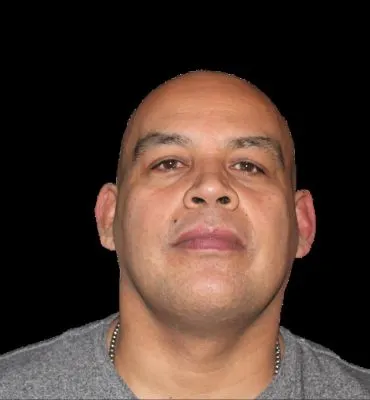
Marcos "Flexa" Neves Mello is a Brazilian jiu-jitsu black belt under Carlson Gracie Sr., promoted in 1997. Born and raised in Copacabana, Rio de Janeiro, he found jiu-jitsu at 14 and lived inside the Carlson Gracie Academy as Carlson's assistant, sleeping on the mat for over a year. He placed second in the world at purple belt in 1996 before back injuries ended his competitive career. Among the first Carlson Gracie black belts to teach seminars in Germany (1999), he immigrated to Amsterdam with no English, cleaned restaurant kitchens to survive, and began teaching jiu-jitsu on a deck in the city's parks in 2002. Twenty-five years later he runs a 150-square-meter Carlson Gracie academy and still teaches seminars internationally.
About the Gym
Carlson Gracie Amsterdam is a Brazilian jiu-jitsu academy in Amsterdam West, founded by Marcos "Flexa" Neves Mello in 2002—the first known BJJ in the city. It carries the Carlson Gracie lineage, with Marcos representing Carlson Gracie Holland, and trains roughly 106 members.
Programs span adult BJJ in gi and no-gi, a Friday women's-only class led by Professor Olga Lyashevska (a 3rd-degree black belt), kids' classes on Wednesdays and Saturdays, and Carlson Gracie self-defense and open-mat sessions. Marcos honors the Stadspas—Amsterdam's low-income discount card—on the mats, so members who couldn't otherwise afford it can still train.
📍 Address: Burgemeester de Vlugtlaan 125, 1063 BJ, Amsterdam (Amsterdam West), Netherlands
📞 Phone: +31 6 81911917
Summary
This is the story of a man who built Amsterdam's first jiu-jitsu academy from a piece of mat on park grass. Marcos "Flexa" Neves Mello found the art at 14 in Carlson Gracie's Copacabana academy, slept on the mat for over a year as Carlson's assistant, and earned his black belt in 1997.
He arrived in Amsterdam with no English and no money, cleaned restaurant kitchens to survive, and started teaching in the parks in 2002—"one guy brings a beer, the other guy the sounds, and you train."
Twenty-five years later he runs a 150-square-meter Carlson Gracie academy he calls a family, not a fight club—and still lives by the line the black belt gave him: "everywhere I go, the door is open for me."
What They Told Us
Alex Cuevas took the Gymdesk Originals camera to Amsterdam West, to a Carlson Gracie academy tucked inside a government-run neighborhood building. Its founder, Marcos "Flexa" Neves Mello, is a black belt under Carlson Gracie who arrived in the Netherlands speaking no English and built one of the first jiu-jitsu programs the city had ever seen. Over an hour of conversation, the story came out the way he tells everything—in short, repeated sentences—about being taken in for free, sleeping on a mat, and slowly turning a strip of deck in a park into a room full of families.
Taken in, and never charged
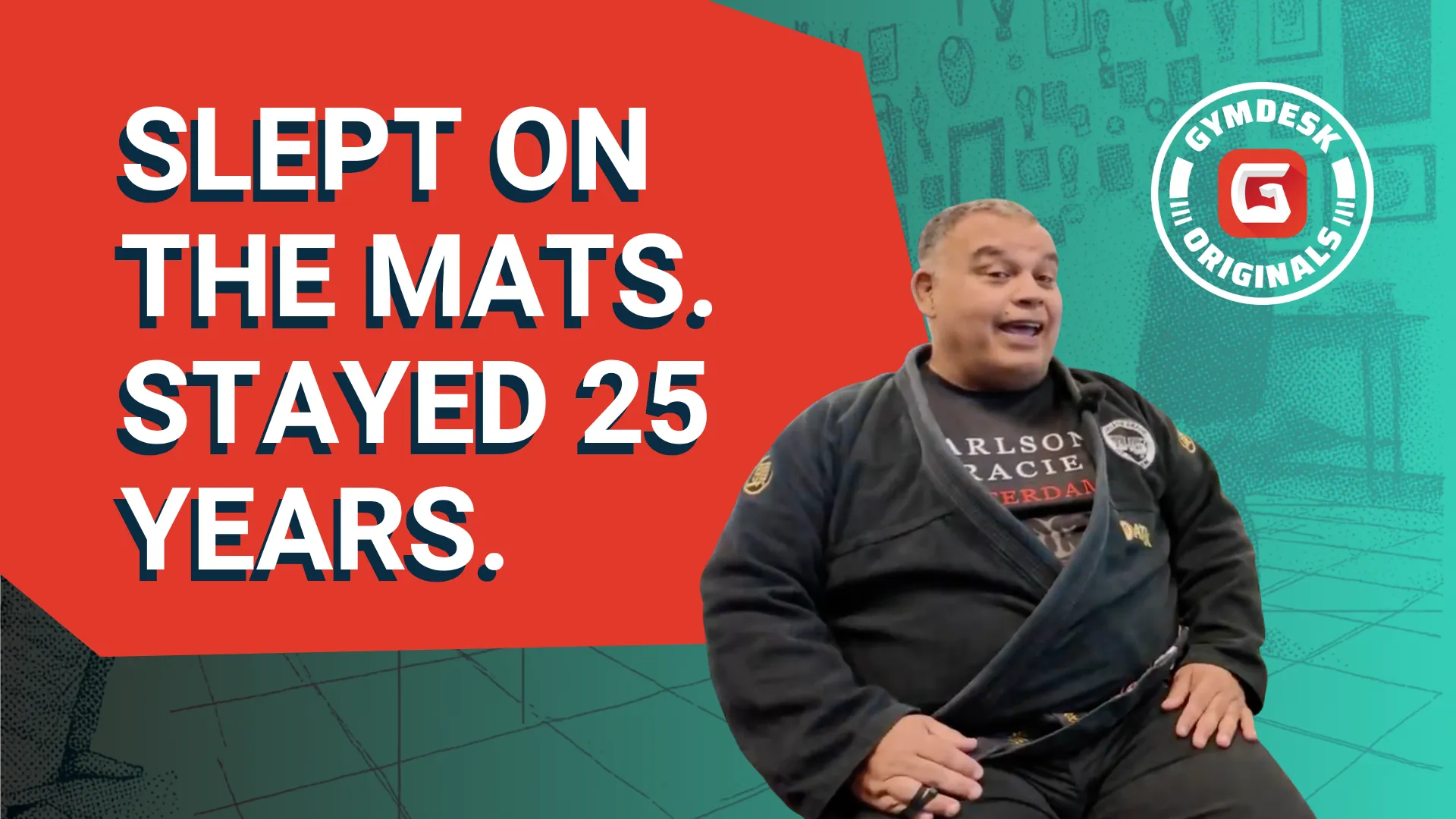
Marcos found jiu-jitsu at fourteen, at the Carlson Gracie Academy in Copacabana, invited in by an aunt who was already a blue belt. Carlson took him upstairs, put him on the mat, handed him gear, and never charged him a thing. For a stretch when he had nowhere else to go, the academy became home in the most literal sense—he slept on the mat, opened the doors, and was already there when Carlson arrived at six in the morning.
"I sleep more than one year on the mat. Wake up, clean the mat."
—Marcos "Flexa" Neves Mello, Owner and Head Instructor, Carlson Gracie Amsterdam
Nine years at one belt
Promotion inside the Carlson Gracie team was a bottleneck, not a ceremony. The competitive weight classes were stacked full from blue belt all the way to black, and a student could only move up when the person ahead of him did. So Marcos waited. He competed the whole time, placed second in the world at purple belt, but the ladder simply would not clear.
"I still around nine years in the blue belt."
—Marcos "Flexa" Neves Mello, Owner and Head Instructor, Carlson Gracie Amsterdam
Starting over with nothing
He earned his black belt under Carlson Gracie in 1997, taught the first seminars of his career in Germany, and fell for Europe on the long drives to Amsterdam. Then he went back to Rio, worked and saved, and immigrated with almost nothing to his name. The first years were pure survival—cleaning restaurant kitchens for a living, leaning on a friend for a place to sleep, learning a country in a language he didn't yet speak.
"The life here was tough. Tough. Tough. Because I come, I don't speak any English. I just come. One friend invite me to come, have a room for me to sleep for two weeks. And that's it."
—Marcos "Flexa" Neves Mello, Owner and Head Instructor, Carlson Gracie Amsterdam
A mat on the park grass
The academy did not begin with a lease or a sign on the door. It began with a handful of Brazilians, a piece of mat laid over a wooden deck on the park grass, and summer sessions that were half training and half party—one person bringing a beer, another bringing the music. No gi, no walls, just whoever showed up when the weather held.
"I started jiu-jitsu right in the park. … And we train, the Brazilians train together."
—Marcos "Flexa" Neves Mello, Owner and Head Instructor, Carlson Gracie Amsterdam
Why the women's class exists
One of the academy's most deliberate on-ramps is a Friday women's-only class, run by one of its black belts. Marcos frames it as the answer to a practical problem—a twenty-kilo size gap makes mixed beginner rolls discouraging, and some newcomers are simply too shy to walk into the main room first. The class is not a side project. It is a feeder, and he watches it work every week.
"Some women is a little bit shy and don't like to come. And this is a good introduction for the jiu-jitsu, because all the girls that started the women's class come to my class too."
—Marcos "Flexa" Neves Mello, Owner and Head Instructor, Carlson Gracie Amsterdam
Finding the right software
For years Marcos ran the gym on a generic all-sports platform priced by the check-in—more visits meant a bigger bill. He wanted something built for his sport, so he Googled his way to Gymdesk. Switching systems is its own kind of misery, and the thing that made it survivable was a free month he used to actually learn the platform before committing, running both tools in parallel before moving everyone across.
"To change from one software to another, it's tough, man. … And you guys give me, I think, one month free. One month free. And this one month, I study a lot, the Gymdesk. And then I really decide to change from the Gymdesk, because it just really helped me a lot."
—Marcos "Flexa" Neves Mello, Owner and Head Instructor, Carlson Gracie Amsterdam
Read the full transcript
Lightly edited for readability. Speaker labels are omitted because the source recording is not diarised; quotes attributed elsewhere on this page were verified against context.
We'll be right back. At the gym, there's a story, a mission, a spark of passion that started it all. This is Gymdesk Originals. Real owners, real struggles, and the communities they've built from the ground up. Made it to the train station in London, and I'm heading to Amsterdam now. Looking forward to visiting some new customers in Amsterdam, in Netherlands. Bye. Made it to Amsterdam, a little bit warmer than London, I think it was raining. And conveniently, I'm not too far from the hotel, so let's go.
Good to be back. All right, here I am at Carlson Gracie, Amsterdam. Made my way over this morning on a train from London, and now I'm just going to try and find the building in here. There's somewhere in here, I think. Hi. Hi. Hi, thank you. I'm Alec. I'm too. Oh, nice to meet you. I wasn't sure if this was the right place. Yeah. Yeah? Right. Oh, wonderful. Oh, this is like, they have different things in here. Yeah, yeah, yeah. Nice to meet you, sir. Nice to meet you, sir.
Yeah, thank you. You should see the rest of it. Nice to meet you, sir. All right. Good. Well, I am exhausted. Yeah, good. This was a really, really fun class. We did a lasso guard. Yeah, we started with past the guard for warm-up, huh? Yeah, past the guard. Wrapped both legs. Yeah, and then I had the lasso. And then, yeah, when I showed you some past the guard. Yeah. And then one submission. Yeah. And then we started the lasso, huh? You moved a lot, huh? Yes.
Moved a lot. I had a lot of fun here. And here we are. I made it. I made it to Carlson Gracie, Amsterdam. Yes. One of my favorite cities in the world. Yes. I love Amsterdam. It's one of my favorites. I haven't been here in a while. It's probably been, gosh, probably seven years. Seven years? Something like that. It's been a long. It's been a while. So, I'm happy to be here. I'm really happy. You're here, too. Yeah. I'm here already 25 years. 25 years. 25 years I'm here.
Yeah. And I come 2021. Yeah. In November 21. It was September, October 21. No, before I was in Germany in 1999. Is I travel for seminars in Germany. I received my black belt in 1997. And in 1999, I come to Germany. I was the first black belt in Germany to teach seminar in Germany. And I stayed there for a couple of months, six months. And then I'm back to Rio de Janeiro. And then I worked hard in Rio de Janeiro to make money to come to Amsterdam.
Because during my stay in Germany, I come to Amsterdam many times. And, yes, I drive to Amsterdam from Hamburg in Germany to Amsterdam. I drive many times with friends. Yeah. It's very, very fun to travel with friends. And Amsterdam was... Amsterdam 25 years ago was very nice. Now, completely different. All the city, yeah. And what is that, like a four or five-hour drive? More. More, more, much more. Much more. Okay. Much more. Yeah, around the eight-hour drive. Okay, eight hours. All right. I remember I drove to Germany once.
Yeah, around one of those times. And it was... I thought it took me like four... But I didn't go very deep into Germany. So, yeah. I'm not sure. I don't remember where I went. But your journey, you started in Rio. Yes, I started with... I was 14 years old. I was in Carlson Gracie Copacabana. I'm from Copacabana. I grew up there. Yeah. And when I was 14 years, I grew up in Carlson Gracie Copacabana. My... My aunt... Aunt? Is the sister for my mother. My aunt.
Oh, aunt? Aunt. Sorry, my English. She was already the blue belt for Carlson Gracie. Oh, wow. Yes. And she invited me to go there. To Carlson Gracie Academy. And then she... She invited me to go there and... Talked with Carson. He's my... He wanted to start to... To jiu-jitsu with you. And Carlson Gracie received me. And invited me to go upstairs and put me in the mat. Give me a gear. Give me everything. I never paid gym. Wow. Never paid the gym. And, yes. As long as you joined there.
And then I started to compete. Every... Every tournament, he put me to compete. But first, I stayed there two years to learn, learn, learn, learn. Yeah. And then I never stopped competing there. I competed until 96. Okay. In the world, 96, I was brown belt. But it was an hernia problem. I had a surgery in the hernia two times in my back. But I still fighting until 96. In 96, I was the first world I fight. And I was second place in the purple belt. But because of my hernia, I had to stop completely.
Oh, no. And then it was difficult to live with this problem on my back and to hernia. I come to Holland. I teach in Holland. But in the cold weather, it was very hard to teach. Because always I feel my back. Always I feel my back. Yeah. But now I'm okay. Now I'm okay. Now I discover some peptides that help me a lot. Oh, yeah? Yes, yes. Helps a lot. And so when you were back in Brazil and you were competing, would you go very far from Rio?
Or was, you know, where did you go when you were... Always inside the Rio de Janeiro. Okay. Yeah, we compete. I did a lot of competition there. But I still fall longer in the blue belt. I still around nine years in the blue belt. Okay. Because there to pass me to the blue belt, blue to purple, you have to take the guy from purple and pass to the brown. And the guy to brown and pass to the black and the black belt out. Oh, understand? Carlson Gracie have the full schedule.
The schedule for the old... Weights, all category was full. It was impossible for him to pass me to the other belt. Because I have to take the guy to the other belt and pass and pass. And everybody was a little bit stuck. Yeah. And then I remember when I was fighting one of the competitions, Barra da Tijuca. I don't remember the competition. I don't remember the competition name. I think it was a... Okay, I don't remember. And Master Hobson Grace tells the castle, this guy cannot fight in the blue belt anymore.
He has to pass the purple belt. Oh, this is my student. So you cannot talk about this all by students, blah, blah, blah. And then finally, the guy, the castle passed me to the purple belt and I still compete. But it was nine years, only the blue belt. Wow. So Carlson Grace's philosophy is only when you can beat a purple belt, then you are able to go to a purple belt. Is that how that works? I can beat a purple belt only if the purple belt that fight in the same category for mine, if you have space there.
If you don't have a spot there for me to go, you know. Oh, you're stuck? Yes. Yeah, I'm stuck. Oh, because the other guy's stuck. Because it's full of guys, brown, purple belt there. Yeah, yeah. And then from the purple belt also to pass to the brown belt because I was super heavyweight. Okay. And the super heavyweight and the blue belt and the purple belt and the brown belt and the black belt. It's full of the schedule. And now you cannot change. It's a completely different mentality.
Yeah. So did you feel like here, look, I have one, I lost my stripe. Yeah, yeah. I washed it and lost it. But I've been a white belt for, gosh, I think I started training jiu-jitsu when I was like, what is it, 25 years old? And I'm almost 50 now. Long time. 25 years old? Yeah, yeah. But I only trained for like maybe a solid two years and then basically nothing for like 15 years. Okay. And then just started again. Yeah, that's happened. I have many students like this.
Yeah. I'm every, every, every year, once a year, two a year. I cannot promote that computer like this. Yeah, yeah. Yeah. And the way I feel like, I don't, I don't, I actually don't mind wearing the white belt. I feel like. Yes, yes. I could wear this forever and not ever get ranked up. It's like if you're wearing Brazil. People don't, don't, never ask the belt. Yeah. For Carson. Yeah. Ask the belt for Carson is a big problem. So how do you feel as a blue belt for that long?
Did you feel like you were fine? No, I feel fine. Yeah. Completely fine. Yeah. At home. I, in the blue, when I was blue belt, I was teaching, I helped Carson to teach. I was a Carlson Gracie assistant. Yeah. And then, uh, in some period of, for my life, I have no, no place to live. I live inside the Carlson Gracie academy. I sleep more than one year on the mat. Wake up, clean the mat. Carlson Gracie comes six o'clock in the morning. I was there.
And then he come with students. I was there. Put my gear and help Master Carson. Wow. And then, yeah. But this gives me a chance to learn a lot. You know, it's hard, but give me a chance to learn a lot with the Carlson Gracie. That's amazing. Yeah, that's amazing. He was really my father. He was my father. He catch me and my father, not only for me, for a lot of guys. A lot of guys. And, uh, you were one of his last black belts that he promoted himself.
Yeah. Yeah. Was one of the last day that he promote like, um, big event. He make an event in the gym and he invite everybody. Liborio was on my belt promotion, Liborio. Uh, all the big famous guys was there in this day, but this is right in 97. And after this, we don't have events like this. Um, uh, I'm the last generation. And so, um, you get promoted when you went to Germany. Were you already, uh, black belt? Yes. Okay. I got my black belt in 97 and I was in the gym in 99.
Okay. Okay. 99. And during this period, I have many different academies. And the Carlson Gracie, he's, uh, support me to have the academy. He signed it for me. He signed, he make it like a documents. Like, uh, I signed it here for Marcos Flexa that he's having the capacity to use my Instagram. You can go to my Instagram. Yeah. Yeah. I'm sure at this time, you probably had an opportunity to maybe explore other places, maybe Canada, America, other places, Latin America, all over Europe. And then you're in Germany.
And only because you came to Amsterdam that you're like, oh, I want to go to Amsterdam. That was like what, what triggered you to say, I want to come back specifically here to the Netherlands. Uh, no, America. Oh, my, the Carlson Gracie team, I think 95% for the Carlson Gracie of more, migrate to America. Yeah. And the Carlson Gracie also, uh, tell me, I got to bring you to America. I got to bring you to America. And the next time, next minutes, he started to make a joke.
No, but your girlfriend, you have a girlfriend here, you cannot live without the girlfriend. And blah, blah, blah. And make a joke a lot with me. But, uh, I had a chance to come to Germany because, uh, one group of German guys come to Carlson Gracie Academy. And I was leaving. I was leaving. I was sleeping in the Carlson Gracie Academy. And the guys come inside. They say, oh, come inside. And they start to teach. I started to help the guys. And the guys like fall in love for the jujitsu and come next time, come next time.
And then travel to Germany and come again, big group. And the guys invite me to go there. Oh. And then I say, okay, I go there. I stay there for a couple of, uh, couple of months. Yeah. And then I teach in Hamburg. I teach in, uh, Lach. It's a one more, a small city in, uh, Schwarzwald. Schwarzwald is a Floresta Negra in Portuguese. Okay. Beautiful place. Beautiful place. And then, yeah, I back. I go to Brazil and then I fall in love for Europa. And then they sit to work hard, like a private class.
Teach. I work in a security company. I. So you're saving all your money. I save the money to come here. Yeah. Come here. And the life here was tough. Tough. Tough. Because I come. I don't speak any English. I just come. One friend invite me to come. Have a room for me to sleep for two weeks. And that's it. And then, uh, wow. And then I find another one, uh, in a couple of months. I find the mother for my daughter. She's a French. And, uh, we have a nice, uh, daughter.
I have a daughter with 22 years old today. And, uh, yeah. And then I make the papilla, everything. And then I become legal. Okay. But in 2000, 2002, I started Jiu Jitsu right in the park. I take one, a piece of a mat like this, the, and I put it in the park. And we train, the Brazilians train together. Okay. Yeah. One guy bring a, bring, bring a beer. The other guy, the sounds. And you train. Oh. And I teach there, like, uh, in the summertime.
Yeah. Like, I don't know, I teach there, uh, five, six, seven times. Because the summer, he's, uh, he's a crazy. It's raining a lot. Yeah. But the, when you have the opportunity to go there, you go there and have fun. Now, when you're doing this in the park, are people looking? People looking around, the police come, oh, so what's happened, what's happened? No, no, no, it's okay, it's okay. It's just a play for fun with music and beer. What's happening? A gi or no gi? No, no, no, no, no gi.
Oh, okay. Well, you have a mat down, too, yeah? It's not mat. It's standing on one, uh, um, one deck. Oh. One deck on the grass. And then we play there. It's fun. And then, you start the people from the capoeira also together. And the guys from the capoeira tell me that have a space that I can teach. And then I'm going there. And then I talk with the owner. And the owner say, okay, you can teach here two times a week. And then I start it two times a week.
And then from this place, I go to the other place. And, uh, and, uh, let's play. That's very big, a famous place in Amsterdam. And then I teach in university. And the, university one, uh, university sports center in Amsterdam. Like, big place, but little money. I open my own gym. Yeah. And I open my own gym. And now I, and now I do only this. I'm curious about when, uh, you're in capoeira. They have wood floors, no? Uh, yes, yes. So you had to bring your own mats, or?
The capoeira, no, the capoeira guys is, because it's all Brazilian. Okay. And then it's all friends, all contact together. But the people from capoeira help me a lot, too. Okay. So then your journey, then, uh, after the university, um, how long before you ended up here? No. The, on this place, I started, uh, two years ago. Two years. In, uh, in the beginning of 2035, January. One, one, a little bit more than one year. But before, I was in the other place, because this place is the place for the government.
Okay. Government rents from here. And then this is, like, some project for the neighborhoods here around. Okay. And before this place, I was in the other location. That's always the same project. Okay. And the other location, I stayed for 12 years. Wow. But very small place. Very small place. So, it's, like, 80 square meters. And that's it. People change there. And, um, it's crazy. It's crazy. Now, we have a big space. Like, this is 150 square meters. Douches, two douches outside. Yeah. And more toilet. Nice ventilation.
Very nice. Very nice light. Now, change completely. I'm going to stay here, I think, for more, three years. And I go to the other project. Okay. Yeah. Together with, uh, government. Oh, I see. Yes, yes. So, they basically have different places. Different places. Yes, yes, yes. Because before, they're broken down. Ah. And then, he rents before they're broken down. And then, you can, sometimes, you can stay there for three, four, ten years. And, uh, yes. This is the project. Very nice. And, but, I mean, the class, you said, today is the day of ascension here.
Yes? Ascension in, uh, the Netherlands today? Oh, yes. Yeah. Ascension. Ascension. Yeah, yeah, yeah. Today is the holiday time. Right. And it was still very full in here. It's still very full. Yeah, yeah, yeah, yeah. But during the, and it's holiday time. In Holland, people travel a lot. Okay. In the holiday time, people go outside of Netherlands. Yeah. And then, it looks empty today. It's not very full. Yeah. But if you come on normal day, Monday, Tuesday, Wednesdays, it's full. It's full, it's full, yes, yes.
I mean, I feel like, uh, I want to ask you about, you know, your life changed when you were brought to Jiu-Jitsu. Yeah, yeah, yeah. Because it opened the world up for you. Yes, exactly. Um, tell me a little bit about that. Like, what was your life like and, you know, how, how it has opened up these new, you know, possibilities? Yeah. Uh, everything because of Carlson Gracie, Master Carlson Gracie. Master Carlson Gracie opened the Jiu-Jitsu for the world. Okay. We have a Royce Gracie that showed the Jiu-Jitsu for the world.
But before Royce Gracie, the Jiu-Jitsu was closed with the Grace family and only rich people can pay for that. Understand? And then Carlson Gracie opened, the goal for Carlson Gracie is make a good, good, uh, fighters. Not, uh, rich fighters, good fighters to make, because he liked the event. He liked to see people fight and he liked to put his student to fight and he opened the Jiu-Jitsu for the world. And then I was happy to be, uh, black belt for Carlson Gracie because everywhere I go, the door is open for me.
Yeah. Yeah. Everything starts for Carson. Carson opened this, uh, this is, uh, Jiu-Jitsu. Today exists BJJ competition because of Master Carlson Gracie because in the past, Master Carlson Gracie forced one academy to compete against other because before Carlson Gracie was not, not. Oh, really? Yeah. Master Carlson Gracie make a big team and the, this is, uh, Carlson Gracie against Gracie Barra. And in the past, Carlson Gracie won everything like 90%, 99% of the fight. The Carlson Gracie team won everything. And forced the other team also to work hard to be better.
And then all the teams started and all the teams started and then four teams, five teams, six teams. And then it's growing because of Master Carlson Gracie. Yeah. So all the Jiu-Jitsu. Oh, the Jiu-Jitsu started, yeah. Everything started because of him, man. Because he, in the beginning, he forced the competition. And then he, Carson opened the doors. Yeah. Okay. And then I went, everywhere I go, I have this gym, but I do seminars in a lot of different gyms. I go to the Germany to do seminars.
I go to the, uh, Irland to do seminars. Sometimes I teach also camp in Brazil. And then I travel, I don't travel a lot, but I travel sometimes to, for the seminars in private class too. Do you go back to, uh, Rio much or? Yes, I was there this year. Okay. I was there, yes, this year with my daughter. Okay. Yeah. And so it was your daughter was brought up here, yeah? Yeah. In the Netherlands? Yes. She, yeah. So she, the culture of Brazil is a little, like, it's part of her blood.
Yeah, yeah. It's part of blood. Yeah, yeah. But it's not. She loved the culture, the food, everything. She loved it. But she's a little bit crazy because she's mother is French. Yeah. And she was born in the Netherlands. And then she have a French and Netherlands language. Yeah. I talk only Portuguese with my daughter and she fall in love in English. And then all these four languages don't. Oh, she knows four languages. Four languages. Wow. Four languages. From? Yeah. From a very young, five years old, six years old.
She's already talking four languages. And she trains or no? She trains here. Because he'll have it every Friday, only, woman's only. Okay. And I have one girl. She's a black belt from the Carlson Gracie, Mr. Dan. She's tough. She's a black belt, three degrees. Olga Leshevska. And she runs the class. Okay. It's girls only. Okay. I try to come sometime and say, no, no, no, no, no boys. Yeah. Yeah. I talked about this before on camera and like, it never, uh, I didn't, I didn't understand why you'd want to have a woman's program before.
I really understood the, like someone explained to a woman is explaining to like, you know, if you weigh, uh, I don't know how to convert it to kilograms, but like. Yes. If there's like, uh, I don't know, 20 kilos difference between a woman and a man, it's a lot. It's a lot. Yeah. Yeah. So it's like me going with the guy who's 20, 25 pounds, kilos on me. It's a lot. And so it having only women together, it helps them with the technique. Yes. Yes. Yeah.
And some women is a little bit shy and don't like to come. And this is a good introduction for the Jiu Jitsu because all the girls that started the women's class come to my class too. Yeah. Yeah. It started one times a week, one times a week, and then two times a week. And these, these girls that we have, he's come from the kids class. Yeah. Have a kids class on Saturday. And then the girls are already training. I don't know, three, four years. And then she's coming to adult class.
No problem. Yeah. And then I motivate the girl. I ask the girl to the center. She do the techniques with me. And then, uh, she learn how to teach with me the same way that Carlson Gracie did it with me. Yeah. I, he's not a, only, he teach me on, not only to fight, but he teach me. I'll teach. Yeah. The class. I'll run the class. He teach me. Yeah. And, um, what, since you've been teaching for so long, um, and you, I mean, obviously Jiu Jitsu has changed your life.
Yes. Do you have stories of how Jiu Jitsu has changed the lives of your students? Anything that, you know, you could think of like a kid or anyone in here. I don't have a night in mind here, but yeah, for sure. I have a, I have a, I have a many students, was he, the guy that trained with you. Yeah. Also the brown belt. Who's he? Yeah. Was here. Was here. Was here. Yeah. He lived very far away from here. It's two hours car. And he come here every time.
Two hours car. He live in a big company. He work in a big company. He tell you work in a big company. It was, I think it's the more big the company in the world. They make it ship. Yes, exactly. And he have a opportunity to train there, but he want to come here. Two hours car. And now, now he have two hours back almost every week. He cannot come every day because he have three, three children. But he come every time that he can. And I have other students also, other side for the land he comes here.
I have the guys, I have a pilot from the Delta airline. Every time that he land here, he come to my gym to train with me. Like that. The people, people that know me for a long time, like, just always come. That's dedicated. Yeah, it's dedicated, yeah. Yeah. And I, like, I live in the middle of nowhere in a very small town. There's a town of maybe a thousand people. A lot of farmland and stuff. And so I don't live in Manhattan. I live, like, upstate New York.
And my drive to my school is like 25 minutes. And I'm always like. 25 minutes. Yeah, yeah. And I'm like, oh, it's so far. But I mean, that guy's driving two hours. Two hours. Yeah. And the other students come for public transport. Yeah. Like, one hour, two hours to be here. That's amazing. Yeah. I cannot be in there everywhere at the same time, but. Yeah. Yeah. So, well, so the plans are is to continue here for a few more years. A few more years. Maybe continue or maybe go to another place with a program to help the neighborhood.
Yes, yes, yes, yes. It's also helping the kids' class always have a, because in the Netherlands, we have a card for the people that don't have much money. Yeah. And then this card gives you a discount in cinema, in the theater, in the museum, and also in the jiu-jitsu. Wow. It's like a pass. I don't know, start pass, the name. Okay. Also give you a discount in the jiu-jitsu. And then you work also with these people that don't have much money to pay. Feels like you're giving back a lot.
Yes, yes. You're a very good person, I can tell. Like, I try my best. You're very humble, but even your students were saying that, like, your story, you don't talk much about yourself. No, no, no, no, no. I mean, gosh, I've been here for, what, an hour? And everyone was talking about you. You're very well respected and loved, and I could tell from your story. That's amazing. Thank you. Yes, I have a lot of history, but it's difficult to tell. I have to prepare myself before I, the other thing I like about doing these things is that you don't always get to spend time like this talking to everyone who comes in and trains, right?
What I find is a lot of times, especially kids and their parents, maybe drop the kids off. They don't really know your backstory. That's why I love doing these so that people can understand more about your journey. Okay. You know? I grew up in Copacabana. Okay. And then, yeah, I was like a kid that played in the street a lot. Okay. I was not guys that stayed home. Here in Holland, it's cold. And then everybody stayed at home. But there, it's very hot. And then we play a lot on the street.
Yeah. And then Copacabana is nice because they have the beach, very nice beach with very nice waves that you play every day, waves, waves, waves, and have the nice florist. In the same place, you have a florist and you have the ocean. And then in the morning, we go, we surf a lot. And when I was younger, I was a little bit crazy in the beach. When the wave was very, very, very big, only me. And a couple of guys, but just a little guy, two or three can go inside and surf these big waves.
But it's not surfing with the board. Okay. It's a birdie surf. Oh. Birdie surf. You just go and jump for the waves. Yeah. But this, because I like it too much, this, and also playing jiu-jitsu at the same time, I pay a little bit for this because this cost me my back. I drop for the waves and go. Oh, yeah, yeah. I don't know. When I was younger, 20, 30 times a day. Oh, oh, oh. Every time. And then I start to feel my back, but I don't know why.
Yeah. But because of the big waves. And then sometimes I surf and I go to the Carlson Gracie Academy and training and back and surf. It was a day, it was a very full day. And I study in the nighttime because in Brazil, you have the opportunity to study in the nighttime when you don't have time to study in the morning or in the middle of the day. Because in Brazil, you have three sessions. You can study in the morning, in the middle of the day, often the night.
And then I choose to study in the night because in the day, I train jiu-jitsu or I surf. And Carlson Gracie, he signed this for me because not everybody can go in the night. Only people that really need it. And Carlson Gracie signed the document for me to study in the nighttime because I was assistant for academy in the daytime. Oh, okay. And then this is a, nobody knows this. So you got to do like night school. Night school, exactly. But I studied a lot there in the night school, but completely tired for the full day.
Yeah. But it was, yeah, yeah, nice. Yeah, I mean, I could see, so I was in Hawaii. Hawaii, yeah. Long time, I think I was maybe 22 and I was pretty fit. And I went to a place where they had these big waves. Yeah. And the lifeguard went to me before I went in the water. He's like, hey, just so you know. Exactly. Don't go in here unless you know what you're doing. I'm like, yeah, I'll be fine. He's like, no, just to let you know, this is the beach where everyone gets injured.
Yes, yes, yes, yes. And I'm like, oh, whatever. I had a body surf, a body board, right? I went in there, the wave was coming, and it threw me off. And I hit the, like, it launched me, and I hit the ground. And then the wave hit me on top. It was like, I hit the... I love this. I love this. I was every day like this. My neck, it went... Yeah. The water went on my ear. It came out of my eyes. Yeah. I hit so hard.
And I was dizzy. I was like, I'm done. I wasn't... One day, I was very dizzy. I dropped one big wave. Yeah. And then I go with my head, and I stay, like, paralyzed for a couple of seconds. And the ocean, the waves put me out. Yeah. And then I was there, like... Yeah. And then little by little, I start to move again, start to move again. I don't know. I think I was 78 years old. I broke into my body because of the surf. I have my collarbone, or collarbone outside here.
I have three hernias on my back. And then I broken a lot of my body because of it. And then I cannot... Today, I cannot train jiu-jitsu like I wanted. It's so out of... It's the waves. The waves. The waves help you. Yeah. Wow. Yeah. And about the bodyguard, I know... Lifeguard. Lifeguard. I know everybody in the past know me there because I'm surfing a lot. And then the guys, when somebody go and have a problem there, and the guys asking me to go there to help.
And I was there inside the way, then I help. And they come there, they took helicopter. And fished the guys. And they go together. No way. Yeah, they fished me there. I go. Are you out of the water? Many times out of the way, the helicopter put me there on the beach. And then the guy's okay. And then the ambulance, everything's like that. And then I'm back to the surfing again. Yeah. Fall in love with surfing, body surf, yes. Yeah, that's amazing. So, yeah, probably people don't know that story, right?
No, no, no. Of course not. You know, I'm only jiu-jitsu. You worked at a restaurant too, yeah? I worked at a restaurant. Okay. Because I, yeah, I don't speak any English. And then I have to survive here. No jiu-jitsu. And then I work in the cleaning, restaurant cleaning for long years here. And then when you work in the cleaning, you also help people inside the kitchen. And then I learn how to do the dessert, salads, and all these things. Wow. And I start to grow in the restaurant.
And the last one I worked was in a hotel. Okay. In Haspa Plaza is a place here. The name of the hotel company, a very famous one. I was an independent cooker. Okay. Independent. I was alone there to cook for everybody. I think for sometimes come 100 guys with booze and I have to cook for everyone. But I stopped with this because this is not for me. Yeah. I don't think I have control in the kitchen. I eat everything. Kitchen is not for me. Yeah. Kitchen is not for me.
I was crazy for sugars and small things. I, oh, they eat, eat, eat, and they get that. And now I have to work hard, to fast in, and then I use some peptides to go low, low, low again. Are you fasting right now? I'm fasting right now. How long do you do? Like intermittent? I do minimal 16 hours per day. Okay. And then sometimes I can, I do more, 70, 80, 20 hours fasting. Yeah. But minimal 16 hours every day. So I used to be really big into fasting.
Yes. I did, I started with one meal a day. So literally. Yeah, yeah. Sometimes I do only one meal. 23 hours. 23 hours. Yes, yes, yes. And then I went to. But when do you train? Oh, it's too hard. It's too hard. You have to eat more. Yeah. So then I went to 48 hours. Mm-hmm. And then 72. Yeah. And then I did. I did also, 72. 72. Yeah, you start feeling like. It's tough until you want more points. Yeah. And then you forget completely. Your body forgets.
It's okay. Just water and some minerals. Yeah. Salt. Yeah, salt. Yeah. Yeah, that's an important piece. I think if you don't do that, you feel terrible. Yes, you feel terrible, yes. So I did one session, 10 back-to-back, three-day fast. Yes. Which was a month. So in the month, I only ate 10 times. And I shrunk. In the month, 10 times. Yeah. One meal every day. Yes, yes. And three times a week is okay to eat. The body, no, the body survived good. Yeah. And they responded really good.
So I haven't done that in a while. I'm actually competing for the first time in Jiu-Jitsu. I've never done that before. Never done. Like in two months, I'm going to try it. And so I don't know when this will come out. Maybe it'll be around the same time when I'm competing. But it'll be in July. But I need to drop like, I think it's 10 kilos. If I did the math right, like 20, 20 pounds, something like that. Yeah, like 22 pounds around there. And I'm probably going to do fasting because like.
Fasting is the best. Yeah, it's the best. I just haven't done it in so long. So I'll do it in like a three day. I think if you do three days, you don't lose muscle. But once you start going more, you start to eat away at your muscles. Something like that, if I remember. I have to work together with your muscles. And legs is important. Chest, core is important. Well, maybe I'll ask you about how you got started with Gymdesk. How did you find this? Okay, Gymdesk.
I started with one other company. I like the software. I like the software. In the beginning, it's always difficult because you feel like a little bit loser. What the hell to do and how I put the name, how I do this. But if you have a time and you study, really study serious, and then it's become very good. And then I started with the other software. I don't want to consider the name for the software. But I started with the other software. But the other software was for all sports.
All sports. And you pay for the software. It depends on how many people check in. Okay. Check in, check out. And then you pay. I don't know, 300 check-in per month. If you need more check-in, you have to pay more. You understand? Yeah. But I study software. I use it a lot. But I was looking for software for BJJ. And then I Google. Google. BJJ, BJJ, BJJ. And then I find the Gymdesk. And then I stay longer to start in the Gymdesk because to change from one software to another, it's tough, man.
And then I say, okay, no problem. And you guys give me, I think, one month free. One month free. And this one month, I study a lot, the Gymdesk. And then I really decide to change from the Gymdesk because it just really helped me a lot. Helped me a lot. And then for one year, I stay with two softwares. But only Gymdesk run the gym and the other softwares only to keep the holding voice for the guys holding voice. Like the records and stuff. Yes. And also keep the other one for the, because the academy normal is like sleepy students.
The students that don't show up too much, but still there with contract. And then I still there. And then I think beginning of this year, I immigrate everybody for only Gymdesk. And I use only Gymdesk now. And I like it. I like the other possibilities to put the skill there is also nice. The schedule is nice. The look is very good. And you give me also websites. And then I use the website. It's simple, but it's what I need it. It's what I need it. And then I can sell the, I save a little bit money because I have to pay the website once a year.
I use many, many softwares to run the website. Yeah. And then I can sell everything. I was on the Gymdesk. Yeah. Well, and we have, it's not out yet, but we have new things coming to make the website. Yeah. It's always, the guys upgrade. And so I've been a CEO for like a little over a year and a half. And we're investing heavily in engineering. Nice. Nice. And we're very focused on martial arts right now. Nice. Nice. A lot of times I go out and I have conversations and people say, oh, it'd be nice for this or that.
If it's around martial arts, we're listening. We're trying to make it better. We're trying to help grow martial arts in general. And, uh, what I like is about the money party and the money party, you make it the, all the membership for the students, but the money party control, I control by Stripe. Yeah. I have my own content, Stripe and it's separate. Yeah. And then, yeah, I like it. Yeah. Yeah. Yeah. And, uh, we're also payment agnostic. Like you can use whoever you want, like Stripe, Square.
Yeah. Square, exactly. I choose for the Stripe. Yeah. We're told. We just came out with Gymdesk Payments, by the way. Uh, not here yet. Not, not in Europe, but, um, soon we'll have it. Nice. But, um, yeah, no, it's, uh, it's always fun to visit customers. Yes. Yes. No, it's great. It's great software. The guy is, uh, is really good. Congratulations for the software. You make me very happy. Thank you very much. Professor, if you don't mind me calling you that. Yeah. No, no. I'm grateful for you.
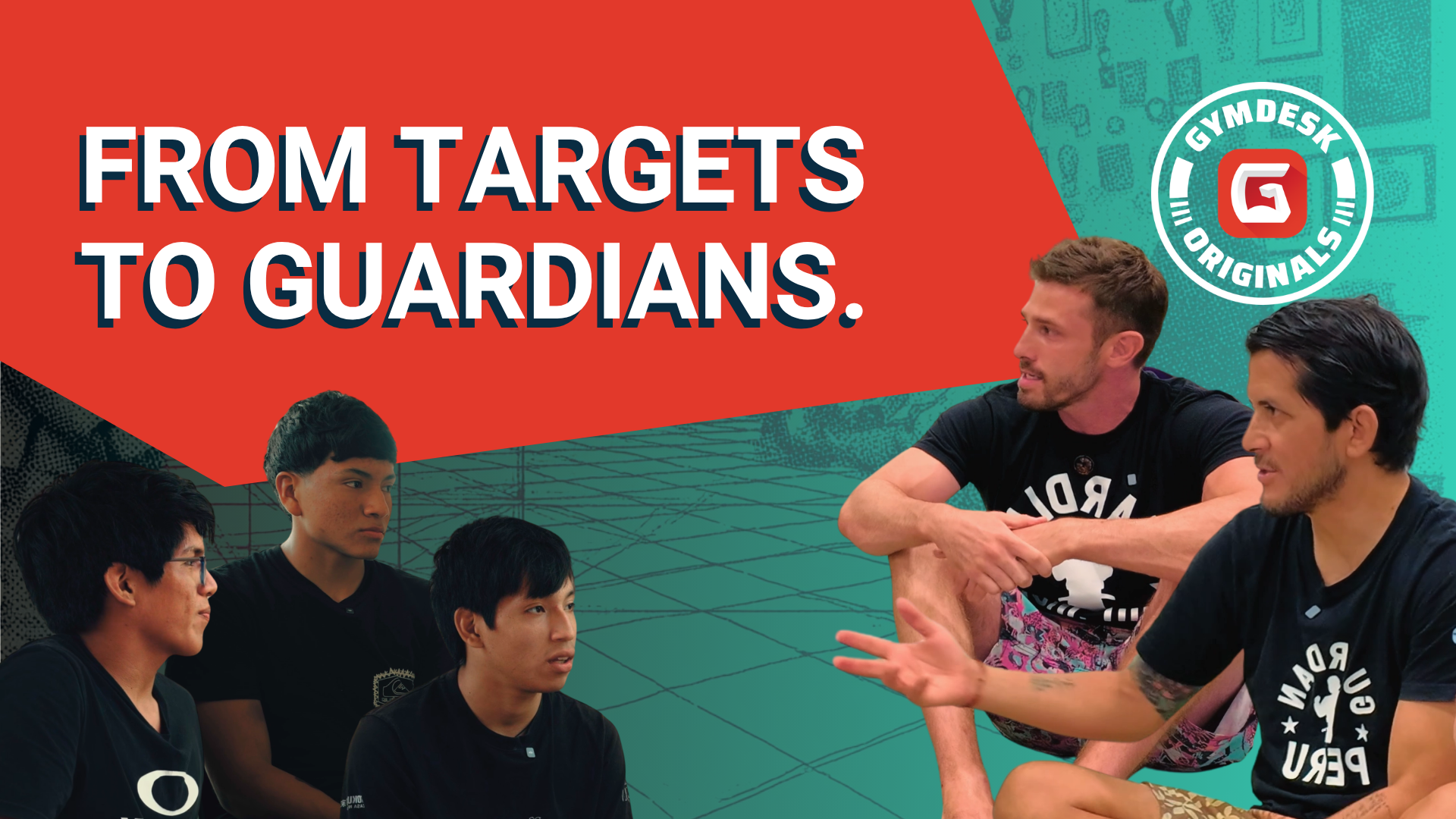
You're letting me in your class. I had a wonderful time and your students were really, really amazing too. Yeah. Thank you. Yeah. But this is the Carlson Gracie Academy. Yeah. You make, you try to make a very nice environment for people. You don't open the door and you see the, uh, fight club. Yeah. That's everybody inside. They want to prove something for you. Want to pick your leg many times. Yeah. No, he's, uh, everybody can come. He's a family. He's a big family. He's a big family.
You see children, see little girls. See, he's a big family. He's very respectful. And, you know, yeah. I mean, I had my jacket. I was in it like, and people didn't know me like, you know, they came introduce themselves to me. I was like, that's really nice. Yeah. That's, that's nice. It feels good to me. It's not, it's completely different for the fight club. Fight club. Yeah. Right on. Okay. Well, Professor, thanks again. I appreciate it.