Tumbling Classes: What Parents Ask and What Gyms Should Answer
Search "tumbling classes" and Google hands you a map.
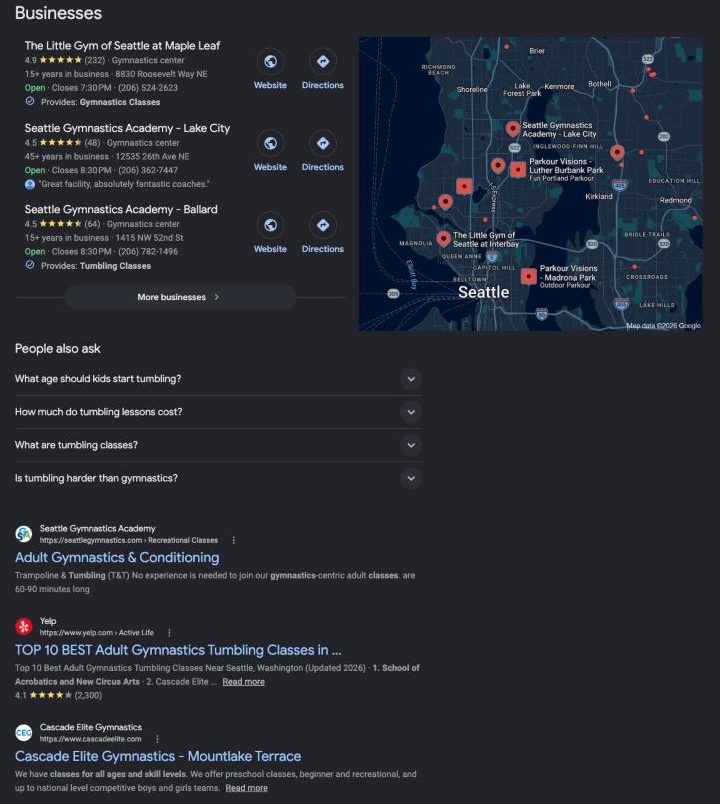
Google results for "tumbling classes," searched from Seattle on October 14, 2026.
An ad, three local gyms on a map, a Yelp list, and a row of program pages. Under all that sits the list of questions people keep asking.
They want to know what age to start, what it costs, what actually happens in a class, whether it's the same thing as gymnastics, and whether it's safe.
Those are parent questions.
As a dad of young kids, I'd add a sixth: will this tire them out before bedtime?
But if you run a tumbling program, they're your questions too. Every one of them has to be answered on your class page before a parent books a trial.
Each section below answers one of those questions, followed by a note on what the answer means for your program.
What Is a Tumbling Class?
Tumbling classes teach acrobatic skills on the floor: rolls, handstands, cartwheels, round-offs, walkovers, handsprings, and eventually flips and twists.
There are no bars and no beam. Kids work on a spring floor, a mat, or an air track, moving up through a ladder of skills one level at a time.
Sports medicine researchers studying cheer define tumbling as any hip-over-head skill that starts and ends on the floor without anyone holding the athlete up.
That's also where tumbling stops and stunting starts.
There's a competitive version too. USA Gymnastics runs trampoline and tumbling (T&T) as its own discipline. Its power tumbling event is done on elevated spring runways that send athletes, in the federation's words, "higher than a basketball goal."
Most kids in a Tuesday tumbling class are not headed there. Some are.
OWNER'S NOTE:
A parent reading "Level 2 Tumbling" on your page learns nothing. Name each level by its goal skill. Ocala Athletix lists goal skills under every tumbling class (cartwheel and round-off for beginners, standing back handspring for intermediate), so a parent can place their own kid before they ever call.
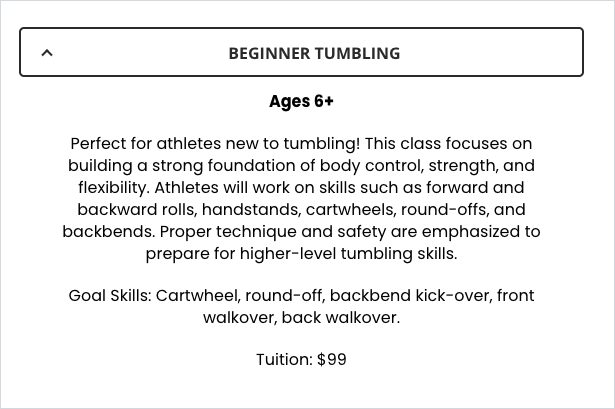
Ocala Athletix's Beginner Tumbling listing: who it's for, what kids work on, the goal skills, and the price, all in one panel. Screenshot taken October 14, 2026.
Tumbling vs Gymnastics: What's the Difference?
Gymnastics is a multi-event sport.
In a recreational gymnastics class, kids rotate through floor, beam, bars, and vault. Tumbling pulls out the floor part and makes it the whole class.
A kid who wants a back handspring for cheer tryouts gets more reps on it in a tumbling class. In a gymnastics class, floor is one rotation out of four.
A rough way to choose:
- Gymnastics suits young beginners, kids who like variety, and anyone who might want to compete in gymnastics later.
- Tumbling suits cheer athletes, dancers adding acrobatic skills, and kids chasing one specific skill. It also suits the kid who tried gymnastics and found bars boring.
- Both is common. Plenty of gyms have kids in a gymnastics class and a tumbling class in the same week.
Tumbling and cheer go together.
There were 3.5 million cheer participants in 2022, most of them girls between six and 17, according to Sports & Fitness Industry Association figures cited by AOSSM.
Epic Gymnastics, a Utah gym, notes that cheer tryouts at the middle school, high school, and club level almost always include floor tumbling.
OWNER'S NOTE:
If you run a gymnastics gym, your tumbling class is probably your best route to cheer families who'd never sign up for "gymnastics." If enough of them ask for a team, you can start a cheer program later. For now, market the class to them directly: tryout season, school cheer squads, the skill they need by spring.
We'll keep you in the loop with fresh content, podcasts, how-to guides, tool reviews, and product exclusives.
What Age Should Kids Start Tumbling?
AcroSchool reviewed the gymnastics-style class listings in its directory and found 18 months was the most common starting age for parent-and-child classes, and that most independent preschool classes start at three.
Structured skill classes typically begin around five or six.
Tumbling classes follow a similar pattern. Ocala Athletix runs Preschool Tumble for ages three to five and its tumbling levels from six up, and the trampoline and tumbling program at Seattle Gymnastics Academy starts at age four.
The pediatric guidance lines up.
The American Academy of Pediatrics says most children under six don't yet have the motor skills for organized sports. It names tumbling as one of the basic skills to build at that age.
Instruction should be short, show-and-tell, and full of playtime, with no competition. By about six, most kids are ready for simple organized sports.
A four-year-old in a tumbling class should mostly be rolling down a wedge and jumping into a pit. Any parent of a four-year-old will tell you they do that at home already. The gym just has better padding.
Before a drop-off class, parents should also check readiness: whether a child can leave them for 45 minutes, follow an instruction from another adult, and wait a turn.
We've written more on when a child is too young for gymnastics.
OWNER'S NOTE:
A common setup is the one Ocala Athletix uses: Mommy & Me from 18 months to two years 11 months, Preschool Tumble for ages three to five, and tumbling levels from six up.
Spell out your bands on your page, and put the readiness questions there too. That way the parent of an anxious three-year-old knows to stay in parent-and-tot one more term.
Then make your booking system enforce the bands, so a nine-year-old doesn't land in the toddler class because someone clicked the wrong time slot.
What Does a Tumbling Class Consist Of?
Most classes run 45 minutes to an hour. Move Tumbling's standard class is an hour a week, and AcroSchool found 45 minutes was the most common length for preschool classes.
Most follow the same shape every week:
Kids move up when they can do every skill on their level's checklist consistently.
Move Tumbling, a Utah program, holds periodic "pass-off weeks" where students test out on the skills they've been working on.
If you're the coach planning those hours, our tumbling lesson plans post covers lesson structure and skill progressions in detail.
How Much Do Tumbling Classes Cost?
Half of the 43 gyms AcroSchool reviewed in September 2026 charge between $85 and $110 a month for a once-a-week tumbling class, with a median of $99.
Those figures use each gym's starting price. Most gyms also charge an annual registration fee, with a median of $45.
That puts tumbling classes almost level with recreational gymnastics, which the same review put at a $102 median. Preschool and parent-and-child classes run a little lower, with a median of $80.
Prices swing a lot by class length, class size, location, and facilities.
A 45-minute preschool class and a 90-minute advanced class are not the same product. Parents should compare price per hour.
Some real examples from program pages:
- Ocala Athletix charges $99 a month for every tumbling level and $69 for its Mommy & Me class.
- Move Tumbling starts at $58 a month for one hour a week, with a $35 individual or $50 family registration fee.
For comparison, a 2019 survey by the Aspen Institute and Utah State University found families spent an average of $1,580 a year on a child's gymnastics, against $693 for the average youth sport.
A once-a-week tumbler at AcroSchool's $99 median, plus its $45 median registration fee, comes to about $1,230 a year. That's below the gymnastics average.
OWNER'S NOTE:
Set your base rate the way you'd approach pricing gymnastics programs, then structure it:
- Price by weekly hours. Seattle Gymnastics Academy prices its trampoline and tumbling program this way, and it scales cleanly when a kid adds a second class.
- Charge the registration fee. It's standard, and several of the gyms in AcroSchool's review tell parents it helps cover insurance.
- Give families a break. Move Tumbling's family registration rate is one version, and a monthly sibling discount is another. Tumbling runs in families. Younger siblings rarely sit still in the lobby for long.
- Sell privates. They bring in revenue beyond tuition, alongside the other alternative income streams a gym can run. The cheer athletes from earlier, the ones chasing a tryout skill by spring, will pay for one-on-one time.
How Long Does It Take to Learn Tumbling Skills?
There's no honest single number.
It depends on age, strength, flexibility, fear, and how many hours a week a kid trains. A coach who promises a back handspring "in six weeks" to every new student is selling something.
What you can count on is a progression.
Kids build rolls and handstands first, then cartwheels and round-offs, then walkovers, then handsprings. Each skill rests on the one before it, which is why skipping ahead is how kids get hurt.
The Tumbling Skill Ladder
Each skill rests on the one before it. Kids climb one step at a time.
1
Rolls and handstands
2
Cartwheels and round‑offs
3
Walkovers
4
Handsprings
5
Flips and twists
Skipping a step is how kids get hurt. How fast a kid climbs depends on age, strength, flexibility, and weekly training hours.
Training hours matter too. Most recreational trampoline and tumbling students at Seattle Gymnastics Academy train one to two hours a week, and kids at higher levels train more.
More reps on a skill means fewer weeks to get it.
OWNER'S NOTE:
Once parents can see the checklist, the next question is how to speed it up. Have an answer ready that they can buy: a second weekly class, a supervised open gym, or privates.
Is Tumbling Safe?
With a trained coach, proper matting, and a sensible progression, tumbling is a reasonable risk for most kids.
It's still a sport where children go upside down at speed, so injuries happen. In cheer, where most of the injury research is, the ankle, wrist, lower back, and knee are the most commonly injured areas.
That same review names the main ways to bring risk down: certified coaches, safe facilities, and proper skill progressions.
It also found that all-star cheerleaders are more likely than other cheerleaders to get hurt tumbling, likely because they attempt harder skills.
Their overall injury risk, and their risk of catastrophic injury, is similar to high school cheerleaders'.
Parents comparing gyms can ask:
- What training do your coaches have? USA Gymnastics runs U101, a safety and risk management course whose certificate lasts four years. In cheer, the U.S. All Star Federation credentials coaches by tumbling level, from one to six, and those credentials last five years.
- How do you decide a kid is ready for the next skill? The answer to listen for is "a checklist and a progression," not "when she feels brave."
- What's the coach-to-kid ratio? Smaller groups mean more turns and closer spotting.
- What's on the floor? Spring floor, landing mats, an air track, a pit. Hard gym floors are for walking on.
OWNER'S NOTE:
Put your coaches' credentials on your class page. A parent comparing three gyms is more likely to pick the one that answers the safety question before they have to ask it.
Hiring? Here's how gymnastics coaches get certified.
Injuries still happen with every precaution in place, so make sure every family has a signed waiver before the first class.
Talk to your broker about coverage (our guide to insurance for gymnastics gyms is a starting point), and have your coaches read our injury prevention guide.
Are There Tumbling Classes for Adults?
Yes, many gyms run them. AcroSchool's directory lists 263 gyms with adult classes.
Adult classes often run in the evening, start from rolls and handstands like everyone else, and lean harder on conditioning and flexibility.
They suit former gymnasts and cheerleaders, and also parents who've watched from the bleachers long enough to want a turn.
OWNER'S NOTE:
"Tumbling classes near me for adults" gets about 2,400 searches a month in the US, according to DataForSEO keyword data. Your floor sits empty after the last kids' class, and an adult beginner class or adult open gym costs you a coach and some electricity. Price them like any other adult class, and keep them off the kids' schedule.
Running a Tumbling Program Without the Admin Pile
Everything above sounds simple on a class page. Running it is less simple.
Trial classes have to get booked, and each new kid needs to land in the right level. Age bands have to hold. No kid should step onto the floor without a guardian's signature on a waiver.
Siblings get their discount every month, without someone remembering to apply it.
And when a parent asks "when does she move up," every coach should work from the same record of who passed which skill. It shouldn't matter who's at the desk.
Plenty of programs start with a spreadsheet and a clipboard. That works until a second coach starts marking skills on a different copy.
Then nobody knows which copy is the real one.
This is the kind of work gym software should handle. Gymdesk for gymnastics gyms covers the pieces a tumbling program runs on:
- Booking with rules. Set an age range and capacity on each class, with a waitlist that fills cancelled spots automatically. Parents book trials through online class booking, and the system won't let a nine-year-old into the toddler slot.
- Waivers at sign-up. Liability forms are signed during booking, and guardians can sign for minors, so nobody's chasing paperwork at the door.
- Family billing.Family discounts apply automatically when a household holds multiple memberships.
- Levels and skill checklists. Build your tumbling levels as ranks, attach the skills each one requires, and mark them pass/fail as kids hit them. Promotion requirements can include skills and minimum age, so moving up follows the checklist and nobody has to argue about it. If you turn it on, parents can see their kid's promotion progress in the member portal.
Set it up once, and the program runs on the same rules every week. Your coaches spend the hour spotting round-offs. And parents get what they actually signed up for: a kid who comes home tired.
FOR GYMNASTICS AND TUMBLING GYMS
Age bands that hold, waivers signed at booking, family discounts that apply themselves, and one skill checklist every coach works from. Set it up once, and your coaches spend the hour spotting round-offs.
See Gymdesk for GymnasticsGym management software that frees up your time and helps you grow.
Simplified billing, enrollment, student management, and marketing features that help you grow your gym or martial arts school.


FAQ
Tumbling Classes FAQs
Short answers to the questions parents search most.

Sean has spent the last decade creating content that helps businesses—small and not so small—grow smarter to allow operators to do more of what they love. You know, the fun stuff.
From shipping and international logistics to web development and marketing, he's done the work (not just the words) to scale retail and service businesses efficiently.
You can find his work at Sendle, Shogun, The Retail Exec, Gymdesk, and more.