

Most yoga studios start as a picture in someone's head.
It's 7am. Sun is pouring through the big front windows, the plants are thriving (in the daydream, the plants always thrive), the playlist is perfect (dreamy sitar sort of stuff), and every mat in slow flow is taken.
Someone you've never met says it's the best class in town.
Then a lender asks the question that picture can't answer: how many people have to pay you every month before the rent stops being scary?
A yoga studio business plan is where you answer it, on paper, before you sign a five-year lease.
This guide walks through every section, then fills in the money part for one example studio so you can see the arithmetic.
Meet Om Sweet Om. It's a made-up one-room studio, and the name is the most painful part of this post. I promise the numbers are kinder.
Made-up example studio
Om Sweet Om
One room in a strip center. Working adults, 6am classes, and a parking lot.
Here's the short version
Decide your business model first, meaning how students pay, where you teach, and how teachers get paid. Then write the eight sections a lender expects, put real numbers in the financial plan, and find your break-even member count.
If you're not borrowing, the one-page template further down does the same thinking on a single sheet.
If you're still deciding whether to open at all, start with our step-by-step guide to opening a yoga studio.
This post is step one of that guide, blown up to full size.
Lean or Traditional: Pick the Plan You Need
The US Small Business Administration sorts business plans into two formats.
A traditional plan can run dozens of pages, and it's the one lenders and investors usually ask for. A lean plan is typically one page and can take as little as an hour.
Pick by where the money's coming from:
- Borrowing from a bank or the SBA? Write the traditional plan. The lender will want the financials in it.
- Opening on savings, or renting a room by the hour? A lean plan is plenty. Run the numbers anyway.
- Bringing in a partner or an investor? Traditional. Anyone putting money in deserves to see what you're assuming.
Either way, the thinking is the same. The traditional plan just shows its work.
We'll keep you in the loop with fresh content, podcasts, how-to guides, tool reviews, and product exclusives.
Choose Your Yoga Studio Business Model First
A lot of templates start with the executive summary. I'd start one step earlier.
Your yoga studio business model is four decisions: how students pay, where you teach, how your teachers get paid, and whether the room is heated.
Every number in the plan comes out of those four. Change one, and the whole financial section moves.
Yoga studio business model
Decision 1
A studio that's mostly memberships knows its income on the first of the month. A studio that's mostly drop-ins finds out on Friday.
Decision 2
Plenty of owners work through more than one of these on the way to a lease of their own.
Decision 3
After rent, teacher pay is your biggest monthly cost, and it's usually the last thing new owners plan.
Decision 4
A half-full hot class costs the same to heat as a full one.
How students pay
Most studios sell some mix of these:
- Unlimited memberships. Usually monthly, and the steady money that makes the rent predictable.
- Class packs. Something like 10 classes to use over a couple of months. Good for students who come once a week and hate feeling guilty about it.
- Drop-ins. One class at a time, at your highest per-class price.
- An intro offer. A low-priced first week or two for new students, designed to turn into a membership.
For the price ranges, our guide on what to charge for yoga classes puts in-person drop-ins at $15 to $25, unlimited memberships at $100 to $150 a month, and class packs 10% to 20% below the drop-in rate. Those are planning ranges.
Your town's prices are the ones that count.
The mix is a plan decision. A studio that's mostly memberships knows its income on the first of the month. A studio that's mostly drop-ins finds out on Friday.
Where you teach
Plenty of owners work through more than one of these on the way to a lease of their own.
Each route costs a very different amount up front:
Space model | Upfront cost | What you're committing to | Best for |
|---|---|---|---|
Rent a room by the hour | Close to nothing | Nothing past the booking | Building a following first |
Teach inside a gym or wellness center | Low; usually a revenue split or a flat fee | Their schedule and their rules | Testing demand with someone else's foot traffic |
Lease your own space | $15,000 to $50,000 for a lean one-room start; $75,000 to $150,000+ for a full build-out | A multi-year lease | Running your own schedule and brand |
The lease ranges come from our breakdown of yoga studio startup costs, which also covers the line items.
If the middle row appeals, read up on partnering with a gym first. If you'd rather skip the room entirely for now, there's a whole guide to teaching yoga without a studio.
How teachers get paid
After rent, teacher pay is your biggest monthly cost, and it's usually the last thing new owners plan.
Group classes pay $25 to $75 per class, according to our guide to yoga instructor pay. Some studios add a per-head bonus of $1 to $4 per student once a class passes a minimum headcount.
When you pay teachers per class, you pay the same $40 whether three students show up or 25. Teacher pay doesn't stretch, which is a little ironic for a yoga studio.
Teacher pay behaves like rent. Your schedule sets it. So when you add a class to the schedule, you're adding a fixed cost, and the plan should treat it like one.
You also have to decide whether teachers are employees or independent contractors. That turns on how much control you have over the work.
The guide to hiring yoga teachers walks through it, and your accountant should get the final word.
Hot yoga or not
If you're writing a hot yoga studio business plan, know that a heated room changes the whole budget.
A hot room adds several line items a regular studio skips:
- A heat source: infrared panels, forced air, or radiant floor heating
- Humidity control, since infrared heat doesn't add any
- Insulation and a vapor barrier, so the walls don't grow anything
- Moisture-resistant flooring that won't turn slippery
- Enough electrical capacity, plus the landlord's written OK
- A much bigger utility bill, every month
Studio software vendor Studio-Deck puts an independent hot studio at $55,000 to $200,000+, with infrared panels installed for $5,000 to $15,000.
Treat that as one vendor's estimate and get real quotes for your space.
One more thing to write down: a half-full hot class costs the same to heat as a full one. Your utility line won't care how January is going.
The Sections of a Yoga Studio Business Plan
The SBA's traditional plan has eight core sections.
Here's what goes in each one for a yoga studio, with Om Sweet Om's answers where they help.
One tip before you start
Write the executive summary last. It sits at the top of the plan, and it's much easier to write once everything under it exists.
The eight sections a lender expects
Executive summary
Keep it to one page.
Name the studio and the neighborhood, who you teach, what makes you different, what it costs to open, your first-year revenue goal, and how much money you're asking for.
A lender reads this page first.
Sometimes it's the only page they read, so make it the clearest one in the document.
Company description
Cover your mission, your legal structure, and your edge.
Many small studios form an LLC, though a sole proprietorship is legal too. Ask an accountant which one fits your situation before you file anything.
Om Sweet Om's edge is simple: it's the only studio within 10 minutes with a 6am class and a parking lot.
Market analysis
Start with who practices yoga, then narrow it down to your neighborhood.
According to the CDC, 16.9% of US adults practiced yoga in 2022. The same data shows how lopsided that group is: 23.3% of women did yoga, compared with 10.3% of men, and adults 18 to 44 practiced at more than twice the rate of adults 65 and older.
Income tracks it too. Higher-income adults practiced at more than twice the rate of lower-income adults.
And among people with a gym or studio membership, the Health & Fitness Association found that yoga was the most widely practiced activity in 2025, with 17.7 million participants.
Use those splits to size up your own neighborhood.
Check the age, income, and gender mix within a 10-minute drive of the space you're looking at. Om Sweet Om's answer is working adults who want to practice before or after work.
Then look at your competition.
For a yoga studio, that list is longer than other yoga studios. It includes gyms that run yoga classes, the barre and Pilates studio next door, and the free videos on every student's phone.
Those videos are hard to beat on price. They've also never once fixed anybody's down dog.
For each competitor, fill in a row like this:
Competitor | What they teach | Drop-in / unlimited | Schedule gaps | Your angle |
|---|---|---|---|---|
Studio A | Hot vinyasa, sculpt | $25 / $149 | Nothing before 9am | Early classes |
Big-box gym | Two yoga classes a week | Included with gym | Packed, no props | Smaller classes, real instruction |
Studio B | Yin, restorative | $20 / $120 | No beginner series | A six-week beginner series |
Example rows. Fill in your own from competitor websites, a phone call, or a trial class.
Organization and management
Who owns the studio, who runs the front desk, who teaches what, and how they're paid. Include your teachers' training.
Many studios look for teachers with at least a 200-hour certification.
Put your policies here too: booking, cancellations, late arrivals, and what happens when a teacher calls in sick at 5:45am.
Classes and services
List your class types, levels, and weekly schedule, plus everything else you'll sell: privates, workshops, teacher training, retail, and corporate classes.
Privates and workshops can add real money once the core schedule is running.
Our guide to yoga studio revenue streams sorts out which extras are worth adding.
Marketing and sales
How do the first 50 students find you, and what will it cost? Cover your intro offer, your yoga studio SEO, your opening plans, and a monthly budget.
In the plan, you only need what you'll do first and what it costs. The yoga studio marketing guide has the tactics.
Funding request
Say how much you need, what it pays for, and where the rest is coming from.
The SBA's guide says to cover funding needs over the next five years, not just opening day.
Om Sweet Om could cover its $46,800 with about $20,000 of the owner's savings and a microloan for the rest.
Financial projections
This section holds your startup costs, revenue, monthly running costs, a cash-flow view, and your break-even point.
The SBA asks for five years of projections, with the first year broken out monthly or quarterly. That sounds like a lot.
Most of it is the same 12 months copied forward with a growth assumption, and the first year is where the real thinking happens.
A Worked Example: Om Sweet Om's Financial Plan
Every number below is an example input.
Where a figure comes from a published source, it's linked. Everything else is a placeholder you'd replace with your own quotes and your own market.
Keep the arithmetic, and swap in your own numbers.
Om Sweet Om plan calculator
Swap In Your Own Numbers
It opens on Om Sweet Om's month 12 from this guide. Change any number and what's left each month, your startup cost, and your break-even update as you type.
Your Schedule and Costs
Rent, utilities, insurance, software, marketing, cleaning, bookkeeping.
Typical range: $25 to $75 a class.
About 10% for W-2 teachers. Set to 0 for contractors.
What Students Pay, and How Many
Opening and Your Pay
Deposit, build-out, floors, props, permits, website, marketing, opening event.
What's left this month
$7,220
It pays you. That's at least the $4,000 salary you set, before loan payments and income tax.
- Revenue
- $15,845
- Overhead (before teacher pay)
- $5,100
- Teacher pay (fixed once the schedule is set)
- $3,050
- Card processing
- $475
- Total running costs
- $8,150
- Revenue in membership terms
- about 127 memberships
- Startup cost, with reserve
- $46,800
- Break-even, owner paid nothing
- 68 members
- Break-even, with your salary
- 101 members
Teacher pay is classes other teachers cover × pay per class × 52/12 weeks a month, plus payroll taxes, rounded to the nearest $10. Break-even is running costs divided by what one unlimited member brings in after card fees, rounded up.
Om Sweet Om is a made-up example studio. Every starting number is an example to replace.
Om Sweet Om's assumptions:
- One room of 1,000 square feet in a strip center, with space for 25 mats and rent of $3,500 a month
- 24 classes a week; the owner teaches eight, and other teachers cover 16 at $40 a class
- Unlimited membership at $125 a month, a 10-class pack at $170, drop-ins at $20, and a two-week intro offer at $39
- Teachers are W-2 employees, so their pay includes about 10% for payroll taxes
- The owner takes no salary in year one, so whatever's left is their pay
Startup costs
This is everything Om Sweet Om spends before the first class, including a cash cushion it sets aside and tries not to touch.
Om Sweet Om's opening budget:
Item | Example cost | Note |
|---|---|---|
Lease deposit and first month | $7,000 | Rent of $3,500 a month |
Build-out | $8,000 | Paint, lighting, cubbies, a small lobby |
Flooring, mirrors, and fixtures | $6,000 | |
Props and sound | $4,000 | Mats, blocks, straps, bolsters, speakers |
Licenses and permits | $500 | |
Website and booking setup | $1,000 | |
Marketing and branding | $4,000 | |
Opening event | $1,000 | |
Cash reserve | $15,300 | Three months of overhead |
Total | $46,800 |
That total lands inside the $15,000 to $50,000 range for a lean one-room start. A full build-out or a hot room would push it well past that.
Don't skip the cash reserve.
It's what pays the rent in month three, while the intro students are still deciding whether they like you.
Think of it as the savasana of your budget. It looks like nothing's happening, and it's holding everything together.
The gym startup cost calculator runs this same exercise with your numbers.
Monthly running costs
Yoga is light on gear. That's great news for the startup budget and no help at all with the monthly bills.
Om Sweet Om's monthly costs, before card fees:
Cost | Per month |
|---|---|
Rent | $3,500 |
Utilities | $350 |
Insurance | $100 |
Software, website, music licensing, and phone | $300 |
Marketing | $400 |
Cleaning and supplies | $250 |
Bookkeeping | $200 |
Overhead (before teacher pay) | $5,100 |
Teacher pay (16 classes a week × $40, plus payroll taxes) | $3,050 |
Total | $8,150 |
For the example, I've assumed card processing at about 3% of whatever you take in, on top of these. Use your processor's real rate.
Our guide to studio insurance costs covers what that $100 a month should actually buy.
Month three vs month 12
A yoga studio doesn't open full.
Memberships build slowly, and early on, a lot of your income is intro offers that haven't turned into anything yet.
Here's Om Sweet Om in its third month and its twelfth:
Line | Month three | Month 12 |
|---|---|---|
Unlimited members ($125) | 25 members: $3,125 | 70 members: $8,750 |
Class packs ($170) | 12 sold: $2,040 | 25 sold: $4,250 |
Drop-ins ($20) | 40: $800 | 50: $1,000 |
Intro offers ($39) | 50: $1,950 | 30: $1,170 |
Workshop | None yet | 15 students at $45: $675 |
Revenue | $7,915 | $15,845 |
Running costs | $8,150 | $8,150 |
Card processing (about 3%) | $237 | $475 |
What's left | −$472 | $7,220 |
Look at the first column.
Om Sweet Om loses money in month three with 25 members and a full schedule, which is exactly what the cash reserve is for.
By month 12, the studio clears about $7,220 a month. That's before loan payments and income tax, and it's the owner's whole paycheck for teaching eight classes a week and running everything else.
Is that enough? Only you know what your life costs. And month 12 has to actually show up on time.
One sanity check worth doing: if members come about eight times a month, month 12 works out to roughly nine students per class in a room that holds 25.
That leaves room to grow without adding a single class.
Break-even
Break-even answers one question: how many members do you need to cover your costs?
Because teacher pay is fixed once the schedule is set, the math is short. Om Sweet Om needs $8,150 a month.
Each unlimited member brings in $125, minus about $3.75 in card fees, so $121.25.
Divide $8,150 by $121.25 and you get 67.2. Round up, and Om Sweet Om breaks even at 68 members, with the owner earning nothing.
Add a $4,000-a-month salary for the owner, and the number becomes $12,150 ÷ $121.25, or 101 members.
Class packs and drop-ins count toward that number too. In month 12, Om Sweet Om's total revenue equals about 127 memberships, which is why it's comfortably past break-even with only 70 actual members.
How many members Om Sweet Om needs
Members paying $125 a month, about $121.25 after card fees. Class packs and drop-ins count toward the month 12 bar. Example numbers.
The break-even calculator does this with your numbers in about a minute.
A One-Page Yoga Studio Business Plan Template
Not everyone needs 30 pages.
This is the lean plan from the top of the post, filled in for Om Sweet Om so you can see what a good answer looks like. Copy it and swap in your own.
One-page yoga studio business plan
- Who you teach: Working adults within 10 minutes of the studio who want to practice before or after work.
- What you offer: Vinyasa, slow flow, and yin; a six-week beginner series; monthly workshops.
- Why students pick you: The only studio nearby with a 6am class and easy parking.
- How students pay: $125 unlimited, $170 for 10 classes, $20 drop-in, $39 for two weeks to start.
- Where you teach: A leased 1,000-square-foot room with space for 25 mats.
- How teachers get paid: $40 a class, W-2.
- How students find you: Google, the intro offer, a referral credit, and an opening-week open house.
- Startup cost: $46,800, with $15,300 held as a cash reserve.
- Break-even: Break-even at 68 members; 101 once the owner gets paid.
That's a plan. It fits on one page, which means it also fits in your mat bag.
Taking the Plan to a Lender
A lender wants to see the plan hold up and some of your own money in it. They'll also want enough cushion to cover the payment in a slow month.
For a new studio, they'll also look hard at you. The studio has no track record yet.
So the SBA notes that a new business's loan eligibility is typically based on its owner's personal credit score.
The SBA says to have these ready before you apply:
- Your business plan
- An expense sheet (your startup costs)
- Financial projections for the next five years
Many lenders also ask for these:
- A personal financial statement
- Your last two years of personal tax returns (some ask for three)
- Your own contribution, and where it's coming from
- Quotes for the build-out
- The lease, or a letter of intent from the landlord
The SBA options, in numbers
A microloan goes up to $50,000. The average is about $13,000, interest generally runs 8% to 13%, and terms go up to seven years.
A microloan can pay for equipment and working capital, but not real estate. A 7(a) loan goes up to $5 million, and that's the SBA's standard small-business loan. The SBA doesn't require collateral on 7(a) loans of $50,000 or less.
If you want a second set of eyes before the bank sees it, SCORE offers free mentoring from volunteer business mentors, including help with business plans and financial projections.
For routes that don't start at a bank, see gym startup financing options.
Why Yoga Studios Close, and What to Write Down About It
Lenders know plenty of yoga studios close. Answer why in your plan before one asks you out loud.
One big reason is thin margins.
IBISWorld, via an industry analysis by MMCG, puts average profit margins for US yoga and Pilates studios at about 6.7% in 2024.
Om Sweet Om looks a lot healthier than that in month 12. That's because it's a best case.
The owner isn't on the payroll, isn't paid for the eight classes they teach, and isn't making a loan payment yet. Add those, plus the members who cancel every month, and the cushion gets thin fast.
If the economy turns, our guide to surviving a recession is the next read.
Name the risks, with one fix for each. Put this list right after your financial projections:
- Intro students who never come back. Follow up before the intro offer ends, and track how many turn into members.
- Your most popular teacher leaves. Spread the busiest time slots across more than one teacher.
- Rent jumps at renewal. Negotiate renewal options into the lease now, while the landlord still wants you to sign.
- Too many classes, too few students. Add the next class when the current ones fill.
- A slow season. Attendance moves with the calendar. Keep the cash reserve topped up for the quiet months.
- A hot room in a half-empty month. Heat is a fixed cost. Budget the utility bill at full price.
Write those down, and you give the studio a much better chance to namaste open. (Sorry. Not sorry.)
Running the Plan Once You Open
A plan is a list of assumptions. They only hold if members actually get billed what you planned, on time.
That's a lot of moving parts for a one-room studio.
Seventy members renew on different dates, intro offers expire, class packs run down, and somebody always wants to pay for a drop-in with a twenty.
Done by hand, that's the manual tax. It looks like a sign-in clipboard by the cubbies and a student promising to Venmo you after savasana.
Software handles most of that for you.
Yoga studio software like Gymdesk turns your pricing decisions into settings:
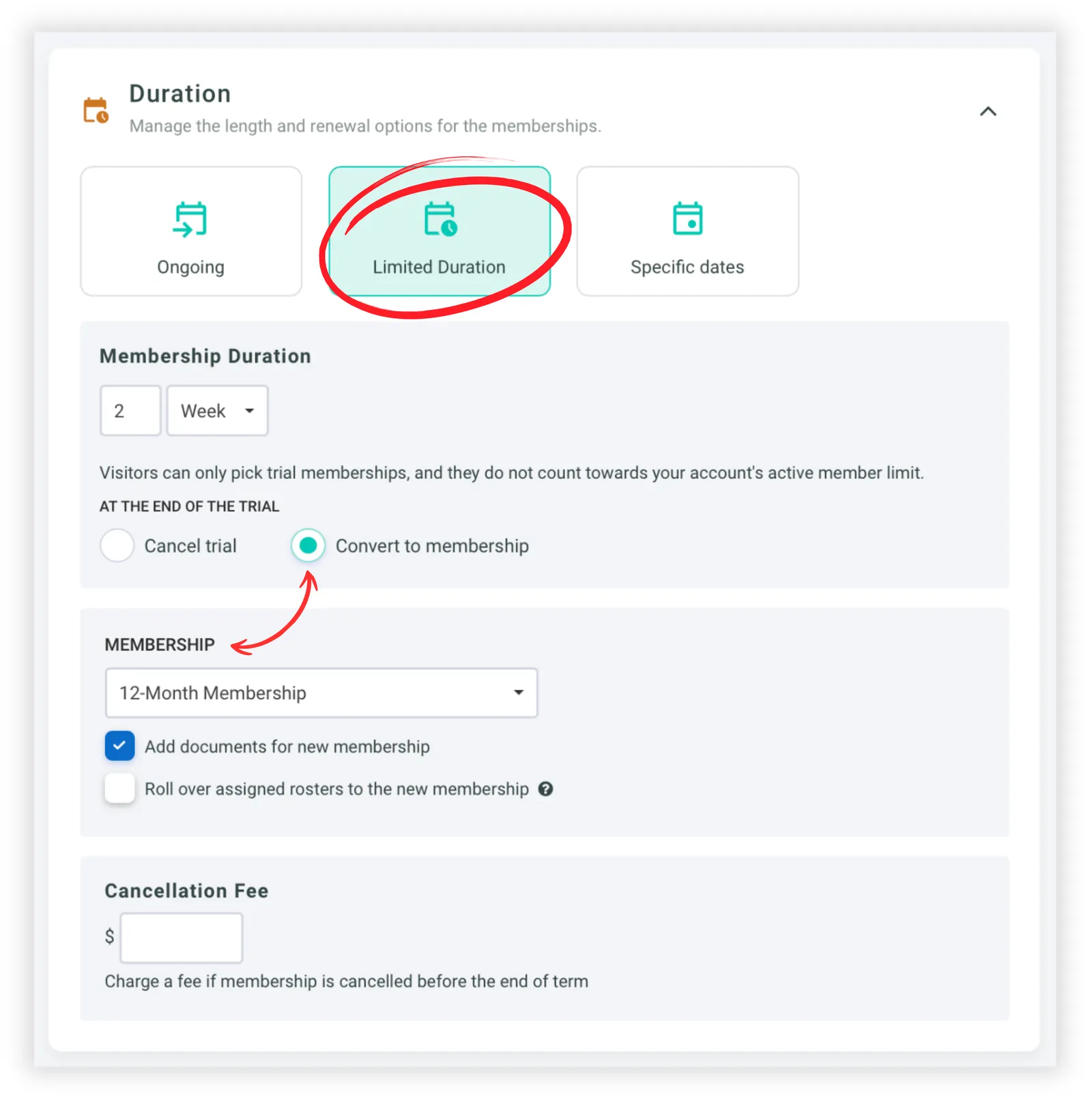
- Memberships and class packs share one system. A 10-class pack counts down with each check-in. On plans with a set number of classes each month, unused classes can roll into the next month, up to a cap you set.
- Intro offers convert on their own. When a trial ends, it can switch automatically to the membership you choose, and automated emails can follow up with intro students before it does. Neither step depends on someone remembering.
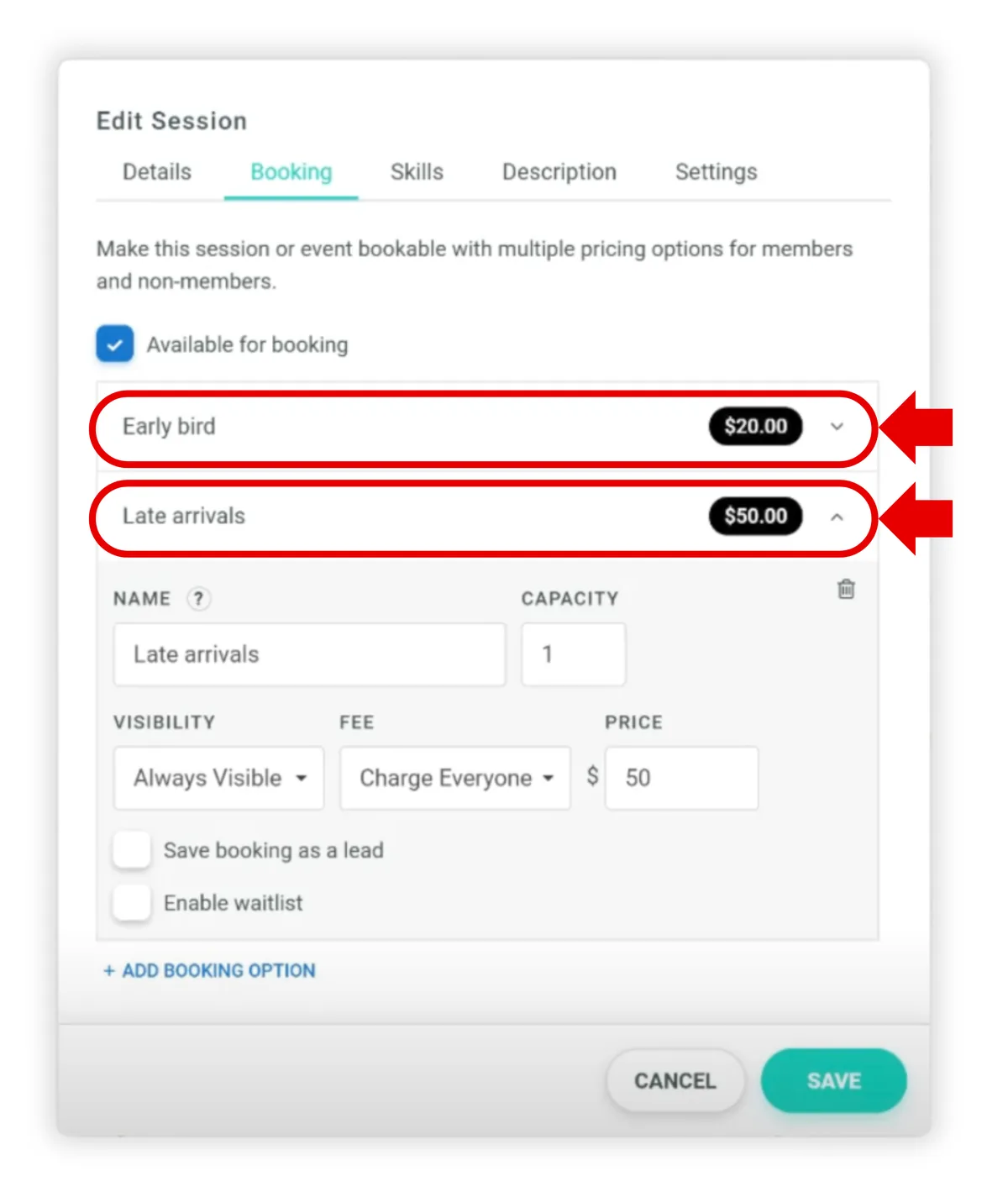
- Drop-ins and members share a class. Both prices can sit on the same class through online class booking, with a 25-mat cap and an automatic waitlist when it fills.
- Billing runs on schedule. Gymdesk's billing features charge the card on file automatically, so nobody has to chase the $8,750 membership line, and you can see who's overdue.
Drop-ins and members can share the same 6am slow flow, too, each at their own price:
Then check the plan against reality once a month.
Pull revenue, active members, and attendance from Gymdesk's reporting tools, and compare them with what you projected.
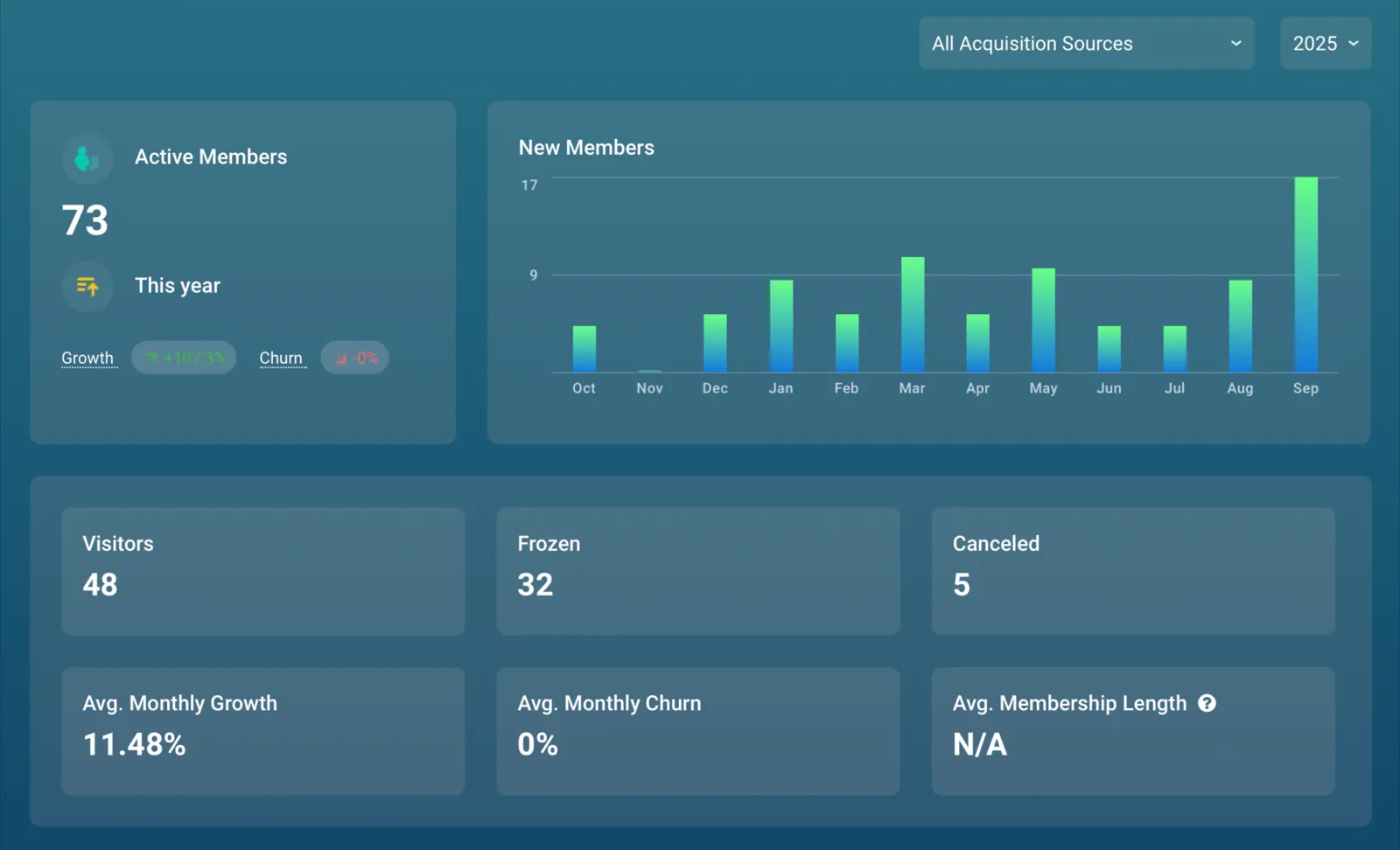
When the numbers drift, the plan tells you which assumption broke.
Before You Sign Anything
Do the math with your own numbers, and put your own salary in it.
You'll either open knowing exactly how many members you need, or find out the studio doesn't work while it's still a spreadsheet.
That's the cheapest way to learn it, and you get to learn it sitting down.
When you're ready to run it, try Gymdesk's yoga studio software free for 30 days.
For yoga studios
A plan is a list of assumptions. They only hold if members actually get billed what you planned, on time. Try Gymdesk's yoga studio software free for 30 days.
Gym Management Software That Gets You Back On The Mats
Run your gym smarter with the right software. Automate your attendance tracking, lead management, belt tracking, and more.


Yoga Studio Business Plan FAQs
The questions owners ask most, answered short.
How do you write a business plan for a yoga studio?
A yoga business plan starts with your business model: your pricing mix, your space, how you pay teachers, and whether the room is heated. Then write the core sections the SBA recommends: executive summary, company description, market analysis, organization and management, your classes and services (the SBA calls it service or product line), marketing and sales, funding request, and financial projections. Write the executive summary last.
How much does it cost to open a yoga studio?
As a planning range, a lean one-room start runs about $15,000 to $50,000, and a full build-out $75,000 to $150,000 or more. A hot room adds heating, humidity control, and moisture-resistant flooring on top. Our example studio needed about $46,800, including a cash reserve of three months' overhead.
Is owning a yoga studio profitable?
It can be, but margins are thin. IBISWorld, via an MMCG industry analysis, puts 2024 average profit margins for US yoga and Pilates studios at about 6.7%. Our example studio clears about $7,220 a month by month 12, before loan payments, income tax, and any salary for the owner.
How many members does a yoga studio need to break even?
Divide your monthly costs, including teacher pay, by what each member brings in after card fees. With $8,150 in monthly costs and $121.25 per member, our example studio breaks even at 68 members, or 101 once the owner takes a $4,000 monthly salary.
Why are so many yoga studios closing?
Thin margins are a big part of it. Rent and teacher pay are fixed once you set the schedule, while income depends on members showing up and renewing. Studios that add classes before the existing ones fill, or that never turn intro students into members, run out of cushion first.

Sean has spent the last decade creating content that helps businesses—small and not so small—grow smarter to allow operators to do more of what they love. You know, the fun stuff.
From shipping and international logistics to web development and marketing, he's done the work (not just the words) to scale retail and service businesses efficiently.
You can find his work at Sendle, Shogun, The Retail Exec, Gymdesk, and more.