Is Brazilian Jiu-Jitsu the Best Martial Art?

Let's cut straight to it: Brazilian jiu-jitsu is arguably the best martial art for one-on-one unarmed combat and mixed martial arts competition.
"Best" always depends on what you're actually trying to accomplish.
If your goal is practical self-defense against a single attacker, BJJ is a top contender. If you're worried about multiple people jumping you or weapons in the mix, you'll need more than ground fighting in your toolkit.
BJJ earned its respect the hard way—it proved itself when it mattered.
In the early UFC events from 1993 to 1994, Royce Gracie—a relatively small fighter by today's standards—submitted much larger opponents from boxing, wrestling, and various striking arts.
He wasn't winning by knockout. He was choking people unconscious and hyperextending joints. That changed how every serious martial artist thought about a real fight.
Key Takeaways
KEY TAKEAWAYS:
BJJ is arguably the best martial art for one-on-one unarmed fighting—it dominates on the ground, and no other art develops submissions and positional control as thoroughly.
"Best" depends entirely on your goal. Self-defense, MMA, fitness, mental health, and competition each point you slightly differently.
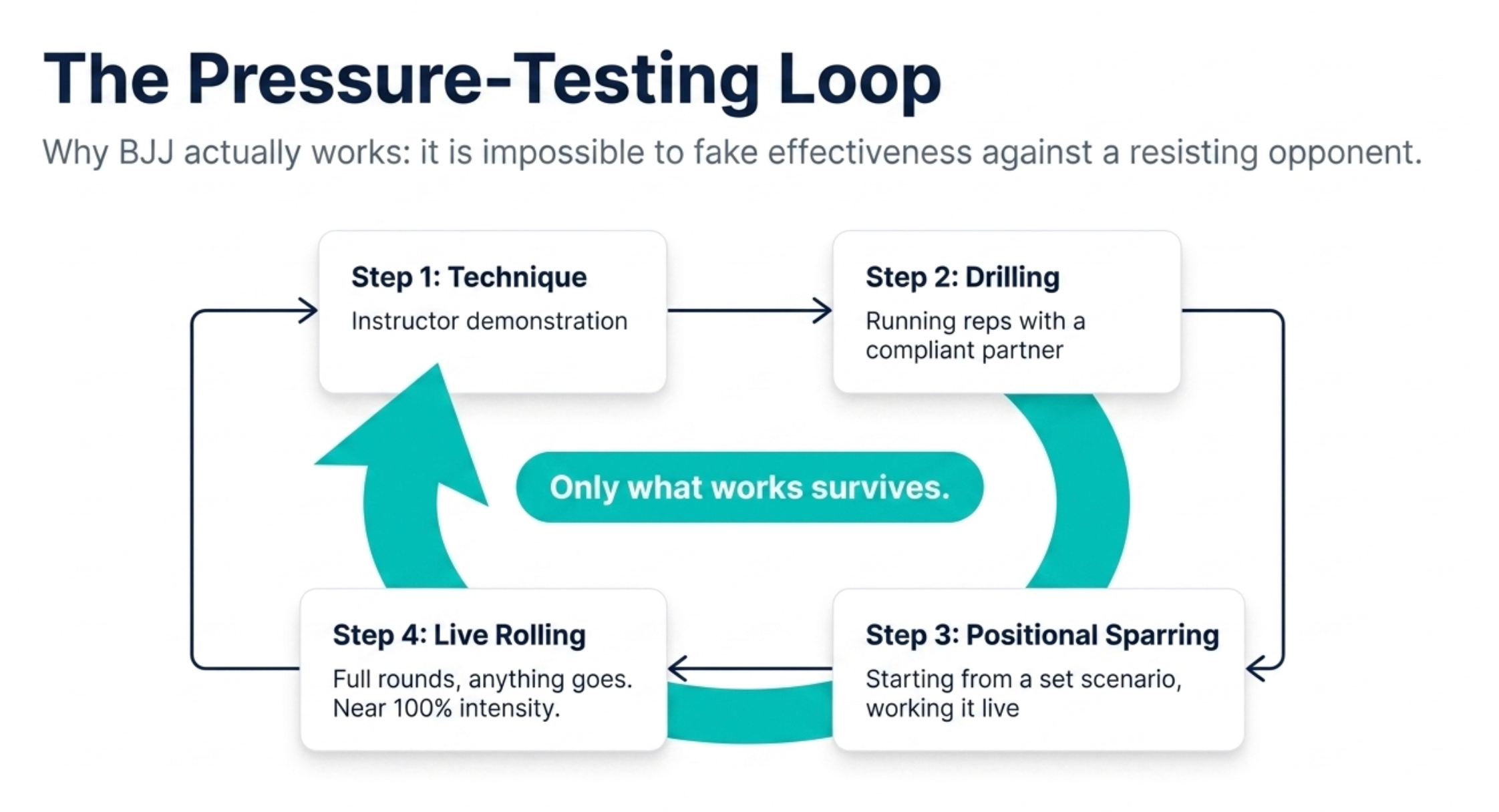
Its core edge is pressure-testing. Because there are no strikes, you can roll at near-full intensity every session, so only techniques that actually work survive.
Know the limits honestly. BJJ doesn't teach striking, and going to the ground is a liability against weapons or multiple attackers.
For most people the real answer is BJJ plus striking—together they cover the full range of a fight in a way neither does alone.
For gym owners, "is BJJ the best martial art" is a high-intent prospect question—and the gyms that answer it honestly, then make trying a class effortless, are the ones that convert.
What Exactly Is Brazilian Jiu-Jitsu?
Brazilian jiu-jitsu (BJJ) is a modern grappling art that evolved from Kodokan judo and traditional Japanese jiu-jitsu.
The goal is to take an opponent to the ground, establish a dominant position, and finish with submission holds like chokes and joint locks.
Unlike striking arts where size and power often decide the winner, BJJ teaches that a weaker person can control and defeat a stronger one through technique and leverage.
How BJJ is actually trained
Here's what sets it apart from most martial arts: how it's practiced. Every class ends in "rolling"—live sparring against a partner who is fully resisting.
There's no choreographed back-and-forth. Your partner is genuinely trying to submit you while you try to submit them.
Only techniques that actually work survive that test—you can't fake effectiveness when someone's trying to choke you.
KEY POINT:
Pressure-testing is the whole reason BJJ works. A technique that only lands on a compliant partner doesn't make the cut, because every rep is stress-tested against someone fighting back.
What a typical class looks like
Most sessions follow a predictable arc:
- Warm-up. Grappling-specific movements like shrimping, bridging, and guard retention drills.
- Technique. The instructor demonstrates a sequence: a guard pass, an escape from mount, a sweep from half guard.
- Drilling. You run the technique with a partner until it starts to feel natural.
- Positional sparring. You start from a set scenario and work it live.
- Rolling. Full rounds where anything goes.
Gi vs no-gi
Most gyms offer both. In gi training, you wear a traditional kimono (like a judo uniform) and can grip the fabric to control your opponent.
No-gi uses rash guards and shorts, feels closer to wrestling, and translates more directly to MMA. Many practitioners train both.
The belt system: a long road on purpose
The belts run white, blue, purple, brown, then black.
Here's what separates BJJ from martial arts with faster promotions: at most schools, a black belt commonly takes 8 to 12 years of consistent training.
Even your first colored belt, blue, usually takes one and a half to three years. That isn't gatekeeping—it reflects the genuine depth of the techniques and the time it takes to develop them against resisting opponents.
Our guide to the BJJ belt system breaks down every rank and how long each one really takes.
A Brief History: How BJJ Proved Itself

BJJ didn't earn its reputation in a marketing deck. It earned it in challenge matches and cages, over the better part of a century.
From Japan to Brazil
The story starts in the early 1900s with a Japanese judoka named Mitsuyo Maeda.
Maeda was one of Jigoro Kano's students at the Kodokan in Tokyo, and he traveled the world fighting challenge matches and teaching.
Around 1914, he arrived in Brazil and befriended a local businessman named Gastão Gracie.
Gastão's son Carlos began training with Maeda and later taught his brothers, including Hélio Gracie. Hélio was smaller and weaker than his siblings, which forced him to adapt.
He refined the leverage-based approach that became the signature of Gracie Jiu-Jitsu: angles, hip movement, and timing instead of brute strength.
The challenge-match era
The Gracies didn't just train in private gyms. They issued open challenges to fighters of every style, competing under minimal rules to test whether their art actually worked.
Those challenge matches and "vale tudo" (anything goes) events across Brazil, from the 1920s through the 1980s, built the family's reputation and sharpened their techniques against real opposition.
UFC 1: the proof
The turning point came in November 1993 at UFC 1 in Denver—a style-versus-style tournament with almost no rules: no time limits, no weight classes, few restrictions.
Royce Gracie entered as one of the smaller competitors and dismantled opponents from boxing, shootfighting, and savate.
He didn't knock anyone out. He took them down, controlled them, and forced submissions. He went on to win UFC 2 and UFC 4 as well.
Those events shattered assumptions about what worked in a real fight. Suddenly every serious martial artist realized that no matter how good their striking was, they needed a plan for the ground.
That sparked the MMA revolution that continues today, where nearly every champion-level fighter has real grappling skill.
Is BJJ the Best for Self-Defense?
For one-on-one self-defense, BJJ has earned its reputation as one of the most effective arts available.
Instead of trading punches with someone bigger, faster, or more aggressive, you close distance, establish control, and use position to neutralize the threat.
You can take a situation to the ground and either hold someone there until help arrives or end it with a choke.
Why it works when it's real
What makes BJJ so effective is the emphasis on control over damage.
If someone grabs you in a bar, you can off-balance them, take them down, establish mount or back control, and hold them there without throwing a punch.
If things escalate, a rear naked choke can end it in seconds. That ability to scale your response—rather than hitting someone repeatedly—is a real advantage.
Self-defense BJJ and sport BJJ aren't always the same thing, and good schools know the difference.
Self-defense programs teach standing headlock escapes, bear-hug defenses, how to handle punches while you're on the ground, and how to disengage safely. Those pieces sometimes get lost in competition-focused gyms.
About that "most fights end up on the ground" claim
You've probably heard it—sometimes attributed to LAPD studies, sometimes to Gracie marketing.
The exact percentage is debated, but the underlying reality is observable.
When untrained people fight, they clinch, grab shirts, tackle each other, and fall.
Real altercations rarely look like boxing matches. They look like ugly scrambles—and in a scramble, ground skills give you a massive edge.
Where BJJ falls short
Be honest about the limits. BJJ is a weaker choice by itself when you're outnumbered.
Going to the ground with one person while his friends are standing exposes you to stomps and kicks you can't defend. And if weapons are involved, grappling range is exactly where you don't want to be.
REALITY CHECK:
BJJ makes you dramatically harder to handle one-on-one, but it isn't a magic shield. Situational awareness, verbal de-escalation, and a little striking cross-training cover the gaps it can't.
If self-defense is your main reason for training, weigh BJJ against the alternatives head-to-head.
Our breakdown of the best martial art to learn for self-defense compares the disciplines across the scenarios that actually matter.
BJJ vs Other Popular Martial Arts
Comparing martial arts is tricky because each one optimizes for a different scenario.
But if we're asking which is "best" for real fighting and self-defense, it helps to look across several criteria at once.
Martial Art | Self-Defense | MMA Success | Injury Risk | Long-Term Training | Live Sparring |
BJJ | Excellent (ground) | Essential component | Moderate (joints) | Very sustainable | Daily at full intensity |
Boxing | Good (stand-up) | Essential component | High (head trauma) | Limited by age | Regular, intense |
Muay Thai | Very good | Essential component | High (head/shins) | Limited by impact | Regular, intense |
Wrestling | Excellent (control) | Essential component | Moderate | Sustainable | Daily, intense |
Judo | Very good (throws) | Useful | Moderate (falls) | Sustainable | Regular |
Krav Maga | Scenario-dependent | N/A | Varies | Sustainable | Limited by technique danger |
Karate/TKD | Variable by school | Limited | Low-moderate | Sustainable | Varies widely |
Where BJJ wins
BJJ outperforms most martial arts in three specific areas:
- Ground fighting and submissions. No other art develops this as thoroughly. If the fight goes down, you have a game plan while many other martial artists are lost.
- Realistic live training. With no striking, you can roll at near-100% intensity every session without accumulating brain damage. That pressure-testing builds skill that actually transfers.
- Longevity. You can train seriously into your 40s, 50s, and beyond, because you're not absorbing repeated head trauma.
Where striking wins
Boxing and Muay Thai have real advantages of their own. A boxer's hand speed, head movement, and footwork can end a fight before it ever hits the ground.
Muay Thai's clinch, knees, and elbows make it the most complete stand-up combat sport.
And if your concern is multiple attackers, the ability to hit and move—rather than tie yourself up with one person—makes striking the smarter tool.
Why wrestling and judo pair so well with BJJ
Wrestling and judo deserve special mention because they combine beautifully with it.
Wrestlers bring explosive takedowns, relentless pressure, and conditioning. Judokas add throws that can end a fight on concrete plus superior grip fighting.
Neither one teaches what to do once you've put someone on their back and they keep fighting.
That's the gap BJJ fills—which is why so many MMA fighters cross-train all three.
THE HONEST ANSWER:
For MMA and one-on-one unarmed fighting, the modern gold standard is BJJ plus striking. Neither alone beats a well-rounded opponent, but together they cover the whole fight.
If you're still weighing which discipline fits you, our guide on how to choose the right martial art walks through matching a style to your goals, body, and schedule.
Is BJJ the Best Martial Art for Mental Health?
Any physical activity helps your mental health, but BJJ may offer specific advantages over other combat sports—especially striking arts like Muay Thai or boxing.
Community and the trust contract
Constant close-contact grappling forces you to trust your partners.
Every time you roll, you put your neck in someone's hands.
That vulnerability, plus the expectation that your partner releases the second you tap, creates a social contract you don't get from solo drills or a heavy bag.
People who've tried multiple arts—kung fu, boxing, Krav Maga, traditional styles—often say BJJ is the one that keeps them coming back, because of that community.
Stress you can rehearse safely
Live rolling mimics intense stress in a controlled environment.
Your body feels the physical sensations of conflict—elevated heart rate, adrenaline, pressure—while your brain knows you're actually safe.
Over time, that trains your nervous system to stay composed instead of panicking.
It's the kind of stress inoculation you can't rehearse shadow-boxing alone, and many people find it carries into hard conversations and high-pressure moments at work.
A puzzle that never repeats
There are no benchwarmers in BJJ. Unlike a striking class where you can drift to the back and hit pads by yourself, everyone on the mat is engaged, solving problems with a partner.
That shared struggle builds bonds that fight off loneliness and isolation.
It's also endlessly cognitive. Where a fixed kata gives you the same sequence every time, live rolling never repeats—so training stays fresh in a way that keeps you showing up.
That adherence matters more than any single session, and it's one of the most commonly cited benefits of training BJJ: people stay for the community as much as the technique.
Who Is BJJ Best For?
BJJ suits some people better than others. Here's how to tell which side of the line you're on.
BJJ is a strong fit if…
- You want practical self-defense without relying on size or speed. The leverage-based approach lets your technique overcome a strength gap—which matters more as you age or if you're naturally smaller.
- You'd rather not get hit in the face. BJJ offers intense training without the concussion risk of boxing or Muay Thai.
- You're a woman, a smaller athlete, or a total beginner. The whole system was designed around a weaker person beating a stronger one. Female competitors at IBJJF Worlds and ADCC prove it constantly, which is one reason women's BJJ programs are among the fastest-growing parts of the sport.
- You're signing up a kid. Many gyms run classes starting around age 4 that build coordination, discipline, and basic safety positions in a playful setting.
KEY POINT:
If you're worried BJJ won't work unless you're already strong, that's exactly backwards. Leverage-based control is built for the person who can't win a strength contest—which is the most reassuring thing you'll feel in your first month.
You might want a different art if…
- Striking is your priority. If you want to learn to punch and kick, boxing or Muay Thai will serve you better—though cross-training is always an option.
- Close contact makes you deeply uncomfortable. Strong claustrophobia or a real aversion to grappling can make BJJ feel overwhelming rather than fun.
- You need weapons or tactical training. If your main worry is weapons defense, or you work in law enforcement with mandated control tactics, you'll likely need training beyond what most BJJ schools offer.
For pure fitness, plenty of activities work fine.
But if you want practical skills, mental engagement, community, and something you can train for decades, BJJ checks more of those boxes than almost anything else.
Sport, MMA, or Self-Defense: What's Your Priority?
BJJ is practiced across three major tracks, and knowing them clarifies what people mean when they call it the "best" martial art.
Sport BJJ focuses on competition under rule sets like IBJJF or ADCC. Training emphasizes point-scoring positions, advantages, and the guards and submissions that work best within those rules.
You'll see techniques like berimbolos, elaborate lapel guards, and detailed leg locks.
This track produces incredibly skilled grapplers—but some habits, like sitting to guard without controlling your opponent, only make sense in a world with no strikes. Under IBJJF rules, sport BJJ obviously dominates, because it's built for that exact game.
MMA-oriented BJJ blends grappling with striking and cage work. You learn to close distance against punches, hit takedowns on someone trying to knock you out, and keep submissions alive while dealing with strikes on the ground.
The techniques resemble sport BJJ but get applied differently, and positions that leave you open to strikes get de-emphasized.
MMA fighters treat BJJ as one essential piece of a complete game that also includes wrestling, boxing, and Muay Thai—and inside a cage, that well-rounded approach wins.
Pure self-defense BJJ prioritizes standing defenses, an escape-first mindset, and awareness of hard surfaces, multiple attackers, and the legal fallout of hurting someone.
Classes lean into headlock escapes, bear-hug defenses, and getting back to your feet safely.
The goal isn't always to submit the other person. Sometimes it's to control and disengage, or hold them until help arrives. This track treats BJJ as a tool for personal safety, not competition.
When people say "BJJ is the best martial art," they usually mean the best for one-on-one unarmed fights like early MMA.
That's a fair claim—but context matters. Decide what you care about most (a podium, feeling safer on the street, or your mental health) and judge BJJ against that goal.
Common Criticisms of BJJ
No martial art is perfect, and an honest evaluation names the weaknesses alongside the strengths.
"Sport BJJ is unrealistic for the street"
Critics point to habits like butt scooting or pulling guard—willingly going to your back—as dangerous when strikes are legal and concrete is unforgiving.
There's real merit here.
A sport-focused grappler who reflexively sits to guard in a live altercation is making a potentially catastrophic mistake.
But plenty of gyms teach self-defense oriented BJJ and de-emphasize sport-only tactics for beginners, so ask about the curriculum before you sign up.
"It overemphasizes the ground"
Sometimes staying on your feet is safer—especially against multiple attackers or on hard surfaces.
That's valid too. Going to the ground should be a choice, not a reflex.
Awareness and striking cross-training address most of this. Many schools now fold in wrestling takedowns and basic striking, and if you want a complete skill set, seek that integration out.
Injury risk
BJJ puts regular stress on joints—knees, shoulders, and fingers especially—and hard competitive training raises the risk of ligament damage.
Good coaching, tapping early, proper warm-ups, and sensible intensity keep most of it manageable.
And compared with the cumulative brain trauma of boxing or Muay Thai, a lot of practitioners consider BJJ the safer long-term choice even accounting for the joints.
Gym culture varies
Some academies are ego-driven or unwelcoming to beginners, and some instructors teach outdated techniques. That's a real problem—just not one unique to BJJ.
BEFORE YOU SIGN UP:
Look for qualified black belt instructors, clean facilities, a culture that welcomes beginners, and a structured beginner program. A trial period tells you everything a website can't.
For Gym Owners: "Is BJJ the Best Martial Art?" Is a Buying Signal
That search query, "is BJJ the best martial art," is a window into one of your most motivated prospects.
The people asking it aren't idly curious.
They're comparison-shopping toward a decision, weighing BJJ against boxing, Muay Thai, and everything else before they walk through anyone's door.
By the time they've read a guide like this one, they're close. The only question is whether your school is the one they try.
Answer the comparison honestly
PRO TIP:
The gyms that win these prospects don't claim BJJ beats everything in every scenario. They meet the reader where they are—"here's what BJJ is genuinely great at, here's where you'd cross-train"—and let that honesty do the selling. Trust converts comparison shoppers; hype makes them keep looking.
Make the next step frictionless
An honest answer only matters if what comes next is easy.
Here's where most schools leak the opportunity: a prospect finishes reading, feels ready to try a class, and hits a paper form, a "call us to book," or a contact box someone checks twice a week. The energy that got them to "yes" quietly drains away.
Gymdesk closes that gap.
You can publish an online sign-up page for a free trial class and let prospects book themselves in without a phone call.
When they're ready to join, their info carries straight over into a membership—no re-entering contact details.
Automated follow-up reaches every lead on schedule instead of whenever a coach remembers, so a first-timer who says "yes" at 11 PM still gets a reminder before their first session.
Retention is the other half
A comparison shopper who converts is only worth it if they stay. The same belt progression and skills tracking that make BJJ compelling for students double as a retention engine for you.
When every stripe and promotion is tracked and celebrated, students can see their progress—and students who can see their progress keep showing up.
Gymdesk keeps attendance, skills, belt history, and member profiles in one place, so promotion day runs on data instead of a whiteboard someone erased.
If you're mapping out how to turn martial-arts demand into a real business, our guides on starting a BJJ academy and converting trial programs into members go deeper on the mechanics.
Start a free trial to see how Gymdesk turns interested prospects into long-term members—with less admin, more members, and zero guesswork.
So Is BJJ the Best Martial Art for You?
BJJ has proven itself in real fights, early UFC events, and modern MMA.
It offers unmatched depth in ground fighting, real physical benefits, documented mental health advantages, and a community that keeps people engaged for years or decades. Among martial artists who actually pressure-test their skills, it's taken seriously as a foundation of effective fighting.
Is it perfect? No, nothing is.
A single "best" martial art ignores the reality that different contexts demand different skills. Weapons change the equation. Multiple attackers change the equation. Specific professional requirements change the equation.
But if your goals include effective one-on-one self-defense, a sustainable way to stay fit, and building resilience, confidence, and connection, BJJ is a top contender by almost any measure.
The only way to really know is to try it.
Most schools offer a free trial week or drop-in classes. Show up, ask questions, roll with people, and pay attention to how it feels.
Compare that with a boxing or Muay Thai trial to feel the difference yourself—no article substitutes for mat time, and our guide on when to start BJJ covers what a realistic first month looks like.
When you're ready to pick a school, look for a qualified black belt as head instructor, clean facilities, a culture that welcomes beginners without hazing or ego, and a program that builds logically from fundamentals.
Expect your first month to be humbling—everyone taps constantly at the start. That's normal, and it's the point. BJJ teaches you to accept failure, learn from it, and keep showing up.
Forget "best" in the abstract. The real question is whether BJJ is right for you, your goals, and your life. The mat is waiting. Go find out.
A 7-part email course covering everything from lease negotiation to your first 100 members. Written for martial arts instructors ready to open their own school.
Gym management software that frees up your time and helps you grow.
Simplified billing, enrollment, student management, and marketing features that help you grow your gym or martial arts school.


FAQ
Is BJJ the Best Martial Art FAQs

Josh is a martial arts educator and coach who bridges live training on the mats with evidence-based teaching. A 4th degree Taekwondo black belt and dedicated Brazilian Jiu-Jitsu practitioner, he’s spent years running classes, mentoring students, and helping instructors move beyond rote drills to training that actually works under pressure.
He holds a Master of Education in Teaching & Learning from Liberty University and runs Combat Learning, where he breaks down ecological dynamics, constraints-led coaching, and games-based training for combat sports. Through his writing and podcast work with Gymdesk, Josh turns coaching science and gym-owner stories into practical ideas you can use to run better classes and build a stronger martial arts school.