When to Start BJJ: The Best Age for Kids, Teens, and Adults
You're too weak.
You're not old enough, big enough, strong enough, fast enough. You're over the hill, your glory days are behind you. There's no way you're going to be able to perform. Jiu jitsu is for athletes—not someone like you.
These are all lies.
But they're things people believe about themselves. Things parents worry about when deciding whether they should enroll their kids in jiu jitsu. What if my kids aren't ready for this? What if they can't handle the pressure?
Is there a recommended age for jiu jitsu?
What Is the Recommended Age to Begin BJJ?
The question "at what age can you start doing Brazilian jiu-jitsu?" is a legitimate one. Are there age-specific requirements that students should be worried about? Today, we're going to answer three important questions:
- Is jiu jitsu right for you (or your child)?
- Have I missed my window?
- When is the best time to start?
I'm going to provide you with a framework you can use to answer these questions for yourself. Believe it or not, the question about age isn't actually about age at all.
These are the questions that determine whether someone is ready for jiu jitsu (or not). If you read articles on the topic, everyone seems to be focused on a specific age—especially when kids are involved. These hidden questions do a better job of assessing capability than the standard age question.
What do you mean, Andrew?
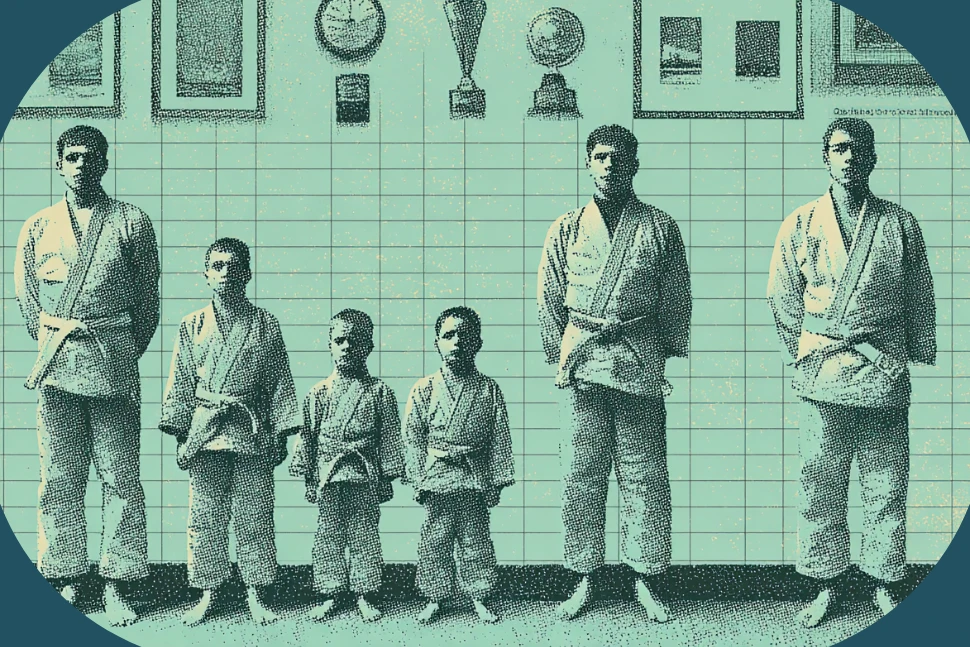
Well, let's take a look at two kids, John and Rick. They're both seven years old.
- John is 7, but he looks like a 5-year-old. He's small, skinny, and flexible. He's in the 35th percentile, so 65% of kids his age are bigger, stronger, and faster than John.
- Rick is 7, but he looks like a 10-year-old. He's in the 97th percentile for his age group. He's taller, bigger, stronger, and faster than almost every other kid in his age group.
- John is 7, looks 5, but he behaves like a 10-year-old. He's able to handle complex commands, listen well, and move well physically.
- Rick is 7, and he acts his age. He's a sweet kid who's focused on running, jumping, climbing, and playing with his friends. This is wonderful when it's time for physical activity; it's challenging when it's time to listen to instructions.
See the problem?
No two children develop at the same pace. As you'd probably expect, there are age ranges for all behaviors and milestones.
What about the adults?
- Robert is a 42-year-old software engineer; he's a programmer by day, bodybuilder by night. It's no surprise then that he looks like this:

- Robert is a physical specimen with really, really, bad knees. He's had several knee surgeries, and he's missing a small part of his LCL.
- Jeremy is 42 years old, and he's just made partner at his law firm. He's tough, driven, and decisive. Here's what he looks like physically.

- Jeremy used to run marathons in his 20s and 30s. Aside from the little extra he's carrying, he's strong and in good shape.
Can you see what's happening?
This is problematic because these comparisons make it difficult to answer the age question. This isn't about the relative age of each student. It's about their attention span, durability, and physical and emotional readiness.
Let's break this down:
- Attention span: Can kids stay focused, stay still long enough to receive instructions? Can they listen and follow those instructions? As an adult, are you willing to take responsibility for your learning and growth?
- Durability: In the absence of good coaching and supervision, a frail 120 lb. student training with a strong 250 lb. student is a recipe for disaster. A 120 lb. man who has a significant amount of muscle or experience playing sports (any kind) is much more durable than our first example.
- Physical and emotional readiness: Are you physically able to move your body in a way that's comfortable or natural? Do you have a disability or injury history that makes physical movement more difficult? Are you claustrophobic? Is there a history of physical or sexual abuse?
So, what now? Do we abandon age as a requirement altogether then?
Not at all.
We use age requirements as a guide, but we qualify these expectations for each age group. This approach gives students and parents the clarity they need to determine whether jiu jitsu is right for them.
Here's what that looks like.
What Every Parent Should Look for in a BJJ Program
Before we get into age-specific details, here's a universal checklist. These apply whether your child is three or 17.
If you're evaluating gyms, Gymdesk's trial class management makes it easy for schools to offer and track trial sessions—so look for programs that make it simple to book one.
Now let's look at what changes by age.
Early childhood (ages 3–5)
As a parent, you're probably wondering if this jiu jitsu thing is right for your 3–5 year old.
Some parents are uncomfortable with the idea of their little one getting into physical contact with other kids. Others are eager—they want their kids to be tough, strong, and prepared for the world.
Remember John and Rick? A kid like John—small but mature beyond his years—might thrive at this age. A kid like Rick—physically gifted but still focused on free play—might do better waiting a year or two.
What's different at this age:
- Instruction built for exceedingly short attention spans (one to three minutes)
- A curriculum that's primarily based on play—not technique drilling
- Private care stations stocked with supplies (wipes, pull-ups, nail clippers, band-aids) are a sign of a program that truly understands this age group
Kids in this age group are ready to participate if they're interested in socializing, enjoy group play, and can handle gentle physical contact. If kids are stressed in a group environment or aren't ready to separate from their parents, that's a signal it's better to wait.
Here's what that looks like:
Young kids (ages 6–8)
At this age, kids are looking for more independence. They're better with games that involve rules and structure. They're better equipped to handle winning, losing, and playing fair. They're better able to make friends and be a friend.
They're still pretty little, but they're much more capable and durable.
What's different at this age:
- Instruction built for short attention spans (around three minutes)
- A game-based curriculum that introduces techniques, rules, and structure
- Opportunities for kids to chime in, disagree, and share their feedback
Kids at this age are generally able to perform at a higher level. This is when jiu jitsu begins to look "technical."
- Kids can listen and follow directions. They've hit important developmental milestones and can follow multi-step instructions.
- They're ready to practice fundamental positions. Major positions like guard, mount, and side control are introduced through drills, games, and positional rounds.
- Play is treated as a cornerstone, not a reward. Movement, structured games, and play naturally build resilience and confidence while developing skills.
This age range is an important time period for kids who decide to train. If they're placed in the right environment—with age-appropriate class scheduling and instructors who understand developmental stages—they'll build a foundation that carries them through every belt.
Here's what that looks like:
Progressing Skills for Ages 9–12
Cognitive development accelerates for many kids at this age. Kids in this age bracket begin developing critical reasoning skills. They use deductive reasoning, understand cause-and-effect, and begin thinking hypothetically.
What's different at this age:
- Instruction built for longer attention spans (three to five minutes)
- A relationship-based curriculum that unifies and fosters teamwork and connection
- A structured environment that includes drilling, positional rounds, creativity drills, and open rounds
- Instructors who monitor student relationships and interactions carefully
- Work that challenges students mentally and physically
Ages 9–12 begin the transition to deep skill development.
- Safe live sparring. Carefully monitored and controlled positional rounds with strict supervision and safety protocols. Students are taught the difference between an intensity that's appropriate for training and one that's appropriate for competition.
- Developing technical knowledge. Kids learn advanced pin escapes and begin learning offensive systems. They learn to apply principles, set traps (dilemmas), and develop a strategy or plan of attack for competition.
- Emphasizing respect and discipline. Relationships play a more dominant role; students learn about the power their training gives them. There should be a greater focus on etiquette, perseverance, consistency, and self-control.
A kid like John—who behaves beyond his years—may be ready for this level of complexity earlier than his peers. That's why readiness matters more than the number on the birthday cake.
Here's what that looks like:
Transitioning Teens Into Advanced BJJ
Teen programs are the bridge between kids and adult classes.
Teens in this stage experience rapid physical growth and significant cognitive leaps—they develop abstract and future thinking, as well as increased physicality, speed, and power. They seek greater independence from parents, develop a strong peer and social focus, and work to establish their identity. They move from concrete to complex reasoning and gain a deeper understanding of consequences.
What's different at this age:
- A curriculum that expands into advanced techniques, rules, and structure
- Instructors who monitor student relationships and interactions carefully—social dynamics intensify at this age
- Work that challenges students mentally and physically while balancing their schedule (school, extracurriculars, events)
Teens ages 13–17: The bridge between kids' and adult classes.
- Physical conditioning. Students should be encouraged to regulate, control, and master their newfound strength. Their training should support their growth while protecting joints and growth plates.
- Intermediate technical complexity. Teens can grasp timing, strategy, and personalized game development. This technical complexity should prepare them for a transition into an adult curriculum without overwhelming them.
- Balanced schedules. Student training should be balanced to avoid overtraining. Instructors should be mindful of the training load their teen students carry—school, extracurriculars, and events (performances, games, recitals). They also need to manage their rest and recovery.
Starting BJJ as an Adult (30s, 40s, and Beyond)
Many practitioners start BJJ in their adult years.
Remember Robert and Jeremy? Robert looks like he was built for jiu jitsu—but his damaged knees tell a different story. Jeremy doesn't look the part—but his endurance, toughness, and competitive drive make him a natural. The point isn't what you look like. It's whether you're willing to show up and learn.
Eddie Cummings began training in BJJ at 26. He started at Stony Brook University before ending up at Renzo Gracie's gym, in the blue basement, with John Danaher. He earned his black belt in roughly five years and went on to revolutionize jiu jitsu and high-level competition through his innovations in leg locks.
Other notable late starters include:
- Tim Rennick: A World Champion who began BJJ at age 43, focusing on smart pressure.
- Jim Nations: Started in his 40s and became a Masters World Champion in his 60s, notes MMA Coach.
- Ram Ananda: Won Worlds at brown belt in 2014 at the age of 36.
- Felicia Oh: Started around 33–35 and achieved double gold at the Pans and a second place at ADCC as a brown belt.
- Kurt Osiander: Got his black belt at 37, indicating a later start to significant achievement.
- Anthony Bourdain: The famous chef started at 58 and trained consistently for roughly four years.
- Dave Mustaine: The Megadeth front man earned his jiu jitsu black belt at 63 years old—after beating throat cancer in 2019.
- Maynard James Keenan: The Tool front man started training in the mid-1990s and earned his black belt at 59. Decades of neck and back injuries and a demanding music career slowed his progression—but never stopped it.
- Elaine Wynn (the "Jiu-Jitsu Grandma"): Started at 69 and earned her purple belt at 74, training three to four times a week at Gracie Barra Alabama—despite having osteoporosis.
Well, those people are different! Are they really?
This grappler is a blind jiu jitsu world champion. Another grappler, who trains with Jocko Willink, is missing his arms and legs.
Why the focus on these people? What they have isn't talent—it's willingness.
If they can start training and achieve incredible results after getting a late start, so can you. The question isn't really about when you start. It's about the details I've mentioned above, and the culture of your gym.
How to train smart as an older beginner
Training harder or faster is not the answer.
Okay, what is?
- Choose a gym with the right culture. Look for one that prioritizes structure and growth. Some gyms have a kill-or-be-killed culture. Others have a culture of bullying or brawling. Look for a gym that clearly distinguishes between training and performance (competition).
- Adjust intensity and recovery. The harder you train, the more time you need for recovery. Take time for rest, electrolytes, food, and stretching after hard rounds.
- Choose partners and drills wisely. Some students are horrible training partners—whether it's intentional or accidental, they seem to hurt others consistently. They roll too hard, they're rough, and they're focused on winning.
Tips for finding the right gym
- Observe class structure for safety and engagement
- Verify instructor experience, especially when it comes to age-specific experience
- If you're a parent, look for age-appropriate teaching styles that match your child's development milestones
- Request a trial class to assess culture and teaching style
The Bottom Line
You're not too weak.
You're never too old. As we've seen, athletes in their 30s, 40s, 50s, 60s, and 70s start jiu jitsu and achieve incredible success. Jiu jitsu is for those who are willing to do the work—someone like you.
You've seen the evidence.
There's no recommended age for jiu-jitsu. It's never too early or too late to begin.
If you're a gym owner looking to build programs that serve every age group—from tiny grapplers to adult beginners—Gymdesk helps you organize age-specific classes, manage trial signups, and track student progress across every belt level. Start a free trial and see how it works for your school.
Gym management software that frees up your time and helps you grow.
Simplified billing, enrollment, student management, and marketing features that help you grow your gym or martial arts school.


FAQ
When to Start BJJ FAQs
.webp)
Andrew McDermott is a gym owner, Brazilian Jiu Jitsu brown belt, and digital marketer. He’s on a mission to build premier, high-stakes grappling tournaments, world-class academies, and a championship team of high-level athletes.