
Women's Brazilian Jiu-Jitsu: How to Start and Thrive on the Mats

Brazilian jiu-jitsu can look intimidating from the outside. It's a male-dominated sport where you grapple on the ground with partners who are often bigger and stronger than you.
But here's what gets lost in that first impression: this martial art was specifically designed for smaller, weaker people to defeat larger opponents through technique, leverage, and timing instead of brute force.
That design is exactly why women have become one of the sport's fastest-growing groups.
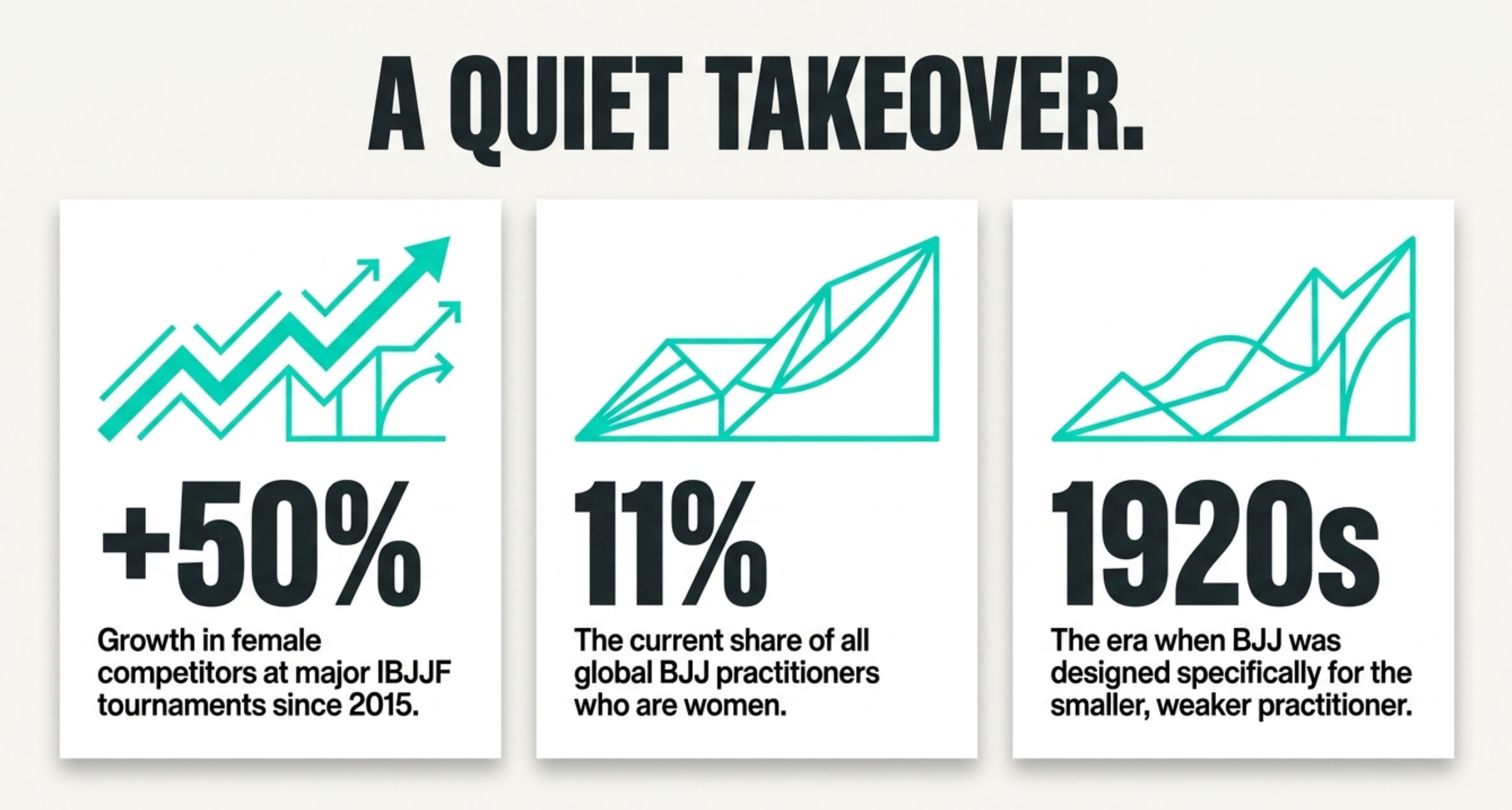
They now make up roughly 11% of all BJJ practitioners worldwide—though still just 4% of black belts—up from a near-absent presence a generation ago.
The institutional side has expanded to match: the IBJJF women's bracket grew from only two weight classes in 1998 to a full nine, rooster through super-heavyweight, by 2014.
What started as a men-only sport in the early 1900s now sees women competing at the highest levels, running academies, and building thriving communities everywhere.
This guide walks you through everything you need to start: why the sport suits women so well, how to find the right gym, the techniques that pay off fastest, and how to build the confidence to keep showing up.
Why Brazilian Jiu-Jitsu Suits Women So Well
Brazilian jiu-jitsu was built to let a smaller, technically skilled practitioner beat a larger, stronger one. When the Gracie family developed their system in Brazil in the 1920s, they proved repeatedly that proper technique beats size and strength.
That core principle is what makes it such a strong fit for women. Unlike striking arts such as muay thai or boxing, where physical power plays a major role, jiu-jitsu rewards leverage, timing, and precise execution.
A 120-pound woman who understands hip movement and body mechanics can finish a triangle choke on a 200-pound training partner—not in theory, but routinely, in any gym.
The ground-fighting focus also makes the skills directly relevant to self-defense. Most real-world attacks on women involve some form of grabbing, holding, or pinning.
BJJ teaches you not just how to escape those positions, but how to stay calm and think clearly when someone is trying to control your body. (For how it stacks up against other styles, see our breakdown of the best martial arts for women.)
There's a mental draw, too. Each position is a chess-like puzzle where the answer is technique, not explosive power—which may be exactly what hooks you if you want the intellectual challenge alongside the workout.
Physical and Mental Benefits of BJJ for Women
The benefits of Brazilian Jiu-Jitsu go well past self-defense. The training transforms both body and mindset in ways a standard gym routine rarely touches.
Strength and conditioning gains
BJJ builds functional strength through movements you won't find anywhere else. A typical hour-long class combines dynamic warm-ups, technique drilling, and 15 to 20 minutes of live sparring that taxes every muscle group at once.
Where the gains come from:
- Core strength: holding a closed guard and drilling hip escapes demands constant engagement of the deep stabilizing muscles.
- Conditioning: five- and six-minute rounds push your heart rate to anaerobic levels while you stay calm under pressure.
- Upper body: constant gripping, pulling, and controlling builds grip strength and shoulder stability—you'll likely notice it within six months.
- Flexibility: guard work and submissions take your hips, shoulders, and spine through full ranges of motion, often with no dedicated stretching routine.
The functional nature of all of it carries straight over into everyday life.
Self-defense and confidence
The self-defense payoff goes beyond techniques. It changes how you move through the world.
Training regularly with larger, stronger partners teaches you that size and strength differences, while real, are not insurmountable when you understand leverage. Learning to stay composed while pinned under a 200-pound partner translates directly into confidence in genuinely dangerous situations.
The ability to escape mount or side control maps onto the most common forms of physical assault against women—being held down and controlled. Those are skills you can rely on, because you've already tested them against full resistance.
BJJ also builds assertiveness through constant boundary-setting. You learn to tell a partner clearly when to ease off, where to start, and what you're comfortable with—directness you'll carry into work and relationships long after you leave the mats.
Mental resilience and problem-solving
The mental side surprises most beginners. The sport forces you to think strategically under real physical and psychological pressure, and getting submitted over and over teaches you to treat failure as data, not defeat.
Stress management transfers directly to daily life. Learning to breathe and hold your composure while someone is working a choke is exactly the skill you need for a tense meeting or a family conflict.
The toughness builds gradually. You start with basic positions and add complexity as you go, so confidence and competence grow together.
Unique Challenges Women Face in BJJ
The benefits are real, but so are the obstacles—and most of them are ones male students rarely run into. Knowing what's coming makes them far easier to handle.
Navigating male-dominated training environments
Most gyms run female participation somewhere in the 10 to 20% range, so you'll often train as the minority in a given class. That reality creates social dynamics that take some navigation.
Finding the right training partners is one of the bigger early challenges.
You want partners who roll at a useful intensity—not so light that you never learn to handle resistance, not so hard that you get hurt. Some misjudge that in either direction, which is where clear communication matters.
So state your preferences out loud: where to start a position, which submissions are fair game, how much pressure feels right. Building relationships with other women helps enormously here—senior female students can point you toward good partners and techniques that work for smaller frames.
Inappropriate behavior isn't universal, but it does happen in some gyms, from unwanted comments to contact that crosses a line.
Knowing how to raise it with an instructor—and being willing to change gyms if the culture doesn't fix it—is part of protecting your own training.
FOR GYM OWNERS:
The culture that retains women isn't an accident. Clear conduct policies, visible female students and instructors, and partners who match intensity appropriately are what turn a first-timer into a long-term member. We break down how to build that into a growth engine in women's jiu-jitsu classes as a growth flywheel.
Overcoming strength and size disadvantages
Size and strength gaps are an ongoing reality. You'll often train with men who outweigh you by 50 to 100 pounds. The fix is strategic, not muscular.
How smaller grapplers close the gap:
- Adapt techniques for a smaller frame: standard grips may not fit smaller hands, so you'll modify collar ties, sleeve grips, and submission holds, and lean harder on angles and leverage points than a bigger practitioner would.
- Sharpen timing and precision: where a stronger person can muscle through a sloppy technique, you'll need cleaner execution to get the same result—which, over time, makes you a more technical grappler than partners who rely on strength.
- Borrow your opponent's momentum: hip tosses, sacrifice throws, and certain sweeps let you use physics instead of supplying strength.
- Build a bottom game: getting comfortable on the bottom—where you'll spend more time than your heavier partners—is what eventually makes it your strongest asset.
Essential Techniques and Positions for Women
Some techniques pay off faster for female practitioners than others. These high-percentage options hold up regardless of size or strength gaps.
Guard game mastery
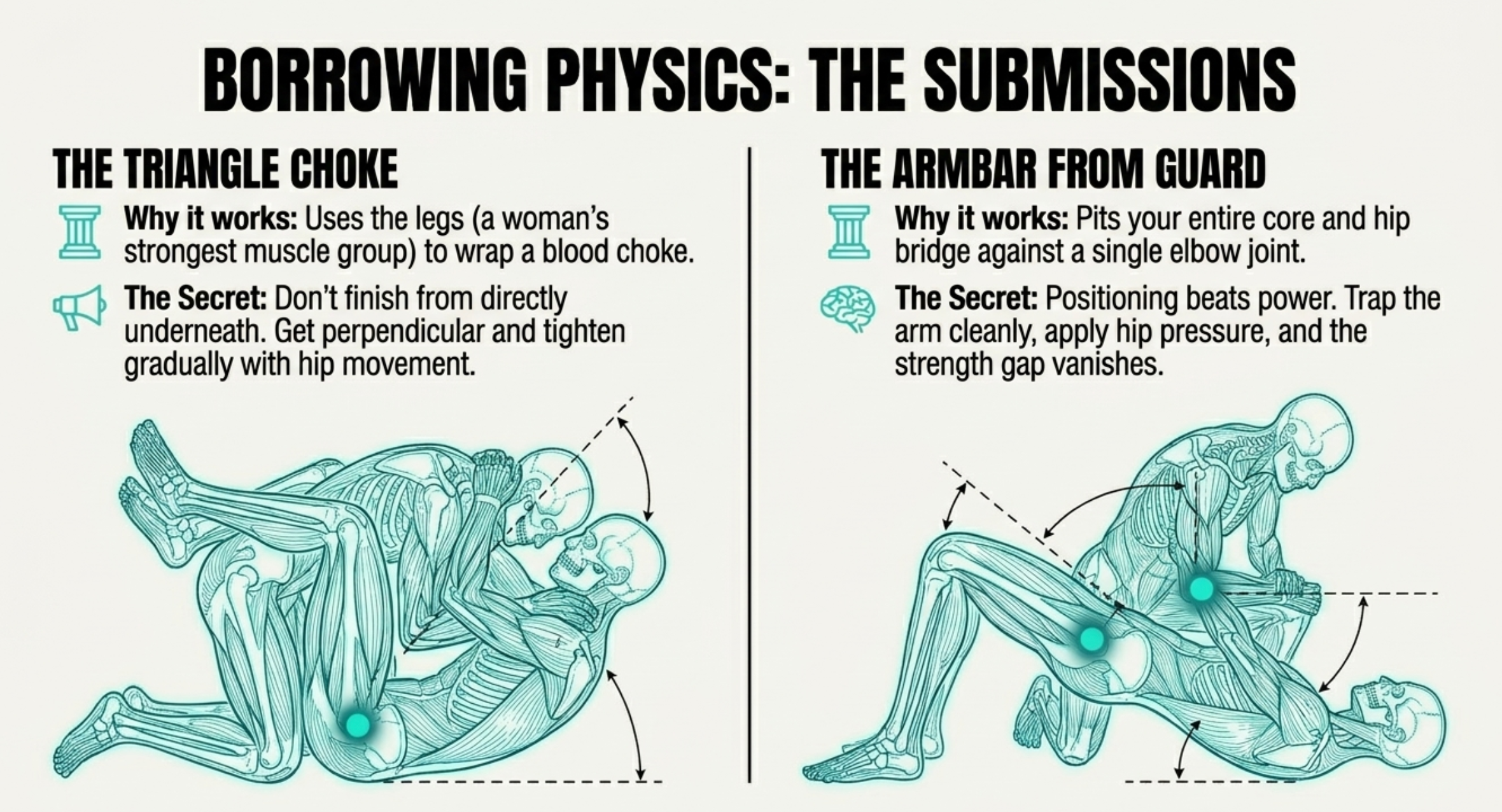
The guard—where you're on your back with your legs controlling your opponent—is one of BJJ's great equalizers. You'll often develop a strong guard precisely because you spend so much time in bottom positions.
- Closed guard: the cornerstone. Break your opponent's posture with your legs and core rather than your arms, then use hip movement to control distance and angles.
- Triangle choke: arguably the highest-value submission for women. It uses the legs—usually a woman's strongest muscle group—to wrap a blood choke around the neck and one arm. Most beginners try to finish from directly underneath; the trick is getting perpendicular and tightening it gradually with hip movement.
- Armbar from guard: hip movement and leverage against the elbow joint, so positioning beats power. Trap the arm cleanly, apply hip pressure, and the strength gap stops mattering.
- Scissor and flower sweeps: leg drive and timing to off-balance a heavier opponent and get on top—a clean demonstration of technique overcoming size.
Escape fundamentals and defensive concepts
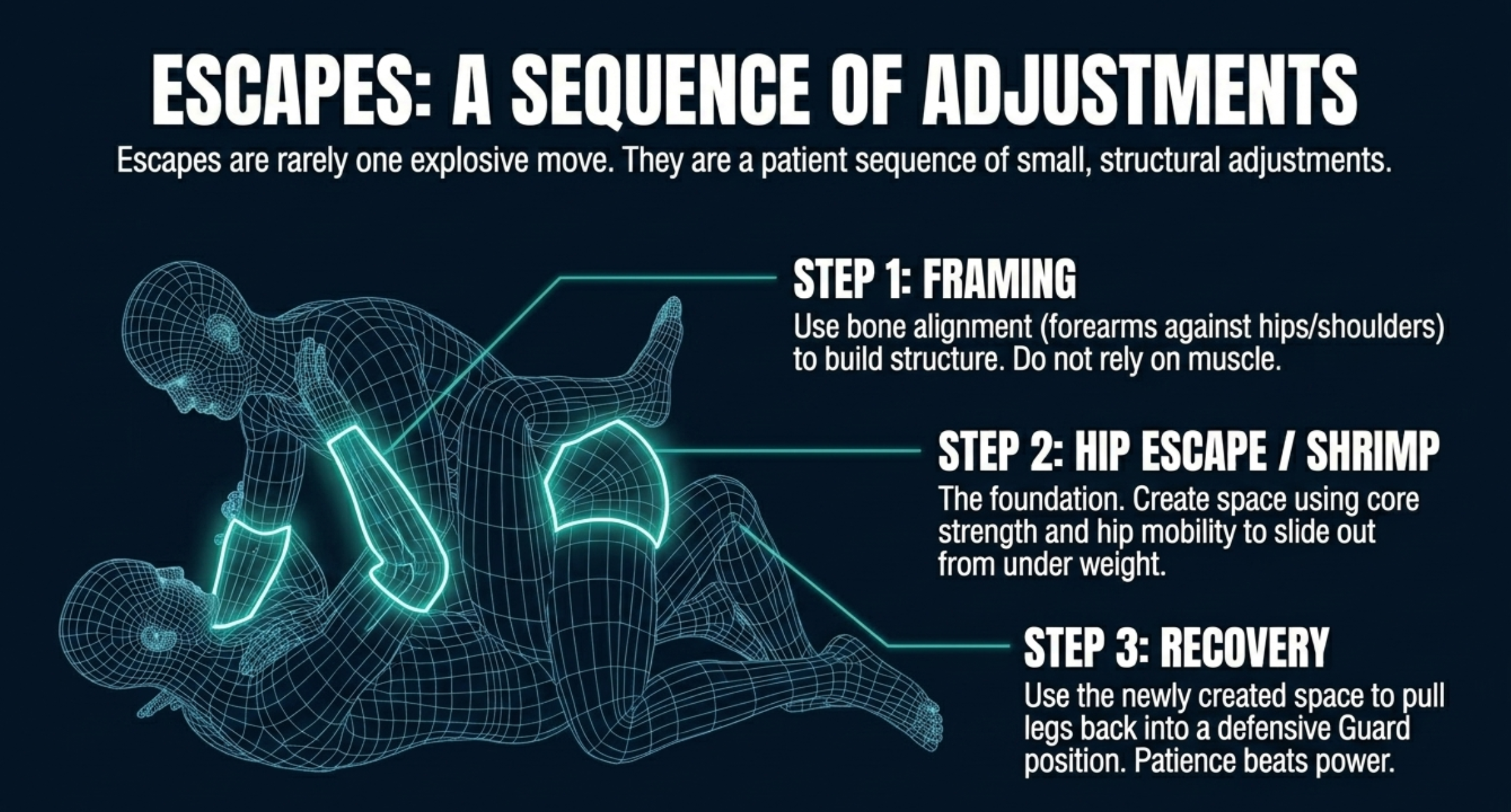
Escapes may be the single most important skill set for women in BJJ, because you'll find yourself on the bottom often—in both training and any real self-defense scenario.
- Hip escape (shrimp): the foundation of nearly every escape. It creates space using core strength and hip mobility. Master its variations and the rest of your defense gets easier.
- Framing: use your forearms against your opponent's hips, shoulders, or neck to hold them off while you create space. Good frames use bone alignment for structure, so you're not relying on muscle.
- Mount escapes: the elbow-knee escape makes space with hip movement and framing; the bridge-and-roll uses an explosive hip drive to unbalance the person on top. Both work regardless of strength.
- Side-control escapes: the toughest, because the position lets opponents use their weight. Frame and move your hips patiently to recover guard rather than powering out.
The mindset matters as much as the mechanics. Escapes are rarely one big move—they're a sequence of small adjustments, and staying patient through that sequence beats trying to explode out with strength.
How to Find the Right BJJ Gym
The gym you choose can be the difference between a transformative experience and one that pushes you away in a month. Women have specific things to weigh beyond location and schedule.
What to look for in a women-friendly school
Culture is the biggest factor. A genuinely inclusive gym puts respect, safety, and learning first for every student, regardless of gender or size. Here's what that looks like in practice:
- Clear, enforced conduct policies: written guidelines on physical contact, language, and behavior that apply to everyone. Ask about them on your first visit and watch whether they're actually upheld.
- Female instructors or senior students: a strong sign of mentorship and proof that women thrive there. Their absence isn't automatically a red flag—some good gyms just haven't drawn many women yet.
- Women's-only classes or times: a great on-ramp for beginners. The best setups offer these and mixed classes, since mixed training builds realistic skills.
- Respectful rolling: during a trial class, watch how male students roll with female partners. Matched intensity and clean technique are good; excessive force or aggression aimed at women is a reason to keep looking.
Visit more than one gym before deciding. For most recreational practitioners, the fit between your personality and the gym's culture matters more than affiliations or competition trophies.
FOR GYM OWNERS:
Every item on that checklist is also a retention lever. A visible code of conduct, a women's-only intro class, and instructors who can coach for smaller frames are the difference between a trial that converts and one that ghosts. Software that tracks trial-to-member conversion by program (like Gymdesk's tools for martial arts schools) tells you whether your women's program is actually working.
Prepare for your first class
A little prep makes a big difference in whether you come back. Knowing what to expect lets you focus on learning instead of nerves.
- What to wear: fitted athletic clothing that won't ride up or gap during grappling, hair tied back securely, and no jewelry. Many gyms loan or include a gi for your first class—if you're buying your own, our BJJ gi guide covers fit and sizing.
- Expect close contact. Body weight, pressure, and contact with sweat are normal parts of rolling, and they stop feeling strange within a few sessions.
- Vulnerable positions: mount, side control, and back control can trigger an anxiety response, especially for anyone who's experienced trauma. Tell your instructor about any concerns up front, and remember you can always tap or take a break.
- Mat etiquette: trim your nails short, show up clean, keep shoes off the mat, and flag any injuries before class.
Most beginner classes follow the same arc—warm-up, technique drilling with a partner, then light positional sparring. Don't try to remember everything from day one; the learning curve is steep for everyone.
Women's BJJ Competition and Belt Progression
Competition isn't mandatory, but it's one of the fastest ways to accelerate your learning, build confidence, and connect with the wider community.
Competition opportunities for female grapplers
The IBJJF now runs full women's divisions across every belt level and weight class, from white belt through black belt. Local and regional tournaments are the ideal starting point for a first competition.
Divisions are structured by both belt and weight for fair matchups.
The IBJJF added rooster and super-heavyweight divisions to the women's bracket in 2014, so women across the full range of body types now have a place to compete.
A first competition is often transformative even when the result isn't. It exposes the gaps in your game, shows you which techniques hold up under pressure, and builds real confidence. The camaraderie among female competitors tends to create lasting friendships.
No-gi events and submission-only formats offer a different rule set you may prefer, often rewarding finishes over points.
Local tournaments usually have the most supportive atmosphere for a debut—smaller divisions, lower stakes, friendlier crowds.
Belt progression and setting goals
Belt advancement runs white through black, with rough time and skill expectations at each level. (For the formal standards, see the IBJJF belt requirements and our overview of the BJJ belt system.)
- Blue belt: one to two years of consistent training for most practitioners—solid fundamentals and basic strategy while rolling.
- Purple belt: another two to three years, signaling genuine intermediate skill.
- Brown and black: years more of dedicated work.
The history is worth knowing. Yvone Duarte became the first woman to earn a BJJ black belt in 1990, promoted by Master Osvaldo Alves; today thousands of women hold advanced belts, and Duarte herself reached coral belt.
Set short-term goals between promotions—master one technique, fix a weak position, sharpen one escape. Timelines vary widely with training frequency, athletic background, and aptitude, so measure yourself against your own last month, not the person next to you.
Building a Supportive Women's BJJ Community
Connecting with other female practitioners makes the whole journey easier and helps you navigate the challenges specific to women in the sport.
Local women's BJJ groups organize training sessions, seminars, and social events—a chance to train with other women, swap experiences, and learn from people a few steps ahead of you.
Women's camps and seminars led by elite competitors like Mackenzie Dern and Michelle Nicolini combine high-level instruction with real inspiration.
Online communities fill the gaps between events, connecting women across cities to share techniques and celebrate promotions.
Mentoring newer students creates a positive cycle that grows the whole community. Experienced practitioners who welcome beginners and offer encouragement are a big reason more women stick with the sport through the hard early months.
FOR GYM OWNERS:
That community effect is also your most durable retention tool. A handful of connected female members recruit their friends, show up consistently, and anchor the culture. Seeding a women's group—even informally—pays off in word-of-mouth growth that no ad spend matches.
Your First Step Onto the Mats
Women's Brazilian jiu-jitsu has gone from a near-absent presence to a thriving community of practitioners, competitors, and instructors reshaping the sport. The barriers that once kept women off the mats have largely dissolved.
The journey won't always be easy. You'll get frustrated with technique, navigate awkward social dynamics, and push through physical and mental walls. But the payoff—real skills, hard-earned confidence, and a community that has your back—is exactly why those who stick with it rarely look back.
It starts with a single decision to try one class. Find a gym with a welcoming culture, show up consistently, and stay open to what the art teaches you on and off the mats.
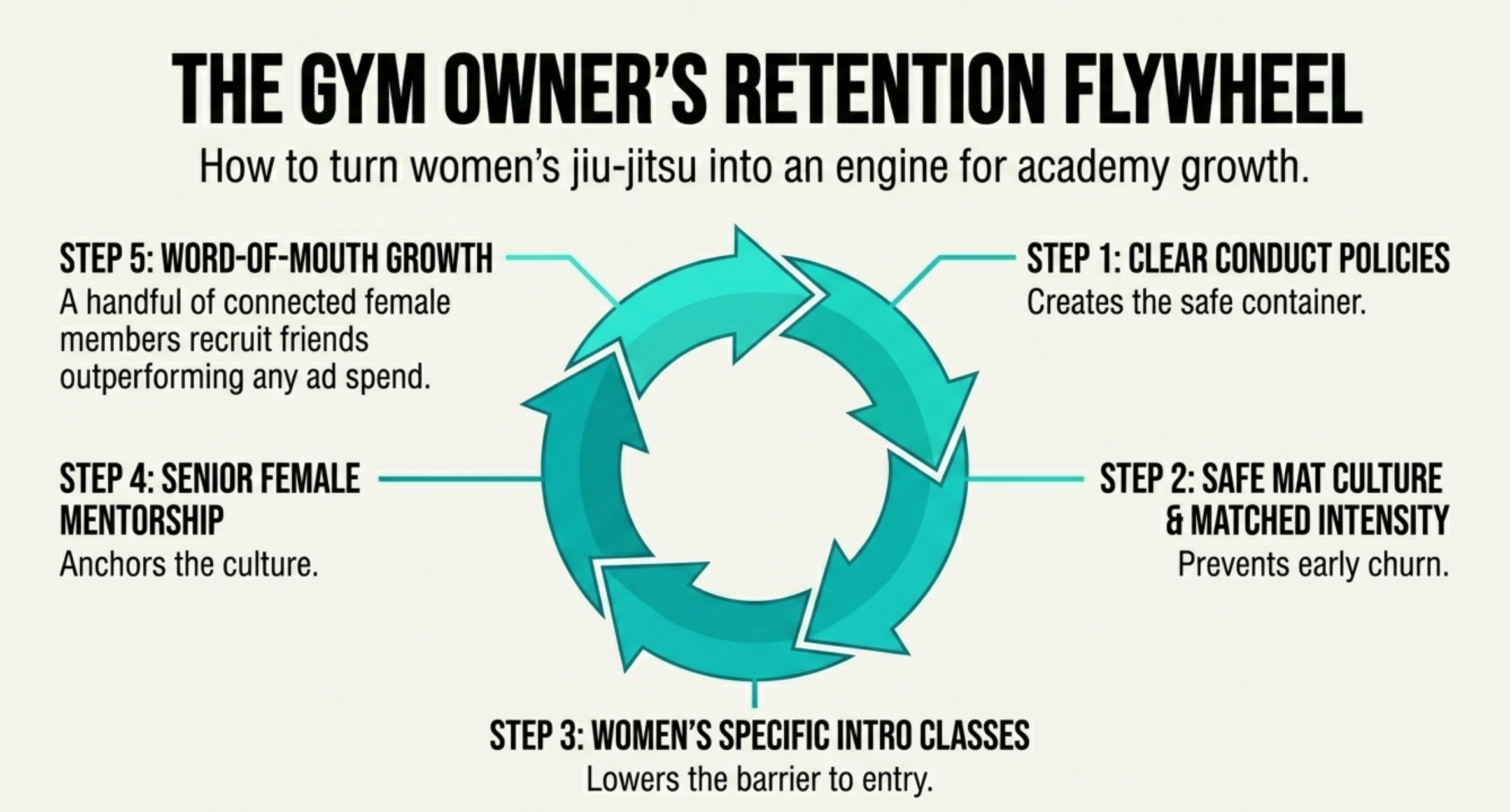
If you run a gym and want more women walking through your door—and staying—start with women's jiu-jitsu classes as a growth flywheel.
Gym management software that frees up your time and helps you grow.
Simplified billing, enrollment, student management, and marketing features that help you grow your gym or martial arts school.


FAQ
Women's BJJ FAQs

Josh is a martial arts educator and coach who bridges live training on the mats with evidence-based teaching. A 4th degree Taekwondo black belt and dedicated Brazilian Jiu-Jitsu practitioner, he’s spent years running classes, mentoring students, and helping instructors move beyond rote drills to training that actually works under pressure.
He holds a Master of Education in Teaching & Learning from Liberty University and runs Combat Learning, where he breaks down ecological dynamics, constraints-led coaching, and games-based training for combat sports. Through his writing and podcast work with Gymdesk, Josh turns coaching science and gym-owner stories into practical ideas you can use to run better classes and build a stronger martial arts school.