

Personal training is usually the highest-margin thing a gym sells. One trainer, one client, an hour of time, and a price point several times your monthly membership.
So why do so many gyms run it as an afterthought?
Usually, because the business side never got built. The sessions happen, but the pricing is a guess. The pay split got decided in a hallway between classes. And nobody's sure the program nets anything after the trainer gets paid.
This guide is about fixing that. Not how to be a trainer. How to run trainers as a profitable part of your gym.
Three decisions do most of the work: how you price and package sessions, how you pay your trainers, and how you schedule and track it all. Pricing first.
Is a Personal Training Program Worth It for Your Gym?
Short answer: almost always, if you structure it.
Group memberships are a volume game with thin margins. Personal training flips that. Fewer clients, much higher revenue per client, and a service members genuinely stick around for.
A member working one-on-one with a coach is one of the lowest-churn relationships in your building.
The catch is that PT only prints money when the split between price and pay actually leaves something for the gym. Run it casually, and you can end up paying out most of the revenue while carrying all the overhead. The floor space, the insurance, the booking headaches, all of it, for a sliver of margin.
The rest of this guide is about not doing that.
Pricing and Packaging Personal Training Sessions
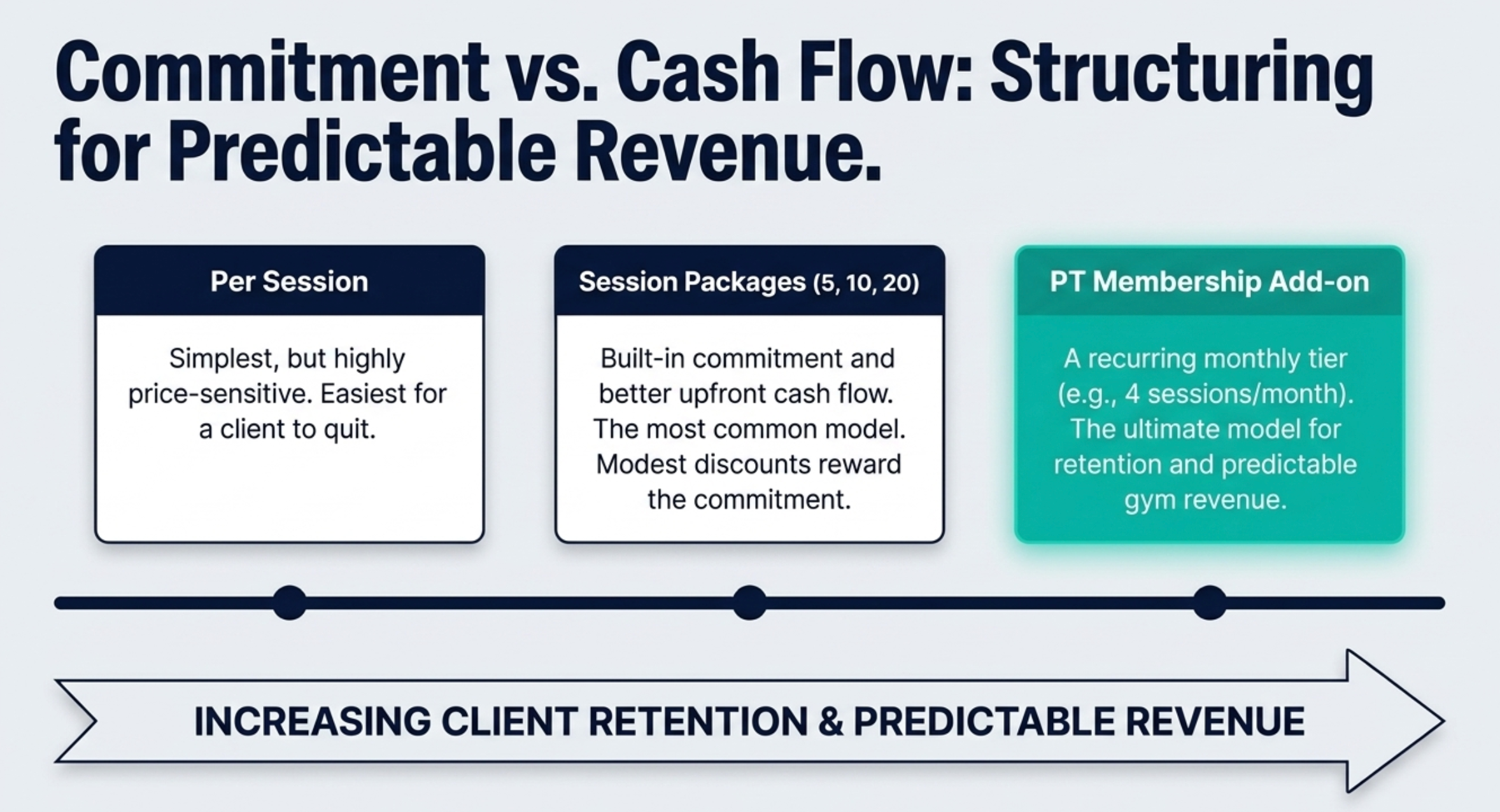
Before you pay anyone, you need a price. "What the gym down the street charges" isn't it.
There are three common ways to sell it:
- Per session. Simplest, but the most price-sensitive and the easiest for a client to quit.
- Session packages (5, 10, 20 sessions). Better cash flow up front and a built-in commitment. The most common model for a reason.
- PT membership add-on. A recurring monthly tier (e.g., four sessions/month) layered onto a regular membership. Best for retention and predictable revenue.
Single-session rates commonly land somewhere in the $40–$100+ range, depending on your market, your trainers' credentials, and whether it's one-on-one or small-group.
Packages usually carry a modest per-session discount to reward the commitment. In practice, a semi-private format (2–4 clients) can lower the per-head price while raising the trainer's hourly revenue.
The number you actually want isn't the sticker price. It's the price that covers the trainer's pay, your overhead, and a real margin. That's a quick calculation, and we built a tool for it.
Try it: the Personal Training Rate Calculator takes your costs and target margin and tells you what to charge per session, so your pricing starts from your economics instead of a guess.
Once your price is set, the next decision is the one most owners get wrong: how the trainer gets paid out of it.
Pay Models: Commission, Hourly, Salary, or Hybrid
The right pay structure is the one that fits how your trainers work and keeps the program profitable. There are four you'll choose between.
Model | How it works | Typical range | Best when |
Commission / revenue split | Trainer earns a % of each session's revenue | Often 40–60% to the trainer at commercial gyms; higher at boutique/independent | Trainers bring or build their own client base |
Hourly wage | Flat hourly rate for session time (sometimes plus floor hours) | Set to your local market | You want predictable labor cost and more control |
Salary | Fixed salary for a set session load + duties | Varies widely | A senior or full-time head trainer |
Hybrid / tiered | Base hourly or low split that climbs as the trainer hits volume tiers | Blended | You want to reward growth without overpaying early |
A few principles that hold across all of them:
Tie the split to who owns the client. If the gym generates the lead, markets the program, and books the session, a larger gym share is fair. If the trainer brings the client, they should earn more. Mismatched splits are the number-one source of trainer resentment, and trainer turnover.
Make the math survive a full room. A split that works when a trainer does five sessions a week can quietly erode your margin at thirty. Model your pay structure at full utilization before you commit to it, not just at launch.
Pay accurately and on time. Nothing torches trust faster than a payout that's late or wrong. When session counts, package redemptions, and splits are tracked automatically, payroll stops being a monthly argument. (More on that below. See gym payroll management.)
Employee vs contractor: the decision underneath the pay model
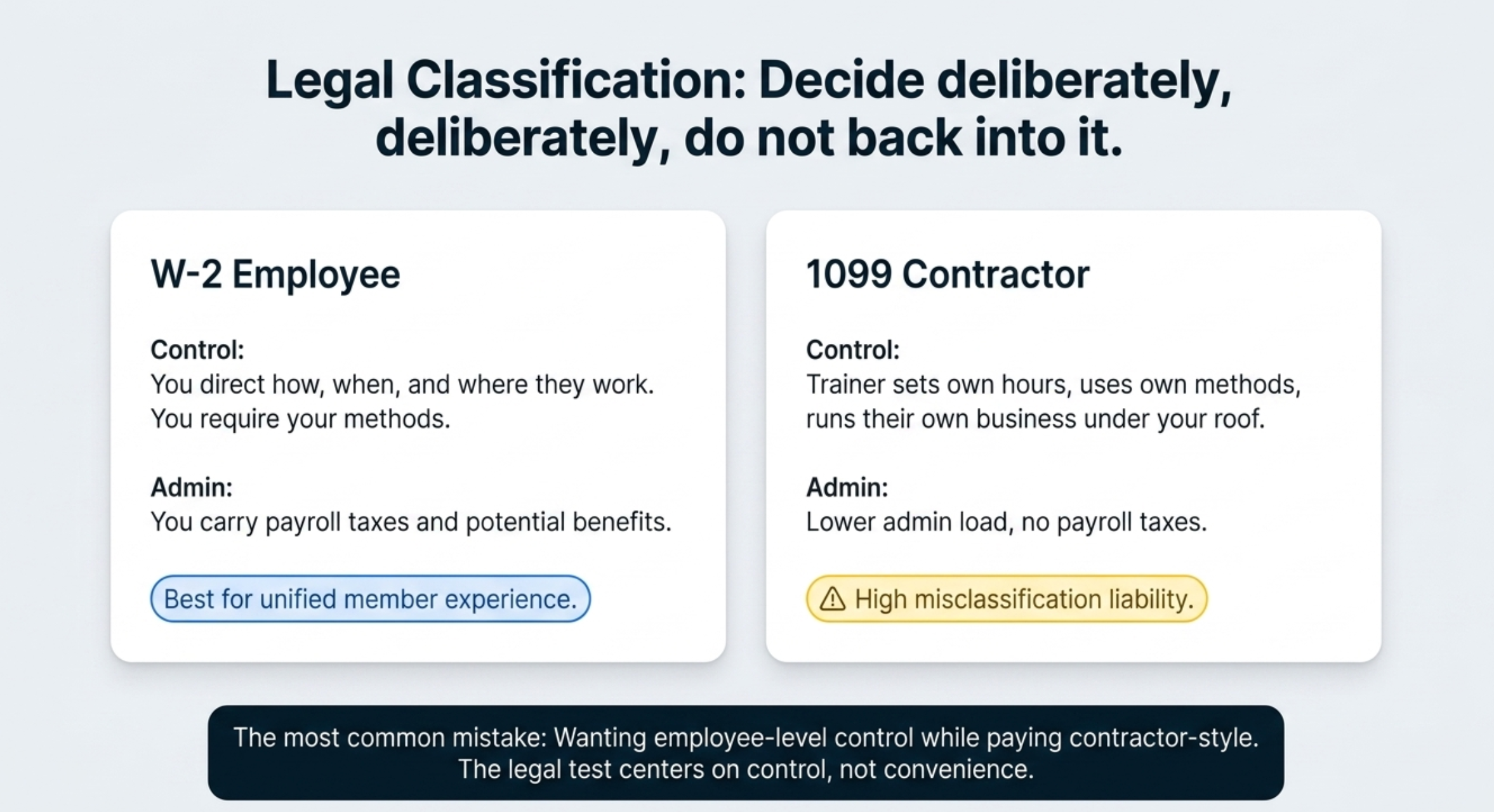
How you pay is tangled up with what your trainers are. W-2 employees or 1099 independent contractors, and this is the part owners most often get wrong.
The rough trade-off:
- Employee (W-2). You can direct how, when, and where they work, set schedules, require your methods, and build a consistent member experience. You also carry payroll taxes, and potentially benefits.
- Independent contractor (1099). Lower administrative load and no payroll taxes, but in exchange you give up control. A genuine contractor sets their own hours, uses their own methods, and isn't yours to schedule at will.
The mistake is wanting employee-level control while paying contractor-style: classifying a trainer as 1099 but treating them like staff. Misclassification is a real liability. In the US, the test generally centers on control, not what's convenient on payday.
NOT LEGAL OR TAX ADVICE:
Worker classification rules vary by country and state and change over time. Confirm your setup with an accountant or employment attorney before you lock it in.
If your program depends on a consistent method, set schedules, and a unified member experience, you're usually describing employees.
If your trainers are truly running their own businesses under your roof, contractor may fit. Decide deliberately. Don't back into it.
Scheduling and Booking Personal Training
A pay model only works if the sessions actually run cleanly. And PT scheduling is messier than class scheduling because it's one-to-one, often recurring, and threaded between group classes on the same floor.
The friction points are predictable:
- Double-booked trainers
- Clients who no-show without a card on file
- Packages where nobody's quite sure how many sessions are left
- A booking process that runs through text messages
Letting clients self-book open slots, requiring a card to reserve, and auto-decrementing a package on each booking removes the three biggest leaks at once.
HOW GYMDESK HELPS:
Session booking and scheduling lets members book PT slots themselves around your class calendar, with paid bookings and package tracking built in—so a trainer's time fills up without a single back-and-forth text, and every redeemed session is logged for payout.
Tracking Revenue, Payouts, and Retention
Once PT is running, two numbers tell you whether it's working: what the program nets after trainer pay, and how long PT clients stay.
You can't manage either from memory. Track PT revenue separately from membership so you can see the program's real contribution, and make payouts off the system's session record rather than a trainer's notebook.
Accurate, automatic payouts are how you keep good trainers from leaving over money.
HOW GYMDESK HELPS:
Integrated payments tie each booking and package to a charge, so PT revenue and trainer payouts reconcile automatically instead of in a spreadsheet at month's end.
When a trainer leaves
That brings up the risk every owner worries about: a trainer leaves and tries to take their clients.
You won't eliminate it, but you blunt it with structure. Clear client-ownership terms in your trainer agreement, gym-owned booking and billing relationships (not the trainer's personal Venmo), and a member experience tied to your brand and facility, not one person.
When the gym owns the system, a departing trainer leaves with their skills, not your roster.
Turn Personal Training Into a Profit Center
A personal training program becomes a profit center when three decisions line up.
You price from your economics, not the gym next door. You pay with a model that survives a full schedule and matches who owns the client. And you run it on a system that books, charges, and reconciles without manual chasing.
Get those right and PT stops being the thing that "sort of happens" at your gym. It becomes one of the most profitable, lowest-churn services you offer.
Once the program is profitable and stable, the lever to pull is volume: keep trainers' calendars full. That's a marketing job. Start by growing a PT email list and increasing personal training income from the clients you already have.
If you're staffing the program in the first place, our guide on hiring gym staff covers the recruiting side. This guide is what to do once they're on the floor.
Gym management software that frees up your time and helps you grow.
Simplified billing, enrollment, student management, and marketing features that help you grow your gym or martial arts school.


FAQ
Personal Training Pay FAQs
The questions gym owners ask most often when they turn personal training into a real part of the business.

Sean has spent the last decade creating content that helps businesses—small and not so small—grow smarter to allow operators to do more of what they love. You know, the fun stuff.
From shipping and international logistics to web development and marketing, he's done the work (not just the words) to scale retail and service businesses efficiently.
You can find his work at Sendle, Shogun, The Retail Exec, Gymdesk, and more.