
How Long Does It Take to Master Brazilian Jiu-Jitsu?

If you've ever watched someone calmly control a much larger opponent using nothing but leverage and timing, you've probably wondered: how long does it take to master Brazilian Jiu-Jitsu?
It's the question every beginner asks, and the answer isn't as simple as a single number.
Brazilian Jiu-Jitsu is a martial art that rewards patience. Unlike some traditional martial arts where black belts can arrive in three to five years, BJJ operates on a different timeline entirely.
The journey is longer, the standards are higher, and the path is filled with more frustration—and more reward—than most people expect.
This guide breaks down exactly what you can expect at each stage of your BJJ journey, from your first awkward class to the day someone wraps a black belt around your waist.
More importantly, it will help you understand what "mastery" actually means in this combat sport and set realistic expectations for your own training.
Quick Answer: How Many Years to "Master" BJJ?
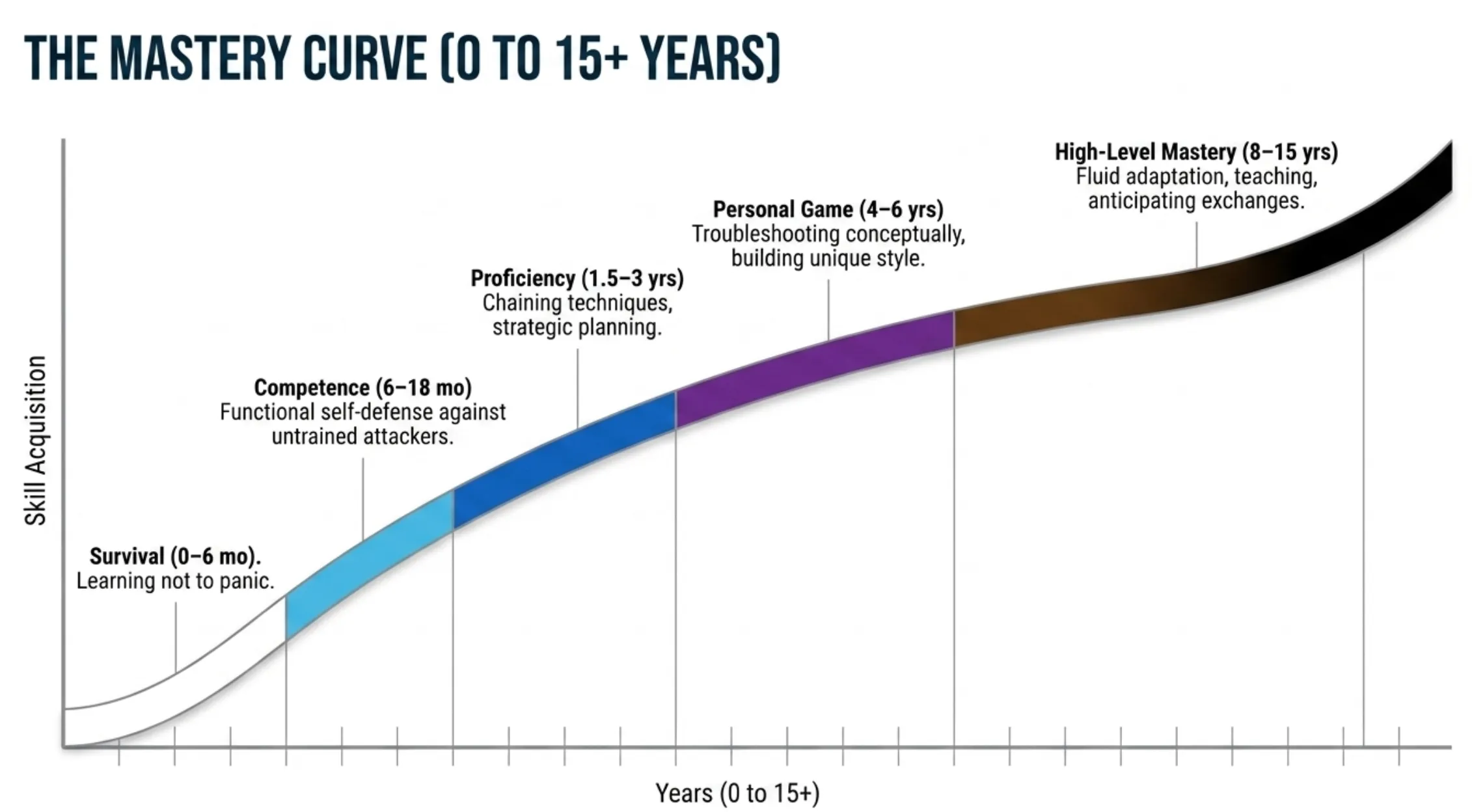
Here's the direct answer: most practitioners who train consistently reach black belt level in approximately 8 to 15 years.
The commonly cited benchmark is around 10 years of regular training at 2-4 sessions per week.
However, meaningful competence arrives much earlier—many students feel confident handling an untrained person within 6 to 18 months.
The confusion around "mastery" comes from conflating different levels of skill. Here's how the progression typically breaks down:
- 0–1 year: Survival mode—learning not to panic and recognizing basic positions
- 1–3 years: Proficiency—escaping bad positions, executing basic submissions, handling untrained opponents
- 8–15+ years: Black belt mastery—adaptable, strategic thinking, ability to teach and adapt
Brazilian Jiu-Jitsu takes longer than most martial arts for a reason. Every technique must work against a fully resisting opponent. There's no choreography, no compliant partners, and no shortcuts.
That's why a BJJ black belt carries serious weight in the martial arts world.
What Does "Mastering Brazilian Jiu-Jitsu" Actually Mean?
The word "master" gets thrown around loosely, but in BJJ it means different things to different people.
For some, mastery means developing basic self defense skills that work in a real confrontation. For others, it means competing at the highest levels. And for purists, it means decades of refinement culminating in coral or red belt ranks that require 40+ years beyond black belt.
True mastery goes far beyond belt color. It includes:
- A deeper understanding of timing, leverage, and weight distribution
- The ability to adapt your game mid-roll based on what your opponent gives you
- Smooth transitions between positions that feel almost effortless
- Enough conceptual knowledge to teach and troubleshoot problems for newer students
Your personal goals shape what mastery means for you.
A hobbyist training for fitness and self defense might consider reaching blue or purple belt level a major achievement—and rightfully so. A competitive athlete might not feel satisfied until they've medaled at worlds. Neither definition is wrong.
Even experienced instructors with 20+ years on the mats typically describe themselves as students, not finished products.
The art evolves constantly—new guard systems, leg lock innovations, and rule changes mean that what counts as cutting-edge technique shifts every few years.
Most practitioners who achieve what looks like mastery will tell you they're still learning something new every week.
Phases of the BJJ Journey: From Day One to Black Belt
Learning BJJ happens in distinct phases that loosely correspond with belt ranks.
But focusing purely on belt color misses the point. The real progression is measured in skills: what you can do, how you move, and how you think on the mats.
The timelines below assume you're training 2-4 sessions per week, which is the sweet spot for most adult practitioners balancing work, family, and recovery. Your mileage will vary based on age, athletic background, and the quality of instruction at your BJJ academy.
What matters most is understanding that every phase brings noticeable improvements.
You don't need to wait for black belt to feel like you've accomplished something meaningful. Each stage has its own rewards.
Phase 1: Survival (0–6 months)
The beginner phase hits like a cold shower. Nothing makes sense. Larger training partners pin you effortlessly. You gas out in two minutes. This is completely normal.
During this phase, you're at white belt level learning how not to panic and how not to get hurt.
The key skills include:
- Recognizing major positions: mount, guard, side control, back control
- Fundamental movements like shrimping, bridging, and technical stand-up
- How to tap early and tap often—protecting yourself from injury
- Basic defensive positions that buy you time
By month three to six, most students can escape basic pins from partners of similar size.
You won't be winning rounds, but you'll survive longer. Progress here is measured in staying calmer, breathing better, and getting submitted less brutally.
Feeling completely lost is part of the process. If you stick through this phase, you'll emerge with body awareness and movement patterns that become second nature over time.
Phase 2: Defensive competence (6–18 months)
This phase spans late white belt into early blue belt territory.
The panic subsides, and you start seeing the game for what it is. You're building a solid foundation in escapes and defensive positions.
By training 2-3 times per week for 6-12 months, most students can handle an untrained person in a grappling exchange. That's a significant milestone.
You'll develop:
- Reliable frames that create space when pinned
- Hip movement that makes escaping mount and side control possible
- Basic guard retention—keeping opponents from passing freely
- Awareness of common submission setups and how to avoid them
You'll still tap frequently to higher belts, but now you understand why you got caught. That mental shift is huge.
Instead of flailing randomly, you'll see the pathway from mistake to submission and start plugging holes in your game.
Many people develop basic self-defense confidence around the one-year mark. You won't be a killer, but you'll no longer feel helpless on the ground.
Phase 3: Proficiency and flow (1.5–3 years)
This phase typically aligns with blue belt level for consistent students—usually somewhere between 18 and 36 months of training.
Rolling starts to feel genuinely fun instead of purely desperate.
The shift here is from reacting to planning. You'll begin to chain techniques together in sequences: pass to side control, transition to mount, threaten the armbar, take the back when they defend.
Your sparring sessions become strategic puzzles rather than survival exercises.
Common developments include:
- Setting traps and baiting reactions
- Experimenting with different guards and passing styles
- Entering local competitions with reasonable confidence
- Rolling comfortably with a wide range of body types and skill levels
This is also where many people quit. The initial rapid improvement slows, and without clear goals, motivation can fade. BJJ practitioners who push through the "blue belt blues" often discover a renewed passion once they reach purple.
Phase 4: Personal game development (4–6 years)
This is the longest phase in jiu-jitsu mastery, and it honestly starts long before you get to 4 years.
Purple belt level typically arrives after 4-6 years of consistent training. This is where you stop copying everyone else and start building your own game.
Your body type, personality, and preferences shape your style.
Maybe you gravitate toward spider guard and sweeps. Maybe you prefer heavy top pressure and smashing passes.
The techniques you choose become extensions of how you naturally move.
At this stage:
- You troubleshoot problems conceptually instead of just memorizing more moves
- Timing, angles, and pressure make more sense than ever before
- You likely help teach newer students and may assist in beginner classes
- Advanced techniques start clicking because you finally have the foundation to support them
This is often called the intermediate-to-advanced transition. BJJ students here understand that concepts matter more than moves—a single principle can unlock dozens of techniques.
Phase 5: High-level mastery (8–15+ years)
Brown belt and black belt arrive after roughly 8-15 years, depending on training frequency, coaching standards, and individual dedication. This is where the word "mastery" starts to apply in the traditional sense.
Practitioners at this level:
- Move fluidly between positions with minimal wasted energy
- Anticipate exchanges several moves ahead
- Adapt their style mid-roll based on what their opponent gives them
- Often coach, run classes, or open their own academies
Beyond black belt, there are degree promotions and eventually coral and red belts.
Under the IBJJF's degree timeline, reaching the 8th degree coral belt takes at least 38 years as a black belt. 9th degree red belt—one of the highest ranks possible—takes nearly 50 years after first earning the black belt. Only a handful of people in history have reached these levels.
The takeaway? Even "mastery" at black belt is really just the beginning of a deeper phase. Most practitioners learn BJJ for life because there's always more to discover.
Typical Belt Timeline: How Long Between White and Black?
The BJJ belt system has more structure than it might seem. Major organizations like the IBJJF set minimum ages and time-in-rank requirements.
For adults, the IBJJF's minimums run two years at blue, 18 months at purple, and one year at brown before you're eligible to move up—plus minimum ages of 16 for blue, 18 for brown, and 19 for black.
While individual academies vary in their promotion standards, certain ranges are consistent across the sport.
Here are realistic averages assuming 2-4 sessions per week:
Add up the low ends and the fastest realistic path lands around six years—but that assumes near-perfect consistency, no injuries, and no long layoffs.
In practice, most BJJ practitioners fall somewhere in the 8-15 year range for total time to black belt.
Some outliers get there faster—particularly full-time competitors—while others take 15-20 years or never prioritize the rank at all.
White to blue belt (1–3 years)
The white belt to blue belt promotion is often the hardest psychologically. Everything is new. Every roll feels like drowning. Most students spend between 1 and 3 years at this level.
Core expectations before promotion include:
- Understanding basic positions and transitions
- A few reliable escapes from mount, side control, and back control
- Several basic submissions: armbar, triangle, rear naked choke, and typically a few more
- Demonstrating competence in fundamental techniques under resistance
Many academies require students to show basic self defense skills before awarding blue belt.
This might include escaping headlocks, dealing with common street attacks, or defending against an untrained opponent.
The best advice for white belts? Set a simple goal like "train steadily for two years" instead of obsessing over the belt. Consistent training beats talent nearly every time at this stage.
Blue to purple belt (2–4 additional years)
Blue belt is where BJJ practitioners transition from reacting to planning. You'll spend another 2-4 years here, refining timing and developing a more complete game.
Expectations at this level include:
- Rolling competently with a wide range of body types
- Solid guard passing and guard retention
- Basic leg lock awareness (depending on your academy's ruleset)
- The ability to apply techniques against resisting opponents, not just drilling partners
Many blue belts experience a motivation slump.
The novelty has worn off, but mastery still feels distant. This is where mental approach matters.
Students who find intrinsic motivation—enjoying the problem solving, the community, the personal growth—push through.
Those who trained only for the belt often disappear.
Purple belt is widely considered the first advanced rank. Earning it signals serious long-term commitment to experienced instructors and fellow BJJ students.
Purple, brown, and black belt (3–8+ additional years)
These higher belts share common themes: refining your own game, deepening conceptual understanding, and often taking on teaching responsibilities.
- Purple belt: Building a distinct style, experimenting with what works for your body and personality
- Brown belt: Sharpening and specializing, eliminating weaknesses, developing a reliable A-game
- Black belt: Broad technical mastery, ability to teach effectively, continued learning and adaptation
Combined, expect 3-8 additional years from purple to black, depending on training load and your instructor's standards.
Promotions slow down significantly here. A stripe on a brown belt might represent more growth than the entire journey from white to blue.
Reaching black belt doesn't end the journey. Many black belts spend decades refining details, chasing new technical trends, and mentoring the next generation. The learning curve never truly flattens.
Key Factors That Change How Long BJJ Takes to Master
Not everyone progresses at the same speed, and that's fine.
The main variables include training frequency, age, athletic background, coaching quality, and mindset. These factors explain why some reach black belt in under 10 years while others take 20+ or simply enjoy the art without chasing rank.
Focus on what you can control.
You can't change your age or genetics, but you can choose your academy, adjust your schedule, and develop smarter training habits. Safe, sustainable progress wins over the long term.
Training frequency and consistency
This is the single biggest factor. Here's how frequency affects learning speed:
Long breaks reset skills and extend timelines.
Regular practice beats sporadic intensity every time. A student who trains twice weekly for five years will typically outpace someone who trained daily for one year then quit.
For most adult practitioners balancing work and family, 3-4 sessions per week represents the sweet spot.
It's enough to build muscle memory and progress steadily without burning out or accumulating injuries.
Think in years, not weeks. A 35-year-old hobbyist training three times weekly will get there eventually. A 20-year-old aspiring competitor training twice daily will get there faster—but both paths are valid.
Age, athletic background, and physical attributes
Prior grappling experience accelerates early progress significantly.
Former wrestlers, judoka, or sambo practitioners often reach blue belt faster because they already understand live resistance, physical attributes like balance, and the discomfort of close contact.
Younger athletes generally recover faster and tolerate higher training volumes. But older students often excel through smarter, more technical training.
People regularly start BJJ in their 30s, 40s, and 50s and still reach high belts over time.
Physical attributes like flexibility, strength, and cardio help early on but become less decisive as technique improves.
A flexible newcomer might survive longer in guard, but a technically skilled practitioner with average flexibility will eventually dominate through timing and leverage.
If you're training with prior injuries or health limitations, adjust expectations and prioritize longevity. Better to train at 70% capacity for 20 years than to go hard for 18 months and blow out your knees.
Coaching quality and training environment
A structured curriculum from experienced instructors can cut years off your learning curve by preventing bad habits from taking root. The difference between chaotic open mats and systematic positional drilling is enormous.
Look for academies with:
- Clear teaching progressions, not just random techniques each day
- A safety-focused culture that keeps students training longer
- A mix of training partners: higher belts to learn from, similar level to test against, beginners to practice control
- Clean facilities and a respectful atmosphere
Toxic or ego-driven environments cause students to quit long before they discover their potential.
If your current gym makes you dread training, find another one. The best academy is the one you'll actually attend consistently.
Mindset, goals, and study habits
Students who embrace tapping as part of learning progress faster than those who protect their ego. Every submission you tap to is data about what went wrong.
Ego-free learners collect that data relentlessly.
Clear goals shape your training focus:
- Self defense: Prioritize escapes, positional control, and awareness of dangerous positions
- Competition: Focus on guard passing, submissions, and cardio
- Fitness: Emphasize drilling and flow rolling over intense sparring
- Personal growth: Treat challenges as opportunities rather than failures
Smart study habits compress learning time without overtraining:
- Take notes after class on what worked and what didn't
- Watch competition footage of high-level practitioners who play similar styles
- Drill specific positions with a partner outside normal class time
- Ask your instructor for feedback and monthly goals
Treat BJJ like learning a language.
Regular exposure, repetition, and immersion build fluency over years. Patience and long-term thinking reduce frustration. Expect plateaus—they're part of skill development—and trust that breakthroughs follow.
How Long Until You're "Good Enough"? Practical Milestones
Most readers want to know when they'll stop feeling completely lost, not just when they'll hit black belt.
The good news is that meaningful milestones arrive much sooner than a decade of training.
"Good enough" depends on your standards and lifestyle. A hobbyist doesn't need competitor-level training volume to achieve their goals. Here are concrete markers you can aim for in your first five years.
3–6 months: Not panicking and staying safe
After a few dozen classes, many beginners recognize key positions and protect themselves better.
Practical gains include:
- Knowing how to fall safely when taken down
- Tapping early to avoid injury
- Avoiding common beginner mistakes like turning away from mount or extending arms recklessly
- Spending less time completely stuck in bad positions
You'll still get submitted frequently, but the submissions happen more slowly. That's progress.
Judge your improvement by comfort and understanding rather than sparring wins. If you're calmer than you were a month ago, you're on the right track.
This is the critical period when most people quit—those who survive the first six months usually stick around much longer.
6–18 months: Functional self-defense against untrained attackers
This is the milestone most students really care about. After 6-18 months of training 2-3 times per week, most practitioners can control or escape from an untrained person in a defense situation.
Typical abilities include:
- Securing mount or back control against someone who doesn't know how to escape
- Escaping basic headlocks and grabs
- Using closed guard to stay safe and sweep to top position
- Maintaining control long enough to disengage or wait for help
This doesn't mean you'll win tournaments or submit trained fighters. But it provides a serious advantage in real-world altercations against an untrained opponent. That's more than most people will ever develop.
If real-world application matters to you, seek academies that integrate practical application alongside sport BJJ. Not all schools emphasize the same things.
2–5 years: Confident rolling and entry-level competition
Around blue to early purple belt, most practitioners feel comfortable rolling with a range of partners. The game has opened up. You're no longer just surviving—you're playing.
Common abilities at this stage:
- Chaining passes and sweeps together fluidly
- Stabilizing dominant positions like mount and back control
- Finishing high-percentage submissions under resistance
- Troubleshooting problems mid-roll instead of just reacting
Many students enter local or regional competitions to test themselves.
Competing isn't required to be "good," but it accelerates learning by exposing weaknesses that comfortable gym rolling might hide.
Celebrate this stage as a major accomplishment. You've done what most people never will: stuck with a difficult martial art long enough to consistently beat newer students and hold your own against experienced partners.
Can You Fast-Track Your BJJ Mastery?
Some practitioners do progress unusually fast. But fast-tracking requires extreme dedication, often includes an athletic background, and comes with real trade-offs.
Common features of fast-track cases:
- Training multiple times per day
- Competing regularly at local, regional, and national levels
- Obsessive study of instructionals and competition footage
- Often younger with fewer work or family responsibilities
For full-time competitors, reaching black belt in 4-8 years is documented but remains rare.
These are outliers, not the norm. Trying to copy their training volume as a hobbyist often leads to burnout and overuse injuries.
High-volume training and competition
A full-time training schedule might include 8-10 BJJ sessions per week plus strength and conditioning work.
Serious competitors travel for regular tournaments, sometimes internationally, to sharpen timing and mental toughness.
Success in large tournaments can influence faster promotions under many instructors. Winning major competitions demonstrates skill more convincingly than time-in-rank alone.
This lifestyle demands sacrifices: reduced income, limited social life, and constant attention to recovery. It's not necessary for the average time investor.
Most people training for fitness, self defense, or fun don't need to—and shouldn't—live like professional athletes.
That said, motivated hobbyists can benefit from occasional "training camps"—a month of higher frequency training—without going full-time year-round.
Smart study habits that speed progress safely
You can compress learning without destroying your body. The key is deliberate, focused practice rather than mindless volume.
Effective habits include:
- Focused drilling on specific techniques rather than random repetition
- Positional sparring that isolates weaknesses (e.g., starting in side control bottom every round)
- Keeping a training journal to track what works and identify patterns
- Supplementing class with high-quality online instructionals rather than random YouTube videos
- Asking instructors for monthly goals: "This month I want to improve my guard retention"
Build confidence in a limited set of techniques—your A-game—before trying to learn everything at once. Depth beats breadth at every belt level.
Recovery matters too. Sleep, mobility work, and nutrition are part of getting better faster, especially for older or busy students. You can't build muscle memory if you're too injured or exhausted to train.
Mastery as a Lifelong Practice
BJJ mastery isn't a finish line you cross at year 10 or when someone hands you a black belt. It's a continued process that unfolds over decades.
The art itself keeps changing.
New guard systems emerge. Leg lock meta evolves. Rule sets shift. Even world champions must keep learning or get left behind.
That's part of what makes BJJ practitioners such a passionate community—there's always something new to figure out.
Think in decades, not weeks.
Find joy in small breakthroughs: escaping a position that used to feel impossible, finally hitting that sweep you drilled for months, helping a white belt understand something that once confused you.
Those moments compound over time into something remarkable.
The real reward is the person you become through years on the mats. Calmer under pressure. More disciplined in your habits. More resilient when life gets difficult. The problem solving you learn BJJ techniques through translates to challenges far beyond the gym.
So here's the bottom line: commit to your first year. Accept that mastery takes time—probably more time than you'd prefer. Let the journey change you.
That's how you master Brazilian Jiu-Jitsu. Not by racing to a belt, but by showing up consistently, training intelligently, and trusting the process.
Start where you are. Train what you can. The mats will be there whenever you're ready.
Gym management software that frees up your time and helps you grow.
Simplified billing, enrollment, student management, and marketing features that help you grow your gym or martial arts school.


FAQ
BJJ Timeline FAQs
Quick answers to the questions most people ask about how long BJJ really takes.

Josh is a martial arts educator and coach who bridges live training on the mats with evidence-based teaching. A 4th degree Taekwondo black belt and dedicated Brazilian Jiu-Jitsu practitioner, he’s spent years running classes, mentoring students, and helping instructors move beyond rote drills to training that actually works under pressure.
He holds a Master of Education in Teaching & Learning from Liberty University and runs Combat Learning, where he breaks down ecological dynamics, constraints-led coaching, and games-based training for combat sports. Through his writing and podcast work with Gymdesk, Josh turns coaching science and gym-owner stories into practical ideas you can use to run better classes and build a stronger martial arts school.