
Designing a Dream: How Alliance Jiu-Jitsu San Fernando Valley Reimagines the Modern BJJ Academy

Behind every gym there’s a story - a mission, a spark of passion that refuses to flicker out. For Professor Gabriel Goulart, that spark has burned across continents, championships, and long nights on a mat in a shuttered gym. It’s the kind of story Brazilian Jiu-Jitsu often produces: grit, sacrifice, and an almost stubborn belief in what’s possible with enough time on the tatami.
But there’s another chapter to this journey, one that many academies overlook. It’s the design chapter: how a gym looks, feels, and functions; how space speaks before an instructor ever does. When Goulart opened Alliance Jiu-Jitsu San Fernando Valley this summer, he didn’t just hang a banner and roll out some mats. He set out to redefine what a BJJ studio can be and why that matters for students, culture, and growth.
This is the story of a life in Jiu-Jitsu that culminates not only in championships and stripes but in architecture and intention, a gym built to elevate the art and the people who practice it.
From Uberlândia to the World Stage
Goulart’s path to Los Angeles began in Uberlândia, Brazil, a city tucked between São Paulo and Rio. Unlike today’s prodigies who start at age five, he found Jiu-Jitsu at 18. He’d already spent years in the water and on the pitch, swimming and soccer - then tumbled through the expressive athleticism of capoeira. Jiu-Jitsu arrived as a humbling surprise: during an early roll at a friend’s academy, he ended up inside a triangle choke. “I realized I wasn’t as tough as I thought,” he laughs. That moment turned into an obsession. He trained three times a day, sometimes six hours daily, and within three months, he won the Brazilian Nationals as a white belt.
While studying law, his university sponsored his competitions. He moved between Uberlândia and São Paulo, sharpened his edge under the Alliance umbrella, and started stacking medals across federations. The sport pulled him to the United States in 2006, and a year later a phone call with Fernando “Jacaré” Cavalcanti - Alliance co-founder, changed everything. Sponsors had dried up. Money was tight. “Stay here,” Jacaré told him. “Live at the gym.”
So he did.
In Atlanta, Goulart lived the monk’s version of the athlete’s life: up at 7 a.m., training all day, eating sweet potatoes and canned tuna heated in a microwave, sleeping in a closet-sized room off the mats. He barely spoke English. The gym ceiling scratched with the sound of rats in the bakery next door. He trained with Cobrinha, rolled with giants, and refused to stop.
One long, surreal day made the suffering make sense. Competing at Worlds, Goulart fought 13 matches, five in his own division and eight in the open class, where weight disappears and technique (and will) remain. As he approached the final, Jacaré shouted from the edge of the mat, reminding him of the nights on the floor, the sweet potatoes, the hunger, and the hope. Goulart won. Middleweight and open. The grind paid off.
From Competitor to Coach
After the medals, teaching arrived like an unexpected gift. Goulart began sharing what he’d learned first through seminars, then on the regular at an academy in Los Angeles. He discovered he loved teaching kids in particular, their quick transformations, the way confidence flickers and then catches when someone finally trusts their own strength.
He remembers Ayana, a shy 12-year-old who avoided group photos and shrank from attention. She was being harassed at school. In class, Goulart set up tug-of-war games and crowned her queen of the mat as she dragged grinning boys across the line. He taught her a takedown and an armbar. When the same boy harassed her again, she put him in a clean, controlled armbar and told him to stop. He did. At school the next day, the crowd parted with her, not against her.
“It’s beautiful how Jiu-Jitsu changes lives,” Goulart says. Shy kids speak up. Uncoordinated kids move with grace. Adults drop weight, add discipline, and greet life differently. The mat is a mirror, but it’s also a ladder. That realization planted a seed: open your own place. Build it your way. Share what you’ve learned from a lifetime inside Alliance rooms from São Paulo to Atlanta to Los Angeles.
A Love Story, Twenty Years in the Making
The gym’s origin story isn’t just athletic. It’s personal. Goulart’s wife was his first girlfriend back in Uberlândia. They dated as teenagers, then life took them in different directions for two decades. She moved to Miami; he moved everywhere Jiu-Jitsu demanded. Years later, a message on Instagram reopened the conversation. She visited California for her birthday. A month later, she moved to Los Angeles, sold the car and the house, and dove into the next chapter.
“My dream became her dream too,” Goulart says. She runs the operations, like Gymdesk, and is the business backbone; he leads the teaching and the culture. Together, they pooled savings from years of seminars, sponsorships, and hard choices. No investors, no shortcuts. Just commitment.
The Case for Design: Why Most BJJ Gyms Get Space Wrong
Walk into a typical Jiu-Jitsu academy and you’ll recognize the template right away: industrial box, roll-up door yawning over a rectangle of mats, rafters exposed to the summer heat, a bench or two against the wall, a makeshift cubby area, and, if you’re lucky, one shower that students compete for during rush hours. It works. Kind of. But it also teaches something, often unintentionally.
Spaces send signals. The industrial template tells new students that training will be a grind. It tells parents that the gym is functional, not thoughtful. It tells working professionals trying to squeeze in a 6 a.m. class that the transition from sweat to desk might be a scramble.
Goulart wanted a different message.
He wanted a space that told people, before they ever tied a belt, that they were valued here. That attention to detail wasn’t a luxury - it was culture. Comfort mattered, not because Jiu-Jitsu should be easy, but because a well-designed environment invites consistency. Consistency builds skill. Skill builds community.
Building Alliance San Fernando Valley: Architecture as a Training Partner
When it came time to design the academy, Goulart didn’t copy the warehouse model. He called an architect, someone with an intimate feel for Jiu-Jitsu culture: Fabio Gurgel’s wife, who has shaped the look of Alliance spaces in Brazil and London. The goal wasn’t to imitate a boutique gym; it was to create a classy, modern dojo that elevates training without turning it into a showroom.
Step inside Alliance San Fernando Valley and you feel it immediately:
- Soft, modern lighting with LED accents cut into the ceiling - bright enough to focus, warm enough to welcome.
- A spacious mat area with premium underlayment that cushions throws and rewards hours of positional drilling.
- Clean lines, neutral tones, and a visual rhythm that doesn’t distract from instruction.
- Four showers and real locker-room amenities - not an afterthought, but an expectation.
- A front-of-house flow that makes check-ins quick and first impressions stellar.
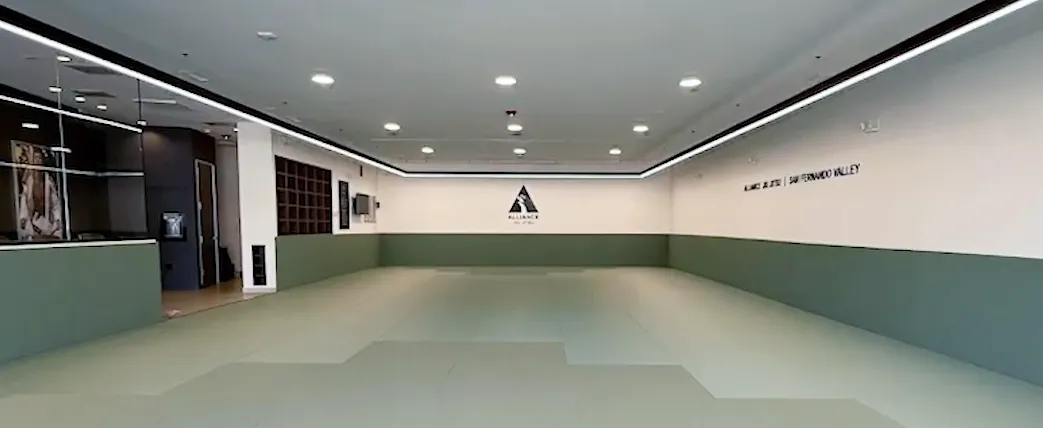
The point isn’t opulence. It’s intent. Students who make the 6 a.m. class can shower and head straight to work. Parents who bring kids to afternoon sessions feel proud of the space. Competitors who drill until late can reset without racing home just to clean up. The gym whispers a simple truth: you belong here, and your time matters.
Design also protects the long-term health of the room. Good airflow and climate control keep hard rounds safe. Lighting angles help coaches demonstrate details without glare. The mat’s density reduces impact stress over years, not months. Even the way spectators sit encourages learning rather than side conversations. In a thousand small ways, design becomes an unseen assistant coach.
Culture by Design
A beautiful gym doesn’t guarantee a strong culture, but it enables one. At Alliance SFV, culture is intentional and rooted in Alliance methodology: clear curriculum, structured progression, and respect that runs both directions.
Here, fairness is visible. Attendance is tracked, not to police students, but to celebrate progress. Kids and adults alike can see how close they are to the next stripe. For white belts, that might be every 30 classes, a rhythm that nudges them to show up, especially when motivation dips. “Everyone knows where they are in their learning,” Goulart says. “It’s easier and fairer to track.”
The team uses Gymdesk to make that happen. It’s the operational nerve center: attendance logs, promotion tracking, communication, and clarity. The software isn’t the star of the show - the mat is - but the right tools keep the mat at the center. Parents get answers quickly. Staff can help without chasing paper trails. Goulart can focus on what he’s spent a lifetime mastering: teaching, building competitors, and transforming lives.
The People Who Shaped the Path
Alliance SFV carries a lineage you can feel in the room. Goulart trained with Lucas Lepri, a childhood friend who became one of the greatest technicians in modern Jiu-Jitsu. He shared cramped rooms and giant dreams with Bernardo Faria, now a five-time world champion and industry builder in his own right. He learned from Cobrinha and lived under the watchful, demanding eye of Jacaré. Those names are etched into the sport’s history, but more importantly, their habits, standards, and sense of what a room should feel like are present in the academy’s DNA.
That’s the intangible part of design: it’s not just carpentry and lighting. It’s the arrangement of values in physical form. The way the front desk smiles first. The pace of a fundamentals class that invites beginners without boring blue belts. The seat a parent takes to watch their child become bigger than yesterday.
A Gym for Today - and for the Next Twenty Years
Opening in early June, Alliance San Fernando Valley took shape during the summer lull- vacations, unpredictable schedules, and lighter attendance. It turned out to be a gift. The team learned the systems, tweaked the schedule, and smoothed the edges before the rush. Now, as the school year settles in and routines firm up, the academy is poised for steady, sustainable growth.
Goulart doesn’t shy away from competition. He was forged in it, but he’s equally committed to the everyday athlete: the parent getting in shape, the beginner looking for a safe start, the teen who needs confidence more than a collar choke. The design serves all of them. It tells the hyper-motivated competitor and the hesitant first-timer the same thing: you’re going to work hard here, and we’re going to make it easier to keep showing up.
Why Design Really Matters
Skeptics might say: “Mats are mats. We’re here to train.” But anyone who’s tried to build habits knows environment is destiny. A thoughtfully designed academy:
- Reduces friction (shower, change, go) - so students train more often.
- Signals standards - clean, organized spaces promote clean, organized Jiu-Jitsu.
- Attracts families and professionals - people who might never walk into a garage-style warehouse will cross this threshold.
- Protects bodies - proper surfaces and spacing prevent the kind of wear that shortens training careers.
- Retains members - because people return to places that feel good and make them better.
Most importantly, design communicates care. Care for the craft. Care for the community. Care for the hour you traded to be on the mat instead of anywhere else.
The Ending That Feels Like a Beginning
If you squint, you can still see the versions of Goulart that got him here: the white belt who won a national championship on pure momentum; the purple belt who fought thirteen times in one day; the young man eating tuna and sweet potato in a room that smelled like effort and ambition.
Alliance Jiu-Jitsu San Fernando Valley is those moments made visible. It’s a mat laid over a map, a life distilled into a place for others to grow. It’s also a statement: BJJ doesn’t have to happen in a box with a roll-up door. It can be modern, beautiful, and meticulously designed, without losing the grit that made the art great.
Walk in for the first time and the space tells you a story. It’s not just about who Gabriel Goulart is or what he’s won. It’s about who you could become here. The lights hum. The mats wait. And design, quiet but insistent, does exactly what it was built to do: make it easier to take the next step, and then the next, until one day you look up and realize you’ve built something too.
Gym management software that frees up your time and helps you grow.
Simplified billing, enrollment, student management, and marketing features that help you grow your gym or martial arts school.


FAQ

Eran Galperin is the founder of Gymdesk, modern gym management software used by fitness and martial arts gyms worldwide to run more profitable, member-focused businesses.
Over nearly a decade, he grew Gymdesk from a bootstrapped side project into a multi-million dollar SaaS platform serving thousands of gym owners across Brazilian Jiu-Jitsu, MMA, karate, fitness, and specialty studios. Working closely with owners at every stage—from first-time school operators to multi-location franchises—he’s seen what truly drives sustainable growth, retention, and smooth operations.
Before Gymdesk, Eran spent years building and scaling software products as a founder, CTO, and engineer. That experience shapes his practical approach to pricing, systems, automation, and technology stacks for gyms: simple, efficient, and focused on real-world results.
Today, Eran writes about gym operations, martial arts business strategy, and software for owners who want to grow without sacrificing the culture that makes their gym special.