The Only Gracie University Academy in the Netherlands
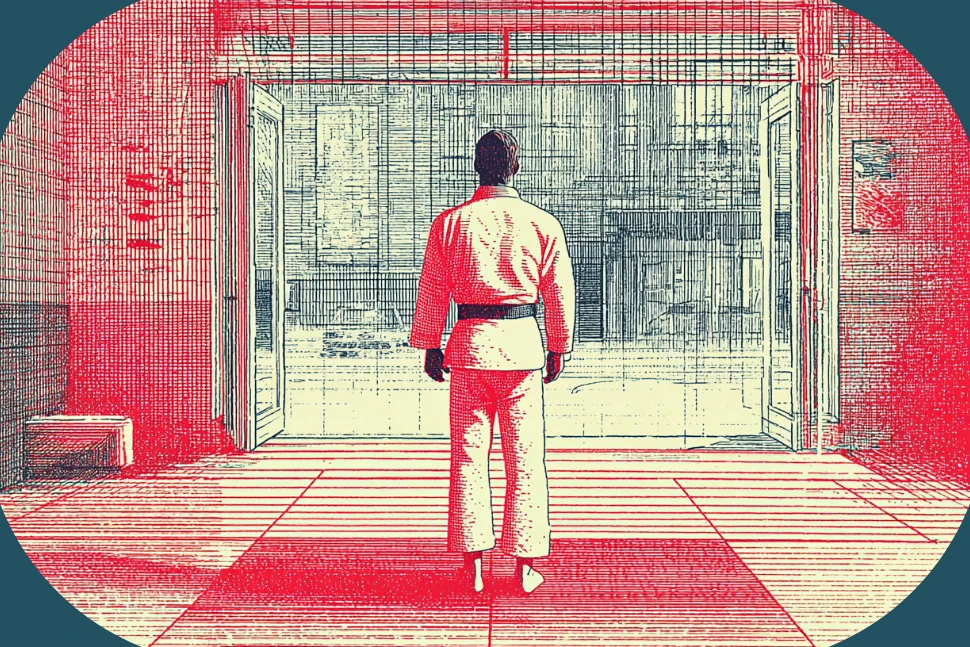
Van Ostadestraat runs through the middle of De Pijp, the loud, good-smelling heart of Amsterdam. The Albert Cuyp market spills out onto the pavement, and the whole neighborhood seems to be eating something on the way to somewhere else.
Push through the right door on that street and the noise drops away. Shoes come off. Bare feet on clean mat. A room where, for an hour, nobody is thinking about their inbox.
This is Gracie Jiu-Jitsu Amsterdam. It's run by a South African named Adrian Alexander, and the strange, winding way he ended up here—the only Certified Gracie Jiu-Jitsu Training Centre in the entire country—starts, of all places, with a billboard he almost drove straight past.
The Billboard He Almost Missed
Rewind about 15 years, to a new neighborhood in Cape Town. Adrian was somewhere in his late twenties, and martial arts had quietly fallen out of his life.
He'd started young, around 12—stand-up stuff, kickboxing and traditional karate, the kind of training that eventually drifted toward MMA. Then work and adulthood did what they do, and the gym stopped being part of the week.
So there was no plan the day he went for an aimless drive to learn the streets around his new place. There was just a billboard. Two words on it: Gracie Jiu-Jitsu.
He went and watched a class. And here's the part he tells on himself—he decided it wasn't for him and walked out. This thing that would become his entire life, and his first read was, no thanks.
The people at the front desk handed him some flyers on the way out. That night, the flyers did their job.
I saw this billboard that said Gracie Jiu-Jitsu... I went into, like, a YouTube wormhole of Gracie Jiu-Jitsu. The very next day I went back, signed up immediately, and then never left.
Getting Mopped by a 13-Year-Old
Ego is the first thing jiu-jitsu takes from you. For Adrian, the bill came due early, and it came in the form of a teenager.
He was around 30, a grown man with years of stand-up fighting behind him, rolling with a kid barely into his teens. It did not go the way you'd think.
He was like 13 or 14 at the time, and I was 30, so this kid just mopped the floor with me... I was like, man, I need to know what these guys are doing over here.
That's the hook. The kid wasn't stronger—he knew something Adrian didn't, and that's a thing you can go learn.
Once that clicks, the depth stops being scary. It becomes the point. Adrian puts it in the language every serious grappler eventually reaches for.
I remember hearing once that you could become a doctor sooner than becoming a black belt.
That academy in Cape Town became his second home. If the story had stopped there, he'd probably still be on those mats.
A Perfect Junction of Opportunity and Preparation
Life moved him instead. About five years ago, a family relocation brought Adrian to Amsterdam—his former partner held the job that carried them north.
He didn't come chasing a position of his own. He just landed in a new country with a new language and the same itch he'd had since that billboard.
He went looking for a Gracie school like the one he'd left. There wasn't a Gracie University one.
Amsterdam has plenty of jiu-jitsu—Carlson Gracie Amsterdam has carried its own proud lineage in the city for decades. But the specific thing Adrian had trained in back home didn't exist here.
That's the Gracie University system, founded by Ryron and Rener Gracie—grandsons of the art's creator, Grand Master Hélio Gracie.
He'd spent years absorbing a method. Now he was standing in a city that had none of it. He calls that overlap a perfect junction of opportunity and preparation, and it's about as clean a description of an entrepreneur's moment as you'll hear.
Reserving the Territory
Before Adrian could open under the Gracie name, he had to be allowed to.
The Gracie University model isn't a flag you buy and hang on a wall. Every certified training centre in the network teaches the same curriculum in the same order, using the same methodology.
A student can walk into a CTC anywhere on earth and pick up exactly where they left off. To run one, you get certified to run one.
Adrian reached back to James Smart, his instructor in Cape Town, and to the Gracie University headquarters in Torrance, California.
He completed the Instructor Certification Program. Then he reserved the Amsterdam territory—claiming the map before anyone else had—and became the first person to open a Gracie CTC in the Netherlands.
If you've ever thought about opening a jiu-jitsu academy from scratch, picture doing it as the transplant. New country, new culture, a system nobody in the market has heard of, and no local playbook to copy.
Adrian's honest about that being the hard part—learning a new market from scratch, and unlearning the assumption that anyone here already knew what Gracie Jiu-Jitsu was.
The upside of the CTC system is that the teaching itself is solved. There's no showing up to a cold room wondering what to run. The standardized curriculum removes that guesswork.
Adrian teaches Gracie Combatives for the fundamentals and the Master Cycle for the students who've moved past them. Both are mapped out for him, class after class, in a sequence that's been refined for years.
The Room That Knows Your Name
The clearest measure of the school's growth is its timetable.
Started off very small, three classes a week for one hour each. And now we're doing like 14 classes a week. Every day, morning classes and evening classes.
Three hours a week to 14. Morning sessions for the early crowd, evening sessions for the after-work crowd, seven days of mat time in the middle of De Pijp. The academy now trains around a hundred members.
Look at who they are and you understand the whole philosophy. They're moms, dads, and working professionals. They aren't chasing a competition circuit—most of them have to be functional at a desk the next morning.
What they want is self-defense they can trust, a hard workout, a problem to solve that isn't a work problem, and a room full of people who know their name.
That last part is the thing you can't standardize.
The culture inside a jiu-jitsu school—the reason a stressed-out professional keeps coming back at 7 a.m.—is built one interaction at a time. Adrian describes what happens the moment you step on: everything else gets left at the door.
As soon as you walk in the door, you take your shoes off, you walk on the mat, it's almost like you're leaving everything else behind... It's very hard to think about something else when somebody's trying to break your arm right now.
That's the tuition and the therapy in one. It also runs straight into the core of how he thinks about the art at all—learn to fight, so you never have to.
You want to learn to fight so you never have to fight.
The roadmap from here leans into that hobbyist, everyday-person base. Kids' classes are coming, and a women-only program is planned. Further out, he's looking at law-enforcement training through Gracie Survival Tactics.
None of it is running yet—but the direction is clear, and it's all pointed at people who want capability without a competition schedule.
The Software That Grew With the School
Somewhere in that climb from three classes to fourteen, the back office had to keep up. Adrian found Gymdesk early—back when it still went by its original name, Martial Arts on Rails.
He did his own research and took a free demo, and what he remembers is the absence of noise. No bloat, no fifty features a hundred-member gym will never touch.
He points to the visual interface and the class-level data—being able to actually see attendance and who's showing up—and to the support, where a real person emails him back in something like seven minutes.
As the school got bigger, the platform kept pace instead of getting in the way.
I like the fact that the business kind of grows with you. Gymdesk kind of grows with my gym. So the more students I have, the more functionalities become available.
There's a small vindication in it for him, too. Adrian was on Gymdesk from the start—well before Gracie University adopted it across the network. He got there first, the same way he got to the territory first.
Home Is Here Now as Well
Five years in, Adrian is still a Cape Town man. He goes back twice a year, as often as he can manage. You don't build a second home without missing the first one.
But something has settled. The billboard he almost drove past and the territory he claimed in a city that had none of what he loved landed him on a clean mat on Van Ostadestraat, teaching a room full of Amsterdammers to leave the day at the door.
It's been five years now. I still miss Cape Town. I go back twice a year, as often as I can, but I love it here.
Amsterdam is home now. Home is still in Cape Town, but home is here now as well.
The only Certified Gracie Jiu-Jitsu Training Centre in the Netherlands—built by a guy who very nearly kept driving.
Gracie Jiu-Jitsu Amsterdam trains at Van Ostadestraat 155 in De Pijp. Adrian's episode of Gymdesk Originals is out now.
Gym management software that frees up your time and helps you grow.
Simplified billing, enrollment, student management, and marketing features that help you grow your gym or martial arts school.


FAQ

Sean has spent the last decade creating content that helps businesses—small and not so small—grow smarter to allow operators to do more of what they love. You know, the fun stuff.
From shipping and international logistics to web development and marketing, he's done the work (not just the words) to scale retail and service businesses efficiently.
You can find his work at Sendle, Shogun, The Retail Exec, Gymdesk, and more.